The National Assembly, convened for December 17, has incorporated dozens of new deputies since the 2023 elections.
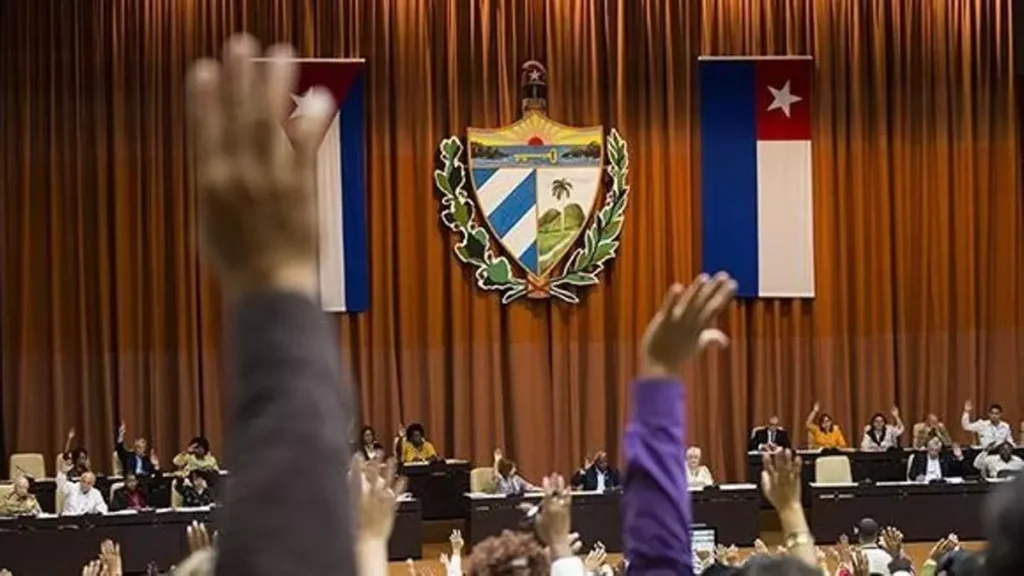
 14ymedio, Havana, November 28, 2026 – Just days before marking half a century of existence, the National Assembly of People’s Power (ANPP) is preparing to hold its final session of 2026 with a composition considerably different from the one that emerged from the ballot boxes three years ago. The successive departures of deputies and changes in the leadership of the legislative body have been accompanied by the results of a recent survey conducted on the Island, according to which 84% of respondents have a negative opinion of the Cuban Parliament.
ANPP President Esteban Lazo Hernández on Friday called the eighth ordinary session of the Tenth Legislature, which will begin on December 17 at nine in the morning at Havana’s Convention Palace. The announcement does not include the agenda or specify whether the existing vacancies will be filled, although traditionally, at this time of year, deputies review how the year has unfolded and year-end figures for various sectors are released.
Since the March 2023 elections, in which all 470 candidates proposed to fill an equal number of seats were ratified, the authorities have repeatedly had to resort to replacement mechanisms. In March 2025, during an accountability presentation before the Council of State, the National Electoral Council acknowledged that nine procedures had been carried out in 2024 alone to fill vacant seats in Parliament.
On that occasion, the resignation requests of Homero Acosta Álvarez and Ulises Guilarte de Nacimiento also came to light
In July 2025, another 18 deputies were sworn in, bringing the Assembly’s membership to 462. Five months later, during the December sessions, the figure rose to 464. Among those appointed at the time was Óscar Pérez-Oliva Fraga, the great-nephew of Fidel and Raúl Castro, whose status as a deputy makes him eligible to seek the presidency of the Republic.
On that occasion, the resignation requests of Homero Acosta Álvarez, secretary of the Assembly and the Council of State, and Ulises Guilarte de Nacimiento, who had headed the Cuban Workers’ Confederation for more than a decade, also came to light.
In July of this year, the Council of State once again ordered that ten vacancies be filled through several resolutions published in the Official Gazette. Among the new members of Parliament was Jorge Legañoa Alonso, president of the official news agency Prensa Latina. Following the appointments, according to information provided by the Cuban Foreign Ministry, 466 of the 470 seats were occupied.
The authorities have not released an updated accounting that would make it possible to determine how many deputies have left their positions since the beginning of the legislature and what proportion of those departures is attributable to deaths, resignations, removals, or other causes provided for under the law.
Barely 2% expressed a favorable assessment
The turnover among parliamentarians coincides with deep public skepticism toward the institution. A survey conducted by the National Opinion Research Center (NORC) at the University of Chicago, commissioned by the International Republican Institute (IRI) and published on November 18, reveals that 79% of respondents have a very unfavorable opinion of the ANPP, while another 5% consider it “somewhat unfavorable.” Barely 2% expressed a favorable assessment.
The study, which covered 1,199 Cuban adults interviewed in their homes between July 22 and September 7, used a nationwide probability sample and recorded a response rate of 20%.
Against this backdrop, in December the deputies will have to examine the state of an economy whose official forecasts have once again been exceeded. Without waiting for Parliament to convene, the Council of State this week amended the 2026 State Budget Law and increased the authorized fiscal deficit by 85%, bringing it close to 138 billion pesos.
Next December 2 will mark 50 years since the establishment of the first National Assembly of People’s Power. In July 2025, at Raúl Castro’s proposal, the legislative body approved a constitutional reform that eliminated the age limit for anyone seeking the presidency of the Republic for the first time.
Half a century after its creation, the Cuban Parliament still has no organized opposition within its ranks. The departures of its members have not altered the unanimity that characterizes its sessions, while replacements take place without citizens being called back to the ballot boxes.
Translated by Regina Anavy
______________________
COLLABORATE WITH OUR WORK: The 14ymedio team is committed to practicing serious journalism that reflects Cuba’s reality in all its depth. Thank you for joining us on this long journey. We invite you to continue supporting us by becoming a member of 14ymedio now. Together we can continue transforming journalism in Cuba.