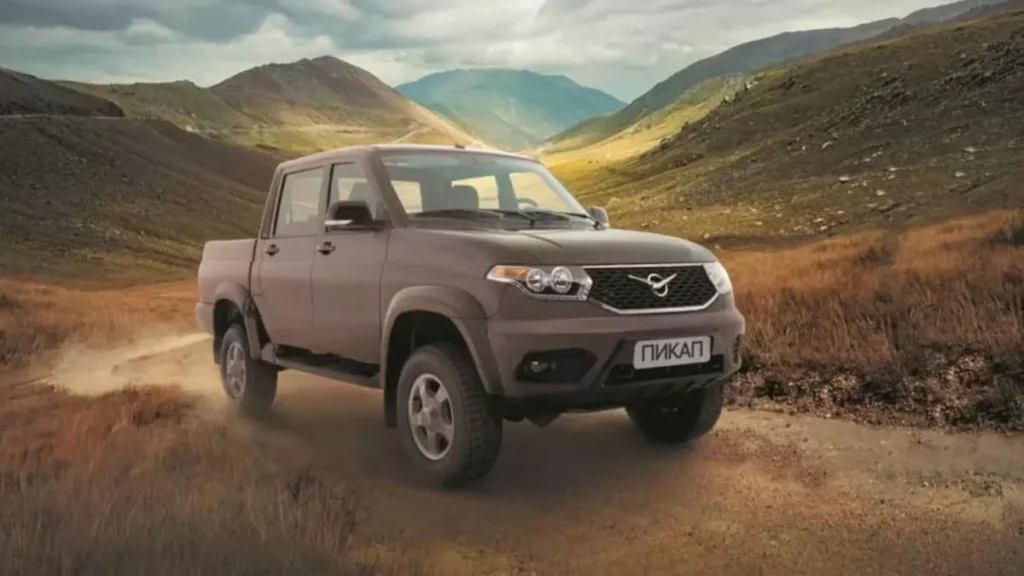
The UAZ off-road vehicle plant, with a planned capacity of 500 vehicles a year, produced only a few dozen in 2025.
 14ymedio, Madrid, November 26, 2026 – Eight months after the Ulyanovsk Automobile Plant (UAZ) announced the suspension of assembly of its Russian off-road vehicles in Havana due to a lack of electricity, the project’s partners want to expand it to include electric vehicles and economy-class cars. Russia’s Echo-Export and Cuba’s state-owned Empresa Integral de Servicios Automotores (Eisa) signed a memorandum of understanding on Wednesday for that purpose.
The document, signed during the Havana International Fair (Fihav), provides for the creation of an international economic partnership between the two companies. According to the Tass news agency, citing Russia’s trade mission in Cuba, the signatories were Ruslan Ignatiev, technical director of Echo-Export, and Miguel Ángel Pedroso, Eisa’s director of operations and sales.
The memorandum, signed during the Havana International Fair (Fihav), provides for the creation of an international economic partnership between Russia’s Echo-Export and Cuba’s state-owned Empresa Integral de Servicios Automotores (Eisa)
The partners also intend to expand warranty and after-sales services, the supply of spare parts and equipment for repair shops, and the exchange of technologies. For now, they have not disclosed which electric car models would be assembled on the Island, or the production schedules or volumes, according to a report published Thursday by the Russian technology news outlet Primer Canal Técnico.
UAZ’s press office specified in March that the suspension of assembly of the Patriot and Pickup models was for an indefinite period. As recently as June, the Russian manufacturer was negotiating with its Cuban partners to resume shipments of parts. Since then, it has not released any new production figures.
The establishment of a UAZ plant in Cuba was announced in May 2023, when company executives said they would send the first batches of vehicles to the Island for assembly between July and August of that year. However, the factory did not begin operating until April 2025, coinciding with a visit to Havana by Russian Deputy Prime Minister Dmitry Chernyshenko.
The manufacturer had expected to reach a production capacity of 500 vehicles a year by September of that year, with the possibility of increasing that figure to 1,500 by operating three shifts. However, on January 15, UAZ’s press office acknowledged to the RIA Novosti news agency that during the plant’s first year of operation, only “several dozen” vehicles had been assembled, without specifying the exact number.
On January 15, UAZ’s press office acknowledged to the RIA Novosti news agency that during the plant’s first year of operation, only “several dozen” vehicles had been assembled
In July 2025, the Russian Embassy in Havana announced the delivery of the first batch of Patriots assembled in Cuba. These gasoline-powered off-road vehicles, which consume large amounts of fuel, are assembled in Havana using parts imported from Russia.
The price of the basic Patriot version, equipped with air conditioning, was estimated at $29,000, including taxes, when the plant was inaugurated, according to the Russian news outlet Sibnet.
Vehicle assembly in Cuba was prompted, among other reasons, by UAZ’s loss of market share to Chinese manufacturers. Alexei Zhivintsev, commercial director of Echo-Export, explained at the time that exports of the Russian brand to the Island, which had traditionally ranged from 300 to 350 vehicles a year, had fallen to between 80 and 120 units starting in 2012 because of the more competitive prices of Chinese vehicles.
Translated by Regina Anavy
______________________
COLLABORATE WITH OUR WORK: The 14ymedio team is committed to practicing serious journalism that reflects Cuba’s reality in all its depth. Thank you for joining us on this long journey. We invite you to continue supporting us by becoming a member of 14ymedio now. Together we can continue transforming journalism in Cuba.