- Leonardo Romero Negrín was detained while participating in a tribute to the Abakuá members who tried to save the eight medical students executed by firing squad in 1871.
- The IACHR gives the Government until December 2 to respond about the situation of imprisoned journalist Henry Constantín.
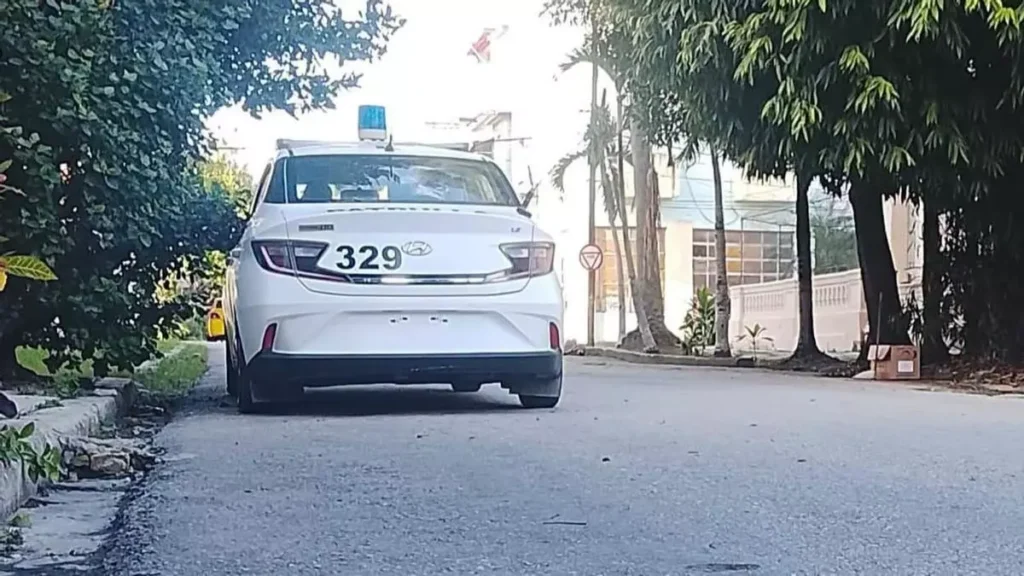
 14ymedio, Madrid, November 27, 2026 – The offensive against the independent press in recent weeks continues to provoke international reactions, but the Cuban regime shows no signs of easing its repression. This Friday, several journalists and activists woke up surrounded by State Security agents, as has become customary on significant dates.
Activist Leonardo Romero Negrín was also detained this Friday and remains incommunicado, with his whereabouts unknown. He was arrested while helping paint a mural at the corner of Colón, between Refugio and Cárcel streets in Havana, to pay tribute to the five members of the Abakuá brotherhood who were murdered for trying to rescue the eight medical students executed by firing squad on November 27, 1871.
Romero Negrín was the only person arrested from the group paying tribute to the Abakuá brotherhood. According to a source close to the activist who spoke to this newspaper, one of the people present was told that he would be released “after the political event,” referring to the Government’s tributes to Fidel Castro on the tenth anniversary of his death, which include a vigil on the steps of the University of Havana that was postponed yesterday because of bad weather.
Another person affected was Camila Acosta, a journalist for CubaNet and correspondent for the Spanish newspaper ABC, who reported on social media the police operation preventing her from leaving her home. “This Friday, November 27, marks six years since the demonstration by artists and intellectuals outside the Ministry of Culture,” she wrote, noting that the date coincides with the tenth anniversary of Fidel Castro’s death.
“There is no better tribute to the supreme dictator than carrying out repression”
“There is no better tribute to the supreme dictator than carrying out repression,” she wrote. “Since 2020, the regime has resorted to this type of harassment to prevent me from going out to report.”
Another independent journalist, Adelth Bonne Gamboa, a contributor to CubaNet, also reported a similar situation on social media: “I just received a call from someone named ‘Darío,’ a State Security officer, to ‘warn’ me that I won’t be able to leave my house tomorrow.”
Last Tuesday, the Office of the Special Rapporteur for Freedom of Expression of the Inter-American Commission on Human Rights (IACHR) denounced the escalation of repression and raised the alarm over the arbitrary detention of at least three journalists, as well as acts of surveillance and restrictions on freedom of movement. “The Office of the Special Rapporteur views with concern the fact that, in Cuba, deprivation of liberty continues to be a frequent response to the practice of journalism,” the statement reads.
Among the cases it cites is that of Yoani Sánchez, director of 14ymedio, who was arrested by State Security agents on November 5. She remained in detention for nine hours and was threatened with prosecution for the alleged crime of “propaganda against the constitutional order.”
Two days earlier, the organization recalls, Camila Acosta was detained near her home after publishing a video in which she reported that an agent was preventing her from leaving. The Inter American Press Association (IAPA) also reported that the journalist was handcuffed and that her phone was returned to her in inoperable condition. On November 2, Bonne Gamboa was also detained; his equipment was confiscated, he was fined 3,000 pesos, and he was threatened with imprisonment if he continued publishing. Amnesty International demanded last Wednesday that the threats and harassment against him cease and that his freedom of movement be respected.
The IACHR also sent a letter to Foreign Minister Bruno Rodríguez Parrilla giving him seven days to respond about the situation of the imprisoned journalist
The most serious case mentioned by the Office of the Special Rapporteur is that of Henry Constantín, director of La Hora de Cuba and regional vice president of the IAPA’s Committee on Freedom of the Press and Information. The journalist was arrested on September 16 and transferred on the 24th to Kilo 7 maximum-security prison in Camagüey. He is accused of “disobedience” for failing to appear in response to a police summons.
Constantín spent 15 days in a punishment cell after prison authorities claimed to have found a homemade knife among his belongings. The reporter denies this and says it was planted to incriminate him. That accusation led to a second criminal case, involving disorderly conduct and possession of instruments intended for assault in prison facilities. His partner, journalist Alejandra García, has been prohibited from visiting him in prison for three months for attempting to bring him water, food, and books outside visiting hours. García also reported receiving threats because of her publications about the case.
The statement says these incidents are part of a broader pattern: repeated detentions targeting the same individuals, pressure intended to force them into exile, and reprisals against family members. It insists that threats, intimidation, and the criminalization of journalists constitute “a manifest violation of human rights and the fundamental principles of the rule of law.” In this regard, it makes an urgent appeal to the Cuban State to release journalist Constantín, put an end to arbitrary detentions, provide information about the legal status of those detained, and return confiscated equipment.
The IACHR also sent a letter to Foreign Minister Bruno Rodríguez Parrilla giving him seven days to respond about the situation of the imprisoned journalist. The document is dated November 25 and signed by the Commission’s Executive Secretary, Tania Reneaum Panszi. The deadline expires on December 2.
The letter requests that the Cuban Government provide observations regarding the petition for precautionary measures in favor of Constantín, submitted in October by Juan Carlos Vargas, director of the Center for Complaints and Defense CD.
“Cuban authorities must understand that imprisoning a journalist does not silence the truth or eliminate society’s right to know what is happening. On the contrary, it increases the State’s responsibility”
The Commission requests detailed information about Constantín’s legal situation, the entity monitoring his case, and the decisions that have been made. It also requires information about his health and detention conditions, including access to water and food, and requests medical reports that would establish his weight and level of hydration. It also seeks explanations regarding the three-month suspension of visits from his partner, journalist Alejandra García.
Along the same lines, last Tuesday the IAPA demanded Constantín’s “immediate and unconditional release” and held the Cuban State responsible for his physical and psychological well-being. Its president, Carlos Jornet, stated that keeping him imprisoned and isolated, with his health at risk, “must not be normalized or left unanswered.”
“Cuban authorities must understand that imprisoning a journalist does not silence the truth or eliminate society’s right to know what is happening. On the contrary, it increases the State’s responsibility before the international community,” Jornet explained.
In its statement, the IAPA also mentions other forms of retaliation. Ernesto Ricardo Medina and Kamil Zayas, from the El4tico project, have remained imprisoned since February, and the Prosecutor’s Office has requested prison sentences of eight and ten years, respectively, for their audiovisual publications. Although the young men have been in prison for more than nine months, the oral trial, scheduled for last Tuesday, was suspended, something the legal advisory organization Cubalex described as “a form of mental torture.”
Austin Llerandi, director of the community media outlet Amanecer Habanero, was forced into exile in Brazil in September along with his pregnant wife after being threatened with imprisonment.
Journalists Yunia Figueredo and Frank Correa were subjected to interrogations, threats, and restrictions on their freedom of movement. The IAPA reports that agents made inquiries about one of their daughters at her university and threatened another daughter, who is 14, with preventing her from undergoing surgery unless her parents abandoned their journalistic work.
Translated by Regina Anavy
______________________
COLLABORATE WITH OUR WORK: The 14ymedio team is committed to practicing serious journalism that reflects Cuba’s reality in all its depth. Thank you for joining us on this long journey. We invite you to continue supporting us by becoming a member of 14ymedio now. Together we can continue transforming journalism in Cuba.