The ills that afflict us today were incubated for decades under his watchful eye
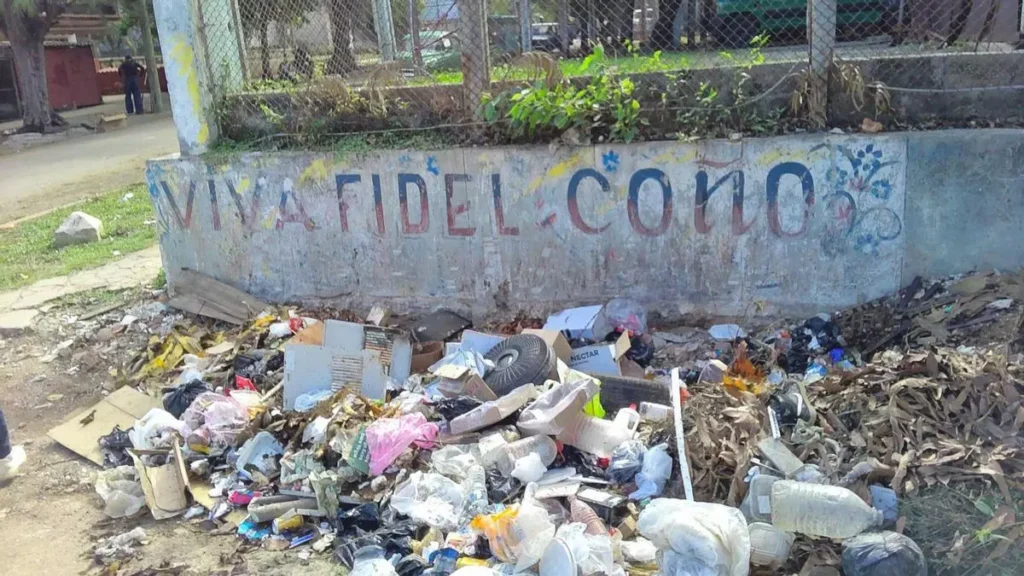
 14ymedio, Yoani Sánchez – Journalist, Funder and Director of 14ymedio – November 26, 2026 / Ten years after his death, Fidel Castro still occupies more space in the laws of Cuba than in people’s hearts, more square meters on billboards than in the affectionate memory of the people. The face that for decades presided over classrooms, offices, and public squares is now blurred on posters eaten away by the sun and the humidity, at whose feet mountains of garbage grow. Few images better summarize the legacy of the man who insisted on deciding every last detail of our lives.
What remains of Fidel Castro? What remains, in official discourse, is hatred of the ideological adversary, the incapacity to recognize the other’s right to exist politically. Dissent continues to be considered a disease that must be eradicated from the social body. The Commander’s heirs conserve intact this vocation to civilly annihilate the dissident, although they lack the histrionic talents with which their predecessor cloaked intolerance in a supposed revolutionary epic.
There also remains an impresentable family clan, whose most grotesque representative is perhaps Sandro Castro. Seeing the grandson’s antics on social media, his capitalist brands designer clothes, his devotion to partying, and his displays of frivolity, it is hard not to think of those young men his grandfather sent to the Military Units to Aid Production (UMAP) or to prison for far less. Fate has decreed that one of the most corrosive caricatures of Fidel Castro’s regime bears the surname of its founder.
What remains is an aging Communist Party, whose current number of members we don’t even know.
Of that highly personal style of governing a country, of improvisations converted into national programs, and of the leader’s word elevated to an indisputable mandate, few visible manifestations remain. But the essential element persists: the subordination of any reform, opening, or correction to the regime’s survival needs.
What remains is an aging Communist Party, whose current membership numbers we don’t even know. What remains is the political police, situated in practice above the law, the Penal Code, and the courts. What remains is the international isolation to which its confrontational incontinence and dependence on foreign patrons led us, only this time there is no Soviet Union willing to finance Havana’s absurdities, nor a Hugo Chávez in a position to pay for them.
It surprises me to still hear some nostalgics claiming that “this wouldn’t have happened under Fidel” when their food spoils due to a power outage or they’ve been without water for weeks. As if the deceased weren’t the root of this debacle, as if the nation’s unproductivity began the day they laid his ashes to rest on a stone in Santiago de Cuba.
For many young people, Castro is just a bearded old man whom their grandparents mention less and less and whom their parents frequently curse.
It was him who transformed economic centralism and nationalization into instruments of political control. He was the one who obliterated small family businesses and curtailed the autonomy of farmers. He was the one who conditioned us to ask permission to prosper and to feel guilty for doing so. He was the one who, with a single fist pounding on the table, confiscated dozens of American companies and led us into the dead end of confrontation with Washington. The ills that plague us today were incubated for decades under his watchful eye. We are living with the consequences of a very long chain of decisions that we were never able to challenge at the ballot box.
We have to recognize that time has had an effect that his political adversaries lacked: it has managed to strip Fidel Castro of his feared hold on the Cuban people. For many young people, Castro is merely a bearded gentleman whom their grandparents mention less and less and whom their parents frequently curse.
This rainy Wednesday in Havana, he is remembered in the morning assemblies at state workplaces, in schools, and on the front pages of official media. Slogans are dusted off, praises are repeated, and emotion is feigned. But behind closed doors, where families take daily stock of their needs and count the empty chairs around the table, Fidel Castro is left with little more than oblivion or rejection.
______________________
COLLABORATE WITH OUR WORK: The 14ymedio team is committed to practicing serious journalism that reflects Cuba’s reality in all its depth. Thank you for joining us on this long journey. We invite you to continue supporting us by becoming a member of 14ymedio now. Together we can continue transforming journalism in Cuba.