The Venezuelan airline will resume flights on November 13, with two weekly flights between Caracas and Havana.
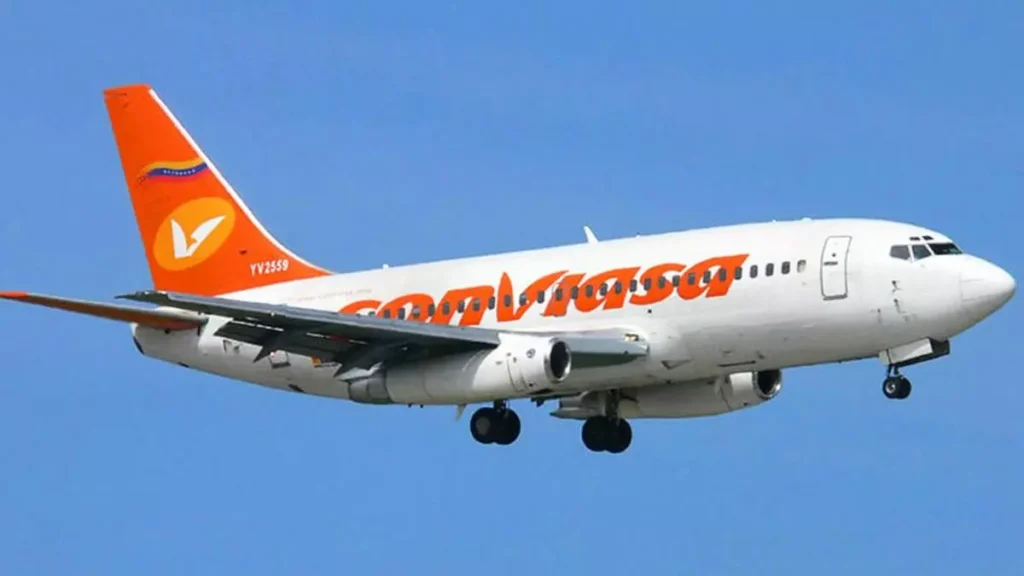
 14ymedio, Madrid, November 10, 2026 – Venezuela’s state-owned airline Conviasa announced that it will resume flights between Caracas and Havana next Friday, November 13, despite the shortage of kerosene at airports for refueling aircraft, which is expected to continue at least until December 1, according to aviation notices issued by the Cuban Air Navigation Company. The airline plans to operate two weekly flights, on Wednesdays and Fridays, according to a report published Monday by the specialized outlet Aviacionline.
Meanwhile, as Conviasa prepares to return to Havana after a two-week interruption, the Spanish tourism group Iberostar, owner of World2Meet (W2M) and tour operator Newblue, has canceled its scheduled trips to Varadero from Portugal because of the deterioration of operating conditions on the Island, which had already forced it to abandon management of all its hotels on the Island at the end of the first half of this year. It has now decided to replace Cuba with Margarita Island in Venezuela.
The Spanish tourism group Iberostar, owner of tour operator Newblue, has canceled its scheduled trips to Varadero from Portugal because of the deterioration of operating conditions on the Island.
World2Fly, also owned by W2M and which suspended its flights between Madrid and Havana in May, will instead operate a weekly charter flight between Lisbon and Margarita Island beginning June 1, 2027, using an Airbus A330 with 355 seats. Newblue will market vacation packages starting at 1,490 euros per person.
Conviasa’s route was interrupted when the airline decided to concentrate on domestic flights. Venezuelan media attributed the suspension to the high operating costs of its Airbus A340 aircraft and low passenger demand. The connection with the Cuban capital was then partially covered by another Venezuelan airline, Rutaca, which operates from Valencia, in Carabobo state. The state-owned airline will also resume its services to Mexico City on November 17, with one weekly flight.
Among travelers interested in connections with Venezuela are Cubans who purchase merchandise on Margarita Island to resell back home. In August, numerous travelers were seeking information about accommodations, transportation, and products to purchase in Valencia, particularly hardware supplies and solar panels. Shopping packages starting at $720 were also being advertised. There are no figures available to establish how many Conviasa passengers use the route for this purpose.
The return comes amid a full-blown fuel crisis for commercial aviation in Cuba
The return comes amid a full-blown fuel crisis for commercial aviation in Cuba. Aviation notices identified as Notam A3875/26 through A3884/26 and issued on October 30 maintain the unavailability of Jet A-1 kerosene until 04:00 UTC on December 1. The restriction affects ten airports, including those in Havana, Varadero, Santa Clara, Camagüey, Holguín, and Santiago de Cuba. The notice corresponding to Havana’s José Martí International Airport confirms that date.
The measure does not mean that the terminals are closing. Airlines can carry enough fuel for both the outbound and return flights or make technical stops in other countries. Conviasa has not publicly explained how it will refuel its flights to Havana. Copa Airlines takes on additional fuel in Panama to complete both legs without refueling in Cuba, as do U.S. airlines that continue to serve the Island. The additional weight forces airlines to slightly reduce passenger capacity and leave behind some commercial cargo.
Conviasa had already modified its operations because of this problem. In February, it rescheduled its flights between Caracas, Havana, and Managua from the 10th through the 19th of that month. The company itself attributed the changes to a Cuban aviation notice concerning fuel supplies and Nicaragua’s new immigration requirements.
Among the airlines most affected is Air China, which maintains the Beijing-Madrid-Havana route but accumulated cancellations in October that left dozens of Cubans stranded in Spain. The airline uses Nassau, in the Bahamas, to refuel on the return leg from Cuba. Runway construction at that airport complicated operations and forced the airline to organize an extra flight to pick up affected passengers. The Chinese Embassy attributed the suspensions to technical reasons.
In Spain, Iberia will keep its direct connection with Havana canceled until the end of June 2027 because of declining demand and operational difficulties, while Air Europa continues flying from Madrid, with a technical stop in Punta Cana, Dominican Republic, to refuel on the return trip to Spain.
U.S. airlines have also not escaped the crisis, although American Airlines and Southwest continue to maintain connections with the Island. The former retains flights from Miami to several Cuban cities, while the latter continues to connect Tampa with Havana. Both can operate without depending on fuel supplies at Cuban airports.
Delta, by contrast, eliminated its Atlanta-Havana route in June and cut its frequencies from Miami by half. It subsequently requested permission to leave part of its flight authorizations unused during the winter season, from October 25, 2026, through March 27, 2027, arguing that market conditions had not improved sufficiently.
Canada’s major airlines, including Air Canada, WestJet, and Air Transat, have also suspended their operations to Cuba, while other international carriers have had to resort to alternative routes or reduce their flight frequencies.
The fuel shortage coincides with the collapse of international tourism. In September, just 27,354 tourists arrived in Cuba, the worst result for that month since comparable records began, with the exception of the pandemic years.
Translated by Regina Anavy
______________________
COLLABORATE WITH OUR WORK: The 14ymedio team is committed to practicing serious journalism that reflects Cuba’s reality in all its depth. Thank you for joining us on this long journey. We invite you to continue supporting us by becoming a member of 14ymedio now. Together we can continue transforming journalism in Cuba.