Among those sanctioned are writer Ángel Santiesteban and José Ramón Viñas Alonso, amid government pressure to gain control of the Supreme Council of the 33rd Degree.
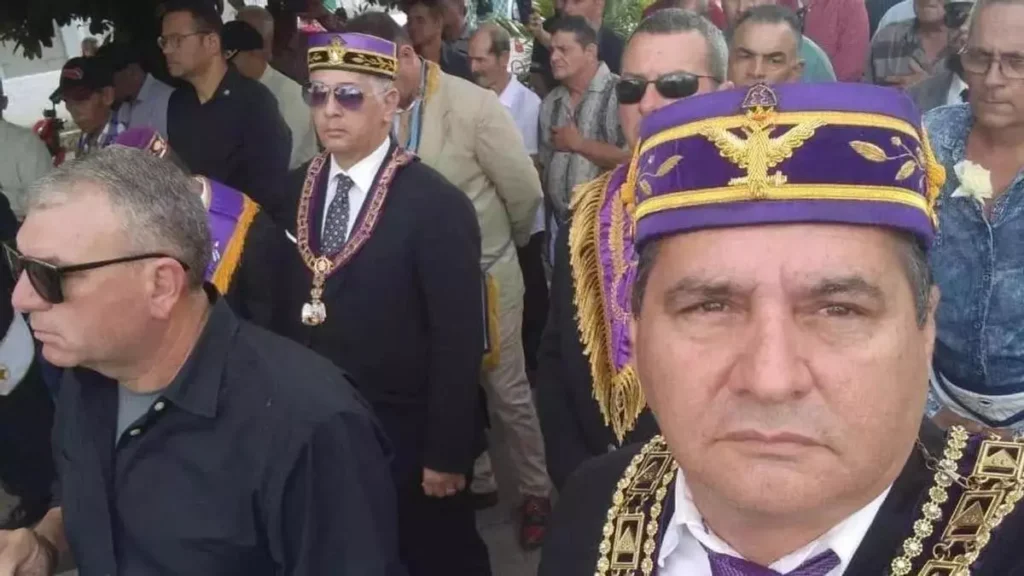
 14ymedio, Havana, November 5, 2026 – Four Cuban Freemasons, including writer and former political prisoner Ángel Santiesteban Prats, were sentenced this Thursday to terms of between two and four years of restricted freedom for exchanging just 300 dollars at the informal market rate. The transactions, carried out in 2023 and 2025, involved funds belonging to the Llansó National Masonic Nursing Home, a charitable institution that cares for the elderly in Havana, according to an informational statement from the People’s Municipal Court of Diez de Octubre published on the social media accounts of Razones de Cuba. The ruling comes amid the prolonged confrontation between the Government and the leaders of Cuban Freemasonry.
The court imposed the harshest penalty: four years of restricted freedom and a fine of 25,000 pesos on José Ramón Viñas Alonso, former Sovereign Grand Commander of the Supreme Council of the 33rd Degree and president of the nursing home’s board of trustees. Fernando Marcos García, the institution’s accountant, received three years and a fine of 20,000 pesos, while Santiesteban and Osvaldo Ernesto Villegas Digat were sentenced to two years and fines of 20,000 pesos each.
The sentences do not entail imprisonment, but they do impose restrictions on freedom. The court also deprived all four defendants of certain rights and prohibited them from leaving the country or holding positions or practicing occupations. The ruling can still be appealed before the People’s Provincial Court of Havana.
The sentences do not entail imprisonment, but they do impose restrictions on freedom
The offense attributed to those convicted is “illegal currency trading,” covered under Article 315.1, subsection g), of the Penal Code. What is striking is that exchanging dollars and euros outside banks is an everyday practice in Cuba, where the differences between official and informal exchange rates have turned the latter market into a common way of obtaining local currency. The two transactions being punished totaled just 300 dollars and took place nearly two years apart.
According to the prosecution documents published by CubaNet, the first exchange took place on September 14, 2023, when Santiesteban handed over 49,600 pesos of his own money in exchange for 200 dollars belonging to the nursing home. The second occurred on June 13, 2025, when Villegas Digat exchanged another 100 dollars from the institution for 37,500 pesos. Both transactions were authorized by Viñas Alonso.
The defense, led by attorney Roberto Ortega Ortiz, maintained that the transactions did not constitute a crime and that none of those involved obtained illicit personal benefits. According to the lawyer, the first 200 dollars made it possible to purchase powdered milk for the elderly residents, while the second transaction provided the nursing home with pesos to deal with emergencies and enabled Villegas to obtain foreign currency to buy medication for his son.
What is striking is that exchanging dollars and euros outside banks is an everyday practice in Cuba
The independent organization Cubalex also questioned the legal grounds for the prosecution. In an analysis published this Wednesday, it noted that the transactions were recorded in the nursing home’s accounting books and that there was no evidence of clandestine intermediation or personal profit. It also questioned the proportionality of the penalties.
The proceedings also contain an explicit political element. In its indictment, the Prosecutor’s Office included among its personal assessments of Santiesteban the statements that the writer “does not engage in any socially useful activity” and “openly expresses himself against the revolutionary process prevailing in Cuba.”
The case was also investigated by a body specializing in crimes against State Security, even though the offense attributed to the defendants falls under the category of crimes against the national economic order.
Translated by Regina Anavy
______________________
COLLABORATE WITH OUR WORK: The 14ymedio team is committed to practicing serious journalism that reflects Cuba’s reality in all its depth. Thank you for joining us on this long journey. We invite you to continue supporting us by becoming a member of 14ymedio now. Together we can continue transforming journalism in Cuba.