After persecuting believers for decades, the Cuban Government turns to the Vatican in search of a political miracle
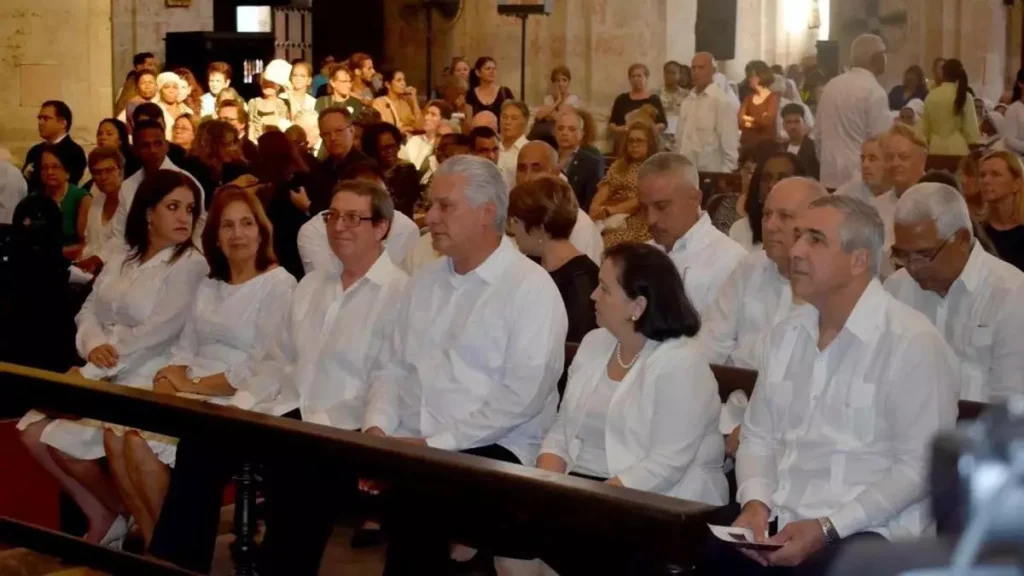
 14ymedio, Madrid, Yunior García Aguilera, October 25, 2026 / After 67 years of die-hard Marxism, the Cuban Revolution seems determined to ask the Pope for a miracle. It is not about turning water into wine, although getting running water in Havana would already be a marvel. Nor about multiplying the loaves, which would come in quite handy. The miracle Cuba’s leaders need is far more complicated: getting their political system to survive. And since Marx isn’t answering, Lenin has been embalmed for too long and Che was never a specialist in resurrections, they have decided to try their luck with the Vatican.
The Cuban ambassador to the Holy See, Leyde Rodríguez Hernández, has just repeated the official invitation to Leo XIV to visit the island. They have been inviting him, without much luck, ever since the white smoke rose from the chimney of the Sistine Chapel. But, for now, the Pope does not seem in any hurry to pack his bags for Havana.
The insistence comes in the midst of the worst economic crisis and growing tensions with Washington. The Communist Party, which for decades preached dialectical and historical materialism, seems to have discovered the practical advantages of divine intercession. Of course, it is not asking forgiveness for its sins. It is desperately asking for a favor.
In 1992 the State stopped declaring itself atheist. The move coincided, not at all by chance, with the collapse of the communist altars in Europe
It is worth recalling a few details of this sudden religious vocation. In the early years of the Revolution, the Government confiscated Catholic schools, expelled priests and turned faith into an obstacle to getting ahead professionally. Believers were discriminated against in universities, workplaces and political organizations. Some even ended up in the sadly notorious Military Units to Aid Production (UMAP), those forced labor camps where the aim was to correct, by dint of the machete, the ideological, sexual and spiritual deviations of Cubans.
Over time, official atheism softened. In 1991, the Party finally admitted believers, and in 1992 the State stopped declaring itself atheist. The move coincided, not at all by chance, with the collapse of the communist altars in Europe. There was no need to prove the existence of God by means of a scientific treatise. It was enough to realize that religion could be very useful in international relations.
In 1998 John Paul II arrived; then came Benedict XVI and Francis. Cuba’s leaders learned to take off their combat fatigues and receive pontiffs with smiles, ties, ceremonies and speeches about peace. They suddenly discovered the diplomatic advantages of appearing alongside the successor of Saint Peter.
The Government wants the Pope to talk about the embargo, but does not seem to show the same devotion when the bishops mention pluralism and freedoms
Vatican diplomacy has already intervened in prisoner releases and in negotiations with the United States. But the most recent episode deserves special attention. In March, Havana announced the release of 51 prisoners as a goodwill gesture toward the Holy See. According to later investigations by Prisoners Defenders, the beneficiaries included common criminals and only a tiny fraction were political prisoners. It was a veritable “Operation Barabbas.” Moreover, several of those released kept their sentences and restrictions.
It would be unfair, however, to confuse the intentions of the Vatican with those of the Palace of the Revolution. The Church has legitimate reasons to be concerned about the suffering of Cubans, to call for an end to the measures that worsen their hardships and to promote peaceful solutions. Leo XIV himself joined, in February, the appeal of the island’s bishops, who warned of the urgent need for profound changes. Curiously, that last part of the message tends to arouse considerably less enthusiasm in official offices. The Government wants the Pope to talk about the embargo, but does not seem to show the same devotion when the bishops mention pluralism and freedoms.
The Hermanos Saíz Association awards its Master of Youth prize to Frei Betto, a Brazilian friar whose loyalty to the Revolution has survived even its economic failures and its orders of combat
The question is what exactly Havana expects from a new papal visit. Mediation with Trump or with Marco Rubio, as Catholic as he is anti-Castro? An easing of sanctions? A photograph that would let the Government present itself to the world as a respectable interlocutor? Any of those possibilities is understandable in terms of political calculation. The trouble with inviting the Pope is that he might come with the inconvenient habit of also listening to his bishops.
And while the Foreign Ministry invites Leo XIV, the Hermanos Saíz Association awards its Master of Youth prize to Frei Betto, a Brazilian friar whose loyalty to the Revolution has survived even its economic failures and its orders of combat. We don’t know whether Cuban communism has finally found God, but it seems to have discovered that some foreign clerics turn out to be more deserving of tributes than troublesome local artists. For purely utilitarian reasons, mind you.
In the Catholic tradition, absolution requires repentance and a firm purpose of amendment. The Revolution seems very interested in absolution (and not only the historical kind, as the bearded one dreamed [a reference to Fidel Castro’s “History will absolve me”], but also the divine kind). It wants its debts forgiven, its sanctions lifted and another chance granted, but without renouncing any of the commandments of its own peculiar political catechism: a single party, blind obedience and prison for heretics.
Translated by GH
______________________
COLLABORATE WITH OUR WORK: The 14ymedio team is committed to practicing serious journalism that reflects Cuba’s reality in all its depth. Thank you for joining us on this long journey. We invite you to continue supporting us by becoming a member of 14ymedio now. Together we can continue transforming journalism in Cuba.