What Raúl Guillermo Rodríguez Castro fails to understand is something extremely basic and obvious: to desire ‘the people’ to live as he does, if taken seriously, requires the disappearance of the system that sustains his luxuries
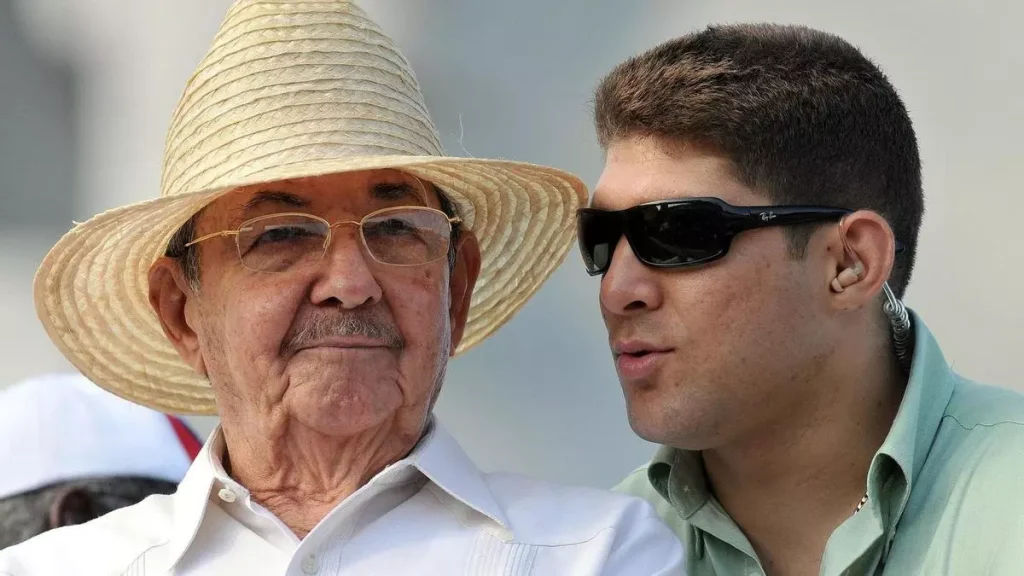
 14ymedio, Montreal, Karel J. Leyva, July 18, 2026 / Raúl Guillermo Rodríguez Castro (known as El Cangrejo, ‘The Crab’), Raúl Castro’s grandson, dressed in Hugo Boss, Hermès, and a steel Rolex, recently told USA Today that it pains him that the Cuban people cannot live as he does.
Criticism of his hypocrisy was not long in coming: a “revolutionary” who not only lives in luxury but flaunts it openly while the people live in the most abject misery; a mere bodyguard with communication difficulties who feels he is helping to improve the situation of a country destroyed and plunged into darkness by his most admired figures, whose initials he has engraved on his gold medallion.
Beyond the heir’s tasteless joke, beyond the moral lapse, beyond the deep revulsion his cynicism provoked, his “pain” reveals a paradox that perhaps not even he manages to grasp.
El Cangrejo does not live well despite Cuba living badly: he lives well because Cuba lives badly
El Cangrejo does not live well despite Cuba living badly: he lives well because Cuba lives badly. The misery, hunger, and darkness of the Cuban people, their physical and moral deterioration, are the very condition that makes his opulence possible. The same apparatus that lets him carry classified reports in a Ferragamo briefcase while plundering the country is the one that produces the shortages El Cangrejo claims to lament.
Beyond his absurd assumption (that it pains him that the people don’t wear Rolexes and thousand-dollar sneakers, as if that were the people’s aspiration, as if that were the standard by which to judge a nation’s wellbeing, as if his lifestyle were the measure of all things, as Protagoras would say), what El Cangrejo fails to understand is something extremely basic and obvious: wanting the people to live as he does, taken seriously, requires the disappearance of the system that sustains his luxuries and those of the entire elite that controls the country.
His “it pains me” is, in fact, a phrase with no possible referent: it points to no world that Rodríguez Castro could coherently want. And yet he said it, in an interview he gave while explicitly positioning himself as a spokesman representing the interests of the Cuban nation.
More than a confession of double standards, El Cangrejo was trying on the suit of a presentable successor before the only audience that today decides whether Cuba has a democratic transition or merely an inheritance. The message, translated, is: here is someone you can negotiate with, without touching the apparatus of oppression.
The people do not need to live like El Cangrejo. They need the system of privilege that sustains his luxuries to disappear, while millions of Cubans barely manage to survive amid scarcity
One could argue that he is at least more honest than some of his relatives, who are always in olive-green uniform, always denying their privilege, while he displays his to the entire world without the slightest remorse. But his stance is either a public-relations technique or simply the carelessness of someone accustomed to feeling and appearing superior to the rest of Cubans for the sole fact of having been born into the family that has oppressed them for decades.
If it truly pains him that the people don’t live as he does, is he willing to stop living as he lives? If his pain is genuine, would he sell his belongings to ease the hunger of the elderly, to buy electric generators? Would he sell his thick gold chain, his sneakers from the luxury French house Hermès, or his Ferragamo briefcase to relieve, even slightly, that pain? Would he also give up everything he would never dare show in front of a camera?
But there is a prior question, and a more fundamental one — the only one that determines whether his pain is sincere: would he renounce the apparatus itself (the conglomerate, the command, the place he occupies by blood rather than merit), would he accept ceasing to be the “presentable candidate,” would he give up the succession he so covets, and above all, would he disappear from the sight of Cubans forever?
The people do not need to live like El Cangrejo. They need the system of privilege that sustains his luxuries to disappear, while millions of Cubans barely manage to survive amid scarcity. But if that system disappeared, so too would the conditions that produced El Cangrejo. And that, precisely, is what El Cangrejo could never want.
Translated by GH
______________________
COLLABORATE WITH OUR WORK: The 14ymedio team is committed to practicing serious journalism that reflects Cuba’s reality in all its depth. Thank you for joining us on this long journey. We invite you to continue supporting us by becoming a member of 14ymedio now. Together we can continue transforming journalism in Cuba.