‘The Economist’ tells the story of the ordeal facing Cuban doctors through the tale of two siblings who chose different paths: staying on the mission and leaving it
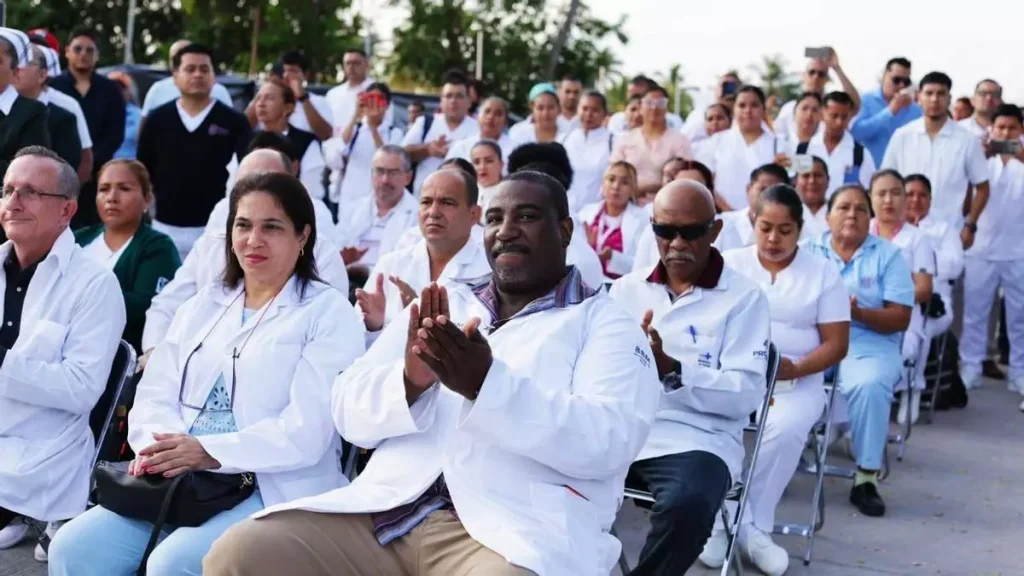
 14ymedio, Madrid, July 17, 2026 / In the midst of the US State Department’s offensive against Cuba’s medical cooperation programs, the prestigious British weekly The Economist published an extensive report this Friday that portrays, through the cases – very distant in time from one another – of two siblings in the medical field, the human and economic fracture that this lucrative labor-export mechanism has bequeathed to the island.
The journalist, a correspondent based in Mexico, spent six months talking with about thirty Cuban doctors who have taken part in the government’s programs, at least half of whom have deserted, while the rest remain in Cuba. The story that anchors the report is that of two siblings, both doctors, who recount very different experiences, though both reflect a shared outlook: choosing a path that would lift them out of poverty, only to end up wanting to flee.
Jorge, 40, is the one who doesn’t manage to leave. He has been working since the start of this year – when he received a call from a Health Ministry official proposing it to him – in a rural enclave in Mexico. He was given only hours to pack his bags, but he didn’t hesitate. He would earn 1,700 dollars in the country, compared with the 14 dollars he receives in Cuba, where he lives with his partner, Bryan, in a province identified only as “far from Havana.” It wasn’t the first time he had done this either, but on this occasion what weighed most heavily was his exhaustion with the blackouts, with living off remittances and gifts from patients: tamales and beans. He recalls from the previous time, in Mexico City during the pandemic, how he would look at stores packed with everything. “I ate so much I felt sick,” the article states.
He now works in a remote region rife with violence, but one that lets him send all kinds of things back to Cuba: a small motorbike, a hard drive full of pirated content, and even solar panels. “I would rather be in Cuba with my family,” he says, admitting that what drives him isn’t humanitarianism but money. He believes that is what motivates everyone, though the journalist notes that among those interviewed she found a bit of everything.
He recalls from the previous time, in Mexico City during the pandemic, how he would look at stores packed with everything. “I ate so much I felt sick,” the article states.
Jorge likes the work in Mexico. Patients appreciate him, he lives simply – he doesn’t pay rent – and he has hot water and internet, things that are impossible in Cuba. He also works fewer than 35 hours a week, since workers head home early before violence takes over the streets. Even so, he keeps turning over in his mind whether or not it’s in his interest to desert. He lives with the nagging doubt of whether, by staying calm and compliant, he is helping to prop up the regime.
In Cuba, the journalist meets Bryan, Jorge’s partner. He laughs when asked whether the doctors are slaves, as the US claims, or humanitarian heroes, as the regime portrays them. “Both things are true. Calling them ‘slaves’ is an exaggeration, especially in a country marked by slavery. Doctors should earn more, but it’s also fair that they contribute,” he says. He adds: “I’m the son of a poor Black woman who cleaned floors to make a living, but thanks to the Revolution I was able to become an engineer. I never paid a cent.”
Jorge, meanwhile, has begun to consider the idea of fleeing. But he is afraid. He recounts the insults hurled, in the brigade’s WhatsApp group, at one of the doctors who abandoned a mission. “We have a rat,” the group leader wrote, asking everyone to send in their opinions. “They wrote horrible things about him. They called him a deserter, a traitor, scum,” he says.
He has that experience within his own household. His half-sister Elisa is the other central figure in this story. She was 24 in 2013, when she joined the medical program to go to Venezuela. At that time there were about 32,000 health workers in the Barrio Adentro mission. She left immediately. “I didn’t have time to grasp how dangerous it was. I felt it was the only option,” she says. Her faith in the Revolution was far greater than Jorge’s, who was raised by their grandparents. She was influenced by her father, a state worker firmly committed to Fidelismo.
Elisa internalized “the idea that she was going to help the Venezuelan people” and left full of enthusiasm, but that wasn’t the only reason. She earned 200 dollars a month, ten times what she made in Cuba, though calm was in short supply where she was posted. Her schedule was 24 hours on duty and 24 hours off, she treated between 60 and 100 patients, and on one occasion a member of a local gang dragged in his unconscious leader, who was bleeding from a gunshot wound. “Save him or we’ll kill you,” he told her.
When she returned to Cuba on vacation she felt euphoric. She bought her mother an air conditioner, a washing machine, and a television, she had a debit card and a 30% discount on household goods purchases. She even put up a Christmas tree, her first “counterrevolutionary” act. But by the end of her vacation, back in Venezuela, she started to think. “I left Cuba with my mind caged. In Venezuela, I began to wake up,” she says.
What bothered her most was how well the Venezuelan elite lived while the population went hungry. There were also other conditions, such as the housing – the back room of a police station shared with 14 other Cubans – the curfew until six in the evening, being unable to leave the state, being unable to have relationships with local people and, of course, being unable to voice a different opinion. When her superiors discovered that a member of the group wanted to desert, they interrogated everyone. “It’s a horrible feeling. You start to distrust everyone, even your own countrymen.”
When her superiors discovered that a member of the group wanted to desert, they interrogated everyone. “It’s a horrible feeling. You start to distrust everyone, even your own countrymen.”
Elisa decided to take advantage of the Cuban Medical Professional Parole program, which was in effect between 2006 and 2016 and under which the United States allowed doctors who abandoned the island’s official missions to emigrate legally. More than 8,000 physicians did so. She left through Colombia via a dangerous route, guided by coyotes. In Cuba, her mother soon received visits from State Security, daily for three weeks. They withdrew 4,800 dollars from her bank account. Her friends insulted her on social media, her best friend stopped speaking to her, and, worst of all, so did her brother Jorge, upset because it derailed his own career.
Elisa now lives in Miami, where she works as a medical insurance broker – she chose not to have her degree validated – is married to an Iraq War veteran, and has two children. The whole family are ardent supporters of Donald Trump, even though she admits she fears for her current immigration status. She also doesn’t want to go to Cuba, afraid she would be identified as a doctor and not be allowed to leave again, amid a dire shortage of doctors and medical resources. The Economist also visited hospitals on the island and saw the collapse, amid total darkness.
In Mexico, Jorge admits he envied his sister – “She was so young when she left…” – and regrets the day he showed his contempt for her, though he still resents that she didn’t think of the rest of the family. In May, mission chiefs in Mexico warned the doctors in a video conference that they had to be ready in case they needed to return to Cuba “at any moment” because the island was “at war.” Jorge panicked and, although his colleagues assured him this was routine, he remains afraid. “I don’t want to go back,” he admits. His doubts are so great that, on one hand, he has consulted a lawyer about the possibility of staying in Mexico, but at the same time he has put his name on the list for the next mission, in 2027.
Teresa, Jorge and Elisa’s mother, lives in Cuba. The correspondent visited her there during her time on the island. The house still has the appliances bought with money from the Venezuelan mission, but the roof was torn off in a hurricane and is now covered with a tarp. She sums up her children’s story simply. “They’re good kids, but my daughter is braver than my son.”
Translated by GH.
______________________
COLLABORATE WITH OUR WORK: The 14ymedio team is committed to practicing serious journalism that reflects Cuba’s reality in all its depth. Thank you for joining us on this long journey. We invite you to continue supporting us by becoming a member of 14ymedio now. Together we can continue transforming journalism in Cuba.