The limit will now be set by individual institutions, the Gaceta says, but that is already what was happening in practice
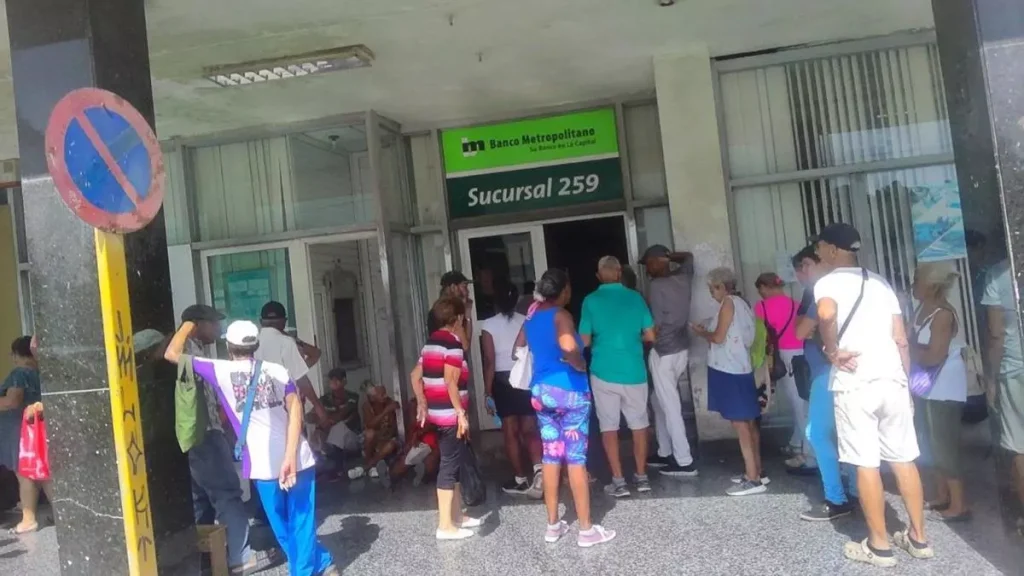
 14ymedio, Havana, July 17, 2026 / As of Monday, the maximum limit of 5,000 pesos for cash payments and withdrawals, established in Cuba two years ago, will no longer be in effect. This is set out in the special edition of the Official Gazette published this Friday, in a rule issued by the Central Bank of Cuba (BCC, by its Spanish acronym) containing just two provisions.
The first repeals two articles of Resolution 111, which, on August 2, 2023, amid the country’s cash shortage, imposed a 5,000-peso ceiling on bank transactions and required that, once that amount was exceeded in a single operation, cards or electronic payment channels had to be used instead.
In its statement of grounds, the BCC refers to “the economic and social changes approved” – a clear reference to the 176 measures announced with the aim of liberalizing the economy – and to the “goal of making more efficient use of available cash,” for which reason “it is necessary to amend the aforementioned Resolution 111 by suspending the established limit, until conditions in the country allow for a more flexible scheme.”
As for the second provision, the Central Bank determines that the “petty cash fund for minor payments” will be agreed upon “between the commercial banks and the economic actor
This fund, it continues, will be “managed by mutual agreement between the commercial banks and state enterprises; higher-level business management organizations; budgeted entities; non-agricultural cooperatives; agricultural cooperatives; agricultural producers; individual farmers; commercial fishermen; micro, small, and medium-sized enterprises; local development projects; self-employed workers; artists and creators; foreign investment arrangements and associative forms created under the Law on Associations, as well as natural and legal persons if they carry out legally authorized commercial and service activities, described as covered parties under Articles 2 and 3 of the aforementioned Resolution 111.”
As for the second provision, the Central Bank determines that the “petty cash fund for minor payments” will be agreed upon “between the commercial banks and the economic actor, taking into account criteria such as: income received into the checking account for tax purposes; cash deposits made; volume and proportion of transactions carried out through Online Payment; use of the extra cash-window service; nature of the economic activity; conditions in the local area; and cash availability at those banks.”
The new resolution – which takes effect three days after its publication in the Gaceta, that is, on July 20 – in practice simply puts on paper what was already happening: depending on how much cash was available, each branch set its own, different limit. “It was almost never 5,000 pesos,” says a retiree from Nuevo Vedado, in Havana. “The last time I went to a bank, the one at Marino and Conill, they were only giving out 1,000 pesos per person, in 20-peso bills.”
In Luyanó, a neighbor says, a few weeks ago they were only handing out 500 pesos per person. And from Sancti Spíritus people report an even more dramatic figure: a 200-peso limit per person. “That doesn’t even buy a soda,” the affected resident laments.
And that is only if you’re lucky – that is, if the bank branch has a minimum amount on hand, or if it even has power, which is even rarer these days. About thirty people were crowded into the Banco Metropolitano branch at Belascoaín and Zanja, in Central Havana, this very Friday, due to the lack of electricity. “You mean there’s not going to be a limit on withdrawals anymore?” exclaimed an elderly woman upon being told of the new rule. “Not that it makes any difference to me, since there’s no cash anyway.”
Translated by GH.
______________________
COLLABORATE WITH OUR WORK: The 14ymedio team is committed to practicing serious journalism that reflects Cuba’s reality in all its depth. Thank you for joining us on this long journey. We invite you to continue supporting us by becoming a member of 14ymedio now. Together we can continue transforming journalism in Cuba.