Drying the grain is done outdoors due to “the current challenging energy conditions”
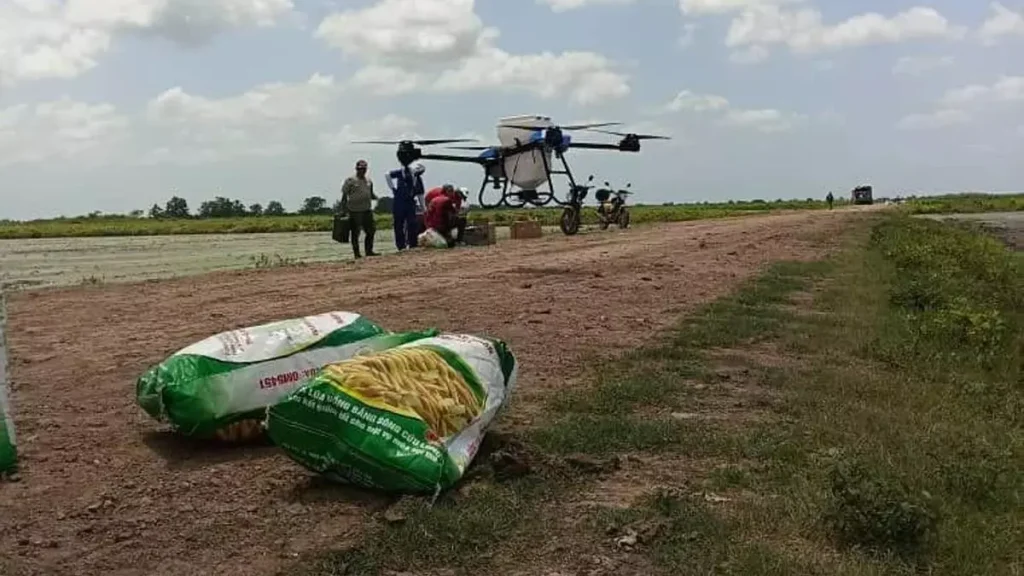
 14ymedio, Havana, June 29, 2026 — The province of Granma, once among Cuba’s leading rice producers, has launched a rice-planting program using drones in an attempt to improve its diminished production. The project is being carried out by the Fernando Echenique Agroindustrial Company, which aims to plant 240 hectares of the grain in areas belonging to the binational TB Agri Connecting Vietnam-Cuba project, in the Granma municipality of Yara.
At the beginning of May, according to a report in the state press, the project’s first planting was carried out, covering 160 hectares as part of the spring campaign, which began in March and ends in August. The process was even attended by Lehuy Thang, deputy director of the TB Agri project.
In a post, the company stated that it will use drones to optimize the cultivation process and achieve more efficient results. “The combination of innovation and experience promises to transform our agricultural practices and maximize productivity in the fields,” it said.
State media emphasize that collaboration with the Vietnamese company makes possible “the introduction of high-quality rice varieties, technological packages, equipment, and the modernization of industrial grain-processing infrastructure, particularly drying and milling facilities.”
The company itself has revealed on social media that it must perform juggling acts in the face of “the current challenging energy conditions”
Nevertheless, the company itself has revealed on social media that it must perform juggling acts in the face of “the current challenging energy conditions.” One of the crucial processes in harvesting seeds and grains is drying. Although methods such as hot-air drying or intermittent drying are used, both require a facility powered by electricity. Fernando Echenique stated in a post that it is carrying out natural rice drying, “which not only allows available resources to be optimized but also contributes to the sustainability of the final product.”
The publication is accompanied by three images showing grains spread out on plastic sheets in the open air. The message concludes by assuring that the initiative reflects the company’s commitment “to adaptation and resilience in difficult times.”
Although the use of drones is innovative, the number of hectares involved pales in comparison to Granma’s historical contribution to national production. Just last year, there were plans to plant 41,000 hectares of rice out of the country’s total 200,000 hectares, although producers were not optimistic.
One reason for their pessimism about reaching that goal was the absence of a package that included imported fertilizers, herbicides, and pesticides, all essential for certain crops, including rice.
The yield from these lands barely reaches two to 2.5 tons per hectare, compared to the five tons achieved in the past.
Last December, Odisnel Traba Ferrales, agricultural director of the Fernando Echenique Agroindustrial Company, stated that they had gone “practically four years without having that technological package.”
As a result, lands that were once highly productive no longer deliver the same results. Yields now barely reach two to 2.5 tons per hectare, compared to the five tons achieved in the past. The figure looks even more modest when compared with the success the Vietnamese are achieving in Pinar del Río, where the company Agri VMA, which holds land under usufruct, exceeds 7.2 tons per hectare.
If one looks at the data from Vietnam’s state-level cooperation, yields are even higher, according to recent figures published by the Cuban Institute for Seed Plant Research, which recorded up to 9.14 tons per hectare in the winter campaign (7 tons in spring) for one of the varieties being cultivated, Viva76.
To the rice harvest process must also be added transportation, which is likewise affected by fuel shortages
Although the state media report does not mention it, transportation is another necessary part of the rice harvest process, and it too is affected by the fuel shortage.
The difficulties in producing the grain have led the regime to propose taking advantage of the shortage to stop eating potatoes and rice. Roberto Caballero, a member of the National Executive Committee of Agricultural and Forestry Technicians, and José Carlos Cordobés, general director of Industrial Policy at the Ministry of Food Industry, argued that achieving food sovereignty would be easier by changing habits that conflict with the reality of Cuban soils and eliminating some products from the regular diet.
“We are not Asians; that is not a Cuban habit,” Caballero emphasized last December on the program Cuadrando la Caja, before suggesting that, although it has become an established tradition, that too could change. “With the shortages that exist, anything you put in the local market will sell,” he assured.
Translated by Regina Anavy
______________________
COLLABORATE WITH OUR WORK: The 14ymedio team is committed to practicing serious journalism that reflects Cuba’s reality in all its depth. Thank you for joining us on this long journey. We invite you to continue supporting us by becoming a member of 14ymedio now. Together we can continue transforming journalism in Cuba.