The UNE forecasts a 2,072 MW shortfall during Saturday’s peak hours after a full day of blackouts
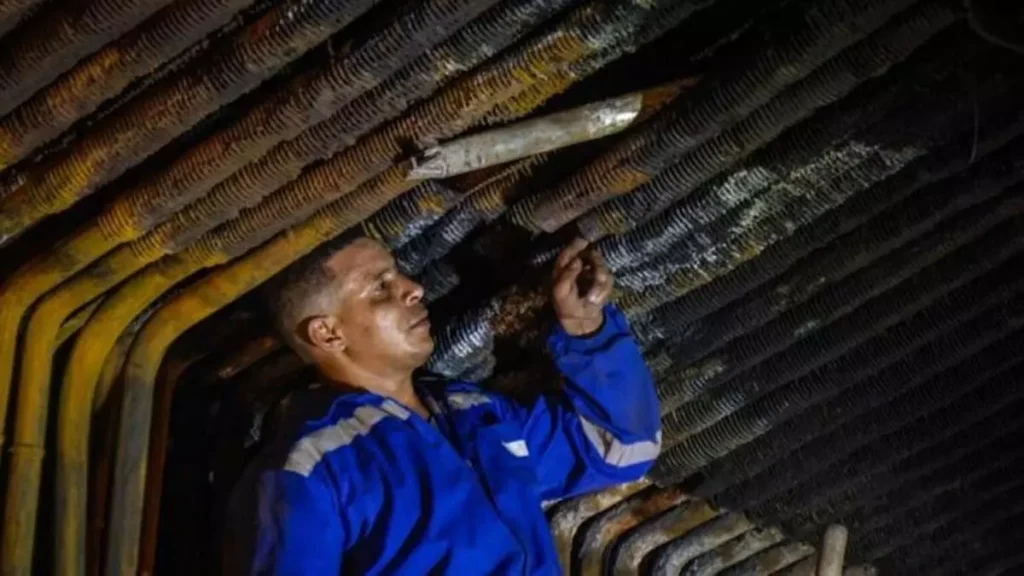
 14ymedio, Havana, May 30, 2026 — The Antonio Guiteras thermoelectric plant, the largest single generating unit in Cuba, has once again gone offline from the National Electric System (SEN) for a reason that encapsulates the deterioration of the country’s basic infrastructure: a “lack of raw water.” The shutdown occurred shortly after the plant had been reconnected to the grid, forcing the Electric Union (UNE) to acknowledge that Friday’s power deficit exceeded projections “due to the emergency shutdown” of the Matanzas facility.
The “lack of raw water” now joins the peculiar catalog of explanations that the UNE has offered for the Guiteras plant’s repeated outages, a list that increasingly seems written for Cuba’s brand of dark humor. Added to “unavoidable maintenance” are such causes as “control valve malfunction,” a “false superheated steam signal,” and the famous “boiler puncture”: expressions that have transformed technical jargon into popular satire.
The latest shutdown came at a particularly delicate moment. The Guiteras had synchronized with the grid on Thursday at 7:48 a.m., after spending several days out of service due to a “small hole in the economizer,” a failure that forced the unit offline on May 24. Its return provided only a few hours of relief before the plant once again went out of operation.
For peak demand hours, when solar energy no longer contributes to the SEN, the state utility is forecasting a deficit of 2,072 MW, one of the most severe figures of recent days
Although authorities typically present each outage as an isolated incident, the pattern of recent weeks shows that Cuba’s main thermoelectric plant is operating at its limits, with partial repairs, brief restarts, and recurring shutdowns. Every disconnection has an immediate impact on blackouts, because the Matanzas facility can contribute more than 200 megawatts (MW) when operating steadily, although that is still far below its original installed capacity of 330 MW.
The national situation on Saturday confirms the continuing deterioration. At 6:00 a.m., SEN availability was only 1,113 MW against demand of 2,720 MW. At that time, 1,562 MW were already affected, and the UNE estimated a 1,600 MW deficit by midday.
The nighttime outlook is even worse. During peak demand hours, when solar generation contributes nothing to the grid, the state company forecasts a shortfall of 2,072 MW, one of the highest figures recorded in recent days. The only generation expected to come online for the evening peak is Unit 3 of the Renté thermoelectric plant, contributing 45 MW, far too little to alter the overall situation.
The list of breakdowns leaves little room for optimism. In addition to the Guiteras, Unit 2 of the Lidio Ramón Pérez thermoelectric plant in Felton and Units 3 and 5 of the Antonio Maceo plant in Renté remain out of service due to failures. Unit 5 in Mariel, Unit 6 in Renté, and Unit 5 in Nuevitas are under maintenance. Added to this are 318 MW unavailable due to limitations in thermal generation.
Solar generation drops as night approaches, precisely when residential demand rises and blackouts intensify
Fuel shortages continue to worsen the situation. The UNE reported that 106 distributed-generation plants are out of service for lack of fuel, removing 890 MW from the system. Also idle are the Regla floating power plant, the Mariel fuel-oil plant, and the engine facilities in Moa. In total, the company acknowledges that 1,203 MW are unavailable due to fuel shortages.
Not even solar power can offset the collapse in thermal generation. The country’s 54 new photovoltaic parks produced 3,643 MWh on Friday, reaching a maximum output of 526 MW around midday. The UNE presented the figure as a source of relief, but solar generation falls sharply as evening approaches, exactly when residential demand increases and blackouts become most severe.
For ordinary Cubans, however, the technical explanations matter less than the outcome. This will be another Saturday of prolonged power outages, with entire provinces subjected to increasingly difficult rotating blackout schedules. The government continues to manage the crisis through daily reports, but each new bulletin confirms that the system has no real reserve capacity. When one unit comes online, another goes offline; when demand falls, a boiler breaks down; when fuel becomes available, there is a shortage of “raw water.”
Translated by Regina Anavy
______________________
COLLABORATE WITH OUR WORK: The 14ymedio team is committed to practicing serious journalism that reflects Cuba’s reality in all its depth. Thank you for joining us on this long journey. We invite you to continue supporting us by becoming a member of 14ymedio now. Together we can continue transforming journalism in Cuba.