The employee at the state-run store checks each banknote and rejects it if it has any pen marks or is wrinkled.
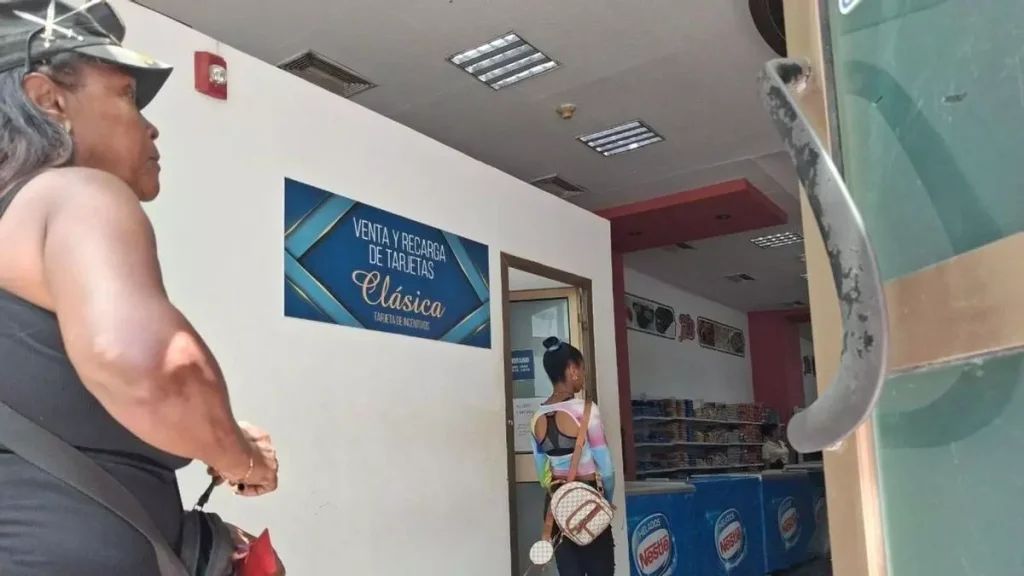
 14ymedio, Yoani Sánchez, Havana, April17, 2026 — The approach of July and August is palpable. After ten in the morning, being out on the street becomes increasingly difficult. Insect repellent, sunscreen, a bottle of water, toilet paper in case I need to use the restroom, and patience—lots of patience. This Thursday the heat is unbearable, so I speed through Central Park with its collection of white marble slabs that reflect the sun. This time I’m not looking for a drain for my sink or some sandpaper. I’m going to do something more difficult: deposit dollars onto a Classic card.
A friend of mine finally got his turn to buy gas after waiting in the virtual queue for over two months. His daughter’s wedding depends on him being able to fill the tank of his old Lada, which is older than his bride-to-be, with 20 liters. As a gift, the couple has asked everyone who can to contribute some money to top up those little blue cards that are the magic bullet for buying gas at supermarkets and gas stations.
Before, people wanted for their wedding day to receive boxes of wine, bouquets of roses, perfume, or jewelry. But now we live in a stark world where simply turning the wheels of a car feels like receiving a multi-carat gold ring as a gift. Nor is rice thrown when the newlyweds leave the church after saying “I do.” A pound is worth over 300 pesos in the markets, and nobody’s going to throw that much money in the air.
Nor is rice thrown when the newlyweds leave the church after saying “I do.” A pound is worth over 300 pesos in the markets, and nobody’s going to throw that much money in the air.
After pooling money for gas with friends, another bitter pill to swallow. Throughout Havana, there are few places where you can recharge a Clásica card, issued by the military’s financial arm, Fincimex. These locations are at the mercy of power outages, bank connection failures, and any other problem, from a clogged pipe to an employee suffering from chikungunya.
I head for the Harris Brothers store on O’Reilly Street in Old Havana. A line of about a dozen people is already waiting in front of the main entrance for the same thing. The wait is agonizing. The sun is already beating down, there’s nowhere to sit, and just a few meters away, an open sewer is spreading its stench. To enter the tiny shop where they refill the Clásica, you have to leave your wallet in the market’s baggage claim. In every store in Cuba that sells anything of even remotely valuable, you have to get rid of backpacks, bags, and packages. We’re all potential thieves for the Cimex corporation that runs these markets.
I didn’t see a single tourist the entire way. The security guard outside the Floridita looked bored. An elderly homeless man dozed in the doorway of the La Moderna Poesía bookstore, which had been closed for years. Along the stretch of Obispo Street I could see, there was only a peanut vendor and an employee from a private restaurant, dressed in a crisp white shirt and a black bow tie, who stared at the ground with a weary expression. Tips are getting worse and worse, I thought.
The dollar has always been the most welcome currency for waiters, bartenders, and restroom attendants across the country. Not all tips are created equal. Foreign currency, whether American or European, lifts spirits, brings smiles to the tired faces of waiters, and can even lead to the appearance of disinfectant and toilet paper in the restrooms of the humblest establishment. But dollars are scarce because tourists are scarce. If it could, the regime would confiscate all the dollars circulating on the streets, and I wouldn’t be surprised if, in some offices “up there,” there are still those who dream of criminalizing dollars again and throwing us in jail if we dared to carry them in our pockets.
The Classic cards are part of the official vacuum cleaner designed to suck up every dollar possible. A piece of plastic where you deposit those greenbacks and then can’t withdraw them, but can only use them to buy things at the stores and gas stations run by the same owner of those cards. I’m going over all of this while I wait outside Harris Brothers. But I’m also thinking about how inefficient the regime on this island is at carrying out any task, even one that is of such urgent interest to them, like removing the faces of Lincoln and Washington from our pockets.
But I’m also thinking about how inefficient the regime on this island is at carrying out any task, even one that is of such urgent interest to them, like removing the faces of Lincoln and Washington out of our pockets.
“The only thing they’re good for is repression,” a friend tells me every time I complain about government programs that were launched with great fanfare and then collapse a few weeks later. Finally, it’s my turn to deposit the money that will eventually fund the Lada taking my friend’s daughter to the Wedding Palace. Two hours have passed since I started lining up. I’ve been lucky. Another nearby place that used to offer the same service has been closed for weeks.
The clerk eyes with suspicion each bill I hand her. Not even the Federal Reserve Board examines these papers this closely. If any have pen writing on them, they’re rejected. If Franklin’s face is too wrinkled, they won’t accept it. If Hamilton has creases that cross his eyes, he’s out. So much need for dollars, and yet so much fussiness about accepting them, I complain to myself. Finally, I pass the test, deposit the money, and the woman gives me a receipt confirming the transaction.
I call my friend. “Tell your daughter to rent the dress; the gas is practically covered.” I think I’ll bring some rice to throw at the wedding anyway. A spoonful or two, no more.
Previous Havana Chronicles:
The Shipwreck of a Ship Called “Cuba”
Havana Seen From ‘The Control Tower’
In Havana, the Only Ones Who Move Are the Mosquitoes
Reina, the Stately Street Where Garbage is Sold
Searching for Light Through the Deserted Streets of Havana
The Death Throes of ‘Granma’, the Mouthpiece of a Regime Cornered by Crisis
The Anxiety of the Disconnected Cuban
One Mella, Three Mellas, Life in Cuba Is Measured in Thousands of Pesos
It Is Forbidden To Leave Home in Cuba Today Because It Is a “Counter-Revolutionary Day”
Vedado, the Heart of Havana’s Nightlife, Is Now Converted Into a Desert
COLLABORATE WITH OUR WORK: The 14ymedio team is committed to practicing serious journalism that reflects Cuba’s reality in all its depth. Thank you for joining us on this long journey. We invite you to continue supporting us by becoming a member of 14ymedio now. Together we can continue transforming journalism in Cuba.