In the streets of Matanzas, retirees barely survive
 14ymedio, Matanzas, Pablo Padilla Cruz, March 31, 2026 – As in any besieged city, it is the weakest and most vulnerable who are the first to succumb. The same happens with the inflation affecting Cuba. Many are forced to double their work or, in many cases, to seek new forms of income in a desperate attempt to survive.
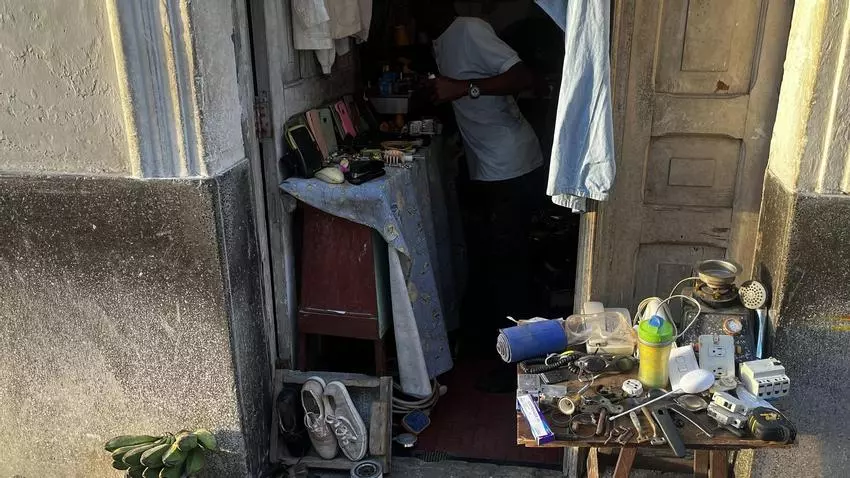
On Contreras Street in the city of Matanzas, Duarte, a neighbor awaiting his retirement, resists becoming a burden on his family. He has improvised a small stand in front of the entrance to his house: a modest table where he sells everything he finds, from cellphone batteries to second- or third-hand bathroom fittings, covered in magnesium residue. The place sometimes looks like the setting of a detective game.
“I don’t have many other options. My retirement hasn’t come yet and, besides, it would only be 2,100 pesos, according to estimates; that is, a bottle of oil and a bag of rice,” he calculates roughly. “I think I’ll fall short if prices keep rising.”
“Here I earn almost nothing, but it keeps me occupied. The neighbors give me their junk, as they say, and from time to time something sells”
Duarte worked as a night security guard at one of the port docks, but the early mornings and long trips to the industrial zone eventually took their toll. “I would have liked to keep working, but it’s not the same anymore. Here I earn almost nothing, but it keeps me occupied. The neighbors give me their junk, as they say, and from time to time something sells,” he says. “A hundred pesos here, twenty there, it never hurts.”
With a mix of resignation and hope, he reflects on his future: “First I have to finish the retirement process. After that, maybe I can work as a guard somewhere nearby; if not, I’ll continue here. Maybe one day someone will want to invest and we’ll improve the offerings, but at the rate things are going, I don’t know if I’ll be alive to see an improvement.”
Duarte’s situation is not exceptional. The purchasing power of the elderly who depend on a state pension pushes them increasingly into the streets, even after retirement. People with disabilities are not spared this reality either, receiving monthly assistance that is entirely insufficient in the face of the worsening crisis.
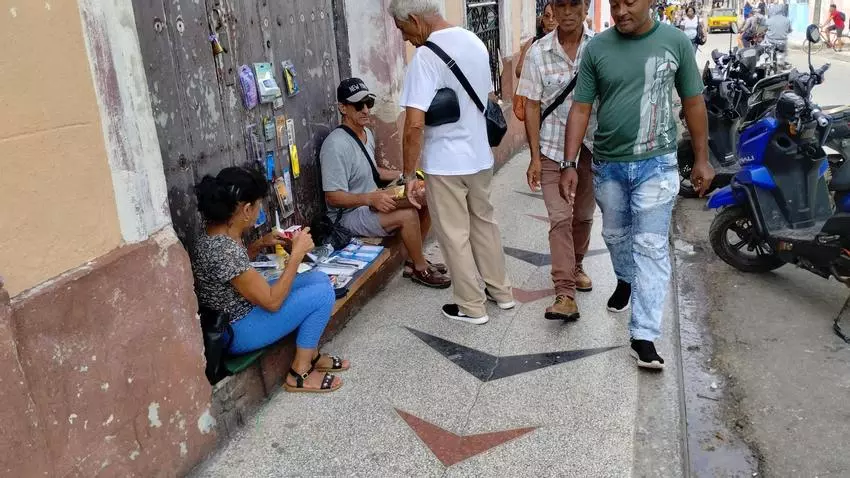
Armando, blind, is one of them. With the help of his friend Maritza, who guides him through the city streets, he sells various items from a cardboard box at any improvised kiosk on Calle del Medio.
“It has become easier over time, but even so, it’s complicated to come every day and return home with the box still full of things,” he says. “Luckily Maritza helps me: she tells me when someone wants something and makes sure the payment and change are correct. She also makes sure no one steals from me. With her help, we get by. I never imagined doing this, but these are difficult times.”
Maritza, for her part, assumes her role naturally and with solidarity: “Here, fortunately, we help each other. It would be low of me not to lend him a hand in his situation. And don’t think he doesn’t help me too. We keep each other company day by day. This kiosk is our office, and we are partners for better or worse,” she says, smiling, just before selling a bottle of glue to a hurried customer.
Both Armando and Duarte see in their respective incomes — a still-pending pension and modest state assistance — a partial relief for daily expenses. However, there are those who do not even have that support, which makes their daily struggle even harder.
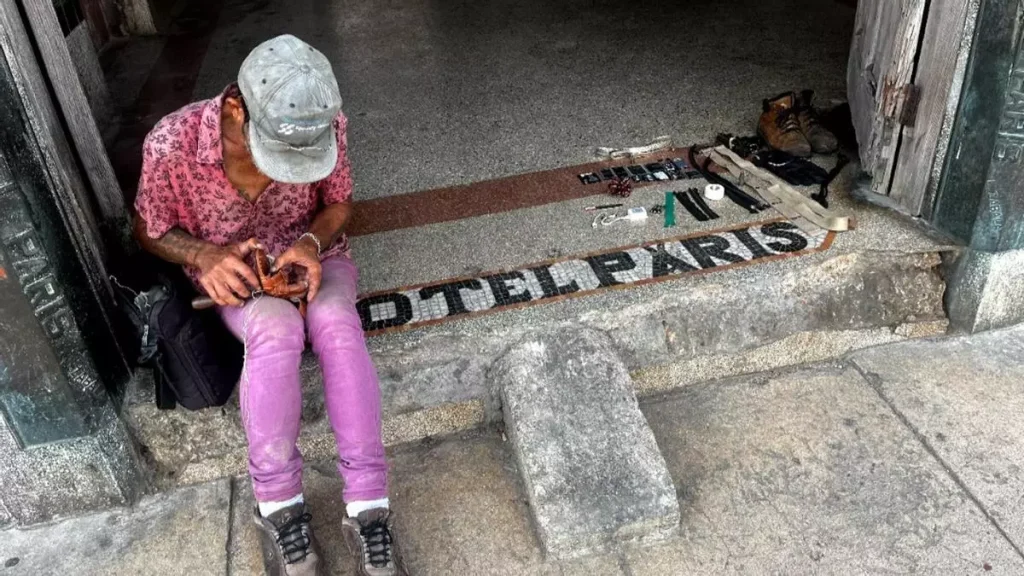
“I made many mistakes in my life, many excesses. In prison I paid society, as they say, but there is a cross I continue to carry.” This is spoken with sadness and frankness by Roilier, who survives by selling whatever he finds or is given, while repairing shoes, a trade he learned during his sentence.
Sitting at the entrance of the former Hotel París, where he occupies a small room in the back, he tries every day to earn enough for food. When asked about the cellphone batteries he sells, he answers bluntly that he does not know if they work; he has no phone to test them.
“I don’t complain,” he stresses. “I lost the ability to complain a long time ago. I only see how unfair life can be: even if you pay for your mistakes with your time, you will always have an invisible mark that doesn’t let you move forward. You will always be, when looking for a job, the one who did this or that. It doesn’t matter if it was fifteen years ago or a month, or under what circumstances. Mistakes never completely disappear, and so all you have left is this,” he says, pointing to his tools: “waiting for death while you mend a sole.”
Translated by Regina Anavy
______________________
COLLABORATE WITH OUR WORK: The 14ymedio team is committed to practicing serious journalism that reflects Cuba’s reality in all its depth. Thank you for joining us on this long journey. We invite you to continue supporting us by becoming a member of 14ymedio now. Together we can continue transforming journalism in Cuba.