Shouting “Freedom!” dozens of residents of the city in Ciego de Ávila protest against the endless blackouts and clash with the police. There are at least five detainees.
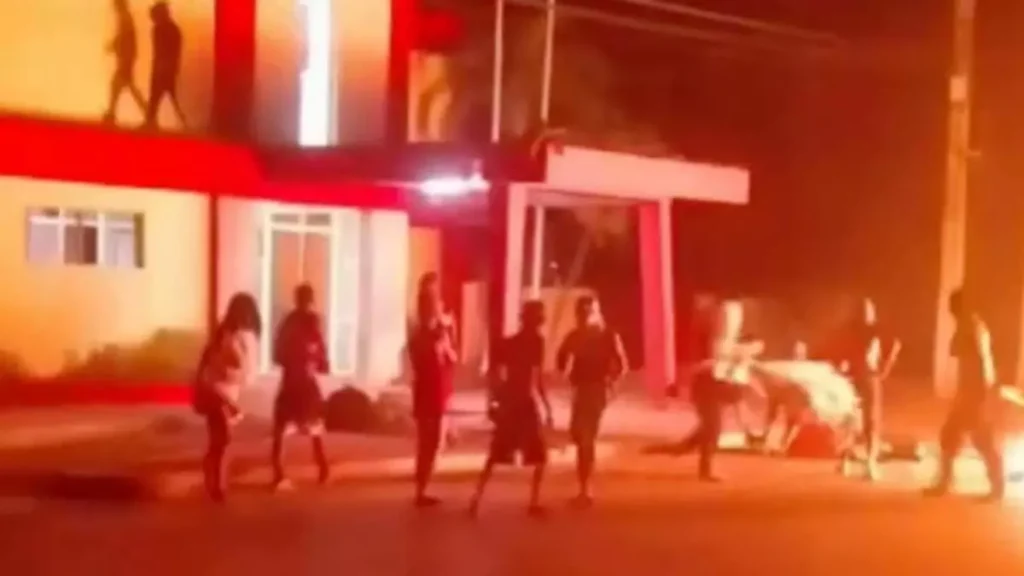
 14ymedio, Havana, March 14, 2026 – “Freedom!” That was the cry that echoed on Friday night in the streets of Morón, in the province of Ciego de Ávila, when dozens of residents went out to protest against the blackouts that are suffocating the country. The march passed through different areas of the city to the rhythm of pot-banging, reached a police unit, and ended in front of the headquarters of the Communist Party of Cuba (PCC), where protesters burst into the building, threw furniture and banners into the street and built a bonfire in the middle of the road.
Videos shared on social media show groups of people moving through the streets of the municipality in Ciego de Ávila while demanding an end to the blackouts that are hitting the entire Island, which are usually longer in towns and cities in the interior. According to several testimonies, when the march arrived in front of the police unit the protesters were met with threats and officers armed even with machetes.
The protest continued to the municipal headquarters of the PCC. In some images, protesters can be seen taking chairs, tables and propaganda posters from inside the building and piling them up in the street to set them on fire. It can also be seen how they attempted to set fire to the building, a symbol of the regime’s political control in the territory.
The official government press speaks of “acts of vandalism” carried out by “a group of people” from the El Vaquerito neighborhood council
The scene contrasts with the version published by the official government newspaper Invasor, which described what happened as “acts of vandalism” carried out by “a group of people” from the El Vaquerito neighborhood council. According to the state media outlet, what began as a peaceful protest over the electrical situation and food shortages “turned into acts of vandalism against the headquarters of the Municipal Party Committee,” where a small group allegedly threw stones at the entrance of the building and started a fire with furniture from the reception area.
Images shared by residents tell a more complex story. In several videos, dozens of people can be seen walking through the city, banging pots and chanting slogans. Some witnesses say the march advanced without incident for a long stretch, until it gathered in front of the PCC headquarters, where tensions with security forces finally erupted.
One of the most serious moments of the night was captured in a recording circulating on social media: a young man is carried in the arms of several protesters after receiving a gunshot wound to the thigh. According to testimonies shared by residents of the area, the shot was fired by
a police officer who was trying to disperse the crowd gathered in front of the Party building.
In the images, several people can be seen carrying the wounded man while trying to move him away from the area to give him first aid. The government newspaper denies the shooting and claims that the injured person was “in a state of drunkenness” and “suffered a fall.” It also states that the person is being “treated at the Roberto Rodríguez General Hospital.”
The official publication also mentions supposed damage to other establishments
Other reports speak of violent repression by special forces from the Ministry of the Interior, including black-beret units and officers with dogs. Witnesses claim the forces released the animals against the protesters and carried out arrests, five according to the newspaper Invasor.
The official publication also mentions supposed damage to other establishments, including a pharmacy and a sales point belonging to the Tiendas Caribe chain, although it offers no details about the damage or about the real scale of the protest.
What does seem clear is the origin of the outbreak: it is the energy collapse the country is experiencing, which in recent weeks has caused prolonged blackouts across the Island. In Morón, as in much of Ciego de Ávila, electricity cuts have stretched for hours amid food shortages and the general deterioration of basic services.
Ciego de Ávila is under the provincial political leadership of Julio Heriberto Gómez Casanova, first secretary of the PCC in the territory. Gómez replaced Liván Izquierdo Alonso in 2024. Despite corruption scandals surrounding Izquierdo in the province, he ended up being appointed first secretary of the Party in Havana. Gómez Casanova’s account on X remains restricted.
The events in Morón also occurred on the same day that Díaz-Canel appeared before the government press to confirm that the Government is holding talks with the United States
Direct political and administrative responsibility for Morón rests with three key figures in the state and party apparatus: Alberto Echemendía Manzanares, first secretary of the PCC in the municipality; Celia María López Reyes, president of the Municipal Assembly of People’s Power; and Yorqui Navarro Pérez, mayor. In a system where the Party dominates all state structures, the three concentrate the political and governmental leadership of the territory and are therefore the main officials responsible for local management amid the crisis that triggered the protests.
The events in Morón also occurred on the same day that the country’s president, Miguel Díaz-Canel Bermúdez, appeared before the official press to confirm that the Government is holding conversations with the United States, after repeatedly denying those contacts. His speech, which once again repeated the usual narrative without offering concrete solutions to the crisis, generated widespread rejection both among critics of the regime and within sectors traditionally aligned with the Government.
In reaction to the events, the Cuban Observatory of Human Rights (OCDH) said this Saturday that the protests reflect the growing social exhaustion on the Island. In a statement released from Madrid, the organization said that only hours after the televised appearance of Miguel Díaz-Canel, “the people took to the streets demanding freedom and a change of system.” The OCDH also asked countries such as the United States, Canada, the Netherlands, the Czech Republic and Sweden to promote actions to protect protesters and opposition members, and reiterated that in the face of the regime’s economic and social collapse, the only way forward for Cuba is a peaceful transition to democracy.
Translated by Regina Anavy
______________________
COLLABORATE WITH OUR WORK: The 14ymedio team is committed to practicing serious journalism that reflects Cuba’s reality in all its depth. Thank you for joining us on this long journey. We invite you to continue supporting us by becoming a member of 14ymedio now. Together we can continue transforming journalism in Cuba.