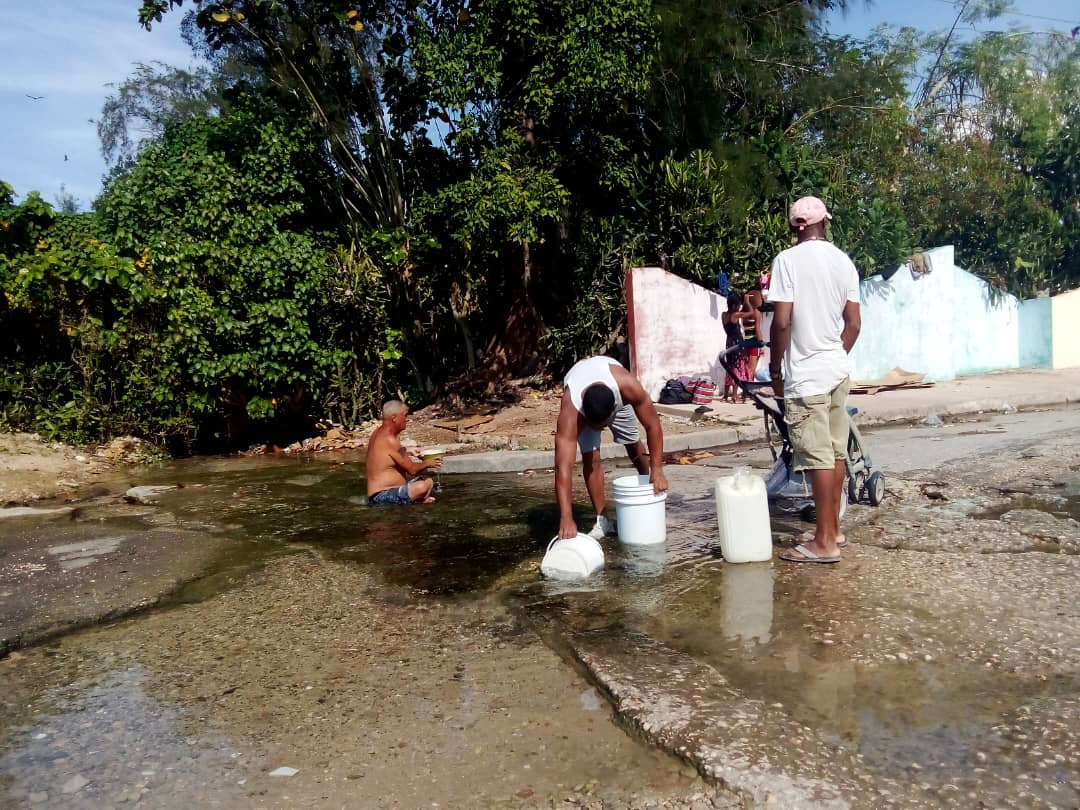
Faced with a lack of water supply in their homes, thousands of residents fill buckets from leaking pipes in public places.
 Julio César Contreras, Matanzas, 29 May 2025 — When the first signs of weakness appeared, Ana María, 68, thought it was due to the nutritional deficiencies she had been accumulating for years. Retired from the education sector, with a pension of no more than 2,000 pesos a month, this resident of the city of Cárdenas, Matanzas, didn’t immediately conclude that her discomfort was due to a virus, hepatitis A, and that it had been transmitted to her through the water.
In Ana María’s house, like in most homes in Cárdenas, the water coming through the pipes is dirty, sometimes brown in color and has an unpleasant odor. The solution families used for decades to counteract the poor quality was to boil and filter the water, but long power outages and the rising cost of cooking coal have forced them to abandon this healthy practice.
“I have a filter, one of those that claim to eliminate a lot of dirt, heavy metals, and bacteria, but it doesn’t seem to work for this,” Ana María tells 14ymedio. Despite defining herself as a “very cautious” person with everything she puts in her mouth to avoid diarrheal diseases, this time the hepatitis A virus evaded her hygiene protocols and now, from her liver, forces her to rest.
We should “consume quality drinking water, boiling it if possible,” but the lack of fuel makes this task difficult.
This retiree’s case is not an isolated one. The newspaper Girón recently confirmed the appearance of a hepatitis A outbreak in the 13 de Marzo neighborhood and the La Marina neighborhood in Cárdenas. The report warns that people should “consume quality drinking water, boiling it if possible,” but the lack of fuel makes this task difficult. Faced with the choice between using the limited amount of liquefied natural gas, firewood, or coal, which they can purchase at 1,300 pesos a sack, to heat food or water, most Matanzas residents opt for the former.
Hepatitis A, an infection transmitted through the fecal-oral route, usually through contaminated food or water, typically has a good recovery prognosis, and those who suffer from it acquire lifelong immunity. However, the aging population, malnutrition, and difficulties in resting and eating according to medical recommendations, and maintaining hygiene during illness, hinder the process of overcoming the virus.
“In this neighborhood, there’s an elderly woman who had to be taken to the hospital because she contracted hepatitis A and was already sick, bedridden, with bedsores, and alone,” explains Ana María. The exodus of children and younger relatives has left many elderly people in an extremely vulnerable situation. In the face of any health problem, they find themselves helpless, without home care, and lacking medication.
“The doctor couldn’t even give me instructions on what kind of diet I should follow because he says he knows I won’t be able to follow it.”
“They prescribed me rest and plenty of water. I know it’s a virus and there’s not much I can do, but the doctor couldn’t even give me instructions on what kind of diet I should follow because he says he knows I won’t be able to follow it.” Low fat, natural products, vegetables, lean proteins, and no alcohol complete the suggestions for those suffering from hepatitis A, precisely the food groups with the highest prices in the markets.
Others don’t even know if the fatigue they’re experiencing is due to the virus spreading through the province. Abel, 23, hasn’t been able to get out of bed for days. He blames his laziness on the water from a supply point in the city of Matanzas, across from the Transmetro bus station, a few blocks from the Simpson neighborhood. He also has intermittent fever and nausea, but the lack of reagents for the test delays the results, and he can only guess that he has hepatitis A.
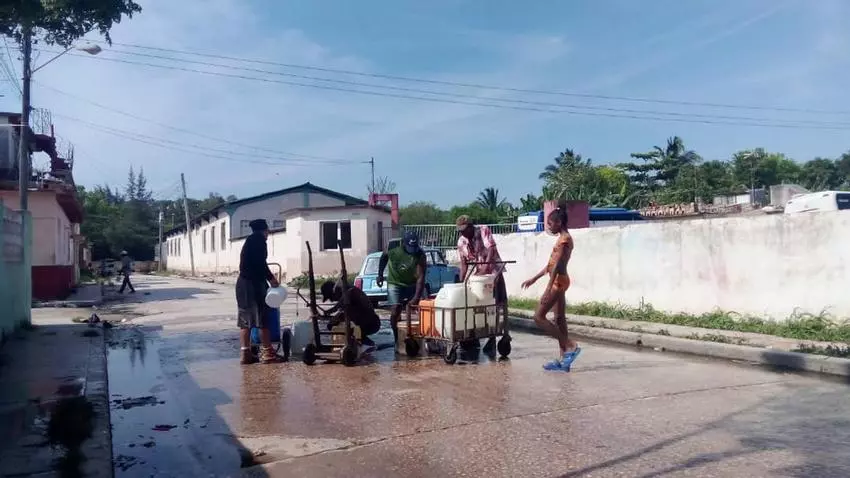
Two of Abel’s friends have already been diagnosed with the virus. “They collect water from the small well next to Watkins Park Zoo, but it could all end up being contaminated,” warns the Matanzas resident. Faced with a lack of water supply in their homes, thousands of city residents flock to the so-called manholes, sinks installed on a street corner or a hole in the sewer that spills its contents into a public space, where they fill buckets, jugs, and tanks that they then haul back to their homes.
“The other day, a Public Health inspector, seeing us filling the buckets, warned us not to drink that water, but what can we do?” the young man reflects. His hope is that he hasn’t lost his appetite, one of the most common symptoms of hepatitis A, and that, therefore, his discomfort could be just a minor stomach infection. Acute diarrheal diseases are also hitting the province hard, and their prevalence is expected to increase as summer approaches.

“If I had the money, a courier would bring spring water to my doorstep,” reckons Abel, who wants to avoid future moments of uncertainty and fatigue. “What we’re doing at home is using different utensils to eat, but we’re forced to use the same bathroom, and most of the time, we don’t even have water to flush or wash our hands.”
Under the kitchen counter, Abel’s family keeps containers containing some of the water they carried for several blocks. This essential and vital liquid contains their greatest ally and perhaps their worst enemy.
____________
COLLABORATE WITH OUR WORK: The 14ymedio team is committed to practicing serious journalism that reflects Cuba’s reality in all its depth. Thank you for joining us on this long journey. We invite you to continue supporting us by becoming a member of 14ymedio now. Together we can continue transforming journalism in Cuba.