Cuba’s Foreign Ministry Summons US Chief of Mission Mike Hammer for “Inciting Cuban Citizens To Commit Criminal Acts”

Hammer is accused of using diplomatic immunity “as cover for acts contrary to the sovereignty and internal order of the country.”
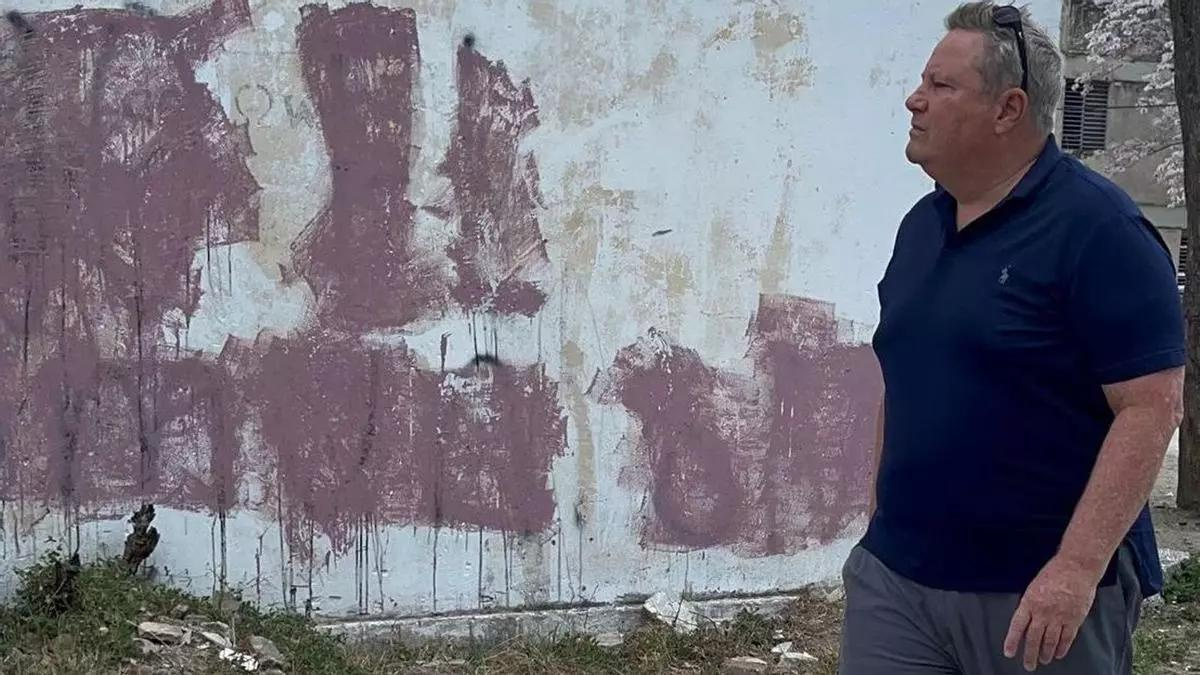

Mike Hammer, head of the U.S. mission in Cuba, in front of the defaced anti-government sign in the Lenin neighborhood of Holguín. / Courtesy/14ymedio

14ymedio bigger14ymedio, Havana, 30 May 2025 — The Chief of Mission of the U.S. Embassy in Havana, Mike Hammer, received a verbal note from the Cuban Foreign Ministry on Friday accusing him of inciting Cubans to commit serious crimes against the state. The diplomat was summoned to the Ministry of Foreign Affairs for his “interventionist and unfriendly behavior,” as the regime describes his extensive schedule of visits to opponents and entrepreneurs.

In statements to Martí Noticias, a U.S. State Department official backed the diplomat’s actions: “Chief of Mission Mike Hammer and the U.S. Embassy proudly represent President Trump implementing an ’America First’ foreign policy and holding the Cuban regime accountable for its malign influence in the Americas.”

“We will continue to meet with Cuban patriots, religious leaders, and those fighting for Cuban freedoms,” the State Department added, emphasizing that the regime’s “corrupt, inept, and failed” policies are causing unrest among Cubans.

Alejandro García del Toro, a diplomat in Washington for several years and now director of bilateral affairs with the US, was in charge of reading Hammer the riot act “once again.” The Foreign Ministry argues that the US representative has violated the Vienna Convention and the Agreement on continue reading

the Restoration of Diplomatic Relations signed between Havana and Washington.

A statement from the Foreign Ministry stated that the conversation was “emphatic” and that Hammer was accused of “inciting Cuban citizens to commit serious criminal acts, attacking the constitutional order or encouraging them to act against the authorities, and demonstrating in support of the interests and objectives of a hostile foreign power.”

García del Toro told the US representative that he could not use diplomatic immunity “as cover for acts contrary to the sovereignty and internal order of the country” and could not sustain “provocative and irresponsible behavior.”

He also criticized Hammer’s allusions to José Martí, which the Foreign Ministry considers a sign of “public and insulting manipulation.” In a video of his visit to the Santa Ifigenia Cemetery in Santiago de Cuba on May 19—the anniversary of the hero’s death in combat—the diplomat referred to Martí as “the Apostle of the homeland.”

Hammer quoted a phrase that the regime finds problematic: “Respect for the freedom and thoughts of others, even those among the most unhappy, is in me fanaticism. If I die or am killed, it will be for that.” The verbal note asserts that the diplomat is unaware, in quoting this thought, of Martí’s “anti-imperialism” and emphasized—with arguments valid in the 19th century, but in no way applicable to the current situation—that the US is a “danger” to the island.

As a kind of symbolic counterattack, García del Toro gave Hammer a copy of Martí’s unfinished letter to Manuel Mercado, cited countless times to justify Fidel Castro’s hostile stance toward Washington.

Since his arrival in Cuba, Hammer has been a stone in the shoe of the Foreign Ministry.

Since his arrival in Cuba, Hammer has been a a stone in the shoe of the Foreign Ministry. Untouchable due to his position, affable in his dealings with the country’s inhabitants—opponents, but also entrepreneurs and all kinds of Cubans—and accurate in his assessments of the crisis on the island, the diplomat’s popularity on the streets is directly proportional to the regime’s animosity.

Last week, Hammer held a press conference in Miami in which he made clear the US position on Cuba and, furthermore, his willingness to support the Cuban people. One of his statements that most resonated in Havana was this: “The Administration is determined to sanction the repressors. There will be consequences for their actions, and I cannot anticipate further measures that will come, but they will come, I can assure you of that.”

Knowing that State Security is following him wherever he goes, he took the situation with humor. “Obviously there’s a lot of traffic; you see Ladas everywhere. If we turn right, they turn right. I don’t like going left, but hey, if we go left, they go with us. They’re constantly filming me.”

____________

COLLABORATE WITH OUR WORK: The 14ymedio team is committed to practicing serious journalism that reflects Cuba’s reality in all its depth. Thank you for joining us on this long journey. We invite you to continue supporting us by becoming a member of 14ymedio now. Together we can continue transforming journalism in Cuba.
Cuba Receives 130 Irregular Migrants Deported by the United States

Another 193 people were returned by Washington to Venezuela, including eleven children.

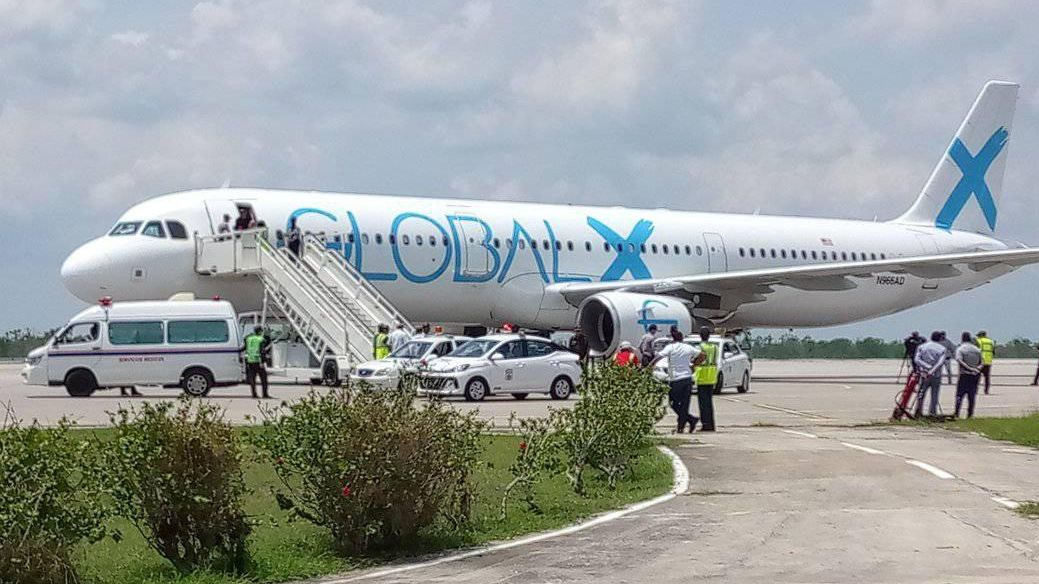
The flight carried 106 men and 24 women / Minint Hoy/Facebook

14ymedio biggerEFE (via 14ymedio), Havana, 31 May 2025 — Cuba received on Friday 130 irregular migrants deported by the United States by air in the fifth operation of this type carried out since the second term of President Donald Trump began, on January 20 of this year. The return of 106 men and 24 women was carried out “in accordance with bilateral migration agreements” between the governments of Havana and Washington, according to a note from the Ministry of the Interior, which has been published in official media.

Among the returnees are five who “were transferred to the investigative body because they were on probation at the time they illegally left the country,” says the report. With this new operation, 19 people have been returned from different countries in the region so far in 2025, with a total of 587 people.

The Cuban authorities stressed that they remain “firm” in their commitment to “regular, safe and orderly” migration and reiterated the danger and life-threatening conditions that illegal departures from the country by sea represent. continue reading

The governments of Havana and Washington have a bilateral agreement that all migrants arriving by sea to US territory be deported to the island. Also, the deportation flights that were suspended since 2020 were resumed at the end of April 2023, mainly for Cubans considered “inadmissible” after being held on the border with Mexico.

Havana and Washington have an agreement that all migrants arriving by sea to the US territory be deported to the Island

According to data from the US Customs and Border Protection Office (CBP), during the fiscal period 2024, which ended on 30 September 2017, 217,615 Cubans arrived in the United States. In addition, a total of 8,261 Cubans were registered by the US border authorities last October, the first month of fiscal year 2025. The border agency added that more than 860,000 migrants from the island entered the territory of the US in the last four years.

In 2024, 93 returns were made from different countries in the region, with a total of 1,384 irregular migrants returning to Cuba, according to official sources.

Another 193 Venezuelan migrants deported by the United States arrived in their country on Friday, according to the Ministry of the Interior and Justice, which added that 11 minors arrived in the group. Through a post on Instagram, the ministry indicated that the Venezuelans came from Texas. “On this occasion 153 men, 29 women and 11 children returned to their country,” it added.

The ministry stated that the returning migrants were cared for by “the different organs of the Venezuelan state with the corresponding protocols on legal security, identification and health, among others.”

According to official figures, counting these 193 migrants, there are already 5,396 Venezuelans who have returned to the country, the vast majority deported by the Trump administration since last February, after an agreement signed in January by Caracas and Washington, which have been without relations since 2019.

On Thursday, a plane from the state-owned Conviasa, coming from Mexico, landed at Maiquetía Simón Bolívar International Airport in Caracas with 315 repatriated migrants, according to the Ministry of Interior and Justice. The institution noted, through Instagram, that of the total number of migrants, 146 were minors and 169 were adults.

This Friday, the US Supreme Court ruled in favor of allowing the Trump administration to withdraw the temporary legal protection granted by the previous Biden administration to 532,000 migrants from Venezuela, Cuba, Nicaragua and Haiti. The US Supreme Court has granted the emergency request by the Department of Homeland Security with a vote of seven judges in favor and two against: Sonia Sotomayor and Ketanji Brown Jackson, both Democratic appointees.

The Trump administration was trying to challenge a ruling by a federal judge — which is now without effect — of the state of Massachusetts, who considered that the government could not overturn humanitarian parole, which allowed beneficiaries to live and work temporarily in the US, without analyzing the procedure on a case-by-case basis.

Today’s is the second ruling by the Supreme Court this year in this area, after it authorized Trump 10 days ago to withdraw Temporary Protection Status (TPS) from some 350,000 Venezuelan migrants.

Translated by Regina Anavy

____________

COLLABORATE WITH OUR WORK: The 14ymedio team is committed to practicing serious journalism that reflects Cuba’s reality in all its depth. Thank you for joining us on this long journey. We invite you to continue supporting us by becoming a member of 14ymedio now. Together we can continue transforming journalism in Cuba.

Cuba’s Blackouts Are Due to a 25 Percent Drop in Electricity Production, Not to Excessive Consumption

In 2024, billed consumption was 13,985 GWh, a value close to what was produced, which makes the energy debacle even more incomprehensible.

A significant 3,742 GWh of consumption corresponds to Havana/ 14ymedio

14ymedio bigger14ymedio, Havana, May 31, 2025 — The Cuban energy debacle in the last four years fits into the 16-page report published this Friday by the National Bureau of Statistics and Information (ONEI). Among the “selected indicators” of the crisis, the fall of 25% of the national electricity generation in that period stands out, a decisive factor in the season of endless blackouts in which Cubans have been immersed for months.

In 2024, the generation of electricity in Cuba was only 14,334 gigawatt hours (GWh), a radical drop compared to what was generated in 2020, about 19,070 GWh. Of the annual total, most is produced by utilities -13,921 GWh last year- and a small percentage of only 284 GWh, which the ONEI calls self-producers – that is, non-State companies and other “independent” generators.

The other side of the coin is the invoiced consumption, whose total in 2024 was 13,985 GWh, a value close to what occurred, which makes the energy debacle even more incomprehensible. However, ONEI clarifies that the total consumption – including what is not invoiced by the Electric Company – reached 15,047 GWh. continue reading

Most of it is produced by utilities -13,921 GWh last year- and a small percentage, of only 284 GWh, by autoproducers

As was to be expected, invoiced consumption is concentrated around the country’s major cities. A significant 3,742 GWh of consumption corresponds to Havana, a figure that is not even close to Santiago de Cuba, with only 836.9 GWh.

However, Holguín (with a consumption of 1,188.4 GWh), Matanzas (1,131) and Villa Clara (1,016) are the provinces that consume the most electricity. For the remaining provinces, led by Camagüey as the largest consumer and Isla de la Juventud as the smallest (with 115 GWh), consumption is between 300 and 700 GWh.

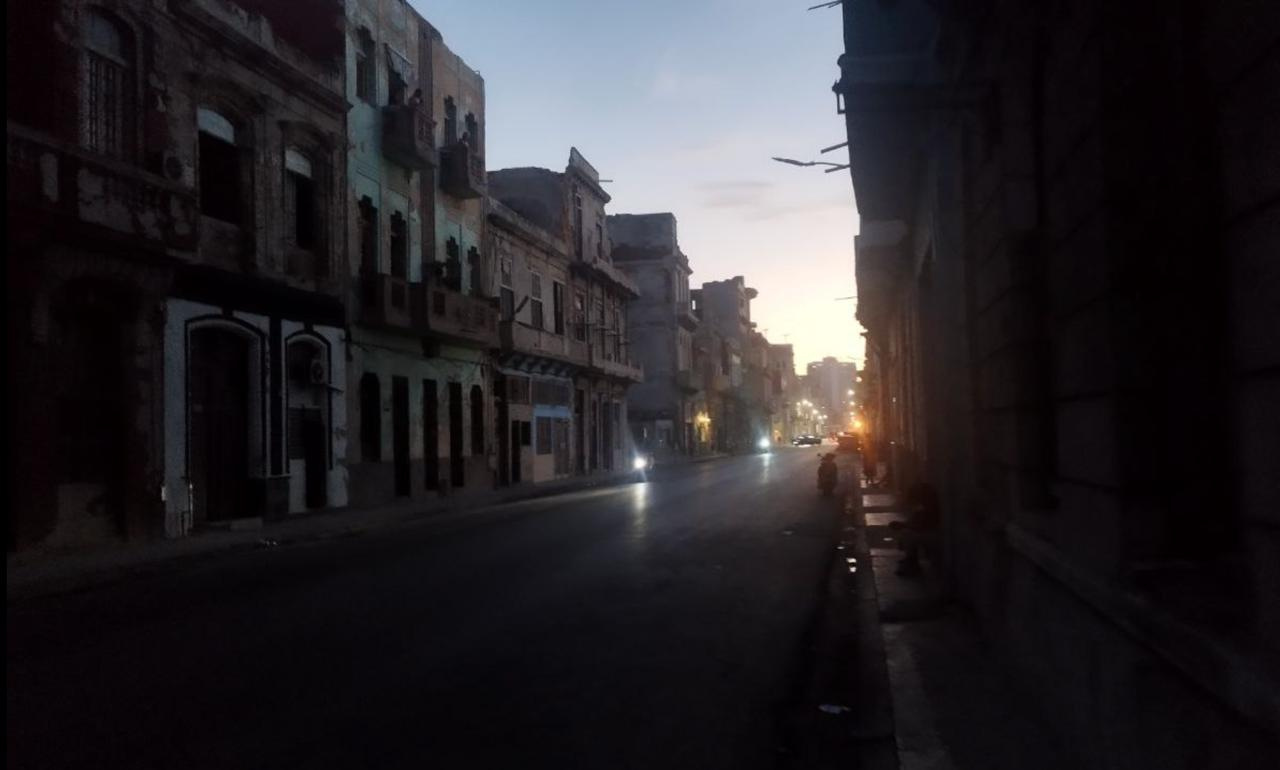
In the whole country, it is the private sector that consumed most in 2024, with 9,414 GWh – 8,843 of them by the residential sector- while the state consumed 4,570 GWh, of which just 170 went to the deteriorated public lighting system. Considering the ridiculous number, even with stable electricity, the streets of the island would be dark.

ONEI reports that the mobile generation from the floating power plants contracted to the Turkish company Karpowership, one of which could be about to leave the island if it is confirmed that the OK cargo ship has arrived in Havana to take the Suheyla Sultan away, in 2024 provided 3,647 GWh, 19% less than the previous year, 4,493 GWh.

The report devotes an important portion to distributed generation, whose production has also fallen significantly since 2021 – when it produced more than 5,900 GWh – up to 2024, with only 2,095, between generators operating on fuel oil and those operating on diesel.

With daily blackouts of around 18 hours in most of the country, Cuba has nothing to brag about in terms of energy

With daily blackouts of around 18 hours in most of the country, Cuba has nothing to brag about in terms of energy. Miguel Díaz-Canel dedicated a chapter of his podcast, From the Presidency, to comment on the situation, without daring to hope for any improvement except a “secret” plan with Venezuela to import more oil.

The president summed up the energy problem in the very high demand of the island and its contrast with the little fuel available. ONEI’s report this Friday refutes another of Díaz-Canel’s arguments: that the blackouts are due to the excessive consumption of Cubans. With its main energy fronts in crisis, the idea of a country without blackouts is further away as the summer consolidates, a season that brings as many power cuts as excuses from leaders.

Translated by Regina Anavy

____________

COLLABORATE WITH OUR WORK: The 14ymedio team is committed to practicing serious journalism that reflects Cuba’s reality in all its depth. Thank you for joining us on this long journey. We invite you to continue supporting us by becoming a member of 14ymedio now. Together we can continue transforming journalism in Cuba.
Etecsa, Cuba’s Communications Monopoly, Justifies Its ‘Tarifazo’ and Popular Indignation Increases

The president of the monopoly admits that they violated the contract to avoid “anxiety” and public action.

Various sectors of civil society and the Cuban exile are organizing a concrete response to the abusive price increase

14ymedio bigger14ymedio, Havana, 1 June 2025 — Despite the damage control operation launched by Empresa de Telecomunicaciones de Cuba S.A. (Etecsa) after announcing its latest price increase, which Cubans call the ’tarifazo’*, indignation among Cubans not only persists but has multiplied. Even official newspapers, such as the Matanzas Girón, published this Saturday an editorial with the flavor of protest. The Communist Party, with its usual arsenal of excuses, has ordered its cadres to justify the measure and organize “closed” meetings with various sectors, such as university students, in order to offer “specific solutions.”

The appearance this Saturday of the state monopoly directive on State TV’s Round Table program did not calm the waters. Randy Alonso acted more as the head of public relations for Etecsa than as a communicator. Faced with such a disconnection from reality, the regime activated plan B: Lázaro Manuel Alonso, the young face of officialdom with “license” to ask more incisive questions, although within the limits of the approved script.

The response of the president of Etecsa was a combination of corporate drama and revolutionary victimization]

“Why now?” asked the intrepid Alonso, alluding to the context of national weariness over blackouts, inflation, and a multisectoral crisis that is no longer worsening but is in its death throes. The response of Tania Velázquez Rodríguez, president of Etecsa, was a combination of corporate drama and revolutionary victimization: technological obsolescence, international frauds and unpayable debts. The full catalogue of the “good monopoly” manual in distress. continue reading

But if there is one thing that has not changed since the foundation of Etecsa, it is its financial opacity. Without competition, it can raise prices, offer questionable services and curb technological innovation without fear of retaliation. By the way, it reserves the right to cut off communications in case of protests, becoming the official fire-extinguisher of the regime. The problem is that so much abuse without competition also takes its toll, and not precisely in national currency.

Even other communist countries have preferred to open the cage a little

State monopolies like Etecsa are an endangered species. Andorra, with just 85,000 inhabitants, and Ethiopia (which has already sold 10% of its Ethio Telecom) are similar rarities. Even other communist countries have preferred to open the cage a little. Vietnam, for example, has operators like Viettel, MobiFone and Vinaphone, which compete with each other as good capitalist comrades. In China, although all companies are state-owned, they compete fiercely for the market. Even the paranoid North Korea has two operators: Koryolink (a joint venture with Orascom) and Kangsong NET, a state network launched in 2015.

Velázquez pulled out the excuse of “the cost of submarine cables.” The ALBA-1, launched in 2011 and operational since 2013, unites Cuba with Venezuela and Jamaica. Its 1,602 kilometers and 640 Gbps (gigabit per second) capacity cost 70 million dollars. More recently, the Arimao cable, 2,470 kilometers, linked the island with Martinique thanks to an agreement with the French Orange S.A. That’s a lot of fiber optics, yes, but with few visible results for ordinary Cubans who still depend on WiFi zones of the last century.

And no wonder: more than 85% of Etecsa’s infrastructure is obsolete, and more than half of its radio base stations lack energy backup. With the blackouts, the whole country can be disconnected. In addition, 10% of radio base stations have technical failures which, according to the directive, could not be resolved because of “lack of resources.”

Regarding the loss of foreign exchange, Velázquez admitted that the monopoly has ceased to capture “more than 60%” of what it used to receive from abroad. He also regretted that the “official channels” for recharging are “not being used as before.”

Velázquez, without blinking an eye, explained that this was not possible because “it would generate anxiety”

And then came the stellar moment: the justification of the violation of Etecsa’s own contract. Article 19 of the prepaid contract establishes the obligation to inform customers 30 days in advance of any price change. But Velázquez, without blinking an eye, explained that this was not possible because it “would generate anxiety” and possibly cause “actions” of the customers.

Etecsa, however, may have underestimated the reaction. This time it is not just complaints about being the last in line to buy chicken. Various sectors of civil society and the exile are organizing a concrete response. Between June 3 and 9, a campaign with the hashtags #BajenLosPreciosDeInternet, #EtecsaImpopular and #NoMasRecargasACuba will be deployed on X. The call sends a clear message: national patience is not infinite, let alone prepaid.

All this happens at the gates of summer, the season that in Cuba not only brings heat but also political commotion. If the regime has shown anything, it is that it fears a July with blackouts and disconnection more than any external sanction. What Etecsa did not calculate is that, with each rate increase, it is not only increasing its revenues, but also the chances of a new explosion.

*Translator’s note: The “azo” ending in Cuban Spanish is a ’magnifier’, in this case, roughly: “the gigantic price increase thing”

Translated by Regina Anavy

____________

COLLABORATE WITH OUR WORK: The 14ymedio team is committed to practicing serious journalism that reflects Cuba’s reality in all its depth. Thank you for joining us on this long journey. We invite you to continue supporting us by becoming a member of 14ymedio now. Together we can continue transforming journalism in Cuba.
Some 29 Percent of Cubans Only Eat Two Meals a Day, Denounces an NGO

According to Food Monitor, of the 2,400 respondents, 42.2% spend their entire salary on food and 21% suffer from food insecurity.

The report also focuses on water supply and the loss of purchasing power. / 14ymedio

14ymedio bigger14ymedio, Havana, 31 May 2025 — The NGO Food Monitor Program described the food situation in Cuba as “alarming” and progressively declining on Friday during the presentation of a survey that places the proportion of the population suffering from food insecurity at 21%. According to the study, presented virtually, “there is a widespread shortage of all types of food products,” but the shortages are also compounded by prolonged daily power outages, difficulties with the water supply, and a sharp loss of purchasing power due to high inflation.

Given the current state of the meat industry, it’s not surprising that 7.1% of those surveyed said they never eat meat, and 19.3% said they could afford to eat it once a week. Last February, after ten months of inspections and raids against cattle rustlers in Cuba’s fields, the Ministry of Agriculture offered an overall result for the beef sector: 2,914,009 cows remain on the island. The figure is disastrous for a country that ten years ago had nearly four million cows, and which before 1959—with a population of six million—boasted almost one cow per person.

The pork and poultry industries are following suit. Just a week ago, authorities acknowledged that by the end of 2024, due to a lack of feed and food, some 120,000 chickens would be lost in Sancti Spíritus alone . Since then, both chicken meat and egg production have plummeted, only receiving relief when a Brazilian company and a Cuban SME prevented the food from disappearing completely from the provincial market.

According to the Food Monitor report, another 9.8% of respondents say they never eat vegetables.

According to the Food Monitor report, another 9.8% of respondents say they never eat vegetables, and 40.5% emphasize that they never consume dairy products. Likewise, 55.1% say they eat three meals a day, 29% say they eat two, 11.9% say they eat “more than three,” and 4% limit themselves to one. Furthermore, 24.6% said that some days they didn’t have enough food and went to bed hungry. continue reading

The shortage of basic supplies and foodstuffs, practically exclusive to dollar stores and with prohibitive prices, has led nearly 72% of those surveyed to change their diet and the recipes they usually prepare. Nearly the same number, 71.2%, report having suffered dietary problems due to power outages in the last three months.

With respect to the water supply, 38.9% say they have intermittent access to drinking water, 34% say they have access to it every day, and 24.7% say they have access to it “rarely,” according to the third annual edition of this study. Water has been another of the major headaches for Cubans in recent years, a situation that has been worsening and, in recent weeks has reached critical levels, due in part to the drought and in part, to obsolete supply systems. The Zaza Dam, the largest in the country which supplies water to several central provinces, reported at the end of May that its levels were at a worrying 12%, a record for that month in recent years.

Some 42.2% of respondents said they spend all their income on food, followed by those who spend up to 80% of their income (36.7%), those who spend up to 50% (17.4%), and those who spend up to 30%, just 3.6% of the population.

The study, titled “There is Hunger in Cuba 2024” and involving 2,400 participants, reported that 60.9% of Cubans believe they have suffered a “considerable” loss of purchasing power, while 31.1% maintain that their income has been “somewhat limited.”

60.9% of Cubans believe they have suffered a “considerable” loss of purchasing power.

Regarding state-run grocery stores (bodegas), the most common in Cuba, 88.9% considered the selection to be “incomplete” or “deficient,” and 74.6% rated the quality of the products as “regular” or “terrible.”

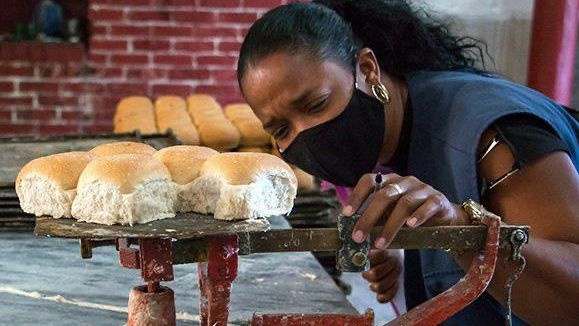
This issue became a source of controversy this week, when residents of Ciego de Ávila complained about the size of the bread sold at the La Especial grocery store in the city. After an inspection, authorities found that the establishment was selling rolls weighing between 35 and 42 grams, half and two-thirds, respectively, of the 60 grams each unit should weigh.

Of those interviewed by Food Monitor, 84.9% also stated that the ration book supply “decreases in quantity and quality every year,” and 96.6% emphasized that this subsidized food supply system does not meet their needs. Respondents identified “poor state administration” (64.1%) and “hoarding/corruption” (26.2%) as the main causes of food shortages in Cuba. Only 8% cited “the US embargo” as the cause of the shortages.

____________

COLLABORATE WITH OUR WORK: The 14ymedio team is committed to practicing serious journalism that reflects Cuba’s reality in all its depth. Thank you for joining us on this long journey. We invite you to continue supporting us by becoming a member of 14ymedio now. Together we can continue transforming journalism in Cuba.

A Bodega in Ciego De Ávila, Cuba, Is Fined for Reducing the Weight of Its Bread by up to 50 Percent

Although the product reached the population with 35 grams, authorities estimated that “the difference was not that noticeable.”

In September 2024, the government reduced the weight of bread from 80 to 60 grams. / Cubadebate

14ymedio bigger14ymedio, Havana, 29 May 2025 — Bread from Cuba’s ration system’s regulated basket has once again been the victim of a “serious violation,” which reduced its already meager weight from 60 to 35 grams (2.1 to 1.2 ounces) at the La Especial grocery store in Ciego de Ávila. Outraged by the abnormal size of the rolls, residents of the province complained to the authorities, and this Thursday, in an article published in Invasor, the response of the director of the Food Industry in the province is paraphrased: “Although the rolls were underweight, the difference was not that noticeable.”

In reality, the dough lost between a third and half of its intended weight, and the rolls reached the population weighing between 35 and 42 grams (1.2 and 1.5 ounces). “As insignificant as it may seem,” Invasor argues, the altered weight can “make a difference between one day and the next for the people of Ciego de Ávila,” especially for a product whose availability in the ration stores is also irregular.

Five fines of 8,000 pesos each were imposed, the outlet reports, without mentioning who was sanctioned, although it added that the administrator of La Especial, the master baker, and the “workers involved” will also be punished.

“Such a violation is even more serious considering the instability in production and the ever-questionable quality.”

“Such a violation is even more serious considering the instability of production and the ever-questionable quality. Despite this, the 75-centavos bread is an option for many compared to the high cost of non-state-run products,” he asserts. continue reading

Trying to excuse La Especial, the director of the Food Industry, Ramón Arrizabalaga, explained that the production process at the bodega has faced problems in recent times due to constant power outages and low-quality flour, which could have influenced the bread’s weight.

In addition, he said that other irregularities were found, such as the fact that the “specialists designated to oversee the weight did not perform their duties as required,” and promised to “intensify” surveillance of the remaining 11 bakeries in the city, as well as those throughout the province, where a situation similar to that at La Especial could arise.

It’s not unusual for Cubans to demand that heads roll over bread, a scarce but “settled” food, especially when weight fluctuations have been a problem they’ve been dealing with for years. “The issue of bread weight is an old one, and we shouldn’t wait for people to report it before inspecting it, because that’s what they’re there for. Even when the flour is good, the bread doesn’t have the right weight, and everyone knows that. When it’s not inspected regularly, anything happens,” complained one user at the bottom of Invasor ’s Facebook post .

In Ciego de Ávila, a 80-gram soft bread roll, sold on a limited basis, can cost between 18 and 35 pesos. / Onei

For a nominal price and despite its poor quality, the grocery store’s bread represents a significant relief for families who avoid paying for better, but more expensive, products. According to a price report published Wednesday by the National Statistics and Information Office, in Ciego de Ávila, a soft, 80-gram (2.8 ounces) bread, sold on a limited basis, can cost between 18 and 35 pesos.

The price doesn’t reach the 58 or 60 pesos that are paid for the same product in Havana and Santiago de Cuba, respectively, but it’s still prohibitive for Cubans.

The bakery industry is also in its most critical state in recent decades. Production, which experienced a 50% decline during the height of the Special Period and remained mediocre but upwardly mobile until 2012, is now even lower than it was in the 1990s.

In September 2024, the Food Industry was forced to announce a reduction in bread weight from the standard 80 grams to around 60, to ensure the product remained on sale despite the flour shortage.

____________

COLLABORATE WITH OUR WORK: The 14ymedio team is committed to practicing serious journalism that reflects Cuba’s reality in all its depth. Thank you for joining us on this long journey. We invite you to continue supporting us by becoming a member of 14ymedio now. Together we can continue transforming journalism in Cuba.