The United States Offers Scholarships for Young Musicians From 54 Countries, Including Cuba

OneBeat 2021 Participants. (U.S. Consulate in Brazil)

14ymedio bigger14ymedio, Havana, 1 September 2023 — The Office of Educational and Cultural Affairs of the U.S. Department of State announced the call for the OneBeat scholarship, for 50 musicians between the ages of 19 and 35 from 54 countries, including Cuba. Those chosen will have all expenses covered during their stay in the United States, distributed in the months of April and September 2024.

The program, which is presented as an opportunity to influence the communities of origin of the participants, promote civic rights and democracy and develop cultural exchanges and individual identities, is open to countries from all continents, including Venezuela, Haiti, Bolivia and Cuba, in addition to Russia, Ukraine, Iraq and Israel, among others.

As prerequisites for acceptance, the creators must have a good command of English and skills for composition, performance and improvisation, as well as an “interest in crossing cultural and musical barriers to create original music or reinterpret traditional music, respecting the essence of each tradition.” The social impact of their previous work is also a plus point for candidates. continue reading

OneBeat will also bear the travel expenses, stay and a “modest stipend” for the daily life of the scholarship recipients

OneBeat will also bear the travel expenses, stay and a “modest stipend” for the daily life of the scholarship recipients, who will be able to interact with local musicians, conduct workshops and “delineate their plan for the future.”

The scholarship will conclude with a tour of different cities in the United States in which the original pieces conceived during the program will be presented, and it is expected that, on return to their countries of origin, the recipients will implement initiatives that demonstrate their “social commitment through art.”

“For more than a decade, OneBeat has redefined musical diplomacy through a series of programs that use collaborative musical creation as a civic discourse. Young musicians from around the world explore how artists, communities and institutions can work together to rejuvenate local economies through music, technology and the creative arts,” the statement summarizes.

Since its third edition, in 2014, the program has counted among its participants Cuban artists such as the flautist Haydée López, the drummer Rodney Barreto, the rapper Rolando Navarrete, the guitarist Millet Padrón, the percussionist Degnis Bofill and the composer José Gavilondo, all from Havana, as well as the rapper Kamerum.Cuba, from Santiago de Cuba.

Most of these musicians today live outside the Island, touring around the world or permanently residing in other countries.

Translated by Regina Anavy

____________

COLLABORATE WITH OUR WORKThe 14ymedio team is committed to practicing serious journalism that reflects Cuba’s reality in all its depth. Thank you for joining us on this long journey. We invite you to continue supporting us by becoming a member of 14ymedio now. Together we can continue transforming journalism in Cuba.
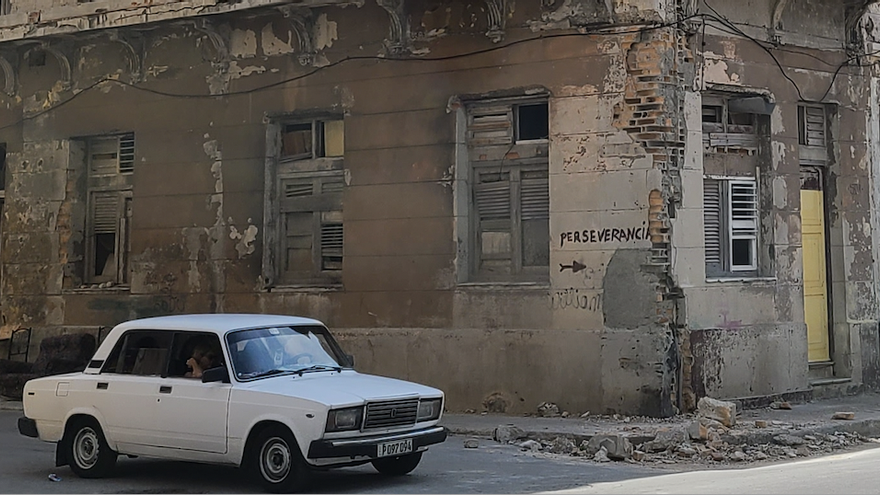
San Lazaro and Perseverance Streets, Another Bombed-Out Corner of Havana

The house has deteriorated badly due to poor maintenance and salt air.

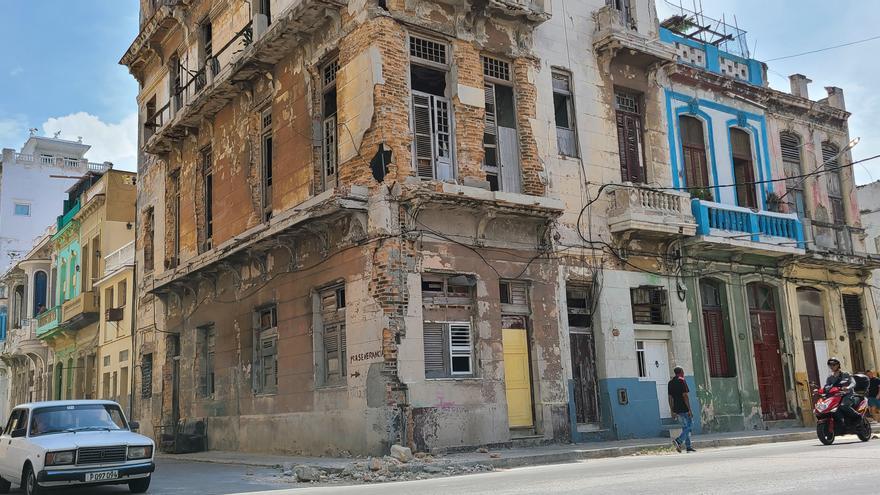
14ymedio bigger14ymedio, Nelson García, Havana, 28 August 2023 — Oscar sleeps “with one eye open and the other closed” in case the roof ends up collapsing on this 67-year-old Havana resident and his family in the middle of the night. The retiree, who lives at the corner of Perseverancia (Perserverance) and San Lazaro streets in Central Havana, has spent years complaining about the poor condition of the building, now a ruin due to poor maintenance and salt air.

Sitting in the doorway to his lower-floor apartment, Oscar describes in detail the anxieties he feels living amid bare brick walls, balconies that have fallen to pieces and exposed, rusty beams. “There is still a family up there on the roof,” he says, pointing to the upper floors that have no doors or windows.

The retiree fears “tragedy could occur” on any given day, that the building could collapse, taking with it the lives of its residents. “My wife and son live with me and we spend our days in total fear. When it rains or when a hurricane is approaching, we’re terrified,” he says as he shows passersby some avocados he has for sale.

The only signage identifying the name of the street is hand-painted on the side of a dilapidated building. (14ymedio)

“Every time we complain and demand officials come up with some solution, they tell us the shelters are at full capacity. We don’t have anywhere to go. We either stay in this building or live on the streets,” says Oscar. Guillermo, his 41-year-old son, looks through the window and confirms the story. “This piece here fell off two days ago,” he says, pointing to a hole in the wall. continue reading

Oscar and his family’s situation seems to repeat itself wherever you look. San Lazaro is one of the most important streets in the Cuban capital. It is also one of the thoroughfares with the most visible deterioration. Although the damage extends from the beginning of the Malecón to the grand outdoor staircase of the University of Havana, it is the section from Paseo del Prado to Belascoaín Street that is the most affected.

Almost fifty buildings have been either fully or partially lost along this stretch of San Lazaro Street. Proximity of the sea, governmental neglect and the poverty of the area’s residents have left the avenue looking like it was bombed. The holes in building facades, shattered cornices and collapsed balconies seem like relics from a city at war.

The scene repeats itself on the side streets. In spite of the extension of neighboring Lealtad Street and the importance of nearby Galiano Street, Perseverance is one of the most dilapidated routes in the city. Where once there was a butcher shop, there is now only a bricked-up door and a hole that used to be a window through which residents throw bags of garbage. Pedestrians must navigate around the sidewalks’ potholes, sewage and debris from falling balconies.

“You have to walk in the street. Even if you get hit by a car, it’s better than having a piece of the building fall on your head,” complains a young woman who has just come out of a boarding house. At the corner, she has to dodge a pile of trash that has been growing ever larger for weeks because there has been no garbage collection. As she approaches, dozens of flies take flight. They return a few seconds later, settling on the bags of waste.

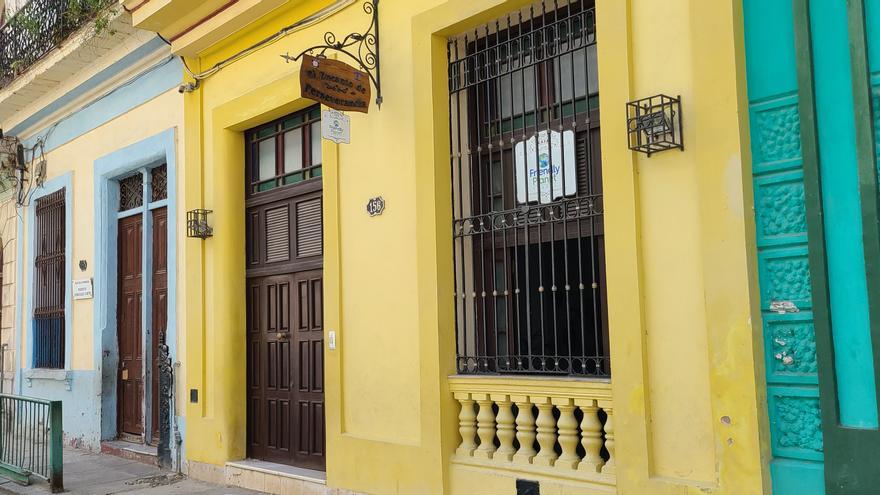
The townhouse, remodeled in 2013 as a high-end tourist hostel that charges as much as a hundred dollars a night, is an oddity amid the grime and destruction surrounding it. (14ymedio)

A produce vendor pushes a cart that bounces every time one of the wheels hits a pothole. When he reaches number 156, a woman inquires about the price of his lemons. She is leaning out of a window of a fully restored mansion that now serves as a tourist hostel. “The Charm of Perseverance” — with its bright yellow facade, elegant doors and spotless railings — looks like a shiny spaceship that has just landed amid of the grime and destruction.

Built in the early 20th century, the townhouse has a wide central courtyard, antique pendant lights hanging from its high ceilings, several rooms for rent and a 40-square-meter (430-square-foot) suite that in peak season can go for more than $100 per night. From the rooftop, guests can enjoy a view of the sea and escape the desolate landscape of the street below.

In June, seven people died, including two children, right in front of the house, at 159 Perseverance Street, when an electric scooter caught fire inside one of the dwellings. The tragedy has left deep wounds among the neighbors and added one more ruin to the street, where the only things that seem to persevere are destruction and hopelessness.

____________

COLLABORATE WITH OUR WORKThe 14ymedio team is committed to practicing serious journalism that reflects Cuba’s reality in all its depth. Thank you for joining us on this long journey. We invite you to continue supporting us by becoming a member of 14ymedio now. Together we can continue transforming journalism in Cuba.
Havana, As Seen Through Its Overflowing Garbage

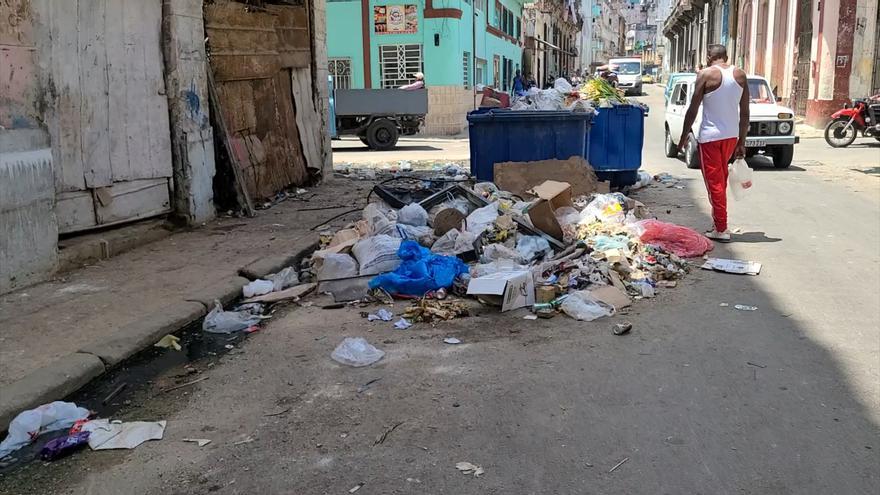
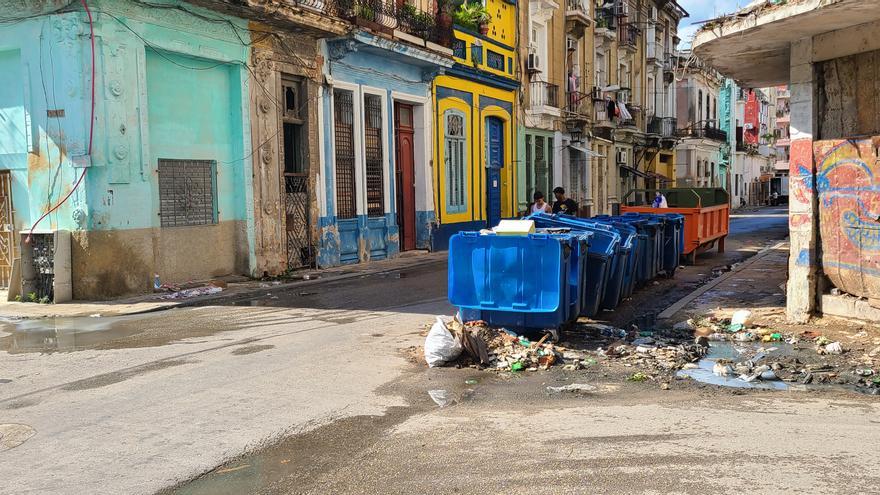
On the corner of Industria and Ánimas, in the neighborhood of Colón (Central Havana), the garbage containers are overflowing with waste and debris. (14ymedio)

14ymedio bigger14ymedio, Nelson García, Havana, 31 August 2023 — Celia holds her breath every day when she passes by the corner of Industria y Ánimas, in the neighborhood of Colón (Centro Habana). The garbage containers are overflowing with waste and debris. The sidewalk stopped being passable some time ago, and pedestrians mix with the vehicles and taxi-bikes on the street. Rusty metal sheets cover the entrances to the building in front of which the mountain of waste grows.

“Before, when a hurricane was coming, the Communal companies picked up the garbage and cleaned the sewers, but with Idalia they didn’t even show up around here,” complained Celia, while pointing to the row of crammed-full garbage cans. Near them, a huge cargo container of a truck contains construction debris, parts of broken furniture and the garbage generated by a nearby business that sells animals for religious sacrifice.

Despite the ugliness of the scene and the bad smells, people who pass by react normally. Dirt has become so familiar in Havana that the surprising thing is those blocks where cleanliness, painted facades and order contrast with the rest of the city. People seem to have become accustomed to living with the filth due to the inability of the authorities to collect it in time.

Garbage is also the way for many to survive. The dumpster divers search the containers for raw materials to sell, empty perfume bottles to refill to scam some unsuspecting customer, food waste to feed the pigs, pieces of appliances that serve to repair others and even clothes that help protect them from the breeze and humidity during the early hours of the morning. Where some see rubbish, others find their means of sustenance. continue reading

Despite the ugliness of the scene and the bad smells, people who pass by react normally. (14ymedio)

Garbage in Havana is also one of the most obvious ways to measure the state of the economy of the Cuban capital. During the crisis of the 90s, garbage containers had only what could no longer be used for almost anything. Not even pieces of old wood were thrown into the cans, because people used them as firewood to cook. Finding leftover food among the waste was a miracle in what Fidel Castro named the Special Period.

Then, the garbage of Havana began to fill with plastic bags that until then had been considered a status symbol for those who bought in dollar stores. Little by little, with the opening to private businesses, the expansion of markets in convertible pesos and the arrival of more tourists, cans, plastic containers and boxes of electronic devices appeared on the streets.

“The garbage smelled different,” recalls Genaro, 68 years old and a resident a few meters from the corner of Industria and Ánimas. In those years, this habanero and his two sons had a small business collecting empty cans of beer and soda. “There wasn’t the poverty there is now.  You could get something from selling in the cans, but it’s not worth it anymore,” he tells 14ymedio. “Even the garbage is in crisis.”

Some stone faces peep out on the facade of the building on the corner in front of the containers. They wear curly wigs that mimic some European headdress, which are totally out of tune with the destroyed balconies, the thresholds without doors and a couple of bushes that have grown on the eaves of the semi-ruined building. From up there they look like the guardians of the waste, the watchmen of the city’s offal.

The dirt also affects entrepreneurs. Lourdes has seen the clientele of her cafeteria in the neighborhood of Colón languish to the same extent that the garbage pile in front of her place grows. “Who is going to want to have a milkshake or eat a pizza with this plague?” she asks. The journey of the neighbors to eradicate the huge garbage pile has taken them from the meetings with the Delegate of People’s Power to “writing letters to the Council of State,” the woman tells this newspaper.

“Who is going to want to have a milkshake or eat a pizza with this plague?” she asks

The result of the complaints has been null. Over the years, the sidewalk around the pile of garbage has disappeared, “because instead of picking it up with the right trucks they bring a bulldozer and scoop it up,” Lourdes says. Water accumulates in the hole left by the heavy machinery, and “a mosquito farm is formed that does not allow us to live.”

Hanging from the ceiling of the cafeteria, Lourdes has put some transparent plastic bags with water that, someone told her, “help to scare away the flies.” But the curious invention doesn’t seem to be working. This Wednesday several insects were perched on the bags and flew down on the food of the few customers who came to buy. The owner’s hand constantly waved a cardboard to ward off the flying intruders, which sometimes went from the waste thrown on the street to the meringue of some small sweets.

At noon, an impeccable white police patrol car passed in front of Lourdes’ house with a camera installed on the roof. With the windows closed and somewhat fogged, revealing the air conditioning inside the vehicle, the uniformed men roamed the streets of a neighborhood where poverty and discontent are the breeding grounds for complaint and protest. The wheels of the car passed over some garbage bags and continued on their way to the next block. And like that, four or five times a day.

Translated by Regina Anavy

____________

COLLABORATE WITH OUR WORKThe 14ymedio team is committed to practicing serious journalism that reflects Cuba’s reality in all its depth. Thank you for joining us on this long journey. We invite you to continue supporting us by becoming a member of 14ymedio now. Together we can continue transforming journalism in Cuba.