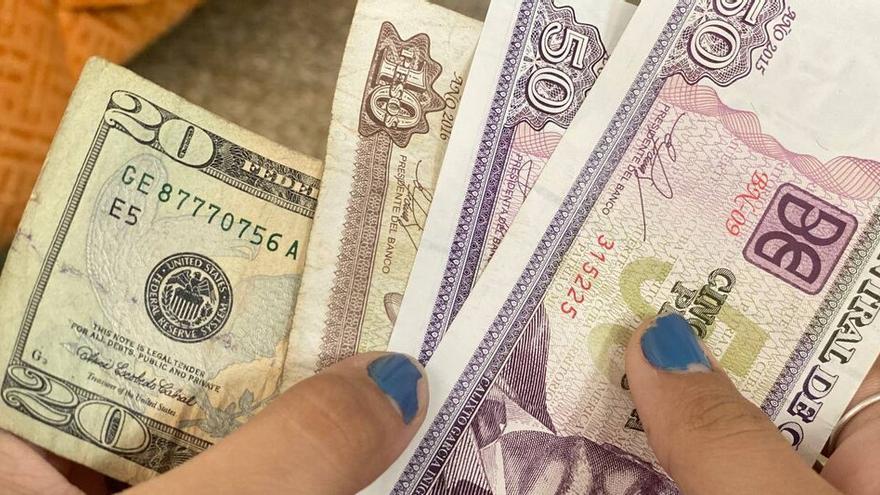
Cuba: More Than 13,000 Cows Have Died in Villa Clara in 2023, a Third of Them Due to Malnutrition

Between non-compliances and deaths, the most critical municipalities are Manicaragua, Placetas, Santa Clara, Camajuaní and Ranchuelo. (Vanguardia)

14ymedio bigger14ymedio, Havana, 9 August 2023 — New data show the magnitude of the crisis due to the lack of food in Cuba: about 13,690 head of cattle have died in Villa Clara so far this year. Nineteen percent of the animals died from malnutrition and another 15% from digestive disorders, according to the official press on Tuesday.

If the numbers of cattle killed by deficient food and other unspecified causes are added to those that were victims of illegal ’sacrifice’ [slaughter], the figure rises to 18,413, in a province that began the year with 121,112 animals.

Among the factors that contributed to the poor nutrition of the animals are, Vanguardia reports, the lack of nutritious pastures in the province — only Camagüey province has worse conditions on this factor — the absence of sources of drinking water, and the lack of grains to complement the diet.

Of the total number of dead animals, 7,740 are classified as cows, yearlings (approximately one-year old calves) and heifers (young cows). The loss of these young animals is a blow to the reproductive and food production chain. This number does not include calves, says Vanguardia, without explanation. continue reading

Between non-compliance and deaths, the most critical municipalities are Manicaragua, Placetas, Santa Clara, Camajuaní and Ranchuelo, said the official portal Soy Villa Clara. In the entire province, only three territories showed discreet increases in the livestock mass: Corralillo at the head (780 animals), Remedios and Caibarién (whose figures were not revealed).

With these numbers, the authorities fear that by the end of this year, statistics similar to those of 2010-2011 will be reached, when the loss was 23,000 head.

The provincial birth plan aimed to reach 60% this year, a figure that the authorities consider “not low.” However, the province already has a delay of 2,331 births compared to what was planned in this period. The cause: lack of “the necessary artificial insemination.”

The newspaper estimates that very few places in the territory use modern methods and technologies to increase reproduction. Artificial inseminatiom also “guarantees the genetic improvement of the animal mass.” With natural mating the chances of increased births are reduced, and soon “there will be fewer females for milk  production and reproduction.”

Milk production, at critical levels on the Island, has also been reduced. Authorities estimate that about 1,394 breeders did not contribute milk in the last quarter. In the municipalities of Manicaragua, Cifuentes, Placetas, Ranchuelo and Camajuaní, the media reports, “specific cases of manifest non-compliance abound.”

Currently, only 64% of the annual production plan is satisfied, which this year already quantifies about 7,280,600 liters less than those that had been contracted in the province. Deficiencies in the territory forced producers to reduce, this August, the contracted amount to 5,991,100 liters per month.

This figure would mean a daily delivery of 193,300 liters. However, the forced reduction in the plan did not achieve the desired numbers. On the contrary, only 98,800 liters are being delivered per day.

In meat production, the statistics are not encouraging either. So far, only 78.2% of the demand for beef and 85% for horse meat have been met. The planting of food intended for animal consumption has suffered the same fate. “The plantations of grain are non-existent. What about soy? The crops are minimal, and when they are achieved, extraction of the oil costs more than the use of the waste for animal feed,” says Vanguardia. The silage (forage conservation process), he adds, “stands out by its absence.”

According to the media, despite the drought and other obstacles, at the end of July some producers delivered what was agreed and even exceeded the plan of liters of milk per cow. The solution it finds, however, does not lie in the protection of breeders from crime, or in the improvement of working conditions, much less in the delivery of food and machinery at affordable prices. A quote from Alberto López, governor of the province clarifies it: “There are producers who make fun of the managers,” he said, alluding to the high rates of livestock crime in the province.

Translated by Regina Anavy

____________

COLLABORATE WITH OUR WORKThe 14ymedio team is committed to practicing serious journalism that reflects Cuba’s reality in all its depth. Thank you for joining us on this long journey. We invite you to continue supporting us by becoming a member of 14ymedio now. Together we can continue transforming journalism in Cuba.
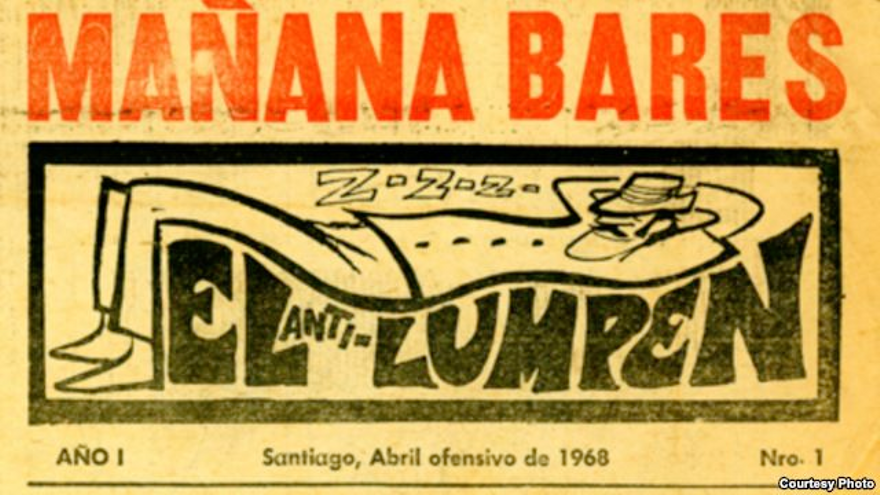
To Have or Not to Have Private Businesses

A Castro-era campaign against private businesses, in this case bars. (Archivo)

14ymedio bigger14ymedio, Yunior Garcia Aguilera, Madrid, 9 August 2023 — No one hated private business in Cuba more than Fidel Castro. In his 1968 speech announcing the Revolutionary Offensive, which nationalized all remaining small private businesses in the country, he called business owners lazy, hangers-on, exploiters, privileged and lazy. Spooked by his own shadow, he vented his spleen against the 955 private bars that still existed in Havana. According to his “detailed” report, 72% of the owners had a counterrevolutionary attitude and 66% of their regular clientele was made up of antisocials.

With that over-the-top, carnivalesque tone, the comandante shouted: “Gentlemen, we did not have a revolution here to establish the right to trade! . . . Are we going to build socialism or are we going to build boutiques?” He also emphasized that no one had shed his blood so that others could earn a few pesos selling rum, fried eggs, or omelettes. He was much more blunt when he prophesied, “There will be no future in this country for commerce, self-employment, private industry, or anything else. Because whoever is self-employed then pays for the hospital, the school, pays for everything, and pays dearly for it!” His offensive was intended to uproot capitalism, it seemed, once and for all.

However, after the fall of socialism and the crisis of the 1990s, the communist leader had to swallow his pride and permit small private initiatives. This “necessary evil” was seen as a temporary measure, though the paladares (private restaurants) would cling to life in ongoing skirmishes over the size of their seating capacity, as though it were the game of musical chairs.

Shortly after inheriting the throne, his younger brother became aware that his power of hypnosis was not enough to keep the masses entertained with ludicrous battles of ideas. The beardless general urgently needed to get the economy out of the swamp, or at least appear to be trying. To avoid enraging the party’s most pro-Fidel faction, he opted for the word “update” over “reform.”

However, the most rabid “I-am-Fidel-ers” did not remain silent. Who would have thought that what would save socialism was more capitalism? Iroel Sanchez, a compulsive Castrophiliac, echoed his guru in apocalyptic tones: “This revolution can be destroyed. . . We can destroy it and it would be our fault.” continue reading

Certainly, few things have fractured the regime’s image of unity as much as the aforementioned MSMEs (micro, small and medium-sized companies). Anyone who has the stomach for the “revolutionary debates” coursing through the internet will realize how polarized opinions have become on this subject among those who claim to be supporters of the system. On Iroel’s side is Javier Gomez Sanchez, dean of the School of Audiovisual Communication Art. In an online post complaining about the privatization of Jalisco Park, he writes, “To make matters worse, they say that they are going to inaugurate it on July 26. . . Have they no shame? How far are they going to go? What’s next? The privatization of Coppelia?”

The Cuban bureaucratic caste has always been concerned that those they refer to as the “emerging bourgeoisie” will usurp their privileges. But to avoid sounding envious, they try to present themselves as tenacious custodians of the Marxist-Leninist faith preached by Papa Beard. They argue that McDonald’s and Coca Cola are a more lethal threat than the U.S. Navy and warn against the dangers of the carrot-and-stick approach of soft power politics. They are loathe to admit that the idea of socialism as the precursor to true communism has died and that its corpse is on display in the supermarkets of Chinese capitalism.

Now, can a free market alone bring about democracy? We know it cannot. When I discuss this question with knowledgeable Europeans, they almost always tell me Cuba is not China, and China is not Vietnam, but you do not have to look far for comparisons. You have only to see what is happening in Venezuela or Nicaragua to understand that the existence of private enterprise is not enough to eradicate totalitarianism.

In certain quarters of the exile community and the opposition, there are also differing opinions with respect to private enterprises in Cuba, though at times it is easier to find more slogans and conspiracy theories than arguments. While fully aware of all the anomalies surrounding MSMEs, I for one defend the freedom to give them a shot, even in places where freedom has yet to be attained.

Much as I am reluctant to agree with the ultra-Fidelistas, so great was the aversion Fidel felt towards private businesses, and so great were his efforts to annihilate them, that it probably was not, as they claim, a heart attack that killed him. Maybe it was the MSMEs.

____________

COLLABORATE WITH OUR WORKThe 14ymedio team is committed to practicing serious journalism that reflects Cuba’s reality in all its depth. Thank you for joining us on this long journey. We invite you to continue supporting us by becoming a member of 14ymedio now. Together we can continue transforming journalism in Cuba.
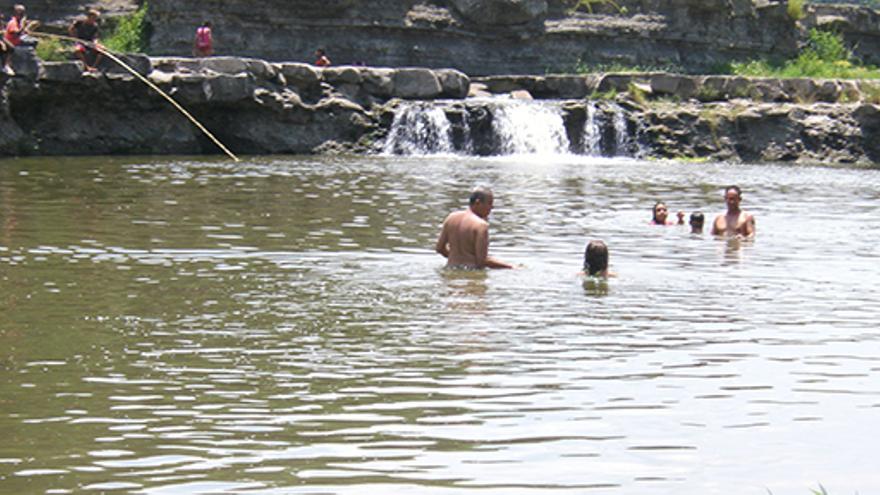
Two Girls Drown in a River in Santiago De Cuba

The Government has not published updated data on deaths by drowning in Cuba. (Radio Baraguá)

14ymedio bigger14ymedio, Havana, 3 August 2023 — Two girls, one 13 and one 16, drowned this Tuesday in a river in the town of San Francisco, in the Dos Ríos popular council, Santiago de Cuba. The event was confirmed on social networks by Aris Arias Batalla, head of Red Cross Operations and Relief in the province, who said that the young women were in an area where swimming is prohibited, where there where no lifeguards at the time of the tragedy.

Arias Batalla identified the girls as Yuleidis Sánchez Escalante (13 years old) and Claudia Escalante Carmenate (16 years old), both residents of the municipality of Palma Soriano. The official explained that it is “impossible” to supervise some rivers and beaches with lifeguards, so he appealed to common sense.

“It is the responsibility and obligation of each family member to care for and protect swimmers and even more so for children,” Batalla wrote in his Facebook post, while adding that lifeguards constantly face tourists who “don’t respect” the signs or calls for attention to stay in the areas of coverage.

In another publication, Arias Batalla pointed out that on July 21 he visited the swimming areas on the beaches, where he was able to verify “the needs and lack of support with which these brave lifeguards systematically work,” as well as the “imprudence of families,” since there were unsupervised children playing on the shore and adolescents outside the area of coverage. A lifeguard from the coast of Juraguá told Batalla that same day that he had rescued a young man who was drowning. continue reading

Batalla, who promotes the work of the Red Cross in the province, indicated that it was also necessary to “lament the loss of human life.” Although he did not specify a number, he said that they were children and teenagers. “The highest incidence of these deaths has occurred in rural towns,” he insisted.

The Government has not published updated data on deaths by  drowning in Cuba. The most recent information corresponds to 2019, when 262 people were registered, which meant a death rate of 2.2 per 100,000. The information is derived from a report prepared at that time by the World Health Organization (WHO) for an international congress aimed at addressing drowning as an important and preventable cause of mortality.

Although the figures are lower than countries such as Russia or Thailand, they are much higher than those of surrounding and western countries (1.5 in the United States, 0.9 in Spain). The lack of public swimming pools means that thousands of Cubans do not even know how to swim, and they risk their lives not only in moments of leisure, but in cases of need, such as floods.

Translated by Regina Anavy

____________

COLLABORATE WITH OUR WORKThe 14ymedio team is committed to practicing serious journalism that reflects Cuba’s reality in all its depth. Thank you for joining us on this long journey. We invite you to continue supporting us by becoming a member of 14ymedio now. Together we can continue transforming journalism in Cuba.
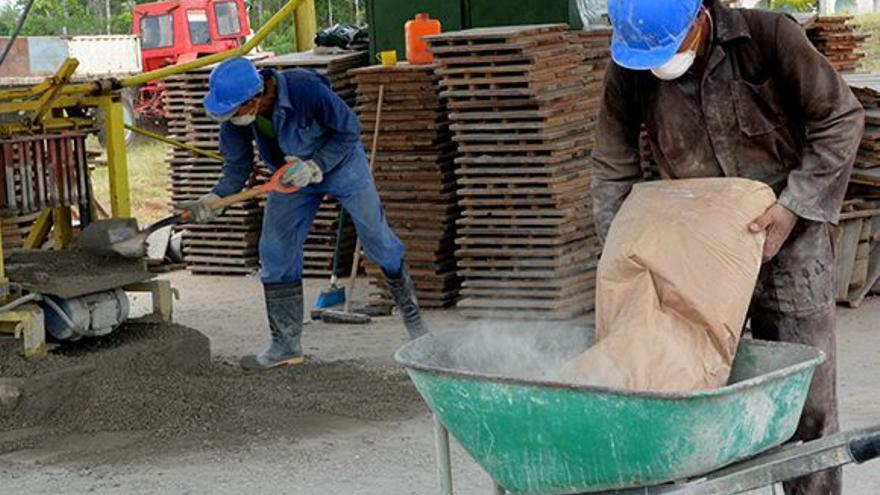
Construction of Homes in Villa Clara Has Been Stagnant for Two Years, Cuban Authorities Acknowledge

Production of bricks in the Villa Clara Geomining Company, which produces construction materials for the housing program. (Cubadebate)

14ymedio bigger14ymedio, Havana, 8 August 2023 — Thirty-nine percent of the homes in Villa Clara are in poor condition, the official press admitted in a report on the living conditions of the province. The situation is going through a critical moment, since the territory’s capacity to build homes is at barely 45% of that planned, due to the shortage of materials, and the subsidies that the State offers to the sector are still the same as three years ago, when inflation and the price of materials had not yet skyrocketed.

According to María del Carmen González, provincial director of Housing, in 2019 the entity designed a ten-year plan to build 46,051 new houses and repair another 33,111. However, of the plan for the last four years – 13,353 homes – 3,287 remain to be completed, or 25%. Most of the properties were built between 2019 and 2020, just before the global coronavirus pandemic, which was followed by a period of stagnation that hasn’t ended.

In contrast, during the same period the number of houses built “by self-effort” – that is, financed by families themselves – tended to grow, far exceeding what was estimated in the Housing plan. The only exception to the private push was the year 2021, when due to the pandemic and then to the consequences of the so-called Ordering Task,* including the shortage of materials, the number of completed residences fell dramatically but then recovered in 2022.

On the other hand, the number of buildings by the “State path” (the properties erected by companies after investing their profits in the construction of homes for their workers or to be donated) and the subsidy plan has decreased. Of 1,188 subsidized houses in 2019, the Government has gone on to cover just 403 in 2022. That same year, of the 1,987 houses built, 1,198 were built by the owners’ own effort. continue reading

Since 2012, Villa Clara has granted 7,130 subsidies for the construction of homes. This May, 701 procedures were still pending, according to the Provincial Directorate of Housing. Specifically in Santa Clara, the municipality with the largest number of inhabitants, 876 subsidies were offered and 126 remain unresolved. The provincial capital is closely followed by the municipalities of Camajuaní, Santo Domingo and Ranchuelo in the approved aid statistics.

Obtaining State funds to build homes is not easy. In principle, the applicant must document that he or she belongs to a vulnerable family, with little income, or that he or she has no home. However, the lack of resources to complete the construction plans has forced the State to prioritize those affected by natural events with partial or total loss of housing – there are 1,557 applications left unaddressed – or “critical social cases,” such as those who live in buildings with plumbing problems or large families (with three or more minor children).

Of these, in particular, the province has detected 2,707 mothers of several children who suffer from “housing problems.” Of these, only 900 have been addressed, according to the Vanguardia newspaper.

Preference is also given to budget requests for properties that don’t require major repairs, a practice that is to the detriment of houses that need more work and, therefore, more money.

Other limitations are the need to buy essential materials – cement, steel, gravel and bricks – in the State “courtyards” for the sale of materials in each municipality and the delivery of credits according to the phase of the construction. For example, the State does not deliver steel to those who are now finishing the property or toilets to those who are just beginning to “raise walls.”

Most of those interviewed by the provincial newspaper had seen their situation stagnate for one reason or another and had even asked for the reassessment of their budget in order to finish building their home. “Prices have risen a lot and they have not increased one peso through the recalculation that Housing must do. However, I have encountered people who have done it three or four times,” Lisleidy Mesa, one of the people of Villa Clara affected by the delinquency of the process, acknowledged to the media.

In other cases, people resort to illegal channels. “When you give a subsidy to a person, you are turning them into an investor in your home, and not everyone has the necessary preparation to do so. There has been everything: mason scams, sale of resources and, above all, violation of the technical project,” said Daniel Pozo, deputy director general of Housing in Villa Clara.

In the case of those who build with their own money, the situation is even more difficult, given the prices of the informal market and the disappearance of the most basic resources such as screws, light bulbs or cables for electrical installations.

The housing situation, which is not exclusive to Villa Clara, is one of the worst areas of the Cuban economy. Even if after the triumph of the Revolution it was declared one of the priority sectors for the attention of the State, “it is still an unmet demand, a reflection of persistent inequalities in society,” the media admitted.

*The Ordering Task is a collection of measures that include eliminating the Cuban Convertible Peso (CUC), leaving the Cuban peso as the only national currency, raising prices, raising salaries (but not as much as prices), opening stores that take payment only in hard currency, which must be in the form of specially issued pre-paid debit cards, and a broad range of other measures targeted to different elements of the Cuban economy. 

Translated by Regina Anavy

____________

COLLABORATE WITH OUR WORKThe 14ymedio team is committed to practicing serious journalism that reflects Cuba’s reality in all its depth. Thank you for joining us on this long journey. We invite you to continue supporting us by becoming a member of 14ymedio now. Together we can continue transforming journalism in Cuba.
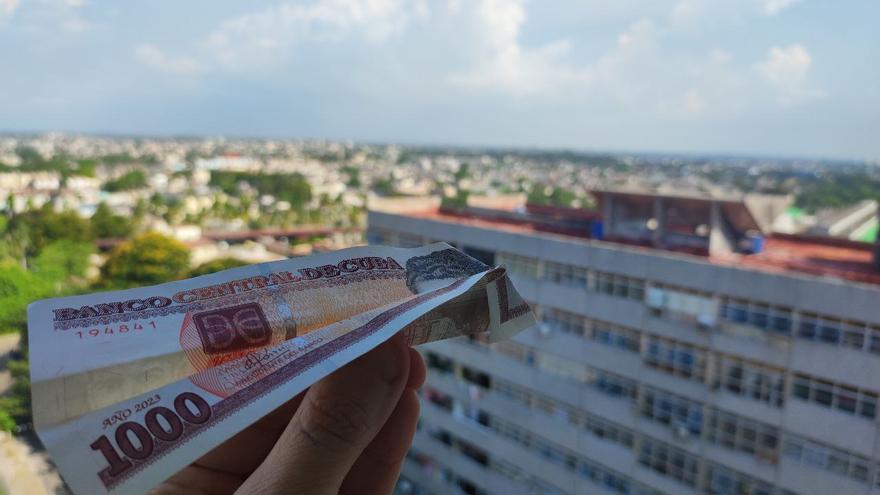
Fishers and Farmers Are Exempt, for Now, From Cuba’s ‘Bankification’

The banks still do not have cash, although there are no restrictions on paper. (14ymedio)

14ymedio bigger14ymedio, Madrid/Havana, 10 August 2023 — “Bankification will advance in places where conditions exist,” said Julio Antonio Pérez Álvarez, general director of Operations and Payment Systems of the Central Bank of Cuba (BCC) in a new edition of the Round Table program dedicated to the financial measures that have revolutionized the warm Cuban August. The official insisted on the gradual implementation of the program, a concept already reiterated on Televisión Cubana last Monday, although some economists have already seen in his speech the first signs of a brake on the plan.

“Yesterday I commented with several colleagues that it seemed the order to cool down the bankification was given,” says Cuban economist Pedro Monreal, upon consulting his colleague in Spain, Elías Amor, who goes much further and talks about the plan’s “burial.” “It was given at the highest level, and they use these straw men to hide from social unrest. Before long we will see something else,” the expert said, grateful for the reference.

In fact, few developments were noted this Wednesday in the program regarding what was already discussed two days ago. The only surprise was for the workers of the primary sector, undoubtedly frightened by the imminence of a process – which must be completed in six months – for which they are not prepared. The BCC made it clear that, for now, they can stop worrying. “This is a gradual process; there are sectors such as fishers or farmers where there is no infrastructure, so it would be irrational to undertake those actions,” argued Pérez Álvarez.

Alexis Trujillo Morejón, president of the Banco de Crédito y Comercio (BANDEC), which operates extensively with this sector, agreed. “We emphasize to the farmers that this process will not affect their operability, their work or the creation of wealth,” he said, calling for calm. He added that he understands the doubts and concerns that these workers have expressed, and that they  will be addressed “little by little.” continue reading

Trujillo Morejón added that it is the same for the MSMEs (micro, small and medium-sized enterprises) and local development projects. “There are many specifics in the relationships of natural persons with the banks, of the self-employed with the banks … so we are working on giving answers for each case,” he said.

Another piece of news in the speech was the specific creation of branches for “economic actors.” Pérez Álvarez admitted that operations and lines have increased, despite the fact that offices have been open longer. “We are designing it so that every bank operates with the speed and appropriate attention that they need. This leads to a process of reorganization of our offices, and we are not oblivious to organizational problems. We are designing offices that are going to perform the same banking services to customers as before.”

The official said that “the training process at the level of banking structures” has already concluded, although users continue to encounter problems with the extraction of money. Pérez Álvarez repeated that there are no limits on the withdrawal for natural persons, but reality clashes with theory because, despite the rule, the truth is that there are no banknotes in the banks.

This same Wednesday, a woman living in Centro Habana told 14ymedio that, after lining up at the Conill and Marino branch, she was only able to withdraw half of her pension due to lack of cash. On Tuesday, this newspaper also learned of a neighbor of El Vedado who asked her acquaintances anxiously for any amount in bills to be able to buy food, but most rejected the transfer that the woman proposed in exchange. “What are we going to do with those 500 virtual pesos?” wondered a retiree who finally agreed to the exchange.

Daily life was exposed in the words of Pérez Álvarez – “It involves our money, in addition to the fact that the use of cash has not been eliminated in the world, although the trend is to increase the use of electronic payment channels” – as well as those of Ernesto Rodríguez Hernández, Deputy Minister of Communications, also present to talk about connectivity in Cuba.

According to his data, 83% of Cubans have mobile phone coverage, “50% of the spaces in Cuba have 4G coverage and 75%, 3G,” which puts payments with Transfermovil and EnZona at their fingertips. “It was as if I had never made an Internet connection in Cuba in my life or forgotten the frequency of blackouts,” Elías Amor objected on his blog Cubaeconomía.

The deputy minister reviewed the number of operations that are already carried out by electronic payment channels, in theory 29 per second only with Transfermovil (444 million in 2022, many more than with EnZona, 45 million), and insisted that there is no doubt that the efficiency of the service must be improved, but that there are already millions of transactions carried out by this route, especially in supplies.

Telephony (87%) leads the list of electronic payments, followed by taxes (60%) and electricity (40%). “These numbers illustrate trust and security, but also the well-being of citizens, when they can pay electronically for services. What we are trying to do now is to generalize these payments,” said the deputy minister, who also announced the availability of the Youth Clubs to alphabetize by technology a population that he defined as cultured and to which, consequently, he attributed part of the responsibility when it came to achieving the modernization, via banking, of the country.

The broadcast ended with the mandatory ideological and motivational message. “We will be able to aspire to have an increasingly modern country, with a digital transformation that exceeds conceptual issues, and the citizen will see it in practice, enjoying the advantages and benefits of this process.”

But to date, the main concern of Cubans around this issue has not been addressed, as reflected in the forum enabled by Cubadebate: how are private individuals, who solve most products on a day-to-day basis, going to import, if they buy in foreign currency and sell in pesos but lack an official foreign exchange market.

Translated by Regina Anavy

____________

COLLABORATE WITH OUR WORKThe 14ymedio team is committed to practicing serious journalism that reflects Cuba’s reality in all its depth. Thank you for joining us on this long journey. We invite you to continue supporting us by becoming a member of 14ymedio now. Together we can continue transforming journalism in Cuba.
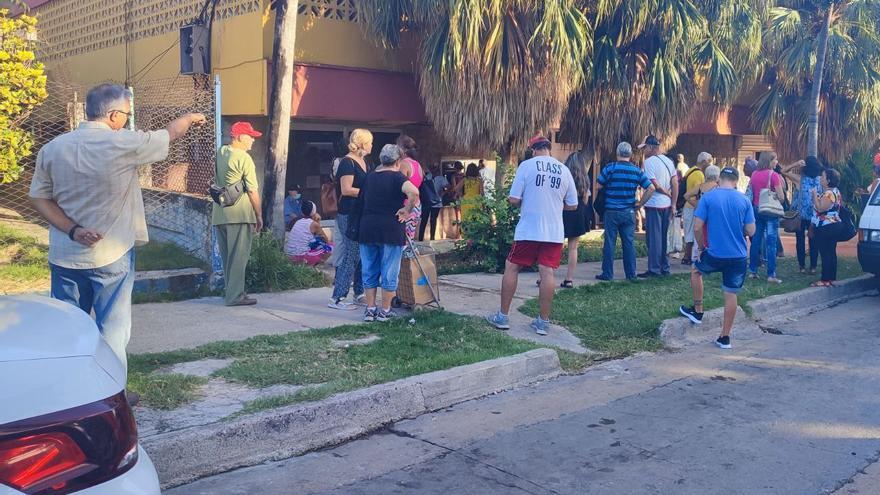
Cuba’s Central Bank’s New Regulations Are Suicidal Claim Economists

A line for the Banco Metropolitano ATM at Marino and Conill streets in Havana’s Nuevo Vedado  district. (14ymedio)

14ymedio bigger14ymedio, Madrid, 7 August 2023 — “Expanding the role of banking is essential for our economy but Resolution 111, which that the Central Bank has just announced, is suicidal,” states economist Oscar Fernandez in a reference to measures taken by the Cuban government last week. He is joined by a growing chorus of monetary experts who are strongly critical of this, the latest in a long list of economic initiatives by the Cuban regime.

In a Facebook post, Fernandez likens the new restrictions to “putting out a fire with gasoline.” He predicts, “This new regulation will deal a devastating blow to all: pensioners, workers, small-business owners, students, the unemployed, people who receive remittances, everyone.”

He does not deny that banking institutions are facing a cash shortage, nor that private businesses still have very limited access to banking services, “which makes the situation extremely complex.” He claims, however, that the island’s shortage of banknotes is the result of other issues that are not being addressed.

He points out that, just last January, “the public felt relatively confident about their digital transactions.” Then the Central Bank of Cuba (BCC) suddenly imposed a monthly limit of 120,000 pesos on transactions between individuals. The intention, Fernandez believes, was to “curtail operations on the informal hard-currency market, where each operation involved moving large sums of money.” The efforts, he points out, were counterproductive, however. “The result was that banks no longer had a role in any of these operations, which were suddenly thrust into the cash economy.” continue reading

Fernandez is critical of the BCC for not increasing the denomination of banknotes now that Cuba is experiencing runaway inflation and consumers increasingly need more money to buy the same goods. Instead, more banknotes will have to be “put into circulation to carry out the same operations with the subsequent increase in costs that this implies.”

“Responsibility for the rise of an informal currency exchange market and the ongoing devaluation of the peso — whether the result of real monetary variables or intentional manipulation — rests solely with the government, which long ago should have assumed the reins of the currency exchange market by buying and selling foreign reserves at the going rate,” he argues.

Fernandez believes the consequences of the new resolution will be “direct and immediate” and are “very easy to predict.” He foresees bank branches, which even now struggle to provide basic services, being overwhelmed by thousands of small private businesses trying to make daily deposits and withdrawals. He also believes there will be a severe reduction in private imports and a subsequent rise in prices for products whose prices “had begun to drop.”

“It is important to point out that it is not just ’solvent’ people who buy private-sector imports,” writes Fernandez. “Chicken, cooking oil and detergent are purchased by many people who are, by no means, in a high income bracket. These are people who find private-sector suppliers preferable to the black market, both in terms of price and safety. And, incidentally, they are many times cheaper than hard-currency stores. On the other hand, when the supply of private-sector supply of chicken dries up, higher income people will create a demand that will be met by the chicken of the poor. They will divert and buy chicken intended for poor people. It’s that simple.”

His bleak outlook does not stop there. He predicts that employment and many families’ stability will be impacted given that private enterprises (and not just those in the import business) will either close or be severely affected while others will cancel plans to a business.

He believes informal markets will also expand, furthering the so-called dollarization of the Cuban economy. “Prioritizing banking will slow the circulation of the Cuban peso (CUP) in its cash form but it will not shrink the cash economy. The dollar will assume that role. Financial digitalization will not restore the CUP’s monetary functions. On the contrary. We may as well dismiss the CUP as a unit of account and as a means of hoarding. And while we’re at it, we may as well welcome the new informal cash market.”

Fernandez closes with harsh words for the island’s authorities: “Given the current circumstances, whoever came up with this regulation — without thinking about these and other consequences — is making the same mistake as those who came up with currency unification.”

Along the same lines, financial expert Darien Garcia Linsuaín claims that the BCC’s measures “are currently impossible to put into practice and are clearly unrealistic given our situation.”

“You get a culture of banking,” says Garcia Linsuaín, “when the public respects and has confidence in its banks.” Rather than generating confidence, he believes measures such as these create more fear and mistrust. “Just go to any ATM or bank these days. They all have long lines, even late at night.”

The new regulations, he predicts, will have a direct impact, especially on the agricultural sector. “Our farmers will have to start following banking procedures in less than six months. It was mentioned on television on Thursday morning, August 4, that 24% of our individual farmers have bank cards. It’s taken all these years just to get to 24% and now, in six months’ time, we’re going to get the remaining 76%? How are they going to do that?” he asks.

Garcia Linsuaínalso mentions the island’s technological limitations and provides a personal example. “Last Monday I was trying to do some business at a state-owned institution with a digital payment platform but got stuck in line because the connection was very unstable that day. And we want to prioritize electronic banking? Connectivity is even worse in the countryside. So, back to the previous point, what are individual farmers supposed to do with their cards if there’s no connection?” he asks.

He also points out that one of the smartphones needed to access electronic banking “is out of the reach of many people in the country.” He asks that the president of the Central Bank, or some other official, indicate how they plan to implement this schedule in nine months.

For his part, economist Pedro Monreal speculates that one reason for the hasty rollout of the new banking program may be something that the government has not explicitly mentioned: the hope that it will serve as an emergency brake to slow the recent flurry of devaluations of the Cuban peso on the black market.

“There has been talk about banking reform for a long time but there never seemed to be any urgency to implement a program,” observes Monreal, who also recalls that in July’s parliamentary session the measure was hardly mentioned.  Nor did the “zero cash” pilot test of the Electric Company and CIMEX reveal any cause for any urgency either.

The new regulations on money “can be classified as monetary policy,” writes the economist, “and therefore it is reasonable to assume that it is part of the macroeconomic stabilization program often trumpeted but never presented in detail.

What suddenly set off alarm bells for the Cuban government, he reasoned, is the devaluation of the Cuban peso in the informal market. Between June 22 and August 7, recalls Monreal, the dollar strengthened 19%. This same Monday, the newspaper El Toque, which follows the value of currencies daily, indicates that the US currency exchange rate has reached 240 pesos to the dollar.

In any case, the scenario that economists foresee is not encouraging. That officials have announced a special Monday episode of the TV interview show Mesa Redonda (Roundtable), to be devoted to this topic, is indicative of the concern and confusion on the streets.

____________

COLLABORATE WITH OUR WORKThe 14ymedio team is committed to practicing serious journalism that reflects Cuba’s reality in all its depth. Thank you for joining us on this long journey. We invite you to continue supporting us by becoming a member of 14ymedio now. Together we can continue transforming journalism in Cuba.

A Private Company Prepares Havana’s Varsovia Restaurant for Conversion to a Food Store

Few vestiges remain of the central Havana restaurant that once occupied the wide corner storefront. (14ymedio)

14ymedio bigger 14ymedio, Juan Diego Rodriguez, Havana, 9 August 2023 — Despite the solid gray paint and rustic appearance, repairs to the facade of the old Varsovia (Warsaw) restaurant — located at the corner of 12th and 17th in Havana’s Vedado district – are a welcome sight. After several years of neglect, plans by a medium-sized private business to turn it into a food market are beginning to bear fruit. New equipment, shelving and furniture can already be seen through the glass windows.

The dilapidated neon sign bearing the name of the Polish capital has also been removed from the post at the corner as have the boards which the state used to shutter the windows.

The only thing missing from the interior, as far as this reporter can see, is the merchandise. Otherwise, it appears ready to open. Several wooden boxes, to be used to display bread, fruits and vegetables, have been configured into shelving. The frozen foods section looks ready and various machines have been installed.

The presence of a counter at the back of the store suggests that the owners of the converted space also plan to sell food and drinks to go. The premises also have air conditioning and are equipped with cameras.

Once known for its heavy red curtains, dim lighting and very formally dressed waiters, few vestiges remain of the central Havana establishment that once occupied the wide corner storefront. Though never of the same caliber as its neighborhood cousins — El Monseñor, El Conejito, La Roca, La Torre or the opulent Moscú — Varsovia did have its moments of splendor, offering a varied menu in the years of Soviet subsidies. continue reading

The economic crisis of the 1990s hit the business hard. Gradually, the façade lost its sheen, the menu got smaller and and potential staff lost interest in working in its increasingly dark dining room. By the time it closed to the public and was boarded up, the place was no more than a greasy spoon with the smell of burnt cooking oil and dirt everywhere.

Several wooden boxes, to be used to display bread, fruits and vegetables, have been configured into shelving.

____________

COLLABORATE WITH OUR WORKThe 14ymedio team is committed to practicing serious journalism that reflects Cuba’s reality in all its depth. Thank you for joining us on this long journey. We invite you to continue supporting us by becoming a member of 14ymedio now. Together we can continue transforming journalism in Cuba.

Cuba Paid the U.S. Ten Million Dollars More in June for Chicken Than in May

Line for chicken in Luyanó. (14ymedio)

14ymedio bigger14ymedio, Madrid, 9 August 9, 2023 — The sudden increase in the price of a kilo of chicken in the U.S. makes an impact on the import expenses of the Cuban government, which in June paid 32.8 million dollars for the 27,631 tons it bought. Compared to the month of May, spending has increased by 44.7% for the acquisition of just 9.3% more meat, figures that reflect the 33.7% increase in unit value, according to the calculations of Cuban economist Pedro Monreal, who publishes these statistics on a monthly basis.

“Exports of chicken from the U.S. to Cuba oscillate,” he says, “but in the long term they show Cuba’s growing import dependency on the main meat consumed in Cuba.”

This June, the price of each kilo of chicken was $1.19, much higher than in May, when it was barely $0.89. That month, 22.69 million dollars were spent on the purchase.

Despite the high investment, Cuba continues to have its largest supplier in the U.S. market. Brazil, the second in importance, has been losing steam so far this year, which can be seen in the comparison of the first half of 2023, in which 44% less chicken was bought from that South American country, on average, than in the same period of the previous year.

Throughout 2023, Cuba has had difficulty importing the product from other markets that, although they were not the priority ones, contributed to increasing the availability of a meat that has become the most desired on the Island, in the absence of pork and, even more so, of beef. continue reading

Spain, Poland and the Netherlands have maintained an irregular flow in this type of trade, but in most of the months of the first half of the year they did not even report commercial activity with Havana.

Although Cuba is forced by the embargo to acquire U.S. food products under unusual conditions for international trade – cash payment in advance – the country continues to be one of its main sources.

Last July, the U.S.-Cuba Trade and Economic Council reported that during the last month with available data, May, there was a 3.7% increase in food exports from the U.S. to Cuba, worth $26,476,991. Among the products sent to the Island were coffee, waffles, wafers, cookies, powdered milk, beer, toilet paper, pork, preserves and chicken.

By product, chicken was the largest expense in the Island’s  imports from the U.S., with an abysmal difference compared to the rest of the purchases. Compared to the $32.8 million Cuba spent on poultry meat, the second item in order of importance was dairy products, which cost $1.3 million.

Behind these are pork, with 774,000 dollars; cereals and pasta, 526,000; non-alcoholic beverages, 294,000; beef 193,000; and flour, 153,000. At the end of the list are fruit juices and chocolate products, worth 97,000 and 78,000 dollars respectively, and the list closes with a product that in Cuba is considered a basic necessity and which it is increasingly forced to bring from outside: rice.

After a disastrous harvest in 2022, which stood at 120,000 tons – when national consumption demands at least 700,000 – the Island is still forced to import rice or to get donations, most frequently from Vietnam. In the month of June, according to the available data, Cuba spent $64,000 to bring rice from the United States.

Translated by Regina Anavy

____________

COLLABORATE WITH OUR WORKThe 14ymedio team is committed to practicing serious journalism that reflects Cuba’s reality in all its depth. Thank you for joining us on this long journey. We invite you to continue supporting us by becoming a member of 14ymedio now. Together we can continue transforming journalism in Cuba.

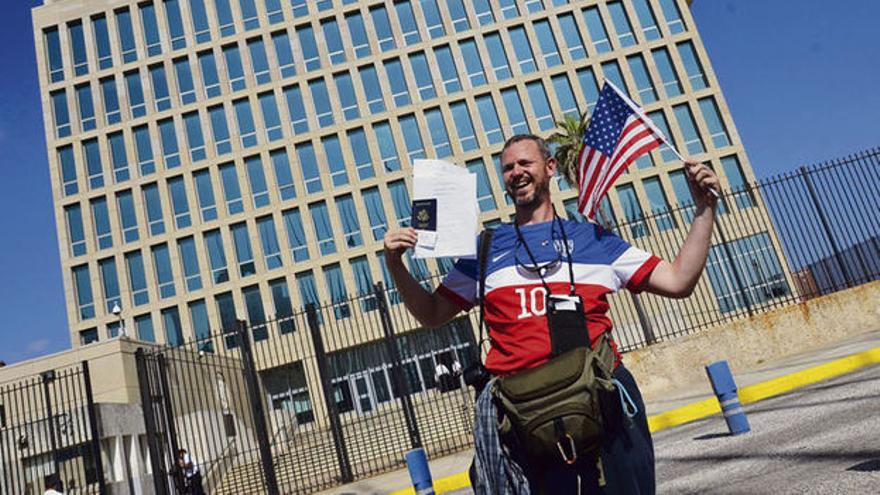
About 3,000 Cubans Win the U.S. Visa Lottery, More Than Twice As Many as Last Year

A man poses with his immigration documents in front of the United States Embassy in Havana, Cuba. (EFE)

14ymedio bigger14ymedio, Havana, 9 August 2023 — No fewer than 3,081 Cubans were selected by the United States in the Visa Lottery for 2024, the draw that takes place every year in that country for immigrants “with low representation.” The number is more than double that of the Cubans awarded in 2022 (1,358), when the Island was also the country that contributed the most winners in Latin America.

In total, the State Department will deliver permanent residency to 143,000 people, including the 55,000 selected, their spouses and their children, as detailed in the latest visa bulletin, published last Friday.

The winners were randomly chosen from more than 22.18 million applications from six regions in Africa, Asia, Europe, North America, Oceania and Latin America.

After Cuba, the countries that contribute the most citizens to the winning list are Ecuador, with 814, and Peru, with 742. In total, the State Department approved petitions from 20 countries in Latin America and the Caribbean, a list that excludes Venezuela, El Salvador, Honduras, Mexico and Haiti given the high rate of migration.

Those chosen must attend an interview where they will have to present evidence of secondary education or its equivalent, as well as documentation that verifies that they have work experience in an occupation that requires at least two years of training. continue reading

The State Department urges those selected to “act quickly,” since they have to complete the entire process before September 30, 2024.

The economic crisis, aggravated in the last two years, has pushed hundreds of Cubans to migrate, mainly to the United States or Spain. The Customs and Border Patrol Office (CBP) records that since the beginning of the fiscal year, in October 2022, 164,475 Cubans with irregular immigration status have been arrested, of which 10,885 were apprehended last June alone.

Of those arrested, 113,044 were adults, 49,973 were family groups, 1,231 unaccompanied minors and 227 accompanied minors.

The United States has several programs for the entry of Cubans into its territory through legal channels, as well as an agreement with the Government in Havana to deport migrants who enter without documents.

The Biden Administration launched the humanitarian parole program last January, and last June announced that it will expand asylum requests for citizens from the Island who are in Mexico. Both projects also cover migrants from Haiti, Nicaragua and Venezuela.

Translated by Regina Anavy

____________

COLLABORATE WITH OUR WORKThe 14ymedio team is committed to practicing serious journalism that reflects Cuba’s reality in all its depth. Thank you for joining us on this long journey. We invite you to continue supporting us by becoming a member of 14ymedio now. Together we can continue transforming journalism in Cuba.
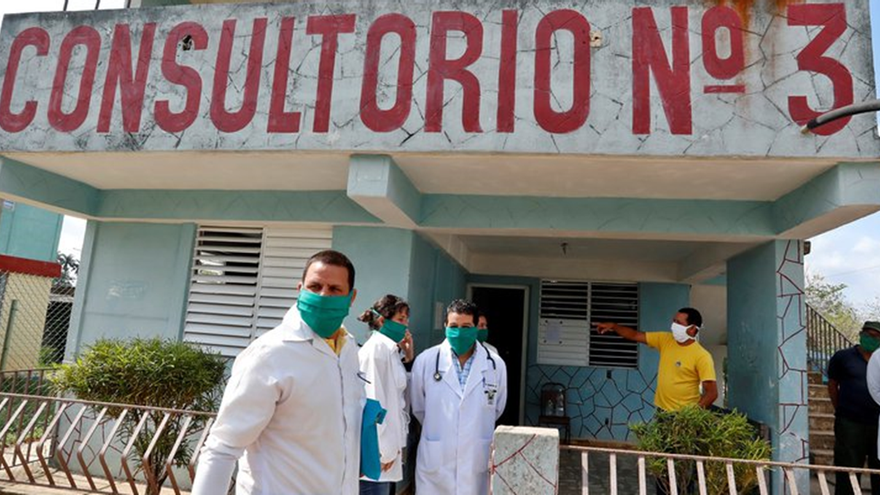
Cuba Loses More Than 30,000 Health Care Workers in One Year, Including 12,000 Doctors

Both the total number of consultations and the number of consultations per inhabitant also dropped slightly. (EFE/Ernesto Mastrascusa)

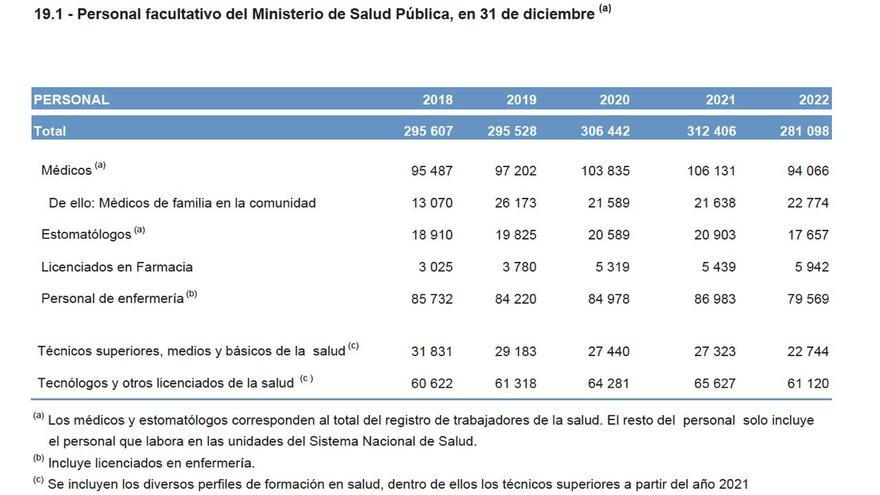
14ymedio bigger14ymedio, Madrid, August 10, 2023 — The crisis of the healthcare system in Cuba, palpable in hospitals and polyclinics, now has its correlation in official figures. According to the most recent Statistical Yearbook on Health and Social Assistance published by the National Office of Statistics and Information (Onei), the Island lost 12,065 doctors in one year, in addition to 3,246 dentists and 7,414 nurses.

The country went from having a total of 312,406 healthcare personnel in 2021 to 281,098 in 2022, a loss of 31,308. This category includes senior, medium and basic technicians, technologists and other Health sciences graduates.

According to the same document, both the number of consultations (from 112,496 in 2021 to 108,586 in 2022) and the number of consultations per inhabitant (from 10.1 to 9.8) decreased slightly. Deaths also decreased in one year, from 44,780 to 32,872.

All these numbers indicate a considerable demographic loss and are consistent with the unstoppable migration figures of recent years.

One illness increased, however, and it is striking: acute diarrheal diseases, which went from 104,797 in 2021 to 140,269 the following year.

The debacle of the health system is something that Cubans have been experiencing firsthand for months. “I’ve been planned to have gallbladder surgery for months, but they don’t give me an appointment because they say there’s a lack of personnel,” a resident from Centro Habana laments to this newspaper. Now, a few days ago, at the Calixto García hospital, which is the one that serves this patient, and where 14ymedio has registered numerous irregularities, the surgeon suggested that she go “to the emergency department” whenever she wanted, and that he would operate on her. The woman was surprised: “That has to be paid from outside, because if not, I don’t understand it, but I don’t have money.” continue reading

Last June, this newspaper also reported a flagrant loss of specialists in the country, to which not only the massive exodus, a meager salary and mistreatment by superiors and patients all contributed.

According to a doctor from the William Soler hospital, in the Havana municipality of Boyeros, speaking at the time, “nobody wants to be a clinician, a pediatrician, and even less a gynecologist.” And he recounted, by way of example, how around April, eight of the 12 young people who had started as pediatric residents abandoned their positions all at once.

Data of health personnel in Cuba corresponding to the year 2022. (Onei)
Data of health personnel in Cuba corresponding to the year 2022. (Onei) [Line 1 – Doctors. Line 2 – Of them, family doctors in the community. Line 3 – Dentists. Line 4 – Nurses. Line 5 – Technicians, senior, midlevel and basic. Line 6 – Technicians and other licensed healthcare workers.]
The most serious thing in his story, however, was the shortage of personnel in intensive care services, some of which have had to be closed, and in operating rooms. As an alternative, the doctor denounced, they were using undergraduate surgical residents.

Last February, the AFP agency published a report that also attributed the labor debacle on the Island to the continuous exodus of professionals via emigration. The conclusion of the report was devastating: theoretically in Cuba there is plenty of employment, but nobody wants to work in the deplorable conditions established by the regime’s economy. According to the data provided to the international press, the majority of Cuban emigrants are between 19 and 49 years old and, in addition, are highly educated.

The internal lack of health personnel is also compounded by the drop in contingents sent to international missions, the marketing of which is the regime’s main source of income after tourism and remittances. At the beginning of January, the Ministry of Foreign Affairs announced that in 2022, 23,792 Cuban “collaborators” were working in 56 countries.

The figure, presented with the usual hullabaloo by the authorities, actually reflected a pronounced drop compared to the 30,407 health workers it had in 66 countries in 2021, as well as compared to the number even a year earlier, during the outbreak of the pandemic: 28,000 doctors in 58 nations.

The “sending of health professionals to different countries of the world to offer comprehensive medical care to the most disadvantaged population” is something that the ONEI report itself highlights as part of the Comprehensive Health Program.

In the same document it is extolled that the National Health System “is based on the principles of socialist public health, through which the right of the population to receive, free of charge, the services provided by institutions dedicated to both medical assistance and and social assistance,” which “constitutes one of the greatest achievements of the Cuban social model. However, the Island does not appear in the in the top twenty ranking of countries with the best public health coverage of the World Health Organization, all of which are countries with free market economies.

It is a fact that the recently published numbers support the progressive discredit both of the export of healthcare workers – considered by the United States and various international organizations as forced labor – and of the Cuban health system itself. The official propaganda about the Island as a “medical power” is increasingly unsustainable.

____________

COLLABORATE WITH OUR WORKThe 14ymedio team is committed to practicing serious journalism that reflects Cuba’s reality in all its depth. Thank you for joining us on this long journey. We invite you to continue supporting us by becoming a member of 14ymedio now. Together we can continue transforming journalism in Cuba.
Bottled Water in Cuba, Only Available in Private Shops and at Prohibitive Prices

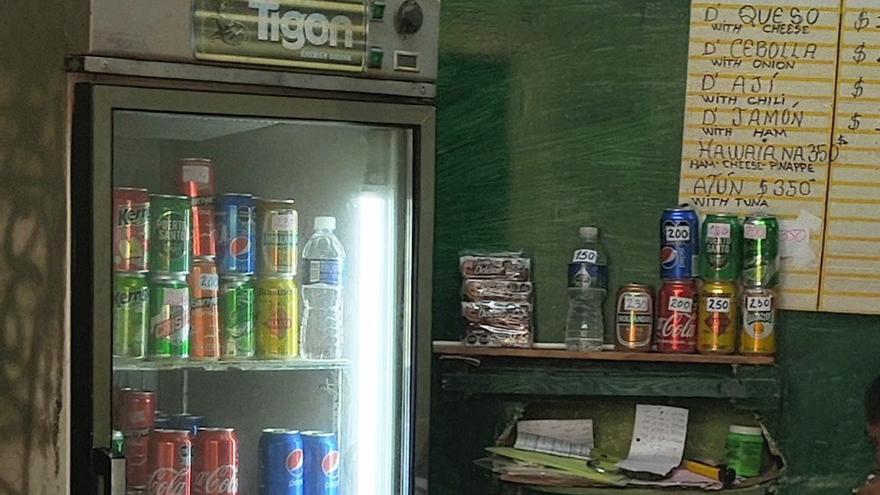
A small bottled water can cost up to 150 pesos. (14ymedio)

14ymedio bigger14ymedio, Juan Diego Rodríguez, Havana, 8 August 2023 — Of all the basic products that are scarce in Cuba, the most dramatic in these days of extreme heat is water. It’s not only that you cannot get a free glass of water in any shop, state or private business, but that the bottled ones have disappeared from state businesses, which nevertheless do sell alcoholic beverages and soft drinks. Bottled water remains, as a last resort, in the private businesses, at impossible prices for most of the population.

Doris says that until recently in state shops, such as the El Mercurio cafeteria, located on the ground floor of the Lonja de Comercio in Old Havana, she could buy a bottle of water “at a reasonable price” before going for a walk to the port. “Last month they didn’t have any in El Mercurio, and I had to buy it at the Café de Oriente, also state-run, but at 70 pesos.”

This Monday, there wasn’t any water in either of the two places, and she had to walk almost ten blocks, to Obispo Street, sweating through every pore, before finding a store that sold it. “Of course, it was in a private shop and cost 150 pesos,” complained this 30-year-old woman of El Vedado. “That, a small bottle, which is a cup and a half of water. They never go below 100 pesos.” The one and a half liters usually costs 300. continue reading

Bottled water “is in the hands of private individuals at exorbitant prices, and of course no one gives you a glass of water, no one gives you anything.” (14ymedio)

“How is it possible that with this terrible sun that makes you faint the State doesn’t have water?” asked Doris, indignant, unable to understand how something nationally produced could be missing. It’s true that “everything is in the hands of the private stores at exorbitant prices, and of course no one gives you a glass of water, no one gives you anything. I can only assume that they divert it to the private businesses so that they can resell it.”

The woman is grateful for at least having money and being able to spend it on a bottle of water, “but a poor old woman who walks down the street, thirsty, begging for alms? What water does she drink?” Her questions remain unanswered.

Translated by Regina Anavy

____________

COLLABORATE WITH OUR WORKThe 14ymedio team is committed to practicing serious journalism that reflects Cuba’s reality in all its depth. Thank you for joining us on this long journey. We invite you to continue supporting us by becoming a member of 14ymedio now. Together we can continue transforming journalism in Cuba.
Two Cuban Players Escape to the Dominican Republic and Are Now Aiming for the Major Leagues

Cuban baseball players Emmanuel Chapman and Julio César Pérez. (Collage/Twitter/@francysromeroFR)

14ymedio bigger14ymedio, Havana, 8 August 2023 — Two other promising young men have joined the long list of players who have left Cuba. Emmanuel Chapman and Julio César Pérez are now in the Dominican Republic,according to sports journalist Francys Romero.

Romero reported last Saturday that 24-year-old pitcher Emmanuel Chapman Ayón left Cuba in April of this year. He had participated in three National Series with the Holguín Cubs before leaving the country.

“Several Major League (U.S.) organizations have confirmed interest in Chapman. He has been training in the Dominican Republic for a couple of months, increasing his power and muscle mass,” Romero emphasized.

Chapman now has a demonstration scheduled before Major League coaches for August 25 in the Dominican capital. His exhibition will be at the Villa Mella stadium, located on the Hacienda Estrella road. The young man seeks to shine before the evaluators with a pitch that is over 90 miles per hour.

For his part, the catcher Julio César Pérez Dávila, only 19 years old, has been in the same Caribbean country since last week, Romero said last Sunday. continue reading

The reporter included Pérez at number 11 as the best catcher in his class in his list of 25 best U-18 prospects in Cuba, for the year 2022. He also recalled that the athlete finished the National Championship as the most valuable player in the category.

Romero explained that during that event, the promising Havana player achieved a record of 14 hits in four turns at bat, which is equivalent to a batting average of .286. In addition, he contributed with a double and participated in four games as catcher and one as designated hitter.

“In the 2022 U-18 National Championship he led the batters with .438/.579/.604, 8 doubles, a triple and 2 home runs. His average was the highest among the qualified batters. At defense he’s an excellent fielder,” Romero wrote about the catcher’s abilities.

Romero added that “if he has to improve anything, it’s his arm.” However, he said, “Pérez’s definitely has potential.”

In this regard, he said that although coaches have traditionally preferred Venezuelans and Dominicans as catchers over Cubans, “in recent times that reality has changed,” with the signing of  catchers like Edgar Quero (top prospect of the Chicago White Sox).

As the specialist recalled, the emigration of Cuban baseball players “has maintained constant numbers in 2023.” In 2022, “more than 100 players left through different routes.” Recently Romero reported on the departure from Cuba of pitchers Alexander Valiente, Renyi Norbel Membrives, Javier Mirabal, Yulian Quintana, Daivel Álvarez de la Torre, Roger Bolaños and Marlon Vega.

Translated by Regina Anavy

____________

COLLABORATE WITH OUR WORKThe 14ymedio team is committed to practicing serious journalism that reflects Cuba’s reality in all its depth. Thank you for joining us on this long journey. We invite you to continue supporting us by becoming a member of 14ymedio now. Together we can continue transforming journalism in Cuba.
Cuban Baseball Player Yasiel Puig Returns to the Dominican Professional League

The baseball player Yasiel Puig, in the image he has disseminated on his networks. (Twitter/@YasielPuig)

14ymedio bigger14ymedio, Miami, 7 August 2023 — Cuban outfielder Yasiel Puig will join the Eastern Stars of the Professional Baseball League of the Dominican Republic for the 2023-2024 season, which begins on October 19. The athlete himself announced the news on Saturday via his social networks.

“I was born to play baseball,” wrote the athlete, adding: “The best is yet to come.” In the same message, he thanked the Eastern Stars for giving him “the opportunity to play on the best baseball team in the Caribbean this winter,” and concluded: “Mentally, physically and spiritually I am ready to raise its name high with my teammates.”

He also said that, at his own request, it will be the first time he will leave his number 66 to use the number 33, the age that Christ was when he died: “God has given me another chance. I dedicate this number to Him.”

Puig, who was born in Cienfuegos in 1990 and left the Island in 2012 after several attempts has had a profitable career in Major League baseball. In 2019, he became a naturalized American citizen.

With a trajectory that includes participation with teams like the Los Angeles Dodgers, the Cincinnati Reds and the Cleveland Indians (now the Cleveland Guardians), Puig has demonstrated his ability on the mound, his power at bat and his versatility in the field.

This will not be the first time that the 32-year-old player has participated in the Dominican league. The right fielder has had two successful seasons with the Toros del Este, accumulating a total of 16 regular series and 7 postseason (playoff) games in the 2020-2021 and 2021-2022 campaigns. continue reading

As reported on the official website of the Dominican league, “in 7 seasons in Las Mayores, Puig hit for an average of .277, with 132 home runs and an on-base average of .348. He had three consecutive seasons of 20 or more home runs (28,23, 24) from 2017 to 2019.”

The arrival of the athlete to the Eastern Stars for the Dominican baseball championship has been received with enthusiasm by the organization. The general manager of the team, Manny García, stressed that “his experience will be of great help to the many young players we have who will play an important role on our team.”

Yasiel Puig has also left his mark on other baseball leagues, including those of Mexico, South Korea and Puerto Rico.

Translated by Regina Anavy

____________

COLLABORATE WITH OUR WORKThe 14ymedio team is committed to practicing serious journalism that reflects Cuba’s reality in all its depth. Thank you for joining us on this long journey. We invite you to continue supporting us by becoming a member of 14ymedio now. Together we can continue transforming journalism in Cuba.

Cuban Authorities Promise That It Will Be Possible To Pay in Cash, Except at Hotels

The authorities admit that not all the population has access to electronic payment but say that they should be given the option. (14ymedio)

14ymedio bigger14ymedio, Madrid, 8 August 2023 — “An hour and a half of more talking about the same thing, pondering a decree that in itself is good but in the general context is useless.” This is the assessment of a reader of the official Cubadebate about the appearance of the president and the vice president of the Central Bank of Cuba (BCC), Joaquín Alonso and Alberto Quiñones, in the television program Mesa Redonda (Roundtable), to explain the process of “bankification,” collecting in a few words the perception of most viewers, judging by the reproaches launched in the parallel forum that the media had foreseen and announced.

The directors of the BCC insisted on what is perhaps the biggest news of this Monday: there will be no “zero cash” operation except in one sector: tourism. At least, for the time being. Both stressed that there will always be exchanges with physical money, among other things, because “not all the population has access to digital media or knows how to use it.”

Quiñones reiterated that what the rule dictates is that all establishments must guarantee the access and use of electronic payment channels, but it does not require their use. “The most important thing is that it is the population and not the seller who chooses the payment channel,” he clarified. That will happen, they vehemently insisted, in ration stores, markets and all kinds of shops, with one exception. “The Tourism sector has decided that all payments in hotels will be electronic. As we move forward, we will empower the population to benefit,” Alonso said.

The directors repeated for the umpteenth time the measures announced last Wednesday and later explained them in the press through interviews – such as the one carried out with the Minister of Internal Trade, Betsy Díaz Velázquez – and question and answer sessions. The greatest space was dedicated to the reasons for the approval of the “bankification” program, the main one being to redirect the economy along a legal path. continue reading

“The transactions in our economy have to be lawful activities, according to the Constitution,” said the president of the BCC. “Therefore, to the extent that operations and transactions are transparent with the bankification process, there will be less room for illegal transactions.”

The theory is good, but the users of the parallel forum did not give credence to the reality, also parallel, in which the authorities seem to live. “When will they realize that all the cash is being dominated by people in the large black and illicit market, who have no relationship with State companies, much less with the MSMEs [micro, small and medium-sized enterprises]?” asked a reader.

Another user directly accused the authorities of not understanding how the economy works. “The MSMEs are not the ones that move the foreign exchange market in cash, no. They develop their exchange rate dynamics through digital channels. (…) You have to know how that market works to understand and propose solutions. You have to understand the measures.”

The population, which has seen double-digit inflation for more than a year, was beginning to notice how some MSMEs managed to lower prices thanks to the increase in supply. The concern about how they are going to import – when buying in foreign currency and selling in pesos, in the absence of an official foreign exchange market – has been revealed in a multitude of comments. “Currently more than 90% of the products that can be purchased is thanks to the MSMEs that have proliferated and are everywhere. State stores are depressed; they do not offer what the population demands. If this measure results in the closure of the MSMEs or a decrease in what they can offer, the people will suffer the consequences, and who knows how great the damage will be,” said one user.

Supported by some graphs that the Cuban economist Pedro Monreal has described as hieroglyphs – the unit of measurement of the economic magnitudes is not shown – the bank directors explained that starting with the Ordering Task* there was an increase in money in circulation, injected by the BCC itself to respond to the higher prices, which was followed by the logical withdrawal because of the higher prices. Then, “the effect of cash outflow and reduction that is not logical in the functioning of the economy began to be distorted.”

With the arrival of the MSMEs, there also has been a setback in the use of banks, and there is a large amount of cash outside the banking system, especially so far this year. Therefore, the State intends to recover it by promoting technology – which must be strengthened – encouraging electronic payments with discounts and benefits, and reminding people that these methods work seven days a week, 24 hours a day.

Cubans seem to know that the idea is desirable but difficult to realize on the Island. “The measure is implemented at a bad time. We are not prepared, and we are not a normal country. Let a few months pass and you will see the consequences,” said another forum member.

Alonso and Quiñones also tried to establish the idea that “bankification is a gradual process.” They repeated this on several occasions and even added that the population demanded the measures, as was seen “in the debates of the recent ordinary session of the National Assembly of People’s Power.” Just a few hours ago, the economist Pedro Monreal, who exposed on his X account (formerly Twitter) his reflections on the measures, defended a completely different idea.

“There has been talk of ’bankification’ for a long time, but a program to implement it did not seem to be urgent. However, the sudden announcement of Central Bank resolution 111/2023 has caused public concern,” he wrote. “The unexpected resolution seems to denote an urgency not observed before. In the July parliamentary session, ’banking’ was barely mentioned, nor did the ’zero cash’ pilot test of the Electric Company, and Cimex did not reveal urgency,” he continued.

The specialist said that the emergency means they are trying to devalue the dollar. “The recent price of the dollar has had an almost vertical trajectory. Between June 22 and August 7, it rose by 19%.”

For Monreal, delaying the situation is vital due to the inflationary effect of transferring the devaluation to the prices of the formal and informal markets and for something less tangible: the general perception of the failure of the Government’s economic recipes. But in this there is no turning back, and the users of the forum organized by the ruling party made it very clear. In the words of one of them: “The Ordering Task was just as optimistic and look at the good it did.”

*Translator’s note: The Ordering Task is a collection of measures that include eliminating the Cuban Convertible Peso (CUC), leaving the Cuban peso as the only national currency, raising prices, raising salaries (but not as much as prices), opening stores that take payment only in hard currency, which must be in the form of specially issued pre-paid debit cards, and a broad range of other measures targeted to different elements of the Cuban economy.

Translated by Regina Anavy

____________

COLLABORATE WITH OUR WORKThe 14ymedio team is committed to practicing serious journalism that reflects Cuba’s reality in all its depth. Thank you for joining us on this long journey. We invite you to continue supporting us by becoming a member of 14ymedio now. Together we can continue transforming journalism in Cuba.

Suchel Promises Products in Pesos and Demands More Funding From the Cuban Government

The production of Bamboo, which began last April with just four of the seven products that the batch should include, has already been criticized by some customers. (Cubadebate)

14ymedio bigger14ymedio, Havana, 31 July 2023 — The directors of the joint venture Suchel Camacho will once again put products on the Cuban market in national currency, after almost four years of selling in freely convertible currency (MLC) and through virtual stores. At least the company promised this in an interview published this Monday by Cubadebate, in which it promoted Bamboo, a new line of hygiene products.

According to the managers of this company, after the COVID-19 pandemic and with the implementation of the Ordering Task* in 2021, which brought with it the closure of the peso stores, the industry had to focus on the almost exclusive sale in MLC and through virtual platforms to survive. From that process, Habanabell was born, Suchel’s own electronics store that has generated 15 million dollars in profits so far.

Yaney Cisneros, general director of Suchel Camacho, told the official media that these gains have been used to improve the factory’s equipment and to acquire quality raw materials. In addition, Cisneros predicts that with the Government’s plan to allow State companies to buy foreign currency at an exchange rate of 1 MLC for 120 pesos, Suchel will be able to increase its production, destined for sale in pesos, and fulfill its objective of being “in the home of every Cuban.”

The production manager, Jorge Seoane, explained to Cubadebate how the acquisition of foreign currency works. “The country gives us the currency and with the approved figure we buy it, but at an exchange rate of 120 pesos per dollar,” he said. He also pointed out that the first exchange operations that the society tried to carry out presented problems due to the banking bureaucracy.

Despite the inconveniences, the company has already announced the return of its products to the national showcases. Its new Bamboo line, created specifically to be produced using the new exchange method, includes seven hygiene products – cologne, toothpaste, deodorant, body lotion, shampoo, conditioner and soap – of which four are already available in the stores of the Caribbean chain and through the Cimex Tu Envío platform.

However, Cisneros recognized that the quantities being produced are not enough to meet the demand of the population and do not reach all the provinces. In fact, it’s a brand that, at least for most habaneros, people have not seen anywhere. continue reading

The lack of funding seems to be a key factor that involves the cooperation of the State, judging by the statements of the managers.

“We are struck by how the country sometimes imports finished products of this type instead of allocating that money to national productions. We have presented studies of how much we could do if the same money that is used today to buy toilet and cosmetic products went to our industry,” Cisneros lamented. The official also explained that with the reintroduction of the products the company needs “stability” to recover its former rhythm.

The production of Bamboo, which began last April with just four of the seven products that the batch should include, has already been criticized by some of the readers of Cubadebate.

“Hopefully before the momentum runs out, I will be able to find and buy these much-needed products in Cuban pesos in the east of the country,” said user Ojeda, referring to the commercialization of these products that until now could only be purchased in Pinar del Río, Havana, Mayabeque, Matanzas, Cienfuegos, Villa Clara and Sancti Espíritus, according to the newspaper.

Another Internet user, identified as Truth, was more incredulous. “When I see the sale of products in Cuban pesos, I’ll believe it,” he said. Others spoke out more desperately. “Good statistical work, but what I need is for them to tell me the month and year when I’ll be able to go to a store and buy the toiletries I need in national currency. I can’t stand one more long explanation. Right now the foreign exchange market is history, and nothing has been solved,” said Collin.

The user Sabelotodo complained about the poor distribution of the products and said that he has only been able to find them in Tu Envío La Habana. “So, where does that leave us? Cuba is not just Havana; we all need those personal hygiene products.”

The official newspaper Granma announced last Friday that Suchel had created a “strategic alliance” with Quota, a private professional services company for business development and the creation of alliances. The purpose of this type of society, which has been created between different forms of State and non-State management, is that, while the State company remains at the center of the economy, the micro, small and medium-sized enterprises (SMEs) and other private businesses act as support, occupying a secondary role.

Economist Elías Amor Bravo published on his blog Cubaeconomía an analysis in which he foresees, based on economic criteria, the failure of these associations. “With this type of hindrance and forcing the private sector to pull the ballast of communist inefficiency, it will not make the economy more prosperous. They should rectify this before it’s too late. This path of the socialist State enterprise as the center of the economy is a dead one,” Amor wrote.

For the economist, the rigid and centralized control methods with which State companies operate cause disorganization and lead, ultimately, to an “every man for himself” mentality that cannot compete with private forms of management. “Private actors in Cuba are on a path, by the way, that is increasingly prosperous, and the regime is falling behind,” he concluded.

*Translator’s note: The Ordering Task is a collection of measures that include eliminating the Cuban Convertible Peso (CUC), leaving the Cuban peso as the only national currency, raising prices, raising salaries (but not as much as prices), opening stores that take payment only in hard currency, which must be in the form of specially issued pre-paid debit cards, and a broad range of other measures targeted to different elements of the Cuban economy.  

Translated by Regina Anavy

____________

COLLABORATE WITH OUR WORKThe 14ymedio team is committed to practicing serious journalism that reflects Cuba’s reality in all its depth. Thank you for joining us on this long journey. We invite you to continue supporting us by becoming a member of 14ymedio now. Together we can continue transforming journalism in Cuba.