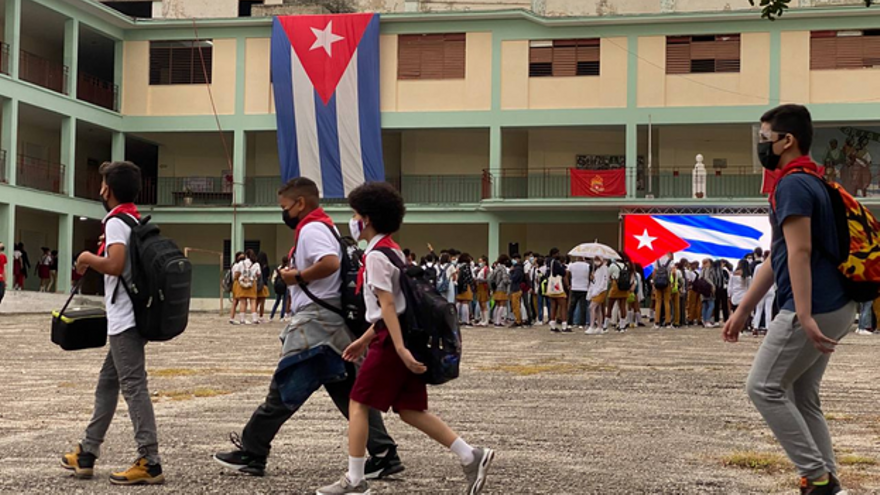
 14ymedio, Juan Izquierdo, Havana, 26 August 2022 — After two years of ups and downs, between the forced confinement of the pandemic and the economic crisis, the beginning of the school year in September is causing more than one scramble in Cuban homes. The return to school will take place in the midst of high inflation that increases the price of shoes to the snack that students need.
Parents wonder what this new beginning of teaching will be like with the long blackouts that hit the island, the shortage of flour that has sunk the production of bread, so necessary for school snacks, and the loss of value of the Cuban peso against foreign currency, in a country where only in stores that take payment in freely convertible currency can you buy shoes or a backpack.
Given the succulent slice they can get from the sale of school accessories, even several restaurants that sell their products through the Internet have added offers that have nothing to do with food. Backpacks for children at 60 dollars, snack bags, water bottles, pencils and erasers now alternate with their dishes of lasagna or fried rice.
“School supplies for girls,” reads one of these options, which for $120 include the backpack, a pair of notebooks and other tools needed in class. Home delivery in Havana can add about ten dollars more, but in the provinces it can be even more expensive. Having a family abroad that finances the purchase is essential in this case, because payment is made online with Visa or Mastercard.
Those who don’t have emigrated relatives must buy school supplies in Cuban pesos, at the exchange rate with the dollar that is currently in force in the market. Translated into the national currency, the price of a small backpack purchased in Panama can exceed 2,000 pesos, plus 300 for shipping to the house. continue reading
As for the school uniform, the nightmare is no less pressing. “I’ve been wearing this uniform since the tenth grade,” a student from Sancti Spíritus, who is about to start his last year of high school, tells 14ymedio.
“They give you high school uniforms, but no one thinks about the growth spurt at age 17. In the eleventh grade my mom had to ask for another pair or pants and depend on the officials to solve it,” he says.
He’s lucky that his mother is a seamstress, otherwise everything would get tight. “To top it all off, the polyester fabric is hot and fades easily,” he says. In the middle of the school year, the family had to buy a few meters of fabric that was very expensive to sew extra shirts and pants. “I have to take care of them,” the boy continues, “because when high school is over I have to donate them to a cousin of mine who is just starting out.”
No matter what grade he’s in, his municipality or the family’s condition, the student will always have hand-me-downs in need of repair from their use by many generations, with books full of Soviet anecdotes, anachronistic for today’s Cuban student.
“My books always have to be passed down,’” says the young man, showing the texts marked with a pen, drawn on the back and the covers or unbound. “Pencils and notebooks are another story: before you could go to Artex, and get a pencil and a couple of notebooks, but now there isn’t even that.”
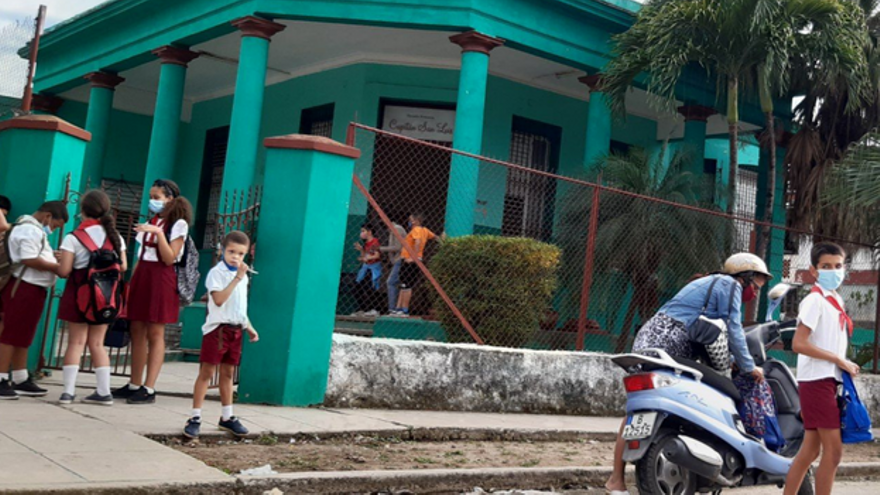
The shops of the Artex group used to market stationery, backpacks and other school supplies. But with the extinction of the Cuban convertible peso and the dollarization of the economy, the family can invest very little money in materials that Artex no longer even offers, as it is now almost entirely dedicated to the sale of tobacco and handicrafts at outrageous prices.
“Books almost never arrive; notebooks, which are of very bad paper, always come in the second or third week, hopefully. And it’s better not to mention the pencils with horrible graphite” says the student interviewed by this newspaper.
The young man has been wearing the same backpack since junior high school; the shoes are sent to him by a family member from the United States and the rest, such as socks and underwear, had to be bought in the informal market.
After two years of zero, or hasty and mediocre activity, the logistical aspect is just one side of the problem. Even primary school students don’t feel sure about the exams if they haven’t paid a tutor for several sessions beforehand. In many cases, those who offer these support classes are the same people as the student’s teachers, who have found in these reviews of the coursework a financial complement to their squalid salaries.
Another issue is the food,” continues the young man. “When you live far from the school, you have to bring a snack, because the prices of snack vendors and the private restaurants are impossible to pay. Or you walk home, which, for example, can be over one mile from school.”
Despite these and other obstacles to learning, such as the terrible school furniture or the lack of hygiene in the bathrooms, triumphalist announcements about the beginning of the new school year proliferate in the official press.
“The material base of study is assured in both internal and semi-internal centers,” lies the newspaper Tribuna de La Habana, although it discreetly admits the deficit of 4,000 teachers in the capital’s classrooms, which will be covered “with various alternatives.”
“Completing the faculty and ensuring retention” are priorities of the new course at the Artemisa pedagogical school, says a local newspaper, although it doesn’t specify what measures will be taken to achieve that goal when there are only 77 places out of the 122 that should be filled.
In the continuous journeys through the provinces by the Minister of Education, Ana Elsa Velázquez, the directors of the sector formulate the same guarantees: the State has resolved all the weaknesses, everything has been repaired and the panorama is positive.
The domestic reality, the complaints of mothers on social networks and the external aspect of schools suggest the opposite. Those Cubans who expose the reality are harassed by State Security, as happened with Trilce Denis, a Havana mother who denounced in a direct transmission the difficulty of starting school in such precarious conditions.
“I want to know, on the 7th, when school starts, what snack is going to be given to the children,” Denis said, upset. “Today I decided that I’m not going to send my son,” she concluded.
Translated by Regina Anavy
____________
COLLABORATE WITH OUR WORK: The 14ymedio team is committed to practicing serious journalism that reflects Cuba’s reality in all its depth. Thank you for joining us on this long journey. We invite you to continue supporting us by becoming a member of 14ymedio now. Together we can continue transforming journalism in Cuba.
