Cuba Brings 200 Doctors Home from Venezuela to Deal With the Desperate Situation in Ciego de Avila

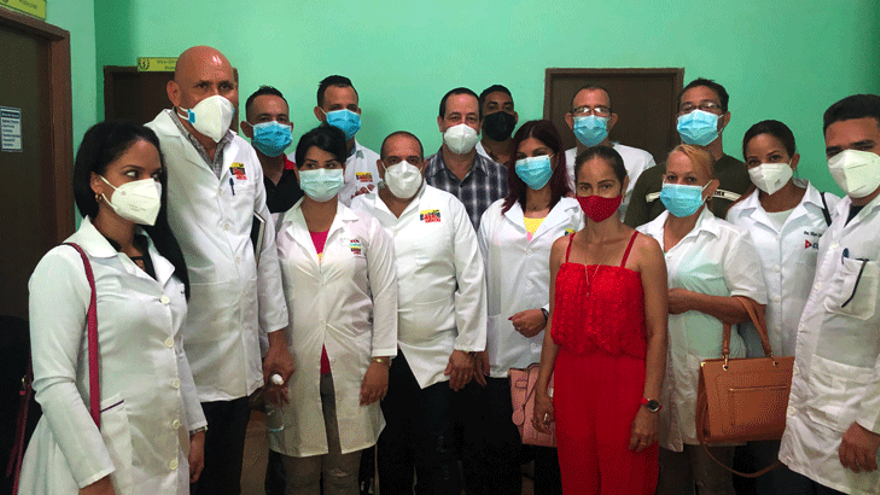
The Minister of Health, José Ángel Portal Miranda, in the center, with a score of Cuban doctors recently returned from Venezuela. (PCC)

14ymedio bigger14ymedio, Havana, 4 August 2021 — Faced with the catastrophic panorama that Ciego de Ávila is experiencing due to the covid, the Government has sent for a ’mission’ Cuban doctors who were serving in Venezuela. About twenty of them arrived at the Jardines del Rey International Airport on Tuesday and were received by the Minister of Public Health, José Ángel Portal Miranda. On Wednesday, another large group is scheduled to land, about 200 in total.
“You have not come to supervise, you have come to mobilize, to put your heart to the complexity, you are going to find many problems, but we know that you have the capacity to solve them,” Portal Miranda told the newcomers.

When informing the doctors of the reception, the website of the Communist Party of Cuba does not hesitate to say that the province presents “a resounding mortality rate that is out of step with the national context.” continue reading

The same text specifies that the doctors, “who held management positions” in the mission, will join the health areas of the main municipality and the Antonio Luaces Iraola Provincial Hospital “to also implement a new protocol, designed from the current availabilities of drugs.”

“At the same time, they are tasked with better management of the human resource capacity so that, for example, in the hours of greater patient care, the consultations have more doctors and the wait is shortened,” the report continues.

In a short note, Radio Surco details that the doctors, originally from Camagüey, Santiago de Cuba, Holguín, Las Tunas, Villa Clara and Pinar del Río, gave up their vacations “to support this central province with the difficult epidemiological situation.”

It is the second time that the regime uses its international brigades to help in the internal crisis. At the beginning of July, some 200 Henry Reeve doctors and nurses joined the health centers of Matanzas, then the epicenter of the pandemic on the island.

Knowledgeable sources inform 14ymedio that they are gathering doctors abroad to tell them that, during their vacations, they will have to go to Cuba “because of the collapse of Healthcare” and “to calm the people.” In recent weeks, there has been criticism of the fact that thousands of doctors are serving abroad while there are no hands on the island.

However, the return of the brigades, the main source of foreign currency for Havana, is not on the horizon. “The mission will remain,” say the same sources. “They are not going to stop sending doctors to Venezuela.”

This Wednesday, 1,192 new cases of the coronavirus were reported in Ciego de Ávila, which is again in second place in number of infections, only behind Havana (1,445), which has four times the population, and followed by Cienfuegos (1,032).

The desperate situation made the Government send Deputy Prime Minister Jorge Luis Tapia Fonseca to the provincial hospital on Monday, which, the official press recognized, is in an extreme situation.

____________

COLLABORATE WITH OUR WORK: The 14ymedio team is committed to practicing serious journalism that reflects Cuba’s reality in all its depth. Thank you for joining us on this long journey. We invite you to continue supporting us by becoming a member of 14ymedio now. Together we can continue transforming journalism in Cuba.

‘Communism in Cuba is Throwing Its Final Temper Tantrum’

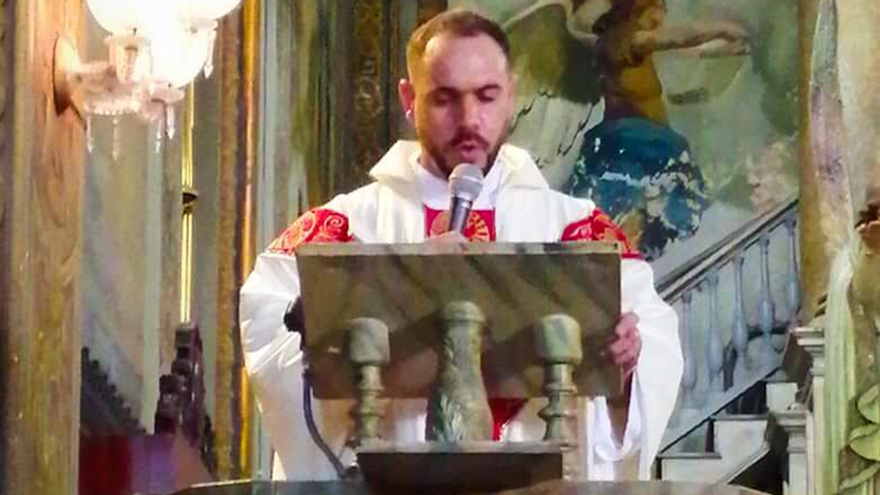
Fr. Ruben Orlando Leyva Pupo, a priest with the Congregation of the Mission, last year in Havana. (Facebook)

14ymedio bigger14ymedio, Havana, 3 August 2021 — Another priest is raising his voice in opposition to the repression unleashed after demonstrations on July 11. Like most of the protesters that Sunday, he is also very young. His name is Rubén Orlando Leyva Pupo, a computer scientist who was ordained a Vincentian father just last year.

“Those who hold political, military and economic power in Cuba now have the chance to finish burying this obsolete, absurd and dark system that is communism and that is now throwing its final temper tantrum,” wrote Leyva Pupo on his social network page last Sunday .

“Cuba is dying,” he wrote, adding that he cannot close his eyes to “the harshness of this reality.” He noted that people are dying in hospitals and in Covid-19 isolation centers due to a shortage of medicines. “Malnourished and unvaccinated people from a very vulnerable population are becoming ill due to hunger and poor nutrition.”

The young priest, who serves in Santiago de las Vegas on the outskirts of Havana, writes, “There is always hope… This whole nightmare will pass. These 62 years of silence and numbing fear already continue reading

came to an end on July 11.”

Cuba, he argues, now has the chance to write a new history, “to be brave, to turn off this bumpy road… to retake the path it should never have abandoned, that of a democratic Republic that is truly free in its political, social and economic participation.”

In his post, he maintained that the armed forces and police have the option to join those “who should serve and not repress the people,” adding that the current government has “the opportunity to craft a different legacy and future for new generations, who look upon this ineffective ideology of hatred and subjugation, clinging to power, with clarity and disgust.”

Fr. Leyva Pupo called upon all Cubans to play leading roles in a new nation, “with true rights” and economic and entrepreneurial freedom. “You have just been made aware, you who govern in the midst of popular discontent, that Marxism is not loved by the children of this nation, that communism is a ruinous Soviet import, which did not even worked for them,” he declared.

In conclusion, Fr. Lepo Pupo expressed his desire for a country where “ideology no longer reigns, where everyone has a place, where the streets belong to everyone, where power does not oppress or repress, or lash out… where people do not have to hide or lower their voices to express what you think and believe is correct.”

After the July 11 protests and the wave of repression that the regime unleashed on protesters, several religious leaders — some of whom had already made their position against the regime public — clearly reiterated that they are on the side of the people. The Cuban Conference of Catholic Bishops expressed “its discomfort at the deterioration of the economic and social situation” on the island.

“We not only we see the situation get worse but that we are also moving towards a rigidity and hardening of positions that could give rise to negative responses, with unpredictable consequences that would harm us all,” the bishops stated, insisting that “a favorable solution cannot be imposed by decree or by calls for confrontation.”

For its part, the Cuban Conference of Religious Men and Women requested “the prompt release of all those who have been unjustly arrested simply for exercising their right to demonstrate, to express their grievances.” It also noted, “It is a legitimate and universal right of every citizen to express his or her grievances in an orderly and peaceful manner in public space that is not the monopoly and privilege of any particular ideological group.”

A week after the protests, Pope Francis expressed his concern over the situation in Cuba and urged “dialogue and solidarity” in the country.

“My thoughts are with the beloved Cuban people at this difficult time, especially with the families, who are suffering the most. I pray that Lord will help build in peace, dialogue and solidarity an increasingly just and fraternal society,” said the pontiff.

____________

COLLABORATE WITH OUR WORK: The 14ymedio team is committed to practicing serious journalism that reflects Cuba’s reality in all its depth. Thank you for joining us on this long journey. We invite you to continue supporting us by becoming a member of 14ymedio now. Together we can continue transforming journalism in Cuba.

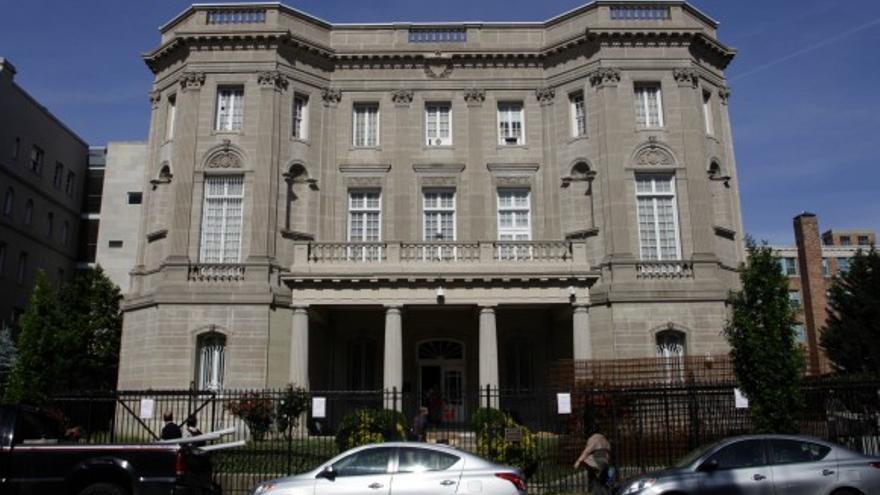
The New Address of the Cuban Embassy in Washington is Oswaldo Paya Way

Caption: Oswaldo Payá Way is in front of the Cuban embassy in Washington. (EFE)

14ymedio biggerEFE, via 14ymedio, Miami, 3 August 2021 — U.S. Senators from both parties approved on Monday the naming of the Washington street in front of the Cuban Embassy in honor of the late Cuban opposition leader Oswaldo Payá (1952-2012).

Cuban-American Senator Marco Rubio said yesterday that the change pays “a tribute to the life and legacy of one of the island’s most important civic leaders who paid the ultimate price in defense of the democratic future.”

For Rosa María Payá, daughter of the deceased dissident, Oswaldo Payá Way will be “a permanent reminder of the urgency of stopping the regime’s impunity.”

“My father’s legacy lives on in the struggle for freedom and the rights of the Cuban people,” the activist told EFE when the project was presented. continue reading

The approval comes in the midst of the protests that have erupted in Cuba since July 11 against the government of Miguel Díaz-Canel and which have been echoed in various demonstrations of support around the world, especially in Miami and Washington.

“Following the historic protests led by Cuban Americans in front of the regime’s embassy in our nation’s capital last Monday, another symbol of the tenacity of the Cuban people in their quest for freedom will be etched for eternity,” Rubio added.

Payá founded the Christian Liberation Movement (MLC) in 1988 to promote democracy and civil liberties through peaceful resistance.

A decade later, the organization created the Varela Project, which sought to advance democratic reforms under a provision of the Cuban Constitution that allowed the public to introduce bills.

Changing the name of the street “is a small but significant step that will force all those who visit or write to the embassy to remember not only Payá, but all those who have challenged the cruelty and oppression of the Cuban communist government.”

Payá’s family has maintained that the car crash in which the opposition leader and dissident Harold Cepero died on July 22, 2012 was caused by agents of the Castro regime.

Payá and Cepero were traveling in a car that went off the road. The car was driven by the young Spanish conservative politician Ángel Carromero, who was sentenced to prison in Cuba for voluntary manslaughter, but was repatriated to serve his sentence in Spain, where he was released within a few days.

In 2012, the U.S. Senate passed a resolution honoring the life of the Cuban opposition leader and calling for an impartial investigation into his death.

Translated by: Hombre de Paz

____________

COLLABORATE WITH OUR WORK: The 14ymedio team is committed to practicing serious journalism that reflects Cuba’s reality in all its depth. Thank you for joining us on this long journey. We invite you to continue supporting us by becoming a member of 14ymedio now. Together we can continue transforming journalism in Cuba.

Cuban State Security Continues to Harass Activists After the July 11 Protests

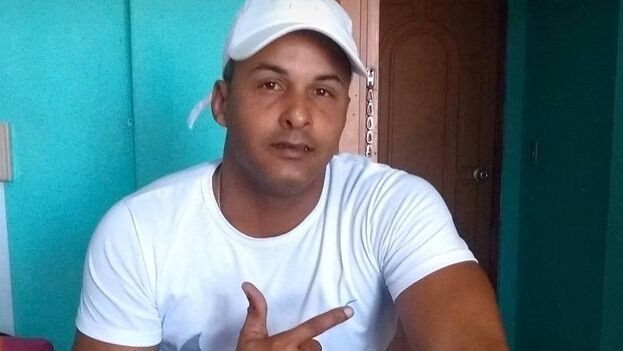
Sadiel González was taken out of his house in handcuffs on Monday night and his family is still unaware of the legal situation in which he finds himself. (Facebook)

14ymedio bigger14ymedio, Luz Escobar, Havana, 4 August 2021 — “If you have nothing to hide, come join us, let’s talk”. With the arrogance that characterizes the political police in Cuba, several agents showed up at Sadiel González’s house to take him away this Monday.

He’s not the only one. Since July 11th, social networks have been flooded with posts denouncing the arbitrary arrest of dozens of Cubans who filmed or participated in the protests.

This Sunday afternoon, González had broadcast live images of young people on the streets of Old Havana with the text: “Barrio de Jesús María, youth poured into the streets. Patria y Vida [Homeland and Life]“. As of this Tuesday, he still has not been released, so his relatives and friends fear that he is being detained.

The “visit” of State Security to his home occurred after nine o’clock at night, at which time the city of Havana initiates a curfew that prohibits citizens from going out into the street or moving from a place to another.

On his Facebook profile, González was able to denounce, through a live broadcast, the moment when the agents arrived, arrested him and took continue reading

him to the police station without presenting a warrant. When the young man, a resident of the municipality of 10 de Octubre, complained to the authorities that he must be summoned at least 24 hours in advance, the agent replied “you’re leaving with me now.”

“Sadiel, you are making it difficult for me (…) if you have nothing to hide, please join us (…) we are going to talk to the police”, said the officer, who identified himself as “the head of State Security in the municipality”.

As confirmed to ‘14ymedio’ by independent reporter Iliana Hernández, Sadiel González participated in the April 30th protest and in the one on July 11th

In the video, the activist’s mother is heard saying that they are taking him “to the sixth station” while the man specifies: “It’s an interview mother, don’t worry.” When González finally comes out to the police patrol in handcuffs, with the officers, the State Security agent explains to his mother:

“Your son is committing counterrevolutionary acts, about a month or two ago he was involved in a counterrevolutionary provocation in Havana (the Obispo Street protest of April 30th) and we have been following him since that date. Today your son did a direct one, inciting the people to carry out violent acts and to hold demonstrations. He is inciting the population to take to the streets”.

He also told her that, after July 11th, everything that her son has been doing “is wrong… He is telling lies, saying that it was a demonstration when all it was were young people playing in the street, he is manipulating information and that is a crime”, referring to a live broadcast carried out on Monday afternoon from the Jesús María neighborhood in Old Havana.

“I arrived with a lot of respect, but I almost had to threaten him to open the door for me, I told him ‘either you open the door or I’m looking for an order to knock it down’, (which I can do, too). If I come with an order and I knock down the door, how would you feel? With what money will you fix that? the officer added and concluded: “We cannot allow what your son is doing.”

As confirmed to 14ymedio by independent reporter Iliana Hernández, Sadiel González participated in the April 30th protest and in the one on July 11th .

Of the demonstrators who protested on Obispo Street, seven are still detained, awaiting trial and, as of this week, and have been deprived of liberty for three months. All were arrested on April 30th at the demonstration on Obispo Street when they tried to get to the house of artist Luis Manuel Otero Alcántara, who was on his sixth day of a hunger and thirst strike so that the siege to which State Security has subjected him would cease. During this protest, the participants shouted “Homeland and Life” and “Down with communism”.

Other activists who have taken to the streets to protest peacefully are also in prison awaiting trial. This is the case of Luis Robles Elizastigui, the young man arrested on December 4th during a protest on Havana Boulevard

Reporter Esteban Rodríguez, ADN Cuba correspondent, is in the Combinado del Este prison; activist Thais Mailén Franco Benítez, is imprisoned in the Guatao women’s prison, in La Lisa, Havana; Christian youth Yuisán Cancio Vera, is in the Combinado de la Construcción Augusto César Sandino Prison, in Pinar del Río; and Inti Soto Romero in the Taco Taco Prison.

Ángel Cuza Alfonso also remains in jail while journalist Mary Karla Arés and activists Nancy Vera and Leonardo Romero Negrín are under a precautionary measure of house arrest.

Other activists who have taken to the streets to protest peacefully are also in prison awaiting trial. This is the case of Luis Robles Elizastigui, the young man arrested on December 4th during a protest on Havana Boulevard. His brother, Landy Fernández Elizastigui, reported to 14ymedio this Tuesday that he has not received calls from him for almost a month.

“I still haven’t received a call from Luis since last July 4th,” he told this newspaper. He also said that the lawyer had received a new refusal of a change of precautionary measure that he requested last month but that he presented a new one on August 2nd.

“The lawyer showed me a new application that he presented this August 2nd and it is based on the words of the President of the Supreme Court, who said in a press conference on July 24th that thinking differently, questioning what the process is doing, or demonstrating does not constitute a crime”, he pointed out.

Human rights groups such as Amnesty International, the Inter-American Press Association, the Committee to Protect Journalists, the United States government, the European Parliament, and the International PEN have spoken in favor of the immediate release of the Cuban protesters.

Translated by Norma Whiting

_______________

COLLABORATE WITH OUR WORK: The 14ymedio team is committed to practicing serious journalism that reflects Cuba’s reality in all its depth. Thank you for joining us on this long journey. We invite you to continue supporting us by becoming a member of 14ymedio now. Together we can continue transforming journalism in Cuba.

‘Free Rice Will Not Silence Us,’ Say the Residents of Punta Brava, Cuba

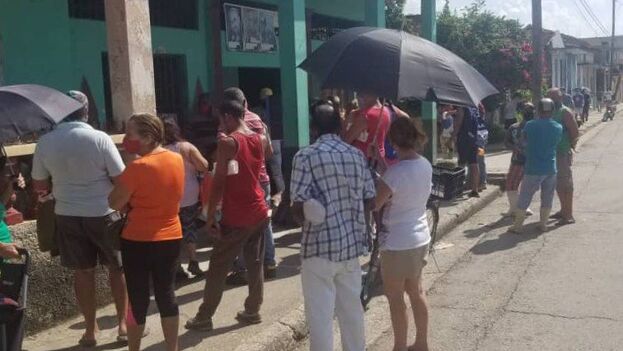
The Punta Brava bodega (ration store), in the Havana municipality of La Lisa, where the distribution of free food modules is carried out. (14ymedio)

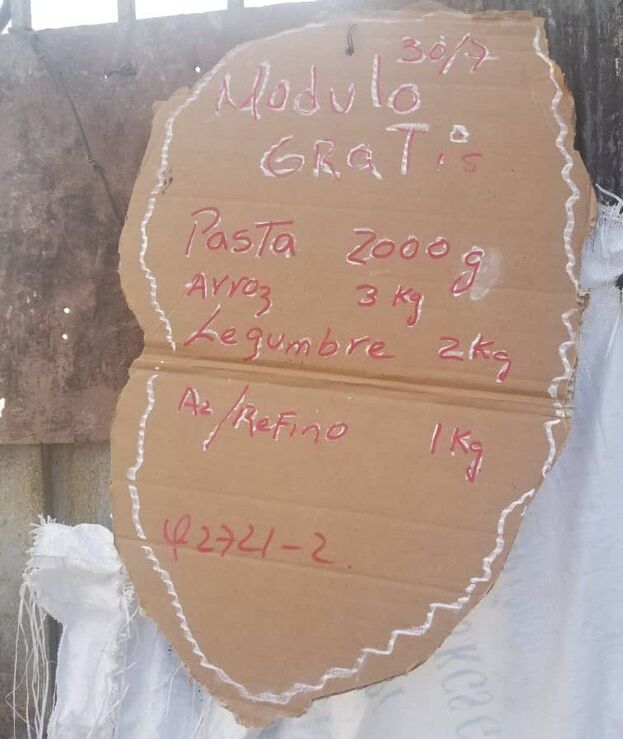
14ymedio bigger14ymedio, Natalia López Moya, Havana, 1 August 2021 — Since Friday, the line has not stopped outside the bodega (ration store) at 251st and 50th streets in Punta Brava, a Havana neighborhood of La Lisa. But unlike other times, customers only need their ration book and a bag, because the food module that is distributed is free.

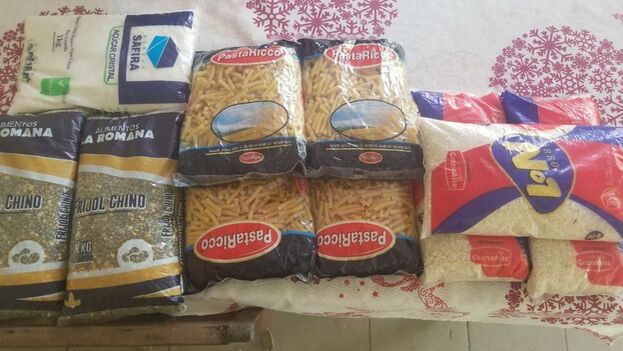
“People don’t believe it yet, that’s why half the town has come today, so they won’t regret it later and start charging us,” jokes Juan, one of the surprised residents in the vicinity of the premises who returned home with two bags of pasta, some sugar, two packages of peas and three of rice.

The products are part of a free distribution that the Cuban government has started in a hurry to try to calm things down after the popular protests on July 11. The first places where the distribution began on July 30 coincide with the neighborhoods of the capital where the demonstrations were most intense.

“Here the people rushed out into the street, and the people of Bauta, which is the nearby town, also joined to go from here to the center of Havana. There were many of us and we reached the checkpoint but they blocked us with a bus and several police cars to continue reading

prevent us from leaving,” Yantiel, age 25, told 14ymedio.

“In Punta Brava there are still many young prisoners, whose mothers have not even been able to see them since that day they were arrested,” he laments. “Although there have not been other protests like that one, it has happened that the neighbors have stoned the houses of the thugs who hit the people that day.”

Products included in the free modules distributed in the neighborhood of Punta Brava. (14ymedio)

María Elena, 64, also believes that “none of this would be distributed, much less for free, if it were not for the fact that people took to the streets.” According to this worker in an industrial products store, “we are living very badly here, there is hardly any food to be found and our electricity is cut off all the time.”

The free module is “a patch to cover the gap,” she adds, but it does not solve the serious problems of a neighborhood with more than 140,000 inhabitants, very affected by mobility restrictions with the Cuban capital. “They want to shut us up with a little rice, but don’t forget that this area is called Punta Brava [Brave Point] and it is for a reason.”

The delivery has begun in Havana, the epicenter of the protests, and will spread to other provinces with high population densities and where the demonstrations were also very numerous, such as Matanzas, Ciego de Ávila, Santiago de Cuba, Holguín, Guantánamo and Isla de La Juventud, before reaching the entire country.

The information was expanded on Friday by the Minister of Internal Trade, Betsy Díaz Velázquez, on the Roundtable television program. The minister explained that it was decided to distribute these modules after a donation from Russia and “after learning about offers and donations from Mexico, Bolivia, Vietnam and other nations.”

“In this way, a delivery schedule has been set up. In parallel, to those who are not receiving this module in the first 15 days, other products that are arriving will be delivered and others that will be received will continue to be delivered so that there is a benefit.”

The authorities have also announced the sale of an additional three pounds of rice per consumer from August to December, an increase that the minister justified from the profits of the unpopular stores that take payment only in freely convertible currency (MLC). “The result of the sales in those stores, it was always said, is for the benefit of the people,” said Díaz.

“They have not been able to do like in other times when they have sent donations and they have ended up selling them,” says a resident of Punta Brava. This sign at the ration store lists the items residents will receive for free. (14ymedio)

In a few hours, the report of the official’s words, published by the official press, has generated hundreds of comments, many of them critical. Several commenters alluded to the limited variety and quantity of the module’s products. “Minister, is there no chance of an increase in coffee?” Asked a netizen who identified himself as Luma.

But an official from the Ministry of Internal Trade responded that coffee “is not one of the donation products,” a statement that sparked another barrage of complaints from customers who have seen the popular drink disappear from stores in Cuban pesos, to remain available for sale in foreign currency or at sky-high prices on the black market.

“They have not been able to do like other times they have sent donations and have ended up selling them,” adds another neighbor who was waiting in line this Friday to acquire his family’s module. Last April, several Internet users denounced on social networks the sale in the rationed market of vegetable oil donated to the Island by the United Nations World Food Program (WFP).

At that time, the criticisms rose so much in tone that the Ministry of Internal Commerce had to come up with a statement in which it assured that the product “will be replaced” when the breakdowns in the national industry were repaired, but this action has not been reported so far by the official press.

Billboard near the ration store in Punta Brava, La Lisa, where the free food modules from international donations are distributed. “In La Lisa, Yes we could, yes we can, yes we will.” (14ymedio)

This was not the first time that this type of complaint came to light on the island. In 2017, after the onslaught of Hurricane Irma, numerous governments, non-governmental organizations and UN agencies sent donations to Cuba to alleviate the shortages in food, medicines, water and construction materials. Several victims then complained that they had to pay the state for mattresses, stoves and even charcoal.

In Punta Brava they feel they have won a little battle. “At least this time they are not going to get money from us for something that was donated for the people,” adds the neighbor. “But here we are still very upset with the situation and a little macaroni is not going to calm that down.”

____________

COLLABORATE WITH OUR WORK: The 14ymedio team is committed to practicing serious journalism that reflects Cuba’s reality in all its depth. Thank you for joining us on this long journey. We invite you to continue supporting us by becoming a member of 14ymedio now. Together we can continue transforming journalism in Cuba.

Help From China Has Arrived in the Collapsed Hospitals of Ciego de Avila

Visit of the Deputy Prime Minister Jorge Luis Tapia Fonseca this Monday to the Doctor Antonio Luaces Iraola Provincial Teaching Hospital, in Ciego de Ávila. (Screen capture)

14ymedio bigger14ymedio, Havana, 3 August 2021 — The alarms are ringing in Ciego de Ávila. With 1,434 coronavirus infections detected this Monday, it is the only province that casts a sad shadow over Havana where — with four times the population — 1,698 cases of covid-19 were diagnosed yesterday.

Although the incidence data for every 100,000 inhabitants at 14 days has not been updated for weeks, the province already far exceeded a rate of 2,000 infections, well ahead of the capital, which then reported a rate of 478 cases.

The situation is so serious that the official press does not skimp on details, and even this Monday the Government sent Deputy Prime Minister Jorge Luis Tapia Fonseca on a visit to the Doctor Antonio Luaces Iraola Provincial Teaching Hospital. This Tuesday, the newspaper Invasor published an article, How can the hospital in Ciego de Ávila be helped?, which gives an account of the extreme healthcare situation in the area and asks for volunteers.

“The hospital lacks hands and this is not a metaphor that I write: it is an emergency. Hands are lacking for continue reading

its elevators, to carry stretchers, to clean rooms, to put juice to a patient’s lips, to assist them with food or in the bathroom, so nurses could then take care of procedures that other hands would not know how to do,” he explains.

Help, for now, has come from China, according to the official press, in the form of respirators donated by the Asian giant. The provincial hospital received five of them, ChenWei brand, in addition to 80 oxygen concentrators. Meanwhile, the Roberto Rodríguez Hospital, in Morón, and the Nguyen Van Troi Psychiatric Hospital, enabled to care for coronavirus cases, received two ventilators each, in addition to dozens of oxygen concentrators.

The population, meanwhile, speculates on another option coming from Beijing: vaccines. Comments on the possibility that this serum is being used in the province’s vaccination campaign have been taking shape through social networks and have reached the readers of the official press, without being denied, so far.

The rumor stems from a meeting of the temporary working group for confronting Covid-19 held in the province last week and in which, according to one of the participants, the option of immunizing Ciego de Ávila residents with the Chinese vaccine was mentioned.

Since then, readers have asked Invasor journalists directly about the alleged vaccination with Sinovac or another of the Chinese vaccines, and demanded transparent information and, although no explanation has been given, they have not been denied the rumor. “You can be convinced that the moment we have that information we will publish it. What we cannot do is publish unconfirmed or official information,” replied an editor of the official newspaper last Friday to those who asked her to clarify what they considered an “open secret.”

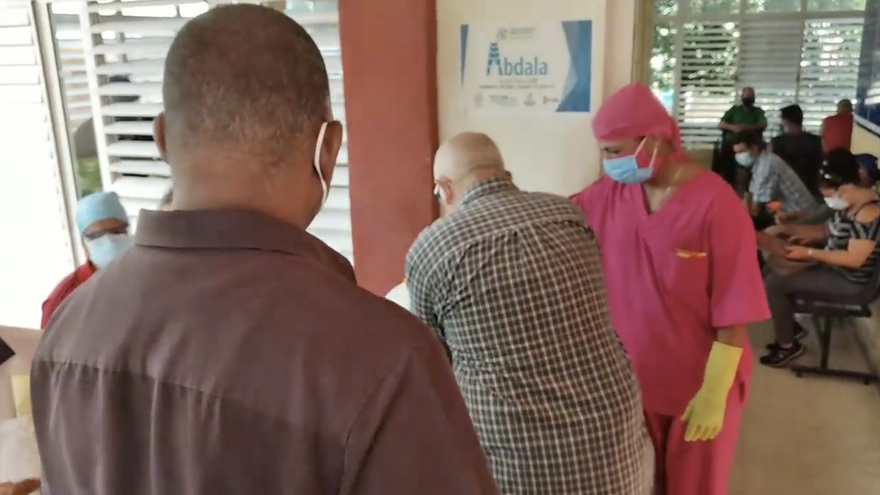
This newspaper has not been able to verify that the Ciego de Ávila population or people in any other part of Cuba has been inoculated with Chinese drugs as of yet, but a delay in vaccination with the Cuban Abdala has been verified, which apparently only applies to the rate planned for the city of Ciego de Ávila and the municipality of Morón.

In several calls made by 14ymedio to polyclinics in Chambas and Ciro Redondo, health workers confirmed that the only vaccine being used is the Abdala, but not for the general population, but rather pregnant and postpartum women. With regards to the Chinese vaccine, they claim to know nothing.

In several communities of the rural municipality Primero de Enero, vaccination with Abdala has been postponed for a week. This Tuesday, when they were to start in some cooperatives, it was announced that immunization is postponed until tomorrow.

“They are going to vaccinate 30 people a day, no more,” a resident told this newspaper. “And we even have to prepare a snack and food for the health personnel,” he complains, while pointing out that the Government does not guarantee the feeding of the doctors and nurses who will vaccinate.

The extreme situation is experienced on all fronts and not only in hospitals. There is a lack of capacities in cemeteries, it takes time to transfer patients, the tests are analyzed with a slowness that leaves infections uncontrolled, and that collapse only generates more and more cases.

Maria Elena Soto, head of the Department of Primary Health Care of the Ministry of Public Health, announced this Monday that immunization in the capital had concluded after having injected 1.3 million people with Cuba’s vaccines, Soberana and Abdala, including all pregnant women. According to the data provided, which will be expanded on Tuesday on the Roundtable television program, 23% of Cubans over the age of 19 have received the complete series of vaccinations and the goal is to continue with children and adolescents.

According to two doctors consulted by the state agency Prensa Latina, the majority of those vaccinated have not had adverse effects and have not suffered from Covid in a serious way, although there is no data yet to support their beliefs. The truth, according to official figures, is that more than 50% of Havanans who had received all doses of the vaccine were infected with coronavirus, unusual numbers in other countries. But it is not known how many of them had severe Covid or were hospitalized.

This Wednesday, the total number of reported cases, with yesterday’s data, is 9,629, and it is already the third day in which more than 9,000 cases have been reported. The deceased were 80, for a total of 2,993 confirmed deaths so far, always according to official figures that some organizations consider far below reality.

Cuba, with a population of 11.2 million people, currently has an incidence rate of 1,111 cases per 100,000 inhabitants and the triumphalist tone of Díaz-Canel himself has collapsed. “We will have difficult weeks” in which “much remains to be done and we cannot allow mistakes,” he wrote in a tweet this Tuesday.

____________

COLLABORATE WITH OUR WORK: The 14ymedio team is committed to practicing serious journalism that reflects Cuba’s reality in all its depth. Thank you for joining us on this long journey. We invite you to continue supporting us by becoming a member of 14ymedio now. Together we can continue transforming journalism in Cuba.

More than 187,000 Cubans Participated in 584 protests During July

A young man is arrested by police and State Security agents during the July 11 protests in Havana. (Capture)

14ymedio bigger14ymedio, Madrid, 2 August 2021- – The massive demonstrations of July 11 “transformed Cuba”. The latest report of the Observatorio Cubano de Conflictos (OCC/Cuban Observatory of Conflicts) is conclusive in this regard: more than 187,000 Cubans participated in a total of 584 demonstrations throughout the island last month.

Not only has the number of protests in Cuba increased, notes the Miami-based NGO, but, above all, the number of people involved in them. The growth is dramatic compared to June, when 1,600 Cubans took to the streets in 249 protests, most of them small acts by a few or one individual.

“The public has been incubating a deep resentment fueled by the indolence of the authorities in the face of growing misery and their disastrous management of the Covid-19 pandemic,” says the Observatory, which notes that the song Patria y Vida “galvanized this sentiment on a national scale and became an anthem of national insubordination.”

Faced with this, the organization denounces, the response was “police and paramilitary brutality… The repressive method is continue reading

no longer a surgical one against organizations and dissidents but a massive one: neighborhood raids, beatings, expeditious sentences,” details the OCC, which includes the figures of detainees from Cubalex and Human Rights Watch: 745 people.

“The military caste has found that the citizenry has lost its fear of the repressive apparatus, so now they turn to terror,” the report says. “This is a war against all the people.”

The Observatory points out that of the protests in July, 435 (74%) were related to political and civil rights, and the remaining 149 (26%) were linked to the demand for economic, social and cultural rights.

It also highlights the “public break of renowned artists with legal trade union institutions (UNEAC), the denunciations of relatives and friends in support of the prisoners and disappeared, as well as the graphic documentation of repressive brutalities” in the second half of the month.

Translated by: Hombre de Paz

____________

COLLABORATE WITH OUR WORK: The 14ymedio team is committed to practicing serious journalism that reflects Cuba’s reality in all its depth. Thank you for joining us on this long journey. We invite you to continue supporting us by becoming a member of 14ymedio now. Together we can continue transforming journalism in Cuba.

Eliminating Price Controls on Agricultural Products In Not Enough, Say Two Cuban Economists

Price controls reduce earnings in the private sector, already hit hard by Covid-19 restrictions. (14ymedio)

14ymedio bigger14ymedio, Havana, August 2, 2021 — The Cuban government is walking back the price controls it had put in place during the first half of 2021. A new resolution published on Friday voids measures adopted in February and April that limited how much private-sector producers could charge for agricultural products and for certain items (taro, bananas, sweet potato, mango, guava, papaya and tomato) destined for “social consumption” (crops farmers are required to sell to the state).

The Ministry of Finance and Prices announced that the current decision was made as a recognition of agricultural producers’ current costs and with the goal of “stimulating an increase in production.” It acknowledges the need to “create better conditions for price agreement and contracting with producers, both for social consumption and for sale in the retail market.”

The complex formulation is a veiled admission that the measures taken since January had failed to encourage production by capping prices, which in most cases prevented producers from continue reading

recouping their operating costs.

Private-sector price controls on agricultural products, which took effect in mid-February, were set by provincial and municipal councils, and could not be exceeded by more than double.

Another resolution was passed in April that imposed price controls on the collection and purchase of agricultural products for social consumption, medical diets, family service programs and industry have now also been lifted.

However, prices for all other products will remain capped in an effort to contain “abusive and speculative prices,” says the ministry.

Cuban economist Pedro Monreal supports the measure though he believes the decision to do away with price controls reflects the realization that they were not effective in the early months of 2021 at controlling inflation caused by currency unification.

Monreal argues that price controls could have a favorable impact if combined with support for private farmers and subsidies for poor families that do not have the resources to feed themselves.

“The sequence in which price caps on agricultural products were lifted was not done properly but that could be remedied relatively quickly with measures to support private agricultural producers. The effect would not be immediate. Magic doesn’t work in economics,” he says.

After analyzing the data from several provinces, Monreal found that in some cases there were increases of more than 30%, even after January when currency unification had already made prices substantially more expensive. “The demand for food is ’inelastic’. People must eat and rising prices do not substantially reduce the demand for food. People cut back on other things to buy food. As a result, changes in supply have a large effect on prices,” says Monreal.

Elias Amor Bravo, a Cuban economist based in Spain, welcomes the government’s about-face but believes it is too limited. “Why lift price controls only on those agricultural products and not for prices in general?” he asks on his blog, Cubaeconomía. “Is it that the government wants to pay its providers less because it has less money to spend?”

“Fragmenting the market and deciding who can and can not make allocations based on supply and demand… is a serious mistake with very negative consequences for related prices, rents, income and costs,” he adds.

Another related resolution was announced on Friday in the Official Gazette. It lifts customs duties on entities importing inputs and raw materials for non-state companies and cooperatives though it does not appear to apply to self-employed workers.

The text of the resolution reads, “The objective is to reduce costs and stimulate production of goods and the rendering of services by non-state forms of management.” Amor wonders, however, why such duties are not lifted from all imported goods if that is the goal. In his words, “Patches go only so far.”

____________

COLLABORATE WITH OUR WORK: The 14ymedio team is committed to practicing serious journalism that reflects Cuba’s reality in all its depth. Thank you for joining us on this long journey. We invite you to continue supporting us by becoming a member of 14ymedio now. Together we can continue transforming journalism in Cuba.

South African Medical Students in Cuba Barely Have Enough to Survive

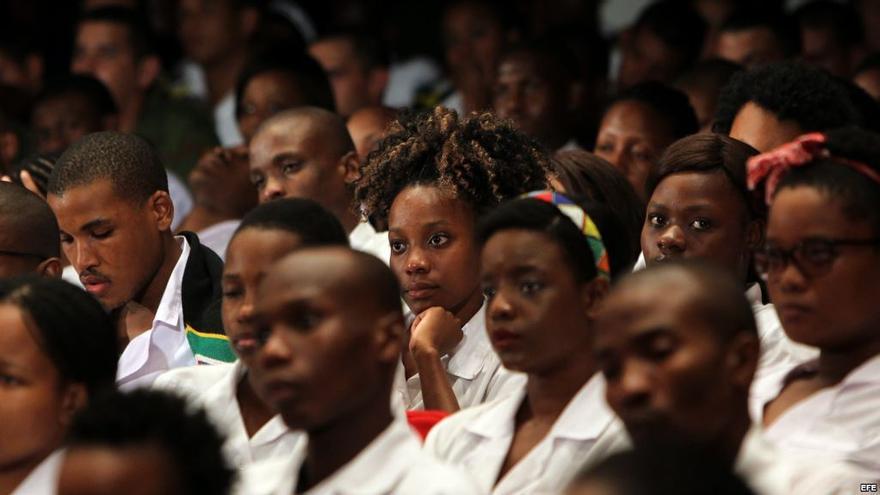
The South African medical students were scheduled to travel home last year, but that did not happen. (EFE)

14ymedio bigger14ymedio, Madrid, 2 August 2021 — The Democratic Alliance (DA) party of South Africa, opposed to the Government, asked the South African Department of Health on Monday to take the necessary steps to return to their country 500 medical students stranded in Cuba in deplorable conditions.

The young people, who completed their fifth year of career on the island, barely survive on the bare minimum, News24 published.

The students were scheduled to travel back to South Africa last year, but that did not happen. In June, the local media reported on the critical situation of some young people, who in some cases even “had to sell their clothes to get money” because they did not receive the stipends that the government of their country was continue reading

supposed to send.
Medical studies in Cuba for South Africans last six years, including a preparatory year for Spanish language classes. During this period, they are allowed to go home twice on vacation.

The students told News24 that the Health Department refused to organize commercial flights and their departure was postponed until August 5.

The spokesman for the Department, Popo Maja, insisted that two charter flights had been guaranteed to take the young people back at the end of July, but that the flights were delayed “because the students demanded that they be paid their stipend before boarding the flight.”

“The stipend has not been paid due to challenges in the transfer of funds to Cuba, which are beyond the control of the department,” Maja excused himself, while assuring that the matter was “being addressed” with the Department of International Relations and Cooperation and the Treasury.”

“The government’s argument is that international payments to students go through the financial systems of the United States and, as there is an embargo on Cuba, the money has been paid but has not reached the hands of the students,” Deputy DA Haseena Ismail said on Monday, calling what is happening government “mismanagement and planning”.

Ismail noted that “the Nelson Mandela-Fidel Castro Medical Collaboration Program was established to provide students from poor and disadvantaged backgrounds the opportunity to study in Cuba with full scholarships,” but that “it has been plagued with failures since its inception, leaving students stranded in a foreign country without sufficient stipends, poor quality accommodation and food, and limited access to essential items such as toiletries and sanitary napkins.”

The deputy asserted that the South African government cannot continue to send students to the island “just to leave them with the minimum necessary to survive.”

Already last March, the South African press had reflected the precarious situation of the scholarship recipients, reporting that government sources maintained that to say that the program was not working as planned was to put it mildly.

“The dream (…) has turned into a nightmare due to the doubling of food prices in the socialist country, terrible living conditions and lack of access to sanitary articles,” The South African said at the time.

The South African government had to take action and send food after initially telling families to send suitcases of food.

The medical exchange agreements between the Island and South Africa come from 1997 and include the sending of professionals to the African country, the purchase of medicines from BioCubaFarma and the training of health workers on the Island. It is estimated that as a result of these agreements more than 1,500 South Africans have graduated from Cuban universities.

Be that as it may, Cuban cooperation in South Africa has been a source of scandals for more than a year, the most serious of which is that the South African Armed Forces invested more than 17 million dollars in illegally importing interferon alfa-2b, alleging they feared the coronavirus could be germ warfare.

Last July, the South African teachers’ union complained that specialists from the island hired by the Department of Basic Education to train South African teachers earn 800,000 rand a year (almost $56,000), a figure much higher than the salary paid to local teachers.

The complaints joined those of local doctors and engineers, who were also underpaid relative to their Cuban colleagues, through controversial agreements. Engineers from that country denounced at the time the hiring of Cuban specialists who are not even authorized to assist the Department of Water and Sanitation.

The unions had access to the agreements, which reveal that Cuban engineers cost almost $22,000 more a year than local workers, who even have to supervised by them, especially in a country with unemployment of more than 30%.

Good relations between Cuba and South Africa began with the rise to power of Mandela, but have continued seamlessly with his successors, Thabo Mbeki (1999-2008), Jacob Zuma (2008-2018) and the current president, Cyril Ramaphosa.

____________

COLLABORATE WITH OUR WORK: The 14ymedio team is committed to practicing serious journalism that reflects Cuba’s reality in all its depth. Thank you for joining us on this long journey. We invite you to continue supporting us by becoming a member of 14ymedio now. Together we can continue transforming journalism in Cuba.

Second Class Citizens in Cuba

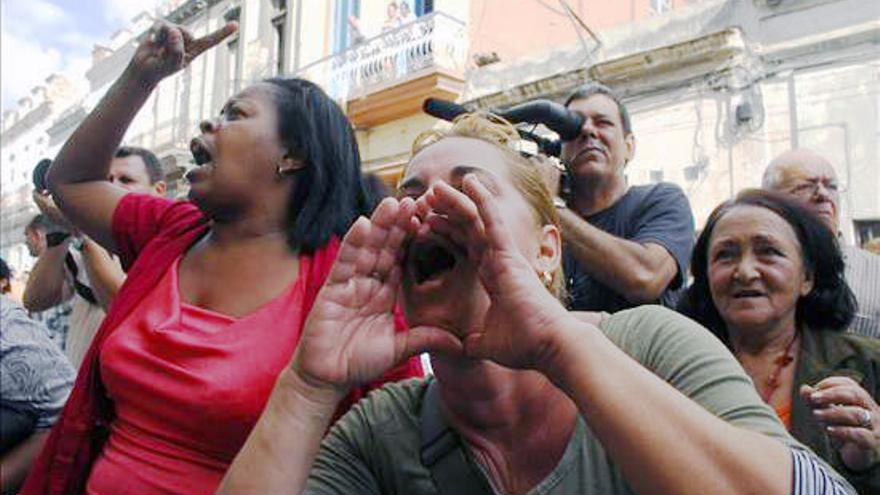
A government supported Rapid Response Group carries out an act of repudiation of the Ladies in White. (Cubasindical)

14ymedio bigger14ymedio, Karel J. Leyva, Montreal, 1 August 2021 — Citizenship is a condition of civic equality. It is a status of belonging to a political community in which all citizens have the possibility of establishing jointly and under equal conditions both the terms of social cooperation and the collective goods that derive from political association.

Citizenship requires a political framework in which all citizens are treated impartially, regardless of their ideological conceptions, economic situation or degree of social influence. To do this, citizens must be able to conceive themselves not only as equals to each other, but as belonging to the same State. They must also be treated as rationally autonomous beings, that is, endowed with a rational agency that enables them to publicly deliberate on their concerns and interests.

These conditions of citizenship are weakened from the moment a government defends a specific political doctrine and divides the population, giving preference to sectors that adhere to this doctrine. This is precisely what the Cuban government has been continue reading

doing for far too long now.

There is no civic equality when calling those who reject the demand to adhere unconditionally to the political ideology preferred by the State mercenaries. By treating its detractors as influenced, manipulated, confused or oriented from the outside, the Cuban Government not only delegitimizes the demands of freedom and democracy from broad sectors of the population, denying the very essence and the exercise of citizenship, but also denies the ability of the Cuban people to think for themselves.

The Government of Cuba has a moral duty to facilitate citizen participation in the political and social processes that determine the present and the future of the Cuban nation. Such participation would make it possible for citizens, without distinction of ideology, beliefs and interests, to shape the political and economic framework capable of defining the quality of life of the Cuban people.

Citizens, to understand themselves as such, must be able to openly debate the problems that affect them directly or indirectly on equitable terms. Instead of using dichotomous categories that establish artificial divisions between the revolutionary people and the counterrevolutionary ’little groups’, between patriots and traitors, between decent and vulgar people, between people who love and people who hate, the Government of Cuba has a moral obligation to respond to the concerns and interests of all Cubans.

The State does not belong to a specific group, nor should it be identified with a particular ideology or political conception that alienates a part of the population.

The way in which a state treats its people determines not only the perception that individuals have of themselves, but the perception that such individuals have of others. the very principle of citizenship will be seriously compromised as long as some citizens feel supported by the Government to publicly repudiate others; as long as a part of the citizenship considers that the ideology they defend authorizes them to exclude dissidents from political processes; and as long as some are socially stigmatized for dissenting and others applauded for agreeing.

Being citizens implies the right to have rights as members of a political community. Such rights — understood as legitimate claims that individuals can make both to others and to their Governments, with the purpose of being treated in accordance with certain standards of decency — must be inscribed in the very nature of social relations on a basis of respect and equality.

A government that puts wooden clubs in the hands of its supporters to repress those who defend their rights not only violates the latter; it violates the very nature of citizenship.

By legitimizing two categories of citizens established according to the degree of affiliation to the political ideology preferred by the State, the Cuban Government sends a message of exclusion and unequal treatment to the Cuban people.

This message clearly states that some people are not full members of the political community, that they cannot speak out publicly on an equal footing with others, and that their interests are not adequately represented by the political institutions of the nation.

In this way, the Cuban political regime treats a part of the population, those who disagree, as second-class citizens.

____________

COLLABORATE WITH OUR WORK: The 14ymedio team is committed to practicing serious journalism that reflects Cuba’s reality in all its depth. Thank you for joining us on this long journey. We invite you to continue supporting us by becoming a member of 14ymedio now. Together we can continue transforming journalism in Cuba.

Mathisa’s Brand New Plant in Cuba Cannot Distribute Half a Million ‘Intimates’

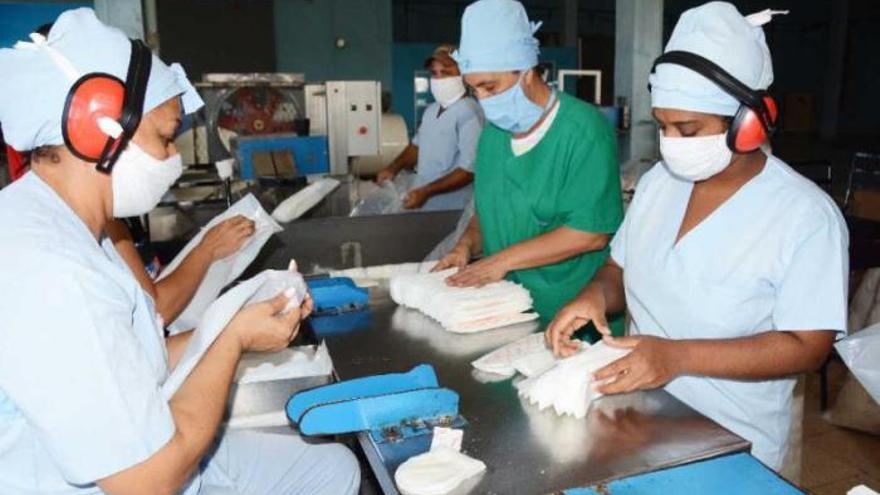
At the new Mathisa facilities, 72,000 packages of sanitary pads are manufactured per month, which, however, do not reach the users. (Escambray)

14ymedio bigger14ymedio, Havana, 2 August 2021 — The sanitary pad factory of the state monopoly Mathisa has “a luxurious reception, offices with the required comfort, impeccable bathrooms and lockers and a dining room that resemble the best of restaurants,” but in its warehouses there are 432,000 packages of “intimates” that do not reach Cuban women due to the lack of distribution.

On Sunday, the newspaper Escambray dedicated a report to The resurrection of Mathisa, a text accompanied by several photographs in which it spares no praise for the completion of the works begun in 2018 at the plant, located in Sancti Spíritus, which have allowed the renovation of its installations.

Seven paragraphs to explain what the facilities are like, the “modern machinery” and the new work organization which allows 72,000 packages of sanitary pads to be manufactured each month, which, however, do not reach the users.

“As long as they are not delivered to the customer, it will be impossible to continue the productive rhythm and, therefore, economic procedures are affected, such as the payment of debts to suppliers and the settlement of our accounts, continue reading

among others,” Mireya Gómez Saya, director of the plant, is quoted as saying at the end of the article.

The sanitary pads manufactured by Mathisa mainly supply, through the Medicines Marketing and Distribution Company (Emcomed), the pharmacies of Matanzas, Cienfuegos, Villa Clara, Sancti Spíritus, Ciego de Ávila and Camagüey; although sometimes they are sent to other areas of the Island.

Gómez Saya maintains that there have been specific problems in the supply of raw materials, but that this is not the greatest of the difficulties. His words now corroborate the version obtained by 14ymedio through a worker at the Pétalos factory who, last February,, attributed the shortage of “intimates” to distribution in Cuba: “They come here to collect them to distribute in pharmacies, and there is no problem in production. The problem is in transporting them, I believe they have no fuel,” she revealed to this newspaper.

The events were confirmed by an Emcomed worker, who maintained that there were “transport problems.”

The problems have accumulated since October, when pharmacies in Havana stopped receiving this staple product, which is sold through the rationed market. The situation was not unique to the capital. In Santiago, shortages were also pressing. “Women are making do with Pampers. The other day I saw a few buying diapers, which caught my attention, and then I learned that they were making sanitary pads from them,” a young woman told this newspaper.

In Cuba, each woman between the ages of 10 and 55 receives through the rationed market, for 1.20 pesos, a monthly package with 10 “intimates” of the Mariposa brand and manufactured by the state monopoly Mathisa. It is a product with a very bad image, not only because it does not reach the public but because of its quality. Among Cuban women, there is constant criticism of its low absorption capacity, its discomfort, and even the lack of glue to adhere to underwear.

In Cienfuegos and Ciego de Ávila there were the same cases of lack of distribution. In this last province, Cuban television even warned of the problems that were taking place, because even the 10 sanitary pads that the State presumably guarantees are insufficient according to the medical recommendations to change them every four hours.

Instead, the black market has a wide variety of products – from pads and tampons to menstrual cups – with prices that are double or triple those of even hard currency stores themselves.

Nothing has been resolved in the five months that have passed since the 14ymedio note on the subject, and nine months since the product began to be missing and the packages are still far from their consumers.

____________

COLLABORATE WITH OUR WORK: The 14ymedio team is committed to practicing serious journalism that reflects Cuba’s reality in all its depth. Thank you for joining us on this long journey. We invite you to continue supporting us by becoming a member of 14ymedio now. Together we can continue transforming journalism in Cuba.

Calls for More European Involvement in a Transition in Cuba

The CTDC has told the EU that the Cuban government must grant amnesty to all political prisoners and prisoners of conscience. (EFE)

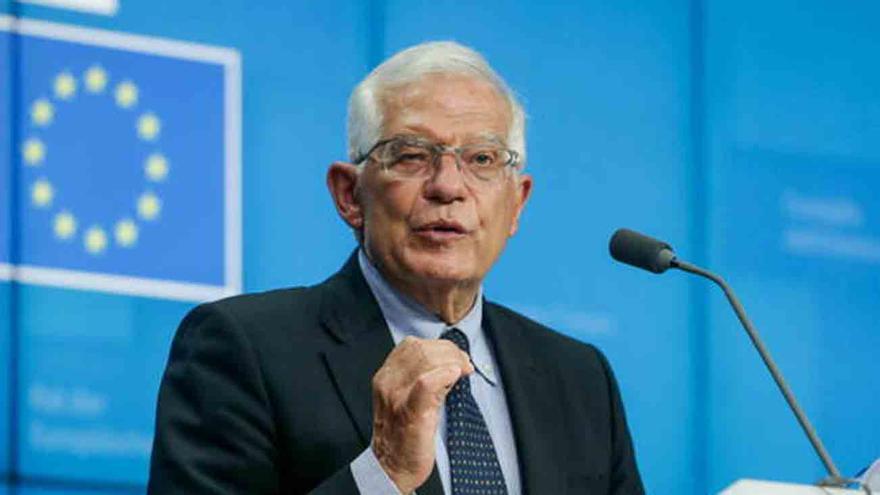
14ymedio bigger14ymedio, Havana, August 1, 2021 — In an open letter to the European Union’s High Representative for Foreign Affairs, Josep Borrell, the Council for Democratic Transition in Cuba (CTDC) called upon the union to prepare an action plan to promote a peaceful democratic transition in Cuba. To keep this agreement in force, it also urged EU to call upon the Cuban government to grant amnesty to all political prisoners and prisoners of conscience.

The letter acknowledges EU support in calling upon the Cuban government not only to free Cubans who peacefully expressed their points of view on July 11 but also to grant amnesty to political prisoners and adopt “political and economic reforms that would relieve the Cuban people of their suffering.”

Additionally, the council calls for “immediate and unconditional freedom, without charges, for all July 11 detainees,” as Josep Borrell, speaking on behalf of the EU, requested on July 29 when he urged the Cuban government to “listen to the voices of its citizens and engage in an inclusive dialogue about continue reading

their complaints.”

The same EU statement also noted that the July 11 protests reflect “popular grievances” over shortages of food, medicine, water and electricity, as well as the denial freedom of expression and of the press “in parallel with the Covid-19 situation.” It argues that these grievances have created “an increased demand for civil and political rights and democracy.”

The CTDC calls upon the government “to accept the creation of Commission for Investigation and Control which will allow the EU to to monitor the unrestricted and unconditional human rights compliance in accordance with the Control Clause in the Agreement of Political Dialogue and Cooperation signed between the European Union and Cuba in December 2016 and provisionally applied since November 1, 2017.” It also calls for “legitimizing an Observation and Scrutiny Committee of the Political Dialogue and Cooperation Agreement of civil society within Cuba.”

On Thursday Borell asked for a relaxation of current EU restrictions on sending foreign currency remittances to Cuba. EU countries have already considered lifting all restrictions on the amount of food and medicine travelers can take into Cuba, which Borell characterized as “a step in the right direction.”

In its letter to Borrell, the CTDC points out, “The Cuban government has flatly refused to accept the 2017 resolution in which the EU reaffirmed its position on democracy, universal human rights and fundamental freedoms. It is clear that, in light of recent events and the lack of will on the part of the Cuban government to respect its commitments, it is necessary to open a broad and updated discussion on the purposes, nature and validity of the agreement. ”

The Cuban government had its own response to the EU’s position. President Miguel Díaz-Canel and his foreign minister, Bruno Rodríguez, accused the European Union of lying, manipulation and slander after the organization on Thursday expressed support for Cuban demonstrators after the July 11 protests and called for the release of detainees.

Rodriguez vigorously rejected the statements by the EU’s High Representative for Foreign Affairs and, in a tweet, demanded Borrell “deal with the brutal police repression in the EU,” without providing further details.

In his written statement he also criticized Borrell for “not daring to mention by name the genocidal US blockade that violates European sovereignty and imposes on the Union its laws and courts.”

____________

COLLABORATE WITH OUR WORK: The 14ymedio team is committed to practicing serious journalism that reflects Cuba’s reality in all its depth. Thank you for joining us on this long journey. We invite you to continue supporting us by becoming a member of 14ymedio now. Together we can continue transforming journalism in Cuba.

Padura: ‘Cuba’s Problems Must be Resolved Among Cubans’

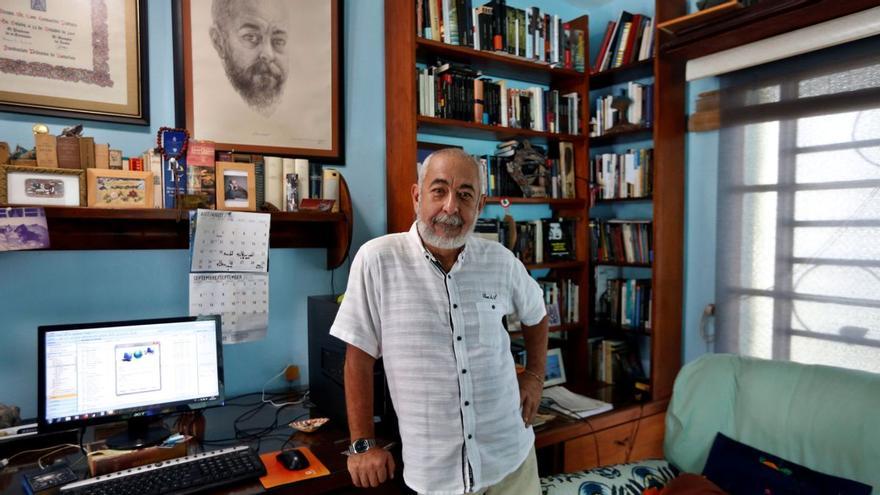
Padura at his home in Mantilla, the Havana neighborhood that saw him grow up, also as a writer. (EFE)

14ymedio biggerEFE (via 14ymedio), Lorena Cantó, Havana, August 2, 2021 — The Cuban writer Leonardo Padura, winner of the 2015 Princess of Asturias Prize for Literature, considers his novels “some of the most radical documents that could have been written” about a Cuba today in turmoil, whose problems “must be resolved among Cubans.”

“I believe that my novels, that were written and many of them published in Cuba, such as The Man Who Loved Dogs, Heretics, and A Novel of my Life, are among the most radical documents that could have been written and said about this country. And that gives me much peace of mind,” says the author in an interview with EFE.

At his family home in the Havana neighborhood of Mantilla, three weeks after thousands of people took to the country’s streets to protest shortages and demand freedom, Padura reflects on the extreme polarization that the island is experiencing, which he hopes “can be resolved among Cubans,” including those in exile.

“I frequently receive attacks from one extreme or the other, because continue reading

I try to be fair and speak of truths about which there is a certain consensus. You already know that truth is not absolute; what is absolute is the lie. And in none of my texts, whether in my novels or my journalistic works, do I need the lie to talk about Cuba,” he says.

And it is also correct to say that “when someone wants to criticize Cuba they don’t have to exaggerate, they only have to tell the truth.”

“I’m at peace with myself. I can’t satisfy all points of view. I don’t want to place myself at any extreme; I’m very afraid of fundamentalisms and extremes because they start from the position that their argument is the only possible argument, and I think there is always more than one argument and you should have a dialogue between these arguments,” he says.

Padura was surprised by the protests while he was watching the Eurocup. “Suddenly they cut the transmission and the president (Miguel Díaz-Canel) spoke and I found out what was happening.”

A short time later, the authorities blocked access to the Internet, and the information that came in was confusing and “very distorted, very partial, very aggressive in some cases, and it was hard to find out what was happening,” he said.

His first feeling, which he described the week after the demonstrations in a text published on the La Joven Cuba platform, “was that a scream had come forth from the innermost parts of a society that demanded other ways of managing life in a general sense, and from there entering the economic, the social, the political …”

The unjustified delay in the economic reforms engendered “something that is apparent”: the growth of inequalities and poverty — reflected in the novel The Transparency of Time.

In this context Padura mentions very poor slums in Havana in which “you realize that this is not the country for which we have worked, for which we have dreamed, for which so many sacrifices have been made. We must find solutions for those people . . .”

The demonstrations, in his opinion, channeled the weariness of waiting for a prosperity that never comes, and evidenced the isolation of those in power from the feelings of the citizens.

“So much so that I think they were surprised by that demonstration, because it wasn’t just that people standing in a line started shouting something, it was that in many parts of the country people came out to demand things, to demand freedom for example, and it’s very serious when the people shout demanding freedom.”

The writer is concerned that this feeling “is not being understood and processed in the best way, because there is a social magma in which there are these intolerances and extremes that we spoke of at the beginning, which may be the ones that prevail, and that would be the worst.”

“The violent responses are simply not the cure the country needs; the country is not the same as it was up until 15 days ago. It’s a different country and you have to handle it in a different way,” he says.

He also points out that what happened was already in the making, as demonstrated by the gathering of young artists on November 27 in front of the Cuban Ministry of Culture.

“There they spoke of the need for a dialogue that in the end was met with a few words and very few solutions. And when people ask for freedom of expression, of thought, of opinion, they are asking for something that belongs to them, something that I believe cannot be denied them in any system in any country,” the author emphasizes.

Regarding all those young people who protested on July 11, Padura warns that the “less desirable” alternative is for them to be marginalized or “even imprisoned for their social or political viewpoint” and the prolonged “bleeding” suffered by the Island because many — among them the most educated — end up leaving.

The author, who in 1996 became the first “independent writer” in Cuba, believes that what is happening now will be reflected in his literature, although “maybe not directly.”

I’ve tried to practice my independence and my freedom for many years. I think that for any creator the need for freedom of expression and thought is fundamental,” although with limits regarding “homophobia, xenophobia, the attitudes that are in some way fascist.”

“In addition, life is too short for us to be limiting ourselves in as many things as we have to limit ourselves under the existing social contract,” he concludes.

Translated by Tomás A.

____________

COLLABORATE WITH OUR WORK: The 14ymedio team is committed to practicing serious journalism that reflects Cuba’s reality in all its depth. Thank you for joining us on this long journey. We invite you to continue supporting us by becoming a member of 14ymedio now. Together we can continue transforming journalism in Cuba.

Cuba: Nursing Student, with Covid After Being Vaccinated, Receives no Healthcare

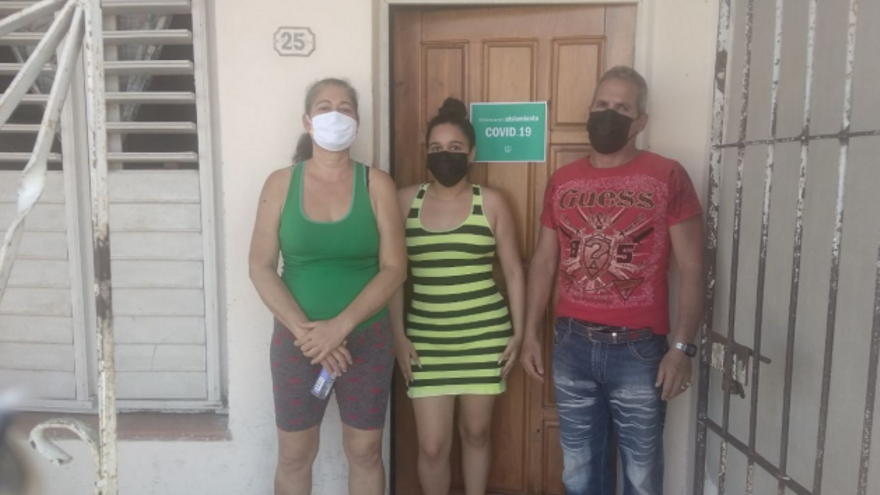
The nursing student, Irasema Escobedo Herrera, is confined at home with her parents by Covid-19. (Courtesy)

14ymedio bigger14ymedio, Irasema Escobedo Herrera, Cumanayagua, 1 August 2021 — My name is Irasema Escobedo Herrera, I am 19 years old, I study nursing and I am infected with Covid-19. I write this text in desperation because no medical personnel are following up with my family and we do not have access to medicines. I tried to post my words on the Facebook page of the Ministry of Public Health, but they censored me.

I have nothing to hide, so I accompany this testimony with my personal data and those of my parents. I live on Calle Orlando Gómez 25, between Calle Rafael Trejo and Artimes, in the municipality of Cumanayagua, in the province of Cienfuegos. When I woke up at home on the morning of July 20, I felt a fever and muscle aches.

I guessed that I was infected and went immediately to the Aracelio Rodríguez Castellón Polyclinic in Cumanayagua. But they had no antigen tests or molecular tests (also known as PCR), although there was a list of more than 400 people waiting. As of Sunday, July 18, these materials had not arrived.

To top it off, there was only one doctor treating people who arrived with respiratory symptoms. Only one for an entire municipality. They put me on a list and told me I could go home. The next day I called early to see if the tests had come but nothing yet. On Thursday I made another call and they finally had the tests.

I hurried over and arrived around 8:30 am, and there were already more than 300 people waiting, some having slept on the benches to continue reading

get a test. As the hours passed, many had to leave without taking the test because the wait was too long. That day there was also only a doctor and one nurse to attend to those suspected of being infected.

Looking at all this, I asked myself “Where are the doctors in my municipality? Where have those hundreds of professionals who graduate annually in my province from the medical and nursing faculties gone? I understood less and less.

Noon passed, three in the afternoon arrived, five o’clock and the line was barely moving forward. There were women with babies in their arms, small children and many old people. Finally at 5:40 pm they did my rapid antigen test. After me there were only 25 kits left and there were more than a hundred people waiting.

My result was positive and I was taken to a room with more than 30 people crowded together. There were several small children and elderly people, bedridden, and we had to wait to do the PCR test. I was finally able to get the test around 7:30 pm. They also filled out a form with my data and as there was no fuel for the buses or taxis, I had to walk back home.

On Saturday, July 24, the doctor from the medical office stopped by our house. When I asked him if I was going to receive any medicine or medical follow-up, he replied that people who are already vaccinated do not receive any treatment. As a nursing student, I have already received all three doses of Abdala, but my parents have not had access to any. That’s why I couldn’t help but ask the doctor what they were waiting for to give us some kind of assistance. AmI going to die? Is that why they sent me home? To die?

On Sunday, July 25, my PCR test was confirmed positive. They put a sign on the door of my house warning that our house had an infected person. My parents, Maité Herrera Peña, 48 years old; and Omar Escobedo del Sol, 50, began to show the first symptoms of the disease.

On Monday the 26th, the polyclinic was given tests again and a group of doctors arrived at our house looking for a certain “Lázara Escalante Herrera,” while my name is Irasema Escobedo Herrera. I do not understand how they can confuse the name of someone who is positive for Covid in that way. Something like this only shows the lack of the organizational level that exists in confronting this pandemic.

They put my parents on a bus and took them to the polyclinic to carry out the test. Upon arrival, the same image of days ago was repeated: more than 400 people waiting, three hours later the kits ran out and my parents had to return without having been tested. This is how they continue to this day, still not tested, and my father already has a cough and shortness of breath when he goes to bed.

The days have passed and they have not brought us any medicine, although the official media repeat all the time that Cuba is a medical power. What medical power do they speak of, when there is not even a pill to lower a child’s fever? What medical power do they talk about when it is not possible to X-ray a person with Covid-19 pneumonia?

I am studying for a Bachelor of Nursing at the University of Medical Sciences of Cienfuegos and I am very disappointed in the whole system and the protocol that is being followed in this pandemic. They cancelled my school vacations and sent me out to investigate possible Covid-19 infections, but they do take care of me and my colleagues. Are we not a priority?

How can they tell me that they are not going to put me on medication because I am not serious yet? Do I need to be seriously ill to receive care? In other words, if I or a member of my family is not about to die, does the country do nothing for us?

On top of that, since we can’t leave the house, we have absolutely no opportunity to go out to buy food, but they haven’t brought us any food supplies either. We have had to survive with some food we have in reserve and the solidarity of neighbors and relatives who leave something for us to eat in the doorway, such as an avocado or a little chicken.

Honestly, I am very disappointed. I urgently need my parents to be given some medication to treat the symptoms. This can not go on like this. I have decided to write and publish this testimony because to help my family I would do the impossible and much more.

____________

COLLABORATE WITH OUR WORK: The 14ymedio team is committed to practicing serious journalism that reflects Cuba’s reality in all its depth. Thank you for joining us on this long journey. We invite you to continue supporting us by becoming a member of 14ymedio now. Together we can continue transforming journalism in Cuba.

Cuba: In Defense of Political Dialogue / Dimas Castellano

Cuban protesters on July 11th.

Emerging civil society has to prepare to deal with the current power or the one that replaces it, and that articulation requires moving through the channels of dialogue.

Dimas Castellano, 13 July 2021 — The recent events of Sunday, July 11, confirm that the Cuban crisis is deepening, that popular discontent is growing and that the Government is unable to solve it. Despite the Cuban president’s discourse, which was literally a call to civil war, the Government will have to accept the participation of Cubans as active subjects, because it is a national demands as well as a demand of foreign institutions and governments.

Given the imminence of the event, the associations of the emerging civil society need coordination to interact with each other and prepare to deal with the current power or with the one that replaces it. Coordination that requires moving through the channels of dialogue.

In the face of social conflicts, the most frequently used solution, in the history of humanity and in Cuba, is the use of violence, which by not removing the causes makes the conflicts resurface, over and over again.

In dialogue, as an art of reconciling interests, the parties, on an equal footing, always have to compromise on something. Those who consider themselves to be in an advantageous position — which is the case of the Cuban government — reject, as it has done, the first calls, but given the worsening of the crisis, continuing to refuse may have a higher price than continue reading

sitting down to dialogue and negotiate.

Why dialogue?

Because it is a form of communication in which two or more interlocutors establish an exchange of information to reach an agreement, for which dialogue is the most viable, safe and positive way.

Dialogue means talking to expose your own points of view, listening to know the opinion of the other and exploring possible solutions to the conflict. Dialogue and flexibility in negotiation enable the disputing parties to gradually resolve differences at the lowest possible cost.

If war is the continuation of politics, as defined by Clausewitz, then politics is the art of conflict resolution through dialogue and negotiation, which does not mean resignation or surrender, but an opportunity for direct communication to clarify positions, policies and proposals for changes.

As a process, dialogue includes efforts prior to negotiation to create a climate of trust, while requiring patience, flexibility, weighing in on the magnitude of demands and their gradual nature. The transformation of any violent conflict towards dialogue requires establishing communication channels between the agents involved, including those who practice violence, whether physical, verbal or moral, as is happening in Cuba against the fighters for freedom of expression.

There are no methods, rather there is only one method for conflict resolution: dialogue and negotiation. In the case of Cuba, although until now it has not yielded the expected results, it retains its validity for relations between the emerging civil society associations, between these with the State-Government Party and between the two with countries or associations of countries, such as the United States and the European Union (EU) respectively.

To be effective, in the case of Cuba, the first demand must be the promotion of rights and freedoms that allow legalized civil society to participate as a protagonist of changes in Cuba. This based on an understanding of civil society as a range of independent and autonomous associations, institutions and resources, which have public spaces and various forms of ownership over the means of production and expression.

Three examples of dialogue and negotiation in Cuba

The Zanjón Pact: After ten years of war, thousands of deaths, suffering and considerable material damage, on February 10, 1878, the Zanjón Pact was signed between most of the insurgent forces in Cuba and the Government of Spain. In exchange for peace, Spain had to implement, in Cuba, the laws related to printing, assembly and association contained in the Spanish Constitution.

The liberation of the slaves who went to war was a death blow for the institution of slavery, and from the freedoms implanted Cuban civil society arose: organs of the press, economic, cultural, fraternal, educational, instructional and recreational associations, unions and the first political parties, all of which served to restart the struggle in 1895.

The Platt Amendment: At the opening of the Constituent Convention, Military Governor Leonardo Wood told the delegates: “It will be your duty, first of all, to draft and adopt a Constitution for Cuba and, once it is finished, to formulate what should be, your judgment, the relations between Cuba and the United States.”

The commission designated for the formulation of relations, after exhausting all attempts to prevent the inclusion of the Platt Amendment, agreed to add it to the Constitution by 16 votes to 11 . The Platt Amendment endorsed the right of another country, the United States, to intervene in Cuba, omitted the Isle of Pines from the limits of the national territory and imposed the sale or lease of land for foreign naval bases.

The delegates had two options: violence or negotiation. The first, which meant suicide, implied indefinite occupation and the need to declare war on the United States. Cuba was now without the party of José Martí, who had died in combat, the Liberation Army had been demobilized, the economy was dependent on others and the island had not crystallized as a nation. In short, the country was plunged into desolation and ruin, and national self-esteemed had been weakened by years of military occupation.

The second option, negotiation, meant that, once signed, the Army of occupation withdrew, and the Republic was founded. Not the one we want, but the possible one. Sovereignty over the Isle of Pines was recovered; Civil society developed and the Platt Amendment was repealed.

The Constitutional Convention of 1940: Between 1902, together with the advances in the economic sphere, the country was immersed in conflicts over re-elections, which caused the Guerrita of 1906 and the uprising known as La Chambelona, in 1917; the massacre of thousands of black and mulatto members of the Partido Independientes de Color in 1912; and the reform of the 1901 Constitution to extend the power of President Gerardo Machado, which opened the period of struggle that led to the Revolution of 1930.

Those almost 30 years of political instability were followed by another seven until, in 1936, during the presidency of Colonel Federico Laredo Bru, a period of dialogue and negotiation was inaugurated that led to the Constitutional Assembly, where the capacity for dialogue and negotiation between communists, liberals, conservatives and social democrats was demonstrated. Together, they tackled the controversies and the result was the most advanced constitution in the region at that time, which offers a lesson in the value of negotiation for the destinies of nations.

Force is used to win, dialogue and negotiation to solve what is impossible through force, which obliges us to strengthen it as a starting point, as an essential concept, as a guiding principle and as a permanent strategy.