
Regulations Against Horsecarts Aggravate Transport Problems in Artemisa

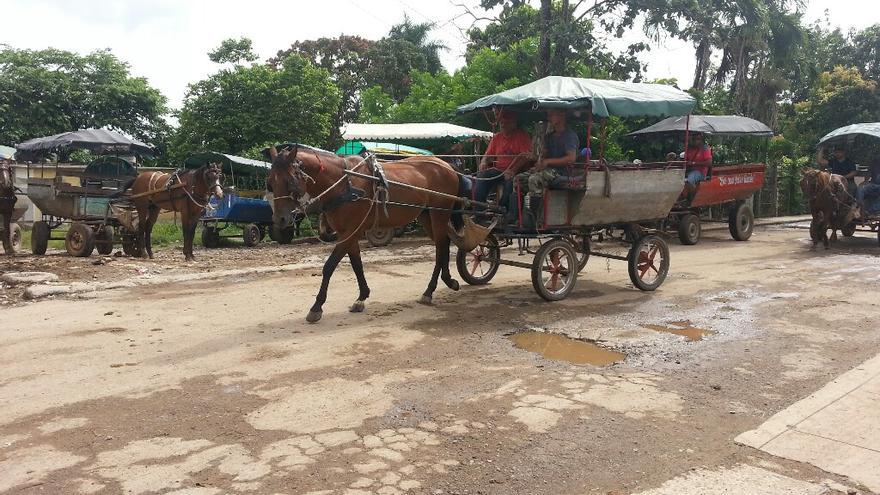
In several municipalities of Artemisa the horsecarts and pedicabs are not allowed to use the main thoroughfare. (14ymedio)

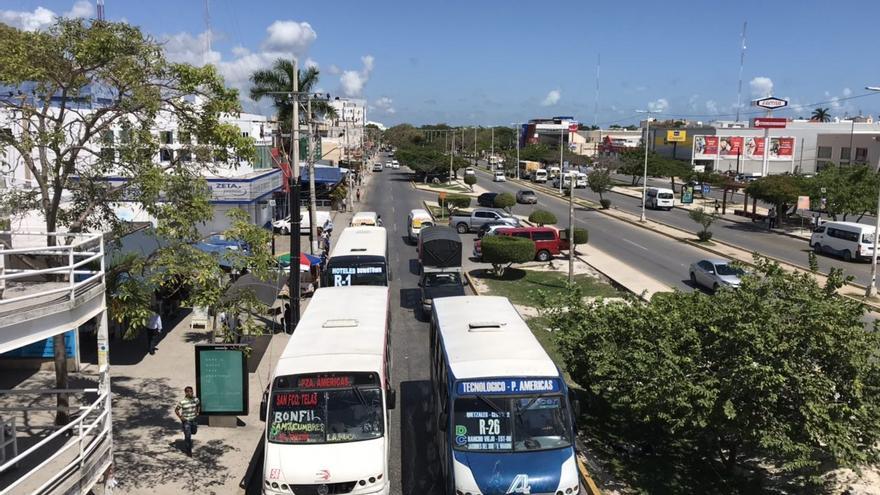
14ymedio bigger14ymedio, Bertha K. Guillén, Candelaria, 15 September 2018 — While horse-drawn carriages are a tourist attraction in the streets of Old Havana, in the municipalities of Candelaria and San Cristóbal, in the province of Artemisa, the authorities impose strict regulations on this popular transport, controls that are worsening the already tense situation of passenger transport.

For more than a year drivers have been forced to travel away from the main avenues, and instead make their way through unmarked alleys in poor condition. Now they must carry out their work almost “secretly,” several of them have reported to 14ymedio.

The thousands of customers who use this form of transport every day also feel that they have gone underground. In a province where very few buses travel the streets, most Artemiseños interviewed say they use these animal-drawn vehicles at least three times a week. continue reading

In 2016, the director of the Provincial Transport Company, Juan Carlos Hernández, said that 150 public transport vehicles covering 143 routes circulated in the province, but two years later many of these vehicles have deteriorated or gone out of circulation, according to sources from the company speaking to this newspaper.

Along with this deterioration, the authorities of the area have launched a crusade against horsecarts under the pretext of avoiding bad smells and traffic accidents. The Provincial People’s Power bodies, together with the National Revolutionary Police, also want to avoid having crowds of people waiting to board these vehicles.

Among the measures adopted, carts and pedicabs have been prohibited on the Central Highway, a decision that pushes the carriers and their passengers to explore alternative routes. “What should have been something to improve the quality of life of the residents, actually has become a headache,” laments Yaima, who on Monday uses the carts to get to the polyclinic where she works.

The young woman pays three Cuban pesos (CUP — about 12 cents US) for each trip, which means a monthly cost of about 120 CUP alone in transportation to reach her job; a significant share of her monthly salary which is around 900 CUP. “If I do not travel that way, I do not arrive on time because public transport can not be trusted, it comes along when it feels like it,” says the nurse.

“The measure to kick us off the Central Highway was taken about a year ago” Eugenio, a coachman in the area, tells this newspaper. “Since then people complain because they have to walk more to get to the carts and because the prices went up because now many segments are longer and the streets where we are traveling are in worse condition.”

In the province of Artemisa some 4,567 animal-drawn vehicles have been documented so far, most of them dedicated to passenger transport, according to official sources. However, this figure only reflects those who have a license to exercise this service, while an increasing number of vehicles circulate illegally.

For their part, the self-employed workers who are licensed to work in the sector complain that their needs are not taken into account. “They almost always make us look like the bad guys in the film by charging three pesos for each segment, but nobody calculates the cost of keeping the animal fit,” adds Eugenio.

The coachman regrets that there is no state workshop to fix this type of vehicle, or a market to “buy tires and other spare parts” at a price that is within reach of their pockets. “They ask a lot of us, they control us everywhere but when we demand our rights they do not listen to us.”

So far this year, the Candelaria Municipal Administration Council together with the traffic police and other authorities have had at least two meetings with these workers to analyze their complaints and also those expressed by their passengers. In each meeting, the parties have not been able to reach an agreement.

“They claim that because they’ve eliminated the payment of 10% of revenues at the end of each month, we can charge less to passengers, but they still do not take into account the prices we pay to keep these vehicles rolling,” says Sergio Martinez, another Artemiseño coachman artemiseño.

These self-employed carriers must pay about 186 CUP to obtain the license, to which is added the transit and veterinary permits that are paid monthly. The purchase of a horse cart can come to about 10,000 Cuban pesos and each year the drivers must pay their personal income taxes.

“It does not matter if it has been a bad season, the authorities assume that someone in this job earns a lot and when the tax return is filed many of us get the fines for alleged tax evasion,” laments Mario Nordelo, with more than two decades in the guild.

Earlier this year the National Tax Administration Office (Onat) reported that it will perform 5,500 “in-depth” control actions, including tax audits, in order to detect tax evasion, and to determine with “greater rigor” the debts and penalties and request the application of administrative and criminal measures.

In 2017, Onat detected that more than 60,000 taxpayers — 35% of those who paid self-employment taxes — reported and amount lower than their actual earnings on their personal income tax declaration for a total amount of some 563,000,000 Cuban pesos (CUP).

“Taxes and fines do not let us live,” says Nordelo. “I know coachmen who have had to pay up to 15,000 CUP in fines in a single year and others who have suffered the confiscation of their vehicle and their animal.” The self-employed transport provider thinks that “although many times the responsibility falls on the coachman due to some imprudence, what the authorities are trying to do is to end this service.”

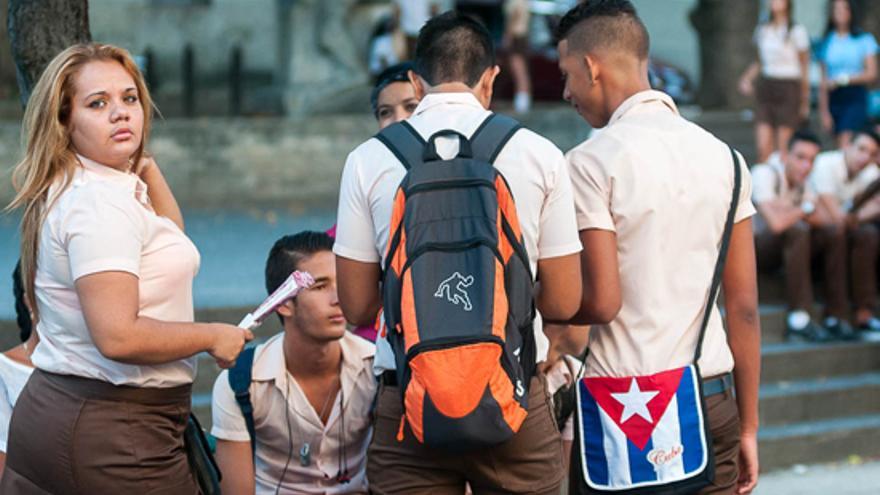
In San Cristóbal, Arsenio Ramírez repeats his routine several times each day. He arrrives at the stop where the customers wait and there he waits until ten people get into the vehicle. “Many people depend on me to arrive on time,” says the coachman in front of a row of teenagers in school uniforms and several doctors in white coats. Four primary schools, a high school and a nursing faculty are located on his route.

“When they made us travel about five blocks away from the Central Highway, we created a union to complain to the Communist Party, but they threatened us with the police and we had to give in,” Ramírez told 14ymedio. “We have organized to clean the area where we park and avoid the urine of the horses being an annoyance, but the police always have a reason to bother us,” he complains.

In recent years there have been numerous strikes and protests by coachmen throughout the island. In all cases the drivers have demanded an improvement in working conditions, tax reductions and permission to travel through the more central streets.

 _____________________________

The 14ymedio team is committed to serious journalism that reflects the reality of deep Cuba. Thank you for joining us on this long road. We invite you to continue supporting us, but this time by becoming a member of 14ymedio. Together we can continue to transform journalism in Cuba.
Canadian Producer Brings the Story of the “Idealism and Altruism” of Cuba’s “Five Spies” to the Big Screen

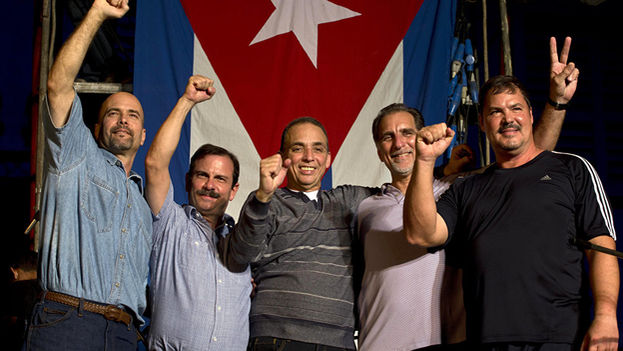
After denying for three years that the five spies were Cuban agents, in 2001 the Cuban Government acknowledged its control over the Wasp Network and led an international campaign for their liberation. (Juventud Rebelde)

14ymedio bigger14ymedio, Mario J. Pentón, 12 September 2018 — The story of the five Cuban spies sentenced to prison in the United States will arrive on the big screen very soon, and twice.

A year after learning that the Frenchman Olivier Assayas had adapted Brazilian writer Fernando Morais’ book The Last Soldiers of the Cold War, the Canadian Pictou Twist Pictures and Picture Plant have partnered with the state-run Cuban Institute of Cinematographic Art and Industry (ICAIC) to bring Los Cinco (The Five) to movie theaters. The film will narrate an “inspiring story of idealism and altruism,” according to Terry Greenlaw, one of the producers, speaking to Variety magazine.

“The Five handed over the rights to their story to the Cuban Institute of Cinematographic Art and Industry (ICAIC), and Pictou Twist, Picture Plant and Conquering Lion Pictures acquired them,” a spokeswoman for those producers said in a statement to 14ymedio. continue reading

The same source told this newspaper that none of the five spies living in Cuba will receive payments for the rights. After their return to the Island (three of them after being pardoned by former President Barack Obama in 2014), the spies became government officials and members of the National Assembly.

In 2014, Obama exchanged the three agents, who had been sentenced to life imprisonment for conspiracy to commit murder, for a US intelligence officer imprisoned on the island. The gesture was accompanied by the restoration of relations between the two countries.

The Cuban-Canadian co-production, with a budget of more than seven million dollars, was inspired by the book What Lies Across the Water: The Real Story of The Cuban Five, by Canadian journalist Stephen Kimber. The film will be shot mainly in Cuba, but also in Colombia and Miami, and production will be finished next year.

Kimber, a fierce defender of the innocence of the five spies, wrote the book after a trip to Havana where a Cuban friend told him that “nothing will change between the United States and Cuba until they solve the problem of ‘The Five’.”

The journalist traveled to Miami, Washington and Havana to gather information about the spies. He also began to meet with them in prison and participated in meetings and conferences in favor of the freedom of the five spies in the United States.

“Receiving Stephen’s letters in prison in 2010 was encouraging for us because we knew he would tell our truth, which we believe he has done through his book,” says René González, one of the five spies.

“We believe that Stephen’s is the best book about The Five, Canadians have become our great friends and we can not think of better partners to help share our history, through cinema, with the world,” he added.

In Miami, however, the reactions to the movie have not been as warm. Orlando Gutiérrez Boronat, president of the Democratic Directorate, a group of anti-Castro organizations, said it was “an infamy.”

“You can not rewrite history that way, the real heroes were the four boys they helped to kill,” Gutierrez said in reference to the four Brothers to the Rescue pilots killed by the Cuban military as they patrolled international waters to rescue Cuban rafters.

“You have to read the transcripts of these individuals with their bosses in Havana to realize that there is nothing heroic about them, they are terrorists, of course, and the objective of that group was to commit violent actions against nonviolent opponents of that regime,” adds Gutiérrez Boronat, who was a part of the Cubans in exile who were under surveillance by Cuban intelligence agents.

The second film dedicated to the five spies will be called Wasp Network and will be directed by the Frenchman Olivier Assayas. The film will feature the performances of the renowned artists Gael García Bernal and Penélope Cruz.

Morais, a journalist and author of the book on which the film is based, investigated the case of the five Cuban spies and published his book in 2012. From the beginning he tried to show an independent perspective of Havana that included not only ‘The Five’ but also to other nine characters of the Wasp Network who collaborated in the United States and some of whom fled to the Island.

Morais has complained that his relationship with the government was not fluid and that he was not always able to interview or access the people he needed for his book.

However, in 2013, surrounded by Luiz Inácio Lula da Silva, then president of Brazil and a close ally of Havana, and Armando Hart and Ricardo Alarcón, Morais presented a translation of his book in Spanish at the Third International Conference for the Balance of the World, a kind of gathering of the internation left in Cuba. At that time, Morais said he hoped to “celebrate the return of The Five to Havana soon.”

“The trial against the spies lasted several months with an irrefutable amount of evidence,” said Mario de la Peña, father of the pilot of the same name who died after the downing of his plane in international waters. “They try to justify sending the spies because they supposedly protected them from violent actions on the part of the exile,” he said.

“Those spies tried to infiltrate American bases and penetrate peaceful organizations of the exile whose only sin was to be against the Castro brothers’ regime,” he added.

“Gerardo Hernández and the others were convicted not only for espionage, but for conspiracy to commit murder. They can write whatever they want now, but the evidence that they are murderers is there,” said De la Peña.

__________________

The 14ymedio team is committed to serious journalism that reflects the reality of deep Cuba. Thank you for joining us on this long road. We invite you to continue supporting us, but this time by becoming a member of 14ymedio. Together we can continue to transform journalism in Cuba.

Apples of Discord, Corruption and Selective Punishment / Miriam Celaya

Cubanet, Miriam Celaya, Havana, 28 September 2018 — For some unknown reason, apples have had an extraordinary role in the cultural imagination of the West. For better or for worse, this fruit has marked milestones that have transcended the passage of time and geographical borders.

For example, in Greek mythology, a golden apple sowed discord between the goddesses Pallas Athena and Aphrodite, a discrepancy that would dramatically influence the Trojan War. For its part, in biblical mythology, an apple was the temptation that drove Adam and Eve to the original sin, for which we have all been punished (blessed sin!).

An old Swiss legend tells that the national hero William Tell had to skewer with an arrow, accurately shot from his crossbow, an apple placed on the head of his son by the tyrant oppressor of his people; while another fable explains how the wise Isaac Newton discovered the law of universal gravity, one of the most important physical-natural phenomena, thanks to an apple that fell directly on his head. continue reading

The apple is a kind of cult object sown in our consciousness since earliest childhood. What child did not know Snow White’s apple? And, as adults, who has not dreamed of visiting that other “Big Apple”, New York, at least once in his life?

The surprising thing is that in XXI Century Cuba these fruits again have become not only central characters, but in the body of the sin of one of the many sagas of corruption that cross Cuba’s harsh daily reality. In recent days, the sweet apple, or to be more exact, 15 thousand apples, have evolved into a temptation much more dangerous than that in the Holy Scriptures.

The case has been sufficiently disseminated by the official press, but it is appropriate to briefly summarize the facts. It is about the allegedly illegal sale, in a retail market in Havana (La Puntilla market in Miramar), of a large number of apples (15 thousand) to “a group of tough youngsters” – according to an aggressive commissioner (allegedly “an exemplary revolutionary journalist”, in the words of the hand-picked President) which aroused the suspicion of the referred to writer, who, unfortunately for the offenders, personally witnessed the transaction.

For a greater sin, “a good part” of these young people were “uniformed” with the American flag. It would have been better if they wore fig leaves, like the primal sinners of the earthly paradise. The President’s favorite journalist was not going to stand for an insolent provocation, such as that of displaying a symbol of the Evil Empire.

That might explain, far from facing the youths to give them an educational talk and prevent the “hoarding” and “the misuse of state resources”— since the buyers bribed the driver of a state minivan to transport their merchandise – this intransigent revolutionary spied on their movements, followed them, carefully pointed the license plate number of the vehicle that transported the 150 boxes of apples “at 100 CUC (roughly $100 US) each box” (what grief this detail caused the combative reporter!), and demanded a copy of the receipt as proof of purchase from the store clerk. Both photographs, the minivan and the copy of the receipt, were published on his personal blog. (“The …something…pupil”), where “someone is watching” becomes evident).

As a result, sanctions proliferated. Two employees of the store were fired as an administrative measure. Their names were published in the press though they were not subject to criminal sanctions. Some were lectured, and all other members of the collective were warned and reprimanded. As far as some of the aforementioned young apple addicts, they have been accused of “illicit enrichment”, among other causes, have been arrested and must face court trials.

The case is not exactly a novel incident, and it’s not less true that corruption is a scourge which must be fought, has metastasized throughout Cuban society, and now covers all areas of daily life. Corruption has reached such colossal dimensions in Cuban society that it not only touches all of us in some way, but it’s an indispensable part of survival. Given that the system itself generates and replicates it, it’s not possible to eradicate it by attacking its effects, but by eliminating the cause: the system, which is essentially corrupt. Ergo, it’s a problem with no solution.

However, what is more alarming is that the scapegoats are always anonymous people, opportunistic peddlers, marginals of all sorts, mules, the self-employed, or any propitious victim of the social subsoil that the authorities deem handy to use to intimidate the population through a collective lesson.

What the official press does not publish is the most dangerous of the chains of corruption thriving under the protection of official institutions, in particular those responsible for ensuring compliance with the laws: the bodies of inspectors, the national police (including the “revolutionary” also, let it be known) and a bunch of officials available at various prices.

So it goes that, curiously, also around the days of the apples of discord there has been a case of police corruption that, despite the silence of the government press monopoly, is circulating informally through some neighborhoods of the Cuban capital. According to rumors, a policeman arrested one of the many Venezuelan bachaqueros*, who swarm with relative impunity, especially in Old Havana. The policeman seized his merchandise, a backpack loaded with flip-flops. It is worth remembering that in Cuba almost everything is marketable and profitable.

The “cheating” agent, like so many of his colleagues, decided not to report confiscation of the merchandise, appropriating it instead to profit from it himself. However, also like most, he did not have enough smarts to secure his booty. The Venezuelan, meanwhile, feeling injured – or perhaps appealing to the protection he enjoys in Cuba – decided to complain at the Calle Zanja police station, so that when the superiors ordered a review of the agent’s belongings, not only did they find all the seized merchandise in the backpack, but an additional unexpected find: a bundle of marijuana. That sealed the fate of the clueless agent.

According to an informal source and unconfirmed rumors, the Office of the Prosecutor is asking for 25 years in prison for the agent – it has not been made clear if for being an idiot or for being corrupt – and it has not transpired if the Venezuelan involved has received any punishment or if he has been deported to his country.

Very likely, these rumors may contain part truth and a lot of fantasy. But, in any case, the national experience of decades of fraud and corruption, and knowing the administrative mechanisms and government press monopoly’s lack of transparency, everything points to much more reality than fable in this matter.

I have been visiting the blog of the President’s zealous journalist, so combative, so revolutionary, to see what he thinks of such an audacity, but for some mysterious reason he has not published anything about the matter. It must be because the police are also supposed to be a body of “revolutionaries” and one does not air our dirty laundry among members of the brotherhood…

*bachaquero Venezuelan slang meaning hawker of goods bought at government-set prices

Translated by Norma Whiting

The Remains of the Energy Revolution

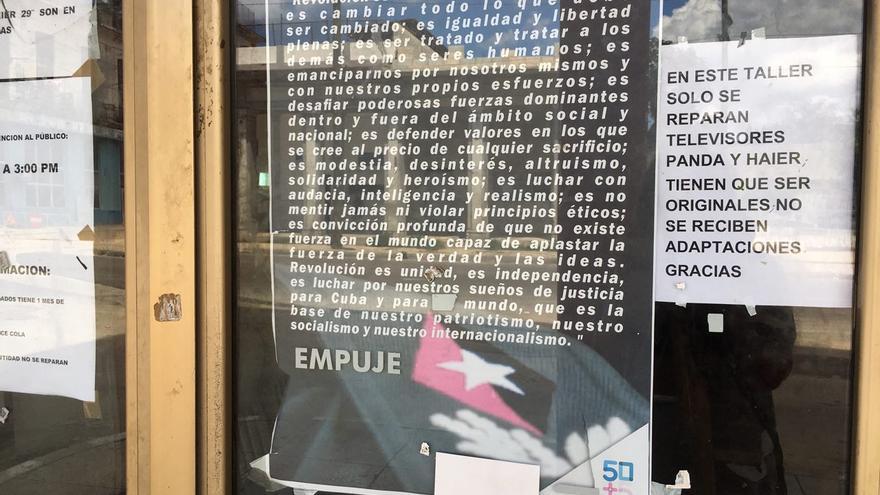
A sign outside an appliance repair shop clarifies that it does not accept televisions or refrigerators with “adaptations.” (14ymedio)

14ymedio bigger14ymedio, Zunilda Mata, Havana, 27 September 2018 – The TV in the  living room arrived 13 years ago at Carlota’s house, during the same days that her youngest grandson was born. Now, the teenager has a girlfriend, but the old Panda brand device sometimes turns on and sometimes not. “It’s a headache  because very few workshops have parts,” laments the retired woman, who at the beginning of this century benefited from one of the last campaigns promoted by Fidel Castro, the Energy Revolution.

During the years that the offensive against high-consumption household appliances lasted, the government distributed, with installment payments and bank credit facilities, refrigerators, energy-saving light bulbs, Chinese-made air conditioners and televisions. “I spent more than five years paying for it and although it was a great sacrifice I managed it”, says Carlota, while recalling that time when “it seemed that the country was going to progress quickly”. continue reading

Beginning in 2005, the Energy Revolution mobilized thousands of people to inventory all the equipment that consumed kilowatts excessively. The social workers, a shock troop created by Castro himself and responding directly to his orders, joined the task and listed old American-made refrigerators that had conserved the food of hundreds of thousands of families for more than half a century throughout the Island.

At least 2.5 million refrigerators were replaced and few incandescent bulbs were saved from that offensive, in which most were replaced by compact fluorescent lamps (CFL). The authorities assured that this change meant an annual saving of 354 million kWh, equivalent to between 3% and 4% of the total electricity consumed in Cuba.

The fans also got their turn. The Electric Union (UNE) reported that 1.04 million of these devices were exchanged, especially those that were the fruit of popular ingenuity that, in order to cool a room, were adapted from old Soviet washing machine motors by attaching blades, a device which could waste more than 100 watts to run, almost triple what a modern device consumes.

The televisions became a symbol of that technological renovation and Carlota felt proud when she went to buy hers. However, shortly thereafter flat screen devices came to the black market and stores that accept convertible pesos and “these devices were devalued,” she acknowledges. The daughter of the pensioner bought a more modern TV for her room and Carlota’s Panda began to break frequently.

Private repairmen kept changing the parts of the apparatus. Many patches were made so it could still be watched but left the TV “rejected by the state workshops where they do not accept those that have ’adaptations’, laments the woman. The last time she tried to have it repaired, a technician sarcastically told her she should “throw away the Panda and buy a Samsung.” Although for that Carlota knows that she will have to pay “in cash with convertible pesos and without any little poster of the Energy Revolution”.

Translated by Wilfredo Díaz Echevarria

____________________

The 14ymedio team is committed to serious journalism that reflects the reality of deep Cuba. Thank you for joining us on this long road. We invite you to continue supporting us, but this time by becoming a member of 14ymedio. Together we can continue to transform journalism in Cuba.
Cuban Bishops Will Publish A Pastoral Letter On Constitutional Reform

Cuban bishops will give their official opinion on constitutional reform (COCC)

14ymedio bigger14ymedio, Havana, September 28, 2018 — The Catholic Church in Cuba is preparing a pastoral letter to make clear its position on the constitutional reform promoted by the Government. In a telephone conversation with this newspaper, Wilfred Pino, archbishop of Camagüey, explained that for the moment each diocese (administrative unit of the Church) is doing its own reflection on the document.

“Each bishop has been saying what he believes on the matter in his diocese. As a Conference we are going to declare ourselves, but it’s not something to be rushed because the consultation process and the referendum are planned for February of next year,” indicated the religious figure.

Pino, 68, added that he has been pleased to see that the people are expressing themselves in a spontaneous manner without fear of reprisals in the meetings that the Government has organized to debate the reform proposal, which includes controversial subjects like marriage equality, the recognition of private property, the elimination of the term Communism, and term limits for the Government. continue reading

“People have talked about salaries that aren’t enough and many have expressed their doubts about marriage equality, which is something that is being talked about for the first time in Cuba,” he added.

The archbishop published this week a letter titled My modest opinion where he suggested that the word “marriage” not be used to define the legal union between persons of the same sex. In the text, Pino used as an example several countries in the European Union where some type of legal union is recognized without using the word “marriage,” with the goal that both persons have the same rights before the law.

Remembering the words of John Paul II, who asked Cubans to take care of families, Pino reviews “the anti-birth mentality” prevalent in the country. He also goes over timely matters like low salaries (the average salary is $30.60 per month) and gives concrete examples on how this affects the stabilities of families and the country.

In ten exclamations the archbishop points out matters that worry the country, like the low birthrate, corruption, the constant exodus, overcrowding in homes, prison overpopulation, drug addiction, and alcoholism.

“I think that each one of us Cubans must express our opinion on what is being debated. And when the day of the vote comes, vote Yes or No according to the dictates of one’s own conscience,” adds Pino.

Pino’s position seems much more flexible regarding marriage equality than that of his fellow churchman, Dionisio García, archbishop of Santiago de Cuba.

García published at the end of August a document where he said that “to ignore what nature has given us or to go against the laws and written processes always brings lamentable consequences.”

The prelate insisted that the idea that rejecting gay marriage comes only from Christians is “simplistic and false” and branded the desire to reform the Constitution to permit it as “cultural imperialism.”

Article 68 has provoked controversy as well among evangelical churches, some of which even signed a document rejecting marriage equality, arguing that it was not in accordance with the ideals of communist countries.

A good part of the Cuban opposition has reported that the argument around Article 68 may eclipse more important matters like political liberties, the perpetuation of the Communist Party in power, and the human rights situation.

Wilfredo Pino said that the Catholic Church would continue its reflection on the political and civil rights of the Cuban people. The archbishop of Camagüey confirmed that the document being prepared will also deal with those matters.

Translated by: Sheilagh Carey

__________________________

The 14ymedio team is committed to serious journalism that reflects the reality of deep Cuba. Thank you for joining us on this long road. We invite you to continue supporting us, but this time by becoming a member of 14ymedio. Together we can continue to transform journalism in Cuba.

Cancun, a New El Dorado for Cubans

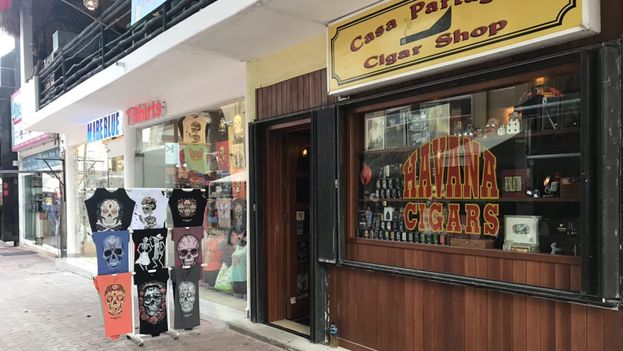
It’s not difficult to find stores with rum or tobacco in Cancún. (14ymedio)

14ymedio bigger14ymedio, Mario J. Pentón, Cancún, México | September 28, 2018 — The wind was barely blowing and the humidity was unbearable. Outside Terminal 2 of Cancún’s international airport, Juan Ernesto waited for his brother, who was arriving aboard an Aeroméxico flight from Havana. It was Jonathan’s first time abroad. His purpose: to buy some basic essentials in order to resell them on the Island.

“What Cuba is most lacking right now is hygiene products. Basic essentials like disposable diapers, soap, toothpaste, shampoo, and conditioner,” explains Juan Ernesto, who asks for his surname to be omitted out of fear that authorities will confiscate his purchases.

Traveling as a mule to supply the growing underground market on the Island is not legal. Cuban customs has begun an intense campaign against those bringing products to resell them. Even so, Cuban travel to countries like Mexico, Panama, Russia, and Guyana is increasing. continue reading

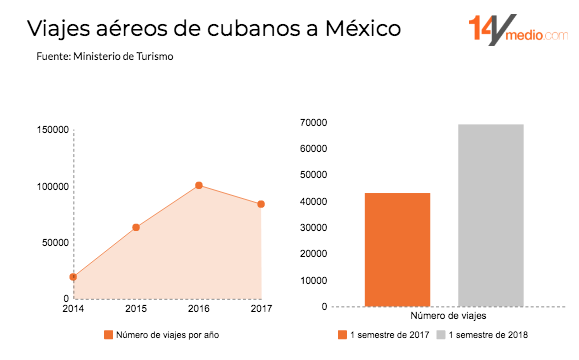
According to statistics provided to this newspaper by Mexico’s Tourism Ministry, in the first half of this year the number of Cubans landing in that country grew by 60.5% compared to the first half of the previous year. As of July of this year, 69,105 arrivals to Mexican airports were recorded, 26,050 more than in the same period of 2017.

Cubans traveling to Mexico by air. Left: Number of trips per year. Right: Number of trips in first semester of 2017 (left) and first semester of 2018 (right)

In 2016, there were slightly more than 100,000 entries of Cubans because of the migratory crisis. With the end of the wet foot/dry foot policy decreed by the United States at the beginning of 2017, the flow decreased but remained above 83,000.

“Getting a Mexican visa is difficult,” explains Juan Ernesto. Among the requirements set by the Mexican consulate in Havana is having a bank account that demonstrates economic solvency, a property title belonging to the interested person, and filling out a visa request online.

“Most of the time the website where you arrange the appointments isn’t working. Our visas cost around $3,000. Corruption is the order of the day in Mexico just as much as in Cuba,” he adds.

At the airport’s exit various taxi drivers offer their services. “Minivan! Minivan for 100 pesos!” yells one in the direction of a group of Cubans.

A network of businesses has been developed to serve the numerous travelers arriving from the Island. Low-cost hotels, stores that accept dollars, Mexican pesos, or Cuban convertible pesos, shipping agencies, and even job offers can be found in the Benito Juárez municipality, which the city of Cancún belongs to.

“Here there are a bunch of stores with Cuban owners where many people from the Island work. You can find anything they sell in Cuba there: clothes, electrical appliances, medicine, hygiene products,” Juan Ernesto explains to his brother.

“Right now in Cuba deodorant is hard to find. Here we buy Gillette tubes for 3.50 and we sell them there for double. Little perfumed balls for clothing cost 255 Mexican pesos (about $14) and you can sell them for up to triple,” explains the young man.

Right now in Cuba deodorant is hard to find. Here we buy Gillette tubes for 3.50 and we sell them there for double. (14ymedio)Jonathan is 25 and is finishing an engineering degree. His trip to Mexico is only for a weekend. He wants to follow in his brother’s footsteps, who thanks to the constant trips to resell products and to the self-employed work that he carries out on the Island, has a greater purchasing power than the average Cuban.

“In Cuba the Government doesn’t realize the opportunities that are being lost. It goes after self-employed people and is dedicated to a model that doesn’t work. Each of the Cubans who comes to Cancún brings at least $1,000 to spend here. That’s money that businesses on the Island are losing out on,” he says.

The young man laments that an engineer’s salary barely surpasses $30 a month, while a reseller can pay for an airplane journey and leave the country.

But it’s not going so well for all self-employed people. Some even opt to try their luck in countries like Mexico, where the daily salary is well over what they would make in Cuba in a month.

Annia is a young Cuban woman of 26 who lives in Cozumel. After various trips to Cancún, where she would buy products to bring to Matanzas, she decided to stay to work as an undocumented person.

“In Cuba I was working as a hairdresser, but with that I couldn’t get ahead. Everything that I earned went to the high cost of products and to paying bribes to inspectors,” she says.

When she had the opportunity to visit some relatives who live in Cancún, the young woman decided to remain with them. Since then she has lived in this city for three months and has worked as a waitress, salesperson in shops for Cubans, and street vendor.

A network of businesses has been developed to serve the numerous travelers arriving from the Island. (14ymedio)

“Right now I’m applying for my Mexican residency. It has cost me several thousand dollars but it’s worth it,” she says. According to Annia, the owners of the restaurant where she works are delighted that she is Cuban because it specializes in the cuisine of the Island. In addition they sell tobacco and rum.

“I haven’t felt discriminated against at all, just the opposite. People here know that we Cubans work hard,” she adds. Annia earns about eight dollars a day in her position as waitress, and she is happy because she has more opportunities to better herself than in Cuba. “At the beginning it’s always necessary to make sacrifices. I work nights and early mornings so that the immigration police don’t find me and I live with a friend to pay half the amount in rent ($150), but it’s worth it.”

“When I have my papers I will be able to work in a hotel like the other Cubans do or start my own business. I’ve already been able to send some money to my family and in the future I hope to bring them here to live with me,” she says hopefully.

Translated by: Sheilagh Carey

______________________________

The 14ymedio team is committed to serious journalism that reflects the reality of deep Cuba. Thank you for joining us on this long road. We invite you to continue supporting us, but this time by becoming a member of 14ymedio. Together we can continue to transform journalism in Cuba.
Daniel Ortega in the Prison of a Book

Daniel Ortega has kept a low profile with regards to what is exposed of his private life in the media.

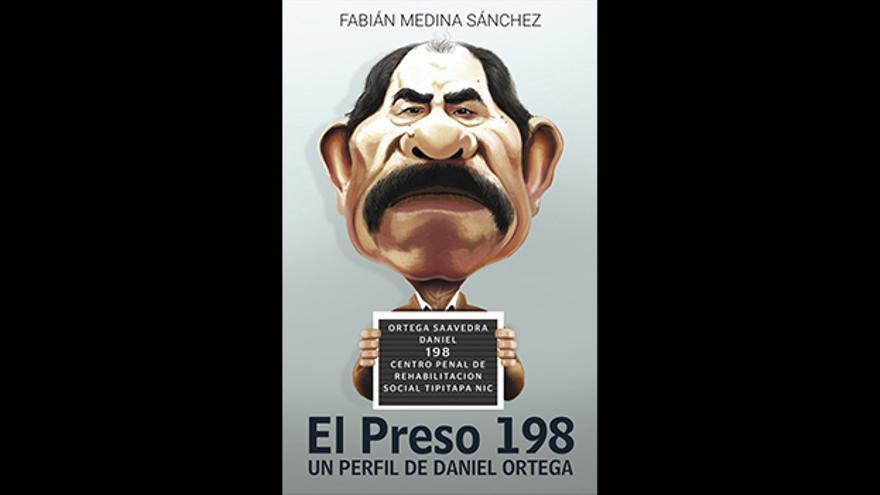
14ymedio bigger14ymedio, Reinaldo Escobar, Havana, September 26, 2018 — In the middle of the acute political crisis that is happening in Nicaragua, the Nicaraguan journalist and writer Fabián Medina Sánchez has released the book Prisoner 198, a biography of Daniel Ortega where the author has set out to speak about the facts without trying to convince anyone of whether the character is a good or bad person.

Despite having been one of the most influential politicians in the Central American country in the last fifty years, including four terms as president, Daniel Ortega has kept a low profile with regards to what is exposed of his private life in the media. A notable exception is an interview that he gave in 1987 to Playboy magazine where he confessed: “It was like the cell was always with me.” continue reading

In the portrait of the controversial commander-become-president, sketched in this book it seems like Ortega has not managed to get rid of the overwhelming sensation of being incarcerated. According to Fabián Medina, this condition “has marked his whole life, from family and romantic relations, to his vices, manias, and form of exercising power.”

For five years the author undertook an investigation that not only included checking journalistic texts, books, and historical documents, but also interviews with hundreds of people close to Daniel Ortega who shared with him prison, war, conspiracies, and power.

Among these testimonies one that stands out is that of Carlos Guadamuz, a childhood friend who later was murdered in still-unclear circumstances. The author also relied on a pair of interviews that he was able to carry out with Ortega during the years that he was away from power, but he never received a response to a request for a new exchange by the time he had plans to write this biography.

The number 198 identified Daniel Ortega when he entered the Modelo prison at the beginning of 1968, where he remained for seven years after being found guilty of robbing a bank. He remained there until he traveled to Cuba as the result of a rescue operation carried out by a commando group of the Sandinista Front.

The first murder that he committed, the tortures he was subjected to, his quarrels with other leaders of the Sandinista Front, his maneuvers to remain in power, and his relationships with diverse women are narrated in this work with a journalistic, pleasant, and precise style.

The figure of his wife Rosario Murillo accompanies Ortega in these pages with the full weight of her influence. Perhaps a character of great complexity who deserves a separate book.

The milestones in which the reader can immerse himself most deeply in the life of Daniel Ortega are the electoral defeat of 1990, the heart attack he suffered four years later, the charge of sexual abuse made by his stepdaughter Zoilamérica, and finally the popular rebellion initiated in April of 2018.

Among the situations in Daniel Ortega’s life that are not investigated deeply in Prisoner 198, his relationship with Cuba deserves mention. In this country he not only received military training, as mentioned in the book, but he also found support to oust Somoza and become the key figure of the Sandinistas because he was Fidel Castro’s favorite in that movement.

Obviously the final destiny of Daniel Ortega does not appear in this biography because in real life it still remains a matter to be decided. Many in Nicaragua would like to see him subjected to a judicial process and finally imprisoned, but justice sometimes comes late. At least in these pages he will remain locked up to be judged by readers.

Translated by: Sheilagh Carey

_____________________

The 14ymedio team is committed to serious journalism that reflects the reality of deep Cuba. Thank you for joining us on this long road. We invite you to continue supporting us, but this time by becoming a member of 14ymedio. Together we can continue to transform journalism in Cuba.
Cuba’s "Slaves Without Rights" of the Youth Labor Army

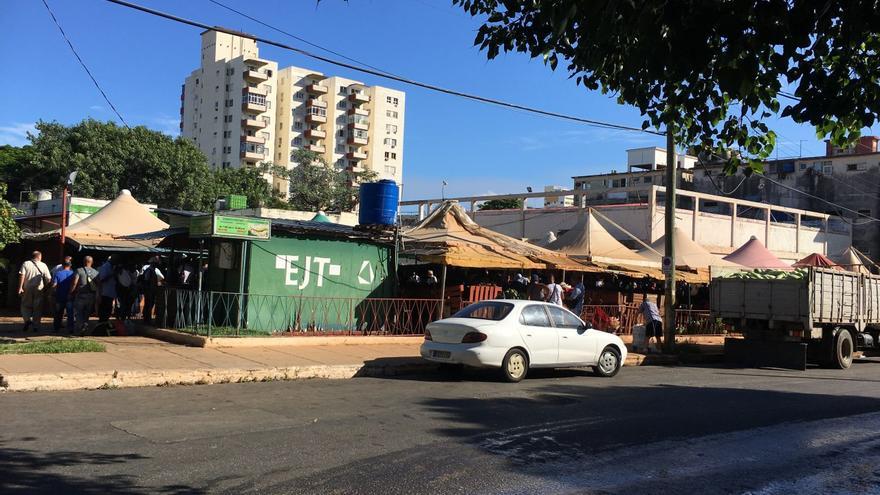
EJT (Youth Labor Army) market on Calle 17 and K in Vedado (14ymedio)

14ymedio bigger14ymedio, Marcelo Hernández, Havana, September 26, 2018 — Rigo, Suandy, and Alberto arrive each morning at a corner in the Capdevila neighborhood in Havana, with the order to look for breeding places of the Aedes Aegypti mosquito. Barely 17 years old, they are part of the Youth Labor Army (EJT), an unarmed version of Active Military Service (SMA) that is also being questioned in the constitutional reform debates.

Founded in August of 1973 by Raúl Castro, thousands of young people under the age of 20 have ended up in the EJT over the past four decades. Their labors have concentrated fundamentally in agriculture, construction of houses, and the repair of railroad tracks. But the hard work conditions and the low compensation have put it at the center of the criticisms. continue reading

“Every day my son works for more than eight hours in a furrow producing vegetables and foods that are then sold in the Youth Labor Army markets at a much higher price than he and his companions receive for so much work,” Xiomara, a resident of the Boyeros municipality, lamented last week at a meeting to discuss the reform of the Constitution.

All over the country, and especially in the Cuban capital, the farmers’ markets managed by EJT have displaced in space and in the amount of offerings others that were privately or cooperatively administrated, which opened following the economic reforms of the 90s. Although they have slightly lower prices than their competitors, the quality of the merchandise in these businesses doesn’t please all their consumers.

“They’re an unspecialized workforce and that shows in the deterioration of production, but also in the numerous injuries that they suffer when they have to work in the fields or on railroad lines,” adds Xiomara, while at the table that presided over the debate a man punctually wrote down each phrase.

Young people who complete high school and earn a place at university are only required to spend a year mobilized in the SMA and, as a general rule, are placed in the EJT, where they only receive military training in the so-called “preliminary,” which lasts a few weeks.

Then they are relocated to EJT units, many of them without dormitories and from which they can leave every afternoon to sleep in their homes. However, their members are considered active military members and during their time in the Army they must comply with a chain of command that functions under the rules of that institution.

“Although I am happy that my son doesn’t have to have a gun, I believe that the new Constitution should offer more work options to the conscripted young people, including other tasks that they might be better at, like social work or incorporation in industrial production,” pointed out the woman.

Xiomara’s point of view was backed by various residents with adolescent children who lament that the EJT has turned into “a lucrative business where young people work hard in horrible conditions and receive salaries that aren’t enough for anything,” according to another of the meeting’s attendees.

“At least they no longer have to go to Angola as soldiers, but it’s necessary to dignify the work of these young people, because what they earn doesn’t even mean 15 CUC (Cuban convertible pesos, roughly $15 USD) each month, let alone 20, but in the EJT markets they raise much more. Where does that money end up?” asked the resident. The Revolutionary Armed Forces (FAR) don’t report their resources and rarely publish the amounts of the profits earned with the work of their conscripts.

In 2009 thousands of young people in the EJT were assigned to the repair and maintenance of railroad lines, work for which it is difficult to find a voluntary labor force due to the difficult conditions in which it takes place.

On the outskirts of Bayamo, in the Sakenaff camp, Ruadny was one of the many young people in the area who held for the first time in his life “a pickaxe and shovel to lay a railroad tie,” he recounts now. “I wasn’t even 18 when they sent me to that unit and the truth is that after one week there I would have preferred to go to a military company,” he assures.

Demobilized two years ago from the EJT and with his sights set on emigration, the young man has no qualms in assuring that, at moments, he felt like “a slave without rights.” Ruadny remembers that they received a short training from the Eastern Railroad Company but that they arrived at the field “with very little knowledge of the work.”

“We had many cuts because, of course, the majority of the kids had never handled a pickaxe in their lives and I don’t remember that there was a union structure to protect us,” he laments. Ruadny came to make more than 500 Cuban pesos monthly for his work, less than $25. “I’m a musician, what I love most is the guitar and after that I couldn’t even play a note because my hands were so destroyed.”

The Government has deployed EJT conscripts to all those areas where the workforce fails because of the bad work conditions or low salaries. They can be seen in the coffee harvest, in clean-up operations after hurricanes, and in the building of state-owned facilities, but also in the sugar harvest, the maintenance of highways, and the remodeling of dams. The so-called “antivector” campaign, agriculture, the setup of electric lines, and communal services round out their tasks.

In 1999 a report made public during the International Work Conference in Geneva required Cuban authorities to be more transparent about the mechanism by which Cuban young people can opt to be part of the EJT and “to choose can constitute a useful guarantee.” The body reminded the Island that it needed to suppress “the use of forced labor as a method of using the workforce with the goal of economic promotion.”

For Ruady the deficiency of that right remains. “It’s true that now you can spend your military time far away from shrapnel, but they are still treated like soldiers, whoever doesn’t obey goes to the dungeon,” he assures.

Translated by: Sheilagh Carey

____________________

The 14ymedio team is committed to serious journalism that reflects the reality of deep Cuba. Thank you for joining us on this long road. We invite you to continue supporting us, but this time by becoming a member of 14ymedio. Together we can continue to transform journalism in Cuba.

At Least Four Students in Cuban School Wounded with Knives

Students of professional technical education in Cuba. (Twitter)

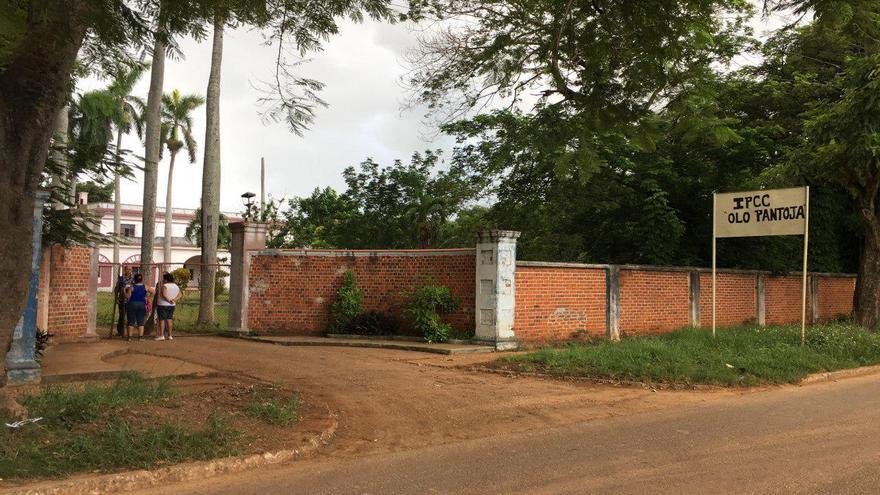
14ymedio bigger14ymedio, Havana, September 17, 2018 — This Monday morning at least four students were wounded at the Olo Pantoja Technological Institute in the La Lisa municipality in Havana. As an employee confirmed to 14ymedio, four people entered the school, opened the classroom doors, and “started stabbing,” explained the source.

According to the testimoney of this employee, who preferred to remain anonymous, at least six students were wounded, five males and one female, by knives. The Pediatric Hospital of Marianao confirmed that four adolescents received emergency treatment, among whom one had cuts in the face.

“Of the four treated only one remains hospitalized for a previous injury,” said a spokesperson from the hospital. continue reading

The wounded were transferred first to the Cristóbal Labra Polyclinic, near the center, to receive first aid. A school employee said that once in the clinic an individual tried to attack the students again, but was detained by police. According to this source three of the four attackers have already been detained.

14ymedio tried to speak with the police station of La Lisa but did not receive a response to multiple calls. Official media sources have not reported on the incident.

“The school’s problem is that it has no security. People enter without being asked for identification,” said the employee by telephone.

The center’s administration has asked parents to come collect their children because the school is “being evacuated.” Classes have been suspended until next Monday. According to one of the employees who spoke to this newspaper, various parents have said they will ask for “the removal” of their children from the school out of fear that violent events like this Monday’s will be repeated.

The Olo Pantoja school is located on Avenida 51 and Calle 222 and offers technical vocational training in construction with specialties in carpentry, brickwork, and others. Its name is an homage to Orlando Pantoja Tamayo, one of the men who accompanied Ernesto Guevara in the guerrilla war in Bolivia where he died on October 8, 1967, one day before the death of Che Guevara.

The Government maintains a strict censorship over the violent or criminal acts that occur in schools and the official press rarely addresses these topics. The few reports on school violence, prostitution, and bullying are done by the Island’s independent press.

At the beginning of the year it became known that a hidden shelter at a high school in Camagüey was being used as a meeting and leisure area by a group of young people aged between 13 and 23 that have been involved in a case of corruption of minors and drug use.

Six girls and one boy between 13 and 15 years old would meet in the shelter with young people between 16 and 23 years old to allegedly drink alcohol and take controlled medications like Carbamazepine and Dyphenhydramine.

Cuban education, considered for decades to be one of the principal banners of the Government, has not escaped the crisis experienced by the nation since the end of Soviet subsidies at the beginning of the nineties. The exodus of teachers and the low qualifications of personnel have forced massive recruitment of young people in training programs for teachers.

In 2008 a 12-year-old student died after being hit by a school chair by his teacher, who was 17. The murder, which happened in the Domingo Sarmientos high school, in Lawton, received no coverage in the official press.

Translated by: Sheilagh Carey

_______________________________

The 14ymedio team is committed to serious journalism that reflects the reality of deep Cuba. Thank you for joining us on this long road. We invite you to continue supporting us, but this time by becoming a member of 14ymedio. Together we can continue to transform journalism in Cuba.
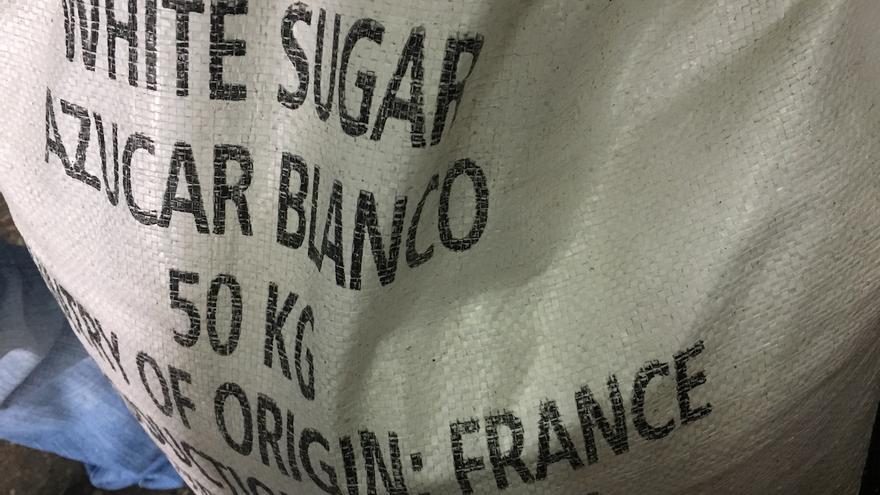
In Cuba Sugar is Imported from France

This September the sugar that has been distributed in the “basic basket” of the rationed market comes from France. (14ymedio)

14ymedio bigger14ymedio, Marcelo Hernández, Havana, September 23, 2018 — This September the sugar that has been distributed in the “basic basket” of the rationed market doesn’t come from Cuban fields, but rather from far-off France. The poor performance of the last sugar harvest forced the Island’s Government to import a product that, until a few years ago, was the symbol of the country.

In impeccable white bags, the sugar that has arrived in Havana stores is bringing satisfaction to consumers for its quality and cleanliness. “It’s fine, it’s not damp, and it doesn’t have any dirt,” is how Norberto, a grocer from Havana’s La Timba neighborhood near the Plaza of the Revolution, describes the product.

“We’ve had sugar from Brazil but this is the first time that we’ve gotten it from France,” adds the state employee, a fact confirmed to this newspaper by a worker from the Sugar Business Group (Azcuba) who prefers to remain anonymous. “We’ve had to buy French sugar because we’ve committed the majority of the national sugar harvest to international buyers,” he details. continue reading

Cuba has a high sugar consumption and needs around 700,000 tons annually to satisfy the demand of the rationed market, local industries, and the self-employed sector. The Island has a commercial agreement with China to sell it 400,000 tons each year, but this year the production wasn’t enough to cover both internal consumption and exports.

In the 2017-2018 sugar harvest the Island produced a little over one million tons of raw sugar, far from the 1.6 million that sector authorities had forecast. “Which didn’t permit the fulfillment of what was planned,” indicated the president of the state-controlled group Azcuba, Julio García.

The Cuban sugar industry, for decades, was the flagship of the Island’s products and the leading export. In 1991 it reached 8 million tons just before the collapse of the Soviet Union sank the Cuban economy and caused particular damage to that sector.

In the present, sugar production has been lagging, far behind tourism, remittances from emigrants, and the sale of professional services, principally in healthcare, which have displaced the former economic driving force of the Island.

In 2002 and under the mandate of Fidel Castro, a process of dismantling of dozens of sugar production centers began, under the argument that the fall in prices of the product in the international market was making the industry unsustainable. In 2011 the Ministry of Sugar was eliminated and its functions were assumed by Azcuba.

Three five-year-periods after that offensive, 64% of the centers remain closed; their workers were relocated to other positions, and the majority of the sugar plantations have been directed to other crops.

In the previous sugar harvest only 54 centers operated and the rains affected the harvest that should have finished before what was predicted, due to intense precipitation in the spring, which made the harvesting of the cane in the fields more difficult and contributed to a rapid deterioration of the product.

Translated by: Sheilagh Carey

___________________________________

The 14ymedio team is committed to serious journalism that reflects the reality of deep Cuba. Thank you for joining us on this long road. We invite you to continue supporting us, but this time by becoming a member of 14ymedio. Together we can continue to transform journalism in Cuba.
Cuba and the End of the Historical Generation

Three Cuban presidents (past, present and future) in a photo taken during the 7th Congress of the Cuban Communist Party (EFE)

14ymedio bigger14ymedio, Yoani Sanchez, Havana, 24 September 2018 — Nearly 60 years after its triumph, the Cuban Revolution today does not resemble what it was or what it pretended to be. In almost six decades, those bearded youth who came down from the mountains went from generating dreams to provoking fear or apathy. Their formula for staying in power has been a mixture of obstinacy and political cynicism.

Of those one hundred founding figures, rebaptized today as the “historical generation,” there are barely a dozen survivors of whom only four occupy key positions. Fidel Castro’s ashes repose in a stone and his brother Raul has passed on the powers of the Government while preparing for his replacement at the head of the Communist Party.

A quarter of a century after the collapse of socialism in the countries of Eastern Europe, and in the midst of a crisis of the left in Latin America, Cuban socialism has had to adapt to new times on a globalized planet where the concept of “capitalist countries” encompasses virtually the entire rest of the world. In order to not perish it has borrowed practices and formulas that it once rejected. continue reading

One of these cyclical make-overs is happening right now with the process of constitutional reform. This process is marked, on one hand, by the stubbornness of official thinking, which maintains that the system is irrevocable, and, on the other, by an excess of hopefulness among the reformist sectors which are betting on the Constitution being a step on the long road toward the transformation of the country.

Outside these two postures is positioned the extensive bloc of pessimists, who think that as long as there is no change in what has to change everything in Cuba will remain the same.

Irrevocability

The Constitution, which is being cooked up under the strict surveillance of the only party allowed in the country, maintains the concept that “socialism and the established political and social revolutionary system are irrevocable.” Thus, when Cubans go to vote on the constitutional referendum, on 24 February 2019, they will be ratifying or rejecting a straitjacket.

Raúl Castro has prepared a meticulous framework of 224 articles to leave the new generation of officials with a cast-iron system, in which it is almost impossible to promote a change of direction from within. The Constitution is the road map that can’t be deviated from by a single inch, or at least that is what the ex-president has planned.

Not even Parliament has the power to reform this principle of irrevocability that functions as a legal constraint for the new generation preparing to take the helm of the national ship, a generation that may be tempted to take the reforms too far, once the group of the historical generation has finally been extinguished.

The extensive text is the last move by the olive-green octogenarians to control the country beyond their deaths, to win the game of biology and continue to determine the fate of Cuba.

Reformist hopes

The most optimistic believe that despite the rigid bars imposed by some articles of the Constitution, other articles open a space for greater economic and social freedoms.

In the new Constitution that is now being promoted, the use of the word communism to define the final goal of the Revolution has been removed, the explicit purpose of eliminating the exploitation of man by man has disappeared, private ownership of the means of production has been accepted and the market’s role in the economy is recognized.

These adjustments open the way for the eventual establishment on the Island of a model in the Chinese or Vietnamese style, where the Party maintains rigid political control while the State renounces its monopoly on property. Economic centralism is undermined by the acceptance of other forms of management, but it is clear to entrepreneurs that they cannot grow or enrich themselves beyond a strict limit.

Other points, such as the acceptance of equal marriage or the regulation of the maximum age of senior officials in the country, are part of an attractively wrapped package within which they want to hide the poisoned candy of the Constitution. With these flexibilities, the ruling party wants to attract the LGBTI community and other reformist groups to endorse the document, despite the fact that the rest of the articles have an immobile and reactionary character.

In the public debates being held on the project, many voices are heard calling for permission for nationals to have the right to invest on equal terms with foreigners and it has been proposed to eliminate the article that inhibits “concentration of ownership in natural or legal non-state persons.” But so far these are only proposals and nobody knows if they will be reflected in the final document.

Optimists also worry about the oscillations or the backward steps that accompany each advance.

While it appears that the long dreamed of aspiration to be able to access the internet will be realized by the end of this year through connections from mobile phones, the ruling party has launched an offensive against the independent dissemination of content and the non-governmental press, which has had its climax in the enactment of Decree Law 349, which tightens the screws on cultural censorship.

Laws have recently been enacted to control entrepreneurs, who are not yet allowed to export or import and who lack a wholesale market to supply them with resources. The new enemy of the Cuban Revolution is – and has been for some time now – the private sector that is outperforming the State in services and quality.

For the Government, self-employed workers are a group that they suck the blood out of with taxes and fines, but also a group that should not be given wings to expand too much or allowed to organize themselves in unions. It is precisely in this area of ​​civil liberties that the system is most reluctant to take steps forward, fearing that a small opening that allows free association will jeopardize the monopoly of the Communist Party.

All or nothing

Despite the surveillance and repression, the sector of discontented Cubans has grown significantly in recent years and numerous nuances have appeared. This critical sector encompasses citizens who suffer, without protesting, the harsh reality where a salary is not enough to feed a family, where market shelves are empty and public transport has collapsed, but also activists who take to the streets to shout slogans demanding democracy and respect for human rights.

Among the latter, especially, the idea prevails that the only solution to the country’s problems necessarily involves “the overthrow of the dictatorship.”

According to this point of view, there is no other way, given the fact that the generational change in power is being cemented by the irreversibility of the system and a single party that presents itself as “the leading force of society and of the State.”

However, outlawed and with few resources, without access to national media and constantly monitored, the likelihood of activists decapitating the system seem nil.

For the opposition, the constitutional referendum could become the only opportunity in a long time to send a message to the regime. For years, disunity, personal conflicts and the constant work of the political police have taken a toll on dissident groups. The diplomatic thaw between Washington and Havana deepened that fracture and divided civil society between those who accepted the rapprochement and those who rejected it.

Now they are at the crossroads of uniting around a No vote in the constitutional referendum or allowing the Government to end up closing the cage with a Constitution that aims to perpetuate the system. In the coming months, the decisions taken by the most important opposition leaders will become clear.

For the moment, there are already many arguments which could convince the ordinary citizen of the need to reject the Constitution. The promise of a bright future that Castroism offered as one of its most important popular pillars has vanished from so much failure to deliver. Nor is there a charismatic leader capable of dragging the masses to new heights of sacrifice.

In the national context the new generations lack enthusiasm, both to surrender their youth to the socialist utopia, and to rebel against the regime. The escape valve of emigration that functioned for decades has been largely closed by the end of the wet-foot/dry-foot policy in United States, the main destination of Cubans.

It is a moment of fragility for that process called the Cuban Revolution. A system that arrives at six decades of existence without having been able to fulfill a good part of its promises, but with the intention of staying in power by force and with a Constitution that consecrates it for eternity.

_____________________

Ed. note: This text has been published by the newspaper La Prensa Gráfica which authorizes this newspaper to reproduce it.

The 14ymedio team is committed to serious journalism that reflects the reality of deep Cuba. Thank you for joining us on this long road. We invite you to continue supporting us, but this time by becoming a member of 14ymedio. Together we can continue to transform journalism in Cuba.
Venezuela: And if Almagro is Right?

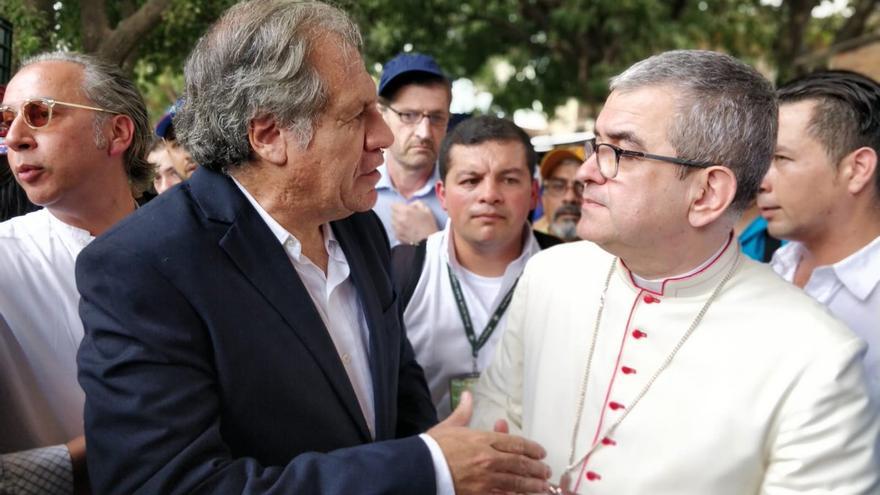
Luis Almagro made some controversial statements during a visit to the Divine Providence canteen and temporary help center for migrants in Cúcuta.

14ymedio bigger14ymedio, Carlos Malamud, Madrid | 17 September 2018 — The statements of the secretary general of the Organization of American States (OEA), Luis Almagro, went around the world and caused a great scandal both internally and externally. On the Colombian-Venezuelan border, ground zero of a migratory catastrophe turned into a regional drama, Almagro was asked about a possible intervention. His response, blunt and without room for subsequent nuances, was the cornerstone of the scandal: “As for a military intervention to overthrow the regime of Nicolás Maduro I believe that we should not discard any option.”

The enemy camp felt his words to be an open provocation and accused him of subordinating himself to the plans of the United States. Venezuelan Vice President Delcy Rodríguez said that he was looking to revive the “worst measures” of “imperialist” military interferences in Latin America and even announced a complaint in the UN for “promoting a military action.” continue reading

The Chavista accusation against US imperialism is paradoxical considering Venezuela has just sold its soul in oil to Xi Jinping. This way, China will intervene to “finance development” and also to influence “the form of governing this country.” Even if, as Maduro reminded us, the biggest difference from Yankee imperialism is that China wants a future “without hegemonic rule that blackmails and dominates.” And if he says it, you have to believe him.

The bewilderment among the sectors most critical of the Venezuelan regime was great. Eleven of the fourteen countries of the Lima Group rejected any military intervention in Venezuelan territory. There were also those who branded Almagro’s words as undiplomatic. It’s true, his statements were not an exercise in subtlety, nor do they allow the possibility of keeping open negotiations, neither regional nor multilateral.

However, the diplomatic option was closed a while ago, and not by the international community, but rather by the constant insults and declarations of a regime that refuses to negotiate both inside and outside of its borders. The imposition of an unconstitutional Constituent Assembly or the aggressive conduct of Delcy Rodríguez when she was the Minister of the Exterior and triedto firce herway into a meeting in Buenos Aires where the suspension of her country from Mercosur was being discussed and to which she had not been invited, are only a few examples.

Almagro could not be diplomatic where there was no space for diplomacy. Nor did he encourage, as his critics claim, a military intervention, but only said that it could not be discarded. Venezuela is at a dead end. No short-, medium-, or long-term solution is in sight. The most complete catastrophe has installed itself in the country and not even Chinese patience can solve it.

In the current conditions it is difficult for anyone to promote or sustain an external intervention. From within is another thing, but here it seems complicated, given the Cuban infiltration in the military and the complicity of its chiefs with the regime. In reality they are the regime. The civic-military alliance is by now more military than civilian and it is the heaviest legacy of Hugo Chávez. This, along with his supposed “Bolivarian Revolution,” was the path chosen to destroy Venezuela.

 Translated by: Sheilagh Carey

____________________________

The 14ymedio team is committed to serious journalism that reflects the reality of deep Cuba. Thank you for joining us on this long road. We invite you to continue supporting us, but this time by becoming a member of 14ymedio. Together we can continue to transform journalism in Cuba.
Latin America and the New Populist Cycle

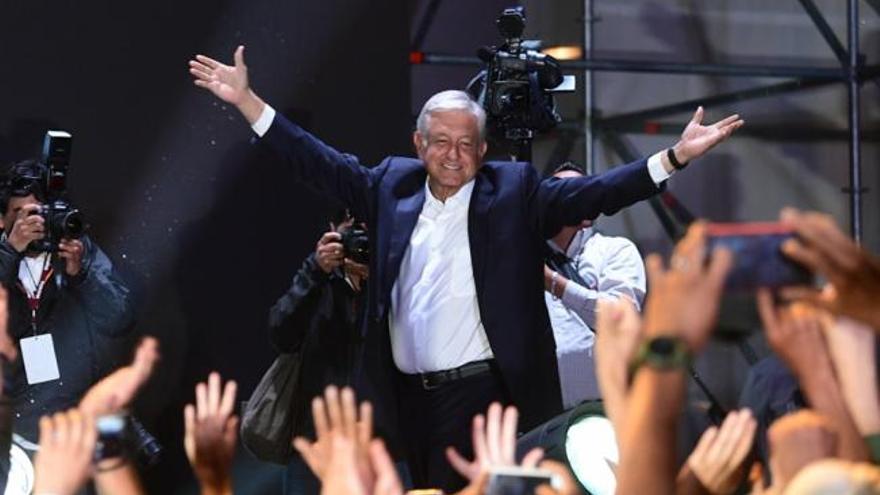
Andrés Manuel López Obrador has legitimately won the Mexican elections and is not expected to govern with prudence. (@PartidoMorenaMx)

14ymedio bigger14ymedio, Carlos Alberto Montaner, Miami, 23 Septmber 2018 — In Mauricio Macri’s Argentina the Peronists do not give a damn that Cristina Kirchner and her husband were two world-class thieves. “Whoremonger or thief, we want Perón” is still the slogan of the tribe. Maybe we are not Republicans. Or sufficiently Republican. To be so, it is essential to voluntarily place oneself under the authority of the law and to respect the dictates of impartial courts, but that is particularly difficult for us. Republics are fragile structures that are only able to breathe in a virtuous atmosphere. Outside of it they die or become something else.

In the Brazil of ‘Lula’ da Silva and his Odebrecht cronies more or less the same thing happens as in Argentina. Cheating, bribes, massive frauds were the order of the day, but to the supporters of the charismatic leader those violations of the law made no difference. Just recently it was learned that Lula himself, against the opinions of his own technicians, gave instructions for the National Bank for Economic and Social Development of Brazil (BNDES) to lend 600 million dollars to Cuba under very favorable conditions. continue reading

The objective was to put the development of Cuba’s Mariel Port in the hands of Odebrecht, knowing that the island could not repay the loan. A substantial part of that credit returned to Brazil in the pockets of corrupt politicians. It was the slice that Odebrecht distributed clandestinely, paid for with the taxes of the mocked Brazilian people. The project, by the way, carried out by a developer that would charge reasonable profits, cost half the amount paid to the Brazilian company.

Despite this filthiness, Lula headed the polls until the courts forbade him to run for president. After this impediment for corruption, imposed by Sergio Moro, an exemplary judge who set up the criminal investigation called the Lava Jato, and who has faced the political mafias of the Workers’ Party with enormous courage, Lula has chosen Professor Fernando Haddad to replace him. Haddad is a radical political professor, former failed mayor of Sao Paulo, also with pending charges of corruption against him. Simultaneously, he has recruited the young journalist Manuela d’Avila, deputy star of the Communist Party of Brazil, as Haddad’s vice president. The selection of the pair shows how things really work. Capital is terrified and is running out of the country through all the available holes. As has been said so many times, “there is no animal more cowardly than a million dollars.”

At the other end of the electoral spectrum, Jair Bolsonaro, the candidate of the right in October’s upcoming elections, a former captain of paratroopers, doesn’t respect the current legality too much either. He speaks with nostalgia of the time of the military dictatorship, justifies the torture, at the time had phrases of praise for Hugo Chávez, and regretted that the army had not shot 30,000 people, including former president Fernando Henrique Cardoso, whom he accused of connivance with the Workers’ Party. Meanwhile, former General Hamilton Mourao, his vice president, mumbles badly about the chances of a coup if they lose the election for alleged fraud. Some in Brazil call Bolsonaro the Brazilian Trump. May God have mercy on our souls.

It is very possible that we are again entering a populist cycle. Macri in Argentina could lose power as a result of the economic crisis. Haddad could defeat Bolsonaro and establish a leftist populist regime. Or Bolsonaro could defeat Haddad — they are tied in the polls — and start a kind of right-wing populist  of a republic. Andrés Manuel López Obrador has legitimately won the Mexican elections and is not expected to govern with prudence.

In Latin America, all the the evil dictators — Nicolas Maduro, Daniel Ortega, Evo Morales, Raul Castro and his handpicked Diaz-Canel — don’t even have to sit patiently at the doors of their houses and wait for the corpses of their enemies to pass by. All they have to do is entrench themselves in power and wait for a new populist cycle. Which we are in.

 _____________________________

The 14ymedio team is committed to serious journalism that reflects the reality of deep Cuba. Thank you for joining us on this long road. We invite you to continue supporting us, but this time by becoming a member of 14ymedio. Together we can continue to transform journalism in Cuba.
The Perseverance of ’Cuba Posible’

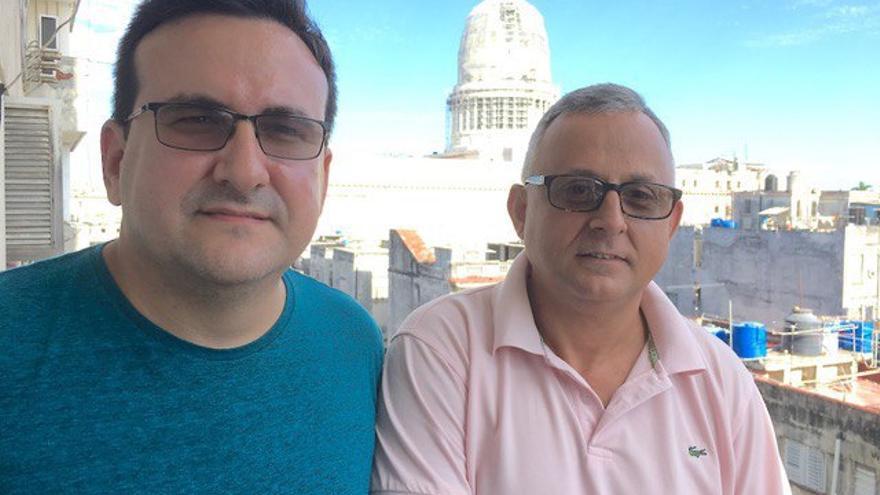
Roberto Veiga and Lenier González started the project with Espacio Laical in 2005. (14ymedio)

14ymedio bigger14ymedio, Reinaldo Escobar, Havana, 21 September 2018 — The civil society project Cuba Posible (Possible Cuba) will continue its work despite the attempts of the Cuban government to strangle it, the misunderstandings with the Catholic Church, and the suspicions of the most radical sectors of the opposition, according to comments its two principle managers made to this newspaper.

Roberto Veiga and Lenier González, director and deputy director of Cuba Posible respectively, started this initiative under the aegis of the Catholic Church in 2005, when both assumed responsibility for the Espacio Laical (Lay Space) magazine, which, more than a religious publication in print and digital form, functioned for a decade as a “zone of tolerance for political debate.”

This was possible, as Veiga explains, because it occurred “in the middle of the process of dialogue between the Church and the Government, which was not only sponsored by the Bishops’ Conference, but also by the Vatican.” continue reading

In a retrospective look at its origins, the director of Cuba Posible recalls that “at that time the process of rapprochement between Cuba and the United States was also taking place (although it was not yet public) and the European Union was already in discussions to withdraw its “Common Position“, which had been in effect since 1996.

One reason that Veiga suggests for the government’s tolerance of this project is that “perhaps it was one of those gestures that are usually made in this type of process, where it is important to build trust between the interlocutors.”

Among these shifting borders, Cuba Posible proposed from the beginning to open its doors to the greatest plurality possible to promote internal political trust and to open the debate about building bridges.

This debate took place on very important issues, including the constitutional reform, the education system, relations with the Cuban diaspora, the role of the Army and other issues that crossed the borders of the digital magazine, or on paper, until they managed to organize events with the presence of a very diverse public, on some occasions, or only with invited guests, on others.

But it was not, as is believed, a bed of roses. “Even in that initial moment the project suffered from the most orthodox sector of the Government ‘disqualifying’ it — that is refusing to recognize it — and, although it hurt us, there were also many misunderstandings within the Church, which took shape in June 2014, when we confirmed our request to resign from the management of Espacio Laical. We offered our resignations as a response to the indications that we should reduce what was identified as our excessive political profile,” Veiga acknowledges.

In the current situation, that dialogue between the Government and the Church, where they talked not only about political prisoners but also about the economy and international relations, is a thing of the past. The little progress made in improving relations between Cuba and the United States has been reversed, but not only because of Trump’s arrival at the White House. The reversal started with the end of Obama’s visit to the island.

Lenier González adds: “There was a decade of relative tolerance that coincides with the ten years of Espacio Laical and the first two of Cuba Posible where the aforementioned circumstances occur, plus the presence of Raúl Castro at the head of the Government.”

González thinks that for Raúl Castro this type of project was perhaps something small, of little importance. “That is why the transfer of power accelerated the conflict towards Cuba Posible,” he says.

The first public attacks on the project occurred even before Obama’s visit. Since then, the arguments with which the government usually attacks appeared, not only against its most bitter opponents, but even against those who depart slightly from the official line. All are accused of: belonging to the CIA, subversion, foreign financing, intentions to destabilize the country and all the charges that contribute to the execution of a reputation.

Lenier González recalls that in these dramatic moments several events happened, including a meeting of the rector of the University of Havana with all the deans and the faculty. He used his authority to report that this was a CIA project. We know that one of those present told him that such a serious accusation required proof and the rector’s response was: “You have to trust in the Revolution,” he says.

Roberto Veiga is not the kind of person who wants to forge a reputation as a hero. “What made it possible for Cuba Posible to continue working was the number and quality of collaborators we had at that time, both inside and outside the country, which allowed us to continue independently with our programs, each one of which had several concentric circles of collaborators and where the closest ones had a higher level of commitment,” he says.

He is referring to the programs for Fraternity (socio-cultural issues), Zero Poverty (socio-economic), Decent Work (socio-labor), Agora (socio-political) and Orb (international) programs.

With the expression of negative opinions, the work of Cuba Posible was criminalized. “In a vast operation of intimidation they visited all the universities, research centers, communication institutions in the country, to explain why no one could collaborate with us. As a result, some of those collaborators that we had were in the situation of having to abandon us, although others refused to comply with those orders,” says Roberto Veiga.

In the last nine months, all those who resisted have been expelled from their workplaces and few remain in the country. “Even though they do not blame us for their situation, we feel we have an enormous responsibility,” says Veiga. “Even worse has been the case of those who work in provincial centers, where everything has been more oppressive.”

“They were people who, for the most part, never intended to break with the system, some of them militants of the Young Communists Union who have been removed from the organization, even against the opinion of their Base Committee. This creates a difficult situation with their family and in their neighborhood, so because they are professionals with good contacts abroad they opted to leave.”

“The first and second circle of collaborators remain intact, they are people who, despite receiving tempting offers abroad, have decided to stay in the country collaborating with Cuba Posible, although now they have to work under new conditions, especially because they are subject to a process of destabilization, of disarticulation, of strangulation.”

The attacks were perceived by the members of the project as isolated actions of the government’s most dogmatic sector, but in February of last year Miguel Díaz-Canel, still a vice president, acknowledged that he had given the order to cut off all avenues of financing to Cuba Posible. “We confirmed then,” says Veiga, “that it was an official position, which, paradoxically, had more immediate impact on institutions abroad than among our collaborators on the island.”

Lenier González points out that in the summer of 2017 the strategy was coordinated and a strong public offensive was made, focused on the debate on “centrism” where “they launched their battleships to give the impression that this would be the end of Cuba Posible.

The decision of González and Veiga to continue working “irritated them a lot” and, also, created a dilemma for those responsible for Cuba Posible.

“All this led us to believe that the most responsible thing we could do was to decree the closure of Cuba Posible because we were harming our collaborators where a majority wanted to maintain a positive position within the system, because they longed for the evolution of the system without reaching a rupture. Some with more moderation and others with less. Their continuing to work on Cuba Posible led to a break with those who did not want to break, people who enjoyed what they did in the institutions where they worked and we had a responsibility to those people.”

“We have a responsibility to the country, to our collaborators and to our families, which is why Cuba Posible is not going to close down, we will not even stop and then restart. Without stopping work we will create the conditions to continue existing in the midst of this lack of clarity.”

 ______________________

The 14ymedio team is committed to serious journalism that reflects the reality of deep Cuba. Thank you for joining us on this long road. We invite you to continue supporting us, but this time by becoming a member of 14ymedio. Together we can continue to transform journalism in Cuba.
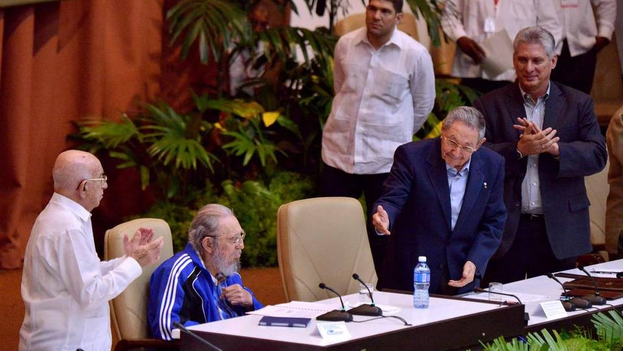
Classes Still Suspended at La Lisa School Where Several Students Were Stabbed

Classes remain suspended at the Olo Pantoja Polytechnic Institute of Civil Construction after several students were stabbed. (14ymedio)

14ymedio bigger14ymedio, Havana, 19 September 2018 — Classes remain suspended at the Olo Pantoja Polytechnic Institute of Civil Constructio  (IPCC), in La Lisa municipality in Havana, after nine students were injured by several people who invaded the school on Monday morning, as confirmed by 14ymedio.

Last Tuesday an employee, who preferred anonymity, confirmed to this newspaper that four adults entered the school, opened the doors of the classrooms and “began to stab people.” At least four students had to be transferred to a nearby hospital and the school canceled classes until further notice.

This Wednesday the entrance gate to the polytechnic remained closed and the parents of students who came to inquire did not receive information about the reopening date. A local employee replied to the constant questions only with the announcement that this afternoon “at three there is a parents’ meeting.” continue reading

According to the testimony of a school employee who spoke with 14ymedio after the incident, at least six students were wounded, five males and one female, with a knife. TheMarianao Pediatric Hospital  confirmed that four adolescents were treated on an emergency basis, among which there was one with cuts on the face.

“Of the four treated only one remains hospitalized for a previous orthopedic injury,” said a hospital spokeswoman.

The wounded were first transferred to the Cristóbal Labra Polyclinic, near the school, to receive first aid. An employee of the school said that once in the polyclinic an individual tried to assault the students again, but was stopped by the police. According to this source, three of the four attackers have been arrested.

14ymedio tried to communicate with La Lisa police station but did not get an answer to multiple calls. The official media have not reported the incident.

“The problem the school has is that there is no security at all. People enter without being asked for identification,” said the employee by phone.

School management informed the parents who came to pick up their children that the school is “under evacuation.” According to one of the employees consulted by this newspaper, several parents have said that they will ask that their children be “unenrolled” from the school for fear that violent acts like this one on Monday will be repeated.

Olo Pantoja School is located on 51st Avenue and 222nd Street and is responsible for training construction technicians in carpentry, masonry and other specialties. Its name pays homage to Orlando Pantoja Tamayo, one of the men who accompanied Ernesto Guevara as a guerrilla in Bolivia, where he died on October 8, 1967, one day before the death of Guevara.

The Government maintains a strict censorship over violent or criminal acts that occur in schools, which the official press rarely reports. The few reports on school violence, prostitution and harassment are made by the independent press of the Island.

At the beginning of the year, it became known that an underground shelter in a junior high school in Camagüey served as a meeting and leisure place for a group of young people between 13 and 23 years old who were involved in a case of corruption of minors and drug use.

Six girls and a boy between 13 and 15 years of age met at the shelter with young people between 16 and 23 years of age, presumably to consume alcohol and controlled medications such as carbamazepine and diphenhydramine.

Cuban education, considered for decades as one of the crowning achievements of the ruling party, has not escaped the crisis that the nation is experiencing since the end of the Soviet subsidies in the early 90s. The exodus of teachers and the low qualifications of the staff has forced the massive hiring of young people from what are called “emerging teacher” training programs.

In 2008 a 12-year-old student died after being hit with a school chair by his teacher, who was 17 years old. The homicide, which occurred at the Domingo Sarmientos Junior High School in Havana’s Lawton neighborhood, did not receive coverage in the official press.

 _________________________________

The 14ymedio team is committed to serious journalism that reflects the reality of deep Cuba. Thank you for joining us on this long road. We invite you to continue supporting us, but this time by becoming a member of 14ymedio. Together we can continue to transform journalism in Cuba.