Cuban Government Caps Food Prices in Villa Clara to “Stop Unjustified Increases”

Sellers who violate prices in Villa Clara risk severe measures such as seizures and cancellation of their licenses. (Angel M.)

14ymedio bigger14ymedio, Havana, 27 October 2017 — The Cuban government has set price caps for 47 food products in the province of Villa Clara “with the aim of containing the excessive increases” of recent weeks, “a gap that allows profit at the expense of the consumer,” says a note published on Thursday in the local press.

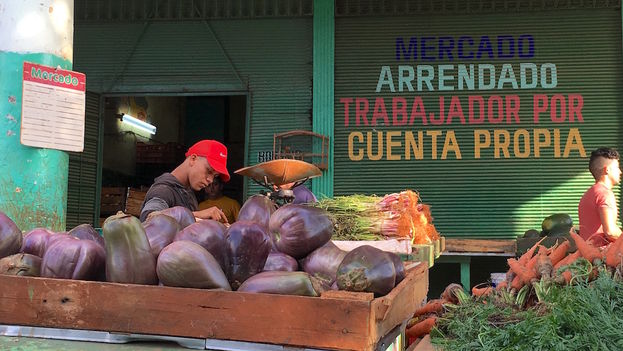
The measure affects the supply and demand farm markets popularly known as agromercados, which sell agricultural products, pork and other processed products. Fixed and mobile outlets (carts) must also comply with the new regulated prices, according to a provision of the Provincial Defense Council (CDP).

The rule, which is temporary, according to the CDP, seeks to “protect customers against unscrupulous people who profit at the expense of increased needs due to shortages caused by Hurricane Irma.” continue reading

The article, published in the weekly newspaper Vanguardia, explains that before the implementation of these prices “meetings were held with the sellers to explain the reasons for these type of actions for the benefit of the people.”

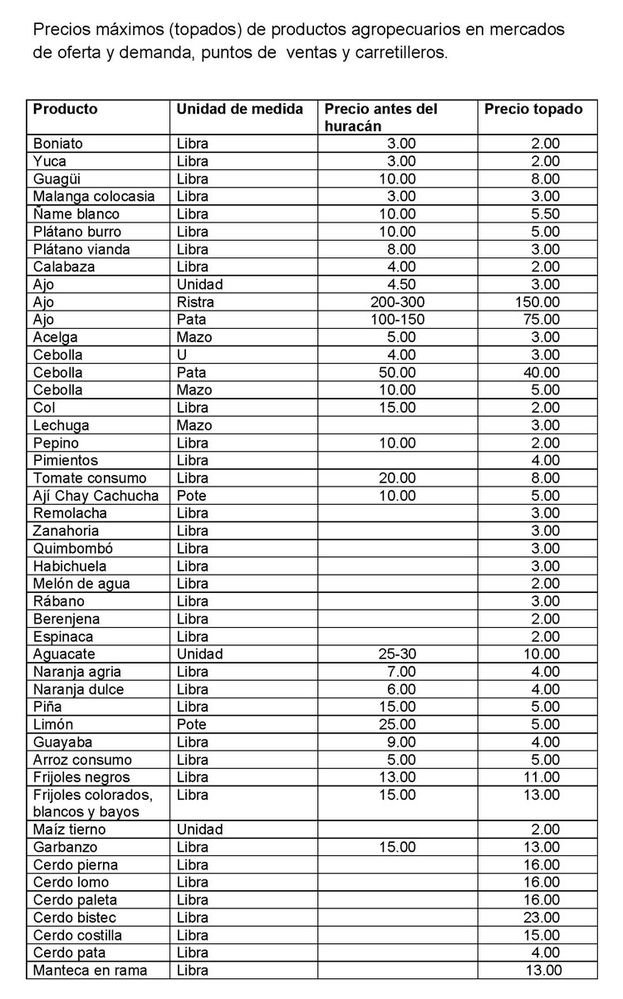
Regulated prices have been established for various products such as root crops, meats, grains, vegetables, condiments and fruits. In most cases “they should be marketed at the same prices as before the hurricane” and will be “evaluated monthly from November to February, during the recovery phase of agriculture,” according to the article.

Sellers who violate price caps risk “severe measures such as seizures and the cancellation of their licenses.” Local authorities have called on consumers to denounce merchants who violate the provisions.

The Directorate of Inspection and Supervision, the Ministry of the Interior, the State Directorate of Commerce, the Labor and Social Security directorates and the National Association of Small Farmers will also redouble their inspections to insure that the price caps are complied with.

Since the end of last year the experiment of capping food prices has been spreading from the province of Artemisa to all the municipalities of Havana and has provoked mixed reactions. Consumers celebrate the lower prices, but complain about the fall in quality and reductions in supply.

The measure was taken after the issue of food prices led many discussions in the National Assembly session held in December 2016. In response to the demands of several deputies, Raul Castro said that measures would be taken to bring prices closer to wages. The announcement served as a warning to producers and intermediaries.

List of prices established in the province of Villa Clara for food products in the supply and demand markets, points of sale and cart vendors. Product/Unit of Measure/Price before the hurricane/Capped price. As can be seen on the chart, many prices are lower than the pre-hurricane prices. (Vanguardia)

Self-Employed Workers In Cuba Show Little Enthusiasm For Bank Loans

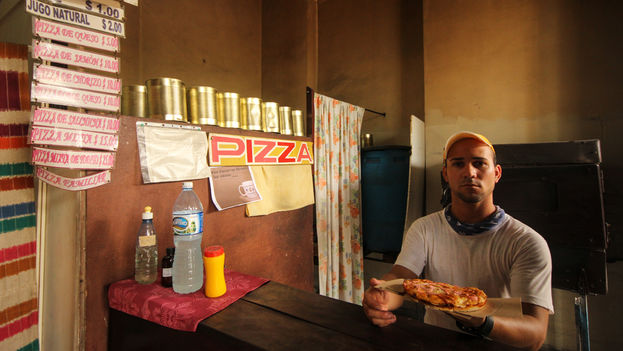
Gustavo Romero, self-employed, offers pizzas in a narrow wooden bar that he financed with a family loan. (Alex S.)

14ymedio bigger14ymedio, Reinaldo Escobar, Havana, 31 October 2017 — Gustavo Romero’s grandfather opened a hardware store in Cuba in the 1950s and a decade later it was confiscated during the “Revolutionary Offensive.” The old Canary Islander lost all his merchandise, but he had protected the cash under his mattress. A lesson that his grandson remembers now that he is working for himself.

“The bank is the last place I would go to save or ask for money,” says the small businessman, who runs a café in Centro Habana. In his case, as in that of so many entrepreneurs, distrust of banking institutions is like a gene that is passed down from generation to generation. continue reading

Despite the fact that in November 2011 a new bank credit policy was implemented in Cuba to support the private sector, entrepreneurs have made little use of this alternative and the amounts they have requested remains low, as demonstrated by a recent investigation by economist Jorge Ignacio Guillén published in the magazine Convivencia.

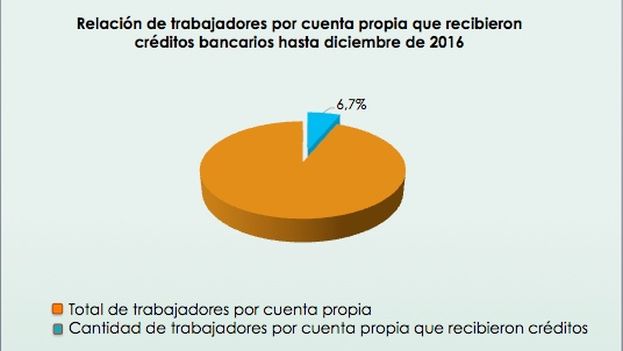
As of December 2016, fewer than 7% of the self-employed licensed in the country had received financing through bank loans; of the money that banks have in their loan portfolios, only 2.1% had been allocated to support the private sector.

On the other hand, the largest portion of the resource pie available in these portfolios had gone to financing the State budget, to state companies and to individuals who request loans to support self-managed home construction/repairs and to acquire kitchen equipment.

The lack of enthusiasm of small entrepreneurs for bank loans was reflected in statements made two years ago by the vice president of the Central Bank of Cuba, Francisco Mayobre Lence, who acknowledged that the number of “self-employed workers” who had taken out lines of credit was not yet “representative of the total registered in the country.”

The official expected these numbers to grow thanks to the creation of a new type of loan for amounts up to 10,000 Cuban pesos (400 dollars) without the need to present economic guarantees or a guarantor to the Banco Popular de Ahorro (People’s Savings Bank), which operates throughout the country except in Havana. However, the increase in applications has not appeared.

Share of Cuba’s self-employed who have taken out bank loans. (14ymedio)

In the case of Gustavo Romero, the initial investment for his pizza stand was $500 USD that a brother sent him from Pennsylvania, he tells 14ymedio, a type of credit common among the self-employed who prefer to appeal to family or friendship ties before they knock on the door of a bank.

Many local entrepreneurs keep their earnings or the amount to start a new business under the bed or in a drawer, according to the results of a thousand interviews conducted by Guillén. More than 70% of self-employed persons interviewed for the study rejected the option of keeping their cash in a bank and more than 85% have never applied for a loan.

The measures promoted by the government more than six years ago for these self-employed to access sources of financing show alarming results, according to the young economist, “both in terms of regulations and in the practice of loans to self-employed workers.”

In a country where, for decades, citizens hid their resources from public view to avoid being branded as “rolling in it,” “hoarders” or “bourgeois,” it is still taboo to talk frankly with banks and see them as allies in some business, especially because there is no private banking in Cuba, rather the entire system of savings accounts, loans and pensions is managed by the state. The connection between the Bank, the State, the Ministry of the Interior and the Office of the Comptroller of the Republic is a recurrent association when it comes to putting money in a safe place or requesting a loan to start a business.

The guarantees that the applicant must offer also complicate the process. The bank only accepts assets such as vacation homes, automobiles, jewelry, works of art or bank deposits of the would-be borrower and third parties. Resources that in many cases are out of reach of a self-employed person who lives day-to-day and seeks a loan just to “get out of the hole.”

Current regulations do not even clearly specify how the bank should proceed with these assets in the case of non-payment. There is no defined and public protocol for the institution to sell, exchange, occupy or confiscate the property identified as collateral.

Not do those who decide to start a business have it easy. The banks only provide loans to those who are already working as self-employed, hence the initial capital of most of the ventures comes from remittances received from abroad, personal savings and other types of informal financing.

A growing phenomenon is black market lenders, formerly thugs, one of the emblematic figures of the capitalist past, “who were swept away by the Revolution” and now resurface before the need for resources to start any small business.

Among the bureaucratic obstacles to obtaining a loan there is also ignorance. An opinion held by Niclaus Bergmann, general director of the German Foundation for Savings Banks, based in Bonn, which collaborates with several Cuban banking entities, such as Banco Popular de Ahorro (BPA) and Banco Central de Cuba.

Banks lack experience in the granting loans and methods for assessing the solvency of the ventures. “Therefore, a component of cooperation” between the German Foundation and its counterpart on the island is focused on teaching “how to make business decisions and judge when investments are sensible,” says Bergmann.

The collaboration paid off in the creation of a Business Unit in the city of Trinidad on an experimental basis, which shortens the deadlines for the delivery of loans and tries to eliminate the suspicions that remain among the self-employed in their relations with banking institutions.

A couple hundred miles away from this historical town, Gustavo Romero offers pizzas in a narrow wooden bar that he financed with a family loan. Under the mattress of his bed, like his Canarian grandfather, he keeps his earnings and the money that one day he will return to the brother who helped him to open his business.

A Summoning to General Elections / Somos+

Somos+, Havana, 27 October 2017 — By the present lines, I, Dr. Carlos Raúl Macías López, Institutional Secretary of the Political Movement Somos+, by virtue of Article I of the Electoral Regulations, and by the expressed mandate of the National Council, headed by the current President Engineer Eliécer Avila: summon all members of our organization to participate in the first general elections for the honorable duty of President.

Election Timeline for 2017:

  • 10th of November: Presentation of the Electoral Commission.
  • 13th of November: The preparations and means to register and enroll Candidates will be announced.
  • 20th of November: Deadline for Candidates to register and enroll.
  • 21st of November until the 5th of December: Publication and debate of the messages of the candidates.
  • 8th of December: The Electoral Commission communicates to its participating members (eligible to vote) the methods, protocols and technical details to achieve suffrage directly and secretly.
  • 10th of December: National and International Suffrage, in accordance with the methodology that the Commission will define.
  • 10th of December: Announcement of Results and Celebration!

continue reading

It is important to remind all of our members the immense responsibility and privilege that it means for us to be a part of this process, that it strengthens and honors us for its exceptional and neccessary course, for our Homeland “Patria” and our Time.

At the same time, we must not forget the obstacles of all sizes that we will be facing to achieve with success what we are hoping and longing for.

The stability that we have had in a general sense during these past four years, is today more necessary than ever in order to guarantee the subsistence of our project and to be part of the light and good example that our nation needs to reconstruct itself.

We recommend that everyone read the Electoral Regulations carefully, and be in constant contact with the Commission, once it be presented, in order to clear up any doubts or report any anomalies in the process.

We will continue offering information as necessary.

Dr. Carlos Raúl Macías

Institutional Secretary

Political Movement Somos+

Translated by: Ylena Zamora-Vargas

Coming Changes Emphasize the Contradictions of Cuban Migration Policy

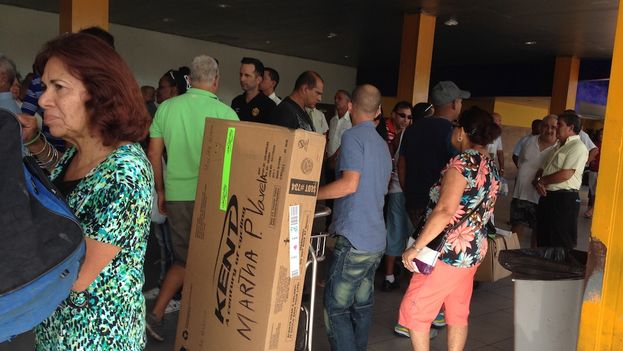
Outside Terminal 2 of José Martí International Airport in Havana. (14ymedio)

14ymedio bigger14ymedio, Zunilda Mata, Havana, 30 October 2017 – On Monday, Concepción González was waiting another day at the immigration office at 3rd and 22nd Streets, in Havana’s Playa municipality. The travel and immigration measures announced this Saturday brings to reality her old dream of reuniting with her rafter son.

On Saturday, during the IV Meeting of Cuban Residents in the United States held in Washington, Cuban Foreign Minister Bruno Rodríguez reported that as of January 1 of a package of four measures will go into effect, among which is the elimination of special permission required on the passports of Cuban emigrants living abroad in order to return to their native country. continue reading

In addition, Cuban citizens living abroad will be allowed to enter the country on pleasure boats; those who emigrated illegally will no longer (for the most part) have to wait eight years before returning; and the children of Cuban residents living abroad will no longer have to settle in Cuba to claim citizenship.

The announcement has provoked an avalanche of questions on the street about the convoluted Cuban migratory picture, questions that are reflected in the numerous comments on digital forums and social networks.

Meanwhile, the official media present the new rules as a response to the escalation of accusations about the presumed sonic attacks against the US diplomats that the administration of Donald Trump has launched and the recent cancellation by Washington of the issuance of visas in its Havana consulate.

“It was necessary for Trump to put a firm hand on the Cuban government’s determination to loosen the retrograde immigration measures imposed on its citizens abroad for decades,” says Rolando Gallardo, a resident of Quito, Ecuador, for years.

During the closing of the event, the Minister of Foreign Affairs declared: “The government of the United States closes and Cuba opens.”

“The Cuban political elite wants to expose itself to the world as the antithesis of an aggressive Trump,” political scientist Armando Chaguaceda, a Cuban emigrant, reflected in his column in the Mexican newspaper La Razón. Chaguaceda maintains that the flexibilizations seek an economic impact because “Raúl Castro and his heirs need minor allies to sustain the nascent authoritarian capitalism.”

With the repeal of the passport special authorization, which has been in force since 2004 and involves expenses of about 70 dollars to obtain it through an intermediary, 823,000 Cubans living abroad will benefit, according to official sources. Now, to enter the island, they will only need a valid national passport, renewed every two years.

From the United States, the country with the largest Cuban community, the issuance of the passport costs 375 dollars and is valid for six years. Each of the two extensions contemplated in that time costs $180 USD. With the costs of sending and processing the passport issuance process can reach 400 dollars.

The Cuban emigrants who arrived this Sunday at José Martí International Airport in Havana learned about the news there. “It took me a long time to get the authorization and this is the first time I’ve use it, but I’m glad that next year it won’t be necessary,” Yantier, 28, who lives in the Dominican Republic told this newspaper.

“It was a bit humiliating to ask permission to enter my own country,” adds the young man. Many of his friends “have had to behave well and not talk about politics publicly to ensure that they will put this stamp on their passport,” he says, and he believes that the new measures can help more people dare to say what they think.

Just a few hours before the official announcement, the authorities did not allow the widow of opposition leader Oswaldo Payá to enter the country despite her passport having the required authorization. Ofelia Acevedo denounced that in spite of having her documents in order and complying with the law, she was forced to return from Havana to Miami without being given any explanation of why she could not enter Cuba.

One of the doubts that remains to be resolved since Saturday is whether the government of the Island will allow the entry of opposition leaders in exile and former political prisoners who left the country, as is the case of many of those prosecuted during the Black Spring of 2003.

Pablo Pacheco, one of the former prisoners of the Black Spring, a member of the Cause of the 75 released in 2010 and now living in the United States, wrote on his Facebook page, “Bruno Rodriguez, I don’t believe you, I don’t believe that all Cubans are included in these supposed benefits.”

The authorization of entry and exit to Cubans living abroad on recreational boats through the Hemingway and Gaviota-Varadero International Tourist Marinas, something that was totally forbidden for years, also generates confusion among those affected.

“If I sail on my yacht from Miami to Havana, I can enter,” a Cuban emigrant reflected on social networks. “However, if I take advantage of my stay in Cuba to do the repatriation process and obtain a Cuban identity card, what will happen? Can I be a resident on the island and still have my yacht in the Marina Hemingway?” he asked.

Nationals living on the island are forbidden to have motor boats in these exclusive recreational marinas, so the new measures highlight even more the contradictions between “the different types of Cubans,” according to this emigrant.

Emigrants who have not undergone the repatriation process still have no right to buy property in Cuba or participate in elections, traditional demands of the Cuban exile. Nor is the double nationality they have obtained in their second homeland recognized, so they must enter the country with their Cuban passport.

Concepción González’s rafter son, who left in a poor boat to Miami from the western area of ​​the Havana coast in 2012, could benefit from the measure that abolishes the period of prohibition of entry to Cuba in the eight years after emigration illegal.

“I have not seen him for more than five years and I thought we had to wait for another three,” the mother tells 14ymedio.

However, for professionals who deserted medical missions or diplomatic missions or while traveling in sports or other delegations, the situation does not change. The restriction of entry to the Island is maintained against them during the first eight years after their departure. Nor does the picture change for those who left through the United States Naval Base in Guantánamo.

Another of the measures to be eliminated as of January is a requirement for the children of Cubans living abroad, who until now have had to live for 90 days on the island to be eligible for the citizenship of their parents.

Flexibility is a “double-edged sword” for Cuban families living in countries that do not grant birthright citizenship, as Spain does with some conditions, and as is widespread in Europe. The Civil Code of that country allows granting citizenship by “simple presumption” to children of foreign parents who lack nationality but who are permanent residents.

Now, that argument will not be able to be used to claim Spanish nationality as long as the island’s consulate will process the nationalization even if the child has never set foot on Cuban territory. This situation could be repeated in other countries with similar laws.

In spite of the doubts and the situations that still do not find answers after the new migratory measures, this weekend in innumerable Cuban homes the happiness about reuniting with their relatives has allowed people to park their questions for a while.

“I count the days remaining in this year until I see my son,” Concepción González confesses. “I know that many mothers still do not have that joy, but I trust that more openings of this kind will come,” she says. “They can not close any more, so they just have to open.”
Clothing Store Clandestina Makes the Leap to Online Sales of its Designs

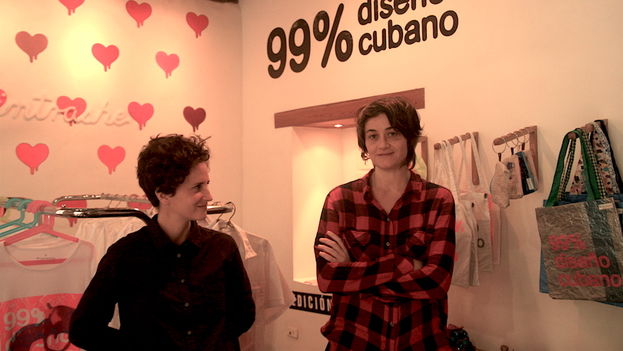
In spite of the difficulties of connecting to the web in Cuba, the business founded in 2015 by Idania Del Rio and Leire Fernandez has opted to distribute its products on the internet. (14ymedio)

The store gained international popularity after President Barack Obama’s visit to the Island in March 2016, when the leader ordered a t-shirt for his daughters.

14ymedio bigger14ymedio, Havana, 27 October 2017 – Clandestina, the clothing store that markets its own brand, this June became the first store of its kind on the Island to sell its products through the internet. Its creators emphasize the international character of their business, with clothing designed in Havana, sewn in Nicaragua and finished in South Carolina (U.S.).

In spite of the difficulties of connecting to the web in Cuba, the business founded in 2015 by Idania Del Rio and Leire Fernandez has opted to distribute its products on the internet. “We have barely had any internet this past week,” they say on their website. continue reading

Currently the store operates under the domain clandestina.co, but after November they will be able to move it to the better known “.com” which until now it has not been available.

Clandestina earned international popularity after President Barack Obama’s visit to the Island in March of 2016 when the leader mentioned the business in a televised interview and asked where he could find a t-shirt of that brand for his daughters.

All the products that will be sold on the web by by the small business are exclusive designs of the studio and can be acquired for 28 dollars.

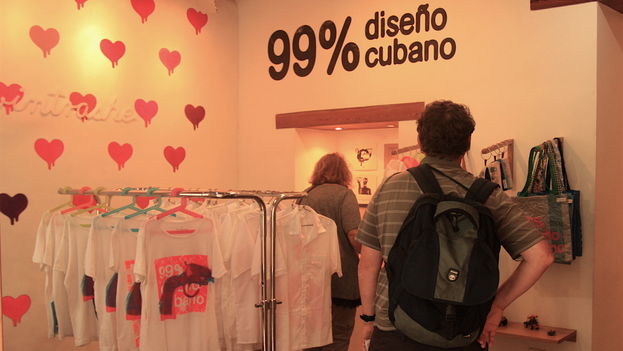
The virtual store’s offerings includes six t-shirt designs, among which are some with the phrase “99% Cuban Design,” a slogan that defines Clandestina. Other more controversial designs show the face of an adolescent Ernesto Guevara labeled within the “revolutionary” category.

The virtual store offers six t-shirt designs, among which are some with the phrase “99% Cuban Design,” a slogan that defines Clandestina. (14ymedio)

With the new website, the small space located in the heart of Old Havana stands out among the private businesses that are using new technologies in order to promote their products on the Island.

So far, the presence of individuals on the web for business purposes has been limited to the vacation rental sector, as is the case with those who rent rooms in their homes to tourists through platforms like Airbnb or their own digital pages.

Some musicians, like the Singer Haydee Milanes, also have managed to sell their records on iTunes, and several app developers have placed their products in Google and Apple stores, but almost always with the help of some friend who lives abroad and can collect customers’ payments.

In Clandestina’s case, the fact that Fernandez has Spanish citizenship has permitted her to register the business in the United States in her name, and this opens “more opportunities for business.” Her idea is that “all the creation and art is done here and then produced in the U.S.”

The site sells products for delivery in the United States, Canada and Mexico, but its managers aspire also to hire a supplier in Europe to lower the cost of transporting merchandise to the Old Continent.

Clandestina intends to play with the image of international icons like Ernesto Guevara, from whom it has designed a youthful version. “It is a young Che . . . still a boy. He hasn’t done anything bad, he has not done anything,” says Fernandez, who nevertheless acknowledges being “tired of seeing Che on every street in Havana.”

Translated by Mary Lou Keel

Cuba Removes Obstacles So Its Citizens Can Return to the Island

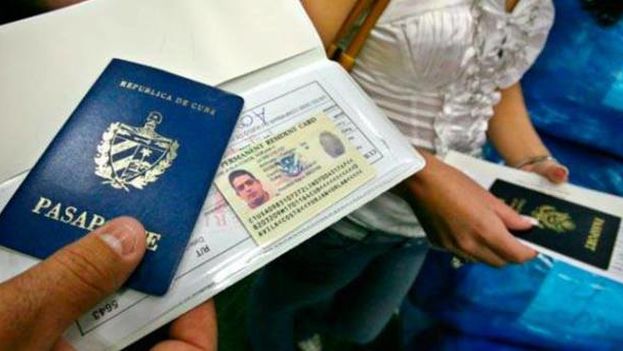
Cuba demands that its citizens who have spent more than 24 months outside the national territory receive a “habilitation” on their passport to be able to return to the island, even to visit. (EFE)

14ymedio biggerEFE via 14ymedio, Havana, 28 October 2017 – The Cuban government announced Saturday that as of 1 January 2018 it will eliminate “the requirement that children born to Cubans abroad establish themselves in Cuba to obtain Cuban citizenship,” and it will no longer require Cubans living abroad to obtain “permission on the passport for travel to Cuba.”

“The United States government closes and Cuba opens,” Cuban Foreign Minister Bruno Rodriguez said at a ceremony in Washington, announcing a series of immigration measures in response to measures recently taken by the US administration. continue reading

Cuba will also authorize “the entry and exit on pleasure boats,” currently not permitted, of Cuban citizens residing abroad, and entry to the island “of citizens who left the country illegally, except those who did so through the United States base in Guantánamo,” explained Rodríguez. Pleasure boats and cruise ships currently dock at the Hemingway and Gaviota Varadero marinas

The measures seek to relax Cuba’s immigration policy at a time when the United States has complicated travel between the two countries by suspending visa procedures at its embassy in Havana and expelled much of the Cuban mission in Washington.

The elimination of the process whereby Cubans living abroad receive permission to visit Cuba, known as “habilitation” of Cuban passports, was an old demand of the Cuban diaspora and could benefit 800,000 islanders living abroad, according to sources from the Cuban government.

The government will also eliminate the so-called process of “settlement,” established in the current Cuban Immigration Law, which requires that the children of Cubans born abroad spend at least 3 months in Cuba to be eligible to be granted citizenship.

Rodríguez spoke at the Fourth Meeting of Cuban Residents in the United States held today in Washington, where the Cuban historian Eusebio Leal also spoke.

Oswaldo Payá’s Widow: “The Cuban State did not want to tell me why I can’t enter my own country.”

Our apologies for the lack of subtitles on this video.

14ymedio bigger14ymedio, Mario Penton, Miami, 28 October 2017 – On Thursday, after four years of exile, Ofelia Acevedo, widow of Oswaldo Payá, the deceased opponent of the Cuban regime, was not allowed to enter her own country. Acevedo, an activist in her own right, had decided to travel to Havana to clarify the circumstances of her husband’s death in 2012, after a traffic crash that the family believes was an attack planned by the authorities.

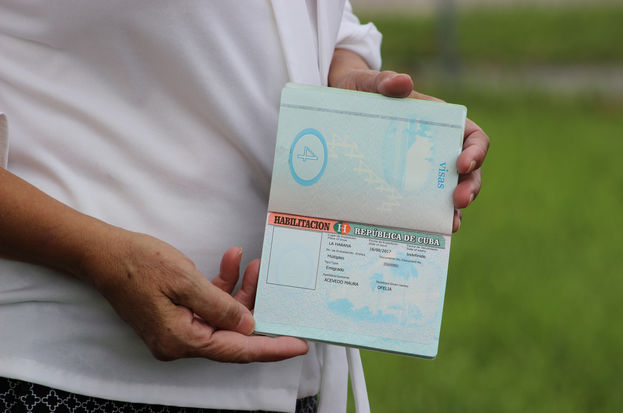
Although the Cuban government provided her with a new passport, stamped with the special authorization that citizens who have been out of the country more than two years must have to enter Cuba, when she arrived in Havana she was refused entry to the country and forced to return to Miami from Jose Marti International Airport in Havana. continue reading

“The Cuban State will not let me enter my country. Despite having my papers in order and meeting the legal terms, I was forced to return [to the United States] on Thursday without even an explanation of why I can not return,” says Acevedo, who spoke with 14ymedio at her home in Miami.

“I wanted to get the autopsy reports for Oswaldo [Payá] and Harold [Cepero, who died in the same crash], because when I was in Cuba I filled out endless paperwork and they never gave them to me,” she explained.

“Upon arriving at the immigration barriers, an officer told me that the system showed a restriction order, so that I could not enter the country. I told him that I would not move from there until they explained to me why I could not return to my own land,” she says.

Acevedo tells how a nervous Customs official asked her to follow his directions. “I’m just doing my job. You must have a job and surely you do it,” he repeated.

In the face her demands, Major Ángel Hernández Báez, the person in charge of immigration, appeared and informed her that his function was “to execute the action” of not letting her enter. “My sole function is to keep you from entering the country,” he stressed to Acevedo.

The widow of the Cuban dissident Oswaldo Payá shows the authorization on her passport, granted by the same authorities that later did not let her enter Cuba. (14ymedio)

For hours, Payá’s widow, in the company of her daughter Rosa María Payá, leader of the CubaDecides citizens’ initiative, debated with the official until finally Hernández Báez explained that the return flight was about to leave and that she would definitely not enter the national territory. The officer gave the airline a withdrawal order, but Acevedo was never given an explanation of the refusal.

After the crash that cost her husband and the young activist Harold Cepero their lives, the widow reports that she tried to obtain the report of the autoposy, but that the authorities never allowed it.

“After having taken so many steps and going to so many places the hospital director told me that he would send it to me in the mail, which he never did. I complained several times to the hospital but they never answered me,” she says.

The family has a right to the autopsy report, she asserts. From letters to the Minister of Public Health, Roberto Morales Ojeda, to an accusation presented to the Ministry of Justice, she took every possible action to seek to shed light on the fateful event.

Oswaldo Payá Sardiñas (1952-2012) was a charismatic leader, president of the Catholic-inspired Christian Liberation Movement, which organized the Varela Project in 1998, collecting more than 20,000 signatures to demand political reforms from the government then presided over by Fidel Castro.

The Constitution allows the organization of a national referendum for any proposal signed by a minimum of 10,000 citizens. However, the National Assembly of Peoples Power, under the absolute control of the Communist Party, dismissed the initiative and Fidel Castro promoted the declaration of the “irrevocable” character of socialism, eliminating any attempt at political change through laws.

Payá’s widow says she will not rest until she gets all the information she deserves about her husband’s death and makes “the truth” known.

“I still demand an investigation so that we really know what happened, even with all the limitations that I have, like this one of not entering my own country,” she says.

“I fear for the life of my daughter because their [the Cuban government’s] logic is not our logic, it is evil. They have not changed anything. Rosa María has not abandoned the path traced by her father and they can’t forgive this. They hate my family a lot.”

“This Soul of a Wounded People is The Worst Thing That Castroism Has Left Us”

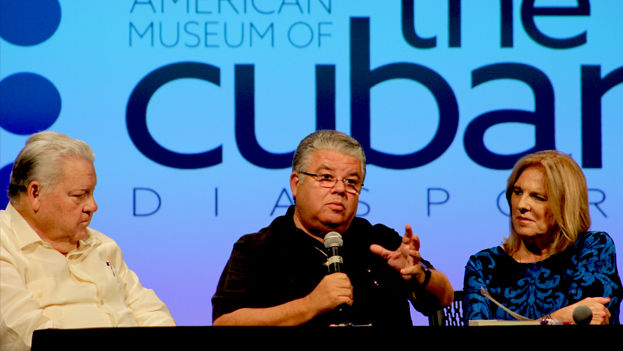
Father José Conrado Rodríguez (center) during the presentation of his book at the American Museum of the Cuban Diaspora, accompanied by Manuel Salvat and Myriam Márquez. (14ymedio)

14ymedio bigger14ymedio, Mario Penton, Miami, 27 October 2017 — “The Catholic Church in Cuba has a future of hope because despite the forces that have wanted to sow hatred in the Cuban nation, love has always triumphed.” This was the central message of Father José Conrado Rodríguez, presbyter of the church of San Francisco de Paula in Trinidad, during the presentation of his book Dreams and Nightmares of a Priest in Cuba in Miami on Thursday.

“That is the great victory of Cuba and Cubans: they wanted to separate us, they physically separated us, but they could never separate this people from love. We loved each other and we love each other and we will continue to love each other despite all the isolation and sowing of mistrust. Love has conquered,” the priest said with deep emotion. continue reading

The amphitheater of the American Museum of the Cuban Diaspora was small for the more than 150 people who came to the presentation of a book defined by the author as “intimate,” with passages related to the history of the Cuban Church of which he has been an eyewitness.

“I carry in my chest the cross of the pains of my people,” said Rodríguez, recalling the words he delivered in his first Eucharist when he carried a cross made from the wood of the presidio to which the revolutionary government confined the Catholic priest Miguel Ángel Loredo for ten years.

The genesis of the book reflects the deep controversy surrounding this man who is able to confront the authorities of the island and his own pastors to ask for more freedom for the people of Cuba.

“It is not a coherent book. These are different times and that is what I want to be clear about,” Rodriguez said. The idea of ​​writing the book came after a request from a professor at the San Gimignano Institute in Italy specializing in religious sociology, who had previously asked for an analysis of the situation of the Church in Cuba from Cardinal Jaime Ortega. The contrast between the experiences of Ortega and Rodriguez led the professor to seek the vision of a priest of the people to compare to that of the cardinal.

“My vocation as a priest is to serve the poorest and most needy, those whom they turn their backs to because they are committed,” recalled the priest, who in 1994 wrote an open letter to Cuban leader Fidel Castro and in 2009 did the same to his brother Raul.

“The economic crisis affects all households and causes people to live anxiously wondering: What am I going to eat or what am I going to wear? How am I going to get the most elemental things for my family? The difficulties of everyday life become so overwhelming that they keep us mired in sadness and hopelessness,” said the letter sent to the Plaza of the Revolution to which he never received a reply.

The book Dreams and Nightmares of a Priest in Cuba begins with a prologue by Felipe J. Estévez, bishop of San Agustín, Florida. The prelate praised the “creative fidelity” of the Cuban priest in the years of hard persecution against the Catholic faith that followed the triumph of the Revolution in 1959.

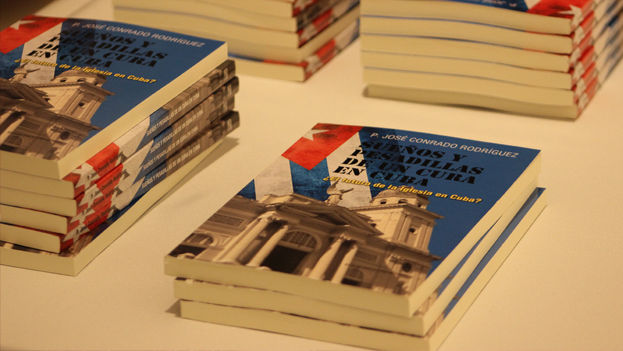
Cover of the book Dreams and Nightmares of a Priest in Cuba, by Father José Conrado Rodríguez. (14ymedio)

“To build bridges between people, institutions, different points of view, to be a meeting place for a diverse people, his being a priest of Christ has been and is an essential part of his life,” said the bishop.

Rodríguez then presented a panorama of “the Castro brothers’ Cuba” during his forty years of priesthood, followed by his reflections on the need for reform of the Cuban Church and a project to accomplish it. The book also has three interviews on the need for the Cuban Church to be bolder, along with some reflections on the situation of the Island at the present time.

“This book says very serious things, including the learned hopelessness, perhaps the worst evil affecting Cubans at this time, the feeling that they can not do anything to change their lives,” said the director of the American Museum of the Cuban Diaspora, Ileana Fuentes.

“This soul of a wounded people is the worst thing that Castroism has left us,” she added.

The editor of the text, Manuel Salvat, highlighted the book’s autobiography. “This is a priest who has studied a lot and is very well informed, putting everything at the service of God and his people. This book is an essential tool to know the present and the future of the country,” he added. “In this difficult town that is Cuban Miami everyone wants a copy,” he said visibly excited.

For her part, the former director of el Nuevo Herald Miriam Marquez said that the first and only time the Cuban government let her enter the island Father Conrado allowed her to see the reality of the island beyond what officialdom showed.

For Jorge Graña, producer for the Catholic Television Network EWTN and a former seminarian in Santiago de Cuba, Rodríguez represents the prophetic role in the Cuban Church. “The Prophet is not the one who predicts the future, but the man of truth, who carries the voice in his heart and consoles and encourages the people. That is José Conrado,” he said.

“Long before Pope Francis asked the shepherds ‘to realize that we too are sheep’, José Conrado would go to the outskirts and feel the pain of the people. The sheep know who their pastor is and that is why so many follow him.”

Self-Employment Grows In Cuba Despite License Restrictions

Less than 70% of those who have a license to work on their own account have been covered by the Social Security scheme. (14ymedio)

14ymedio bigger14ymedio, Havana, 26 October 2017 — The self-employed sector in Cuba grew by 56,560 workers during the period from September 2016 to September 2017, the official newspaper Juventud Rebelde (Rebel Youth) reported Thursday. The total rose from 522,855 employed in this form of work to 579,415.

The number of people working in the private sector has continued to rise despite the fact that last August the government froze the issuance of permits for various activities, including the management of private restaurants and the renting of rooms or homes to tourists. continue reading

The measure was announced as part of a “systematic process of review and perfecting, aimed at correcting deficiencies,” said Marta Elena Feitó, deputy minister of Labor and Social Security.

The authorities announced that a series of measures would be implemented to prevent private workers from engaging in ‘irregularities’, but the bulk of the new regulations have not yet been released.

Data from the Ministry of Labor and Social Security (MTSS) “show a tendency to increase activity since October 2010, when this option of non-state employment was extended and relaxed,” the text says.

The MTSS also updated the composition of the sector: 32% is made up of young people; women represent a little more than a third of the total; 15% of the self-employed “combine [self-employment] with work in the state sector, while another 11% are retired,” the report said.

Of the total, 402,805 people have taken part in the Social Security program, which represents less than 70% of those who have a license to work on their own.

The production and sale of food is the main activity, with 61,301 people; followed by freight and passenger transport, with 57,911; in addition, 39,442 self-employed are licensed for rental of dwellings and rooms; and 24,736 are employed as telecommunications agents.

As a result of the reduction in public employment announced by Raúl Castro’s government in 2009, the self-employed sector has grown to now account for about 10% of the labor force, while the state sector has laid off 596,500 workers, according to one report from the Cuban Workers Center.

Fidel Castro Has a Statue in South Africa

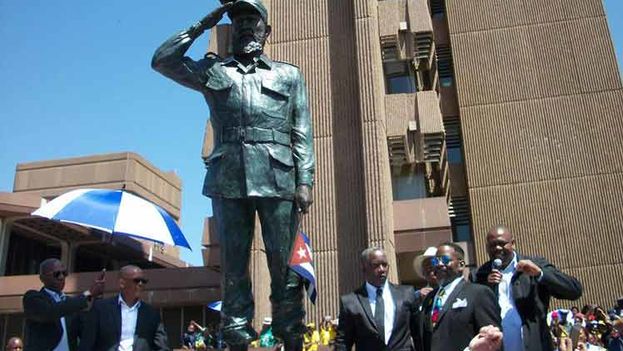
Statue of Fidel Castro in South Africa during the unveiling. (Prensa Latina)

14ymedio bigger14ymedio, Havana, 26 October 2017 — Oliver Tambo, one of the most important leaders of the anti-apartheid movement in South Africa, has a new partner. The sculpture of the leader in the province of Free State is next to a bronze statue of Fidel Castro that was unveiled this week.

The ceremony was attended by the first minister of the province, Ace Magashule, and the commercial advisor of the Cuban Embassy in South Africa, Pedro Arteaga. continue reading

The full-body figure represents the deceased Cuban leader making his characteristic military salute. He is dressed in a uniform and holds a Cuban flag in his hand.

Several South Africans who “studied in Cuba” were present at the ceremony along with “cooperators” from the Island who provide services in the Free State. At the end of last year, 424 Cuban health professionals were working in South Africa under a cooperation program that began in 1996.

The placement of the sculpture in South Africa contrasts with the prohibition established since the end of 2016 for the use of the name or image of Castro in public spaces or monuments in Cuba.

The decision, adopted in the Cuban National Assembly, was presented as part of the former president’s will to “avoid any manifestation of personality worship.”

Last August an eight-foot high monument, made of limestone and with the image of Castro accompanied by the words “Victory is perseverance,” was unveiled in Crimea.

What Remains of Che in Cuba / Iván García

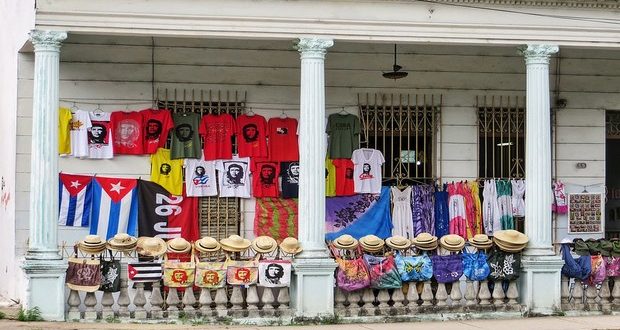
Che T-Shirts in Santa Clara, Cuba, among other souvenirs. Taken from the blog Flora the Explorer.

Iván García, 9 October 2017 — Inside a Miami house devoid of grand architectural pretensions is a museum devoted to Brigade 2506. It commemorates the Cuban troops who came from the United States to confront the island’s militias and armed forces at the Bay of Pigs.

On several wooden panels hung on the walls are hundreds of photos of combatants in who fell in armed confrontation against the communist system imposed by the Castro brothers in those years. continue reading

With any luck, you might run into Felix Rodriguez, a former CIA agent who on October 8, 1967 captured the Argentinian guerilla Ernesto “Che” Guevara in Quebrada del Yuro, Bolivia.

Rodríguez, an elderly man who maintains a military posture despite physical ailments, has on countless occasions recounted an episode that demystifies the image of the illustrious hero that Cuba’s dictators wants to promote.

No one, not even his adversaries, question Che’s courage. But on that cold morning Guevara was forced to surrender after being ambushed by the Bolivian army.

The man who captured him reports that at the time Che was wounded, dressed in rags and in possession of an unused firearm. He was also very disappointed to have lost contact with Havana. Rodriguez remembers that he still had bullets in his pistol and that upon surrender he told his captors, “I am worth more alive than dead.” That is what Felix Rodriguez also believed.

But orders from superior officers were to execute him and to bury his body in a section of runway at the Vallegrande airport. This fact is overlooked in official accounts by the Castro government. They prefer to emphasize his heroism and guerrilla leadership.

Che Guevara’s life has become an imprecise myth. In Cuba his death is commemorated on October 8 though he actually died in a hail of gunfire a day later. John Lee Anderson, who has researched the life of Guevara, claims that the date of birth — June 14, 1928 — is false, that he was actually born a month earlier in the Argentinian city of Rosario.

After gaining immortality by winning the last, decisive battle of the Cuban revolution in Santa Clara, Guevara’s exploits in the field of combat were reduced to a string of failures. Because conditions in the Congo and Bolivia were not conducive to guerrilla warfare, skirmishes there turned into bloodbaths.

He did not distinguish himself in the field of economics either. After Guevara was appointed head of the national bank and Minister of Industry, he tried to graft his concept of the “New Man” onto the normal commercial, wage and financial rules by which a country is governed. The results were routinely bad.

His enemies accuse him of murder. While he was the commander of La Cabaña Fortress, he signed five hundred summary death sentences  A dedicated Communist, he always came off as a sullen, inflexible guy during his time in the Sierra Maestra, though one who was highly cultured. He personally recruited a number of subversive guerrillas.

His disregard for material possessions, his austerity and his personal integrity were probably his most striking personal qualities. And above all he risked his own neck to validate his “truths.”

Along with Fidel Castro, Guevara is today one of the patron saints of the revolution, which has now evolved into the perfect dictatorship. From childhood, Cubans are inculcated in the almost religious cult of Che.

“I remember in pre-school they told us stories about Che and his friendship with Camilo [Cienfuegos] and Fidel. Then you enter primary school and every morning they make you repeat the slogan ’Pioneers for communism, we will be like Che.’ This systematic indoctrination has left a mark on many people,” recalls Octavio, a civil engineer.

Ada, an educator, argues that the way the life and work of Che Guevara has been advertised and marketed is “simply atrocious.” She adds, ” They create conditioned reflexes that end up beatifying figures of the revolution. But when you reach adulthood, you recognize them as being the ones guilty for the national disaster. The same thing happens with Che. His mistakes as [economics] minister are minimized while the government’s advertising campaign emphasizes his abilities as a leader. Among young people in the western world he is a more iconic figure than Lenin or Mao and this has made him into a political marketing tool. People with no attachments to Communist ideology, such as Madonna or Mike Tyson, get tattooed with his likeness. His face is printed on T-shirts and luxury wristwatches. Major brands have used his image in publicity campaigns.”

In a mansion in Guanabo, a town to the east of the capital famous for its beach, lives one of Cuba’s best tattoo artists. I asked if Che’s image still sold well.

“It’s one of the top sellers, not just among foreigners but among Cubans as well,” he says. “What has always struck me is how many freaks, sex fiends, liberals and lovers of capitalism pick his image for a tattoo because Che was the antithesis of all that. You don’t often see officials from the Young Communist League or the Communist Party coming here for tattoos even though they are his most loyal followers. Perhaps it’s because of the pain, or the cost. Every tattoo costs from twenty-five to fifty convertible pesos,” says the Havana tattoo artist.

If anyone has profited off Che’s visage it is his family in Cuba. Under the pretext of promoting her father’s work, Aleida Guevara has created a foundation in his name whose trademark yields good economic dividends.

Let’s call him Ruben. He is a person intimately familiar with the Che Guevara Foundation’s scams. “The fat lady (Aleida) does not miss a thing,” he says. “Two years ago a left-wing South American publisher released a book on Che’s ideas and Aleida sued them, demanding payment. Che would have been very honest but his Cuban descendants are litigious. They like money more than sweet coconut.”

Daniel, a fan of Harley Davidson motorcycles, recalls, “At a time when there were very few people in Cuba who cared about Harleys, some of us formed a club which met on weekends. After going through a lot of red tape, we organized a Harley festival in Varadero which riders from other countries would attend. But when Che’s two sons, Camilo and Ernestico, got wind of it, they took over. They partnered with Gaviota, opened a bar in Varadero which charged in hard currency, rented out brand new Harleys and charged $2,500 to $3,000 to tour the entire island. They have falsified history; the motorcycle Che used on this tour through South America was a Norton 500.

Ernesto Guevara works better as a business venture than an ideology. At the time of his detention, he told his captor, Felix Rodriguez, that he was worth more alive than dead. He was not mistaken.

Cienfuegos To Host Cuba’s First Legal Center On Gender Violence

At present, neither the Cuban Criminal Code nor the Family Code criminalize gender-based violence. (UNHCR Americas)

14ymedio bigger14ymedio, Havana, 25 October 2017 – On November 25, Cienfuegos will be the first Cuban city to open a legal counseling center on gender violence. The initiative is due to the National Union of Jurists of Cuba, with the support of the United Nations Development Program (UNDP).

Igneris Ramirez, one of the lawyers in charge of the new entity, told 14ymedio that the essence of this body will be to “provide guidance, assistance and protection to victims” and especially “women who are victims of violence in all its manifestations.” continue reading

The United Nations ratified the Declaration on the Elimination of Violence Against Women in 1993. At that time it was defined as “any act of violence based on belonging to the female sex that has or may result in physical, sexual or psychological harm or suffering.”

Ramirez added that the operation of the new center intends to deal with gender-based violence by dealing with all its actors, both victims and affected relatives and “the victimizer himself” who has the will to correct his violent acts.

The group of specialists who make up the board consists of 15 jurists, including prosecutors, lawyers and judges, as well as a representation of the Provincial Directorate of Justice, along with five doctors including medical forensic doctors, psychiatrists and psychologists.

They maintain that, if successful, this pilot test can be extended to the whole country.

The site will be located in the Social House of the Union of Jurists in the city of Cienfuegos, at 56th Avenue between 33 and 31st Streets. It is creating spaces to attend to the complainants and train the specialists in postgraduate workshops to give jurists “procedural tools.”

The news about the commissioning of this center occurs when the murder of Leidy Maura Pacheco, an 18-year-old girl who was kidnapped, raped and murdered on 26 September, fills the official press.

Although public statistics on gender-based violence are difficult to access, in addition to being few, incomplete and confusing, Cuba’s Report on Combating Trafficking in Persons and Related Crimes of the past year reveals that in 2015 there were 2,174 child victims of alleged incidents of sexual abuse, of which 333 were rapes.

At present, neither the Cuban Criminal Code nor the Family Code criminalize domestic or intra-family violence, a pending task for the island’s jurists, as we can see that in Latin America at least 14 countries have defined the crime of femicide.

The official Federation of Cuban Women (FMC) will offer support to the new entity. The FMC is in charge of 174 Women and Family Counseling Houses throughout the country, although none provide shelter to victims who have made complaints or who have had to leave their homes.

The Other Diversity

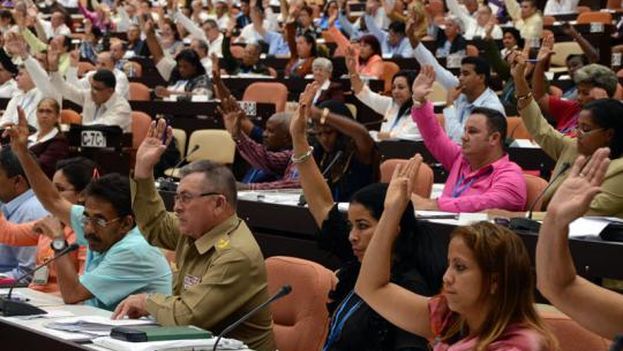
A diversity of candidates in Cuba is not evident in the always-unanimous voting pattern in the National Assembly. (MINREX)

14ymedio bigger14ymedio, Reinaldo Escobar, Havana, 26 October 2017 — On the eve of the People’s Power elections in Cuba, the issue of representation in municipal, provincial and national bodies has again come to life, this time in an interview in Cubadebate with Gisela María Duarte Vázquez, president of the National Candidacy Commission.

The official insists that diversity among the representatives of the people is guaranteed by the appropriate proportion in the number of men and women, young people, students, workers, farmers, technicians, professionals, those engaged in more significant economic activities, state and non-state workers.” continue reading

This range of genres, ages and activities – together with an unmentioned intention to achieve a racial balance and a more or less equitable territorial distribution – forms a mural that represents the population of the country but with a common denominator: identification with the politics outlined by the Communist Party of Cuba (PCC).

The president of the Candidacy Commission does not present it so directly, but refers to several of the catchphrases that reflect the PCC line, such as “commitment to the Revolution,” “commitment to the people,” or “the concept of Revolution that Fidel bequeathed us.”

One of the most widespread criticisms of the current Electoral Law is precisely the existence of these commissions that should guarantee the representativeness of the people in the different People’s Power Assemblies, from the local level up to the national level, but that do not consider the diversity of political opinions.

Duarte Vázquez explained that in the process of preparing the lists of candidates, “as much as possible, we consult the opinions of as many institutions, organizations and workplaces as are necessary, as well as the opinions of the delegates to the Municipal Assemblies of People’s Power.”

This consultation does not exclude information that may also be provided by the organs of State Security and the opinions of the ever-vigilant Committees for the Defense of the Revolution (CDR).

The main argument put forward by the Candidacy Commission is, according to the president, that the system “does away with every kind of stage for conflict, competition and politicking and promotes merit, capacity and commitment to the people” as the elements to consider.

The confusion between “politicking” and politics has its roots in the republican past and refers to the murky maneuvers, frauds, and unfulfilled promises of unscrupulous characters of the last century who exchanged their votes for hospital beds and even enrolled the deceased on the voter lists.

What no one can explain is, why it is that the voters are not allowed to know the platforms of their candidates and must vote for someone without knowing how they will act in Parliament when they become a deputy.

Examples include such controversial issues as the solution to the dual monetary system, the approval of same-sex marriage, the acceptance of small and medium-sized enterprises, the definitive abolition of the death penalty or the end of immigration restrictions, which oblige Cubans residing abroad to update their Cuban passports on a regular basis, even if they have adopted another nationality.

Hypothetically, at least two lists of candidates with equal diversity in the areas of race, sex, age or occupation could be formed in parallel, and with the same social merits, but that would vote differently in these matters.

The function of a parliament is to subject proposals to discussion and to vote for proposals whose essential differences are of a political nature. When a Candidacy Commission annuls diversity of opinions or ignores them, the possibility of political opinions ascending from the people to the powers-that-be through the democratic vote is lost.

It doesn’t matter if they are excellent workers, great students, good parents and better children; equity between men and women and between old and young is useless if the balance between political tendencies can not be measured, resulting not only from the successful or unsuccessful outcome of governmental decisions but also from the many existing ideological currents in the world.

When Cuba has a new electoral law the first thing that must disappear is this Candidacy Commission. The difficulty is that in order for voters to find out how their candidates think, they would have to enjoy sufficient freedom of expression to make their approaches known, and also enjoy freedom of association in order to agree on proposals.

Dignity Movement Activists Denounce “Repression And Arbitrary Arrests”

Activist Belkis Cantillo, leader of the Dignity Movement, reported about the detention of some members of the organization via telephone to ’14ymedio’. (UFL)

14ymedio, Havana, 23 October 2017 — A brief communiqué issued Sunday by the Dignity Movement demands for its activists “the citizen’s right to exercise freedom of movement and communication,” following several arrests during this weekend in Palmarito del Cauto, in the province of Santiago de Cuba.

The activist Belkis Cantillo, leader of the Dignity Movement, detailed to 14ymedio by phone that several members of the independent organization, along with some activists of the Patriotic Union of Cuba (Unpacu), were arrested at a control point at Palmarito de Cauto while heading to the Sanctuary of the Virgin of Charity of Cobre. continue reading

“On Friday I left the house with Maydolis Oribe and Fatima Victoria but when we arrived at the checkpoint they stopped us, threatened us and returned us to the house in a police car,” Cantillo reported. The checkpoint is “near the bridge” that separates the municipality of Palmarito de Cauto from Palma Soriano.

According to Cantillo’s testimony this Saturday, a day after the incident, she decided to “stand” with Maydolis Oribe and call the women of Palma and Palmarito “to leave for the checkpoint.”

When they arrived there “were agents of State Security” and they were threatened with a 1,500 peso fine. Later Cantillo was arrested again next to Oribe and led to the unit of the National Revolutionary Police of the municipality Mella.

Yulaisy Carracero, another member of the Movement, was also among the detainees on Saturday and “was taken to the San Luis police station with Graciela Giron.”

The concern of the Dignity Movement is focused on Carracero who has not yet been released. “Despite everything, next Sunday we are going to leave to go to Mass,” concludes Cantillo.

One of the demands of the Dignity Movement is the elimination of the crime of “pre-criminal dangerousness,” which it considers “an aberration” According to the Cuban Penal Code, individuals considered dangerous may be subject to measures considered therapeutic, re-educational or surveillance by the National Revolutionary Police (including up to four years imprisonment) despite not having committed any crime.

In recent months its activists have been tightly controlled by State Security to prevent them from leaving the municipality.

The organization was founded last January and also works with common prisoners “to help them and their families with the social and legal care they need and don’t have,” Cantillo said in an interview with the newspaper.

In mid-2016, the United Nations Development Program estimated that Cuba had 510 people in prison for every 100,000 people, a figure that puts the country at the head of the region. In 1959 the island had 14 prisons, but today the figure exceeds 200, according to estimates of the Cuban Commission on Human Rights and National Reconciliation (CCDHRN).

Yoandy Izquierdo, Banned From Leaving Cuba, Unable to Travel to Spain

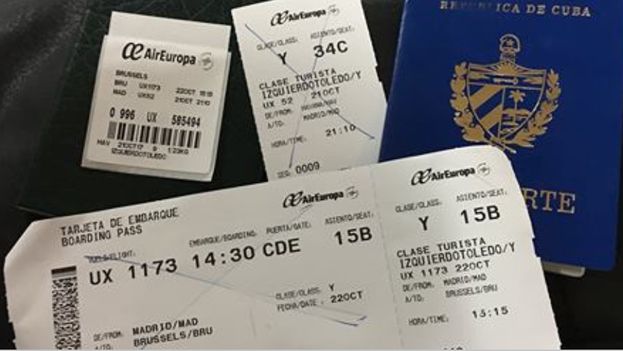
Yoandy Izquierdo had checked in for his flight with Air Europa when an Immigration official announced that he “was prohibited from travel.” (Coexistence)

14ymedio bigger14ymedio, Havana, 23 October 2017 — The authorities prevented Yoandy Izquierdo Toledo, a member of the Center for Coexistence Studies (CEC), from boarding a plane to Spain on Saturday to attend a conference at the European University of Valencia, as confirmed by the activist himself to 14ymedio.

Izquierdo, who was also going to participate in a youth workshop, traveled from Pinar del Rio José Martí International Airport Terminal Three in Havana where he checked into his flight to Madrid with Air Europa. continue reading

“After I checked the suitcase and at the moment of immigration, the official asked me to step back,” says Izquierdo. Immediately an officer appeared and asked him to accompany her to a nearby office.

The official assured him that he was prohibited from leaving the country but could not give him any reason why. The officer cancelled Izquierdo’s boarding pass and urged him to pick up his suitcase.

Two hours after the incident, about nine o’clock in the evening, the Customs employees handed over his luggage. This Monday, Izquierdo plans to visit the offices of the Directorate of Immigration and Immigration (DIE) in the city of Pinar del Río.

“I am surprised by this violation of my right to travel because I have never had nor do I have a pending legal case,” he explains, referring to one reason Cubans are forbidden to travel.

A note published on the CEC’s Facebook page ensures that the denial of travel against Izquierdo adds to “systematic and arbitrary harassment against the magazine and Center for Coexistence Studies, a laboratory of thought and proposals for Cuba.”

The practice of preventing activists and opponents from traveling outside the country has become more frequent in the last year despite the flexibility to leave and enter the island that came into force in January of 2013 with the Migration Reform.

Dissidents, journalists and independent lawyers have reported in recent months that they appear as “regulated” in the DIE database to prevent them from participating in events abroad.

Last Tuesday, reporter and independent writer Víctor Manuel Domínguez was prohibited from boarding a flight from Havana to Brussels where he was to participate in an event on foreign investment in Cuba.

The Cuban Commission for Human Rights and National Reconciliation (CCDHRN) denounced last September that at least half a dozen activists “were prevented from traveling abroad to participate in conferences or training activities.”