The Island purchased barely $523 million worth of goods from its Asian ally from January to September, while sales from the northern “enemy” have exceeded $1 billion.
 14ymedio, Madrid, November 13, 2026 – Cuban Foreign Minister Bruno Rodríguez has flown to Vietnam after concluding a visit to China, from which he obtained no more concrete results than Beijing’s customary expressions of solidarity against U.S. sanctions on the regime. It was the Island’s foreign minister’s second trip to the Asian giant, but both visits have yielded little more than statements about the “potential of bilateral economic cooperation and the willingness of Chinese companies to expand their ties with Cuba.”
This Thursday, Rodríguez participated in a trade and investment forum in Beijing alongside Deputy Prime Minister and Minister of Foreign Trade and Foreign Investment Óscar Pérez-Oliva Fraga. At the forum, Ren Hongbin, president of the China Council for the Promotion of International Trade, “highlighted progress in Chinese exports of electromechanical products to Cuba, as well as the presence of Cuban goods in the Chinese market, including rum, honey, and fishery products.” But the trade balance is so heavily tilted in China’s favor that it is impossible to imagine anything remotely resembling an equal partnership.
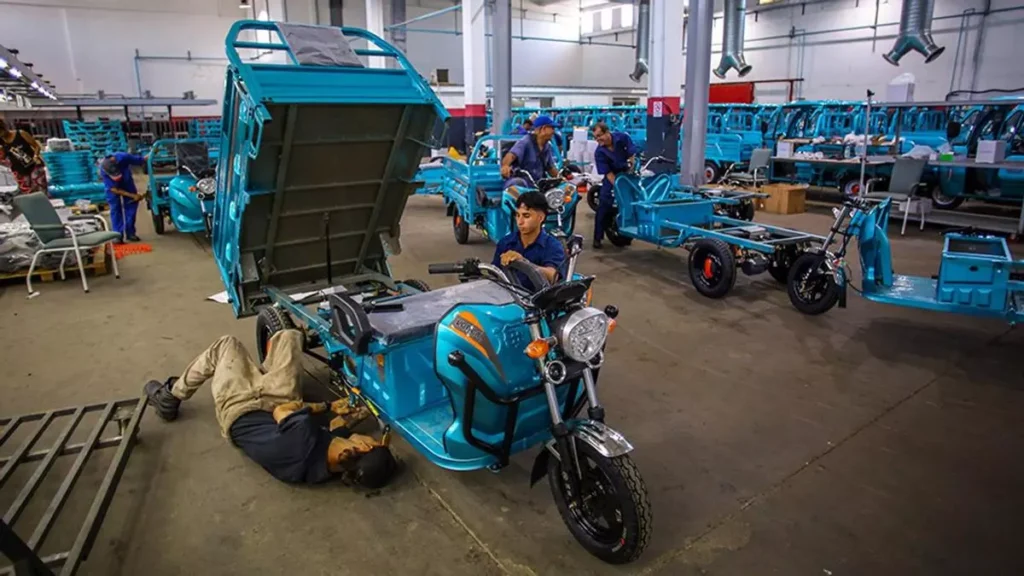
Chinese export figures to Cuba show that the Asian country shipped $523 million worth of products between January and September of this year. Figures from China’s General Administration of Customs reflect a 35.5% decline compared with the same period in 2025. That year ended with a total of $1.08 billion, most of it consisting of electrical equipment—primarily panels, batteries, and telephones—worth $445.88 million. This was followed by vehicles and parts—cars, electric motorcycles, and transportation equipment—at $187.11 million; machinery and mechanical appliances at $123.8 million; iron and steel products at $59.41 million; and a varied group of other products—including aluminum, plastics, and optical and medical equipment—at $263.8 million.
Chinese export figures to Cuba show that the Asian country shipped $523 million worth of products between January and September of this year
Cuba, meanwhile, sent barely $229 million worth of goods to the Asian country, leaving the bilateral trade deficit at approximately $854 million. What was unusual about last year was that the vast majority of those sales ($136.1 million) consisted of metals—zinc, nickel, cobalt, and other metals—along with another $24.6 million in copper scrap. Currently, however, the Island cannot export these products because of the collapse of its mining industry and the departure of several foreign companies as a consequence of U.S. sanctions.
Tobacco ($42 million) and lobster ($12 million) remain at the top of the list. Chemical and pharmaceutical products, to which Cuba attaches so much importance, barely reached $2 million, only slightly more than rum, at $1.94 million. The Island lost one of its major exports to China with the collapse of its sugar harvest, which in 2023 brought Havana $13.5 million before subsequently disappearing from the records, just as it disappeared from the sugar mills and store shelves themselves.
To understand the seriousness of the situation, it is enough to review the historical figures for sugar exports to China. In 2019, Cuba exported $134 million worth of sugar and even in 2020, $130 million. In both years, sugar was the country’s leading export to Beijing, although shortages were already beginning to affect the Island.
Cuba continues to consider China its leading trading partner, ahead of the United States, despite the fact that its neighboring country has managed to move far ahead of its major international rival this year. Between January and September 2026, the United States sold $1.0965 billion worth of goods to the Island, an increase of 91% compared with the same period the previous year ($572.8 million), according to the U.S. Census Bureau. Compared with China’s January-to-September figure—the $523 million cited above—the difference is nearly twofold ($573.5 million).
The jump is spectacular when compared with previous years. In 2024, China sold Cuba $644 million worth of goods, compared with $585.2 million from the United States. In 2025, Beijing surpassed Washington by an even wider margin: $1.08 billion versus $809.6 million. The major change is driven primarily by U.S. fuel sales. Through August alone, trade in fuel between American suppliers and Cuban private businesses amounted to $231,744,309, a category that previously did not exist.
In 2024, China sold Cuba $644 million worth of goods, compared with $585.2 million from the United States. In 2025, Beijing surpassed Washington by an even wider margin: $1.08 billion versus $809.6 million
In addition, $314.3 million came from sales of agricultural products, an exception to the embargo that has been in effect since 2000 and has turned the United States into one of Cuba’s main food suppliers. This role has become more firmly established since the approval of micro, small, and medium-sized enterprises (MSMEs) in 2021. These businesses import enormous quantities of food from Miami while the Cuban state lacks the resources to do anything comparable.
Nevertheless, the United States cannot be considered a trading partner of Cuba in terms of international trade, since that designation implies a two-way flow of goods that is impossible for both legal and practical reasons. According to official U.S. Census Bureau records, total exports of goods from Cuba to the United States barely reach between $1 million and $5 million annually, permitted under very specific authorizations. The products cited include works of art, research samples, and goods produced by the private sector, such as coffee, charcoal, and honey.
Through its shipments, the United States is a supplier of food and authorized goods, but not an economic cooperation partner in the same way as China, which also carries out strategic projects on the Island and provides financial assistance, including debt forgiveness and restructuring.
A geopolitical paradox: Beijing remains the Havana regime’s leading partner, while the Cuban population increasingly depends on food and fuel shipments from the Empire.
Translated by Regina Anavy
______________________
COLLABORATE WITH OUR WORK: The 14ymedio team is committed to practicing serious journalism that reflects Cuba’s reality in all its depth. Thank you for joining us on this long journey. We invite you to continue supporting us by becoming a member of 14ymedio now. Together we can continue transforming journalism in Cuba.