Rubio made it clear that the talks with the Cuban Government were very advanced and that they did not want to do anything that would prolong the regime.
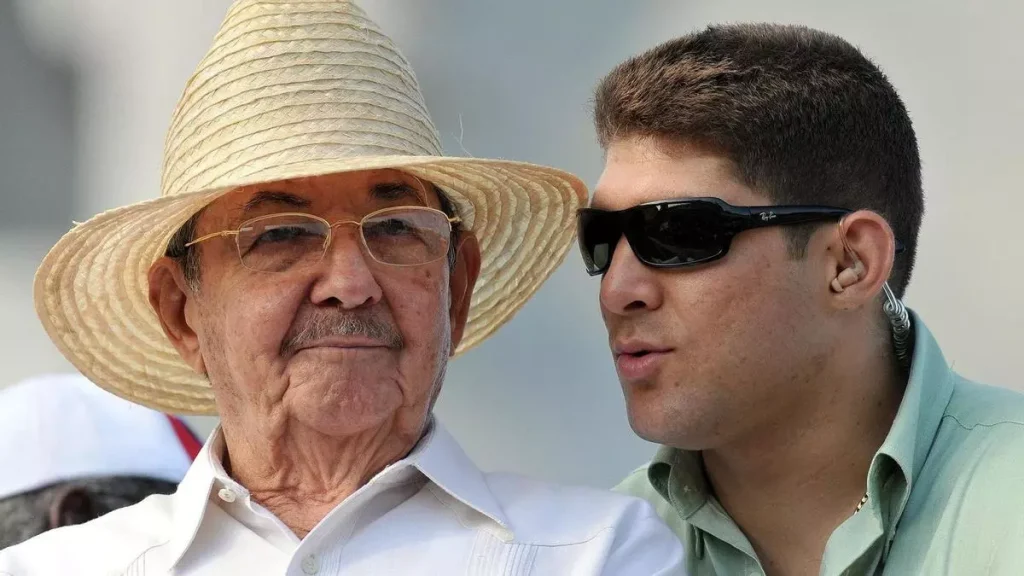
 14ymedio, Madrid, February 26, 2026 – U.S. officials close to Secretary of State Marco Rubio met with Raúl Guillermo Rodríguez Castro, known as El Cangrejo (the Crab), Raúl Castro’s grandson, in Basseterre, the capital of Saint Kitts and Nevis, where the Caribbean Community (Caricom) summit was just held. This was confirmed to the Miami Herald by “multiple sources with knowledge of the meeting” who requested anonymity to speak about the “delicate negotiations.”
According to these testimonies, El Cangrejo met with one of Rubio’s advisers at a hotel near the venue where the summit was held. It is not clear, the Herald adds, “whether Rubio himself, who attended the Caricom meeting and spoke with Caribbean leaders on Wednesday, met with Rodríguez Castro.” The mere fact that “his team is in contact with Castro’s grandson,” the U.S. newspaper reasons, “confirms that the Trump Administration considers him a key figure in efforts by Cuba and the United States to promote reforms on the Island.”
The central topic of the talks was, the Herald asserts, “the possibility of gradually easing U.S. sanctions in exchange for Cuban leaders implementing changes on the Island month by month.” A Caribbean diplomat confirmed to the Miami newspaper that in private meetings with them, on the sidelines of the summit, “Rubio made it clear that the talks with the Cuban Government were very advanced and that they did not want to do anything that would prolong the regime.” The Herald quotes him as saying: “He seemed quite confident that they were close to an agreement.” Another source said that it has not yet been finalized.
The sources stated that a “more formal” meeting between Cuban Government officials and the U.S. State Department was expected to take place today
Rodríguez Castro, the Herald reports, traveled to Saint Kitts “with a Cuban protocol official” on Wednesday, the same day the U.S. Secretary of State arrived to participate in the Caricom summit. Likewise, the sources stated that a “more formal” meeting between officials of the Cuban Government and the U.S. State Department was expected to take place today.
Cuba was a central topic of the summit, according to the Herald’s report. After meeting with Rubio, the president of Guyana, Irfaan Ali, stated that they had held “deliberate and focused discussions” on various topics, including Venezuela and the Island. “Dealing with Cuba is not a simple matter, but we discussed a framework in which Caricom could be part, that would address the issue of Cuba and the necessary transitions for the Cuban people,” were the words quoted by the U.S. newspaper.
The article also reports that Rodríguez Castro met with other leaders during his stay at the Coral Building, next to the Marriott hotel, the meeting site of Caricom.
When asked at the press conference after his participation in the summit, Rubio did not deny either the Herald’s report or that of Axios, which on February 18 had already revealed that the Secretary of State had been holding “secret talks” with El Cangrejo. In its publication, Axios said that Washington considered Raúl Castro the true head of the regime, and that the main objective of the Trump Administration is that “the regime has to go.”
“I am not going to comment on any of the conversations we have had,” Rubio stated. “Suffice it to say that the United States is always willing to speak with officials of any government who have information to share with us or viewpoints to share with the United States.”
“The reason things are so bad is because they have an economic model that does not exist, that does not work”
In his remarks to the media, he reiterated the main point of the Donald Trump Administration regarding changes on the Island: “The only way Cuba can have a better future is by adopting a different economic model.”
Rubio blamed the Cuban regime’s economic and political model for the crisis facing the population, arguing: “The reason things are so bad is because they have an economic model that does not exist, that does not work.”
When asked whether his country would intervene in any way in a possible transition, he stated: “If Cuba wants to make those drastic reforms that open space for both economic and ultimately political freedom for the Cuban people, obviously the United States would love to see that, and it would be helpful.”
The Secretary of State also explicitly criticized the Cuban medical export program, which for decades has been a key source of foreign currency for Havana. He described the scheme as a form of “human trafficking” and labor exploitation, arguing that participating doctors “work under conditions in which they receive very little compensation and have restrictions on their freedom of movement,” and that many countries that contract those services “are paying money to the Cuban regime that does not reach the professionals.”
Regarding the recent easing that allows exports of Venezuelan oil destined for Cuba’s private sector, he emphasized the strict condition that these exports must not benefit the regime. Again, he stressed that economic openness and political freedom are necessary conditions to alleviate the situation on the Island. As a warning, he stated that if it is confirmed that fuels covered by this measure reach state institutions, sanctions will be imposed immediately.
The U.S. Department of the Treasury published guidance this Wednesday indicating that licenses will be issued so that private companies can send Venezuelan-origin oil and its derivatives to Cuba for commercial and humanitarian use. The measure, part of the so-called SCP License Exception (Support for the Cuban People), is presented as a tool to alleviate the severe energy shortage on the Island.
The strict condition is that these new licenses will be granted only if the fuels are managed by entities and individuals from Cuba’s private sector for commercial or humanitarian purposes, and never for the benefit of the Armed Forces, intelligence services, or state institutions that sustain the Havana regime.
Translated by Regina Anavy
______________________
COLLABORATE WITH OUR WORK: The 14ymedio team is committed to practicing serious journalism that reflects Cuba’s reality in all its depth. Thank you for joining us on this long journey. We invite you to continue supporting us by becoming a member of 14ymedio now. Together we can continue transforming journalism in Cuba.