The British weekly says that poor investments in hotels have drastically reduced the foreign currency reserves of the Castro-era empire, while the Central Bank has barely 3 billion dollars.
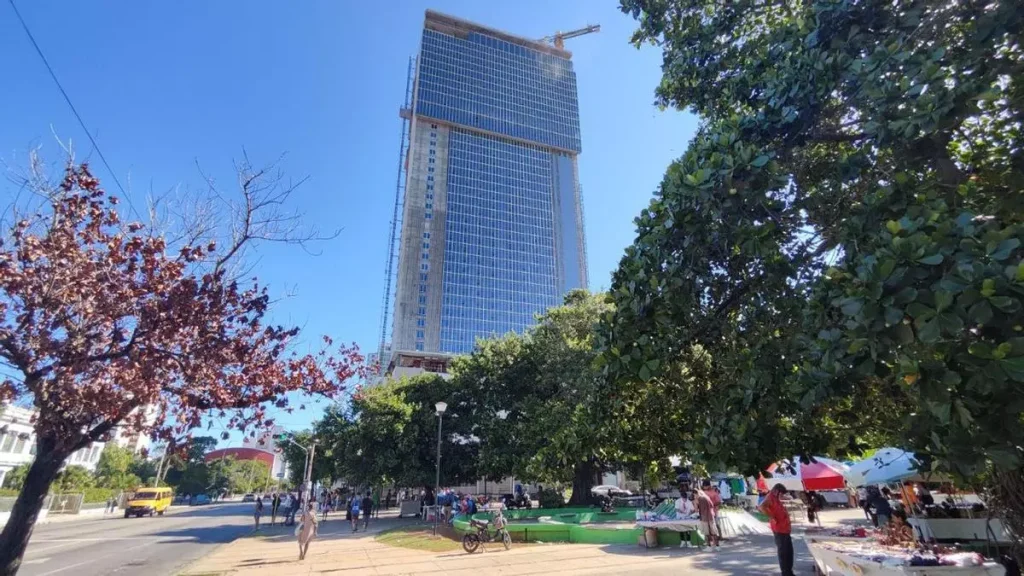
 14ymedio Madrid, March 25, 2026 – Far from the idea of a multimillion-dollar empire that exists about the Grupo de Administración Empresarial S.A. (Gaesa), the military conglomerate is collapsing at breakneck speed, according to the British weekly The Economist, which publishes an extensive analysis of the state of the Island’s finances and how their precariousness could serve as a lever for change. “They are against the ropes. They will do whatever is necessary to save themselves,” a source linked to the negotiations told the outlet.
The article starts from the idea that the Cuban economy was already deeply depressed, following decades of mismanagement and sanctions. “Trump’s new pressure campaign has made the situation even worse,” they note. From there comes a chain of data illustrating the collapse of Gaesa, which over the last ten years had invested 70% of its resources in tourism that was unable to recover after the 2020 coronavirus pandemic and now, without international flights, is practically at zero.
“Judging by analysis of its accounts and conversations with several Cuban officials, [the reality] appears more modest. Before the United States tightened restrictions, Gaesa barely had one billion dollars in reserves. That figure is falling rapidly, as its luxury hotels remain empty,” the article explains. In addition, according to its estimates, Cuba’s international reserves are not much higher: around 3 billion in total and declining. Its media affiliate, The Economist Intelligence Unit, estimates that this year gross domestic product (GDP) will fall by 7.2%, a catastrophe that small investments by Cuban Americans can do little to offset.
The Economist reviews some figures already familiar to the Cuban public. Tourism, mining, and manufacturing generated barely 2 billion dollars in foreign currency last year, but after the oil blockade decreed by Trump at the end of January, they have collapsed. Exports of cobalt, nickel, and zinc, which in 2025 amounted to about 6.6 billion dollars, are suspended following the decision by the Canadian company Sherritt to cancel its operations due to lack of fuel.
A sharp decline is also expected in medical missions, as U.S. pressure has forced the end of those agreements in at least 15 countries. “Italy and Qatar, where an entire hospital is staffed by Cubans, have resisted so far. Poorer countries such as Jamaica, Honduras, and Guatemala have given in,” the outlet summarizes. Only remittances remain “intact,” the analysis says, placing them at around 3 billion, although it does not address the fact that they once reached at least nearly double that amount, and that years of U.S. sanctions and the rise of technology have opened other channels through which vast sums of money flow. In December 2024, the think tank Cuba Siglo 21 had already stated that losses were 95%.
The choking off of each foreign-currency-generating sector responds, according to The Economist, to a meticulous and persistent plan by Marco Rubio, whose personal drive is behind this effort in which, apparently, the United States does not have as much to gain or lose as in the case of Iran (arms) or Venezuela (oil). However, the weekly asserts that Washington does have certain economic interests, particularly Trump himself, in tourism.
“The plan is vague, but probably includes giving U.S. companies access to energy, ports, tourism, and telecommunications. Trump has coveted the Cuban hotel market for decades. The Trump Organization registered its trademark in Havana in 2008 for hotels, casinos, and golf courses, and sent executives to explore potential locations in 2013,” The Economist recalls.
According to its sources, Washington aims for the removal of restrictions on the size of private businesses, the opening of the banking system, and the dismantling of monopolies such as Gaesa itself, even if the U.S. must modify its laws to do so. Havana entrepreneur Yulieta Hernández Díaz has expressed, The Economist reports, a widespread fear: that the main beneficiaries of any agreement will be large U.S. corporations, leaving local businesses at a disadvantage.
In this context, political risk is also present. Future options for Marco Rubio, the article notes, involve not losing the support of Cuban-American congress members who helped elevate him and who now, pushed in turn by Florida voters, fear the consequences of the much-discussed negotiations with Raúl Guillermo Rodríguez Castro, known as El Cangrejo [The Crab] and grandson of the former leader. To his name, The Economist adds two others: one is nothing new—Alejandro Castro Espín, whose role has already been discussed in the international press—but the other is. Diplomat Josefina Vidal, currently at the embassy in Canada, would also be involved according to its sources.
“It should be noted that the United States does not appear to be demanding measures against members of the Castro family, who continue to pull the strings of power in Cuba. An agreement in which a Castro exercises real power from the shadows while a new figurehead occupies the office would be an absurd outcome,” said Ric Herrero of the Cuba Study Group, who is nonetheless in favor of dialogue, but not in any form. The lawyer complained that neither Trump nor Rubio has explicitly spoken of democracy, but rather of change in the face of a catastrophic economy.
“We have not fought for 67 years, with prisoners and deaths, to earn the right to invest under the rules of a communist regime,” said Marcell Felipe, of the Cuban Diaspora Museum in Miami.
The Economist concludes that Trump appears to be on the verge of “closing a deal that keeps the regime under control.” “But,” it adds, “what are the chances that this will lead to a truly beneficial transformation?”
Translated by Regina Anavy
______________________
COLLABORATE WITH OUR WORK: The 14ymedio team is committed to practicing serious journalism that reflects Cuba’s reality in all its depth. Thank you for joining us on this long journey. We invite you to continue supporting us by becoming a member of 14ymedio now. Together we can continue transforming journalism in Cuba.