
Cuban Political Police Claim the Power to Vaccinate

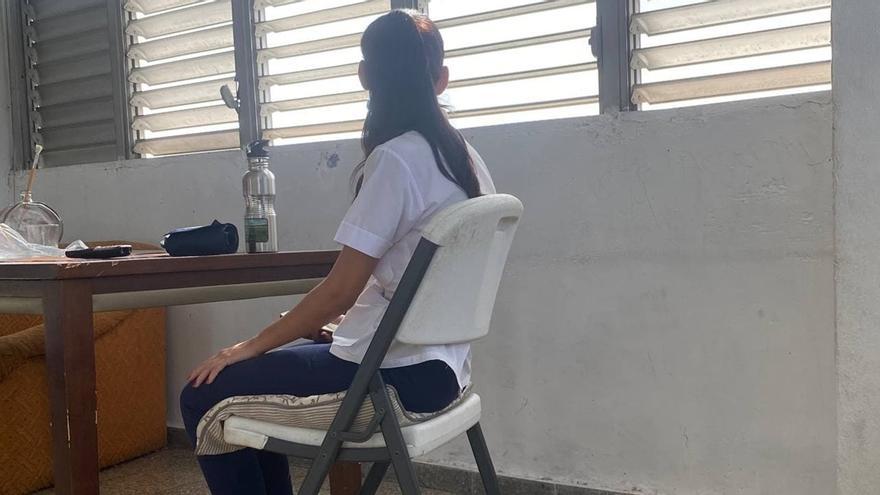
The first few minutes with the young medical student were very uncomfortable. She was looking at her cell phone and I was looking at mine. (14ymedio)

14ymedio bigger14ymedio, Luz Escobar, Havana, 23 July 2021 — Last night I was thinking over and over again that when morning dawned I would have to go to the doctor’s office to receive the third dose of the Abdala candidate vaccine. It would not be a problem for anyone to walk a hundred meters and receive an injection, but for the past 13 days I have had a State Security officer guarding the entrance of my house and preventing me from leaving.

This morning, at 9:40, I tried to leave my house but, when I reached the ground floor of the building, the policeman got up from his chair and repeated, mechanically: “You can’t go out.”

“Today I have to receive my third dose of Abdala so I must and will go out,” I replied. But the agent does not understand explanations. It was like trying to convince a wall. “If you have to go to the office, wait for me to call the patrol right now to take you,” he said.

“There’s no way I’m getting into a police car as if I were a criminal,” I replied. “Then I will go with you,” he answered.

The doctor’s is one block away, I opened the door of the building and went out. The man walked beside me, commented on the weather, and at fifty meters he told me that we had “different ideals.” I didn’t continue reading

answer him.

At 9:45 a.m. I arrived at the doctor’s office, a small room with several chairs and, in the same entrance, a table where a young second-year medical student had the task of taking the blood pressure and temperature of all those who arrive, before registering the name on a spreadsheet.

I asked who was the end of the line, a man answered me and I sat down. The young student told me that it was also necessary to wait at least ten minutes for the person to recover from the exertion of the walk. As I sat down, the officer approached the girl and said something in her ear, she got up and looked for the doctor. The upshot of that conversation was that I was told to walk past the dozen or so people who were waiting.

Annoyed, almost ashamed of having to skip the line, mostly elderly, I went to the doctor who asked for my identity card and vaccination card. After a few brief questions, he jabbed my shoulder with a syringe while I was still dumbfounded and annoyed. Then I was left to wait in another room for an hour to monitor any adverse reactions.

But State Security has its own protocols that do not obey medical or scientific logic. A few minutes after being there, the policeman burst into the room and said: “No, let’s go to your house now.”

The doctor ended up giving in to his pressure, gave me back the documents and again I walked the short distance that separated me from my house, with that impertinent shadow to one side.

Before entering the elevator, the police officer had the nerve to try to make amends for the violation of my privacy and the disrespect he had committed toward the health regulations: “Sorry for the bad time I put you through,” he said, while I was just thinking about my two daughters, trusting that their mother had only gone to “get a jab” and that I would return as soon as possible.

No sooner had I entered my apartment and without being able to process all that, they knocked on my door. On the other side were the State Security officer, the nurse, and the young medical student who had received me at the vaccination center. They asked me if it was possible to “monitor” my physical situation at home. The two women came in.

The nurse left and the first minutes with the young woman were very uncomfortable. She was looking at her cell phone and I was looking at mine. I offered her coffee but she declined, she says she doesn’t like it and she brought her thermos with water. We don’t talk much, we barely exchange a few words, cordial, routine. At 10:45 am the nurse came to pick her up and they left.

The State Security officer is still on the ground floor of the building, and I don’t know how many more days he will stay. Outside at the corner there is a patrol car ready in case I break out in an attack of rebellion and try to leave, despite the warnings. This is the context that surrounds me since July 11 when thousands of Cubans took to the streets to ask for just what I need now: Freedom.

____________

COLLABORATE WITH OUR WORK: The 14ymedio team is committed to practicing serious journalism that reflects Cuba’s reality in all its depth. Thank you for joining us on this long journey. We invite you to continue supporting us by becoming a member of 14ymedio now. Together we can continue transforming journalism in Cuba.

Open Letter From a Swedish Citizen to Miguel Diaz-Canel

The Cuban president, Miguel Díaz-Canel, in his television appearance on July 11. (Screen capture)

14ymedio bigger14ymedio, Hans Lunell (Letters from Readers), Stockholm, 26 July 2021 — I am writing this letter from Sweden, one of the most developed countries in the world as it is free, democratic and capitalist. You live in one of the poorest and most unsuccessful countries in the world since there is no freedom, it is totalitarian and communist.

I do not write “president” because you were not elected but appointed, so you do not have any legitimacy as president. Nor do I write “doctor,” as I have not seen your thesis and I cannot judge if you deserve that title; I fear not. But “sir,” yes, this I can write, at least to identify your sex.

I am writing to you as a lover of Cuba for its climate, its nature, its architecture (what remains), its traditions, its music and its friendly people. But not  for its government, a government that has not been elected and therefore has the same lack of legitimacy as you. Everyone knows that the so-called elections in Cuba are just a sham.

You were named in 2018 as the crown prince of a country already bankrupt and torn to pieces by more than half a century of bad government. Since you took office, you have not been able to do more than increase poverty and misery in your country. However, the time has come to choose the future path. You have two options and the one you choose will decide how you will be remembered by your children, your grandchildren, your family, the Cuban people and the whole world. It is not a decision, then, to be taken lightly.

You can follow the same path as until today and you will be remembered as a puppet, a coward, a simple messenger carrying out the orders of those above. In other words, a buffoon who is becoming continue reading

more ridiculous and less dignified every day. This path is the path of repression, that of a totalitarian and tyrannical system that has already proven futile for many years, a system that brings misery to the people and fills the pockets of people who are already dying.

The other path, on the contrary, is that of a Bolívar, a Martí, a Gorbachev, with whom you can be remembered as a liberator, a hero, the man who opened the doors to a better future for his country and his people. It is the path to freedom, democracy, the market economy. It was the way of Cuba before the Revolution, when the Island was one of the most prosperous countries in Latin America.

To embark on this path, here are some tips:

First, review and change the Constitution, especially all the articles that refer to communism, Marxism, socialism and other similar denominations, including the idea of ​​the one party.

Second, call a fair referendum to set the new Constitution.

Third, allow the formation of different political parties and let them establish themselves with leaders and free programs.

Fourth, allow a campaign open to all parties on equal terms.

Fifth, allow elections with all parties and allow international organizations to monitor them.

Sixth, accept the result and let the winners form a new government.

It may be that there are some elderly generals and other hierarchs who do not agree with these measures. Then take them prisoner. There is always some Cuban law that can be applied. And if there is no room in the prisons, release all political prisoners. You will have a lot of space.

Do you have the courage to undertake this path?

Think ahead, not only for your country, but also for yourself. How do you want to be remembered by your children, your grandchildren, your family, the Cuban people and the whole world? With contempt and shame or with admiration and pride? The time to choose has come and it will not be repeated.

____________

COLLABORATE WITH OUR WORK: The 14ymedio team is committed to practicing serious journalism that reflects Cuba’s reality in all its depth. Thank you for joining us on this long journey. We invite you to continue supporting us by becoming a member of 14ymedio now. Together we can continue transforming journalism in Cuba.
Social Protests, the Embargo, and the Cuban Communist Regime

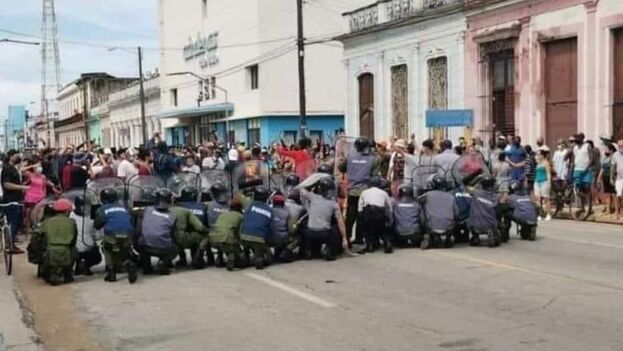
The Cuban dictatorship has militarized the streets of the island to prevent the protests from multiplying. (Twitter)

14ymedio bigger14ymedio, Elías Amor Bravo, Economist, July 26, 2021 – It’s easier to blame the US embargo or ’blockade’ for all the ills of the Cuban economy. And also to believe it. But this is nothing more than an irresponsible attitude, which has reached its end.

The Cubans who came out to protest on July 11, and who will do so again at another time, know that the problems in the economy are due to poor management by their leaders. they are through with excuses, and blaming others.

The propaganda of the regime through its media, sometimes suffocating, doesn’t get through to Cubans, who are ready to demand accountability as soon as the right moment arrives. People turn off the television when the “Roundtable” comes on. A program lacking in credibility.

The demand for holding the rulers responsible begins to take shape. Responsibility for having created an economic system that restrains existing productive potentials, that just seeks to appropriate the latest hard currency entering the country in order to spend it on the objectives of that system.

Responsibility for having frustrated for 63 years the aspirations of several generations of Cubans to continue reading

have their own private assets, to be owners of the means of production, and to use them according to criteria of profitability.

Responsibility for installing a distribution mechanism based on rationing and scarcity, eliminating the efficient action of the market in driving the economy.

The list of responsibilities is so extensive that we could occupy a good part of this blog space, and all of them could be summarized in one: the communist social model does not work.

It has not worked, nor can it be expected to do so in the future. Its days have come to an end, and Cuban society wants change. This can be done in one of two ways: either through a rupture that puts and end to a stage that can be classified as permanently lost; or through government negotiation and dialogue with society to promote an orderly transition.

Of course there are numerous intermediate positions between these two, and nothing is yet to be written about the future of Cuba, but there is no doubt that the people spoke very clearly on July 11, and the regime should take note.

Clearly a change is coming, and a profound one. Even within the regime there is no room for inflexible positions, since many leaders have become aware that things are really very bad, so that there is no place for superficial changes or cosmetic patches, but rather more profound changes and changes must be made, and quickly, with positive expectations for the future. There are many leaders who know that this chimera of a “prosperous and sustainable socialism” will never be achieved because the model itself prevents it.

Despite this perception of reality, the Cuban communists continue to delay any structural change that modifies the fundamental aspects that prevent the economy from improving. In the current situation, they rely on the effects of the pandemic and the loss of income from tourism, among others, but in reality they are fleeing from assuming responsibilities, and that behavior is not the most appropriate.

Cubans increasingly disbelieve the story of the sanctions against Cuba and that the interference of the United States complicates the process from within, and they see it as a permanent excuse, aimed at avoiding necessary changes that, moreover, are urgent.

Perhaps for this reason the recent sanctions against members of the regime have not provoked a reaction similar to previous times, largely because many Cubans know that these measures have a limited duration and appear more as symbolic reprimands than anything else.

The authorities look askance at the neighbor to the north because what really worries them is that there will be a final cut in remittances. Much more than a denunciation of members of State Security (known as black berets) or a high-ranking military officer, as has happened. The serious thing about the situation is that while this was happening, hundreds of very summary trials were being conducted against the participants in the social protests on the island without procedural guarantees, sending people to prison.

The time has come to speak accurately. Cuba is neither blockaded nor embargoed by thousands of ships that surround the island. That image is absurd and really only existed for a few days when the Soviets tried to turn the island into a base to launch their nuclear missiles at cities in the United States.

The blockade does not exist; Cuba trades with, and receives investments, tourists, and capital from 192 countries of the world, with absolute freedom. As long as there are analysts and observers who entertain themselves in codifying something that does not exist, it is not helpful.

The debate must be about the problems and solutions that are within Cuba, and which have to be resolved among Cubans. Thinking about Obama, Trump, or Biden, believing that they are worried about losing votes, and that therefore they act in one way or another because of  electoral pressure, is a misconception.

Relations between the United States and Cuba are well defined by a partisan consensus that has much to do with the inability of the Cuban authorities to resolve a dispute that, moreover, was originally caused by Cuba, and not by the United States.

The Havana regime holds the key to resolving this dispute between the two countries. The Cuban people during their peaceful protests on July 11 said this very clearly.

But the regime’s wanting to do it or being interested in doing it is another thing altogether. To conduct a debate about concessions by the United States to soften these measures is to waste time.

The hunger and desire for democracy in Cuba have less and less to do with the alleged embargo/blockade, no matter how much the regime pretends otherwise. The solution to end it all is in the hands of the regime. It is past time to get to work.

 Translated by Tomás A.

____________

COLLABORATE WITH OUR WORK: The 14ymedio team is committed to practicing serious journalism that reflects Cuba’s reality in all its depth. Thank you for joining us on this long journey. We invite you to continue supporting us by becoming a member of 14ymedio now. Together we can continue transforming journalism in Cuba.
Brazil, Colombia, Ecuador, and the United States, Among More Than 20 Countries That Condemn Mass Arrests in Cuba

The signatories urged the Cuban Government to respect “the rights and freedoms of the Cuban people, guaranteed by law, without fear of arrest or detention.” (EFE)

14ymedio biggerEFE / 14ymedio, Washington, July 26, 2021 — The governments of 21 countries, including the United States and five Latin American nations, condemned on Monday the “mass arrests and detentions” of protesters in Cuba and demanded respect for human rights on the island.

The declaration was signed by the foreign ministers of Austria, Brazil, Colombia, South Korea, Croatia, the Czech Republic, Cyprus, Ecuador, the United States, Estonia, Greece, Guatemala, Honduras, Israel, Latvia, Lithuania, Kosovo, Montenegro, North Macedonia, Poland and Ukraine.

The statement recounts that on July 11, “tens of thousands of Cuban citizens participated in demonstrations throughout the country in protest against the deterioration of living conditions and to demand changes,” and denounces that in the face of these marches “the Government responded with violence.”

The ministers of the countries named above also stressed continue reading

that the protesters “exercised the fundamental freedoms of expression and assembly enshrined in the Universal Declaration of Human Rights, the American Convention on Human Rights, the Inter-American Democratic Charter, and the European Convention on Human Rights.”

That is why they exhorted the Government of Cuba to respect “the rights and freedoms of the Cuban people, guaranteed by law, without fear of arrest or detention.”

“We urge the Cuban government to release those detained for exercising their rights to peaceful protest,” the statement added. “We ask for freedom of the press and the full restoration of internet access.”

The largest protests in more than six decades occurred with the country mired in a serious economic and health crisis, with the pandemic out of control, and severe shortages of food, medicine, and other basic products, in addition to long power outages, which drove Cubans to take to the streets to criticize their government.

Cuban authorities insist on blaming the United States for both the demonstrations and the extreme shortages that the country suffers.

Translated by Tomás A.

____________

COLLABORATE WITH OUR WORK: The 14ymedio team is committed to practicing serious journalism that reflects Cuba’s reality in all its depth. Thank you for joining us on this long journey. We invite you to continue supporting us by becoming a member of 14ymedio now. Together we can continue transforming journalism in Cuba.
They March in Madrid for Freedom in Cuba and Spain’s People’s Party Joins the Demand

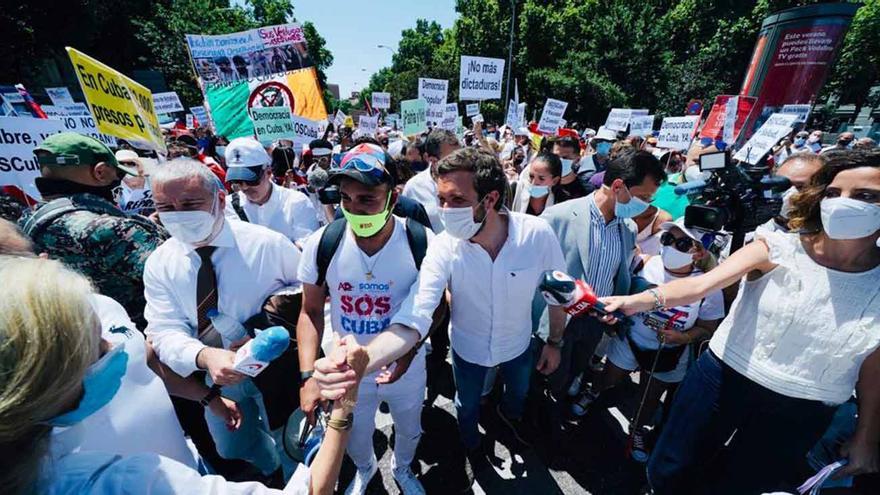
Of course Cuba is a dictatorship, said the president of the PP (Partido Popular / People’s Party) Pablo Casado Blanco. (@pablocasado_)

14ymedio biggerEFE (via 14ymedio), Madrid, July 25, 2021 — With the slogan “The hour of freedom has arrived. If Cuba is in the street, we are too”, the March for Cuba was held this Sunday from the Plaza de Cibeles to the Plaza de Callao Madrid.

Among the participants were the Venezuelan opposition leader, Juan Gauidó and the president of the Popular Party, Pablo Casado, who through his Twitter account declared: “Of course Cuba is a dictatorship” and made it clear that his attendance was to “support #SOSCuba and Yotuel,” one of the composers and performers of ’Patria y Vida,’ the soundtrack of social protests in Cuba.” We are here, he said, “to seek democracy and freedom for the Cuban people.”

As a show of support, the People’s Party will present in the municipalities of the autonomous community motions of support to the Cuban people to demand that the Cuban government end the “repression” of its population.

While the regional secretary of the party, María José González Revuelta, in statements to the Europa Press agency expressed her concern about the human rights situation on the island and continue reading

rejected Miguel Díaz-Canel’s “call to combat,” she also asked for the cessation of “unjustified” violence and “arbitrary” detentions; She also joined the “call” of the Inter-American Court of Human Rights (IACHR) to guarantee human rights, in particular the right to protest.

Also, the actor Yotuel had organized another subsequent march in a nearby area, also in the center of Madrid; but through a video he communicated that it was disbanded. He encouraged both the Spanish “freedom lovers” and the Cubans in Spain to join the earlier march to “defend the rights of the young people who are being massacred in Cuba.”

The singer, front man of the group Orishas, has supported from Miami, where a good part of the Cuban exile is concentrated, the social protests that broke out in Cuba on July 11, shouting “freedom.”

Different organizations have denounced the repression of the protests by the Cuban authorities, with hundreds of detained and disappeared, while Justicia de Cuba [a government organ] has claimed that so far there have only been 19 judicial proceedings involving 59 people and has denied that there have been summary trials.

Translated by Tomás A.

____________

COLLABORATE WITH OUR WORK: The 14ymedio team is committed to practicing serious journalism that reflects Cuba’s reality in all its depth. Thank you for joining us on this long journey. We invite you to continue supporting us by becoming a member of 14ymedio now. Together we can continue transforming journalism in Cuba.

Flotilla Brings Cuba a Noble Message of Support

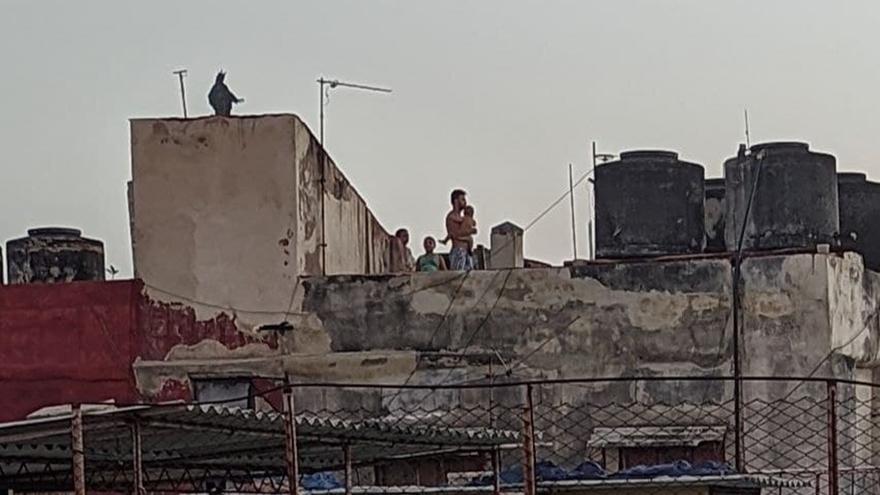
On Friday 7/23/2021, Havana residents opted for climbing on rooftops to watch the fireworks from the flotilla. (14ymedio)

14ymedio bigger14ymedio, Havana, 24 July 2021 – A strong police-military operation prevented hundred of Cubans from trying to approach the Malecón in Havana last Friday, where they tried to watch, from the seawall, the fireworks from the flotilla that a group of Cubans from Miami displayed from the ocean. The flotilla was an initiative to support people on the island, following the protests that started July 11th. The regime’s forces started cordoning off the Malecón early in the afternoon, and they patrolled an extensive area along the neighborhoods of Centro Habana, El Vedado and Habana Vieja.

The flotilla included five vessels and left in the early morning hours of Friday, heading to the international marine limits between the United States and Cuba. The boats left the bridge from Key Biscayne after 8 am, headed to Key West, where the US Coat Guard inspected them, and sailed another 15 miles towards the international limits with the Cuban shorelines.

In response to the police operation along the Malecón, residents from the shoreline neighborhoods climbed to the rooftops of their multifamily buildings to be able to watch the flotilla of Cuban exiles approaching the horizon and their fireworks display. Despite the strong police presence on the streets, Cubans sought refuge on the rooftops, where it became harder for the police to identify who continue reading

was watching the fireworks or not.

According to several Havana residents, the day was cloudy and overcast since the morning, with a heavy fog that blocked the view of the horizon. Even during the night, while the fireworks were going off, they could see the light flashes but they needed to be really close to the coastline to see better.

The 14ymedio newsroom received reports that on the shoreline of the eastern side of Havana, in the Alamar neighborhood, several people where able to get close to the shores and were able to watch, video and photograph the fireworks.

Not only the Malecón was heavily patrolled by police, though. In the coastal neighborhood of Santa Fe, in Playa, the situation was the same. “There were patrol cars, police officers and military all over the coastline. If you would try to get closer, they’d tell you could not be there due to Covid-19 restrictions. Nobody believed that excuse, I walked around that area every single day without any problem,” said a resident from the area.

Meanwhile in Miami, the flotilla was considered a noble gesture to support the Cuban people who has been protesting on the streets since July 11th, and also, as some sort of generational relay from the Cuban exile community.

Ramón Saúl Sánchez, a known leader in the exile community and one of the flotilla organizers, went out Friday to say good-bye and provide advice to those on the vessels heading to international waters. He told EFE News Agency that, in a certain way, it meant they were passing the torch to a new generation of activists.

Sánchez, who is also the president of the Movimiento Democracia, initially advised against the idea due to lack of timely planning, but later supported the flotilla and said he was relieved to see there were a few boats and that the vessels were big enough, which, he said, “reduces the changes of problems with the wind and waves.”

The activists, who in 23 years has organized around 27 flotillas to the island to condemn the dictatorship, and has had vessels confiscated and been tried for entering Cuban territorial waters, was expecting the Cuban regime would try to prevent people on the island from approaching the Malecón to watch the fireworks display, organized by Cuban American Osdany Veloz.

For Sánchez, the flotillas represent “some sort of spiritual bridge between the two parts of the Cuban people that are divided by the dictatorship.”

The vessels departed the United States waving Cuban and American flags. Veloz told the press gathered that they were bringing a message of freedom and support to people on the island, “so they can keep fighting” for a free Cuba.

The US Coast Guard already issued several warnings, through the local media, that the vessels did not have any authorization to cross into Cuba’s territorial waters and reminded the flotilla that doing so would be illegal.

Cuba’s Foreign Affairs Ministry, Bruno Rodríguez, asked the US government to get “serious” about the flotilla and considered the recently announced sanctions of the Biden administration against the Cuban military to be “irrelevant.”

On Friday, Sánchez also reminded the group that their previous flotillas would sail up to 12.5 nautical miles from Cuba’s shorelines, which he said makes the perfect distance for the “lights of liberty” to be seen.

On Veloz’s Instagram account, several comments of support were gathered, some of them from users in Cuba.

Once their demonstration concluded, the flotilla sailed back to the United States without any incident.

Translated by: Mailyn Salabarria

____________

COLLABORATE WITH OUR WORK: The 14ymedio team is committed to practicing serious journalism that reflects Cuba’s reality in all its depth. Thank you for joining us on this long journey. We invite you to continue supporting us by becoming a member of 14ymedio now. Together we can continue transforming journalism in Cuba.

In Cuba ‘They Have Taken Away Even Our Freedom to Think’

Robles was arrested on December 4 for protesting on Boulevard San Rafael, in Havana. (Capture)

14ymedio bigger14ymedio, Havana, July 24, 2021 — Luis Robles, known as the young man with the sign, has been in prison for eight months and, as his brother Landy told 14ymedio, they have again denied the defense request for a change in the precautionary measure of provisional confinement. His trial was scheduled for July 16, but was finally suspended as a result of the massive protests that occurred in the country a few days earlier.

Robles was arrested on December 4 for protesting on Boulevard San Rafael, in Havana. He demonstrated peacefully, by displaying with his arms raised a placard on which he asked for freedom, an end to the repression, and the release of the contrarian rapper Denis Solís.

This Friday, a Facebook page created with the activist’s name to demand his freedom, published a video in which Robles talks about his thoughts, wishes, and also the reasons that led him to be a protestor. The material was recorded on December 1, “a day before his birthday,” it reads. Three days later he was arrested and the regime accuses him of “enemy propaganda” and “resistance”.

We transcribe the full text of this declaration that, more than seven months in advance, reflects the terrible frustrations of the young people who continue reading

took to the streets across the country on July 11.

“Good evening my Facebook people. First of all I’m going to introduce myself. My name is Luis Robles Elizastigui, I’m 27 years old and I’m concerned about everything that is currently happening on social media. I tried to post directly but I don’t know why it wasn’t possible. Many young people like me don’t agree with what’s happening here in Cuba.

“We wholeheartedly desire a change, a change in the system, a change in the country, because really communism has turned this country into a true hell, a hell where it is practically impossible to breathe, not only to breathe air, but also to breathe peace, to breathe tranquility. Like me, many times I say, this is a demolition of people, of souls.

“This dictatorship has converted us . . . we are no longer human beings because we have no rights; we don’t have the right to express ourselves freely, we don’t have the right to be heard. When we say what we think anywhere, the police beat us down. This is for the people of the world to see: this is the reality that ordinary Cubans live in, those of us who have nothing, not even dreams, because here in this country you can’t even have dreams because they have clipped our wings. One thing they will never be able to cut off is dreaming of freedom, because a human being without freedom is nothing.

“Freedom is the greatest thing that one can have in life, and since these shameless communists arrived they have cut us off from all kinds of freedoms — freedoms to a free religion, freedoms to a free ideology, freedoms to elect who you want to win, not the one they impose on you. They have taken away even our freedom to think, they want to dictate even what we think about.

“I’m going to tell you a brief anecdote. I demonstrated in the Plaza de la Revolucion for an injustice that had been committed against someone I loved very much. I thought it was unfair and I went to Citizen Services; I went to court; i went to I don’t know how many places; and no one, no one took me seriously. So the last thing I did, when I saw myself with no way out, was to go to the Plaza de la Revolucion and there I made my film. I took off my sweater and I screamed. I shouted that in this country rights are not respected. I only told the truth.The police didn’t touch me, they looked to pass me off to State Security. They handcuffed me, put me in a patrol car and took me to a unit near the Plaza de la Revolucion. They put me in a cell with a pile of people, and took away my belongings.

“Then they told me that a State Security agent was going to see me. When the guy arrived, he was a young captain and they put me in a room alone with him. The guy asked me why I did it; I told him my reasons. He pretended to listen to me and said: ’Kid, how old are you?’ I told him my age and he said this: ’You’re a young kid, you have no priors. Because you’re a young person we don’t want to encumber your life. We’re going to let you go, but don’t let this happen again. They gave me a warning letter. I currently have a warning letter on my criminal record.

“That day I understood one thing, that if you demonstrate here, even if you’re right, they encumber your life if they want to, they encumber your life and you’re no longer a person. That’s the mechanism at work here on this island, and it’s what I want many people in the world and here in Cuba to open their eyes to. It is time to end this dictatorship.

This generation is not willing to continue holding out. No. This is our time  and we have to take advantage of it. That is why I ask everyone who listens to me to join the fight. I have joined. Yes, I recognize that I may be afraid. I’m afraid that they will “disappear” me, that my life will be destroyed. But what I’m more afraid of, and what scares me the most, is to continue being afraid. No, I cannot continue to allow myself to feel afraid in my own country, where I have to feel free. I have to feel fulfilled and not destroyed as a person.

“I have a son here and I desire with all my heart for him to grow up in a free country, to grow up in a country where he can have dreams, expectations of progressing. And we don’t have that in this country today, where three old men decide what you can and cannot do. No, that is not the country I want for my children. I don’t know if many will have this feeling, but if I would give my life for my son, maybe others would give their lives for their own. Then, if I join the fight I’m not doing it just for myself, I’m doing it for my children and I’m doing it for all of ours.

“Many people who live in Cuba today are going through the same thing that I’ve gone through, having to do twenty thousand miracles to be able to support my son. I’ve even had to do things that nobody could imagine. The salary here is a joke. The only thing this system has is slaves. You kill yourself working for a month and they pay you a pittance of a salary, which they even deduct from. I worked for the State and they even deducted for numerous things. So brother, this isn’t the country that i want for my son, no.

“I have also thought about opting for the alternative that many have taken, and that is to flee. Yes, fleeing is an option. But people have a feeling for their land, and always want to return to their land. And, my brother, if there is a possibility, only one, to see my land free, I’ll take it. That is why I ask that if you want to join as well, if we unite and we are one, Cuba can be free. If you think about it, Cuba can be free.

“So brother, the struggle begins. The San Isidro Movement has lit a flame of freedom in the hearts of many Cubans. That is why I hereby ask that this flame not go out, that this flame continue to burn and grow even more and become a devastating fire and put an end to the scum that has destroyed our country, that has destroyed dreams, that has turned us into machines, merely surviving.

Translated by Tomás A.

See Also: “I Am Not Afraid, I Will Not Stop Asking for My Brother’s Freedom”

____________

COLLABORATE WITH OUR WORK: The 14ymedio team is committed to practicing serious journalism that reflects Cuba’s reality in all its depth. Thank you for joining us on this long journey. We invite you to continue supporting us by becoming a member of 14ymedio now. Together we can continue transforming journalism in Cuba.

Weapons of Mass Disinformation

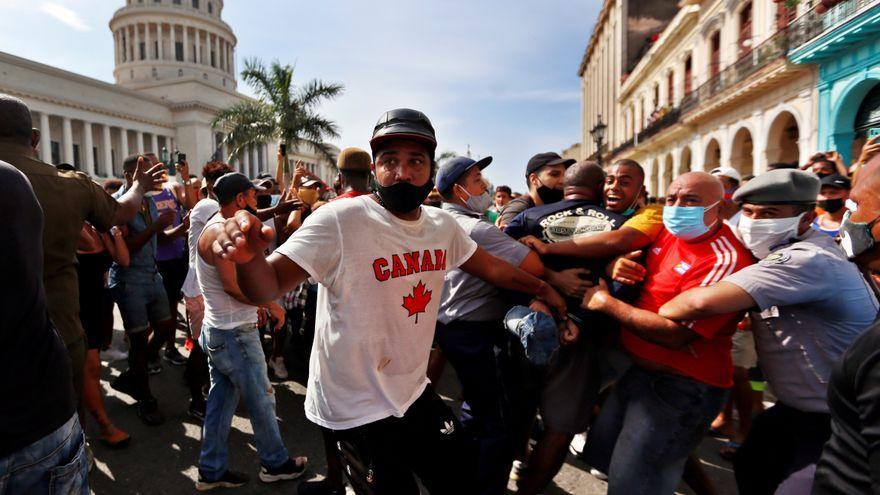
Police arresting demonstrators during protests on July 11, 2021 in Havana. (Marcos Evora)

14ymedio bigger14ymedio, Reinaldo Escobar, Havana, 24 July 2021 — Debate is ongoing as to whether the 2003 war in Iraq was caused by faulty intelligence that confirmed the existence of weapons of mass destruction or whether those reports were inflated by George W. Bush to justify the invasion. What is not in question is that the lack of transparency senior government officials often employ when dealing with spies and their sources can have devastating consequences.

The distance between Washington and Baghdad is over 6,000 miles, which allowed the American president to claim he had been mislead.

The travel time from Havana and the town of San Antonio de los Baños, where protests on July 11 began, is less half an hour by car, such that President Miguel Diaz-Canel could easily figure out — based on all the booing — that what the protesters were really unhappy about was the way he has been managing the country.

Blaming the disturbances on the imperialist machinations and naively denying continue reading

widespread popular disgust arises from a need to come up with a pretext for unleashing ruthless repression. This leads to a kind of of reverse engineering in which State Security has to prove that all causes are external.

Foreign Minister Bruno Rodríguez was the first to present to foreign press reporters in Cuba the results of a study allegedly showing that the hashtag #SOSCuba had originated abroad. Then the smoke cleared and official news media outlets claimed that the protests had been instigated from the United States, later claiming they had been organized by the US government itself.

This was not about finding arms of mass destruction to attack another country but “arms of disinformation” supposedly launched from overseas. It was an attempt to shift blame and justify the incarceration of anyone repeating this alleged disinformation, thus building a bridge of complicity for anyone who might be confused.

It may seem twisted that, in order to maintain the privileges that come from its institutional stature, State Security agencies would exaggerate the alleged threat posed by political adversaries. But what is even more perverse is that the upper echelons of political power would require State Security agents to plant evidence of a crime not committed.

____________

COLLABORATE WITH OUR WORK: The 14ymedio team is committed to practicing serious journalism that reflects Cuba’s reality in all its depth. Thank you for joining us on this long journey. We invite you to continue supporting us by becoming a member of 14ymedio now. Together we can continue transforming journalism in Cuba.
In Cuba ‘Young People Must Be and Will Be the Engine of Change’ says Pablo Milanes after July 11

The 78-year-old singer made it clear that he will continue to express his opinions as long as his health allows. (EFE)

14ymedio bigger14ymedio, Havana, July 25, 2021 — This Saturday Cuban singer-songwriter Pablo Milanés described as “irresponsible and absurd” the use of repression by the Cuban government against the people, “who have sacrificed and given everything for decades to sustain a regime that in the end imprisons them.”

Milanés’ statement comes in the heat of the 11J (11 July) protests and the wave of repression and violence unleashed by the Government against the protesters. International organizations and civil society, relatives of the detainees and independent media have denounced hundreds of arrests, mainly young people, and also minors have been charged.

“For a long time, I have been speaking about the injustices and errors in the politics and government of my country,” the singer continued, emphasizing that in 1992 he reached “the conviction that the Cuban system had definitely failed” and he denounced it. continue reading

“Now I reiterate my pronouncements and I trust the Cuban people to seek the best possible system of coexistence and prosperity, with full freedoms, without repression and without hunger,” added the 78-year-old singer, who made it clear that he will continue to express his opinions as long as his health permits.

“I believe in young people, who with the help of all Cubans, must and will be the engine of change,” he concluded.

Added to the arrests of hundreds of people for participating in the marches are the house arrests of activists, artists, and independent journalists who didn’t even set foot on the streets on Sunday, July 11.

The mass arrests have drawn criticism from the international community, including that of the UN High Commissioner for Human Rights, Michelle Bachelet, who called for the urgent release of the detainees and an investigation.

The protests, in which citizens asked for freedom, took place with the country mired in a serious economic and health crisis, with the pandemic out of control and a severe shortage of food, medicine and other basic products, in addition to long power cuts.

The authorities, for their part, insist on blaming the United States for both the protests and the extreme shortages that the country is suffering.

In addition, this Saturday the Cuban government denied that it is proceeding with summary trials against detainees for the protests, but confirmed that there are minors under investigation who, if convicted, will receive sanctions with “differentiated treatment.”

Almost two weeks after the massive demonstrations, the authorities have not released the official number of those detained or prosecuted, so the only reference is the lists that activist groups and independent organizations are collecting and circulating on social media.

Translated by Tomás A.

____________

COLLABORATE WITH OUR WORK: The 14ymedio team is committed to practicing serious journalism that reflects Cuba’s reality in all its depth. Thank you for joining us on this long journey. We invite you to continue supporting us by becoming a member of 14ymedio now. Together we can continue transforming journalism in Cuba.
Cuba’s State Newspaper Doesn’t Know What Democracy and the Rule of Law Are

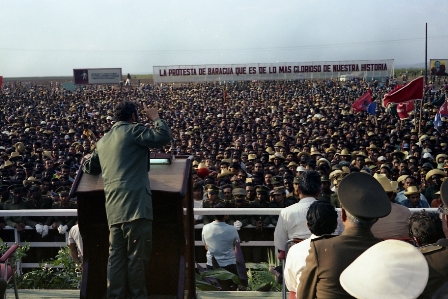
Fidel Castro speaking to the multitudes. Among his famous pronouncements: “Within the Revolution, everything, against the Revolution, nothing.” and “Elections? What for?”

14ymedio bigger14ymedio, Elias Amor Bravo, Economist, 24 July 2021 — The Cuban communists believe so little in democracy that they go so far as to explicitly insult democrats with the things they say and do. Only a completely ignorant person who despises government of and for all people, can say in a headline of Granma, the official newspaper that expresses the opinion of the regime, “the people of the United States send syringes in order to save us, while their government seeks to sow chaos in Cuba.”

This distinction between the people and the government in democratic countries  makes no sense, since in a democracy, the sovereign people elect their government, which, once it assumes authority, directs the affairs of the nation serving the interests of everyone. Understanding these principles isn’t easy for those who have spent 63 years making and unmaking the destinies of the nation at will, so that later, Spanish or Italian deputies will have doubts about whether the Cuban communist regime is a dictatorship.

At Granma they are surprised that in the United States there can be a difference of opinion between a government and the society it represents. But clearly that’s the case. In a democracy, all ideologies coexist without a second thought. Coexistence allows societies to advance from a plurality of opinions. Fortunately, in democracies, there is no Fidel Castro who proclaims to the world “Within the revolution, everything, against the revolution, nothing.” Or the even more insulting, “Elections? What for?” continue reading

In a democracy, it is even legitimate for the government to have a different opinion from that of other social sectors; but there is no repression or torture, there are no political crimes. The important thing is compliance with the Law, which arises from popular sovereignty represented in a legislature in which all voices fit. Justice dictates sentences based on these laws, regardless of political power. In a democracy, there are no enemies, only adversaries, and differing political options are measured in the electoral arena, where all parties compete for maximum social support.

I insist that those writing for Granma at the dictates of the regime should not be surprised that the US solidarity movement with Cuba announces the shipment of six million syringes for vaccination against COVID-19, and, at the same time, that “the United States Agency for International Development (USAID) shouts from the rooftops that now, in order to give the counterrevolution access to the latest two million dollars destined for subversion, it must adapt its proposals to what happened after July 11.”

This difference in positions between civil society and government is what the communists don’t acknowledge. When they rule, the Bolshevik hierarchy prevails: you are either with them or against them. Intermediate positions are not valid. Adversaries must be eliminated or demonized as despicable “gusanos” (worms), who are not given the slightest opportunity for involvement. Those who survive the degrading political repression have no choice but to flee to other countries. Cuba has 2.2 million natives abroad, many of them people who want to live on the island, but are not allowed to.

The Cuban communists cannot understand this. It doesn’t fit with their obtuse, Cold-War-era thinking, that in a democratic country a government agency makes rules and acts according to the guidelines of the government on which it depends. Its operation is regulated and subject to periodic audits. It responds to a legislature that demands accountability, and if the taxpayer’s money is not spent correctly, responsibilities are assessed. This procedure is unknown in Cuba and goes in other directions. USAID, like all U.S. government agencies, works like this.

But at the same time, in free societies there may be associations, organizations, and entities in civil society and the private sector that hold positions different from those of the government. They finance themselves with their own resources, design their plans independently of political power, and answer to their owners. In Cuba, obviously, these types of entities are prohibited by the communist regime, except for mass organizations that act as conduits of communist power.

Returning to the issue at hand, the Cuban communists are obsessed with everything that threatens their imposed position of authority. Justifying whatever they need to, they don’t care about clandestine arrests, the absence of habeas corpus, and slapdash summary trials that condemn even minors. For this reason, USAID announced a few days ago that it would grant financing of up to two million dollars to those projects that promote democracy and human rights in Cuba. What’s wrong with that? If the Cuban communists don’t voluntarily take steps toward democracy, this type of strategy seems to be the most successful way to help the Cuban people.

It is logical that they attack the government of the United States and its institutions, describing their programs as “one of the most obvious interventionist strategies of the United States around the world, and historically used against the Cuban revolution,” and although there is some truth in this, there is no doubt that if this “strategy” were successful, many problems would be solved that do not seem to have a solution, but that the Cuban people demand, whether you see the proclamations of July 11 or not.

There is nothing wrong with the solidarity movements of the United States, Spain or Mexico sending syringes or whatever else is needed to Cuba. Hopefully the regime would act with greater flexibility in all international cooperation programs directed at the island, and not only with those that benefit its interests. In the different democratic countries, pro-Castro associations operate with absolute freedom, exert pressure on governments, and keep an active watch on the most active opponents and dissidents. In Cuba, no one thinks of the operation of organizations that are contrary to the regime. They are all outlawed.

This is reality, and we are not inventing anything new. Cuban democrats want the best for Cuba and we are not going to question the shipments of syringes, medicines, antibiotics, etc., that Cuban industry does not produce or that it sells abroad before delivering them to its citizens, if this can help our fellow citizens who live on the island.

But what we will never question are the legitimate actions of a democratic government, because that would be throwing stones at our own roof. The governments of the United States, Spain, and Mexico, are entitled to follow the political actions that they understand to be the most appropriate to promote peaceful changes to democracy in Cuba.

And the same can be done by the European Parliament, the OAS and any democratic organization or country that sympathizes with the Cuban people, subjected to a one-party dictatorship which has remained in power for 63 years without allowing free and democratic elections.

Confrontation against the people and government of the United States is a failure of responsibility, a shame that reveals the true face of the Cuban communist regime. They are running out of ammunition.

Translated by Tomás A.

____________

COLLABORATE WITH OUR WORK: The 14ymedio team is committed to practicing serious journalism that reflects Cuba’s reality in all its depth. Thank you for joining us on this long journey. We invite you to continue supporting us by becoming a member of 14ymedio now. Together we can continue transforming journalism in Cuba.
Thousands of Argentines Seek to Revoke Che Guevara’s Title of ‘Illustrious Citizen’ of Rosario

In Cuba “there is no free expression and 51% of the population lives in poverty.” (citizengo.org)

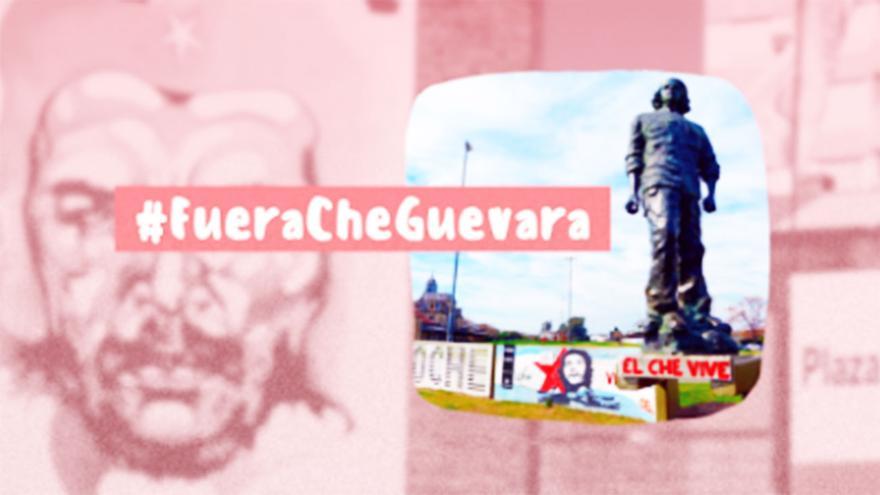
14ymedio bigger14ymedio / Manuel Mons, Argentina, July 25, 2021 — “Out with the dictator Che Guevara from the City of Rosario,” demands a group of young people from the Alternative University Collective, of the Faculty of Political Sciences of the National University of Rosario, in Buenos Aires, through the citizengo.org platform.

The petition is addressed to the mayor of the city of Rosario, Pablo Javkin, and the president of the Deliberative Council, María Eugenia Schmuck. Published on July 15, and already containing 17,847 signatures, and it states: “Young people from Rosario support the fight for the Freedom of the Cuban people.”

The promoters of the initiative note that while in Cuba “there is no free expression, basic goods are scarce, and 51% of the population lives in poverty, in Argentina the authoritarian leaders who plunged Cuba into this chaos are honored and have a cult following.” continue reading

For this reason, they ask the political class for honesty and coherence, and demand the revocation of the title of “Illustrious Citizen,” granted in 2003 by the Deliberative Council of Rosario, to one who facilitated the coming to power of the Castros. In addition they seek to to rename the Plaza del Che to a name voted by the Rosario citizenship. “In the same way, we request the removal of the Guevara mural from the Plaza de la Cooperation.”

Meanwhile, through the Twitter de Alternativa account they strengthened their demand by ensuring that young people from Rosario “don’t swallow the party line and stop treating murderers as if they were heroes. It shows a lack of respect for the Cuban people and the victims of communism.”

And so they expressed their sentiments on July 17 in front of the Flag Monument, in the city of Rosario, where a group of young people gathered to demand the liberation of Cuba shouting “Homeland and Life” in opposition to the official slogan of “Homeland or Death.”

They noted that there have been more than 60 years of repression on the island, a time when “about 2 million Cubans had to go into exile, 78,000 died trying to escape, 11,000 were murdered, and 15,000 died in military interventions abroad.”

The expressions against Che Guevara have also been felt in Madrid, where more than fifty people gathered by the Patria y Vida platform assembled on Saturday in front of the statue of the guerrilla, to express that it represents persecution of the victims of Castroism, so they asked that it be removed from a roundabout on Oleiros (A Coruña, Spain).

Cubans, Venezuelans and Spaniards all chanted slogans such as: “Long live free Cuba!” “We want freedom!” and “Homeland and life.” In statements to Efe, the Cuban Fran Vega, from the Association of Victims of Castroism, proclaimed an end to violence in Cuba and that there should not be one more reprisal, nor one more death.

Translated by Tomás A.

____________

COLLABORATE WITH OUR WORK: The 14ymedio team is committed to practicing serious journalism that reflects Cuba’s reality in all its depth. Thank you for joining us on this long journey. We invite you to continue supporting us by becoming a member of 14ymedio now. Together we can continue transforming journalism in Cuba.
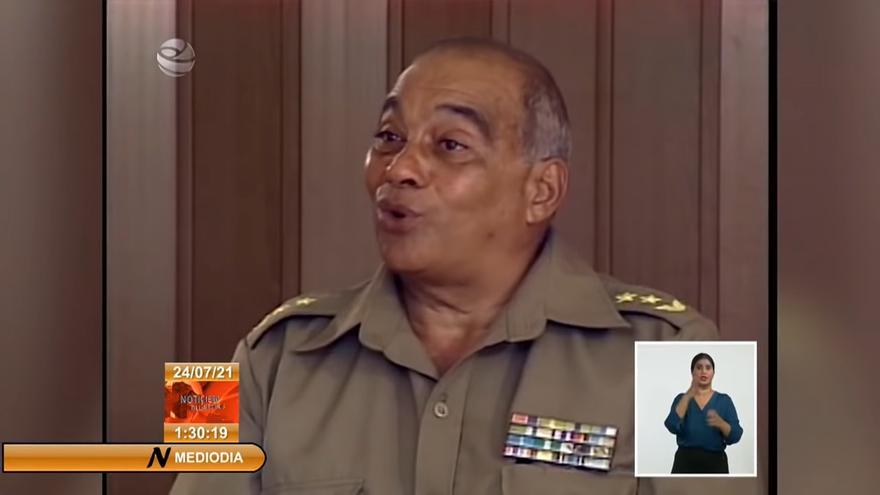
Cuban General Ruben Marti­nez Puente Dies, the Third General in a Week

Martínez graduated as a pilot in 1961 and was commander of the Cuban Air Force from November 1987 to 1999. (Capture)

14ymedio bigger14ymedio, Havana, July 25, 2021 — Reserve Major General Rubén Martínez Puente died this Saturday at age 79, according to a brief note released by the Ministry of the Armed Forces in which the cause of death was not specified.

Martínez was born in 1942 in Santiago de Cuba. He was part of the Rebel Army, joining the Revolutionary Armed Forces in 1958 as a soldier in the Frank País Second Eastern Front, under then commander Raúl Castro Ruz. He graduated as a pilot in 1961 and was commander of the Air Force from November 1987 to 1999.

Since 2003, Martínez and fellow pilots brothers Lorenzo Alberto and Francisco Pérez Pérez have been indicted in the United States for the murder, on February 24, 1996, of four members of the Brothers to the Rescue organization, created to help the rafters who escaped from the Cuba. continue reading

Martínez was charged with having given the order to fire the missiles, from Mig fighter planes of the Cuban Air Force, to shoot down the planes in which the exiles were traveling. The attack occurred over international waters, although the Cuban government justified the shoot-down by claiming that the planes had entered the island’s airspace.

Among other positions, Martínez was also head of the San Antonio de los Baños Air Brigade, Deputy to the Minister of the FAR (Revolutionary Armecd Forces), and Director of the Military Agricultural Union. He was part of the Central Committee of the Communist Party and also a deputy to the National Assembly of People’s Power. He was deployed in the military in Angola and received various official decorations.

“His body will be cremated and his ashes will be displayed for the family tribute on a date that will be reported in due time,” the note states.

With the death of Martínez, three generals have died in Cuba in the last week. Last Tuesday, the official media reported the death of reserve brigadier General Marcelo Verdecia Perdomo, who was Fidel Castro’s bodyguard in the Sierra Maestra.

On Saturday, July 18, the death of another general was announced, the head of the Eastern Cuban Army, Agustín Peña (b. 1963) from undisclosed causes, but knowledgeable sources indicated that Covid-19 was the cause of his death.

Translated by Tomás A.

____________

COLLABORATE WITH OUR WORK: The 14ymedio team is committed to practicing serious journalism that reflects Cuba’s reality in all its depth. Thank you for joining us on this long journey. We invite you to continue supporting us by becoming a member of 14ymedio now. Together we can continue transforming journalism in Cuba.
Cuba: There is No Time Left, You Have to Act

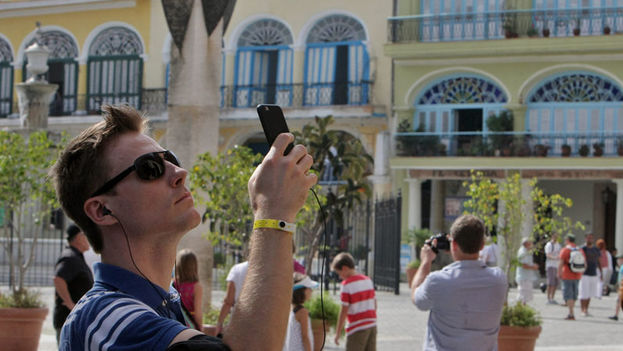
Pre-Covid, tourists take pictures in the Havana’s Plaza Vieja. (EFE)

14ymedio biggerElías Amor Bravo, Economist, July 22, 2021 – No one should be deceived. The Spanish or Italian tourist who travels to Cuba for pleasure and vacation has as much interest in the current political situation on the island as those legendary Swedes who came to Spain in the 60s in search of sun, sand, and the “macho Iberian.”

Those Scandinavian women didn’t know who Franco was, didn’t give a damn that freedom fighters in the cities were being arrested by the secret police, or that the trade unionists were seeking sanctuary in churches to claim holy ground and avoid repression by secret police.

They were going to spend a week or two in Benidorm, the Costa Brava, Marbella, or Mallorca; in short, more or less the same thing that happens with Italians and Spaniards in Cuba, who choose Varadero, María La Gorda, or Holguín to enjoy paradise.

Since the “Special Period,” tourism trends to the Island have been adapting to the times, but rarely does a tourist seek out activists or dissidents, and in many cases they even reject continue reading

them. Here we also find no differences with the “Swedish”.

I remember not long ago that some Spanish friends who visited Cuba told me that when they saw the Ladies in White marching with their gladioli near the church of Santa Rita, the tour guide informed them that they were crazy, or rather, mentally ill, and simply recommended ignoring them, let alone approaching them. When they returned to Spain and learned who those brave women were, they couldn’t believe it.

The same thing happens with foreign investors. Spaniards, Canadians, Italians, or Dutch come to Cuba to do business, involving very large sums of money, deal with people who are Party leaders holding positions in the Administration bureaucracy. They are trapped in a vicious circle that they escape at the earliest opportunity. Even those who try to take advantage of the benefits offered by the Government for those doing business in the Port of Mariel  Special Benefits Zone, find that they cannot freely hire the most qualified workers, but must resort to a state entity which, at its discretion, supplies them with the employees that they designate. And they leave.

In Spain, the manufacturers of capital equipment and intermediate goods established during the Franco dictatorship continued to expand their scale of production during the democratic stage, and few if any businesses left the country forced by political change and supposed situational requirements.

One might think that tourism and foreign investment could open for Cuba an opportunity for growth and development similar to the one that Spain experienced for decades in order for it to reach its current levels of prosperity. It’s not advisable to think that it’s the same. Because it’s not.

There are very important differences that explain why those small coastal hotels on beautiful Mediterranean beaches could be transformed into international hotel chains with thousands of well-managed and profitable shopping districts. Or, that the small open-air cafes could evolve and end up obtaining several Michelin stars. Similarly, car and truck manufacturers and foreign companies established in the 60s and 70s did not leave the country during democracy–quite the opposite–and reached significant levels of development.

In Cuba, no one should wait for these processes. Where does the fault lie? Of course, it’s not necessary to think about the blockade or embargo, which is always the standby argument of the communists. The responsibility is much closer than what is believed, and has to do with the economic and social model that governs the country, based on the Marxist-Leninist ideology that turns the human being into a slave of state political power. A system that has proven to be a failure, and for this reason it has been disappearing in all the countries of the world where it was implanted by force, allowing economic capabilities to appear that have improved the quality of life and prosperity of their inhabitants.

Cubans see that the years pass, and that the communist ideological obsession prevents things from improving. Tourism, which set the goal of 5 million travelers years ago, struggles to survive the Covid-19 pandemic without approaching the figures cited in any year. Foreign investment stagnates and, what is worse, decreases, not only because of the global economic crisis, but because the regime does not offer attractive alternatives, nor does it allow international entrepreneurs to do business freely with self-employed workers.

If the economy prospered in Spain, yet doesn’t in Cuba, despite both betting on similar drivers, it’s necessary to wonder why. And it’s not necessary to go very far to discover that Cuba’s 2019 constitution maintains a Marxist-Leninist model in which ownership of the means of production is in the hands of the state, and the market as an instrument of allocation is subject to government intervention.

And that this model is precisely what prevents the Cuban economy from loosening up and improving the living conditions of the people. This model is a backwardness, an anachronistic element that no one wants to maintain, as the Chinese or Vietnamese have done, and that Cuba, its authorities, will have no choice but to do the same, and more drastically and without so many detours.

Social protests throughout Cuba have clearly indicated which path the communist authorities should follow: negotiate and disappear. Nobody wants communism, nobody wants it to continue the same as it is now. Cubans want change, and they are willing to fight for it. The way is clear. You have to get to work as soon as possible. One minute wasted in this process can be terrible.

Translated by Tomás A.

____________

COLLABORATE WITH OUR WORK: The 14ymedio team is committed to practicing serious journalism that reflects Cuba’s reality in all its depth. Thank you for joining us on this long journey. We invite you to continue supporting us by becoming a member of 14ymedio now. Together we can continue transforming journalism in Cuba.

At the Youth Music Awards, ‘Freedom’ for Cuba was Loudly Heard

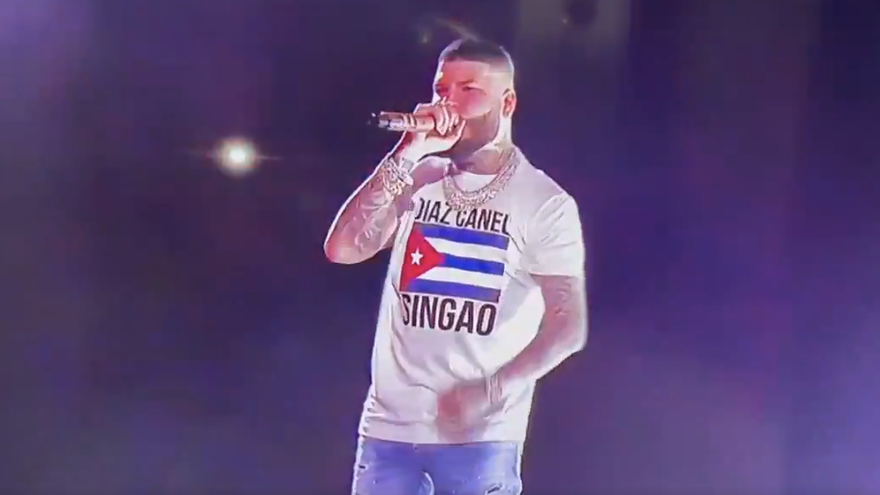
The Puerto Rican singer Farruko during his performance at the Premios Juventud, this Thursday in Miami. (Capture)

14ymedio biggerEFE / 14ymedio, Miami, July 23, 2021 — The 2021 Premios Juventud (Youth Awards) ceremony, this Thursday in Miami, was marked by the call from Cuban artists about the situation that exists on the island after the protests unleashed on July 11th in dozens of cities.

To the shout of “Viva Cuba libre” (Long Live Free Cuba) by Emilio Estefan and Pitbull, the singers Joncien, Lena, Malena Burke and Yailenys Pérez performed Libertad (Freedom), while Gente de Zona and Yotuel Romero offered a special version of Patria y Vida (Homeland and Life), the theme that has been turned into an anthem for those, inside and outside the island, who call for the fall of the Castro regime.

Earlier, a message had been transmitted from Cuban artist Camila Cabello, wearing a T-shirt that read “Patria y vida,” who made an appeal in Spanish to American and Latin American youth to support protesters in Cuba.

“I feel very proud of my Cuban blood and even prouder of those who have taken to the streets to lead the change, despite the repression, despite the fear. Let us unite our voices with theirs, Patria y Vida!” Cabello said.

Previously, the Puerto Rican artist Farruko had come on stage wearing a T-shirt that read “Miguel Díaz-Canel singao” (motherfucker), an insult widely used continue reading

these days to refer to the Cuban president.
But one of the most emotional moments of the gala was when the audience at the Watsco Center welcomed Venezuelan artist Chyno Miranda, who appeared for the first time on television after more than a year fighting severe health problems.

The moment also marked the return of the Venezuelan duet Chyno and Nacho after their separation in 2017. The artists performed a medley of their greatest hits such as Mi Niña Bonita and Andas En Mi Cabeza, and later they sang Queriendote, the new single from their new album.

Miranda, who was always a great dancer, had serious movement difficulties due to peripheral neuropathy and encephalitis that he suffered as a result of his covid-19 infection in March 2020.

The night’s guest of honor was Puerto Rican reggaeton performer Daddy Yankee, who received the “agent of change” award for his fight against child hunger, as well as his help to families affected by the onslaught of Hurricane María.

The Colombian artist Karol G won six Juventud prizes out of the twelve awards to which she was nominated, the same number as her compatriot Camilo was nominated for, but he won none.

The interpreter of “Bichota and 200 cups” won the awards for “young female artist”, “the catchiest ” and “the most trendy”, among others, while Bad Bunny followed closely, with five awards, including two most coveted, “album of the year” and “song of the year.”

From Mexico, Grupo Firme finished with four awards, while Natti Natasha received three, and Becky G and Los Dos Carnales took two each.

Other artists who left the Watsco Center in Miami happy tonight were Puerto Ricans Jhay Wheeler and Franchesca, who were recognized as the best new artists.

In previous years, the songs performed at Premios Juventud were traditionally the most popular of the moment. However, the absence of concert tours in Latin America seemed to stimulate artists to present new music on stage.

During the ceremony, mention was also made of the collapse of the residential building in Surfside, Florida, where about a hundred people died this month, and the use of masks and vaccination against Covid-19 was urged, because it was a night in which music was not detached from the problems of these times.

Translated by Tomás A.

____________

COLLABORATE WITH OUR WORK: The 14ymedio team is committed to practicing serious journalism that reflects Cuba’s reality in all its depth. Thank you for joining us on this long journey. We invite you to continue supporting us by becoming a member of 14ymedio now. Together we can continue transforming journalism in Cuba.

The Cause of the 11 July Demonstrations is Internal, the Way Out is in Democratization / Dimas Castellano

It is better to surrender arms than to fight without morals.

Dimas Castellanos, 19 July 2021 — Men can speed up or slow down historical processes, but only up to a point. The forceful popular demonstrations of 11J (July 11th), unprecedented for their massiveness and spontaneity, definitively confirmed that the crisis in Cuba has no other way out than the participation of Cubans as subjects in the destinies of their nation, that is, through democratization. To ignore this is to lead the country to a tragic outcome.

The rejection of democratization with the false argument of defending the “conquests of the revolution” can lead, as the events that have occurred indicate, to a catastrophe of incalculable consequences. After the failures harvested, the arguments put forward to continue on the same path do not stand up to serious analysis:

1- The Defense of the Revolution

By definition, the Revolution is a change in the structure of power in a short period of time that elapses from when the revolutionaries assume power until they replace the existing institutionality with another, subordinate to their ends.

This process in Cuba — extremely prolonged — began in 1959 and culminated in the 1976 Constitution. After that date, there is no revolution in Cuba, only immobility and retrogression.

The immobility, induced to “safeguard the conquests,” is nothing more than a euphemism to defend continue reading

vested interests and preserve power, which turns unresolved problems into sources of outbreaks, as happened on 11J.

The concept of revolutionary, which designates people who promote changes, is not attributable to those who choose to stop history to preserve what has been achieved. Defenders of the status quo can call themselves anything else, but not revolutionary.

2- TheBlockade

[Ed. note: The American embargo on Cuba is routinely referred to by the Cuban Government as a ’blockade’, which it is not.]

The seizures of the properties in Cuba owned by individuals or companies in the United States, which began in 1959, the attempts to export the revolution to other countries in the region, together with the reestablishment of relations with the Soviet Union — in the middle of the Cold War –were responded to by the United States with the establishment of the embargo, the reduction and suspension of the sugar quota, and the breakdown of diplomatic relations.

Thus began a confrontational escalation that for six decades has been used by the Government of Cuba to restrict the freedoms of Cubans, whose worst effect has been Cuba’s retreat from the most advanced platoon in Latin America with regards to rights and freedoms, to the group of the most backward.

The solution to this dispute does not lie in advertising campaigns or United Nations resolutions, but rather in accepting the causes and bringing them to the negotiating table instead of using it to present Cuba to the world as David before Goliath, to conceal the internal deficiencies, and to use it to make believe that any idea different from those of the Government comes from the United States, which constitutes an offense to the intelligence, culture and professionalism of Cubans.

3- The Principal Cause

In the shadow of the confrontation with the United States, the revolutionary government implemented a package of popular benefit measures (lower rents and lower prices for medicines, improvements in education and public health, the delivery of 100,000 property titles to poor peasants and the subsidy of basic products and services).

In parallel, it replaced independent civil society with associations created by and subordinate to power, suppressed freedoms, concentrated power in the leader, and concentrated ownership in the state. The most negative effect of the populist measures and the establishment of totalitarianism was the disappearance of the condition of citizen: an effect closely linked to the failures harvested, the accumulated malaise and the simultaneous explosion of 11J.

Like any system alien to human nature, Cuban totalitarianism was born doomed to failure. Its long duration lies in the demonstrated ability to subdue people through control of property, education, culture, and the media.

The embargo must cease, but since the main cause of the crisis lies in the adherence to nationalization, centralized planning and the absence of freedoms, the way out is, first in the implementation of measures of change within Cuba and then in the bilateral negotiations with the US, to retrace the path traveled — since the nationalization of US properties and the enactment of the embargo — through dialogue and negotiation.

4- The Shield

As the effectiveness to retain power is not transferable to production, the Cuban nation stagnated and began to regress. The totalitarian model was unable to generate sustained growth to meet the needs of Cubans, which is reflected, among other things, in the lack of food and medicine and in the power cuts.

Faced with the inevitable crisis, instead of escaping forward, the Cuban Government stepped on the brakes and decided to shield the totalitarian model with the 2019 Constitution, whose text preserves the causes of the setback, namely: the existence of a single political party as the superior leading political force of society and of the State; state property, the cause of economic decline as the fundamental form of the economy; the prohibition of Cubans on investing and being entrepreneurs in their country; and freedoms and rights, limited to being exercised in accordance with the ideology of the ruling party; which explains why, in the 11J demonstrations, the common cry was for freedom.

Conclusions

The solution to the crisis depends in the first place on measures aimed at empowering Cubans and banishing the exclusions of a part of the people with that aberrant slogan, “The street belongs to the revolutionaries”, which constitutes an offense to the words of the Apostle [José Martí]: Con todos y para el bien de todos” [With all and for the good of all.] Consequently, the recovery of the condition of citizen is imposed for participation as subjects, not as objects, in the solution of the nation’s problems, which are their own problems.

As the cause of the crisis is internal, democratization is the way out. It is enough to start with a minimum set of measures that allow Cubans to invest and create small and medium-sized production and service companies, produce and trade without the tutelage of the state company Acopio and Foreign Trade monopolies, leaving individuals free to associate in the way they desire, in matters of interest to them. These measures would necessarily have to be accompanied by the formation of a range of autonomous and independent associations without more state interference than is necessary for their registration, existence and operation.