Only 8 of the 23 boats Las Tunas counts on are in operation due to the lack of spare parts to start engines and batteries.
Las Tunas fishing fleet problems have resulted in the city’s shortage of seafood products / Radio Habana, Cuba
14ymedio, Havana, 4 May 2024 — Of the 23 boats that make up the fishing fleet in Las Tunas, only eight are currently working, that is, 65% of the available boats are out of service due to not having enough spare parts to start motors and batteries.
This was revealed by the investment specialist of the state company, Xiomara Concepción, in an interview with Periódico 26, where it explained that the lack of fisheries in the city has resulted, among other things, in a shortage of seafood in the local commercial network.
The shortage of fish in Las Tunas is a reality that, for some years, can be corroborated by the supply shortages of derived foods such as croquettes, sausages and minced meat. The situation has forced suppliers to obtain their fish from neighboring provinces such as Holguín and Camagüey, according reports.
Last March, the Government permanently eliminated the obligation to sign a contract with a company authorized for marketing, which was an obstacle for non-state fishermen to obtain a license.
However, in the little more than a year and a half since the resolution, which also does not consider lobster among its plans, no positive effects have been seen, and in places like Las Tunas the absence of boats adds to the deficit. continue reading
According to data from the Ministry of the Food Industry, fish consumption fell in Cuba from an annual average of 18 kilograms per person thirty years ago to around 3.8 kilograms in 2022. So far, the figures corresponding to 2023 have not been made public, but nothing indicates that they will be any better.
Fishermen from Las Tunas struggle to do their work due to lack of resources / Periódico 26
Faced with this panorama, Yordan Rueda Paz, technical director of Pescatun – the fish marketing company in the province – explained to the Cuban News Agency that an investment exceeding 16,370,000 pesos is already being prepared to strengthen the Las Tunas fishing industry, which is also working to obtain engines and other equipment for the fleet.
The project includes the creation and rehabilitation of centers for young fry, the ‘dynamization’ of the industry and obtaining resources for the capture during 2024 for the Empresa Pesquera de Las Tunas [Las Tunas Fishing Enterprise] , commonly referred to as Pescatun.
“During the next few days, we must complete the assembly of the electrical and hydraulic networks and the false ceiling”
According to the official media, this is not the only project to boost food production in the area. There are others linked to the agricultural sector that are being developed in the province of Las Tunas, and through these projects tractors, irrigation systems and other material resources have been received.
The digital newspaper also reports on the training of private and state producers to dedicate the acquired machinery to the most appropriate uses, and convert them into food, grains, fruits, vegetables, meats and other items destined for the population.
Diametrically opposed to the situation in Las Tunas are the results of the Santa Cruz del Sur Fishing Company, in Camagüey, which on November 6 was proud of having captured the 250 tons of lobster of its annual plan and is continuing in search of more seafood to exceed the plan targets.
To this industry, destined mostly for export and hotel food, the regime allocates the resources that it says it does not have when it comes to fishing for national consumption.
Translated by Norma Whiting
____________
COLLABORATE WITH OUR WORK: The 14ymedio team is committed to practicing serious journalism that reflects Cuba’s reality in all its depth. Thank you for joining us on this long journey. We invite you to continue supporting us by becoming a member of 14ymedio now. Together we can continue transforming journalism in Cuba.
Last Wednesday, in Caracas, the XXIII Summit of Heads of State and the Government of Alba-TCP / Prense Latina
14ymedio, Yunior García Aguilera, Madrid, 27 April 2024 — Alba-TCP, the alliance created by Hugo Chávez and Fidel Castro, has reached 20 years with the vitality of an “almendrón,” a 1950s American car, without spare parts. The high price of oil during those founding years was the viagra that unleashed the social-imperialist fantasies of both leaders. But with the subsequent fall in crude oil prices, as well as the death of its ideologues, the organization experienced a stage of flaccidity that they are now trying to shake up with motivating speeches and new agendas.
Josefina Vidal leaked a few words to show the early detumescence of the Bolivarian Alliance. In an interview with Prensa Latina, the Deputy Minister of Foreign Affairs of Cuba talked about affectations, lack of economic resources, programs on a smaller scale, coercive measures and blockades. Of course, she did not refer to the political and economic crisis that Venezuela is experiencing, nor to the crisis of attractiveness suffered by the Cuban regime. Thus, without a pipe gushing petrodollars and charismatic leadership, Alba offers less light than a night without a moon.
The idea of this “alternative” emerged as a counterpart to Alca. Since the time of Bush senior in 1988, the United States had tried to create a free trade area that ran from Alaska to Tierra del Fuego, with 34 nations and a market of 800 million people. The asymmetry between the countries of the hemisphere aroused suspicions around the project, but many saw more benefit than danger in its concretization. In 1993, Bill Clinton signed the agreement, to take effect in 1994. However, when the IV Summit of the Americas arrived in 2005, Bush junior received a “No” in response, and Hugo Chávez mounted a parallel organization with a slogan that went viral: Alca, Alca, go to Hell!” continue reading
In 1994 Bill Clinton rounded out the idea a little more and planned to implement it in 2005
Fidel Castro, from his bunker in Havana, rubbed his hands and smiled sarcastically. His purpose was never for Latin America to win anything, but for the United States to lose. In addition, he was dying of nostalgia for those years of the Comecon where it was enough to stay in the nest with an open beak, chirping like an eagle in heat. That’s why the bearded man needed something like Alba. It would not be necessary to produce competitively, something in which he did not have the slightest experience or any enthusiasm. Its purpose was to establish a ritual of charitable exchanges, with a whole propagandistic and demagogic apparatus behind it. He was an expert at that. It was always an ideological alliance with subsidies, never a regional cooperation and development project. About the small Caribbean States and their role in this soap opera, we will have to write later.
Alba failed to reduce poverty or inequalities, despite its “mission” and its paraphernalia. On the contrary, both Cuba and Venezuela suffer worse rates of poverty today than in 2004. Nor was it an alternative for “the people,” since decisions have always been made from the hierarchies of these regimes, where civil society cannot even look out.
Last Wednesday, in Caracas, the XXIII Summit of Heads of State and the Government of Alba-TCP took place. Twenty-three summits in twenty years – that’s typical of our tireless bureaucrats! The host, Nicolás Maduro, for whom originality is an unknown concept, presented the Alba 2030 agenda. Don’t expect to find anything new, much less verify results within six years. It’s a diet of bombastic ideas like that of the Petro cryptocurrency*, which the dictator sold as the most solid and stable in the world. Now he sells us a septet of “great goals,” including the resurrection of Petrocaribe**, the University of the Peoples, a “fair” trade zone and other pretty things.
The host, Nicolás Maduro, for whom originality is an unknown concept, presented the Alba 2030 agenda
Díaz-Canel, the front man for the Castros, awkwardly read his flash cards. His dyslexia prevented him from distinguishing between “vecino” (neighbor) and “destino” (destiny), “precedent” and “president.” Which prankster thought of writing the word “consolidation” in his speech? At the conclusion, he made his characteristic grimace of dry swallowing, picking his nose and going from robotic seriousness to a childish smile, looking for a friendly face in the crowd, like a bad student after an uncomfortable oral presentation. Sympathizing with his ineptitude, Maduro released one of his pearls: “Together we are invincible. And together with the women, even more invincible.” That’s Alba, a group of idiots.
Alba, Alba, to the trash!
Translator’s notes: *Petrocurrency was launched by President Maduro six years ago to sidestep US sanctions but was shut down in January, 2024, due to corruption. **Petrocaribe was a 2005 agreement between Venezuela (under Hugo Chávez) and Caribbean nations for selling and buying oil.
Translated by Regina Anavy
____________
COLLABORATE WITH OUR WORK: The 14ymedio team is committed to practicing serious journalism that reflects Cuba’s reality in all its depth. Thank you for joining us on this long journey. We invite you to continue supporting us by becoming a member of 14ymedio now. Together we can continue transforming journalism in Cuba.
• In the first trimester of the year, only a quarter of the international travelers expected for 2024 arrived, far from the 32% needed to meet projections.
• The United States has denied 300,000 electronic visas to European citizens for having visited Cuba before.
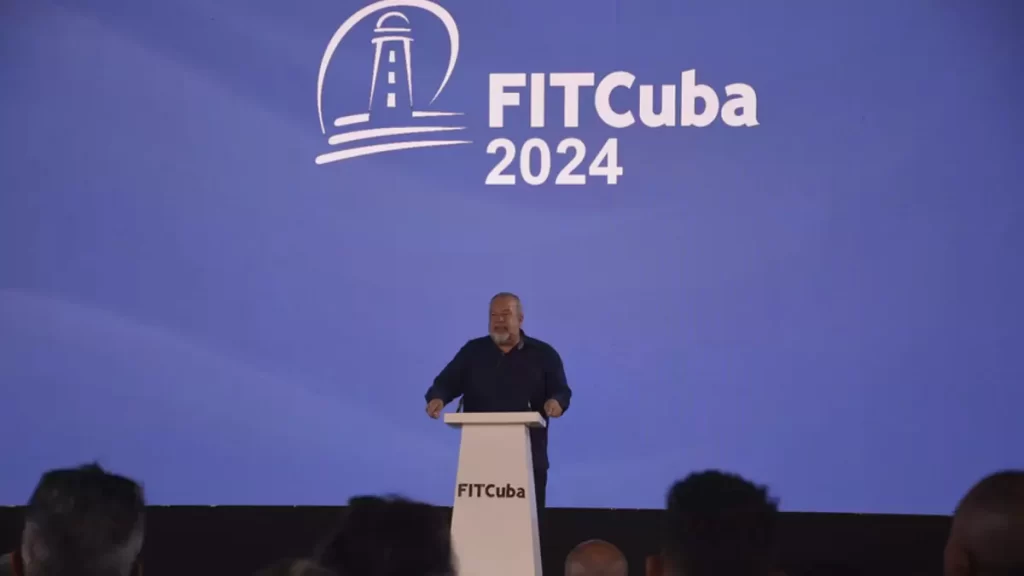
Marrero opened the FitCuba event, in which the Minister of Tourism, Juan Carlos García Granda, was also present / Invasor
14ymedio, Madrid, 3 May 2024 — Prime Minister Manuel Marrero announced the establishment of an electronic visa that will replace the traditional tourist card as of May 6. The document, whose purpose is to facilitate international visits to Cuba, is called E-visa and can be obtained on a website created by the Ministry of Foreign Affairs.
“With the electronic visa, tour operators and end users will be able to manage their application in a simplified way from any device connected to the Internet,” said the executive this Thursday at the inauguration of the International Tourism Fair, FitCuba 2024. Its 42nd edition is being celebrated in Jardines del Rey (Ciego de Ávila).
Marrero opened the event, at which the minister of the sector, Juan Carlos García Granda, was also present, as well as the governor of Ávila, Alfre Menéndez Pérez, and the regional director for the Americas of UN Tourism, Gustavo Santos, who offered the support of the organization for the consolidation of the sector’s recovery in Cuba, which has yet to be completed. continue reading
On April 19, the National Office of Statistics and Information (Onei) provided the official number of tourists who arrived in Cuba in the first quarter of the year. The number was 809,238 international travelers, just 56,807 more than the previous year during the same period. This figure threatens to wreck, once again, the authorities’ annual aspirations of 3,200,000 tourists this year, since the number represents only 25.2% of the objective. In 2023, as of April, 21.4% of the projected 3.5 million had been achieved and the final figure was only 2.4 million.
Cuban economist Pedro Monreal already warned at that time that Cuba needs to achieve around 32% of the forecasts in the first trimester if the goal is to be met
Cuban economist Pedro Monreal already warned at that time that Cuba needs to achieve around 32% of the forecasts in the first trimester if the goal is to be met.
This Thursday, Marrero did not hesitate to blame the United States for the debacle, to which he attributes a “subversive and diversionary policy, aimed at destroying our Revolution, which makes the management and conduct of recovery and development plans difficult.” Cuban authorities have made it their most recent objective to overturn the US rule that prevents tourists who have visited Cuba or any other country on the list of sponsors of terrorism from entering its territory with ESTA (an electronic document that exempts travelers from several countries from visa requirements).
“We are the only country in the world in which US citizens, the main issuing market to the Caribbean, are prohibited by law from traveling freely to Cuba as tourists. Also, as part of the extraterritorial application of the blockade, 300,000 electronic visas were denied to European citizens for having visited Cuba before”, claimed Marrero, citing data published this week by the American press. The measure does not prevent entry into the country, although it does require a tourist visa to be processed, which means more processing time and expenses for the applicant.
The prime minister also referred to the cancellation of the route to Buenos Aires due to the refusal of the Argentine company that supplied fuel to Cubana de Aviación to continue supplying it.
Marrero had, however, good news in store for that day. According to what he revealed, the Spanish Justice System definitively closed the case opened in Mallorca against Meliá Hotels Internacional, the Gaviota group and the Cuban State.
“We recently learned of the definitive victory in the lawsuit against the Meliá Hotel chain, the Gaviota tourism group and the Cuban State in Mallorca, Spain. “Justice triumphed!” wrote the leader on his X account.
“We recently learned of the definitive victory in the lawsuit against the Meliá Hotel chain, the Gaviota tourism group and the Cuban State in Mallorca, Spain. Justice triumphed!”
The lawsuit, which has been open since 2019 and has had countless twists and turns, was filed by the Sánchez Hill family, residing in the United States, who requested compensation of about 10 million euros for the lands located in the current province of Holguín, which were expropriated by Fidel Castro in 1960 and from which Meliá benefits by managing several hotels built there by the Cuban military.
The CEO of Meliá, Gabriel Escarrer – who has been banned from entering the US since 2020 due to the Helms-Burton law – told Cuban Television News this Thursday that he is proud that, for the third time, the Spanish justice system has granted them the point in the lawsuit. “Our commitment to Cuba is unconditional and we have been demonstrating it since 1989,” said the businessman.
Meliá, which manages almost 40 hotels in Cuba, announced a new investment: the Gran Marena Cayo Coco, which will open under the name Meliá Costa Rey and is owned by the Gran Caribe Hotel Group. The Balearic hotel company will manage this establishment, which was the last hotel that operated with a 5-star category under the Accor brand in Cuba, as Pullman Cayo Coco.
FitCuba 2024, which will receive more than 600 participants from airlines, tour operators, travel agencies, hoteliers, transporters and related professionals and will run starting from this Thursday until Sunday, May 5, awarded Meliá, Iberostar and Blue Diamond hotel chains for “their support for the development of the leisure industry.
Translated by Norma Whiting
____________
COLLABORATE WITH OUR WORK: The 14ymedio team is committed to practicing serious journalism that reflects Cuba’s reality in all its depth. Thank you for joining us on this long journey. We invite you to continue supporting us by becoming a member of 14ymedio now. Together we can continue transforming journalism in Cuba.
The current situation in the small nation has revealed the limited effectiveness of the Community of Latin American and Caribbean States and other regional alliances.
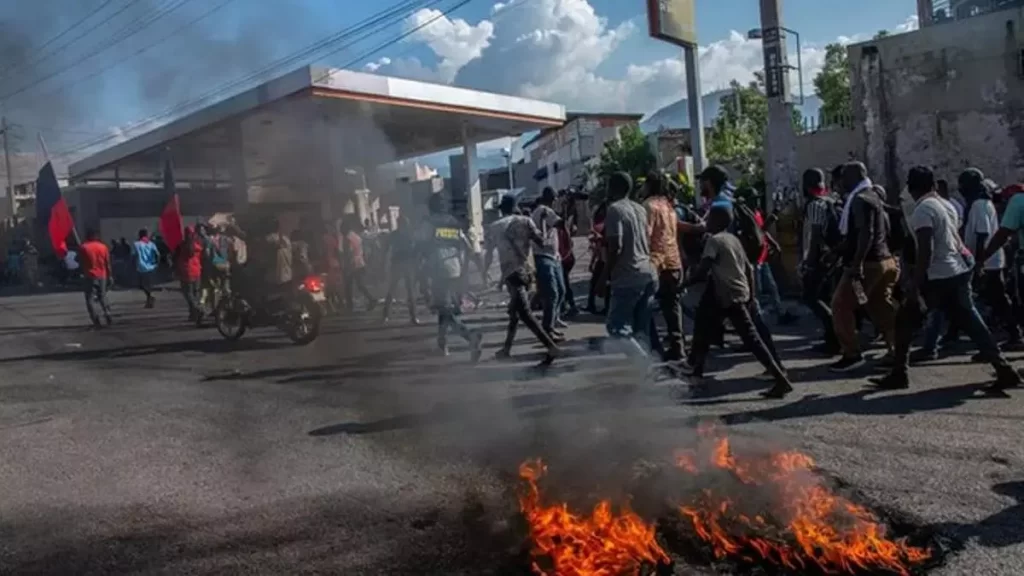
Haitians cannot continue to wait for summits and photos of presidents who smile in front of the cameras / EFE
14ymedio, Yoani Sánchez, Havana, 31 March 2024 — Acronyms, meetings and official photos. International organizations seem more interested in demonstrating that they are operating through events and receptions than with actions or results. In Latin America it is a rare month in which there is not a summit, meeting or alliance that grabs the headlines and generates a new declaration signed by leaders and foreign ministers. However, where the effectiveness of these integration mechanisms is really measured is in reality, a level in which most lack tangible fruits.
The current situation in Haiti has revealed the limited effectiveness of the Community of Latin American and Caribbean States (Celac) and other regional alliances. Instead of accompanying and supporting the Haitian people in the difficult moment they are experiencing, the governments of this continent have chosen to look the other way or to dedicate themselves to distributing historical blame without managing to provide quick and practical help aimed at the population of a country ravaged by violence, the economic crisis and the collapse of political institutions.
Instead of accompanying and supporting the Haitian people in the difficult moment they are experiencing, the governments of this continent have chosen to look the other way
Celac and Latin American executives have failed Haitians because they have not even managed to protect them as refugees. On the dangerous route that crosses the Darién jungle and enters Central America and then crosses Mexican territory until reaching the southern border of the United States, nationals of the Caribbean country are among the migrants in the most vulnerable situation. Without speaking a word of Spanish, in many cases, lacking the resources to pay coyotes, and goaded by racism, they have become invisible beings that local administrations do not want to see, mention or support. continue reading
The lack of programs with residence facilities, access to work and coverage of basic services in many of the countries that make up the migratory journey of thousands of Haitians annually is striking. With more than 12 million inhabitants, the small island depends more and more on its diaspora and supporting these human beings in transit is also a way to save families who have been left waiting for their relatives to manage the trek, send them remittances and support them from the outside. The United Nations Refugee Agency (UNHCR) issued a series of recommendations for neighboring countries to guarantee these Haitians refuge and protection; but, as often happens, the exhortation has fallen on deaf ears.
In addition to specific facilities for these migrants, a joint response to the Haitian drama has been lacking in Latin America
In addition to specific facilities for these migrants, a joint response to the Haitian drama has been lacking in Latin America. The houses of Government are more focused on arguing among themselves over their ideological positions, creating a diplomatic fire based on the publications of a leader on the social network X, or making accusations against other governments, than in sitting down to agree on a plan of action.
During crises and humanitarian alerts, regional organizations are tested and those who represent us in this hemisphere have demonstrated their inability. Haitians can no longer wait for summits and photos of presidents smiling in front of the cameras. An aid program aimed at its injured population is urgently needed and must be as a whole as “the silver in the depth of the Andes.”*
*Translator’s note: The quote is from José Martí’s 1891 essay “Nuestra America”: “The hour to muster and march in unison is upon us and our ranks must be as compact as the veins of silver in the depths of the Andes.”
Cuban President Miguel Díaz-Canel criticized the repression of student protests in several American universities
Wearing a Palestinian “keffiyeh” (traditional scarf) around his neck, Díaz-Canel said he felt like a “father” to all Palestinian students on the Island / Presidencia Cuba
14ymedio, Havana, May 3, 2024 — The Cuban regime is clear about its loyalties in the war in Gaza: Israel is an “occupying power” involved in a “brutal Zionist escalation”; Palestine, a “brother people,” which has sent “hundreds of students” to Cuba and with whom, since the time of Fidel Castro, the Island “has always stood in solidarity.”
These are the words of Cuban President Miguel Díaz-Canel this Thursday, during a speech in which any mention of the terrorist attack by Hamas on October 7 was omitted. The president, who has offered his unconditional support to the Palestinian side, appeared before more than 1,100 delegates in a “meeting of solidarity” for Cuba and Palestine, “against the imperialism” of the United States and Israel. The highest point of his speech has been, however, his criticism of the repression of student protests at several American universities. As hundreds of Cuban activists have reminded him, his Government applies at home the violence it attributes to other police forces.
Wearing a Palestinian “kiffeyeh” (traditional scarf) around his neck – which he has worn in public since last October – Díaz-Canel said he felt like a “father” to all Palestinian students on the Island and gave the floor to Fernando González Llort, one of the five Cuban spies imprisoned in the United States in 1998, currently the president of the Cuban Institute of Friendship with the Peoples.
Since 2017, González Llort has been the regime’s man when it comes to organizing the groups of foreigners who participate in the mass celebrations, such as the May Day parade. During his speech, he said that the delegates invited to the congress “will be able to convey the truth of Cuba to their communities” and condemned “in energetic terms” the “Israeli genocide against the Palestinian civilian population.” He did not allude to Hamas. continue reading
During the meeting, a declaration of support for Palestine was signed demanding that the United Nations recognize a Palestinian State “with the borders prior to 1967 and East Jerusalem as the capital.”
This Wednesday, Cubadebate put on its front page an extensive account of the student protests in the United States signed by the spokesman of the regime Randy Alonso. The journalist argues that this movement is similar to the one that, in the 1960s, demanded the end of the Vietnam War.
Alonso celebrates that, despite being “the main ‘foundations’ of the empire,” universities such as Columbia also host groups that disagree with Washington. These are the people who oppose the “Christian Zionists and fundamentalists” who support Israel, creating an “obscurantist atmosphere.” He also criticizes the fact that several organizations, such as the Wexner Foundation, have broken ties with several faculties that received their funding for the anti-Semitic acts that have taken place in them.
“Either Israel’s Yankee protectorate is defended or you can go to jail,” Alonso concludes, without realizing the irony of writing paragraphs in Cuba in which he lashes out at those who “beat young people, spray them with pepper spray and arrest them.” This Wednesday, in the same line of argument, Díaz-Canel published in his X profile a message of “solidarity with students in the United States who have taken the side of justice, have come out to support the cause of the Palestinian people and are brutally repressed.”
The flood of reactions was not long in coming, and they revolved around the fact that, a few days earlier, the sentence of up to 15 years in prison was announced for those who demonstrated peacefully in Nuevitas, Camagüey, in the summer of 2022.
In Cuban universities, on the other hand, students avoid giving a frank opinion about the conflict
In Cuban universities, on the other hand, students avoid giving a frank opinion about the conflict. On the Island there are no large Jewish communities – and those that exist have already spoken out about the war – but there are many Christian students, especially evangelicals, who feel linked in some way to Israel.
This is the case of Manuel, an evangelical pastor from Villa Clara who listens with concern to what several young university students in his community tell him. They feel “marginalized” for their support of Israel and their opinions about the war, although there has been no “persecution” against them. “The accusation that is repeated in the classrooms is that those who support Israel are religious fanatics, and they are discriminated against for their opinion,” he tells 14ymedio.
“Some time ago they took children and young people to the streets for a kind of act of repudiation against Israel.” The Cuban media does not present “both sides of the conflict; everything is a deception and the information is manipulated,” he adds. The most serious thing, Manuel emphasizes, is that for the Cuban media “there is no longer clarity about who started the conflict and the wave of violence.” In a word, he says, “it is as if Hamas didn’t exist.”
Translated by Regina Anavy
____________
COLLABORATE WITH OUR WORK: The 14ymedio team is committed to practicing serious journalism that reflects Cuba’s reality in all its depth. Thank you for joining us on this long journey. We invite you to continue supporting us by becoming a member of 14ymedio now. Together we can continue transforming journalism in Cuba.
More than 1,500 foreign participants attended the FITCuba, held at the tourist center of the Jardines del Rey Islands / Ministry of Tourism of Cuba
EFE (via 14ymedio), Havana, 5 May 2024 — The 42nd edition of the International Tourism Fair of Cuba (FITCuba), the main event for the tourism sector on the Island, closes its activities this Sunday with the announcement that China will be the guest country in its 2025 edition, according to state media. The FITCuba, held at the tourist center of the Jardines del Rey Islands – Cuba’s second destination for sun and beach after Varadero – was attended by more than 1,500 foreign participants, including 437 travel agents, to explore and do business, according to the Ministry of Tourism.
The Minister of Tourism, Juan Carlos García Granda, explained that the special invitation to China for the next FITCuba is part of the promotion of relations and tourism between the two countries.
He highlighted the resumption of direct flights between Beijing and Havana, operated by Air China, with its inaugural trip scheduled for May 17, with a stopover in Madrid. continue reading
García Granda also announced at the closing of the event the decision of the Cuban authorities to establish a visa exemption for Chinese citizens with ordinary passports.
China’s ambassador to Cuba, Ma Hui, participated in the FITCuba 2024 / Cubadebate
“FITCuba has been the right time to show the renewal of our tourism product, the digitization of processes to improve the customer experience, the expansion of renewable energy sources, the transformation of our products with more accessibility, respectful of the environment and in line with the country’s commitment to the fulfillment of the Sustainable Development Goals,” he said. On the eve of the Fair, the official media celebrated the arrival of the first million foreign visitors to the Island in 2024.
They also confirmed the goal of reaching 3.2 million tourists at the end of the year with the aim of achieving a resurgence in a key sector for the national economy that is going through a critical situation.
The tourism sector is the second highest contributor to Cuba’s gross domestic product (GDP) and the third source of foreign exchange, after professional services and remittances, according to estimates by various independent experts.
Cuba received 2.4 million tourists in 2023, a figure that represented a growth of more than 800,000 visitors compared to 2022, when it did not achieve its goal of hosting 1.7 million, according to official data.
Tourism does not escape the deep crisis that has impacted Cuba for four years due to the confluence of the pandemic and design and implementation errors in national economic policies.
Translated by Regina Anavy
____________
COLLABORATE WITH OUR WORK: The 14ymedio team is committed to practicing serious journalism that reflects Cuba’s reality in all its depth. Thank you for joining us on this long journey. We invite you to continue supporting us by becoming a member of 14ymedio now. Together we can continue transforming journalism in Cuba.
A Cuban rafter supported by municipal police is taken to the hospital / / Tamaulipas Civil Protection
14ymedio, Havana, May 5, 2024 — Cubans Mario Sergio Márquez Ventura, 30 years old, Rogelio Loases Fuentes (50), Yuriesky Romero Hernández (33) and Diosan (26) were rescued this Saturday by fishermen from Laguna Madre, Mexico. The rafters left the Island on April 1, but on the crossing the rudder of the raft on which they intended to reach Florida broke, and they were adrift for more than 30 days.
According to those rescued, four other Cubans died on the way, and their bodies were thrown into the sea. The shipwrecked men, located at the point known as Barra Boca de Catán, were dehydrated and very thin. The rafters told their rescuers that their boat was rammed by strong gusts of wind and waves of up to 17 feet.
One of the Cuban rafters rescued by fishermen at the point known as Barra Boca de Catán / Tamaulipas Civil Protection
One of the Cuban rafters rescued by fishermen at the point known as Barra Boca de Catán / Tamaulipas Civil Protection
The Mexicans transferred the rafters to the island known as Punta de Piedra, where they were treated by members of Tamaulipas Civil Protection and transferred to the San Fernando General Hospital. Their state of health is reported as stable, and the medical report has yet to be released. continue reading
The rescue was informed to the National Institute of Migration, which will take care of the migrants after being medically discharged. Meanwhile, the Cuban Embassy in Mexico has not offered any comments on the rescue.
On April 26, Migración received 28 rafters from the Island rescued 20 miles from Cuba by the Paradise Carnival crew. These Cubans were escorted by sailors to the immigration headquarters of Playa del Carmen. So far, no information has been offered about their condition.
Mexico continues to deport Cubans, despite the fact that last October it announced that the process of “assisted calls” – as they call the expulsions – was paused until further notice. Last January, nine people from the Island were returned on a commercial flight. Last year, the departure of 774 migrants was completed.
Translated by Regina Anavy
____________
COLLABORATE WITH OUR WORK: The 14ymedio team is committed to practicing serious journalism that reflects Cuba’s reality in all its depth. Thank you for joining us on this long journey. We invite you to continue supporting us by becoming a member of 14ymedio now. Together we can continue transforming journalism in Cuba.
If there is one thing that bothers local residents it is that buying something at an MSME is becoming as difficult as doing it at a state-run store
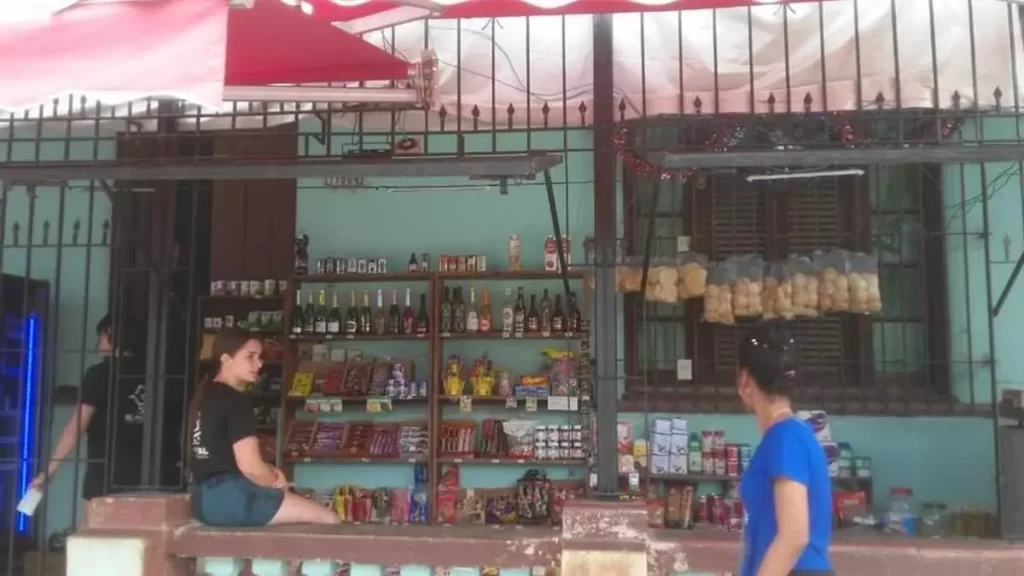
Many local businesses offer products that are scarce or which have not been seen in state stores for years / 14ymedio
14ymedio, Julio César Contreras, Matanzas, May 1, 2024 — For years now, one could map the layout of Matanzas by following the trail of the small and medium-sized private businesses (MSMEs) that have proliferated throughout the city. Street-side produce stands, covered entryways of old mansions and makeshift warehouses have served as the locations for the province’s independent businesses. Many offer products that are in short supply or have not been seen in state stores for years. Others are businesses that previously did not even exist in Cuba.
“How can I help you?” asks the receptionist at a workshop near Freedom Park that sells electronic devices. “Sorry, we don’t have batteries for that model,” she tells Julio, a 56-year-old Matanzas resident who wants to use a phone that he has been keeping in a drawer for months.
“I’ve been here several times, asking the same question, but they never have them,” says Julio. “They’ve told me the issue is that they have problems getting parts past Customs. And because this country is not as technologically advanced as others, we sometimes are still using models that manufacturers no longer produce. It seems absurd that the government makes it difficult for these businesses to import parts when the state itself does not offer these services and we have to rely on individuals.”
An electronics workshop on Milanés Street, near Freedom Park / 14ymedio
Other businesses have cropped up in the city, often with tacit approval from local officials, offering services that Cubans have come to believe are impossible to obtain through legal means, without turning to the black market. Such is the case with SuperVision. Many locals use this optometry and eyeware store on Milanés Street to fill a hospital-provided eyeglass prescription. continue reading
This particular MSME shares a small space with a barber shop. It so happens that is one of barbers who explains how the business fills a void created by shortages at state-run eyeware stores. “You bring in your prescription and they make eyeglasses to fit you. You can provide your own frame or pick one out from their selection,” he says.
“I finally got my progressive lenses,” says a satisfied customer who had not been able to find a solution to her problem at state-run eyeglass stores. “It’s true that the prices here are outrageous but, if you have the money, your situation gets resolved.”
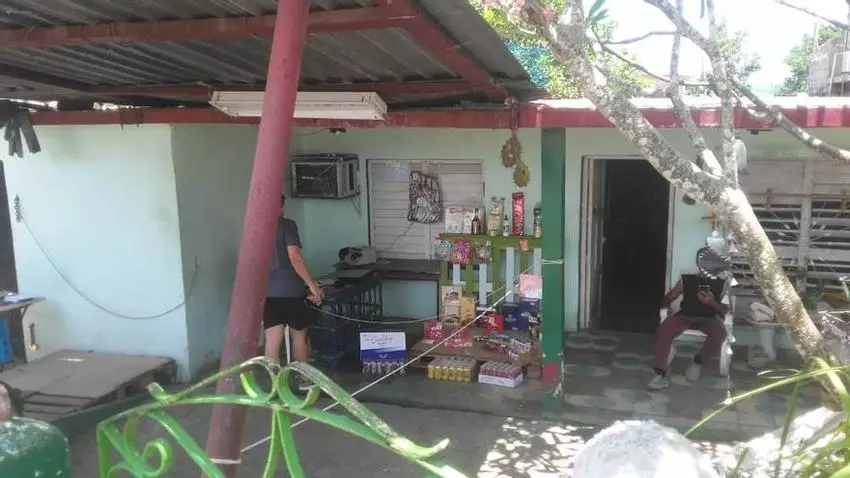
If there is one thing that bothers local residents it is that buying something at an MSME is becoming as difficult as doing it at a state-run store, and not for lack of inventory. In a makeshift business along the Central Highway, a saleswoman will not accept ten and twenty-peso banknotes, even from customers who only want to but a single piece of candy. “Here, we only accept 50-peso bills and higher,” she says. Businesses across the island are rejecting small-denomination bills due to the drop in value of the Cuban peso.
Many private businesses refuse to accept banknotes smaller than fifty pesos / 14ymedio
One neighborhood resident reports that the owners are not worried this requirement will scare away customers because they have the best prices in the district. “One day the place will be fully stocked and the next day it will be empty. They sell everything in a flash,” he explains.
While individual customers use these stores to satisfy their basic needs, other businesses turn to them to buy products wholesale which they can later resell. On Calzada de Tirry, near the house where the late poet Carilda Oliver Labra once lived, El Patrón opens its doors at 7:00 A.M. to a crowd that has gotten there early to buy jams that their families will have for breakfast or to make school snacks for their children. Also waiting in line is Sara, owner of a pushcart who resells El Patrón products in several downtown locations.
“This MSME is the cheapest in town,” says the 62-year-old Matanza resident, who has been waiting in line since 5:00 A.M. “It also attracts a lot of people from far away because what they sell here is high-quality. Since I found this place, I’ve been able to sell jams at more affordable prices,” she says.
Another MSME with competitive prices is located on Second of May Street. It specializes in meats, sweets and beverages, items which Cubans would otherwise only be able to buy at hard-currency stores. However, its “payment options” have made things difficult for more than one consumer. The owners only accept cash, and only in large-denomination bills. Shopping is becoming more difficult because, due to the country’s liquidity crisis, banks only give out small-denomination bills and ATMs never have cash.
For those who must leave the shop in search of the “fat bills” they need to make a purchase, the saleswoman has a ready smile. “No rush. The food here is very well refrigerated. Come back soon,” she says
____________
COLLABORATE WITH OUR WORK: The 14ymedio team is committed to practicing serious journalism that reflects Cuba’s reality in all its depth. Thank you for joining us on this long journey. We invite you to continue supporting us by becoming a member of 14ymedio now. Together we can continue transforming journalism in Cuba.
An operator from the Ministry of the Interior confirmed to ’14ymedio’ the whereabouts of the leader of Porno para Ricardo, who was considered “missing” this Friday
Águila’s songs became a symbol of the counterculture opposed to the regime / EFE
14ymedio, Havana, 4 May 2024 — The Cuban musician and activist Gorki Águila was detained this Friday at the José Martí International Airport and remains at the Santiago de las Vegas Police Station in Havana, as confirmed to 14ymedio by an operator from the Ministry of the Interior. The leader of the rock band Porno para Ricardo had been intercepted by State Security agents when he tried to travel to Mexico.
This Friday, the political activism organization Estado de Sats reported the arrest of the musician shortly after learning that he was “regulated” and cannot leave the country. The operator of the General Directorate of the Police with whom this newspaper communicated by telephone assured that Águila is in the Santiago de las Vegas police station, belonging to the Havana municipality of Boyeros, which is where the Police usually take those who are detained at the airport.
The news of the arrest was echoed by the Cultural Rights Observatory, which issued an “alarm for the arbitrary detention” of Águila and declared him “disappeared.” The organization criticized that the political police “significantly violate freedom of movement, among other human rights” and requested the immediate release of the activist. Ciro Javier Díaz Penedo, a member of Porno para Ricardo, a colleague of Águila and who resides outside the Island, also denounced the arrest.
Ciro Javier Díaz Penedo, a member of Porno para Ricardo, also denounced the arrest
Águila, whose songs became a symbol of the counterculture opposed to the regime, has been in the crosshairs of State Security for decades. The musician has suffered many arrests, the most notable of which was in 2008, when many artists and intellectuals, inside and outside Cuba, demanded his release.
The rocker has had numerous immigration-related run-ins with the island’s authorities. In 2010, for example, the regime hindered his return to Cuba from the United States, alleging that his passport had not been extended. Águila extended the validity of the document that same day and traveled the next, but continued to be harassed.
COLLABORATE WITH OUR WORK: The 14ymedio team is committed to practicing serious journalism that reflects Cuba’s reality in all its depth. Thank you for joining us on this long journey. We invite you to continue supporting us by becoming a member of 14ymedio now. Together we can continue transforming journalism in Cuba.
The intention of the independent media, says Banco Metropolitano, is to reach 11 July 2024 with the US currency at 480-500 pesos
Faced with the onslaught, ’El Toque’ has not just stood by but has responded, one by one, to each “reflection” of the Banco Metropolitano (BM) / 14ymedio
14ymedio, Madrid, 3 May 2024 — On Thursday, 2 May, Cuba’s Metropolitan Bank (BM) launched a WhatsApp channel with which it plans to counteract the “induced inflation” that, according to the entity, is exerted by the financial company El Toque. Although the Bank’s declared objective is to “keep the population informed,” its published exchange rate in force this Friday, stands at 123 pesos for 1 dollar or 134 in the case of 1 euro. The amount is light years away from the rate reported in the independent media, which is 390 pesos per euro and 385 pesos per dollar.
The dissertation continues accusing El Toque of seeking a social outbreak through the “artificial” increase of the dollar. The intention, the BM assures, is to reach 11 July 2024 – an unlikely date, three years after the ’11J’ nationwide protests on that date in 2021 – with the US currency at 480-500 pesos. “There is no economic or political justification for the price to rise in 24 hours, from one day to the next,” alleges the bank, which insists that the independent media is “secretly” financed by the United States and seeks to establish a false value of the Cuban peso, while promoting dollarization and reducing public spending.
“Despite Cuba’s economic problems, the rising values of the dollar respond to political intentions”
“The disproportionate exchange rate difference between the official and informal markets is generated not by the low prices of the former, but by the high levels assigned to the dollar by El Toque,” continues the long message, according to which, the exchange rate is replicated on social networks using big data. “Despite Cuba’s economic problems, the rising values of the dollar respond to political intentions. It is not the state control or deficiency, which exists, that generates the high value of the rate that El Toque presents, but rather its hand and visible intentionality from computer tools of dubious origin,” it insists.
In the most virulent attack in memory from the regime against the independent media, the BM wonders why the US Office of Foreign Assets Control (Ofac) does not sanction El Toque, “managed by Cubans abroad.” The answer to this rhetorical doubt is that it is “a weapon of war of the US Intelligence community, previously used against Nicaragua, Argentina and Venezuela.” For this reason, the entity urges people to obtain information through its “channels.”
Faced with the onslaught, El Toque has not stood by and has responded, one by one, to each “reflection” of the BM. “As we are embarrassed by the level of ignorance shown by those who are supposed to understand something (even a little) about economics, we want to contribute to their understanding by listing 13 reasons that do explain why the dollar continues to rise in Cuba,” the media outlet stated on its X account. continue reading
Their argument is well known and is based on the fact that there is a very high demand for foreign currency and a very low supply, since state banks and exchange houses hardly sell foreign currency. This situation has been reached by a combination of factors ranging from the capital flight that has followed the massive emigration to the strong dependence of micro, small and medium-size private companies – MSMEs – on an informal foreign exchange market to which they are forced to go because of the refusal of the State to sell to them. This last fact explains the rapid variation in the price of the foreign currency, the media states, since it “generates volatility in the exchange rate and further weakens the value of the Cuban peso.”
In its explanation, El Toque returns the ball to the regime’s court and accuses it of being the one who promotes dollarization, through the introduction of cards and stores in foreign currency. In addition, there is a lack of support for accounts in freely convertible currency that is evidenced by the creation of the famous tarjeta Clásica (Classic card), in dollars, which offers discounts and other incentives.
In its explanation, El Toque returns the ball to the regime’s court and accuses it of being the one who promotes dollarization
“The shortage of cash indicates liquidity problems in the Cuban economy, which affects confidence in the peso as a medium of exchange,” the explanation continues. This fact, accompanied by an increase in the prices of electricity and fuel that affect the prices of all goods and services, demands more currency and, in turn, contributes to the loss of value of the national currency.
The message insists that the Cuban economy has not grown for a long time, is excessively dependent on the outside world – both in investments and in aid and remittances – and has production, distribution and supply problems. According to their figures, inflation has exceeded 400% which indicates a significant loss of value of the currency at a very high speed, combined with the lack of political decisions that could redirect the situation.
“The presence of stagflation indicates that the Cuban economy faces both high inflation and a lack of economic growth,” notes the media, which attributes to this disaster the lack of confidence among the citizens themselves towards their currency and their banking system, as well as the same lack of confidence among foreign investors, who prefer more stable currencies when investing.
The personalized and dedicated response to the frontal attack by the regime is joined by a report published this Thursday by Omfi, an independent project promoted by Cuban economists and journalists to provide information on the exchange market and the evolution of the country’s financial and economic indicators, signed by economist Pavel Vidal, professor at the Javeriana University of Cali (Colombia) and expert on the Central Bank.
In it, he notes that the informal exchange market has grown enormously since 2021, when the so-called Ordering Task* came into force, while the Cuban peso depreciated by 660% against the dollar.
The economist points out that El Toque extracts data from social networks and websites through artificial intelligence algorithms
The economist points out that El Toque extracts data from social networks and websites through artificial intelligence algorithms that allow obtaining information about who buys, who sells, what currency, at what rate and what amount.
“The intolerance of the Cuban Government towards an information medium critical of official policies constitutes a motivating factor for disinformation campaigns that occur in the state press and on social networks. Blaming an external entity for the devaluation of the peso and inflation fits well within the script that the Government has used for decades to evade responsibilities and divert attention,” Vidal points out.
For the expert, accusing El Toque of influencing the exchange rate is equivalent to doing so with the National Office of Statistics and Information (Onei) for providing inflation data every month. Despite this, Vidal explains in detail how the exchange rate is calculated to try to dispel the “legitimate doubts” that the medium’s methodology may generate and, after providing all the data, he concludes that “more consumption of financial information in relation to the rate that El Toque calculates does not temporally precede (does not affect) future variations in the price of currencies.”
*Translator’s note: The “Ordering Task” [TareaOrdenamiento] is a collection of measures that include eliminating the Cuban Convertible Peso (CUC), leaving the Cuban peso as the only national currency, raising prices, raising salaries (but not as much as prices), opening stores that take payment only in hard currency which must be in the form of specially issued pre-paid debit cards, and a broad range of other measures targeted to different elements of the Cuban economy.
____________
COLLABORATE WITH OUR WORK: The 14ymedio team is committed to practicing serious journalism that reflects Cuba’s reality in all its depth. Thank you for joining us on this long journey. We invite you to continue supporting us by becoming a member of 14ymedio now. Together we can continue transforming journalism in Cuba.
Ecuador and Argentina, which fell 30 and 26 places respectively this year, are suffering the worst debacles on the continent
World Press Freedom Classification according to Reporters Without Borders this 2024 / RSF
EFE/14ymedio, Madrid, 3 May 2024 — It is no surprise that in the Reporters Without Borders (RSF) report on press freedom in 2024 , Cuba is once again at the bottom of the world rankings and is the worst country on the continent. Its position, 168th out of 180, is five places behind Nicaragua and 12 behind to Venezuela, the three “bad students” of America according to the organization, which published the document on the occasion of World Press Freedom Day, this May 3.
In general terms, the year has been bad for the continent, after the proportion of countries in a “fairly good” situation (yellow) fell drastically, from around 36% in 2023 to 21% in 2024.
Among those that come out worse, with a sudden decline, are Ecuador, which drops 30 places, to 110th; and Argentina, which goes from the 26th position to the 66th. The origin of this situation for Argentina is, mainly, the closure of the state news agency Telam. “The aggressive way in which Argentina’s newly elected President Milei addresses certain journalists demonstrates the hostility of this president towards the union,” Elena García, one of the RSF spokespersons, explained to EFE. continue reading
“Freedom of the press is not one of his priorities, since, a few months after coming to power, he closed the Telam press agency, important not only in Argentina but also in all of Latin America,” she added.
Two of the other most populated large countries in Latin America, Mexico and Colombia, have had improvements of a different magnitude.
Considered one of the most dangerous places to practice journalism in the last 30 years, Mexico has advanced seven places, rising to 121st (in the “difficult situation” range), although a recent RSF note criticized the lack of progress in security of informants during the mandate of the leftist President Andrés Manuel López-Obrador.
“In 6 years of this government there have been 37 journalists murdered and Mexico continues to be one of the countries in the world in which the exercise of journalism is most complicated and most dangerous,” García noted.
However, Colombia, under the mandate of Gustavo Petro, rose 20 places, to 119th, although this is not enough to leave the “difficult” classification.
In the annual ranking released today, on the occasion of World Press Freedom Day, RSF also noted a decline in freedom of information in other countries, such as Peru (-15 places, to 125th) and Guatemala (-11 places, to 138th), although the organization trusts that the newly elected president, Bernardo Arévalo, will contribute to an improvement. Meanwhile, El Salvador sinks 18 places, to 138th.
On the other side of the coin are Brazil, which rose 10 places to 82nd and Gabriel Boric’s Chile, which in the middle of his mandate has improved 31 places, to 52nd in the global ranking.
Costa Rica remains the highest-ranked Latin American country, 26th worldwide, giving it a press freedom rating of “acceptable.”
____________
COLLABORATE WITH OUR WORK: The 14ymedio team is committed to practicing serious journalism that reflects Cuba’s reality in all its depth. Thank you for joining us on this long journey. We invite you to continue supporting us by becoming a member of 14ymedio now. Together we can continue transforming journalism in Cuba.
This is the capital of a country whose ills a single photo can not exhaust
A segment of Revillagigedo street that overlooks the Atarés cove, in Old Havana / 14ymedio
14ymedio, Juan Diego Rodríguez, Havana, 3 May 2024 — It is difficult to make the adventures of a country fit in a single photo. Sometimes, however, the shots come together in front of the camera and the country says what it has to say about itself. 14ymedio captured this snapshot that summarizes, if not all, some of the key points of the crisis in which Cuba has been immersed for years.
This is a segment of Revillagigedo Street that overlooks the Atarés Cove, in Old Havana, where a Supermarket 23 vehicle stopped this Friday. Supermarket 23 provides home delivery of food ordered and paid for by someone “out there” — where the dollars come from — for their relatives or friends in Cuba.
For many Cubans, the online market is the way they always get their food.
Uniformed and clean, the employee distributes the “little bag” with the products in a neighborhood that could not be more dilapidated and in which trash sites proliferate. A few meters from where the car is parked, a person – a cap on his head, backpack and red socks – is digging through a container. For those who do not receive remittances, there is always the garbage. continue reading
Among the overflowing garbage bins, beggars find their food and those who collect and sell raw materials back to the State find junk to dismantle. Properly used, a container can be a gold mine for those the official press — which does not spare euphemisms — calls “wanderers.”
For those who do not receive remittances, there is always the garbage
The bars on the doors, the windows and the air conditioners are eloquent signs of the insecurity that the country is experiencing: without bars, any equipment is at risk of being torn from the wall, and any hole can serve as an entrance for increasingly violent bandits and thieves. Settled on his motorcycle, a man tries to grease and start the mechanism, while residents and passers-by walk through Revillagigedo. Up the street, down the street.
At the mouth of the street, with the sea in full view, appears the imposing silhouette of a Turkish patana, a floating power plant. To suffer blackouts so close to machine that is as polluting as it is powerful is ironic for Havanans. The towers of the floating plant evoke not only the energy instability of the country, but also give the neighborhood an apocalyptic air, which mixes very well — sadly — with the cracked and unpainted building.
This is the capital of country, however, whose ills a single photo cannot exhaust.
____________
COLLABORATE WITH OUR WORK: The 14ymedio team is committed to practicing serious journalism that reflects Cuba’s reality in all its depth. Thank you for joining us on this long journey. We invite you to continue supporting us by becoming a member of 14ymedio now. Together we can continue transforming journalism in Cuba.
•”Eat, Drink and Be Merry for Life is Short!,” reads a sign at the entrance on Carlos III Street*
• The privately-owned business has taken over a sizable portion of a state-run pharmacy, which now has only a single counter to serve customers.
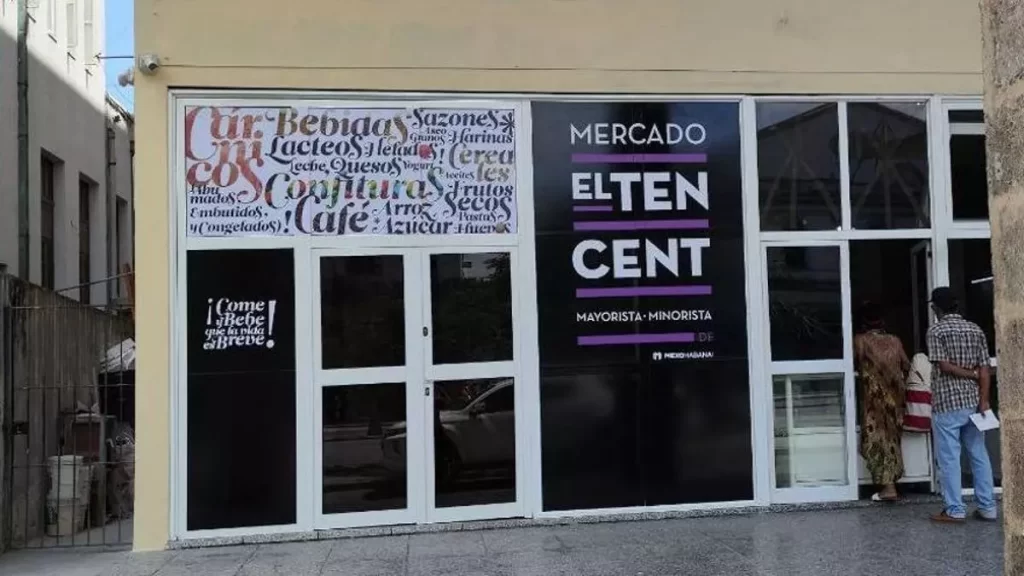
“The Ten Cent Wholesale-Retail Market” reads a sign in a window of the store, which has been decorated for the occasion / 14ymedio
Juan Diego Rodríguez, Havana, 30 April 2024 — The broad avenue in Central Havana already has a large currency exchange, a botanical garden and even a park dedicated to Karl Marx. What it lacks is a pharmacy combined with a privately run food and beverage store. Located at 704 Carlos III Street, the space has been divided into a small area which serves as a drug store and another, larger area for food and drinks.
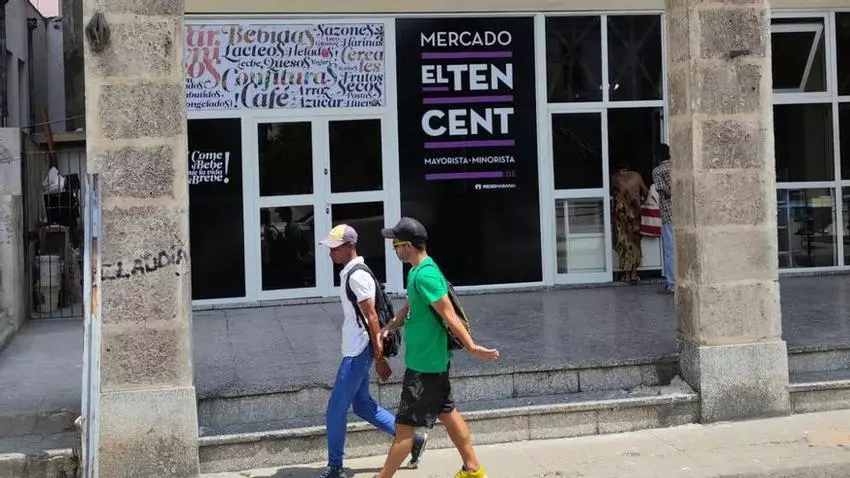
“The Ten Cent Wholesale-Retail Market” reads a sign in a store window, which has been decorated for the occasion. “Eat, Drink and Be Merry for Life Is Short,” reads another sign, this one to the left of the entrance, which — like the rest of the store’s windows —has conveniently been blacked out to keep curious passersby from being able to see what is inside.
On the same sign and in smaller print is the name of the company managing the store: Mexohabana. The business was added to the list of privately-owned small and medium-sized companies (MSMEs) that officials approved in May, 2023. It is registered in the Revolution Plaza district and licensed to provide food services.
The darkened windows and air of secrecy have only fueled speculation about the project. On Tuesday, a woman approached the narrow counter in the part of the building that still operates as a drug store. Customers are no longer allowed inside the poorly stocked pharmacy, which seems lifeless compared to the buzz of the private company with which it shares the iconic retail space. continue reading
On the same sign is the name of the company managing the store, Mexohabana, in small print / 14ymedio
“Do you have Enalapril?” asks the woman who, after being told no, took the opportunity to inquire about the store next door. The employee, reluctant to answer questions, only says, “It seems that they’ll be opening next week.” Another customer, however, a resident of the neighborhood, jumps into the Ten Cent conversation. “They’re putting a lot of money into it. High-quality refrigerators, displays for drinks, counters and lots of boxes with merchandise,” she says.
The owners have spared no expense. Besides spending money on decorations to the entrance, they have also installed new exterior lighting, a new air conditioning system and Axis point-of-sale terminals. Building repairs include painting the walls and solving the decades-long drainage problems.
“From the outside it looks like a different country, like a store in a capitalist country,” observes a street vendor who has placed his meager offerings on a blanket a few yards away. They consist of an empty liquid detergent bottle, some worn women’s shoes, and some half-empty matchboxes. “Several homeless people here at night,” he explains.
There’s been talk of its being an MSME since they started working on it. With the police and the pressure, they’ve been making life difficult for people here,” he says. “They say we have to clear out because there’s going to be a lot of customers and we can’t block the sidewalk or create a bad impression.”
The man finds the use of the Ten Cent name on the façade of the new store nothing if not ironic. “I used to go the one on Galiano Street when I was a child. My grandmother used to take me to the café. I worked nearby, after they had already changed the name and you needed a ration book to buy things there. I never imagined that I would ever see it come back”.
The Ten Cent stores were very popular in Cuba, particularly in Havana, where five of the ten outlets were located. The retail stores, subsidiaries of the North American parent company F. W. Woolworth Company, were located on downtown Havana streets and avenues such as 23rd, Obispo, Monte and Galiano. Many customers were attracted by the spacious sales floors and reasonable prices, which are etched in their collective memory.
Symbols of capitalism and consumption, these businesses succumbed to the wave of nationalizations that swept the country after Fidel Castro came to power in 1959 / Archive
Even today, the name Woolworth is still visible at some of these stores, set in stone at the entry threshold. Older Havana residents continue to refer to them as “Ten Cent,” their original name. Symbols of capitalism and consumption, they succumbed to the wave of nationalizations that swept the country after Fidel Castro came to power in 1959
The new Carlos III Street store is a nod to that pre-communist past. Ironically, it seems that, in order to get built, it needed to take over a substantial portion of a state-run pharmacy that had fallen into disrepair due to the collapse of the Cuban pharmaceutical industry. Where dipyrones, aspirin and mortars were once stored before being crushed and mixed into compounds in the dispensary, imported beers, imported cookies gouda from Holland will soon be on display.
“You don’t know when you’re going to be getting Diazepam?” asks an elderly man standing just outside the narrow door where a makeshift counter has been placed. It serves as the only remaining point of contact between customers and pharmacy employees. “No, Grandpa, I don’t know,” the employee responds tersely. The used goods seller takes the opportunity to chime in, saying in a loud voice, “Diazepam is what we’re going to need to calm down after we see the prices in there because we won’t be able to buy anything for ten cents!”
The gangly silhouette of the man with the knick-knacks is reflected in the glass, just below the invitation to “Eat and drink and be merry, for life is short!”
*Translator’s note: A version of old, popular Spanish rhyme, “Hermano, bebe que la vida es breve.
____________
COLLABORATE WITH OUR WORK: The 14ymedio team is committed to practicing serious journalism that reflects Cuba’s reality in all its depth. Thank you for joining us on this long journey. We invite you to continue supporting us by becoming a member of 14ymedio now. Together we can continue transforming journalism in Cuba.
The sale of medicines and the purchase of foreign currency, all informal, happens in full view of the police and despite the operatives
“Policemen have to solve their problems too, that’s why they are in La Cuevita buying their things” / 14ymedio
14ymedio, Juan Diego Rodríguez, Havana, 14 April 2024 – The market known as La Cuevita, in San Miguel del Padrón, on the outskirts of Havana, is not larger than the one that spreads under 100 and Boyeros in the capital, but it does have a greater impact. “The stall space for the self-employed is small, but the informal sales around them are huge, and that is where the majority of buyers go.”
Nelly, who accompanied 14ymedio on a visit to La Cuevita this Friday, lives in Ciego de Ávila, but comes by every month. Before, she used to work as a mule going back and forth to Haiti, but with the uptick in violence in that country, she has changed it to the markets of Havana. She’s not the only one. “We all arrive with suitcases and then we return to our provinces to sell things there.”
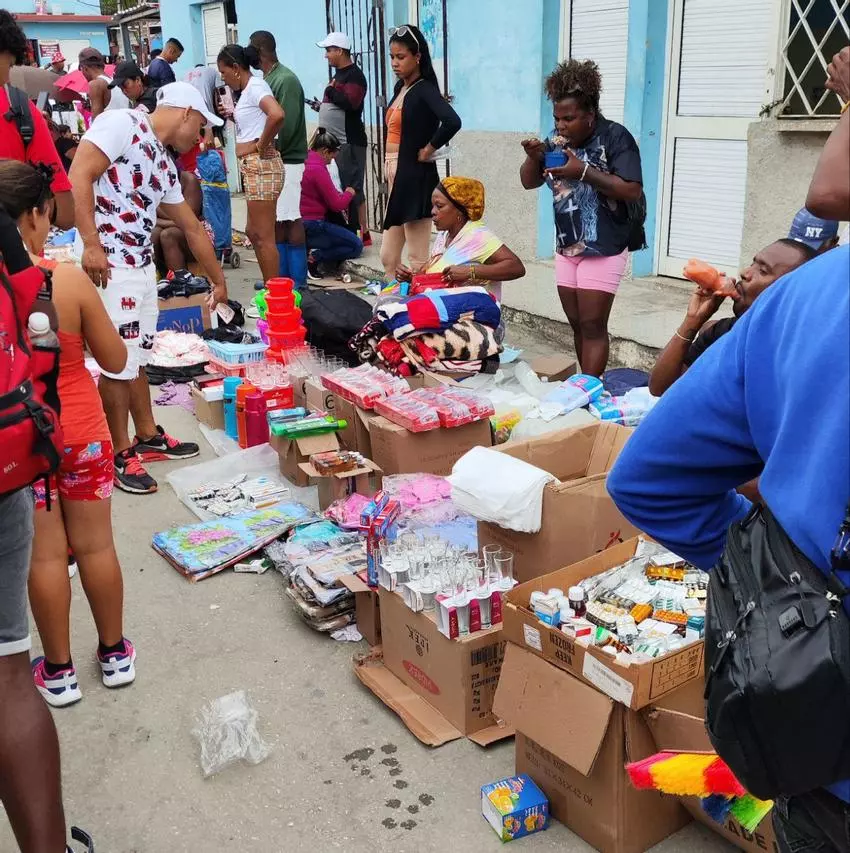
“It’s like arriving at the bus station, you know?” says Raniel, who has come to La Cuevita to buy medicine. In legally established self-employed stores, you can find jewelry, watches, clothing, caps or glasses, but it’s the informal sellers who display an infinite arsenal of items of all kinds. Among them, medicines stand out especially.
“They arrive and stand in the hallway, spread a box full of medicines and stand there to sell them,” explains Raniel, who prefers to buy in La Cuevita than on online sales sites, where they are more expensive. It is easy to see that most of them are imported, that is, brought from outside by mules, but quite a few of them are Cuban-made, which indicates that they come from the state market. “Cuban enalapril* costs 250 pesos per blister here, and in Revolico it costs between 300 and 350 pesos.” And in the pharmacy? “Do not even mention the pharmacy! Enalapril is among the missing”, says Raniel. continue reading
Anti-inflammatories, analgesics, diclofenac with paracetamol, antibiotics of all kinds… Anyone would say, visiting these stands, that in Cuba there is no problem with the shortage of medicines that chronically afflicts the health system.
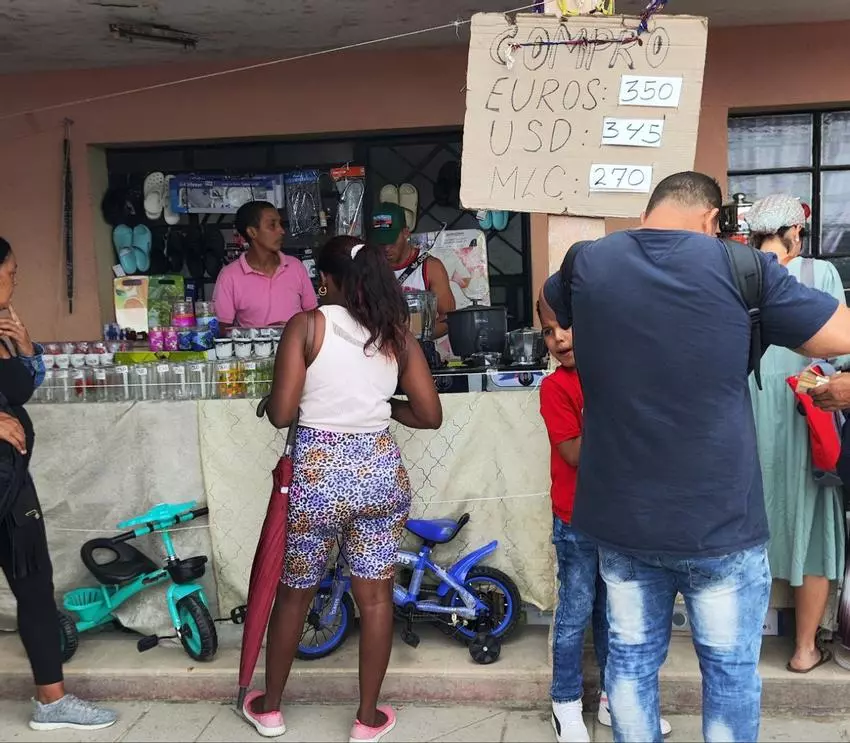
Other striking stands are those for purchasing currency. As with medicines, as if it were a legal activity, huge signs indicate the exchange rate: the euro at 350 pesos, the dollar at 345, and the freely convertible currency (MLC), at 270. “People arrive and, just as if it were a Cadeca [Exchange place], take out their fulas** or take out their euros and sell them there, without hiding anything,” says Nelly, who is no longer so surprised by the activity. And the Police? Because, on paper, this illegality carries high fines. “They have to bribe the inspectors, because there are operatives every day, but they just remain very calm”.
As if it were a legal activity, huge signs in La Cuevita indicate the exchange rate / 14ymedio
During the tour, this newspaper was able to verify, in fact, that there are numerous agents moving through the corridors. “The police have to solve their problems too, that’s why they are here buying their things,” argues Nelly. In the time that she has been dedicated to reselling in the province, she has never been fined, but she has a friend who has not been so lucky. “She already has 8,000 pesos in fines, but she comes back, comes back and comes back, because it is true that we have no other way to make a living in this country.”
If you are in La Cuevita for long enough, you can also see that many surrounding houses are used as warehouses, also informal. It is in these places where small appliances abound, such as pressure cookers, induction cookers and fans.
It is difficult to make your way through the aisles due to the number of people there, who, between jostling, mix with those who shout merchandise: liquid detergent, soap, toothpaste, chicken, oil, medicines, spaghetti, elbows, potatoes… “Even packaged coffee like the one from the bodega [ration store],” says Raniel, who is convinced that many of these are products ‘diverted’ from the state market.
“Informal sales are huge, and that’s where most buyers go” / 14ymedio
The boy takes care of himself among the overwhelming crowd: “Here you take out your wallet, you pay and in the process of putting it in your pocket they take it from you.”
La Cuevita is a place known by Havana residents since the 80s, although it did not begin to gain splendor until the immigration reform of 2013, which allowed Cubans to leave and enter the Island more easily.
But it was with the established rule of eliminating tariffs on food and medicine, after the demonstrations of 11 July 2021, that the market has become crowded.
A mirror seller approaches: “If you buy me the large and medium one, I’ll give you a small one,” he offers, as if he were at a capitalist street market. “There is a very big economic life,” Raniel concedes. “Here people come to fight, to make a living.” And he jokes: “It’s as if capitalism existed in Cuba.”Translator’s notes:
*Enalapril: ACE inhibitor taken to lower blood pressure
**fulas: Cuban slang meaning US Dollars
Translator: Norma Whiting
____________
COLLABORATE WITH OUR WORK: The 14ymedio team is committed to practicing serious journalism that reflects Cuba’s reality in all its depth. Thank you for joining us on this long journey. We invite you to continue supporting us by becoming a member of 14ymedio now. Together we can continue transforming journalism in Cuba.
U.S. official Brian Nichols accused Nicaragua of using migration as a “weapon” against the countries of the region
U.S. Undersecretary of State for the Western Hemisphere, Brian Nichols, met with journalists in Miami, Florida / EFE
14ymedio, Havana, 1 May 2024 — The United States, in its talks with Cuba, continued to demand the release of political prisoners. This was one of the points addressed by both countries during the meeting last month, as confirmed on Tuesday by the U.S. Undersecretary of State for the Western Hemisphere, Brian Nichols, during a visit to Miami, Florida. “We always insist on the importance of respecting human rights, especially those of the most vulnerable,” said Nichols, who recently used his social networks to describe as “infuriating” the sentences of up to 15 years in prison for “Cubans who demonstrated peacefully in Nuevitas in 2022. The continuous repression of the Cuban government against Cubans who strive to fulfill their basic rights and needs is inconceivable.”
Among those sentenced was Mayelín Rodríguez Prado, the then 21-year-old young woman who transmitted the protests through Facebook, charged with the crimes of “enemy propaganda of a continuous nature” and “sedition.”
Nichols explained that it is “a legal process of analysis within several Government Departments that finally reaches the Secretary of State for his “determination”
Nichols also said that he didn’t have any doubt about the unity of the leadership of the Cuban regime. “I think that instead of speculating about it after 60 years, it is better to focus on the government’s actions.” continue reading
The official told several media in Miami that the Island has been asked to stop the irregular migratory flow through Nicaragua, while it has insisted on ending the sanctions. However, he clarified that Cuba’s removal from the list of state sponsors of terrorism is not on the negotiating table: “it is not something we can negotiate.”
Nichols explained that it is “a legal process of analysis within several Government departments that finally reaches the Secretary of State for his determination,” according to a report by journalist Mario J. Pentón for Martí Noticias.
The inclusion of Cuba on the list in January 2021 was one of the last decisions taken by the Administration of Republican Donald Trump (2017-2021) before leaving power.
The United States then justified the measure by alluding to the presence on the Island of members of the Colombian guerrillas of the National Liberation Army (ELN), who traveled to Havana to start peace negotiations with the Government of Colombia.
“The regime of Ortega and Murillo has taken advantage of migration as a weapon against the countries of the region, including the United States,” Nichols said
During his conversation with journalists in Miami, Brian Nichols also accused the Nicaraguan government of Daniel Ortega of using migration as a “weapon” against the countries of the region, including the United States.
“The Government in Nicaragua, the Ortega and Murillo regime, has taken advantage of migration as a weapon against the countries of the region, including the United States, because there are millions of irregular immigrants throughout the hemisphere, many of them due to the actions of the Nicaraguan regime.”
In the last three years, more than 700,000 Venezuelans, 363,000 Nicaraguans, 342,000 Haitians and 600,000 Cubans have reached the southern border, reported Martí Noticias. “All are favored by policies that promote free visas implemented by Daniel Ortega’s regime after its disagreements with the United States.”
Translated by Regina Anavy
____________
COLLABORATE WITH OUR WORK: The 14ymedio team is committed to practicing serious journalism that reflects Cuba’s reality in all its depth. Thank you for joining us on this long journey. We invite you to continue supporting us by becoming a member of 14ymedio now. Together we can continue transforming journalism in Cuba.

 14ymedio, Havana, 4 May 2024 — Of the 23 boats that make up the fishing fleet in Las Tunas, only eight are currently working, that is, 65% of the available boats are out of service due to not having enough spare parts to start motors and batteries.