Military institutions always produce fear. Even if they treat you with respect. This past Monday, August 9th, Havana looked a lot like London. A thin and bothersome rain had been pouring down all day, so much so that even our bones were soaked.
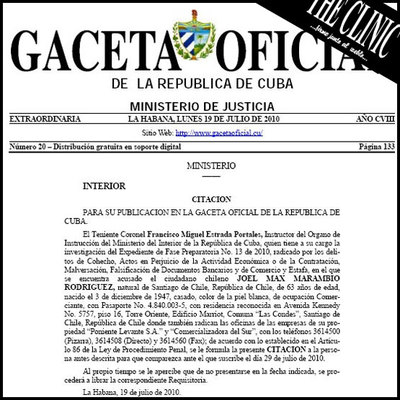
Saturday, the 7th, a State Security official had dropped off a citation for an interview with Colonel Enrique from Military Counter-Intelligence.
At around 9 in the morning, I arrived at the armed forces center, where they train elite troops. A friendly official offered me a rain coat and then led me to a building painted in lime green with light red trimmings.
The building looked like a detention center. A young chubby man led me to a small waiting room, but first he asked me to turn in my cell phone.
The room was tiny and consisted of metal furniture with black leather. The A/C was turned up to the max. Apparently, the measures to save energy are strictly enforced throughout the country, but not in this military unit.
Colonel Livan, from Military Counter-Intelligence, and a major dressed in civilian clothes (and who said his name was Aguila and that he was from State Security) were my amiable interrogators. After taking down some notes, they got straight to the point.
They were upset because of an article I wrote entitled “The liberation of the political prisoners reinforces the role of the Cuban military“, which was published in the newspaper El Mundo (‘The World’) on July 14th. According to the officials, in the article I gravely discredited Cuban military institutions.
A debate began. I alleged that it was my personal opinion. They respected my opinion, but felt that I had been subjected in appreciating the role of certain generals.
“Cuba is a country of rights, and before reaching any penal sanctions, we warn people as many time as we must,” major Aguila told me in a low and neutral voice.
I jumped up like a spring. “Do you think that in a country of rights a person gets cited for writing a newspaper article?” I asked him frankly.
“In other countries they don’t cite you, they kill you,” interupted Colonel Livan. Both officials made it clear to me that, although there is some level of tolerance towards the independent press and the opposition, permissiveness should not be confused with impunity.
We never agreed on who was right. It wasn’t about that. I explained my reasons to them as a man who feels free enough to write and have different opinions from the official discourse.
I consider it to be my right. They didn’t oppose that. They asked me to have more respect when it came down to judging the “brave armed forces which have gained so much prestige worldwide for their struggle in liberating other countries.”
Whatever the case may be, it was not a dialogue of the deaf. At one point, I suggested to Colonel Livan that, if he wished, he could write a reply and that I would be in charge of sending it to El Mundo so they could publish it. This was after I pointed out that the website receives over 24 million views.
After his initial astonishment at the invitation, he told me that Cuban military institutions do not need to engage in a debate with a simple journalist over such a specific subject.
In the end they cited me with a “Warning,” where the officials wrote down their motives and I wrote mine. They said goodbye and told me I could leave. And I did so under an intermittant rain.
In sum, the Cuban special services wish to send a direct message to the dissidence and independent journalists. There is a fine line that cannot be crossed.
The point is that they don’t even know which are the frontiers that cannot be trespassed. Even though both officials were actually kind, soldiers always produce fear. And don’t ask me why.
Ivan Garcia
Translated by Raul G.
August 10, 2010

 Yes, it’s magical realism. Sometimes more evident, sometimes less. But the way one lives on this island at times verges on the incredible, and one has to remember that we live in a land of exceptions, comic or ironic, cruel or terribly sad, where everything can be believed.
 As I have no talent, not even for beating out a rhythm on a door, the artists who play some instrument with virtuosity awaken feelings in me between admiration and envy. When, for example, Frank Fernández moves me with his interpretations of Sergei Rachmaninov or Frederic Chopin, I can hardly bear my own incapacity to do something similar. I feel like an idiot.
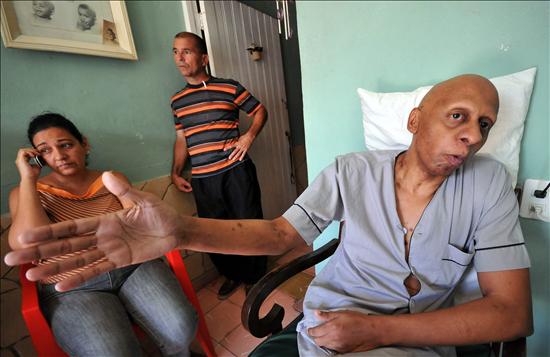 Psychologist and independent journalist Guillermo Fariñas, who was on hunger strike for four months while he demanded freedom for 26 political prisoners, is of the opinion that a step has been taken in favor of the political pulse that sustains the Cuban opposition in the face of the Castro government.
 Photo by: Luis Felipe Rojas
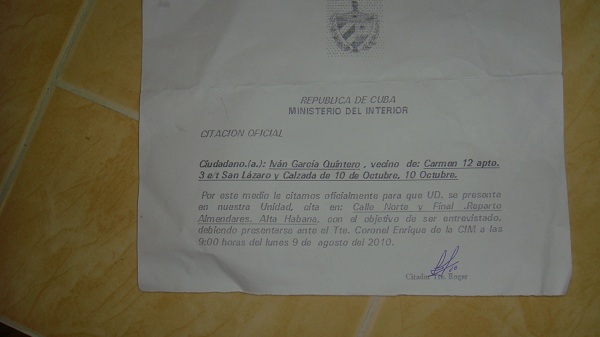 On the morning of August 7th I found out that I was of interest to State Security. My neighbors in the area worriedly told me about two guys who looked like political police agents who were asking about me.
 One of the mistakes most often made by those who say they care about Cuba is what could be defined as taking the part for the whole. A kind of geographical and ideological synecdoche, which makes them assume, when they use the term “Cuba,” that they understand it correctly.