Who’s Who? / Miguel Iturria Savón

In mid-2005 I read the Who’s Who in Cuban Politics?, a reference work that is the responsibility of the Master in Sciences Julio Aleaga Pesant, who updated it in 2007 after endless research in the main cities of the island. For this he relied on territorial research teams who monitored the official and independent press, documents in archives and alternative civic institutions, and even resources from the exile and several Internet sites.

Since mid-2010, Aleaga Pesant and his provincial collaborators are at work once again preparing a new, printed and digital version of a study of the citizens who are main actors in that prickly and fidgety political and social Cuban stage, so determined by the predominance of a party that excludes all others, controls both government and the economy, and exerts a monopoly over education, culture and the media.

The Who’s Who? of 2011 struggles against the manipulation of information, but gives predominance to tolerance and inclusion beyond the usual ideological walls, and this allows it to include citizens and institutions that venture into politics, from humanistic projects to leaders of the alternative society, opposition parties and movements, librarians and independent journalists, and the women who demand the freedom of political prisoners.

The top leaders of the Communist Party are featured in it, obviously, as well as its network of organizations, the deputies of the National Assembly, and the members of the Councils of State and Ministers.

According to Aleaga, the only requirement for anyone to be included in the investigation is to be a resident on the island and to participate in its politics. The document, therefore, will be a reference tool for researchers and students of the island reality. The informative lists facilitate, moreover, potential future actors and scenarios of a nation that is beginning to move.

The repertoire of the 2011 volume has as precedents other reference works such as the Cuban Biographical Dictionary (1878-1886) by Francisco Calcagno; the Who’s Who in Cuba?, known as The Blue Book, by Luisa M. de la Cotera O’Bourke; the Who’s Who in the Cuban Sciences? by the Minister of Science, Technology and Environment, and Organizations of Cuban Civil Society Not Legally Recognized, by Alberto F. Álvarez y García, sponsored by the Canadian Foundation of the Americas (FOCAL, in Spanish); and, lastly, the 2005 document by A. Pesant, which consisted of 1,396 names—officials from the military regime, opposition leaders and gilded entities—and which was updated in 2007 for a total of 1,598 names.

The specialist warns that the objective of the Who’s Who? is to register public servants who have an influence on society, which makes it an important reference tool for libraries, documentation centers, the press, and students of history and politics. Despite the fact that the project was boycotted by the military regime through arrests, data theft and the refusal to include it in the Copyrights Registry, the document was circulated in and outside of the country in print and digital versions.

In its final stages, the pamphlet is undergoing a synthesis of the data that was collected from Cabo de San Antonio to Punta de Maisí, hindered by the minuscule and manipulated official database and by the dispersion of pro-democracy organizations, yet partly facilitated by publications in the diaspora like Cuba Net, Cuban Transition Project and websites.

Regardless of specifications regarding schedule, the individual registry, classification, quality and general tables, it is worth congratulating the coordinator and his assistants, as we are sure that their effort shines a light on the road to the transparency of information, as this new biographical framework will contribute to dislodging the wheel of immobility.

Share

January 23 2011

Message from Jorge Luis Arcos / POLEMICA: The 2007 Intellectual Debate

The recent events triggered in Cuba after the resurrection of Pavón-Quesada-Serguera, to wit, the many outcries of various kinds by email, articulating a common domestic front to protest the raulista attempt to clean their old repressive instruments, to whitewash historical memory, and, incidentally, to humiliate their victims once again, and in general, all intellectuals, if not also, incidentally, to warn that the nightmare could come back again, etc. This is just one more episode in a shattered reality.

Many of the reactions are negative, in spite of themselves. Some advocate that the problem be resolved in-house, as if a significant proportion of the victims weren’t outside Cuba. Others try to deny the obvious: that it all has to do with a strategy of power, as it was in the past and even in the present. Many are critical of what happened; they call for public atonement but, of course, without naming — before or now — the real culprits.

It’s simply incredible. It seems that a considerable part of Cuban intellectuals assume that the current regime will continue to exist, and they, inside the same, with their wide range of complicity, silence, opportunism, or even happy approval. Because even when they correct themselves publicly — which happened recently — that would constitute only a slight rearrangement within a cultural policy essentially subject to a totalitarian power.

It’s all very well to protest the resurrection of the image of that ominous past, but how do you live in the present with a regime that restricts all basic freedoms every day? Worse than forgetting the past, is to have amnesia about the present. Even the most honest critics of what happened show that in the present they themselves remain subject to some censorship, to a fear shaped by decades of repression. As if the terrible thing happened only in the past, as if this cannot be questioned in the present.

In any case, a great deal of conformism reigns.

They have, therefore, a relative civility, selective, pragmatic, opportunistic or conservative. They are afraid, in short. And it’s not bad because we all are, but yes they wield it only when they see the possibility of being affected again themselves, more than they’ve always been.

One of them gives an opinion about those who are on the right inside and outside of Cuba, giving the sense that he is on the left. But what “left” is it that does not want to recognize that the “right” has always been in power?

Well, I also was afraid, I also suffered censorship and especially self-censorship. I had to leave my country to enjoy the dubious privilege of being able to write this article without expecting retaliation, to be able to put in black and white what I really think without fear of losing my job, being kicked out of society, or even going to jail.

But, at least, let’s also respect those in Cuba who suffer a direct repression by the simple sin of saying what they think, and even also let’s respect those who have had to give up our country so we can at least sleep with a better conscience, if that’s still possible.

You who live in Cuba also deserve respect, but — like everyone — you will have to win that respect, either through acts or even silences and significant sacrifices, since how even can you be respected by the same regime that humiliates you every day with its diverse collaborations or selective and timely amnesia? How far can you play the game sincerely at being a reformist? Reforms, what for, to maintain the current state of affairs?

This is the crossroads. If current events do not make them see the obvious, that the regime has been essentially the same, then very little can be expected of a future “with all and for the good of all.” It’s very convenient to advocate that Cuban culture be united and suddenly forget the victims both inside and outside the country. Cuban intellectual friends, the game isn’t played like that.

Jorge Luis Arcos

Madrid, Spain

Another comment by Jorge Luis Arcos

I write the comments that follow (and I now quote Eliseo Diego) “with the melancholy of those who draft a document.”

Surprised by a language of the ’70’s, from Pavón himself, I read the recent statement by the secretariat of UNEAC. As for 10 years I attended many meetings of this secretariat — since in everyday life it became “expanded” so that different people could attend according to the issues under discussion or their responsibilities in UNEAC — I know more or less, after almost three years away, its members and regular attendees. But the Cuban population doesn’t. I have to admit that many of the discussions that take place there have nothing to do with the rhetorical language of the mentioned declaration.

Similarly — and this is perhaps the most important of all that has happened — in countless emails and in some publications outside Cuba, with an understandable passion, this recent phenomenon has existed, before which Cuban intellectuals inside and outside the island have expressed their necessary and healthily different points of view, of course in a very different way, both in form and content – as they say – regarding the document in question.

But also, apart from these passionate disputes or different claims or moving testimonies, something very profound must have occurred there, invisibly, I mean in the minds of so many people who have been affected not only by the pavonato (the so-called “Five Gray Years”), but also in many other circumstances and other times, some very recently. However, according to this declaration by UNEAC, it appears that the matter has been settled. To fail to remember, as one bolero says, again and quickly, that — as a Greek chorus a lo Piñera seems to say in the background — the Party is … immortal?

I have to admit that the mere publication of the text in the newspaper Granma is a rarity. But it seems that such was the magnitude of the unrest that it was almost inevitable to declare oneself and publish it. Yes, they wanted to repair to some extent the mistake, and, moreover, to cap it off, in one case indeed it was remarkable as what our country is going through now. But, as you know, the image is always the most important — the image for the outside and inside, as they say, too. And in the name of that image, truth, passion, memory, as well as the endless contradictions that are inherent to life … are buried. Although, it would be worth asking, for how long?

As for the publication of that unsigned pronouncement, it’s a very widespread custom in Cuba to produce documents “in the name of the population” (actually, in politics, everything is always done “in the name of”; I mean in the name of that abstract entity that can appoint itself as “our people” or “our intellectuals,” etc.), or to call for others’ signatures so as to show support for certain statements or measures.

Why didn’t they appeal, for example, to those mechanisms when they “deactivated” — a delicious euphemism, in which we are experts — Antonio José Ponte from UNEAC? Because then the management of UNEAC itself knew it couldn’t count on majority support even among its members. That is, they resort to those methods that suit them. What Wendy Guerra proposed was an interesting challenge. But even if what she asked had been done, driven by a basic democratic principle and a respect for individual, rather than collective, opinion, who can guarantee that once it happened, all opinions really would be known?

But that’s not even the problem: the problem is the lack of real democracy. It’s been so many years with no democracy in Cuba (over half a century) that very often we can say quite naturally that there is … Because much of the population has been born in a country without democracy. In any democratic society the varied opinions of Cuban intellectuals — I repeat, all Cuban intellectuals — would have been published or presented in different media — even by individual initiative — without a hint of censure.

In Cuba, unfortunately, that is unthinkable. But, even more, we already know the understandable reluctance to express aloud true opinions on any subject. On the one hand, we fear the so-called subtle reprisals, if not the direct ones. On the other hand, as with the now-legendary case of the call to the Fourth Party Congress, we know the futility. As a former work colleague warned on that occasion:

“The well-known argument to justify this lack of democracy is ‘Don’t give ammunition to the enemy.’ But the price of not giving ammunition or not playing to the enemy has been, strangely enough, to suffer an absolute lack of freedom — and the true” [gap in the original]

But was anyone really surprised with this innocuous statement from UNEAC? I think it was predictable in essence. What was not so predictable is the trite tone, full of cliches, not really fitting for the intelligentsia that is left in UNEAC. As Fefé says, what is this story of “annexation” but the purest rhetoric of the Roundtables and the so-called Battle of Ideas — doesn’t that say it all? To always disqualify an opponent or anyone holding a different view has been, as we know, a permanent practice.

But I express all these arguments, I confess, more from weariness or an infinite boredom. It always leaves a bitter taste, as if one lived an infinite postponement… ah, when life happens only once and is so short… After nearly half a century of authoritarian and anti-democratic practice, that is, theatrical representation, what can you expect really? The most bitter taste is experienced — at least that’s my case and I understand it might not be so for others — when at the end of the declaration they mention jubilantly the two people responsible not only for the pavonato but also the sad and complex history — with light spots, too, is their room for doubt? — of the so-called cultural politics of the Revolution. But that was perhaps most predictable. No?

As always, the people of Cuba are truly absent from all these representations. An undeserving people, to their rulers, still not knowing the critical opinions and testimonials of the so-called counter-revolutionary intellectuals, “enemies” or spooky “annexationists” etc. — “Get out, scum! Get out, fags”! Don’t you remember Granma in the ’80s, by the way, without Pavón? — or even the criticisms and testimonials — ah, memory, what a danger — of the considerate Revolutionaries?

I would like to be wrong, but in the end, sadly, this time, visibly or imagined (as Lezama would say), as in so many other cases, “there is nothing new under the sun.” So don’t worry, friends and Cuban intellectual colleagues, inside and outside Cuba, you can rest easy, because, at least for now, absolutely nothing will happen — visibly, I mean.

Jorge Luis Arcos

Spain

Translated by Regina Anavy

January 2007

I Propose That the Government Legalize Prostitution / Iván García

Yaima Beltran, 32, wants to contribute to the public treasury. “I have spent 13 years practicing prostitution. I have gone to jail twice for hooking. And I always return. It’s not easy to go around scared at the prospect of getting caught by the police. I propose that President Raúl Castro legalize prostitution. I know his daughter Mariela wants to create a climate of tolerance toward gays. Shouldn’t they consider something similar with us prostitutes? Each person should be free to do what they want with their body.”

She isn’t the only one. Girls, who the day before got off a passenger train after a long, exhausting journey of 18 hours from a province in eastern Cuba, mill around in the areas near the National Highway.

On the cold nights of January they ply their trade. They wave brazenly at the vehicles traveling at 100 kilometers per hour. And if a driver stops, dazzled by the fine figure of a sculptural mulatto, without exchanging greetings, they make their offer.

Regina, 19, charges five dollars for a quickie in the back seat of a truck or an adjoining banana grove. She’s never been to the tank (prison), and just thinking about it makes her panic.

“It’s time now for a change of policy with hookers. It would be good for the government and the customers. We would have a health card, which would attest that we don’t have any sexually transmitted disease. And we would pay taxes,” says Regina.

Three black girls, regulars at fashionable discos, agree with Regina and Yaima. “To us it seems only fair to pay a tax for hooking. Sure, it shouldn’t be abusive. I don’t think any country in the world can abolish prostitution. With all the prostitutes there are in Cuba, the State is missing a chance to make money,” says one of them.

Perhaps one day the government will recognize the real causes of the phenomenon of prostitution after the triumph of the revolution in 1959. At times, the hookers are more effective for the local economy than a speech by Fidel Castro. Not a few businessmen sign contracts after being seduced by the ardor of a voluptuous Creole.

Almost all the young girls who become prostitutes do so in search of a visa or marriage to a foreigner. When they succeed, they often come back, turned into respectable ladies.

The Cuban regime does not accept the practice of prostitution. But a good part of the two million visitors who enter the island every year come with a lust that goes through the roof, eager to carry out their sexual fantasies with the greedy and appetizing Cuban women, who are cheap and cheerful.

Whether you like it or not, prostitutes are part of the publicity for tourism. Like music, cigars and rum. Either way, it’s unlikely that Raul Castro’s government will legalize prostitution. It goes against his doctrines. Even though they want to pay taxes.

Translated by Regina Anavy

February 2 2011

SweatSuicide / Orlando Luis Pardo Lazo

JANUICEBERG

Orlando Luis Pardo Lazo

For the first time in months, I have sweated today. My forehead. It pearls itself first in innocent droplets. Then comes the sensation of steam on the temple. Smoke in the head. Sweat, sadness, salt. Filthy osmosis of bacteria and enzymes. Sadness that the Cuban climate remains real.

I need a faraway love. A love beyond the Artic Circle. Even when, these days, ice is melting there, too. Better yet. It will be a love of the end of times, so we can witness, together, the summer death of this planet. Criminal dog days heat. Mine will have to be a love who doesn’t speak a bit of Spanish. Or, in any case, one who speaks it so correctly that it comes out with a disguised accent; an affected sweetness, an academic dictionary, a post traumatic accent: lax, almost dyslalia. I ask for an immigrant language for my Nordic love, who will melt, immediately, under the horizontal rays of a murderous sun. I ask for an ephemeral love that leaves me, in the end, very lonely, with a tiny puddle of iceberg water under my feet. A love that makes me piss myself with sadness, but not with sweat. The urea is more drinkable than real tears.

If anyone knows of a love such as this, please pass along my personal information: it is everywhere in this blog and in half of the Cuban Internet (“Cuban Internet” is an exaggeration.) It will have to be a girl, for the time being. Sorry. A girl with Cuba in her head, on top of all contradictions, even if it is Cuba as a curse. A sweet girl with a bit of roughness to her, yet not foolishness. Scandinavian, but not scandalous. One who knows from the start what this pull-and-push love is all about. One who understands that we are already in the aftermath of not just my country. One who will want to dissolve herself in the high latitudes and never return again to the humiliation of our vertical light, disciplinary and totalitarian, official photons of a Tropical island in its sterile Revolution state of things.

A girl who is capable of breeding. Capable of gravity: to be in a grave state of me. With me in her interior body, in case she doesn’t die in her melting and I had to volatilize myself. Leap into the void, like that adult lady did last week, jumping from the top of the FOCSA building, in La Habanada. Hang myself from a nameless tree, like what that teenage girl, the daughter of diplomats, did to avoid, with prepubescent shame, a 2011 in this half-stupid island. To commit the arrogant act of disappearing, like the best José Martí once dreamed of before he almost outed himself from a shot and a mortal cutlass gash: “I know how to disappear.”

Today I have sweated and I realize I had forgotten that detail. I can not bear. I don’t wish to insist. I don’t have refuge in here for my guts. I don’t deserve such lack of winter illusion. As a child, “winter” and “life” were synonymous (it was my father’s fault; those stories he would plagiarize to make me sleep.) As an older guy, “winter” and “life” have become antipodes. I am leaving. I am defeated. Girl, come. Come convinced.

January 5 2011

Wooden Suitcases / Regina Coyula

Photo: Katerina Bampaletaki

There are three, twelve-story buildings behind my house. Because they are lined up next to one another, people call the complex the Chinese Wall. Behind the buildings, there is a void full of dogs and rats, where improvised dumps frequently pile up heaps of garbage. In one of those dumps I made out three wooden suitcases, the sort of case that used to be taken to schools in the rural areas. The suitcases were slightly soiled but in good condition, with their hinges and lock mechanisms still in place. One was painted brown, and the others were unpainted and unvarnished. The raw plywood of one of the latter clearly read the name of the person who had owned it, and the name of her school.

The female students—these cases were for the use of girls only—would store in them, behind their padlocks, their Sunday clothes and food. I suffered from the syndrome of owning a case that proclaimed to be a “traveled” one, because it wore several stickers from faraway places like Gdansk and Praha. Made of reinforced cardboard and metal corner braces, my brother had taken it with him when he left for his studies in Socialist countries in 1962. The case had been the cause of much mockery, denouncing me as a “mama’s girl” in a sea of proletarians. In those times, when the future belonged entirely to Socialism, my suitcase denounced my socially privileged background. I enrolled myself in extra work hours with the system, and went vanguard so the suitcase would not get me into trouble due to my differentiated situation.

Seeing these three suitcases, all ready for their journey to oblivion, I thought about their owner, I thought about who I had been, and I thought of all those things that have gone to the garbage.

February 2 2011

The Mazorra Case: Has the Curtain Come Down? / Laritza Diversent

On Monday, January 31, the Havana Provincial Court imposed sentences of between 5 and 15 years imprisonment on the 13 people accused in the deaths, by starvation and cold, of 26 patients in the Psychiatric Hospital, located on the outskirts of the capital. The incident occurred in January 2010.

The steepest penalty, 15 years, went to Wilfredo Castillo, director of the Psychiatric Hospital. The vice-director was sentenced to 14 years and the dietitian, to 12. As authors of the crime of abandonment of disabled and disadvantaged patients, the vice-directors of clinical surgery and nursing were sentenced to 10 years each. The head of psychiatry received a penalty of 7 years.

For embezzlement, sentences ranged between 6 and 10 years, and the accused were seven employees who were in positions subordinate to the hospital, as managers of the store, kitchen, dining room and bar, among others. Moreover, the Court issued a fine for the head of the center’s pharmacy, for “dereliction of duty to preserve the assets of economic entities.”

All those convicted may appeal to the People’s Supreme Court. The ruling also states that “outside the judicial process severe administrative sanctions were also imposed against other responsible parties.”

These, in brief, are the results of the trial held between January 17-22. A trial that was presented as bad theater by the official press, which tried to decorate with legal technicalities what everyone knows: the collapse of public health, a weak legal system, rampant corruption in all sectors of national life and media hypocrisy.

The newspaper Granma omitted the number of those involved and killed, but gave details on the number of witnesses examined by the Court and the specialties of the members of the commission created belatedly by the Ministry of Public Health to investigate the causes and conditions that led to “the deaths that occurred.”

Have the judges of the Second Criminal Chamber of the Havana Court seen the photos of the deceased that surreptitiously circulated in the city? The skins lacerated by blows, evidence of physical abuse? The faces of those who vainly tried to keep warm when the rigor of death reached them? Emaciated bodies, that received severe punishment because, being unconscious, they couldn’t perceive their abandonment and protest it?

Hunger lashed them with the same harshness as their nurses and doctors, who possibly were tired by such hard work and robbed of human sensibility by material need. Granma called this negligence “insufficient patient care.”

“The prosecution alleged that those involved knew that winter could produce an increase in deaths from respiratory diseases,” explained the journalist. However, “the pattern found in the clinical outcome” showed severe signs of malnutrition, anemia and vitamin deficiency.

A cold front did not cause this suffering. The 26 mental patients died as a result of low temperatures, but also from the lack of adequate nutrition, for months or years. In these physical conditions, death was a matter of time. The sharp drop in the thermometer was a catalyst, perhaps desired.

So the trial ended. Sentences were handed out, but many questions remain.

Couldn’t this sad ending have been avoided? Did no prior medical analysis reveal these diagnoses? What did the government officials and Communist Party members who worked at the center do? In all that time didn’t any historical leader pass through there? Wasn’t the Psychiatric Hospital a strategic objective of the revolution?

One last question: Where was José Ramón Balaguer, the Minister of Public Health at the time? Maybe he was eating, all snug and protected, and then went to sleep in a warm bed. Meanwhile, thirty people who had gone mad, who were human beings, died of hypothermia and malnutrition in a part of the system he managed.

Like other incompetent ministers, he was removed in late July 2010, but he continues his work in high government circles, as if nothing happened. No apologies, no regrets, no public acknowledgment of his error. Balaguer is part of that select group of untouchables, men loyal to the Castros, who are entitled to enjoy “the honey of power” until the end of their days.

Maybe that’s why the court did not get permission to investigate. Justice focused on the cooks, employees and directors of the hospital.

The curtain came down. Case closed. Within days, no one will remember the tragic events. Thanks to the official press, which chose to disguise the human misery of a “sector which is the pride and bulwark of Cuba and many countries around the world.”

Laritza Diversent and Tania Quintero

Photo: People wait to enter the trial in the Peoples’ Court on October 10.

Translated by Regina Anavy

February 2 2011

The Masochistic Left is “Pavonating” Itself / POLEMICA: The 2007 Intellectual Debate

Masochism is the “sexual perversion of someone who enjoys being humiliated or mistreated by someone else,” says the dictionary. Did the writers who now rightly denounce the official television revival of Luis Pavón, Serguera and Quesada actually enjoy it?

“Pick little fights, don’t try to be a hero,” the current director of the Cuban Academy of Language advised me one afternoon in 1997 in Mexico City. Are most of the protests against the resurrection of the deputy commanders perhaps following, with discipline, the morals of this picaresque warning?

Please, the impossible? — to finish with Sancho Panza. Except in one of the protesting jousts — by a talented storyteller — there appears not the slightest intention of judging the lion, nor the brother, by those who never publicly repented of perpetrating that National Congress for Education and Culture in April, 1971, after the disaster of the Ten Million Ton Harvest and the subsequent submission to the Moscow of scientific communism and socialist realism.

Critical thinking in 2007 by the same people who shut down the magazine Critical Thought and the Department of Philosophy at the University of Havana? Is it naiveté or fear on the part of some who today accuse the television — as totalitarian now as it was in the “black decade” — of complying with an order handed down from the Party. Is this similar to what happened then?

Will it be tacitly understood, implied? Let’s hope so … What is not clear or hinted at in the Aristotelian rhetoric of complaints against the media tribute to the supporters of Pavón is, simply, whether they have now lost the little faith they had in the Halls of Power. That’s what, apparently, eludes them.

What did Luis Pavón do before being named president of the National Council of Culture? Was he not perhaps the director of the magazine Olive Green, a cadre very near the absolute confidence of Raúl Castro? Who could appoint the former prosecutor Papito Serguera at the Cuban Institute of Radio and Television? And by the way…

Ah, memory. I suggest a campaign to collect “perfumed love letters.” As I have not lost my memory — nor want to lose it — I remember clearly Fidel Castro’s speech at the closing of the Stalinist Congress on Education and Culture. The same contempt for intellectuals that the vice presidents show at the beginning of 2007: the proof flared up on the small screen.

I agree in general with Duanel Díaz’s article. Perhaps what is worrisome is not the posture of critics that some masochistics now assume, but the message that brings such resurrections with it. Is there another turn of the screw that has been sweetened? Will there be changes in the staff running the government’s cultural policy? Are we witnessing the resumption of blatant repression against artists and writers they consider dissidents? Are we done with being in limbo?

In any case….

José Prats Sariol

México

Translated by Regina Anavy

Fan of the Telenovela / Claudia Cadelo

Photo: Claudio Fuentes Madan

I have a friend who will call her mother to record her telenovela — the soap opera — so she won’t miss it when she’s at a party. For my part, it was one of those I didn’t hear about, even when a new one started. So things stood, I being pretty radical in not letting myself get snagged by the mass media. That is until the other day when I saw a fragment of a new soap opera from Brazil.

It’s about a back-of-beyond country town in Brazil where two young men, a journalists and a publicist, arrive to start a newspaper. They report on a bartender, leader of the opposition in the place, who tries to criticize current policies and denounce the excesses of the administration in power. In addition, they want to promote some campaigns that could benefit the community, and so they invite all the dissidents to participate in the project.

Then I understood everything. Like when one is engaged in an abstract mathematical problem and suddenly a simple formula solves the whole numerical mess. A sort of mystical enlightenment. I understood in that instant why the better part of the population of my country obsessively watches soap operas. I felt like calling my friend and telling her I’d discovered the mystery behind the TV screen. She watches the shows perhaps because the women always find the love of their life — my friend has a certain obsession with that topic — my mother watches because the houses are always clean and bright, the mother-in-law of a friend because the Brazilian landscape is dazzling, and a neighbor because the bad guys never win.

I imagined myself disembarking, let’s say, in the newly created province of Mayabeque — recently created from part of Havana province — and opening a newspaper called, for example, “Havana Forever.” It could focus my attention, perhaps, on what a disaster it’s been for a whole community to have left the capital without even changing their place of residence. It would address the local news ignored by the official press, and of course could analyze the work of the cadres in the area in exposing corruption. It would also give a voice to the opposition politicians in the neighborhood. In short, after so much dreaming, since last week I, too, have been watching the telenovela: That magical world on the screen where you can go from town to town opening newspapers where they talk about politics and criticize the government.

COMMUNIQUE FROM RAUDEL PATRIOT SQUADRON / Orlando Luis Pardo Lazo

THE TRUTH AS LOGIC OF LIFE

(COMMUNIQUE FROM THE PATRIOT SQUADRON)

… It will be good to die on your slopes

victim of your killer earthquake,

to stand like a squadron on the road,

shredding all the flags…

Ángel Escobar

First of all we want to extend, by way of a blessing, an embrace of peace and memory to the world.

We clarify, for those who misunderstand, the clueless, the malicious and the inadvertent that the inspiration of this communiqué (a diplomatic term) is not from threat, pressure, or other arts are not on record among our privileges; rather to question aptitudes and practices of those with whom we are in tangential disagreement, and that its purpose, far from any bait that you might suspect or conclude, is to seek, first of all, responses and dialog. May this clarification serve for those who call themselves militants on the left and for those so-called militants on the right. Also for the ambidextrous and — why not? — to inspire the pacifists and the killers.

The point of this Communiqué is to express the causes that drive us to denounce a totality (and combination) of unfortunate events, committed from one of the highest institutions of governmental power (the Department of State Security), which we interpret as coercive, injurious, and punishable, keeping in mind that they have been exercised from an authority that exceeds any other kind of power, using “methodologies” for their useful but hostile ends.

We assume as a criterion that the fact of understanding doesn’t necessarily imply agreement. This disagreement must never be a motive for avoiding dialog. That would be to victimize difference beforehand. But we also assume that “dialog” (and its meaning) is when two or more (zones) decide to get together despite their differences or similarities, and on those, (re)raise debate, thought, controversy, and the attitude of (mutual) understanding. When one of the parties imposes, dictates (maybe will, fortune, criteria … like when one has a voice and when one must be silent), the event can be classified under many other names or representations, but never will it be a dialog.

The facts that we expound upon are verifiable, and we consider that none is justified, and they surpass all sense of ethics and respect.

  • The friends close to the Skuadrón Patriota are “bothered” frequently by agents identified as being from State Security, with the object (according to these gendarmes) of warning them of the fact that the “discussions” and “attitudes” of Skuadrón Patriota surpass “the limits”. They openly propose to them that they “collaborate” in the spirit of “helping” Skuadrón Patriota not to be manipulated by “enemy agents”.
  • On repeated occasions Skuadrón Patriota has been prevented from performing in various public spaces where it has been invited to share the stage with prestigious rapper groups, including being denied access to these spaces as simple spectators.
  • State Security “constructed” and “instrumented” from false information the rumor that Skuadrón Patriota was involved in the organization of actions that had as their objective the celebration of the first anniversary of the March for Non-Violence which took place the 6th of November 2009. Rumors that we deny since then as total and consciously false.

We ask:

  • Will the practices of our institutions (our police, its policies) be “to mobilize themselves” toward non-dialog, when already many of its results are irreversible, and the wounds and distances created are insuperable?
  • It seems very curious to us that these institutions mobilize themselves (and act) based on “accredited rumors by or from third persons” and almost never (so as not to commit the sin of absolutism) by or from argument and attitudes of those whom we believe and live with truth as life’s logic, although this stubbornness punishes us with more “non-friends” than wheat. Is the rumor perhaps the central principle toward the confrontation of our problems? If so, this would be truly sad.

Before the occurrences of these curious concurrent twists of fate, we have bitterly assumed the obligation and alternative of questioning aspects that don’t correspond to a true dialectic policy.

We warn that:

  • Skuadrón Patriota is not hostage to any postulates which are not those with which one conducts oneself and assumes as life’s logic: demonstrating and expressing the truth from an iconoclast posture, from compromise, from true utility, never from mere appearance or feigning.
  • Skuadrón Patriota is not a beneficiary of interests that avoid and exclude. It does not permit itself to be financed by ideological agendas of any stripe, but only by Hip Hop culture, its foundations, its principles, its remissions.
  • Skuadrón Patriota denounces any type of spin doctoring (whether it be from militancy or from some other cause) of its artistic position as well as sociocultural, and we invite all to know the truth and the reason which guides us, and that we defend.
  • Skuadrón Patriota denounces the stated intents (which we consider invasive on their face) as exercised by State Security to the detriment of our prestige, and which then wound our moral integrity and of friends and family before the community in which we live.
  • Skuadrón Patriota means resistance and liberation, but never nonsense. Skuadrón Patriota means the continuity of values that gave life to the Hip Hop culture: the voice of a generation that refused to be silenced by urban poverty.
  • Skuadrón Patriota does not feel nor will feel any respect for lies and those who spew them, whatsoever may their ideological tendencies be. Skuadrón Patriota respects and defends the right to interpret, to read between the lines, to opine and to be mistaken, but never will defend the lie nor rumors on which it is built.

We reiterate, how much more will there be to prove, to tolerate? Which other bitternesses will have to be crossed? Which will be the new price to pay because of and for the cause of a mistake? Was this Communiqué necessary, its anger, its powerlessness, its hesitation at an inconvenient time? Is Skuadrón Patriota censured? Why? By whom?

These events only demonstrate and show the intrinsic rusting of an incongruent mechanism that does nothing except to break up, eclipse, make uncomfortable, avoid, anger. The true respect to “otherness” starts with self-respect.

Skuadrón Patriota calls attention to these facts and asks (itself): will we be able to give our inattention a rest?

We will wait for answers, and a true confrontation before these unjustifiable slanders which have been brandished against Skuadrón Patriota.

In closing, we extend another embrace in peace and memory for the world,

Güines, 7 December 2010

(+53)53572088

Originally published on this blog: December 20 2010

All This for a Freaking Document / Rebeca Monzo

This morning my friend got up early and in a very good mood. She needed to undertake a long journey and she knew it. She needed to send her cousin, who lives outside of our planet a birth certificate. Fearing long walks—public transportation gets worse and worse with time—she put on a pair of sneakers.

Using those acrobatics she had learned so well during her years as a dancer, she was successful boarding the first bus that stopped. The buses that had passed by before had not even come close to where she was standing; they would stop way before or way after the bus stop and a run would have been required to catch them. Experiencing all sorts of different sensations, she was able to squeeze in and tangle up with the other riders so that she would be able to get off the bus quickly at her destination.

Once there, she of course needed to continue on foot, as the office she needed to go to was a few blocks away from the nearest stop. Once at the office, and after getting the last available number and waiting for another two hours for her turn to come, she finally asked the employee behind the desk for the certificate she had come for. The employee, with a certain amount of idleness, and moving like she had all the time in the world, grabbed a big ledger book, leafed through it for a long time, and finally told her: Sorry, girl, we don’t have that document here. You need to request it at the Registry on Acosta and 10 de Octubre streets.

With all the cool that one can keep in a case like this, my friend embarked once again on her mission to trace down the document she needed. After walking for quite a long time, once at the new office, she requested the document from an employee. And this woman, after the volume and page of the ledger was confirmed, finally told her: But, sweetheart, that is not here. It’s at the Registry you were at before. Tell them there that I ask that they look for it carefully. I don’t know what’s wrong with them; they keep sending me people by mistake.

My friend tells me that, at this point in the saga, her blood was boiling in her veins, but keeping in mind the Chopra book she had read, she decided to sit quietly at the edge of the sidewalk and count to twenty. Little by little she managed to calm down. But she suspected that the worst was not over. That the worst would happen when she finally had possession of the document and made the call to her cousin to ask for the hundred-fifty dollars that it costs to legalize the certificate, as he lives abroad. A long road lied ahead of her. And all of that for a freaking document, one you can request online in other places, and one you receive afterwards through snail mail. And for no charge, on top of it all.

January 29 2011

To Honor, Honors / Rebeca Monzo

It was January of 1998. The city was getting ready for a huge occasion: the visit of the Pope. Our beloved friend Father José Conrado was a guest in our house, staying in the little room upstairs. It was during those unforgettable days when we met Marquetti. He would come each morning to collect JC and drive him around. We became fast friends, as we would ask him to stay for breakfast, something he was enthusiastic about from the start.

During those morning conversations after our meal, we learned that Marquetti—like everyone came to call him fondly—was renting his Lada for those trips, and this enabled him to bear all the costs of gasoline and other expenses. I will never forget the pleasure with which he would butter his bread, exclaiming: Man, it’s been a long time since I had this kind of feast!

Among laughter and jokes he would also talk about serious things, like those times some police officer would stop check him on the road—he did not have a proper license—and, upon seeing his ID card, the officer would tell him “Sorry, my friend. How on Earth can I give you a fine? What I’d like is an autograph!”

I was quite excited yesterday when a friend of mine sent me a clipping from a newspaper abroad (no one has mentioned anything here) describing the tribute he was paid in Miami on the 16th of this month, where five thousand fans, from early in the morning, filled the Rubén Darío stadium to attend a softball match between the Industriales and Cuba.

There were no parking meters left, according to the article, and the match had to be suspended after 45 minutes of play for the organizers to deal with the parking problem. Like we say in my planet, the ebony giant stopped traffic in Miami.

This is one of the most emotive tributes I have ever been paid, said the former slugger of the Industriales team. Many figures from the professional baseball world—most of them former Industriales—came over to greet him. Others who could not attend in person made sure to give him a phone call. The festivities concluded among photos and autographs.

It was once again demonstrated that it doesn’t matter what shore you are at: when it comes to Cubans, those barriers that they try so hard to impose on us never work. Above anything else, that sentiment of cubanía—Cubanhood—will always unite us because, like the Apostle once said: To honor, honors.

January 24 2011

Bitter Coffee / Yoani Sánchez

To have a sip of coffee in the morning is the national equivalent of breakfast. We can lack everything, bread, butter and even the ever unobtainable milk, but to not have this hot, stimulating crop to wake up to is the preamble to a bad day, the reason for leaving the house bad-tempered and fit to burst. My grandparents, my parents, all the adults I saw as a child, drank cup after cup of that dark liquid, while they talked. Whenever anyone came to the house, the coffee was put on the stove because the ritual of offering someone a cup was as important as giving them a hug or inviting them in.

A few weeks ago Raul Castro announced that they were going to begin mixing other ingredients in the ration market coffee. It was nice to hear a president speak of these culinary matters, but mostly it was the source a popular joke, that he would say something officially that has been common practice – for years – in the roasting plants of the entire Island. Not only citizens have been adulterating our most important national drink for decades, the State has also applied its ingenuity without declaring it on the label. Nor will they use the adjective “Cuban” in the distribution of this stimulating beverage, as it’s no secret to anyone that this country imports large quantities from Brazil and Columbia. Instead of the 60 thousand tons of coffee once produced here, today we only manage to pick about six thousand tons.

In recent weeks “the black nectar of the white gods” — as it once was called – has become scarce. Housewives have had to revive the practice of roasting peas to ensure the bitter sip we need just to open our eyes. Whether it can be called coffee, we don’t know, but at least it is something hot and bitter to drink in the morning.

A House With No Surprises / Miguel Iturria Savón

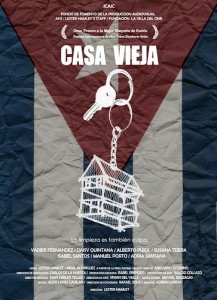
The fictional long-feature film Old House (Casa Vieja) has returned to the cinemas and to Screen #2 of La Infanta, where it can be enjoyed from 13-26 January by those who did not have the pleasure of watching it during the last Havana Film Festival, whose jury awarded it a Special Mention and the Popular Award, which lifted its maker’s Lester Hamlet’s ego; he expressed to Cacilia Crespo, journalist for The Film and Video Programme, that the re-writing of the play by Abelardo Estorino gave him the chance to speak from his essence and nationalism, to “narrate, from a human standpoint, a new conflict; to seek, to find, to suggest.”
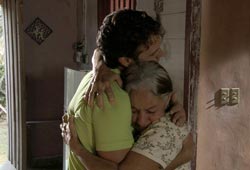
According to the filmmaker, his first work has found its natural niche within the present national film world, because it “speaks from the history of history and tells naked truths, undresses its fears with courage, and already participates in a conscious process of thousands of viewers who have welcomed it in their lives.” He adds that it is “a Cuban film made from patriotic pride.”

This defense is allowed but one needs not to exaggerate. Old House does not tackle any new conflict nor does it suggest anything extraordinary, even if it deals with enduring motivations of aesthetic resonance—cohabiting, sexuality and the existential trances of a family stuck in time—from a human angle. The family is stuck in the 90’s, but with a 60’s resonance in a run-down house where the patriarch is dying, an event that forces the youngest of his sons—a successful yet shy gay man who, without intending to, unties certain taboos and miseries sheltered by male chauvinism and social intolerance—to return home.

The melodramatic atmosphere of the household is one rooted in family values and traditions. A revolutionary past and the respect for established order—referenced by cyclones, armies, mobilizations and labor, as symbolized by the oldest son—palpitates within the home. The actor who plays this role is aging Alberto Pujol, whose character is a married man with children who works as the chauffeur for a town politician, and who despises the irreverent street-sweeper (Isabel Santos) who implores the recently arrived son to assist a young girl from the community who has been offered a scholarship abroad but has been denied an exit permit.

The rest of the film revolves around reminiscences of the mother (Adria Santana) and her other children (played by Yadier Fernández and Daysi Quintana), the brother of the dying man (Manuel Porto), some exterior shots of the coastal town, and funerary and burial scenes where some government secretary directs the acts and is interrupted by the main character, who hates hypocrisy.
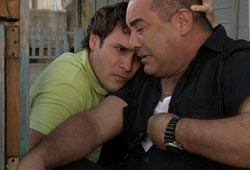
The contradictions in Old House are reduced to the distancing of the prodigal son—shy, cultured and mundane—from family masks and from the immobility of the townspeople, which is why, prior to his return to Spain, he tells his mother he only loves “living things that change.”

That’s where the “naked truths” and the “patriotic pride” end. There is nothing transcendental, neither in the acting performance of characters—limited by spaces and dialogs that were written for a different medium—nor in the geriatric atmosphere of stillness, poverty and lack of expectations. Perhaps the clue to the film needs to be looked for in the recreation of misery, the love frustrations of the marrying sister and in the untimely and honest street-sweeper played by Isabel Santos.

The reception of a work of art does not always confirm its worth or its contemporary character. Maybe hundreds of people witnessed their own secrets revealed by the characters of Old House, but the film seemed, to me, ambiguous and poor. The topic of the stigma of the homosexual in the family, the return of migrants who come back with a different perception, and the patriotic myth is well-digested bread in the island’s film milieu.

Share

January 26 2011