Message from Paquito de Rivera / POLEMICA: The 2007 Intellectual Debate

Message from Paquito de Rivera to Marta Valdés

Dear Marta (Valdés):

I congratulate you on your brave insertion into the group of Cuban intellectuals against the sadly famous ex-ex-ex cultural leader Luis Pavón, who, by the way, has been for a long time a perfect non-entity (pun intended). I hope this is just an introduction before you engage, with full force, him and those who physically conducted that bloody repression against those long-haired/short-skirted youngsters—as Zenaidita Romeu accurately calls them; no one has ever seen Pavón, or that moron Papito Serguera, or any other cultural leader, scissors in hand, go on to cut that long hair or cage those “foreignizing” youngsters at Coppelia, am I right? And given your renown sense of timing, I think I am right to be sure that you already have prepared a song to commemorate the UMAP, that shared idea between Raúl Castro and Che Guevara (maybe the song could have a che-che-che beat, right, you naughty one?). Pablito Milanés should add its first verse (the left-wing gay community would be grateful for that [truncated text in the original]

I patiently await that day when I will be able to support you on your next protest against the higher powers that caused so much pain to us (not moribund rams like Pavón and Serguera). The same goes for Antón Arrufat, Jorge Ángel Pérez, Zenaidita Romeu, Desiderio Navarro, Arturo Arango, Reynaldo González, César López, Norge Espinosa, Abelardo Estorino, Ramiro Guerra, Jaime Sarusky, Monseñor Carlos Manuel de Céspedes, Nancy Morejón, Ambrosio Fornet, Luciano Castillo, Sigfredo Ariel, Marta Valdés, Ena Lucía Portela, Waldo Leyva, Enrique Pineda Barnet, Jorge Luis Sánchez, Senel Paz, Rebeca Chávez, Reina María Rodríguez, Luisa Campuzano, Carlos Celdrán, Pancho García, Adelaida Fernández de Juan, Aries Morales, Magaly Muguercia, Pedro Pérez Sarduy, and the rest of the “protesters” who have “heroically” made firewood out of the fallen tree. This is your time to revindicate yourselves. The two big “R’s” are waiting for you: Ramiro and Raúl. Let’s just see if you have what Tito Puente had, and in excess!

From here to the Victoria (the neighborhood of the happy girls), always!

Paquito de Rivera

United States

Message from Paquito de Rivera to Fefé Diego

Hello Fefé:

Yes, it is true that we do not know each other personally, but you are quite familiar to me, because I always have heard good things about you on the part of people like Lichi, Rapi, Felipe Dulzaides, and especially my old and good friend Sergio Garcia-Marruz, who, out of that whole Vitier-Garcia Marruz-Dulzaides family, I consider—for many reasons—the best of them all. With Sergio I never had much of a friendship in Cuba, but he was the first one to destroy what never made sense from the time Marx wrote his first letter in his big book of German jokes.

I have neither the time nor the desire to immerse myself in all this “pavoroso” (horrific) gossip, but I have read with lots of laughs the stupidities written by our—or, better yet, YOUR—”brave intellectuals.” One whose name is Jiménez wrote, plagiarizing the dissidents (and I am not a dissident: I am a gusano—a worm—mind you): “Revolution belongs to all”… Oh save us all! Such shame, still today! Even your own brother Lichi had the nerve to say, from Mexico, that “no matter what happens, there are still revolutionary writers in Cuba.”

Also in Germany there are writers who still yearn for Hitler, and countless idiots in the United States who belong to the KKK, and not because of that will we cease to despise them and boycott their filthy ideas, my dear Lichi. It’s just like my grandma used to say, “the leopard doesn’t change its spots,” except that in some cases (a few) the earth’s springs DO NOT entice them more than the sea*. Especially the sea of bliss that Chavez talks (or rather barks) about. The damage and the wounds have been indeed huge, but this damage didn’t start with Pavón and Serguera, and Quesada didn’t act alone, dear Fefé. Everything was coming down from “higher up.” Or is it that perhaps you too were also fooled with that idea that the Crook-in-Chief had no idea about UMAP and the cocaine traffic?

Believe me when I tell you that—as Argentinians put it—it bursts my balls to waste my time talking about foolishness, but you and everyone else know that the “Special Period” began very early in the twentieth-century, and that these “mistakes” that were made, and this cultural, economic and social disaster—and disasters of all kinds—started a long time ago. What nerve these cheap intellectuals have to claim they didn’t know about the purges of Stalin, of Socialist Realism, of the dark cultural Maoist revolution and of the how cruel, bloodthirsty and homophobic Che Guevara, Breshnev and Ho Chi Minh were!

In regard to the absence of my name from the cultural circles of this country, I am in very good company, and I am quite happy about that. I don’t want my name to be used like they have used Lecuona’s name or John Lennon’s name. Neither am I interested in having as colleagues and fellow travelers those Cubans who have irresponsibly supported such a vicious regime: the writers and artists. On this side over here we have Cachao, Bebo Valdés, Carlos Alberto Montaner, and many others who fill us with pride, personally and artistically.

Counter-revolutionarily,

Paquito D’Rivera

*Translator’s note: A reference to the Jose Marti poem from which the lyrics for the song “Guantanamera” are based.

Link to original post
December 31 2009

Notes From Captivity / Pablo Pacheco

During the “Black Spring of 2003”, 75 of us peaceful dissidents were arrested and sanctioned to long and unjust prison sentences. As an additional punishment to our families, they dispersed us throughout the entire Cuban geography, hundreds and hundreds of kilometers away from our homes.

A week after arriving to the “Aguica” prison in Matanzas province, I decided to write a journal. It was the only way I could remember all the details from living in solitary confinement. Nearly eight years have passed and now I have learned that it is impossible to wipe out all that I have lived from my memory. The psychological damage caused by such isolation persists.

The first words which I wrote on my journal, where I also kept some inspirational phrases to help me through my imprisonment, were “Thank you God for keeping me alive; I only ask that you help me one day to let the world know of the cruel realities of the Cuban prisons, especially for political prisoners.” In another section of the notes I jotted, “Inevitably, the majority of those who have defended a cause which they believe is just have ended up in prison. But all this time which we live behind bars serves as a process which strengthens our spirits.”

I am of the thought that no sacrifice for the country is in vain. If we don’t get to benefit from the changes, then our descendants will. I also do not consider myself to be a hero. I think we all harbor some heroic elements within ourselves, including us Cubans. In fact, we Cubans have proved this for more than half a century of dictatorship.

There is nothing more unfortunate for a human being to go through life without realizing that you have gone through it. I must honestly admit that the forced separation from one’s family is extremely difficult- it hurts a lot. The older ones from the family understand the situation and eventually accept the reality. But the little ones, in all their innocence, are unaware of the reality and question when you will return home. That’s when you feel a knot in your throat and you feel like you could barely breathe. At that moment, you are forced to lie, because you do not want to contaminate them with so much pain. Those of us who had small children during the Black Spring know very well that this is not a lie, for all the experiences were very similar.

Now, in exile, I could publish memories from my days of imprisonment. From today on, I will start to write for this new blog. I will detail my experiences. I hope to find the same support I had during “Voices Behind the Bars”.

Cubans, undeniably, have to find a path. Ideologies have only served to divide humanity. The important thing for everyone is not a government of the left or of the right, but instead to live like human beings. And we deserve it. One day, Cuba will find the path based on justice, not stained with vengeance. We must keep one thing very present: only love can save us from human misery.

NOTE: Pablo Pacheco was one of the prisoners of Cuba’s Black Spring, and the initiator of the blog “Behind the Bars.” He now blogs from exile in Spain and his blog – Cuban Voices from Exile – is available in English translation here. To make sure readers find their way to his new blog, we will continue to post some of his articles here, particularly those relating his years in prison in Cuba.

Cynicism as an Ideology / Ángel Santiesteban

Photo: Cafe Fuerte / Billboard in Miami

Some days ago, the newspaper Granma published on its first page of news: Google’s censorship of a Cubadebate channel of videos for “copyright infringement,” and the following note: Miami: Billboard Dedicated to the Five Dismantled. The newspaper explained in the associated article: “For 24 hours the air of tolerance and freedom of expression was breathed in Miami. But no longer.” Then it talked about an organization located in that city, a minority (and the word was not meant sarcastically, quite the contrary), that exercised “the right of freedom of opinion,” and asked for the release of the five spies who are serving sentences in the United States.

The TV news and Granma exalted as they delivered the report. And that seems fine to me. We all have the right to express our opinions from wherever we are, where we want, and by whatever means we choose, or at least whatever we have access to. I will always be a defender of my opinion and of the opinions of others, even if I don’t share them.

Then, ultimately being thinking beings, one is obliged to wonder how much self-censorship is imposed on us? At least in Miami — for 24 hours — they could breathe “the air of tolerance and freedom of expression.” And in Havana?

To underestimate the leaders of Cuba’s government would be foolish; at times I have experienced their ignorance of freedom of expression and tolerance. Now, to the contrary, it turns out that they reclaim it and use the right to exercise it. However, when will we have the opportunity to publish, here, an article in defense of the 75 dissidents imprisoned after summary trials in the spring of 2003?

Where were those who have access to the media when the daughters and wives of those prisoners of conscience were beaten for demanding the release of their loved ones?

When can we publish a note of condolence for the death of the prisoner of conscience Orlando Zapata?

Why wasn’t Guillermo Fariñas allowed to explain his reasons for maintaining a hunger strike, beyond the official lies?

Where was the tolerance they demand now when, just a few hours after trying to hijack a tugboat to get to Miami, young men were executed, though no hostages had been harmed? Hostages who appeared more like accomplices, as was known later, when they declared that it was a vile injustice to apply the maximum penalty to the offenders?

What did he say to the mothers of those young men when they went to the prison to bring their children personal hygiene supplies and they were informed that their sons had been shot that night?

When he couldn’t even remember the anniversaries of the victims of the sinking of the tugboat 13 de Marzo?

Who pays for the deaths of those innocents? And when?

Who could, on their personal printer — to even think about the possibility of a billboard would be insane with the current regime in power — print a poster with the faces of some of the many innocents executed in half a century of dictatorship?

How long will they prostitute words and not give them the same meaning when they are in favor or opposed?

When will they allow debate on the official website, the conceptually erroneously called Cubadebate?

When have we had, not 24 hours, but just a few minutes of that freedom of expression enjoyed in Miami, or by some who reside in that city?

In another official newspaper, Juventud Rebelde — Rebel Youth — a gentleman named Lazarus Fariñas, resident of Miami (I don’t know the reason he is found there, only that he abandoned Cuban soil like so many thousands of others), denounces in an article “the corruption of some Florida politicians,” and, contradicting the statement of the official notice of the Communist Party of Cuba, refers to “a lack of tolerance and freedom of expression that exists in Miami.”

First of all, I want to congratulate Mr. Fariñas for that freedom to denounce the political corruption and not subsequently having the police at the door to arrest him and take him to the dungeons of the State Security in Villa Marista, as a dangerous enemy who threatens the maximum power; and also because his family is not besieged, persecuted simply because of their blood bond, and because without the slightest justification he is not left without work and without the possibility that his children, grandchildren, nieces and nephews can aspire to attend university.

I want to congratulate him another time for having the ability to publish his point of view in the official Cuban press, something that many of us who have remained on the Island have not managed to achieve, and so, by necessity, we have had to turn to digital media and become bloggers, assuming we will be professionally marginalized, beaten, persecuted, subjected to harassing and fraudulent judicial processes and in many cases end up in prison.

(At that time facing a prosecution request for more than fifty years, the court has rejected my witnesses and accepts no compelling evidence: the recording of the supposed “witness ” to the prosecution where, before a hidden camera, he explains in detail how he has been pressured to declare and exhibit the gifts received in payment).

Mr. Lazaro Fariñas, I assure you that the day you do not agree with the official views of the Cuban government, not only will you cease to be published in the official press, but perhaps you will never set foot on your homeland again. If in doubt, try it. I suppose you have at least one edge that does not converge with the official attitude — think of the children of the tugboat 13 de Marzo, of the young men executed — some fiber of your being will be moved. Then write, try to publish it and you will discover (I cling to the thought that it is naive and romantic, not cynical), that the doors will not open to receive it.

We will be there as a group, waiting, ready to offer supportive companionship.

February 3 2011

The Effect of Punishment To Make An Example of Someone / Laritza Diversent

Rafael Felipe Martínez Irizar, a Cuban citizen of mixed race from Cienfuegos, and the son of Alfredo and Gregoria, will turn 44 this coming May 26. A few days later, he will have served 2 of the 5 years imposed on him as a sanction for the crime of illegally leaving Cuban territory.

I do not know him personally. I read his file, Case #420 of November 26, 2009, filed by the Office of the Popular Provincial Justice Court of Cienfuegos. I also learned about some of his life story, or, better said, his criminal history.

He committed his first offense when he was 20 years old. He had not yet served the term of one year, as imposed by the courts while he was in a correctional detention center, when his term was increased to three years, on the basis of contempt of court.

In 1993 he once again committed an offense. He was first sentenced to pay a fine of 3,600 pesos (national currency) for attempting to flee the country illegally. Afterwards, he was sentenced to 5 years in prison for money counterfeiting and fraud. In 1995, he unsuccessfully attempted an escape from prison and the sentence was increased to 7 years.

Rafael Felipe, despite not being a man who follows a behavioral model worth imitating, is nevertheless someone with a work relationship with the Cuban State. “He talks badly about the Revolution,” the court concluded. “Yet he participates in all activities of mass organization.”

The judicial organ of Cienfuegos referred to his behavior as “dreadful.” “He gets involved with all sorts of people, drinks excessively, and disturbed the peace constantly, for which misdemeanors he has been fined several times between 1998 and 2008,” reads the appraisal. A repeating felon who is well aware of the consequences of his acts and of directing his behavior.

In his story, I see so many Cubans who, daily, at street corners or in parks, drink to vent their sorrows and frustrations. Those who seek, in the deliriums of alcohol, the strength to scream what they would never be able to talk about in sobriety.

Could it be that, in this country, only alcoholics are brave enough to say what they think out loud? Will we need to be entirely hopeless to let go of our fears? Or that good sense simply alienates?

Beyond what his penal antecedents are, Rafael’s life illustrates something else. It is the example that thousands of Cubans witness every day and that convinces them their opinions should remain hushed. His story makes one feel the effects of punishment-to-set-an-example and reaffirms the thesis that ‘”only delinquents are against the Revolution.”

Martínez Irizar is serving his new sentence. This time, because he tried to escape his context. A friend “told him about the possibility“of taking a vessel to flee the country. He accepted, and the Cienfuegos courts sentenced him, despite the fact he never executed the plan.

Translated by T

February 3 2011

Of Oracles and Soothsayers: Cuba, Predictions and Realities / Miriam Celaya

Divinations

Note: This work was originally written for and published in Voices magazine #5, in January, 2011.

I want to start with a statement of principle absolutely rigorous and rigorously true: I respect the religious beliefs of all people anywhere in the world. The second statement I will make is as vertical and solid as the first: I reserve the right to question certain aspects of magical or religious practices when they cause me doubt — whether motivated by my own ignorance or by the nature and consequences of such practices — and I also claim my legitimate right to publicly expose what I think in that respect. An agnostic of my own doing, and anthropologist by training, man himself, beyond creeds or doubts, is most important to me. That said, I will address the issue.

Throughout history, mankind has always been tempted to decipher the future, and each culture has, at one time or another, in some way, succumbed to it. From the very beginning, primitive cave dwellers consulted the stars, the entrails of animals, and even trees and stones; they devoutly painted rustic cave walls with beautiful drawings and practiced propitiatory rites to enable the arrival and establishment of prosperity and good times. Several millennia have transpired since we supposedly left “barbarism” behind us and since the rise of “civilization”. Those years were a hard journey for humanity, and the inspiration for the oracle was ever-present. To date, the practice of predicting events for self-preservation, protection against them, or the conjuring of threats remains and attracts millions of people from the widest spectrum of creeds and cultures across the globe. To claim that the techno-scientific development achieved by humankind has displaced the magical practices of oracular character is nothing short of pedantry by the more educated: inside, man is still as superstitious as when he inhabited caves, and almost as ignorant, with apologies to cavemen. In fact, today, some oracles are available online, in what might seem, at first glance, the inversion of the equation: technology at the service of superstition.

Thus, no society, no matter how highly developed or sophisticated, has abandoned that universal tradition of divination. Regardless of the vehicle used for the prophetic ritual — whether the Tarot, the I-chin, the Horoscope or any other means — the fascination of peeping into a future subject to the enigma of a predetermined supra-human Destiny seems to defy time. And no wonder. Man is the only living being aware of his mortality, of his ephemeral character, and of his very weaknesses, which transforms Destiny into one of the most tempting mysteries in human existence.

However, from a certain point of view, concerns about the future – despite its romantic halo, a mixture of mystery, magic and enchantment — is not but a manifestation of a deep practical sense: to know what will happen allows us to optimize our brief stay in this world. And, without a doubt, the most practical of all men were, and still are, the wizards… the prophets; because they, as the occasional interpreters of arcane symbols, have others not just believe they possess superior gifts to probe the secrets of the future, but they actually have the ability to influence the will of large sectors of human societies, and to benefit from it.

Cuba, prophecies of survival

The magic substrate of prophecies is well cultivated in religion. In all of them there are omens, predictions, miracles, and even spells that can’t all be listed here. Universal mythology in the generic sense, with its fascinating poetic charge, has planted images, parables and traditions in the cultures of humankind. Cuba, a country with a peculiar religious syncretism, is no exception. The uneven and never clearly defined mixture of Spanish-inherited Catholic religion, the complex animist beliefs of African heritage, and certain magical-religious vestiges of our extinct indigenous cultures, characterized by ancestor worship — as fundamental components of this syncretism — seems to imprint in a large part of Cuban society a sort of natural predisposition to religiosity, a predisposition that has grown exponentially in recent years, marked by deepening shortages, the loss of values, and the urgent search for solutions.

Sociology and history indicate that religious practices –- like the people who profess them — parallel their eras. The sign of “anything goes” that characterizes permanence in a precarious state of survival has empowered Cuban spirituality to the point that many people look for hope and reason simultaneously in every niche of faith. All faiths are worthy when envisioning a personal solution to the crisis, so it is not difficult to find one individual in settings as diverse as a mass at the Cathedral, in consultation with a fortuneteller or at the trays of Ifá. Rosaries, runes, cards and seashells might be the barricade that will protect against the evils that could launch their attacks from any corner.

In the midst of such kaleidoscopic magic-religious outlook, the predictions of the Letter of the Year, a tradition of remote Nigerian origins, beliefs greatly diminished in Africa under the overwhelming Protestant push first and then by the Muslims, paradoxically has been gaining popularity in Cuba, some attracted by the momentum of sincere faith, others by the need to find a glimmer of hope, and all seeking a sign of a future being made ever more uncertain by circumstances.

However, as a phenomenon peculiar to this society and this time, not even the Letter of the Year can escape the unwritten rules that survival and uncertainty impose. There are many contradictions hidden behind a ritual ceremony that — perhaps unintentionally — reflects in part the same original vices than those of a society seeking to make predictions. To begin, each year, two Letters are disclosed in Cuba: one published by the Cuban Council of Elder Priests of Ifá, a consortium whose headquarters is a large house located on Prado, opposite the Parque de la India, in the capital, openly worshiped, recognized and protected by the Cuban authorities to serve their political interests, and one that is spread by the Organizing Committee of the Letter of the Year “Miguel Febles Padrón”, declared “independent” and made available from a modest temple-house in the Diez de Octubre Municipality in Havana, where every year many babalawos* get together and who, this time – according to statements in the printed document that they published — had “the support of the Priests of Ifá, of all the families in Cuba, and of their descendants in the world”, which in itself contradicts the fact that there are two independent predictions within the same religion.

On the other hand, the universal character that the priests of Ifá declare for their oracles causes inconsistencies in its credibility by releasing such general predictions that result in predictable events, without consulting any divination tray. I will return briefly to this point a little later.

Other elements to consider are the predictions themselves, taking into account annual sequences, the events of social interest that they forecast, the recommendations they make, etc., as well as the compliance or lack thereof of the previous years’ Letters; the intelligibility of their sayings and the ambiguity and vagueness of their language, among other key issues. I am referring to the independent nature attributed to the Letter dictated by the Organization Committee based at the Diez de Octubre Municipality location, avoiding, as far as possible, the contaminating official stench that could emanate from the other one.

For example, the Letters published in 2005 and 2007 are identical in many of their contents. The sections that were dedicated to serious diseases, events of social interest, statute’s axioms, and almost all the recommendations, were literally copied from the former to the latter. Two years, that, however, turned out to be quite different from each other in many ways, and right in the middle of which came Fidel Castro’s momentous proclamation (2006) delegating power to his brother and a small committee of characters holding high government positions who were, among others, three of the ousted acolytes of today. If a message about this was stated in the January 2006 Letter, it had to be very cryptic, because no one discovered it among predictions, recommendations and maxims.

Needless to say that some other elements in the Letter of the Year are pure garbage. The announcement of “the death of older people and public figures in culture and politics” that has appeared in one of the last letters is really obsolete, though most fans insist that the deaths of several elderly historic Cubans were announced by the board of Ifá and its interpreters, the babalawos. Predicting the likelihood of death for elderly or public figures of culture and politics “who are around 80 years old or have crossed that threshold — especially when it is known that many officials in high positions are old men engaged to that nomenclature — is not only an immature absurdity, but it makes a mockery of people’s intelligence. The announcement of “power struggles” also seems like a dramaturgical job, in light of the forced retirement of the senile commander.

We don’t have to shake any seashells to “guess” that the interests accumulated by the ruling class for over half a century will inexorably lead to bitter conflicts between the different tendencies that inevitably exist in the ruling elite as soon as the unifying ruler of those historical forces stepped down from the presidential recliner. The numerous purges that have taken place in recent years are a reflection of the realignment of forces that emerge from these conflicts, which, in the long run, will possibly delineate the political landscape that will host the long-awaited transitional changes.

The always ambiguous language used by the interpreters of Ifá allows each person to essentially fit the speech to his own liking, and to interpret whatever he might understand out of its convoluted and faulty syntax, especially when universal significance is given to its predicted effects. Rain, tsunamis, droughts, epidemics, war, military occupation, earthquakes, hurricanes and shipwrecks are omens that lose authenticity when applied generally to the whole planet; it is obvious that these are recurring events that invariably take place each year in one or other region on Earth. Shouldn’t Ifá be more specific in order to have his aid be more effective? Or is it his priests who do not interpret his predictions exactly? In my opinion, these limitations are caused by the effort to apply universal relevance to local-type religions, typical of lower stages of development.

The most recent one, the 2011 Letter of the Year, repeats the 2010 reigning symbol, it has Oggún (patron saint of blacksmiths and the military) as its regent divinity, which some Cubans have interpreted as a complacent acquiescence, or perhaps a friendly wink to General Raúl Castro. This year, the very handy threat of war, confrontation and “military intervention” is maintained, too much like the Cuban government’s discourse, overused and repeated ad nauseam, in order to keep the subjectivity of “the people” around an imaginary enemy attack. Shouldn’t Ifá be more creative? No, the priests will probably say that the Letter refers to events that will occur in other countries of the world.

It also seems a curious coincidence that, pursuant to the “renewal of the model” advocated by General Castro begun some time ago, with measures such as distribution of land in usufruct to the peasants, the 2011 Letter of the Year takes advantage to include in its recommendations “to absolutely restore or eliminate old political schemes to enjoy a new social order.” And with that, all is right with God and the Devil: change has been the popular outcry for years, as is, of late, the regime’s urgent need to retain power through a grace period. It would seem that, instead of proposing prophecies to lead us properly through life, the Ifá’s proposals, through his priests, keep us dependent on the rhythm of the official model, survival, and the vagaries of the system.

However, believers are struggling to find rationalization to support their faith and their hope of improving life among the ambiguities and detours of the year’s patakies**. That’s why, in contrast with the alleged universalism of the Ifá oracle, Cubans seek out even the slightest sign of progress for Cuba… and he who seeks will always find. This is influenced by not only the critical economic situation we’ve been mired in for a long time, but also by the chronic misinformation that the vast majority of Cubans are suffering from, dependent on the meager communication they receive from the strictly government-controlled media.

Contrary to what I discuss here, it could be argued that the Rule of OSA, the Ifismo, or anything related to traditions and principles of this religion do not indicate a political character, in fact, this is what many priests allege, but this is not fully adjusted to the truth. The religions of African origin have been as persecuted by the regime as all other religions, or even more so, given that their practices were largely demonized, their rituals had to be hidden, and their faithful belonged to the poorest and most marginalized levels of society. These circumstances, and the act of existing under a totalitarian government, lend a political edging to every element of social life in Cuba that religions cannot escape.

A priest’s views

Victor Betancourt himself, a babalawo who regularly participates in the ritual of the Letter of the Year Organizing Committee, has recently responded to questions addressed to him by several readers of Diario de Cuba, and recognizes what I would define as a lack of commitment to the predictions and their effects. According to Betancourt, in response to whether or not the prophecies of last year’s Letter came true, “it is very difficult to determine the accuracy of the predictions for those who don’t have within reach data sources, annual ephemeris, annual statistical data, etc. (…) therefore, I cannot ascertain if they were met or not”. In the same setting, Betancourt asks for reporters’ help to verify such compliance, since they are more informed than he is (and Ifá himself, I may add) about what is happening in the world. With this, Betancourt attributes a purely media character to the predictions and their effects.

In response to another reader, concerned about the final fate of Fidel Castro, this Ifá priest states that Castro (Fidel) “abides by the recommendations of Ifá” and that is why he hasn’t died. I remember, however, that Victor Betancourt dedicated a religious ritual to safeguard the life of the eminent commander when, in 2006, he was on the verge of death. He doesn’t seem to recognize any influence his prayers before Ifá had on that occasion, or possibly, he doesn’t want to create a stir on that chapter of his religious career. At any rate, for a priest, I am of the opinion that he lacks a smidgen of faith.

Nevertheless, we have to believe that his prayer for the longest-lived dictator of this hemisphere has no political character, or that his regret is sincere when he says that “many journalists’ questions are always directed at the policy of the revolutionary government and at the leader’s health. We always believed that if we stated publicly, as now, that diseases whose rates will increase are the pulmonary ones, we would be sending a direct message to the health ministers of all countries, as well as to health providers in that specialty who have all the recourses and finances to strengthen this sector. We thought it would be more plausible, before we let the prophecy reach the people with asthma, tuberculosis, etc.” For me, I cannot imagine that the Health Ministers in the UK, Canada or Sweden are waiting for the Letter of the Year and the recommendations of Ifá’s priests to come out to allocate the corresponding budgets and to map out the strategies of the case.

After the predictions, the realities

I must confess that, in recent years, I have shown interest in the Letter of the Year as a phenomenon that brings together a significant number of individuals. It awakens in me a curiosity to understand the motives of human spirituality. Believers or not, “just in case”, almost everyone asks at the beginning of January, “What did the Letter come out with this time? Who is in it? What does it predict?” without ever understanding that they are the ones who must find answers to the crisis of their own existence. Still, this is an event that doesn’t get too contaminated in the midst of this tense and expectant society: it doesn’t offer enough hope as to awaken a mobilizing expectation, it lacks the strong propensity to spark a flame. That is why it is astutely tolerated by the authorities.

But, beyond trickery, credos or incredulities, Cuba’s destiny is not exactly played out on Ifá’s tray. Oggún, the legendary warrior, is useless to me, as is Raúl Castro, myth of the warrior who never was. We Cubans need peace after warring against ourselves for half a century. Enough is enough.

With all due respect, without Ifá’s stone tablets, I can predict that the era of the dictatorship is nearing its end; that there will be changes, perhaps more than we can imagine; that we will finally have an imperfect democracy that will have to be polished for many more years; that tomorrow’s children will not have to swear that they will become like Ché… or even better, that they will not be Little Pioneers; that there will be a multi-party system; that we will have rights; that the remnants of totalitarianism will be swept away by the young and by future generations, that the road will be long and difficult; that we will have to continue to expose chiefs of state, the opportunistic, and the corrupt. The Orishas will not make this omen come true, we will. If Orishas finally decide to help us, all the better. As for me, don’t give me magic seashells… give me Internet.

Translator’s notes:
*A
babalawo, meaning ‘father or master of the mysticism’ in the Yoruba language, is a title that denotes a Priest of Ifá. Ifá is a divination system that represents the teachings of the Orisha.
**Patakies: Myths and legends of the Yoruba religion.

January 31, 2011

The Cyber Battle / Ernesto Morales Licea

Not quite three months ago, on November 12, 2010, I published a post titled Operation Blogger: Algorithm for a Disaster, where I described as vividly as possible a “conference” of Cuban authorities with journalists from the official media, in a new push to form a Cyber-Army to fight in support of the Revolution.

A video just published in various blogs and virtual spaces describes with image what I tried to relate then with words. A video that confirms that accuracy of that post, which many branded as false or overstated.

To those who didn’t believe in the new national campaign in Cuba, launched under the implicit name, “The Cyber Battle,” and to those who believed but didn’t have a reference point to measure how much was real in my narration, the faith in my journalistic honesty, I post for you hear this revealing video which relieves me of the need to say more.

La ciber policia en Cuba from Coral Negro on Vimeo.

February 4 2011

Regarding the Recent Citizen Initiative to Petition an Overhaul of the Cuban Electoral System / Silvio Benítez Márquez

A Proposal for the Modification of the Electoral Law [Propuesta de modificación de la Ley Electoral] was launched yesterday through a petition at a modest press conference. There were no interruptions to the event on the part of State Security, although they were carefully watching us from the distance. The initiative comprises two stages; the first one consists in its distribution, in and out of Cuba; we will attend the neighborhood debates where the guidelines are being discussed and will present our demands of an overhaul of the Cuban electoral system. The second stage will begin with the collection of signatures around the whole nation, which will finally be delivered at the last meeting of the National Assembly of 2011.

http://www.flickr.com/apps/slideshow/show.swf?v=71649

January 27 2011

Press Conference With the Community Spokespeople / Silvio Benítez Márquez

This Wednesday at 10:30 AM a press conference has been organized at 249 Ave. #4614 (between 46 and 48 streets) at Punta Brava, La Lisa, to announce the new citizen initiative which consists of asking the communist government to transform the Cuban electoral system.

See the proposal here: Propuesta de modificación de la Ley Electoral

See appendices here: Anexo

For more information, please call 052541300

SILVIO BENÍTEZ MÁRQUEZ

PROMOTER, VOCES DEL BARRIO PROJECT (Voices of the Community Project)

January 26 2011

Concealed Identity / Silvio Benítez Márquez

The strategy to conceal his Cuban Communist Party (PCC) membership and his collusion with the “rapid response” gangs in the interview with the consular official, had been the perfect alibi of the astute Pelencho in his effort to win a visa and with it the right to travel first class to the beautiful city of Las Vegas.

Pelencho, a fan of the hammer and sickle, had finally broken with the traditional concepts of the Cold War. He wanted to know “the empire” and vacillated between the lovely green dollars without abandoning the agitator’s mask in the neighborhood.

The skilled character knew the risk he exposed himself to each time he presented himself to go visit “La Yuma.” On the one hand he felt infallible faced with the mass of kids he assaulted disdainfully and humiliatingly, and on the other he feared the political challenges of his more vertical allies.

A road paved that, with time, unmasked the true identity of the old Pelencho. He who once again had staged another of his histrionic scenes in front of the neighborhood’s residents. Managing, all on his own, that the wide open door of opportunity would slam shut in his face, forever.

January 25 2011

The Old Man and the Bus Trip / Orlando Luis Pardo Lazo

ASHITTEDOrlando Luis Pardo Lazo

It was on a P-10 road from La Víbora to Paradero de Playa. With the night falling over Cuba, one broken under that indecisive weight of violets and depressions that remind us that there is a sky over Havana. That the world is also here and now. To add to it all, with such freezing cold, one capable of piercing bones, one that is not commonplace in Cuban literature. At the stop on Perla Street, almost at the edge of the suburban rural chord that threatens to devour our capital city block by block.

He boarded without paying. Old. Very old. An elderly man of venerable age, who should have been having dinner with his family in front of the innocuous news at this time of the night. Wearing a suit that had surely been worn for the first time way before the Revolution. He had shat on himself. The old man and his suit. Shat and scared shitless.

The stench gave him away before any glance could. I was busy writing my “Lezama Lima Explained to Children” in the Notes section of my cellphone. A very basic Nokia that works better than a machine gun (Twitter, Twitpics, Chirps, YouTube, Vimeo: the whole of the Internet almost advertises itself from my SIM card). If I didn’t go into too much of a delirium, I could surely publish the text in the Diario de Cuba web portal, now that we all have an opinion about the Fat Man from Trocadero, so pestered at the later stages of his life by the envious, the cowards and, of course, even by Security specialists (their arguments, in view of the future, are more than valid: “We were only doing our job.”).

The stench stabbed me. Damn, I thought. I stepped on shit. Or some kids threw a pile of shit through the bus window, as to appease their neighborhood boredom slightly: it is not the first time it happens to me, although, luckily, they have never managed to hit me with the dog, cow or even human shit. If it’s me, I thought, I will be dead in minutes, without time to warn anyone (Who could I ring at this hour? My mother: my last relative? A lover, second to last impossibility?) If it is I who smells like this and I have still not realized that, then it must mean my intestines have hemorrhaged. I thought of Fidel. But that didn’t make me laugh. Life is such a fragile gift. I had a sort of panic attack. But then laughter relaxed me. The coarse laughter of the Cuban people. Vulgar.

“Get off the bus, pig.” “Blow away, stinker.” “Driver, open the back door so we can throw out the old man right here.” And the P-10 route passengers began to open up a circle around the back door. They were backing up towards me. I stopped typing about Lezama Lima (in his work, curiously, there are exquisite scenes that take place inside Cuban buses, with such formidable phrases as “I am like Martí dreamed about, the succulent poetry…”) and I tried to get close to him, in my ever curious solidarity with the fallen from grace—be it the grace of the State or the grace of our own sphincter. But it was impossible. The crowd and the stench forced me to retreat into the accordion of the articulated bus. Shit had built, by simple osmosis, a material wall amid the compacted air.

The old man began to defend himself with words he could hardly enunciate and to throw out punches, like a braggart. He had probably been a fighter all his life. And now he could not even hold back his feces, voluntarily, not even for a few bus stops. Oh, but anyone who dared to come close would come out of it all messed up. Even if it was the last thing he did in his life, after such a Pantagruelian and uncivil crap.

The passengers never left him alone. Especially the male students, who kept making a racket and mocking him with cheap cabaret-like jokes to impress the girls, who laughed in their un-erotic uniforms with a terrifying lack of intelligence.

The old man resisted as much as he could until he finally jumped out from the bus, three or four stops later, still on Perla Street approaching the William Soler Children’s Hospital. I doubt that was his destination (I doubt he even had one on that late night). But he got off and started limping away. I think the shit was dripping out of his pants.

The stench stayed in the bus all the way down to La Ceguera, where I got off, now really smelling of his ancestral shit myself. More than shit, it was the postmortem molecules of biological decomposition (I witnessed such kinds of fermentation at the Faculty of Biological Science). Cadaverinas, phosphorescent gases and other such exquisite particles. I hate the scientific reproduct-ability of death (necrochemistry more than biochemistry). I hate anything that happens around my Nokia and me.

The old man lost himself into the vilified and aged Cuban night. We continued our journey between the little pale headlights of an imported bus, or those forensic light posts of a sick and tired, embarrassed Havana.

I took a deep breath of freedom. I sniffed my skin. I probed my underarms and private parts. Several times. The accumulated sweat of an insular winter. A deliciously young and human smell. Appetizing. I felt like going out hunting. I was alive. I felt like Twitting it to the world from my cellphone. Damn, what joy, what an urge to burst into tears! To be alive over the yellow line ignored by both students and buses. You get it? Alive!

Translated by T

December 22 2010

So Far From Cairo / Yoani Sánchez

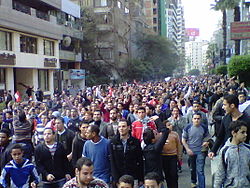
Egyptian Marchers, 25 Jan 2011. Source: Wikipedia

The scene lasted just seconds on our screens, a brief flash, chiseled on the retina, of thousands of people protesting on the streets of Cairo. The situation was described by the pompous voice of the Cuban announcer, who explained that the crisis in capitalism had sparked discontent in Egypt and that social differences were sinking the government. Barely mentioned was that a thirty year cycle was crumbling in a single week, right there, in a country where history is measured in four-digit numbers, wedged in pieces the size of millennia.

The allusion we used among ourselves to refer to Hosni Mubarak’s long stay in power was, as the popular refrain warns: “Don’t speak of the noose in the hanged man’s house.” The insinuation is clear: five decades of authoritarianism here at home has exceeded its expiration date. Perhaps to avoid our making the comparison, the State media showed caution in dealing with the news from North Africa. They administered tablespoon-sized doses of the events, without dwelling on the reasons that drove a people to put a limit on the personal mandate of an octogenarian.

Despite their journalistic stealth, other fragments of what is happening come to us through alternative information networks — persecuted satellite dishes and the elusive Internet. Official prudence can not prevent our seeing an aerial view of Tahir Square, vibrating to the beat of spontaneity, something not seen here for many decades in our sober and gray Plaza of the Revolution. It’s inevitable that watching the crowd demonstrating with placards and banners would make us raise question that that sober announcer, with his striped tie, wants to banish from our minds.

Why doesn’t something like this happen in Cuba? Given that our government has been in power longer and the economic collapse has become an inseparable part of our daily lives? What prevents us from taking the path of civic protest? Of exerting peaceful pressure from the streets? Egypt has shaken our docility and the courage of others has forced us to face our own apathy, in this nation where time is measured in “Revolutionary” commemorations of long-past events, tucked in the yellowing folders of the bureaucrats.

The theory of brave peoples versus cowardly peoples is simplistic. There is no gene for rebellion and one can’t predict when discontent will reach its boiling point. Since 1959 speculation on this long and narrow island has been fueled by Tarot cards, Ouija boards, rhyming quatrains, fortunetellers, babalaos and prophets. Faced with the omens of a future that never comes, millions of Cubans have summarized civic activity in one morose verb: To wait.

They cherish the illusion of a quick fix, of going to bed one night in a country without human rights and waking up the next morning in democratic Cuba. When waiting continues to be prolonged far beyond the expected time, many choose to conjugate the verb “to emigrate” or, alternately, opt for the brief and laconic syllables of “to remain silent.” But to throw themselves into the streets? No. Because the dark asphalt of the avenues belongs to whom? Since we were children we’ve been told the answer: To the Revolutionaries, to Fidel Castro, to the Communist Party. They would have us believe that to protest in public against the layoffs of a million workers, the high cost of living, or to demand the resignation of a cabinet, are actions possible only outside our borders. They have claimed the streets, our streets.

And they have activated mechanisms of control which spring from their fear. To prevent a crowd from taking to the sidewalks to shout in unison, “The president must go!” they have installed surveillance equipment that knows no economic crisis, no cuts, but constantly hovers over us. Right now they are on edge, shuffling their agents, their cars, their laws, to avoid the contagion that could come from the East. Because even though Cairo is very far away, there are too many similarities between Cubans and the faces we saw on the March of One Million. Many of us feel that those who chant against Mubarak on the other side of the screen are calling out to us, making us ashamed of our inertia.

Jumping the Barriers / Yoani Sánchez

La ciber policia en Cuba from Coral Negro on Vimeo.

Are you one of those who fabricates the lies? Or one of those who believes them? I would like to ask this question of the speaker who deploys a complicated conspiracy theory in this video. If it’s someone who is just sending a message, then the answer is simple: the falsehood is concocted higher up and he is just the messenger. But I fear that part of what he is expounding in front of those grim soldiers — with a constellation of stars on their uniforms — is his own production, cooked up by himself. His lengthy presentation, punctuated with words such as “enemy,” “operative,” and “the evils,” shows me what can happen when one talks about the most modern of technologies using old-fashioned language. He doesn’t seem to understand the affinities and ties that link sites like Facebook and Twitter, but applies a prism of his own making to them, rather than recognize that individuals make their own decisions to join them and — horrors! — jump the ideological barriers. Although he might be a brilliant computer scientist, this young man failed social sciences.

On this fictitious base they design strategies that will barely hurt the Cuban blogosphere. Meanwhile, believing that the impulse does not come from us, but from others who manage us like puppets, they will develop tactics that will make a lot of noise but generate few results. To recognize that the New Man — their New Man — is tired of being a soldier, repeating slogans, applauding at political rallies, and now wants to have his own space for expression, would be like confessing that they have failed. All the walls and boundaries they impose on us in the physical Cuba, we have jumped over into that infinite space that so robs them of their sleep. If they can no longer control us, let them at least console themselves by dismissing us.

*Thanks to the commentator in my blog who sent me the link to this video, the distribution of which is proof positive that our government has lost the monopoly on information, including its classified materials. Viva Cubaleaks!

Translator’s note: Given the length of this video I don’t think we will be able to prepare a translation. The gist of it is a detailed explanation of how Yoani and other dissident bloggers are classified by the government as counterrevolutionary enemies controlled from the U.S. and Spain. There is a proud enumeration of the “Revolutionary” blogs and the accuracy of their attacks on Yoani et al. The principle criticism aimed at the alternative bloggers is that they are trying to break the “ideological barriers” (put in place by the Castro regime). The term “human rights” is repeated as if it is an obscenity. At one point the slide on the screen shows us Fidel’s “blog” and how many “hits” he has (more than half a million!).
4 February: Following are links to some additional summaries of what is said in the video. The Diario de Cuba article is in Spanish, but readers can translate it using Google Translator.
El Yuma
The Cuban Triangle
Diario de Cuba
Miami Herald

3 February 2011

Review in VOICES 1 / Orlando Luis Pardo Lazo

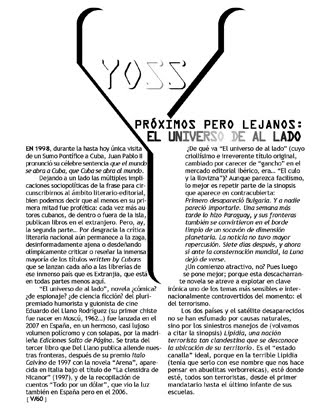
Near but Distant: The Universe Next Door

Yoss

In 1998, during the only visit to Cuba by a pope, Juan Pablo II delivered the now famous phrase, Let the world open itself to Cuba, let Cuba open itself to the world.

Leaving aside the multiple sociopolitical implications of the phrase to concentrate on its literary meanings, we can say that at least the first half of the phrase proved prophetic: every day more Cuban authors, from both inside and outside the island, publish books abroad. But, that still leaves the second part…. National literary criticism, sadly, still brings up the rear, refusing through either ignorance or disdain to critique or review the vast majority of books written by Cubans that are launched every year in bookstores in that enormous country that is Abroad, which is to say everywhere but here.

The universe next door,” comic novel? spy literature? science fiction? by the award-winning humourist and scriptwriter Eduardo del Llano Rodríguez (his first joke was to be born in Moscow, 1962…) was released in 2007 in Spain, in a beautiful, almost luminous polychrome covered edition, by the Madrid publisher Ediciones Salto de Página. This is the third book published by Del Llano outside of our frontiers after publishing his novel “Sand” in Italy in 1997, for which he won the Italo Calvino prize in 1997, and the compilation of short stories “Everything For a Dollar” which also saw daylight in Spain; but in 2006.

From what comes “The Universe Next Door” (whose creoleism and irreverent original title, changed for lacking a “hook” in the Iberian book market, was “The Ass and the Drizzle“)? Although it might seem very easy, the best way to explain it is to repeat part of the synopsis that appears on the back cover:

First Bulgaria disappeared. And it didn’t seem to matter to anyone. A week later Paraguay did it, and its borders also converted themselves into the clean edge of a tunnel of a planetary dimension. The news didn’t have the slightest repercussions. Seven days later, and right now before worldwide consternation, the Moon stopped being seen.

An attractive beginning, no? But then it gets better; because this hilarious story dares to exploit in the key of irony one of the most sensitive and internationally controversial themes of the moment: that of terrorism.

The two countries and the disappeared satellite haven’t been blurred by natural causes, rather by sinister doings of (we’ll return to cite the synopsis) Lipidia, a terrorist nation so clandestine that the location of its territory is unknown. It’s the ideal “mob state”, because in terrible Lipidia (it has to be so with that name that makes us think in wordy grandparents), be wherever it may, everyone’s a terrorist, from the Prime Minister down to the last child in its schools.

After establishing that between one disappearance and another there is a period of seven days to discover the secret location of Lipidia and prevent another nation from disappearing, the CIA forms the most absurd commando that one could imagine, whose peculiar characters are one of the things the author got right.

There is the recurring Nicanor O’Donnell, who this time could be the perfect action hero … if he weren’t so cultured. Nick is the closest thing to a protagonist, given that the fragments of his diary included in the story are the only passages in the first person. The girl on the team is Chrissy (another name familiar to Eduardo’s readers, from the story “The Kiss and the Plan“), a beautiful and evil genius agent-hacker when she’s not working as a model. The leader is Dante, a mulatto fan of Engelbert Humperdinck and (born in Lipidia!!) who, although he has his map tattooed on his back, can’t remember the location of his Fatherland.

Team Rodríguez is completed by Homo rodens or born victim, for whom everyone he meets provokes desires to beat or cure them; and Mercury (HG), an almost-normal black man, except that he’s a specialist in martial arts of every kind happily married to Sarah, a woman from a parallel universe with whom she performs experiments on her physical brother.

The improbable fortunes and misfortunes of this commando worthy of having been recruited by Groucho Marx (sic synopsis, again) happen with astonishing and hilarious speed: while they fly towards Afghanistan (what better place to start looking for terrorists?) they stop a lone aerial pirate from blowing up a plane with a bomb disguised as a minor god. Then, following the loss of Chrissy’s suitcases and of Chrissy herself during a stopover in Madrid, they make contact with her kidnappers: a Muslim commando heatedly focused on retaking the Moon, which they suppose to be stolen by “western devils” and just stopped allying themselves (that’s the pure science fiction part) with them in the middle of a classic fight in a Munich brewery.

And the unexpected incidents don’t stop. Arabs and westerners together fly to a China which is debating the iron-clad official censorship of the People and the enchanting opening to a more consumer-oriented capitalism. They have, for the first time, contact with “the evil ones” (Lipidian people) through an explosion from which they save themselves by pure miracle, and follow them to Havana(!!), a place where — coincidentally? — one of the Muslims, Ali, studied Medicine years before and was the lover of Xiomara (lovingly known as “Muñuñi”), a sculptured and sweet mulatto woman who still lives in Centro Havana and whose brother Lazarito is the most inept State Security agent one might imagine.

Surprised and captured by the Lipidians, who reveal contemptuously that Lipidia isn’t in Havana, they are driven about no more and no less than to the Pink Room of La Tropical, where six evil-looking blacks are to take charge of them. Except that instead of the criminals they looked like, the “chardos” turned out to be the salsa band Matason, and one of them, to top it off, the best friend of Ali during her student days, by which …

It’s enough, because, as bad as it seems to certain critics, the objective of a critic is not to summarize a story, and the most surprising thing about “The Universe Next Door”, as was to be expected, remains reserved for its last third, a true tour de force of ironic dramatic effects and the most attractive crescendo of unexpected unmaskings until launching in the absolutely amazing outcome, which, as good readers suspected from the first pages, involves science fiction of hard and parallel universes … Although not in the form one would have supposed, which is the best of all.

Some purist of realism might be able to question the seeming unreality of this adventure, but implausible? Why? Didn’t everybody swallow the chemical and nuclear arms of Saddam Hussein and applaud Bush’s attack on the dangerous Islamic threat? When reality overtakes fiction, there’s nothing more for fiction to do than to make jokes about reality. Eye for an eye, laugh for a laugh.

Full of erudite cultural references, both pop (Shakira and Barbra Striesand) and “grand culture” (Tarvosky and Dave Lynch), this novel succeeds not only in capturing the attention of the reader if not, which is most difficult, maintaining it. And, despite its irreverent sniping against all flags, it can be equally annoying to extremists on the right and the left, it doesn’t stop surprising, and above all it makes one think, with its final moralizing, about the many faces of the unique, monstrous world of terrorism.

With “The Universe Next Door,” Del Llano here resumes the paradoxical path of the thrillers and political fiction in the style of Frederick Forsythe or Tom Clancy, who already in years past gave such good results in the hilarious novel “Virus,” winner of the April Prize, written in collaboration with Walter Ego of the never well-pondered NOS-Y-TROS, Luis Felipe Calvo.

Nonsensical in its disproportion, without pretending credibility, rather glued in the absurd, like all works of Del Llano, this novel leaves us with the disturbing sensation that not only next door, but also our own universe is completely beyond logic. That reality isn’t as real as it seems, nor the fantasy so fantastic as those elitist critics believed, the ones who dismiss science fiction as “escapist genre” before confessing that they don’t understand it, in the classic attitude of the fox that can’t reach the grapes: “Anyway, they’re too green.”

With a prose of careful, almost mathematical correction, full of footnotes, like the (are these really necessary?) clarifications of the slum slang of Havana for the Spanish reader, “The Universe Next Door” is at one and the same time a pleasant read and one that makes you think.

The only question then is,  is then, as in his day before “Nicanor’s Hourglass”: when will there be a Cuban edition, so that historic and national readers of Del Llano might be able to also follow the new and nonsensical adventures of O’Donnell, secret agent (even in Havana), without having to pay in convertible pesos for the pleasure of its reading?

And I hope this time the questioner won’t be left without an editorial response…

Translated by: LZ Humphreys y otros

August 12 2010

CUBAN MYOPICMATOGRAPHY / Orlando Luis Pardo Lazo

TO BE MYOPIC IS TO MAKE MOVIES

Orlando Luis Pardo Lazo

The eyes, curved, the orbits exorbitant.

The image of the world becomes amorphous and much more brimming over.

A film should be shot entirely like this, from the vision of the

illuminated. For instance, from the perspective of a child that suffers from

overlight.

When I discovered the moon, well focused in my retina, I was disappointed. So

small, so round, so framed inside my first spectacles. A

toy moon. The moon of the myopic is an explosion that

illuminates much more. A waste.

The street lights are also spectacular without glasses. The circles of

light almost always overlap.

No placard will ever have power over you if you cannot focus it in your eye.

You make your eyes small, the muscles make an extra effort to bend

the cornea, but the optical error remains.

With myopia, objects are closer than they seem, as in

those labels on rear-view mirrors.

One must bring things and faces closer to recognize them.

With myopia one is lonelier, but also capable of more solidarity.

And horror does not escalate so sharply over the optical nerve as to steam the brain.

Translated by T

December 30 2010