Opponent Maikel Herrera Bones Dies, Months After Being Hospitalized for Oropouche Fever

  •  11J prisoner Andy García Lorenzo has been on a hunger strike for 12 days, and his family fears for his life
  •  Independent journalist José Gabriel Barrenechea denounces from prison: “I am kept locked up to silence a critic.”
Activist Maikel Herrera Bones, in a file image. / Facebook

14ymedio bigger14ymedio, Madrid, 9 December 2024 — The opponent Maikel Herrera Bones, 48, died at the Pedro Kourí Institute of Tropical Medicine, in Havana on Saturday night, after being hospitalized for more than four months. The news was released by relatives of the activist on social networks and confirmed by some independent media.

According to Martí Noticias, the health of Herrera Bones, who had human immunodeficiency virus (HIV) since 2012, deteriorated due to the “instability in the supply of the medicines he needed and the lack of an adequate diet.” He got hopelessly ill after contracting Oropouche Fever and had to be admitted to the hospital, where he passed away.

“Maikel, who did so much for the freedom of his homeland without asking for anything in return, will not have the beautiful floral arrangements, masses or the grave he deserves,” Roberto Márquez said on Facebook.

Last October the patient was already in serious condition, very deteriorated neurologically

Yoel Parsons Bones, Herrera’s cousin and also an activist, told the same newspaper that the family was trying to get him a humanitarian visa to be treated in the United States. It was last October, and the patient was already in serious condition, very deteriorated neurologically.

To continue his activism “independently,” Herrera Bones left the Patriotic Union of Cuba (Unpacu) and the Cuba Decide platform, in which he had been active, in 2021. This was clarified by Ana Belkis Ferrer García, sister of José Daniel Ferrer, leader of Unpacu, through Facebook.

“In 2020 he suffered seven months of provisional imprisonment in the prison for HIV patients in Güines, Mayabeque, for publicly protesting the lack of electrical service in his community,” Ana Belkis Ferrer said, adding: “If we had been able to get him medical attention in exile, we would have taken him out, but unfortunately we were not able to achieve it with Maikel, continue reading

nor with Cristian Pérez Carmenate and Pablo Moya Dela; nor have we yet achieved it with Raul González, among others.”

Cuba Decide also published its condolences: “We deeply regret the death of Maikel Herrera Bones after years of harassment and repression at the hands of the regime for his struggle for the freedom of Cubans. For years Maikel dealt with health problems and constant medical complications. This brave young Cuban gave his youth to the cause of human rights and for several years promoted Cuba Decide.”

“If something happens to Andy, you will be responsible”

Andy García Lorenzo, sentenced to four years in prison for participating in the demonstrations of 11 July 2021, has been on a hunger strike for 12 days, and his family reports that his life is in danger. According to Pedro López, father-in-law of the activist’s sister, Roxana García, the prison authorities took “letters and documents that he considered important,” away from him. When they weren’t returned, he went on a hunger strike. His family learned of this nine days after he stopped eating.

The last time his mother, Dairy Lorenzo, was able to see him in Guamajal prison in Santa Clara, where he is serving his sentence, “he was very depressed and short of breath, and it was difficult for him to stand,” López said.

This Sunday, Roxana García made another appeal on social networks, explaining that although her mother managed to talk to the medical staff and was told that they had “the necessary materials,” “they have not performed medical tests, which leaves us uncertain about his true state of health.” And she warned: “We demand that the regime act immediately. This is not a matter of pride, it is a matter of life or death. If something happens to Andy, you will be responsible.”

Another political prisoner in Santa Clara, José Gabriel Barrenechea, sent a letter from prison in which he stated: “I am kept locked up to silence a critic, in his analysis and publications, of the Government’s management and the real possibilities of the Cuban socio-political system to get the country out of the crisis in which it is immersed.”

Undersecretary Eric Jacobstein spoke, in addition to independent businessmen and religious leaders, with relatives of political prisoners

The independent journalist was transferred to La Pendiente prison on November 18, ten days after being arrested for his participation in the popular protests that took place, a day earlier, in the municipality of Encrucijada, Villa Clara, after two days of blackouts. In his letter, he says that the demonstration was “spontaneous, massive and peaceful” and “had no other intention than to demand the replacement of the electricity after 45 hours without it and a week in which we had power for no more than 10 or 12 hours in total, in short intervals of two or three hours.”

According to the Denunciation Center of the Foundation for Pan American Democracy (FDP), the penitentiary center where Barrenechea is currently located is “known for its conditions of extreme overcrowding and for housing prisoners of all kinds,” and his stay in it “represents a serious risk to his life.”

Also, a letter signed by more than 200 journalists, activists, intellectuals and academics was released in which they demanded the immediate release of Barrenechea. The letter emphasized that the reporter, a collaborator of 14ymedio among other media, had been arrested “for political reasons,” in “frank violation of his rights.”

The text was signed by journalists Boris González Arenas, Camila Acosta Rodríguez and Yoe Suárez; playwright Luis Enrique Valdés Duarte, the coordinator of the Patmos Institute, Mario Félix Lleonart, analyst Juan Antonio Blanco, political scientist Armando Chaguaceda and academic Alina Bárbara López, among others. “We demand the immediate release of the writer and activist and, by extension, of all political prisoners in Cuba,” they demanded in the letter.

That request was reiterated by US officials visiting Havana last week on the occasion of the biannual talks on migration. According to U.S. Undersecretary of State Brian A. Nichols, U. S. Deputy Undersecretary Eric Jacobstein, independent businessmen and religious leaders conversed with relatives of political prisoners. “They stressed the important work they do to improve conditions in Cuba and called for the immediate release of people unjustly detained,” Nichols tweeted.

Translated by Regina Anavy

____________

COLLABORATE WITH OUR WORKThe 14ymedio team is committed to practicing serious journalism that reflects Cuba’s reality in all its depth. Thank you for joining us on this long journey. We invite you to continue supporting us by becoming a member of 14ymedio now. Together we can continue transforming journalism in Cuba.

‘Now We Are Supposed to Buy from the State but I Do Not Do Business with the State’

Small and medium-sized private businesses (MSMEs) that are not willing to accept the Cuban government’s new rules are liquidating their inventory and going out of business.

The new measures do not only affect private businesses that sell food, though this is one of the most open types of businesses. / 14ymedio/ Archive

14ymedio bigger 14ymedio, Natalia López Moya, Havana, 11 December 2024 — Cookies, soft drinks and bouillon cubes are some of the items on a list that is making the rounds from cell phone to cell phone in Havana’s Sitios neighborhood. In a WhatsApp group, local residents inform each other of the new clearance prices of these products in a nearby privately owned store. “Buy now. This is the last month the store will be open,” reads the text.

The Official Gazette recently announced a resolution that prohibits micro, small and medium-sized enterprises(MSMEs) from selling wholesale merchandise without state involvement. It also prohibits self-employed workers from doing any wholesale transactions, a move that has caused many small privately owned shops to either liquidate their entire stock to comply with the new law or to shut down permanently. “We don’t import but we do buy from a couple of private companies that do — always through a state intermediary — which saves us from all the paperwork of bringing the products in from overseas,” says Pablo, who owns a small store near Carlos III Avenue.

Pablo, an alias this businessman uses to avoid retaliation, began selling off his merchandise in early November after learning that new measures would soon take effect. “I only have a few items left so we are doing an end-of-year sale and offering discounts to clear everything out before December 20. We will not be open at Christmas and by 2025 we won’t even be in business anymore,” he explains. continue reading

“I only have a few items left so we are doing end-of-year sales and offering discounts to clear everything out before December 20

Pablo says that he has two main suppliers, “an MSME that imports frozen foods such as chicken, ground beef and pork from the United States and another that imports detergent and soap as well as shelf-stable foods from Mexico.” Going forward, both companies will not be able to sell this merchandise wholesale to small private retailers. “Now we are supposed to buy from the state but I do not do business with the state, he says.”

Pablo’s distrust comes from having worked for more than two decades at an affiliate of Cubacontrol, a state-0wned company that oversees many of the island’s commercial transactions. “I was an insider and I know how things work at those places. What will happen is that everything will become slower, more difficult, more bureaucratic and that’s really not for me. My wife and I started this business because we wanted to improve our lives, not give ourselves heart attacks.”

A well-stocked store on Central Havana’s Reina Street that used to sell soft drinks, beer and wide variety of knick-knacks has also been closed for a week. Local residents tell would-be customers looking for the place that it has gone out of business. “They closed and sold off what they had left,” says a retiree who is disappointed by the owners’ decision. “The lady who rented them the living room in her house loses that income. And now when you want a smoke or a cold drink, you have to walk further to get it.”

Private businesses that sell food are not the only ones affected by the new measures. “Buy the whole lot. We are having a clearance sale,” explains an ad from a small company that sells wholesale ceramic tiles. “Spanish ceramics. Big discounts if you buy the whole lot, which includes all documentation from [the port of] Mariel. Everything above board. We are not making a profit. We want to clear out our stock before the end of the year.” Several rows of boxes with tiles in different sizes, textures and colors can be seen in the accompanying photos.

“Spanish ceramics. Big discounts if you buy the whole lot, which includes all documentation from [the port of] Mariel

Other construction material suppliers are also selling off their inventory in order to comply with the new regulations. Henceforth, they will be required to buy wholesale from state-owned companies acting as middlemen. “We didn’t have much left in stock because these past few months have been challenging. Almost no new merchandise came in. We’ll see how things go under this new law before closing down for good and then get a different business license to deal with the new conditions,” said the owner of a business that sells cement and tools as well as kitchen and bath plumbing fixtures.

For someone named Raúl Rojas Leiva, having the state act as middleman is a recipe for disaster: “If Cuban distribution companies have so much transportation, infrastructure and commercial experience, why don’t orders arrive on time? Why do these distribution companies sell almost nothing? And I mean nothing,” he asks on the local government’s official Facebook page, which officials in Havana launched in hopes of convincing businesspeople of the new resolution’s benefits.

“Big clearance sale on footwear for men, women and children. Don’t miss out. Don’t say we didn’t warn you,” reads an ad from another MSME, this time in Havana’s Tenth of October district. “It’s all quality merchandise, imported from Panama and currently worn round the world. No old models,” the vendor states. Unlike other store owners who are hoping to stay open under the new legislation, she is taking a more drastic approach. “We are going out of business because our supplier says that he will no longer be able to sell to us wholesale.”

In the case of this shoe store, the closeout also includes the house where the merchandise is displayed. “If you want to buy a two-story house near Santa Catalina, this is your best option. The ground floor is configured to accommodate a business, which is currently a shoe store but can be renovated to house a hair salon, spa or a small grocery,” writes the seller, who adds, “Stay tuned on our WhatsApp channel because we will be getting rid of everything, including the mirrors.”

____________

COLLABORATE WITH OUR WORKThe 14ymedio team is committed to practicing serious journalism that reflects Cuba’s reality in all its depth. Thank you for joining us on this long journey. We invite you to continue supporting us by becoming a member of 14ymedio now. Together we can continue transforming journalism in Cuba.

Spain Dismantles a Network of ‘Coyotes’ That Charged 10,000 Euros for Transporting Cubans

Spanish National Police during an operation in Malaga. /  National Police

14ymedio bigger14ymedio, Havana, 8 December 2024 – The Spanish National Police on Saturday dismantled a criminal network of 36 members, including ringleaders and coyotes, who illegally transported at least 67 Cubans to Europe with false documentation. The migrants paid up to 10,000 euros for the journey through several European countries, which in some cases included traveling hidden in trunks.

The smugglers operated in Serbia, North Macedonia, Greece and Spain, and recruited the Cubans through the website of an alleged travel agency – the name of which was not disclosed – said the European Police Office (Europol) and the European Union Agency for Criminal Judicial Cooperation (Eurojust).

The migrants were given tickets in Cuba to board flights to Belgrade (Serbia), “normally making a stopover at the airport in Frankfurt (Germany),” the investigation details. Thanks to a visa-free agreement between Serbia and the island, Cubans can travel to the Balkan country as tourists, although they must meet several requirements, such as having a letter of invitation and proving economic solvency.

From Belgrade, they were moved by land “to Greece, passing through North Macedonia, being housed during the journey in the houses of the criminal continue reading

network”, according to data provided by the Spanish authorities.

The Spanish National Police arrested 36 members of the migrant smuggling network. / National Police

The transportation was carried out by coyotes who facilitated the border crossings in a clandestine manner, and “in which on many occasions the lives of the migrants were endangered as it was carried out in the trunks of vehicles circulating at high speed,” stresses the National Police. Once in Greece, the organization gave the Cubans “fake or authentic Spanish documents of people with similar features” – a method known as look-alike – with which they traveled by air from Athens to Spain.

The police had been tracking the traffickers since last January when German authorities alerted about a Cuban traveler with a stolen identity document (DNI). The woman arrived from Belgrade and was bound for Madrid. The Prosecutor’s Office of the Audiencia Nacional opened an investigation and was able to confirm this modus operandi in at least 40 cases.

The Second Central Court of Instruction was in charge of the follow-up of the investigation and this Saturday the arrest of 36 people involved was announced. Among the ringleaders, three were arrested in Alicante and one in Malaga. The rest of the arrests took place in Alicante (7), Barcelona (6), Las Palmas (4), Santa Cruz de Tenerife (4), Guipúzcoa (2), Balearic Islands (2), Madrid (2), Cáceres (1), Segovia (1), Toledo (1), Vizcaya (1) and Zaragoza (1).

As part of the process, three house searches were carried out where the authorities found “7,550 euros in cash and abundant computer material and documentation relevant to the investigation,” which is still ongoing.

Translated by LAR

____________

COLLABORATE WITH OUR WORKThe 14ymedio team is committed to practicing serious journalism that reflects Cuba’s reality in all its depth. Thank you for joining us on this long journey. We invite you to continue supporting us by becoming a member of 14ymedio now. Together we can continue transforming journalism in Cuba.

Santiago de Cuba’s Main Hospital Is Falling Apart and Its Doctors Are Desperate

Photographs taken by a doctor show the filth and the deplorable state of the surgical unit.

Leaks in the surgical unit of the Saturnino Lora Provincial Hospital in Santiago de Cuba. / 14ymedio

14ymedio bigger 14ymedio, Santiago de Cuba, 13 December 2024 — The Saturnino Lora Provincial Hospital, located on the central Avenida Libertadores, is the most important hospital in Santiago de Cuba. As such, it has the most specialists, the most patients, and is the preferred center for the most serious cases. Its surgical unit, in particular, is of utmost importance. For example, it cares for those injured in traffic accidents or patients who need difficult operations.

With these credentials, and according to the common reference to the Island as a medical power, anyone would imagine it, if not modern – it was “refounded” 65 years ago, as a continuation of the general hospital created, in another location, in the 19th century – then well-maintained. Or at least, like any self-respecting health centre, clean, with basic hygiene measures. Nothing could be further from the truth.

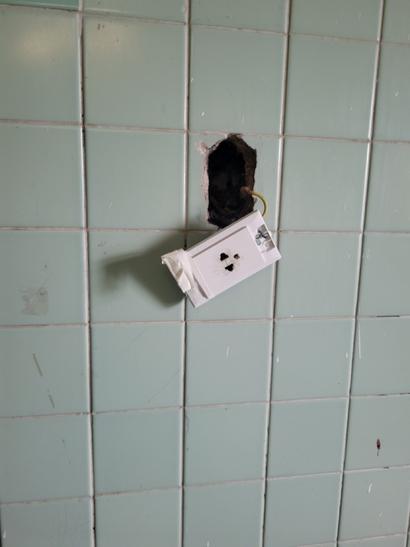
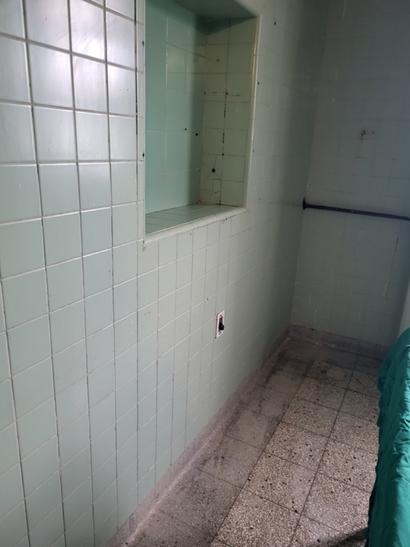
Drips collected in precarious recycled plastic or metal containers, sheets used to dry the water that falls to the floor, rusty oxygen cylinders, plugs without outlets, switches pulled out of the frame, with the cables hanging, as if violently torn off, broken light fixtures, without their white neon tubes, aged air conditioning units, which sound like the engine of an old car, half-broken windows, with traces of green paint, peeling walls, cracked tiles, humidity so severe that it accumulates on the ceilings, black on black. The panorama, offered by some photographs that have reached this newspaper from the surgical unit alone, is chilling. continue reading

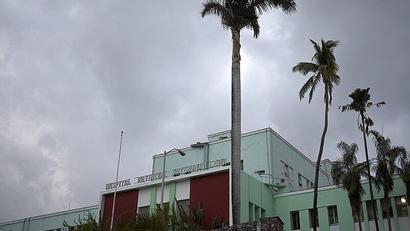
Facade of the Saturnino Lora Provincial Hospital, on Libertadores Avenue in Santiago de Cuba. / CC

The granite tiled floor barely hides the dirt in the hospital section that should be spotless, due to the risk of infections patients are exposed to during surgery. The authorities, however, say nothing of this when reporting on the “major repairs” that the Saturnino Lora has been undergoing “for several months.”

In a note published last November, Sierra Maestra speaks extensively of the “constructive work” being carried out at the center. Among these, the “separation of emergency and urgency,” which although they are synonyms in Spanish, is explained in this way by the director of the hospital, Ana Lubín García: “Now the color code can be followed: red is the patient whose life is in imminent danger, yellow is the patient who has suffered an injury, but whose life is not in danger, but who must be treated urgently, and green is that patient who can arrive under their own power and whose life is not in danger.”

The doctor does not mention the surgical unit at any point, but she does mention “the pharmacy, the blood bank, the sterilization area, electromedicine and the medical room located on the second floor,” where the works “are progressing, despite the lack of some expensive and imported materials.”

Window in the surgical unit of Saturnino Lora. / 14ymedio

Patients are well aware of the dire situation at Saturnino Lora, and few are silent about their criticism, especially on social media. In 2020, during the Covid-19 pandemic, when, like the rest of the centers on the island, it was overwhelmed, it was one of the hospitals that received the most complaints. In addition to the lack of medicines, the precarious hygienic conditions – including the lack of water in the bathrooms – and the stench, in recent years the people of Santiago have added complaints about mistreatment by the staff.

In the face of this, however, overwhelmed healthcare workers are reacting. One doctor from the hospital, who spoke to this newspaper on condition of anonymity, said: “Patients, in moments of extreme adversity, cry out: medical negligence! and demand that doctors be guillotined or burned at the stake. But I ask you to ask yourself: in what conditions do our doctors work? Do they feel safe working? Can they give it their all for their patients?”

With grueling shifts and a salary that barely covers daily expenses, without the necessary supplies to be able to care for the sick, the doctor feels as desperate as the population: “Years of study, dedication and sacrifice are thrown away when, thanks to neglect, mistreatment and threats, many abandon their careers. Few know about it and those who do prefer to remain silent.” And he begs: “The next time you see a doctor or nurse, do not judge them. They do not build hospitals, nor make medicines. They give their hearts and a lot of love, even putting their own lives at risk.”

There are electrical outlets sticking out of the wall, with the cables hanging down, as if they had been torn off violently. / 14ymedio

What is happening at Saturnino Lora, in any case, is similar to what is happening in other hospitals in the country. Just a year ago, six doctors from the Carlos Manuel de Céspedes Hospital in Bayamo, Granma, were convicted of medical negligence after the death of a patient. One of them, Ristian Solano, who received the most severe sentence, three years of house arrest, publicly defended himself, explaining that the death was inevitable, and declaring himself “disappointed” by the lack of support from the Ministry of Health, to which he and his colleagues had filed numerous complaints about the lack of resources.

The case unleashed a wave of solidarity among colleagues in the profession and activists on and off the island. For example, Cuban doctors living abroad Alexander Jesús Figueredo Izaguirre, Arnoldo de la Cruz Bañoble, Sergio Barbolla Verdecia and Jorge David Yaugel signed a harsh letter addressed to Minister José Ángel Portal Miranda, in which they described the punishment of the Bayamo health workers as a “national shame.”

The mottled tile floor barely camouflages the dirt in the hospital section that should be the most spotless, due to the risk of infections. / 14ymedio

“The accusers should – do they know this? – point out those truly responsible for this death. These doctors are also victims of the conflict between their professional commitment and the impossibility of succeeding in the conditions in which they are forced to operate on their patients,” the doctors wrote in their statement.

For them, “those responsible for diverting the resources provided by the medical brigades” [sent to work in other countries which pay the Cuban government for their services] should have been brought to court. They pointed out that “the regime has received billions of dollars in the last decade,” money that “has not been invested in the Cuban health system as was argued at the time to justify the arbitrary deduction of 70% to 90% of the salaries of the brigade members over all these years.” With this, they asserted, “there would have been more than enough to maintain the health system in optimal conditions and pay decent salaries to the professionals in the sector.”

____________

COLLABORATE WITH OUR WORKThe 14ymedio team is committed to practicing serious journalism that reflects Cuba’s reality in all its depth. Thank you for joining us on this long journey. We invite you to continue supporting us by becoming a member of 14ymedio now. Together we can continue transforming journalism in Cuba.

When You See a Dictator Fall, Put Your Tyranny on Hold

From this part of the world, more than one authoritarian ruler must have nightmares since Al Assad fell.

For a nonagenarian like Raúl Castro, it must be especially difficult to deal with what has happened. / Prensa Latina

14ymedio bigger14ymedio, Yoani Sánchez, Generation Y, Havana, 13 December 2024 — The big news of the end of the year is, without a doubt, the flight to Moscow of the Syrian dictator Bashar al-Assad. The collapse of his regime, which opens up a range of possibilities and fears about the political direction that Damascus will take, also refreshes lessons about tyrants that, although well-known, should not cease to be repeated and taken into account. Like a paper tiger, the once fierce leader escaped with his family, left his officials in the lurch and abandoned his army. More than one authoritarian ruler in this part of the world must have had nightmares since then.

He who until a few weeks ago seemed to be a man firmly in power, who had managed to resist a long civil war and was beginning to be reinserted in international organizations such as the Arab League, in just a few days escaped from his palaces, boarded a plane with his family and ended up in Moscow. His soldiers hurriedly removed their uniforms and left them lying in the street, the jailers guarding the fearsome Sednaya prison fled and the Baath party he led has suspended all its activities “until further notice.” The autocrat’s entire apparatus of control and coercion collapsed, despite the fear of the population and the support of Russia.

On this side of the Atlantic, the images of the Syrian people entering the richly decorated rooms where Al Assad lived and the opening of the cells full of opponents must have cost more than one person their the peace of mind. For some time now, the unpresentable regimes of Nicaragua, Venezuela and Cuba have also been eager to show their closeness to the Kremlin. They appear in photos with officials, ministers and military officers under the orders of Vladimir Putin to, among other things, send the message that behind their backs the fierce Russian bear is rising. They use their proximity continue reading

and political harmony with Moscow also as a warning of invulnerability and strength.

On this side of the Atlantic, the images of the Syrian people entering the richly decorated rooms where Al Assad lived and the opening of the cells full of opponents must have cost more than one person their the peace of mind.
However, along with Assad, the great loser in Syria has been Russia, which, bogged down in the invasion of Ukraine, could not defend its crony Damascus. Neither the naval base in Tartus nor the planes with pilots sent by Putin prevented the fall of a dynasty that robbed its people of their freedom for more than half a century. Nor did the diplomatic complicity that Moscow displayed with Damascus in international forums protect it. In a few days, all that became just words, gestures and the past.
For a nonagenarian like Raúl Castro, who maintained ties of collaboration and complicity first with Hafez al-Assad and later with his son, it must be especially difficult to deal with what has happened. The world he knew no longer exists: the socialist camp imploded, the Berlin Wall fell, political allies have been losing power one by one or dying in oblivion, and more than one of his close caudillos has been swept away by the pressure of their own people. And to make matters worse, Moscow no longer seems to inspire the fear it once did, it is not capable of looking after the backs of its cronies. The only option for his fellow authoritarians now is to take refuge in Putin’s land.

________________________

Editor’s note: This article was originally published in Deutsche Welle in Spanish.

The Línea Street Tunnel in Havana is Pitch Black

The time when the Orquesta América sang “they want to cross the tunnel” to celebrate that engineering work is long ago

The Linea Tunnel in Havana connects El Vedado with the Miramar neighborhood / 14ymedio

14ymedio bigger14ymedio, José Lassa, Havana, 12 December 2024 — In Havana there are several types of darkness. There is the one that is sought voluntarily, for a romantic moment, and the other, the most common, is the one imposed by the crisis. The fuel shortage extends blackouts throughout the city, and the deterioration of public lighting makes places like the tunnel on Línea Street turn pitch black. The road that connects El Vedado with the Miramar neighborhood is now a gloomy place that drivers avoid.

“I haven’t been here for a long time and my hair has stood on end,” commented on Wednesday the driver of a car linked to the La Nave application that moved a customer from the vicinity of Central Park to the vicinity of the Karl Marx theater. “With your eyes accustomed to sunlight you move on to this that has a few lamps that do not illuminate anything. It is very dangerous because even if you have good headlights in the car there is almost no visibility,” explains the taxi driver.

The road that connects El Vedado with the Miramar neighborhood is now a gloomy place that drivers avoid

“I felt like someone entering a cave; this is very dangerous and it seems that no one cares,” said a passenger, who could not help but cling to the seat while he and the driver traveled the little more than 200 meters of the underground road. The next time they have to go west of the Cuban capital, it is unlikely that they will choose to immerse themselves in a passageway that could be a scene in a film about a trip to hell.

At night the situation is even worse, because although the pale interior lights are a little more noticeable, they are so immersed in the shadows that it is even difficult to distinguish the lanes. If, on top of this, there is a power cut in the area, then the risks multiply and you have to rely on the headlights, keep your hands firmly on the wheel and appeal to luck so as not to collide with anything or come across some other surprise on the way. continue reading

Lately only bad news emerges from the central tunnel. Last February, several Internet users complained about the water that fell on windshields, blocking the vision of drivers. Those complaints came just a few months after the road was closed to carry out repair work that included painting the side walls at both entrances with an intense blue color that can’t be seen in the dark.

Havana, the city that in the 50s was at the forefront of urban and architectural innovations in Latin America, was left with only three tunnels to channel traffic. Two of them pass under the Almendares, now turned into a pestilent and reduced river, while the third and more impressive is immersed in the waters of the bay. The one that connects Línea Street with Miramar is the oldest, and the amazement it caused after its inauguration was even reflected in a catchy song.

Lately only bad news emerges from the central tunnel. Last February, several Internet users reported the presence of leaks on social networks

It was the well-known musician Enrique Jorrín who composed the theme that later became popular with the Orquesta América. Then, that engineering work was attractive because of its modernity and the romantic atmosphere felt when crossing it. On the stage and phonographs you could hear: “All the people in Havana who like to drive / when they go out / they want to cross the tunnel … And now the little ones say / when they see the car: let’s go to the tunnel, my darling, / let’s go to the tunnel, my love.”

However, fear has never been a good ally of flirting, so now everyone is in a hurry and holds their breath when they cross through the tunnel. No one sees, among so much darkness, an opportunity to fall in love or curl up. Rather, muscles twitch, eyebrows furrow and a chill runs up the neck until they reach the other side. Only then a sigh of relief runs through the inside of the vehicle. The dangerous tunnel has been left behind.

Translated by Regina Anavy

____________

COLLABORATE WITH OUR WORKThe 14ymedio team is committed to practicing serious journalism that reflects Cuba’s reality in all its depth. Thank you for joining us on this long journey. We invite you to continue supporting us by becoming a member of 14ymedio now. Together we can continue transforming journalism in Cuba.
Lacking Tasty Food and Electricity, Dinos Pizza in Cienfuegos Puts Tables Outside To Attract Customers

Every weekend, tables block the passage on the sidewalk in front of the establishment. / 14ymedio

14ymedio bigger14ymedio, Julio César Contreras, Cienfuegos, 7 December 2024 — The strategy of some state-run businesses in the city of Cienfuegos, which, in the absence of appetizing dishes, seek to attract customers by extending service beyond their walls, is similar to the joke repeated decades ago by Cuban comedian Chaflán. When a wife suggests to her husband that they go out to eat, he answers: “Let’s move the table to the patio.”

With red tablecloths, small plates and even an ashtray, several tables at the Dinos Pizza restaurant block the way on the sidewalk in front of the restaurant every weekend. Passersby have to make their way around the obstacles, although they never see anyone sitting on the stools, enjoying an aperitif or paying the bill. “It takes a lot more than putting all these things out for people to want to eat here,” says a nearby resident who mocks the initiative.

Inspired by the terraces of restaurants and cafes very common in Europe, employees have moved the service outdoors because if diners do not come inside looking for a tasty meal, then they have to go out to catch them even if it means interrupting their path and causing them the occasional start if they walk distractedly along the sidewalk.

“Only a tourist falls into that trap,” said a young man near the tables, which were arranged as if part of a stage set. The state-owned Dinos Pizza chain, run by the Palmares SA Extrahotel Company, sells mainly fast food. At its peak, at the beginning of this century, when the Venezuelan oil subsidy encouraged large investments in public services, the franchise was very popular. continue reading

The supply crisis and competition from private businesses have hit Dinos Pizza and other state-owned businesses hard. / 14ymedio

However, the lack of budget, the supply crisis and competition from private businesses have hit Dinos Pizza hard, turning it into little-visited, filthy establishments with a limited menu. “The workers are trying to keep it from closing, but now with all the adjustments that have taken place in the gastronomy sector, they demand profitability and a certain volume of income which they have a hard time obtaining,” says Julia, a retiree from Palmares who is aware of the difficulties that the company is going through, speaking to 14ymedio.

“Now, all the managers and officials are talking about the so-called productive linkage with the new economic actors, but here in the city of Cienfuegos there are few state-owned businesses that have achieved this.” The Dinos, which displays some of its chairs and tables on the sidewalk, “does not receive any payment in foreign currency, so it has very limited ability to purchase products that require freely convertible currency (MLC). For example, if they want to offer customers a mojito, they cannot close a deal to buy bottles of Havana Club in a store in that sells only MLC.”

“Several premises that were previously managed by Palmares have been handed over to private MSMEs, but some are still under state management, although it is clear that they are suffering losses and, sooner or later, they will have to close,” adds the woman. “The employees themselves try to delay the inevitable because they know that, when it passes into private hands, the State will offer them a position in a worse location. Most do not accept the new position and end up going home.”

“I think this is more about presenting a certain image of commercial dynamism and that this is a normal city,” warned a customer outside a central store, a few meters from El Prado, who came across a table, also on the sidewalk, where bottles of sweet wine, vinegar and a rum “so bad that it doesn’t even have a label” were on offer.

On a table, also on the sidewalk, bottles of sweet wine, vinegar and rum were offered. / 14ymedio

The man points to another reason for the increase in sales “outside the door.” “Here we spend almost the entire working day without electricity, in those interior spaces there is no one, neither the workers nor the customers who can stand it,” he explains, and behind him the interior of the shop is practically dark due to the blackout. “Taking the products out onto the street is the only way to be able to sell them, because nobody wants to go into that wolf’s mouth.”

The goods, tablecloths and forks left out in the open are faced with another serious problem: the lack of hygiene. “In Paris or Madrid these tables will look very nice, almost on the street, but here there is a lot of accumulated dirt, a lot of people wandering around and asking for money, a lot of abandoned animals that approach you to ask you to give them some food,” laments another customer who barely read the menu at Dinos Pizza and immediately turned around.

Although the name bears the traditional Italian dish, the disappointed customer did not find on the menu board those five letters that are universal and understood everywhere on the planet: pizza. “There is a lot of apathy, the employees move as if in slow motion,” the woman concluded. A tourist passing by the restaurant ended up sitting in one of the seats in front of the small plate and the glass ashtray.

For a few minutes, before the traveler read the menu, that red tablecloth, with its cutlery, looked like any other in a distant city, where terraces are part of the local gastronomy and are customers’ favorites. That impression only lasted a few minutes, until the man noticed that he was in the middle of a set, got up and left.

____________

COLLABORATE WITH OUR WORKThe 14ymedio team is committed to practicing serious journalism that reflects Cuba’s reality in all its depth. Thank you for joining us on this long journey. We invite you to continue supporting us by becoming a member of 14ymedio now. Together we can continue transforming journalism in Cuba.

France and Germany Award Human Rights Prize to Cuban Activist Marthadela Tamayo

The award recognizes nearly 20 years of commitment to promoting the rights of Afro-descendant women and girls on the island

Marthadela Tamayo told EFE that she felt “great pleasure” at the recognition for herself and her organization. / Facebook

14ymedio biggerEFE (via 14ymedio), Havana, 11 December 2024 — France and Germany have awarded Cuban activist Marthadela Tamayo the Franco-German Human Rights Prize, the embassies of these European countries announced on Wednesday.

The award, as explained by the organizers on social media, recognizes nearly 20 years of commitment to promoting the rights of Afro-descendant women and girls on the island, as well as those of LGBTIQ+ people and against all forms of discrimination.

Tamayo told EFE that she felt “great pleasure” at the recognition for herself and her organization, the Committee of Citizens for Racial Integration (CIR), a group founded in 2008 in Havana.

The identity of some of the award winners has not been published to protect their identity.

“This award encourages us to continue working in the fight for human rights in my country. It is a commitment to defend the rights of women and socially vulnerable populations, such as Afro-descendants and LGBTIQ+ groups,” said the activist. continue reading

Along with Tamayo, the following individuals have been recognized in this edition of the award: South African Melanie Judge, Cambodian Mao Map, Fijian Ratu Eroni Ledua Dina, Indian Anjali Gopalán, Israeli Maoz Inon, Palestinian Issa Amro, Serbian Marijana Savic, Sudanese Samia Hashimi, Tunisian Wahid Ferchichi, Turkish Feray Salman, Ukrainian Kateryna Pryimak and Venezuelan Yendri Velasquez.

The identities of some of the winners have not been made public to protect their identity, the organizers of the awards said on their website.

The Franco-German Human Rights Prize has been awarded annually since 2016 to honor personalities from around the world who have made special contributions to the promotion of human rights in their countries.

____________

COLLABORATE WITH OUR WORKThe 14ymedio team is committed to practicing serious journalism that reflects Cuba’s reality in all its depth. Thank you for joining us on this long journey. We invite you to continue supporting us by becoming a member of 14ymedio now. Together we can continue transforming journalism in Cuba.
The Courts Are Multiplying Exemplary Trials to Intimidate Cuban Society

These sentences emphasize the regime’s concern about the rise in crime.

The first week of the month has been a hive of publications of news about trials in the official press. / Cubadebate

14ymedio bigger14ymedio, Madrid, 10 December 2024 — Cuba’s official press has been illustrating these past few days with a series of “exemplary” trials, an adjective little appreciated in modern criminal law, which considers that justice should be fair and not exemplary. One of the latest to come to light is the one that imposed sentences of 20, 25 and 30 years in prison for murder in Santiago de Cuba, a case that did not become public knowledge at the time it occurred.

The events date back to December 4, 2023, during a birthday party that was being celebrated in El Castillito, a town in El Cobre. The three convicted appeared at the party with a large knife and a machete hidden in their clothes. According to the newspaper Sierra Maestra, the presence of these people disturbed the atmosphere, turning it violent and, without it being recorded how a brawl started, one young man died, another was almost killed and four were injured.

“Thanks to the effectiveness and promptness of the Ministry of the Interior in their arrest and the subsequent clarification of the facts, these people are at the disposal of the courts,” the note highlights, describing a model trial with all procedural guarantees. In it, the three accused were convicted of possession of weapons, public disorder, attempted murder and homicide. Although the date of the trial is not specified, it is known that they are still within the period to lodge an appeal. continue reading

“Thanks to the effectiveness and promptness of the Ministry of the Interior in their arrest and the subsequent clarification of the facts, these people are at the disposal of the courts”

The note begins with another trial, also held in Santiago, for a less serious crime. In that case, the defendant accused of attempted robbery with violence was sentenced to 10 years in prison, since, in addition, he had been a repeat offender, having been tried on two previous occasions for the same type of crime as well as “maladjusted social behavior.”

The incident occurred in the city of Santiago de Cuba, between Corona and Enramadas streets, when the accused attacked the victim with a knife, threatening to stab her if she did not hand over the glasses she was wearing. “The acts he committed are extremely serious and threaten public peace and social order,” the article adds.

Also this Tuesday, Cubadebate reports on a new case against drug trafficking. In this case, the trial, held “recently” in Havana, was massive, since there were 45 people accused of crimes of this type. The heaviest sentence fell on a person accused of possession, commercialization and distribution of drugs, “for the purpose of personal enrichment.” The sentence was 15 years in prison for the accused, who was arrested in the act of committing the crime.

“The prosecutor stressed the importance of the ruling for public order, pointing out aggravating factors such as the large quantities of drugs, the participation of minors and the recidivism of the accused, which could lead to harsher sentences as part of Cuba’s ongoing efforts to combat drug-related crimes,” adds the article, which joins the one reported this Sunday in which the Prosecutor’s Office requested 20 years for a Havana man for selling cannabinoids.

A man was tried and sentenced for exactly the same crime and will have to serve 19 years in prison after having introduced drugs into the prison upon his return from a pass. The case occurred in Camagüey and was reported by the newspaper Adelante on Saturday.

A man was prosecuted and sentenced for exactly the same crime and will have to serve 19 years in prison after having introduced drugs into prison upon his return from a pass.

Another case has emerged in Holguín in which two people were sentenced to six years in prison for illegally slaughtering cattle and trafficking their meat.

Each and every one of the trials announced these days has a coda paragraph explaining the educational, prophylactic or preventive importance of the publicity – it is inferred – given to these cases, which took place within what the authorities have called the “National Exercise of Prevention and Confrontation of crime, corruption, illegalities and social indiscipline.”

As part of this process, which began on December 2 , “more than 4,000 preventive and prophylactic actions have been carried out, which involved the transfer to police stations of more than 3,300 people involved in crimes and illegalities,” Colonel Deniset González reported on television.

The data is of all kinds, from the 100 people tried for theft and receiving cattle to the 50 people prosecuted for price violations, another 15 warned and 900 fined, all of them workers and owners of private businesses. There was also talk of violations of traffic regulations, “non-compliance or abandonment of guard duty,” and supervisions of very specific areas, such as young people presented as troublemakers, as well as shopkeepers, administrators and gas distributors, among others.

In addition, the completion of criminal proceedings has been “strengthened” with a view to taking precautionary measures or requesting the opening of oral proceedings quickly. Among the priorities, the officials interviewed said, has been “the confrontation of crimes that affect the national electrical system,” including the theft of insulating oil, acts that could lead to an accusation of the crime of sabotage.

For violations and crimes of an economic or fiscal nature, more than 200 fines worth 2.18 million pesos were imposed and tax debts of more than 61.3 million pesos were determined.

For violations and crimes of an economic or fiscal nature, more than 200 fines were imposed worth 2.18 million pesos and tax debts of more than 61.3 million pesos were determined, in addition to the confiscation of 3.4 million pesos in cash to be deposited in banks.

The most striking data relate to “price control.” The Minister of Finance and Prices, Vladimir Regueiro Ale, said that 508,845 inspections have been carried out “and a level of non-compliance has been detected that we have not been able to rectify. The main incidents are related to abusive or speculative prices, irregularities in weighing and concealment of goods. This persists and, therefore, greater control, greater consistency and greater confrontation are required in each of the territories.”

It is not surprising, rather the contrary, that the minister confirms that irregularities occur both in the state and private sectors. As a result, hundreds of thousands of fines have been imposed which, although they contribute 814 million pesos to the state coffers, do not seem to be large if divided among those sanctioned, since the average is only 2,600 pesos (about 8 dollars in the informal currency market).

The minister summarized that, as far as fiscal control is concerned, more than 6,000 “control actions” have been carried out, which have allowed 680 businesses to be temporarily closed “until the economic actor rectifies its behavior and acts in accordance with what is established. Otherwise, it will be closed permanently.”

Maricela Sosa Ravelo, vice president of the Supreme People’s Court of Cuba and also present in the program dedicated to offering these data, specifically those in the criminal field, stated that “citizen tranquility is essential and, therefore, the acts committed against our agents of the Ministry of the Interior are serious acts.”

The multitude of reported cases is intended to demonstrate the state’s control over crime, but it also highlights its inability to prevent it and shows that the population’s fears of increasing crime are not unfounded.

____________

COLLABORATE WITH OUR WORKThe 14ymedio team is committed to practicing serious journalism that reflects Cuba’s reality in all its depth. Thank you for joining us on this long journey. We invite you to continue supporting us by becoming a member of 14ymedio now. Together we can continue transforming journalism in Cuba.
Germany Issues a Security Alert for Travel to Cuba

Two researchers cancel their stay on the island at the request of the German Academic Exchange Service

A group of tourists in front of the Hotel Inglaterra in Havana / 14ymedio

14ymedio bigger14ymedio, Havana, 11 December 2024 — The German Foreign Ministry has issued a security warning for those planning to visit Cuba. In a notice in force since December 5, it informs travelers of the problems with electricity generation that, in the last two months, have caused at least three total power outages on the island.

Although in these cases the the national power network was eventually restored, “the capacity to produce electricity does not cover the needs,” the note points out. “On October 17, 2024, the Cuban government informed the population of another worsening of the energy situation in the country,” the text adds, attributing the blackouts to other difficulties and referencing “considerable restrictions” that extend beyond the days of total electrical collapse.

The energy instability is causing “water supply problems” throughout the country, restrictions on public activities and also in tourist centres such as the Varadero beach resort in Matanzas, the warning states. Only buildings with electric generators, such as hotels, can enjoy lighting and air conditioning during power outages, it says. Meanwhile, rescue services are functioning only “basically” and the capacity to provide medical care is also restricted.

“Streets and roads are left unlit at night, public transport is not running or is only operating in a reduced capacity. Internet and mobile phone connections are being cut off,” the statement said. “Food refrigeration cannot be guaranteed at all times under these circumstances, nor can a supply of hot water.” continue reading

“Many public facilities are closed or without air conditioning,” acknowledges the ministry, which calls for “caution” when preparing for vacations on the Island

The difficulties that this situation brings to trade and electronic payments are also mentioned by Germany’s Foreign Ministry: “The card payment system and the provision of money from ATMs” also suffer interruptions in their operation and, in these intervals without electricity “only a few banks are open” to which it must be added that the gas stations for refueling “operate only with restrictions.”

“Many public facilities are closed or without air conditioning,” the ministry notes, urging “caution” when planning a vacation on the island. However, “if you want to travel despite everything,” the notice lists elements to take into consideration such as staying informed through local media and social networks about the situation in the country; avoiding moving around in the dark due to the dangers of being assaulted and robbed; and carrying flashlights, candles and batteries to recharge mobile phones during longer power outages.

The news confirms the testimony that a source in the Cuban academic sector sent to 14ymedio this week. Two researchers from the University of Frankfurt were advised by the DAAD (German Academic Exchange Service), which financed their stay, not to travel to the island because it is not a safe destination. The women had to cancel their tickets to fly, which they had already purchased and were scheduled to arrive at the end of November.

The warning from the German Foreign Ministry follows the announcement by Condor Airlines that it “will not offer flights to Cuba next summer, and will transfer its capacity to destinations that enjoy greater demand.” The statement to clarify why it will stop flying to the island as of this coming May has been another hard blow to Cuba’s Ministry of Tourism’s expectations of travelers from Germany, because it clearly highlights the decline in the popularity of Cuba as a destination.

____________

COLLABORATE WITH OUR WORKThe 14ymedio team is committed to practicing serious journalism that reflects Cuba’s reality in all its depth. Thank you for joining us on this long journey. We invite you to continue supporting us by becoming a member of 14ymedio now. Together we can continue transforming journalism in Cuba.

Seven Prisoners Died in Cuban State Custody in November

All of them died “due to a combination of poor medical care, poor nutrition and terrible prison conditions,” an NGO denounces.

The deaths were the result of torture and medical negligence, according to accusations from NGOs / EFE

14ymedio bigger 14ymedio, Havana, 12 December 2024 — At least seven prisoners died in the custody of Cuban authorities last November, the Cuban Prison Documentation Center (CDPC) reported Wednesday. The latest case was that of Jorge Luis Torres Vaillant, who died Monday in the Boniato prison in Santiago de Cuba, after 28 days with fever without receiving the medical assistance he requested.

According to the report, two of these deaths, that of political prisoner Manuel de Jesús Guillén Esplugas and that of Raúl Clejer Steris, were accompanied by allegations of violence. The other five deceased were an inmate named Maikel, in the Cuba Sí prison, and four prisoners from the Quivicán prison (Mayabeque), whose identities are unknown. All of them, the organization reported, “died due to a combination of poor medical care, poor nutrition and terrible prison conditions.”

So far, according to CDPC records, a total of 49 prisoners have died in 2024, four of them political prisoners detained for participating in the massive Island-wide anti-government protests on 11 July 2021: Guillén Esplugas, Yosandri Mulet Almarales, Geraldo Díaz Alonso and Luis Barrios Díaz, who were between 29 and 36 years of age.

According to CDPC records, a total of 49 prisoners have died so far in 2024, four of them political prisoners.

In these last four cases, the deaths were the result of torture and medical negligence, Prisoners Defenders (PD) reported in its monthly report on Wednesday. “We identified 15 types of torture and showed that 80% of the political prisoners analyzed (181) have suffered five or more” of these types of treatment, the report added.

PD also verified that 70 prisoners suffer from clinically diagnosed mental health disorders and 650 suffer from various medical pathologies.

In its report, the Madrid-based organization also reported that the number of political prisoners registered in November is the highest of the year. The number stands at 1,148, 34 more than last month – three of them minors – a number that “shot up” due to the “wave of arrests” during the most recent protests in the country.

“The Cuban regime’s response to the massive and spontaneous mobilizations that took place throughout the island, mostly to demand basic services, has resulted in 30 of the 34 new political prisoners in November in Cuba: 17 in Villa Clara, seven in Santiago continue reading

de Cuba, three in Ciego de Ávila, two in Camagüey, and one in Pinar del Río,” the NGO reported.

In Villa Clara, where the highest number of arrests were recorded, there were strong protests on November 7 “motivated by more than 48 hours without electricity,” the report said, indicating that hundreds of residents gathered in front of the headquarters of the Municipal Assembly of People’s Power, “banging pots and pans and shouting slogans such as ’they will not silence us!’, demanding the restoration of electricity service.”

The Madrid-based organization also reported that the number of political prisoners registered in November is the highest of the year.

One of those detained was José Gabriel Barrenechea Chávez, an independent journalist and contributor to 14ymedio, who is being held without legal protection in La Pendiente prison in Santa Clara. Since 2019, PD indicated, the journalist “has been “regulated” to prevent him from leaving the country, he is denied the right to work and his books are banned in Cuba.”

In the last 12 months, the list of political prisoners in Cuba has added a total of 155 new names (an average of 13 new prisoners each month). In that period, there were a total of 1,213 political prisoners, “all of them tortured in an eschatological manner without any international reaction to prevent it,” the report accused, which detailed that, from July 11, 2021 until last November, Cuba has held a total of 1,785 detainees for political reasons.

Regarding repressive actions in the country last month, the Cuban Observatory of Human Rights (OCDH) recorded at least 253 cases, of which 89 were arbitrary detentions, while 164 were reported as “other abuses.”

In a report published on Monday, the NGO added that “the main abuses, in addition to arrests, occurred against political prisoners, common prisoners and their families.” It also alleged that the homes of various activists were besieged, in addition to “police summons, harassments and fines.” According to the report, there were more cases in Havana, Matanzas and Villa Clara.

____________

COLLABORATE WITH OUR WORKThe 14ymedio team is committed to practicing serious journalism that reflects Cuba’s reality in all its depth. Thank you for joining us on this long journey. We invite you to continue supporting us by becoming a member of 14ymedio now. Together we can continue transforming journalism in Cuba.

Spanish Director Benito Zambrano Supports the New Cuban Independent Cinema in Havana

Benito Zambrano in Havana, during the International Film Festival, which ends this Sunday. / EFE

14ymedio bigger EFE, Laura Bécquer (via 14ymedio), Havana, 12 December 2024 — /Spanish filmmaker Benito Zambrano defended in an interview with EFE the new generation of young independent filmmakers that has emerged in Cuba, a collective favored, in his opinion, by the arrival of new technologies.

“There is a whole group of filmmakers very well-trained and capable of creating and making cinema without the need for Cuban television or the Icaic (Cuban State Institute of Cinematographic Art and Industry),” said the Sevillian director, after giving a talk in the context of the New Latin American Film Festival of Havana.

The winner of several Goya awards for the films Solas and Intemperie pointed out that “the Cuba of Habana Blues (his second film project and a great success on the Island and in Spain) of the years 2003-2004 is not the same, cinematographically speaking.”

“The technology has allowed many more people to make movies and to be creatively more daring,” said Zambrano, who came to Cuba this time invited by the Transculture Program of UNESCO and the European Union to participate in meetings at the International School of Film and Television (Eictv), the Higher Institute of Art and the Havana Film Festival.

The Spanish filmmaker, who premiered his latest film El Salto in April of this year, also acknowledged that “it is not easy to raise a (cinematographic) project from here (in Cuba),” especially because “the Cuban film industry is very small and dependent on money and external financing”

The director of other films such as La voz dormida, Padre coraje and Pan de limón con semillas de poppy, also confessed his close relationship with the Island, where he grew up as a filmmaker. “Cuba is always part of me,” he confessed.

Zambrano was trained at Eictv, a multinational project created in 1986 and supported by figures such as the Colombian writer Gabriel García Márquez. The Island has been a constant in his artistic creation, as he has stated on several occasions.

The 45th edition of the New Latin American Cinema Festival of Havana, which began on December 5 and lasts until this Sunday, has 110 films in competition – 89 fewer than last year – from 42 countries, among which Cuba, Mexico, Venezuela, Argentina and Spain stand out.

Titles such as Ella se queda (Mexico), Fenómenos naturales (Cuba, Argentina and France) and Los capítulos perdidos (Venezuela) are part of the selection within fiction feature films.

However, media attention has focused this year on the international premiere of the first two chapters of the new Netflix series, based on the famous novel One Hundred Years of Solitude by the Colombian Nobel Gabriel García Márquez.

The names of the winners of the Coral awards are scheduled to be announced this Friday.

Translated by Regina Anavy

____________

COLLABORATE WITH OUR WORKThe 14ymedio team is committed to practicing serious journalism that reflects Cuba’s reality in all its depth. Thank you for joining us on this long journey. We invite you to continue supporting us by becoming a member of 14ymedio now. Together we can continue transforming journalism in Cuba.

With No Ammonia to Freeze Its Ice Cream, Havana’s Coppelia Has Been Closed for Two Months

The gas is essential for production because, without it,” you cannot make ice cream at all,” explains an employee.

On Friday the ice cream parlor on 23rd and L streets was closed. / 14ymedio

14ymedio bigger14ymedio, Natalia López Moya, Havana, 6 December 2024 — There is less hustle and bustle than usual around the white and blue facade on Rancho Boyeros Avenue these days. Coppelia’s main ice cream production plant in Havana has been shut down for more than two months due to a shortage of ammonia, a gas essential for freezing the product. The company’s ice cream is sold at cafes and food service establishments, including the iconic ice cream cathedral on 23rd and L streets in the city’s Vedado district.

Niurka, a company employee whose name has been changed to protect her identity, has been laid off since late September. Though she still collects part of her salary, her income has been significantly reduced. “Everyone knows that no one at Coppelia lives off their salary,” she admits. In Lawton, the neighborhood where she lives, Niurka has at least twenty customers who buy boxes of ice cream from her, “direct from the factory.”

“They ask me when I’ll be getting more but nobody is giving us a date. Every week I call to ask and they tell me that the ammonia still hasn’t arrived,” she explains. Niurka’s dilemma, like that of many other Coppelia employees, is whether to wait until the raw materials arrive so she can return to her job, or look for work somewhere else in order to support her family.

“In recent years we’ve had several shutdowns, some due to supply shortages. We’ve also run out of containers and some flavors but, this time, it is a complete shutdown. They cannot make ice cream at all because there is no way to chill anything,” she says. “It’s no longer a question of making vanilla ice cream instead of chocolate because there is no ammonia for continue reading

either one.”

A limited run of higher-quality Coppelia ice cream was produced for the the G77 Summit in Havana

Another employee recalls that in September 2023, when production had fallen due to a shortage of ingredients, a limited run of higher-quality Coppelia ice cream was produced for guests attending an official event at the G77 Summit in Havana. “They virtually militarized the factory to prevent employees from stealing some of the ice cream,” he says. On the day they moved it out of the plant, they allowed the workers to sample “a small cup of it.”

By November of last year, the ups and downs at the plant were having a severe impact at the giant Coppelia ice cream parlor, which was forced to close its doors because the factory was not producing enough ice cream to serve its sit-down customers. On that occasion, the problem was a shortage of milk and sugar, which halted production of a product in high demand on the island, especially in months when temperatures rise above 25 degrees Celsius.

Though thermometers began dropping early this month with the onset of winter, not even Havana’s mild seasonal climate was enough to prevent would-be customers at the country’s premier ice cream parlor on Friday from becoming visibly frustrated. The outlet has been closed for several days. “After Hurricane Raphael we were only open for a few hours on two days because there was no ice cream,”a groundskeeper explained. He reported, however, that Coppelia was selling four-liter boxes of ice cream despite the shutdown. “But they did not come from the Boyeros factory because it is closed. We have not received anything from there for more than a month and a half.” As for when things might be up and running again, “There’s no reopening date. We just don’t know,” he said.

Coppelia’s closure coincides with the opening of the Havana Film Festival on Thursday, leaving a bad taste in customers’ mouths. “In the old days, when you left the cinema, you would head straight over to Coppelia. It was like a ritual,” recalled a young man outside the Yara theater, who ultimately decided to go instead to a privately owned café that serves ice cream. Though its prices are not subsidized like at its state-owned counterpart, there is no interruption in service. “They don’t seem to experience hurricanes or breakdowns,” he noted ironically.

“Ice cream production is one of Cuban industry’s most energy-intensive manufacturing processes”

A retired engineer who worked in the dairy sector for more than two decades explained the complex situation the factory is facing. “Today, it’s a shortage of ammonia but you have to remember that ice cream production is one of Cuban industry’s most energy-intensive manufacturing processes, he said.” Coppelia uses a two-step refrigeration process that involves vapor compression, which relies on ammonia.”

The engineer details the complexities of operation. “They need temperature extremes. One at the high end to process the milk and other raw materials, and another at the low end to allow the product to cool and harden,” he explains. “The whole process consumes a lot of electricity and cannot be interrupted at any point. A power outage that affects the sequence can ruin the ice cream.” His explanation, coming in the midst of the third disruption to the nation’s energy grid in less than two months, underlines the vulnerability of industry.

“The plant has its own generators but there is still the problem of fuel supply. The industry is not seen as a strategic or vital sector so it does not get high priority,” he added. “As things stand now, even if it survives the ammonia crisis, it will be very difficult to continue producing a reliable, high-quality product.”

Coppelia’s Havana factory is located on the same site on Rancho Boyeros Avenue as the former San Bernardo Lácteos S.A factory, whose original owners lost it to nationalization after Fidel Castro came to power in January 1959.

____________

COLLABORATE WITH OUR WORKThe 14ymedio team is committed to practicing serious journalism that reflects Cuba’s reality in all its depth. Thank you for joining us on this long journey. We invite you to continue supporting us by becoming a member of 14ymedio now. Together we can continue transforming journalism in Cuba.

A Baseball Team in Havana is Denounced for Abandoning Its Coach ‘For Being a Woman’

Baseball players of the Marianao team / Cubadebate

14ymedio bigger14ymedio/Swing Completo, Havana, 10 December 10, 2024 — The more than twenty players of the Marianao team from Havana abandoned their coach, Annie Fonseca, by failing to show up for the game they had this Monday. The club, which is in last place in the Provincial Series, forfeited the game to Plaza by “not being present” in an act that the Facebook page Por La Goma described as “detestable” and “macho.”

https://www.facebook.com/juanka1980/posts/pfbid02nCxGmcWjZmDj5iDJNoHgedN142Aa4Y8VXdTwhe7LJ4ppudJ5cJS6Umi4zXSsYvTql

According to the same publication, the team has a “miserable” attitude by “questioning the ability of a coach just because she is a woman.” It also highlighted Jordan William Bustamante, Daniel Yanes, Pedro Remolar, Yankiel Hernández, Kevin González, Rayco Víctores, Daniel Escalona and Dayron Miranda (injured), the only players from Marianao who did show up for the game.

Por La Goma reported that in the series there are teams like El Cotorro, which is also lagging behind but does not question its coaches. “You can have problems and situations, you can have difficulties and differences, but the pledged word cannot be ’prostituted’ with abandonment; that is not for good men, that is not correct.”

The position of the players generated other reactions. The women’s magazine Alas Tensas interpreted the athletes’ decision “as an act of rejection towards the female figure in command, which has ignited the debate on gender equality in Cuban sport.”

Annie Fonseca won the national softball championship in Guantánamo (1998) with Havana / Facebook/Fidel Ramírez Coll

Annie Fonseca, who was chosen this year to take charge of Marianao in the 64th edition of the Provincial Series of Havana, is not an ’improvised’ coach. As a player, she won the national softball championship in Guantánamo (1998) with Havana. She is currently in the fifth year of a degree in Physical Culture, Sport and Recreation at the University of Sports.

Last year, when Marianao became the runner-up, Fonseca was a bench coach. In November, in a chat with Swing Completo, she accepted that running the club would be a challenge because sexist beliefs still persist. However, she took on the challenge. “I firmly believe that women also have the right to earn respect within the field of baseball. We’re here to build and help the sport that we all love,” she declared.

“I was born a baseball player, and I’m a woman,” the coach said. “I can’t be more woman. Everything is in the person.” Fonseca has relied on elite players such as Dayron Miranda and Jordan William Bustamante.

This Tuesday Por La Goma considered that the sports authorities of Havana should “reformulate their strategies, allowing women who have talent and dedication to represent themselves.”

Translated by Regina Anavy

____________

COLLABORATE WITH OUR WORKThe 14ymedio team is committed to practicing serious journalism that reflects Cuba’s reality in all its depth. Thank you for joining us on this long journey. We invite you to continue supporting us by becoming a member of 14ymedio now. Together we can continue transforming journalism in Cuba.

Four of Every Ten Medical Clinics in Las Tunas, Cuba, Do Not Have Water

The authorities promise that they will “solve” the supply problem, which has been affecting the province for months.

11% of medical offices in the province are in poor condition / ’Periódico 26’

14ymedio bigger14ymedio, Havana, 10 December 2024 — Unsanitary medical care is one of the consequences suffered by the inhabitants of Las Tunas due to the poor water supply. According to the official newspaper Periódico 26 on Monday, 216 of the 517 medical clinics in the province do not have water, which is “detrimental to the quality of Primary Care.” This means that 4 out of 10 do not have the service.

The provincial newspaper also explains that 60% of the centers “are in good condition, but 11% are currently in a bad state in that regard.” The newspaper did not report the conditions of the remaining 29%, but the complaints and posts by patients on social media illustrate the crisis facing some of the facilities that constitute the first step of primary care on the island.

Faced with this situation, the authorities promise better training for health personnel, greater access to the Internet, “revitalizing the clinics” and opening three new ones. They also “confirmed their willingness to solve” the water supply. However, the problem of supply has worsened in recent weeks, but it has been dragging on since at least the beginning of last year, either due to droughts or lack of access to the water network. continue reading

Authorities promise better training for health personnel, greater access to the Internet, “revitalizing clinics” and opening three new ones

The instability of the water supply significantly hampers the operation of health care centers already affected by the exodus of health professionals and the lack of supplies. The family doctor program was one of the crown jewels of health care on the island and the construction of thousands of these facilities, which included an area for consultations and another as housing for doctors, unleashed an official frenzy in the late 1980s and during the 1990s.

In February 2023, the province’s 23 reservoirs had only 106 million cubic meters of water, equivalent to 30% of their capacity. The low accumulation was mainly due to a drastic reduction in rainfall, which at the end of January of that year only reached 6.8 millimeters (mm), well below the historical average for that month of 30.3 mm.

Months later, in November, the problem was access to the drinking water network. The situation was on the verge of collapse in the province. With the reservoirs 75% full, some 90,000 people in Las Tunas had no running water service. A problem caused, in large part, by the lack of fuel to pump the water and breakdowns in equipment and pipes. A month later, 100,000 people were receiving water by tanker trucks and another 6,267 by train service.

Since then, the problem has worsened, but the press has avoided reporting the number of people affected or saying how long the service would take, with some places going months without water. At that time, the authorities promised to stabilize the service to the population, but this did not happen .

The press avoided giving the number of those affected or saying how long the service would take, with in some places going months without water.

Almost a year later, as of this October, the province acquired 10 electric pumps to resume service, but it was not until November that the installations began. The water pumping equipment in the main city had stopped working because, for more than two decades, they had only received light maintenance.

The same newspaper, Periódico 26, reported last month that, of the pumps that were purchased – the official press did not clarify their origin – only four had been installed. And one of those, due to a missing cable, did not start working immediately.

In total, the equipment guarantees a delivery of 375 liters per second of the 500 that the authorities had promised. However, the problem of supply in the province is not limited to sending water from the dams and wells to the water treatment plant and from there to the villages, but also to repairing pipes, and fixing the leaks in the lines that limit the arrival of water to homes.

____________

COLLABORATE WITH OUR WORKThe 14ymedio team is committed to practicing serious journalism that reflects Cuba’s reality in all its depth. Thank you for joining us on this long journey. We invite you to continue supporting us by becoming a member of 14ymedio now. Together we can continue transforming journalism in Cuba.
