
Occasional photos… / Silvia Corbelle
English Translations of Cubans Writing From the Island

 Boston College Cuban-American Student Association (CASA) went all out tonight and translated a BUNCH of posts! LOTS OF THEM! What a treat it was to see the “post done” “post done” “post done” “post done” emails show up one after another.
Antonio Castro, son of the bearded man who governed Cuba for 47 years and nephew of the president hand chosen by his brother, told U.S. channel ESPN, “I don’t think it’s a bad thing that our baseball players leave the country to go play in the best league in the world.”
Tony Castro, of course, isn’t a dissident or dumb. He’s trained to be an orthopedist and is a lover of beautiful women, the good life and baseball. He grew up without a ration book in Zone Zero (the residential complex where his father lives, in the Jaimanitas neighborhood west of Havana), with a cow in the yard where each child of the commander could drink fresh milk. He got first-class medical attention and had the possibility to go see the World Series, while the rest of Cuba’s baseball fans were forbidden to do so.
“He’s a good guy,” his party-going friends assure. He likes to play golf, a sport that his father and the Argentinian Ernesto Guevara banned, ostensibly because it was bourgeois and racist: they said that the caddies were always black.
The talk of Cuban autocrats is a complex exercise of deciphering messages. To those who look at the Revolution with nostalgia, the only things that remain are the sporadic Reflections (as Fidel’s articles in the newspaper are titled), where the leader announces atomic disasters, the end of capitalism or that the moringa tree would be the food of the future.
If you aren’t an ideological fanatic and interpret daily life in Cuba in a reasonable way, we reach the conclusion that each step in the timid reforms of Raúl Castro or pronouncements of his relatives, the real mandarins, have buried Fidel Castro’s wilfulness a hundred meters under the ground.
Maintaining the bored phraseology and ideological symbols has been a masterpiece of political witchcraft by Castro II. Without celebrating a Stalinist opinion, he has shifted all of the ruses enacted by his brother.
The furniture changed drastically. Fidel’s confidantes are either prisoners or have easy jobs. Or, like Felipe Pérez Roque and Carlos Lage, they’re working in a factory, the biggest punishment for any ex-minister.
For some time now, homosexuals are revolutionaries. The boarding schools in the countryside were suppressed, because they intended to supplant the family. The security guards at the borders opened the gate and allow us to travel abroad.
We also stay in hotels, buy American cars from the ’50s or old Russian Ladas. We sell the house and legally engage all of those businesses that previously we engaged in on the side, yes we have money, of course.
They have told us why all of this was forbidden for so many years. It’s nobody’s fault. But the specialists in dissecting the magic realism inside the power in Cuba know that the mud continues flooding Fidel Castro, the promoter of this political jargon.
Even his son jumps at his precepts. And he announces that the old “traitors, deserters, and stateless people of the Cuban exodus” are now welcome. Surely they could be enlisted in future national teams and begin businesses, while they pay the tax collector, of course.
The olive branch, in any light, is a capitalism of the family. A technocracy. Now the problems of government can be spoken about in a taxi or bar in the neighborhood. But you go to jail if you evade taxes.
Tony doesn’t want to get left behind when the cake gets divided up. The ex son-in-law of Raul Castro and his generals control 80% of the actual economy, not the one of bread and croquettes, that never will ruin the country, but rather the one of oil and of the port of Mariel, tourism, exporting of medical services, and other tax collecting and hard money businesses.
Behind Tony Castro’s words there is no light or rebuff. The leaders are sending a message: we want to negotiate with the United States. Taking as a model Nixon’s ping pong diplomacy of the 70s with China, Tony intends to seduce the market of the Big Leagues. He has the cards in his favor.
In 2013, the Cuban baseball players have left as a group. They have had their best season. If we add up their salaries, we see that it adds up to about $600 million. And the smart ones back in Havana send in their bills.
If one day the embargo disappears, around 300 Cuban baseball players, who learned in academies patronized by the MLB, can nurture baseball organizations. For all of them, the economic blade will tax them with high fees. And the zeros in the banks of relatives and friends will grow.
Of course, to reach that dance of the millions and sell the loot of a nation, you need the obstinate gringos to lift the embargo. Therefore, it’s time to pull levers.
Diplomats wear out the soles of their shoes in Florida to convince Cuban-American business owners of the favorability of a new investment law. For the fifteenth time, the chancellor of the ONU has said that the bad guys of this movie are the Yankees, who don’t want to get rid of the “criminal blockade” and refuse to sit down and civilly chat about business like a good capitalist.
In this piñata that Cuba has turned into, Antonio Castro pretends to be the boss of professional baseball’s future on the island. Well, that’s the way it is now.
Iván Garciá
Video: Interview from October 27, 2013 with journalist Paula Lavigne and Antonio Castro in Havana for the show Outside the Lines of ESPN.
Translated by: Boston College Cuban American Student Association
11 November 2013

(Facebook picture from my friend Elena Madan that I love and posted without authorization, but with confidence)
There are decisions that for some may be insignificant but this one that I finally got to make today, was pivotal.
Years, many years, I don’t know how many or I do. I think since the shortage began and notice how old the shortage is. Can you imagine that I am 61 years, 2 months, and 6 days old (I owe you the hours), and since my adolescence, the shortage has followed me, well…there!
Well yes, and returning to my main topic…
They were all there (those here, because those I have there is a lot), serene, like every day, some enjoying the nice air conditioner in the room; others in the hallway closet, comfortable, stretched, well bended, sharp (like my wise great-grandmother would say), not without being a little hot since the air conditioner didn’t reach them there. Others in the kitchen suffering the different dashing aromas that are emitted from my culinary aptitudes and the most blessed, those that would spend all day with me, trailing me economically from here to there and from there to here (and yes because I always return when I leave)…
All of them and each of them with their size, their colors, their personality…some elegant, fine, austere; others colorful, with shine, personalities, how I love those with personality; others very small, precious, those drive me crazy, I have found those everywhere. In the end there were so many, always attractive, a show of authentic goodness because: what would our lives be without them but…
I needed to follow through with this decision, I had taken too much time pondering it and I knew that sooner or later I would do it.
My psychologist told me once that the brain is like a library and that psychological disorders in general have a lot to do with the manner you order them and that topic has always impassioned me but…
How difficult it was for me to let go of all the nylon bags I collected from different parts of the world. To know that the last time I was in Miami was in the year 1998 and that I had kept examples from that trip…let’s not speak of the others…
It has not been easy. I would put them back, take them out, I would put them back again and I would take them out again (I’m referring to the bags). What a guilty feeling, what nonsense, what responsibility after so much time, but I had no other alternative, until finally!
I finished getting rid of that monstrosity, that sickly and intolerable amount of examples that I had selfishly kept, after so many, many years.
To those I give this small homage and I hope all goes well!
And to you all.
Translated by Brenda Rojas, Boston College Cuban-American Student Association (CASA)
21 October 2013
 This past October 21st, Dario Alejandro Escobar, a cuban resident on the island and graduate student in journalism recently published an article on his blog “Un Guajiro Ilustrado“, controversial rebuttal post titled “Metafora del modo subjuntivo.” (Metaphor in the Subjunctive tense).
In the post, the author, in addition to captivating the audience with his interesting and entertaining writing style, gave shocking insights to a hypothetical group of students and their professor. This hypothetical situation embodies the typical teaching method of using videos and images, although those images in my opinion are more pornography than worth anything for sexual education.
I’m no expert, and I’m not going to question if the act is a product of a photo montage, or a real life case, but the evidence points towards something strange, novel or civilized project organized by CENESEX (Cuban National Center for Sex Education). It’s difficult to judge something only from looking at a couple of photos; but just by imagining the reaction that authorities would have in response to this publication, it is clear that the chain will break based at the weakest link.
This case reminds me of someone, who is known for their “proclivity to certain upreaching habits,” very well-known in the media, and even as of recently as the director of a news outlet. I won’t give more details out of respect for his children, especially his daughter, who was raped a few years ago by an “emerging teacher*” teacher while in the 8th grade in a Havana school, in the residential area of Nuevo Vedado.
In that case, the teacher and abused student were put at the mercy of the principal, who in following protocol, began to investigate although it became chaotic.
By the time the father, someone of high esteem and composure, arrived at the school, in his Lada car with a palpable rage and intent to strangle the teacher at fault, he was ready with cell phone lines open to the Central Committee, and he was focused more on prosecuting than on his own daughter who had been scarred by the ordeal itself.
Phones rang all morning, and the world was seemingly going to crash down, educational system and all, as clear as plain sight. From the secondary school emerged the victim, the accused, and accusers. They marched out in that same order, and made their way to the Municipal office of MINED, the headquarters of the Ministry of Education.
When they arrived MININT Building A, the sun had set, and the moon was watching over them, begging for justice. Meeting after meeting, the uncomfortable delegation argued back and forth through the Malecon. Then they crossed in front of the Spanish embassy, and ended their energetic march at the well-located office of the National Youth Union of Communists. That was the end of the story.
There was a big deal made about the situation, yet little was done after all. After a long-awaited a call from the President the injured father, in a very Freudian version of the destruction of the social order, was transformed into a motivational speaker. The daughter remained raped. And the teacher, being an actor in one of the Commander-in-Chief’s plans, that of “Emerging Teachers*,” wasn’t even tossed out.
Fortunately, many people in Cuba know that “When a motivated and strong people cry out, injustice trembles before them”. Trembling with laughter waiting for a foreigner, Cuba Libre in hand, ready to get drunk.
*Translator’s note: “Emerging teachers” was a program developed in response to a teacher shortage in Cuba, which quickly trained high school students to take over classrooms. Incidents such as this one (and including the death of a child at the hands of one of the teachers) led to the program being reconsidered.
Translated by: Boston College Cuban American Student Association (CASA).
30 October 2013

Alberto Salazar, who was one of the most distinguish runners in the United States, today is a highly paid trainer in long distance running around the world.
The best informed on the island know that Jeff Bezos, Amazon’s Executive Director and owner of the Washington Post Newspaper, had a stepfather born in Santiago de Cuba. Ryan Lochte’s mother is from Havana. Alberto Salazar, Mo Farah’s trainer, was born August 7, 1958 in Havana.
Or that Isabel Toledo, the designer of the dress that Michelle Obama wore in January 2009 at her husband’s first presidential inauguration, is from Las Villas where she was born in 1961. And that the first lady has wore models from Narciso Rodriguez, son of Cuban immigrants that arrived in New Jersey in the 1950’s. Narciso was raised in a family very attached to their roots.
Due to the lack of access to the internet, magazines or foreign newspapers, many in the island would be surprised to discover that Dudley, Cuba Gooding Jr.’s grandfather was a Barbado’s native and that in 1936 je traveled to the island and there fell in love and married a Cuban. After her passing, Dudley wanted to remember his love’s homeland naming their son Cuba, who at the same time continued the tradition naming his first descendant Cuba.
Another actor, Steven Bauer, Melanie Griffith’s ex-husband, was born in Havana in 1956, and his real name is Esteban Echevarria. Marcia Presman, Miami’s socialite, is the mother of Brett Ratner, movie director and musical producer. She was born in Cuba, in the center of a Jewish family which in 1960 immigrated to the United States. The famous blogger Perez Hilton (Mario Armando Lavandeira) also has Cuban roots.
Baseball fans follow the news related to Cuban baseball players who decided to compete and earn seven figure salaries in the MLB (Major League Baseball), like Yasiel Puig, Kendrys Morales, Yoennis Cespedes or Aroldis Chapman
But not all know that the Puerto Rican Jorge Posada, ex player with the Yankees is son of a Cuban father and a Dominican mother. Pitcher Gio Gonzalez is son to two Cuban fans. Jon Jay, center field for the St Louis Cardinals was born in Miami; his father was from Santiago de Cuba and his mother from Matanzas. Since his first and last names tend to offer confusion he has said: “Yes, I am Cuban. Of rice and black beans, palomilla steak and cafe con leche”. Perhaps Justo Jay, Jon’s father, might be related to Ruperto Jay Matamoros (Santiago de Cuba 1912-Havana 2008) the largest exponent of naif painting in Cuba.
Of course, Cubans know about the saxophonist Paquito D’Rivera and trumpet player Arturo Sandoval, both American citizens today; they were born on the island. That Andy Garcia came into this world in Bejucal, a town 26 km south of Havana. That Eva Mendez (Miami, 1975) is the youngest of four siblings, all children to Cuban immigrants. And that Cameron Diaz (California, 1972) is the daughter of the American Billy Early and Emilio Diaz, now dead, famous entrepreneur whose parents settled in Tampa.
Also Carlos Leon, the father of Lourdes Maria, Madonna’s daughter, was born in Cuba in 1966. Armando Christian Perez, alias Pitbull, son of Cubans who immigrated to Florida, is heard among toques de santo parties, with white rum and marijuana in the poorest and largely black neighborhoods in the capital.
Willy Chirino (Pinar del Rio, 1947) is almost an “asere” from the neighborhood. His hit, “New Day is Coming” has become a hymn in Cuba. People rent gossip magazines to read about the model and actor William Levy, born in Havana in 1980. Or about Gloria Estefan (Havana, 1957) and her husband Emilio (Santiago de Cuba, 1953).
On the island there are some people who believe that the Cuban-American composer Jorge Luis Piloto is related to the binomial author Piloto & Vera. Which doesn’t stop people from El Pilar, the neighborhood where he lived in the capital, from knowing the lyrics of his songs sung by Luis Enrique or Chayanne.
The regime, in his campaign to discredit Cubans in the exile and their descendants, hide their triumphs in the United States. When they mention names of the ex-president of The Coca-Cola Company, Roberto Goizuete; the Bacardi family or the Fanjul, among others, they link them to the national bourgeoisie or the dictator Fulgencio Batista.
The politicians with Cuban origins that swarm mayor positions or other institutions in Florida or other states or the US Congress, are target of criticism from the regime. Disparagingly they call them the “Miami Mafia”.
The message is understood. Since 1959, when Fidel Castro gained power and started piecing together the most successful autocracy of the continent, the immigrants are considered enemies. Those that choose to leave the ideological madhouse had to endure humiliations, delays in their immigration dealings, go to work in agriculture, or withstand insults and eggs at barbaric acts of repudiation.
Fifty-four years later, the Castro government attempts to masks their treatment of the exiles, wielding an inclusive and moderate speech. They need it. That’s an important source of their economic support.
1,785,547 Cubans or 0.6% of the United State’s population, per the 2010 census, generates ten times more riches than Cuba’s GDP, one of extreme poverty, with a population of eleven million. It’s an incontrovertible statistic.
Iván García
Translated by LYD
11 November 2013
Pedro Luis Ferrer and Frank Delgado: Eternal Exorcists of the Powers-that-be

Frank Delgado
There is no doubt that Cuban music is a letter of introduction to Cuban culture, and its scores have historically been the tapestry of tears of the composers have chiseled their deepest feelings, from love and heartbreak, to the social and historical problems of the nation.
With the coming to power of Fidel Castro, social criticism was suppressed, especially after his speech about “with the Revolution everything, against the Revolution nothing,” which made it very clear what the attitudes and topics of artists would be, but most of all what they would have to communicate in their works.
From that point forward, slanting the culture was the priority of the political commissars who reached out from the military into the culture sector, five for every artist. They persecuted any attitude that did not clearly and openly support the imposed political process and exalt the image of the maximum leader, which signified the marginalization of the arts, and in addition, a wandering life without life projects of any kind.
Thanks to this, the opportunists appeared who imposed their “socialist realism” to satisfy the accepted aesthetic, the conflict-free narratives; they distorted art, confusing many, while others left or chose to go along so as not to suffer.
There were so many years of intense harassment, an iron grip spanning several generations, that still today there is fear, leading to self-censorship as a form of survival, and in this way being able to subsist and remain in the cultural environment and exercise their vocation and offer their art to the masses.
A half-century after the rise to power of the Castro brothers, opportunism and the rejection of criticism continue to be the only ways to earn the title of artist. To do the opposite just leads to ostracism, the lack of promotions, and in the worst cases, prison.

Pedro Luis Ferrer
Two popular Cuban musicians, Pedro Luis Ferrer and Frank Delgado, have chosen to wear their honesty like a flag, and for their irreverent lyrics, only at the disposition of noble principles, in many cases criticizing the State and its functionaries, they have seen their songs banned on television and radio, nor are they invited to festivals nor to play alongside other troubadours, who would risk the same fate.
Carrying their guitars, these two excellent poets have followed their own path, renouncing the support of the government and its spaces, which we know are all the spaces; they receive slaps in the face, marginalization in the media, and on many occasions, persecution, citations to appear to clarify the points of view in their annoying lyrics, just to name a few of the many aggravations maintained against them for years.
These songwriters have withstood the mighty storms that restrict their lives, and sheltered themselves — as eternal exorcists of the powers-that-be — between the strings of their beloved instrument. They simply wait; at some point the storm will break, they say, and they continue to watch their environment, that will be reflected in their next songs, and that perhaps we will enjoy, thanks to the space El Sauce, which collects them thanks to the brave and honest work of its head of programming, the excellent actor and friend Luis Alberto García.
Pedro Luis Ferrer and Frank Delgado, please accept the silent honor of your people, and our appreciation for those who, like you, want to think of freedom.

Ángel Santiesteban-Prats
Lawton Prison Settlement, November 2013
18 November 2013

The recent election that resulted in Cuba joining the membership of the UN Human Rights Council (HRC) for a period of three years has aroused contradictory positions in various opinion sectors, both within and outside the Island. No wonder, since it means the recognition of a totalitarian government that has curtailed all individual and collective freedoms for Cubans for decades, and even today continues to deny rights as essential as those of association, freedom of press, speech and information, just to mention some of the most hard to conceal.
Some optimists, with exaggerated candor, consider that the presence of representatives of the Cuban government – not “of Cuba” — in the HRC could be positive as leverage over the government, since the authorities would be subject to greater scrutiny from the organization, and to fulfill the obligations characteristic of democratic systems, which would lead to an eventual easing or transformation of the human rights situation in Cuba.
Pragmatists, however, are of the opinion that, up to now, belonging to international organizations and commissions that, at least de jure, and with varying degrees of success in advocating the defense of economic, political and social progress for Humanity, has not been an important or sufficient element to promote democratic change in Cuba.
In fact, as the official press release boasts, “Cuba was a founding member of the Council, where it remained until 2012, (…), so we are returning to the forum after a year as a State observer” (Granma, November 13th, 2013, p. 5) without an incidence of any sensible improvement on human rights in Cuba. Additionally, the Cuban government has received recognition in such sensitive areas as health, education and nutrition on more than one occasion, despite the deterioration suffered by the first two items and the chronic failure of the third. Many Cubans interpret so much recognition as a mockery of the plight in which they live and as an affront to decades of resistance, sacrifices and efforts by the essentially peaceful internal dissent.
Of course, the official press is ecstatic. A Granma editorial (Wednesday November 13th, 2013, front page) proclaims Cuba’s election to the HRC as an “earned right” and “a resounding recognition of the work undertaken by our country in this matter”. And, so there be no doubt that the government will persist in applying human rights their own way, using the same excuses as always, that edition’s page 5 editorial reprinted a statement by Anayansi Rodriguez, the regime’s ambassador to the Geneva-based international organizations.
She said that this “is a victory of the Cuban peoples that have learned how to withstand more than five decades the U.S. embargo”, and later warned that “there are no unique democratic systems. Each nation has the right to determine, in a sovereign way, what is the most convenient system for its full realization of human rights”, an ambiguous phrase that Cubans know how to clearly interpret as “the Castrocracy will continue using access to international agencies as another resource to legitimize the oldest dictatorship that the civilized world knows and adulates”.
This is nothing new under the sun, which sometimes seems to show more spots than light, as demonstrated by other obscure members also elected to the HRC on this occasion: Russia, China, Vietnam, Saudi Arabia, Algeria, Morocco, South Africa, Namibia and Mexico, countries in which, independent of nuances and gradations, violation of human rights is part of everyday reality.
Obviously, for the United Nations and its various forums, the precarious global balance requires certain concessions, even those that hurt democratic values. Thus, for better or for worse, the Cuban dictatorship will have another three years grace to try to destroy this international organization.
It is known that, beyond Cuba’s negligible human or financial support to the UN, the primary mission of Castro diplomacy is to jeopardize the functioning of all the forums created for the promotion of democracy, to thin out discussions, to distort agendas, to create antagonism, to polarize the minds and to make use of the venues as platforms to attack the governments of free nations, particularly the US, though that country – of its own choosing — does not belong to the HRC.
The democracy dreams of Cubans, orphans of rights, will gain little or nothing with this pat on the backs of the Castros. The consolation prize (for chumps) is that they will not win over the HRC or democratic countries with such dubious membership either. To some extent, except for the gaps, we will both suffer punishment and penance.
Translated by Norma Whiting
15 November 2013
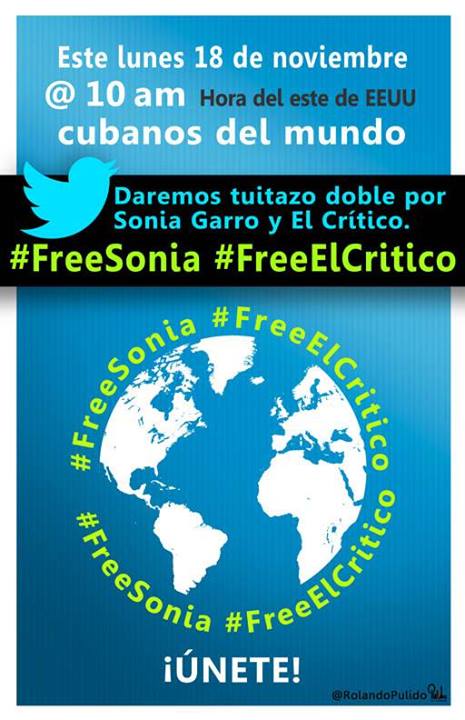
 From Yoani’s Twitter account
 From Yoani’s Twitter account
From Yoani’s Twitter account