The recovery of the electrical system is progressing as far as Camagüey, but a new breakdown in Guiteras is complicating the restoration of service.
 14ymedio, Havana, September 19, 2026 / More than 24 hours after the nationwide blackout that occurred this Friday, caused by the eighth total shutdown of the national power grid (SEN) so far this year, recovery was proceeding unevenly and unsteadily this Saturday. he National Electric Union (UNE) reported that the system was now connected from Pinar del Río to Nuevitas, in Camagüey, although it had not yet confirmed the connection with the easternmost provinces of the country.
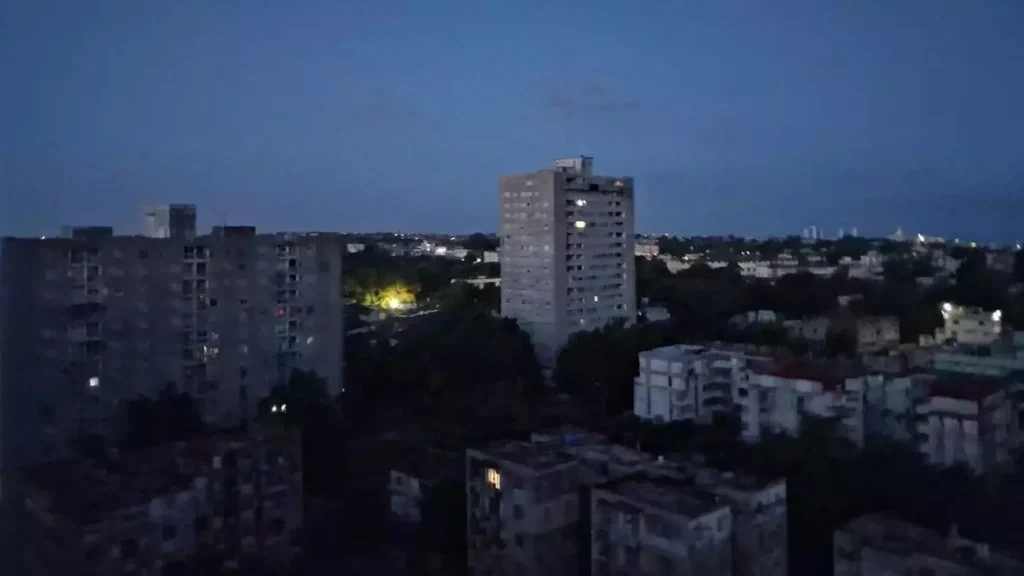
In Havana, shortly before 7:00 a.m., large areas were still without power, 14ymedio confirmed. Amid the darkened landscape of the Cuban capital, only the lights of a few generators and priority circuits could be made out. Many residents who had regained service overnight lost it again a few hours later.
The situation had not stabilized during the afternoon either. Havana’s Electric Company reported that it had restored service to 411,765 customers, 47.7% of the total, but clarified that numerous restored circuits had lost power again. Although 134 circuits had been energized since the outage, at the time of the update only 57 had service, due to the still incomplete recovery of the National Electric System (SEN) and blackouts caused by generation deficits.
The recovery is further complicated by a new breakdown at the Antonio Guiteras thermoelectric power plant in Matanzas.
The instability also affected the water supply. Although the capital’s 18 main pumping systems had regained power at some point during the crisis, only nine were operational when the company released its update. All 46 Havana hospitals had their water supply restored, according to official data.
The recovery is further complicated by a new breakdown at the Antonio Guiteras thermoelectric power plant in Matanzas. Its general manager, Román Pérez Castañeda, reported that the disconnection from the National Electric System (SEN) caused mechanical stress that damaged the boiler, where specialists suspect there are perforations in several points of the steam generator.
The facility needs about 72 hours to cool down, so technicians won’t be able to begin the inspection until Monday afternoon. Only then will they be able to determine the extent of the damage and set a timeframe for repairs. The plant, which had been operating for 44 consecutive days since its restart on August 4, remains offline and there is still no confirmed date for it to resume generating electricity.
Outside the capital, the recovery continued to depend largely on isolated microsystems, according to reports in some of the official newspapers.
Meanwhile, the Ministry of Energy and Mines reported that the Boca de Jaruco combined cycle power plant was generating power steadily, along with five units using companion gas, two units at the Mariel thermoelectric plant, and two more at the Santa Cruz del Norte plant. The two units at the Carlos Manuel de Céspedes power plant in Cienfuegos were in the process of starting up.
The total shutdown occurred at 1:57 p.m. on Friday. The UNE explained that the 220-kilovolt Matanzas-Cienfuegos transmission line tripped first, followed by the Matanzas-Santa Clara line. The system was divided between eastern and western zones before collapsing completely. The state-owned company also noted that unstable weather conditions had been identified in the area.
The 14ymedio newsroom in Nuevo Vedado had its power restored around 3:00 a.m., but was plunged back into darkness at 5:23 a.m. From there, it could be seen that large areas of the Cerro, Playa, and Plaza de la Revolución municipalities were still without service, while other parts of the city barely showed the lights of some buildings and generators.
The same instability was repeated in other Havana municipalities. A resident of Central Havana told this newspaper that electricity returned around 11:30 pm and was cut off again at 2:00 am. In Plaza de la Revolución, another resident received service around 10:30 pm and lost it again at 3:00 am.
A resident of Las Tunas told this newspaper that he had been without electricity for 40 hours, due to a blackout that had begun before the disconnection.
The situation outside Havana is much worse. A resident of Las Tunas told this newspaper that he had already gone 40 hours without electricity, due to a blackout that had begun before the shutdown.
Although UNE announced on Saturday that the national grid connection had progressed as far as Nuevitas, the restoration of power in numerous towns continued to depend on generation capacity and the condition of the distribution networks. During the first hours after the blackout, several provinces had to rely on isolated microsystems to supply essential services.
In Pinar del Río, the provincial power company reported, in a note published by Guerrillero, the creation of a generation island through the Pinar Oeste substation to supply the Abel Santamaría Provincial Hospital and other priority centers.
In Matanzas, Girón reported, citing the power company, on the gradual recovery of several circuits through micro-systems overnight. In Sancti Spíritus, Escambray reported, citing the provincial load dispatch center, that hospitals continued operating on generators and that the process was constrained by low fuel availability.
In Santiago de Cuba, Sierra Maestra reported at around 6:15 a.m. on the activation of micro-systems supplying circuits 7, 10, 15, 17, and part of 18, with priority given to vital centers. The publication warned that these are “isolated and vulnerable” systems, prone to failures and sudden interruptions.
Venceremos, of Guantánamo, reported at around 9:00 p.m. on Friday that the territory was operating through island micro-systems and that the circuits serving the General Hospital and the Children’s Hospital already had service.
Translated by GH.
______________________
COLLABORATE WITH OUR WORK: The 14ymedio team is committed to practicing serious journalism that reflects Cuba’s reality in all its depth. Thank you for joining us on this long journey. We invite you to continue supporting us by becoming a member of 14ymedio now. Together we can continue transforming journalism in Cuba.