The incident occurred in a house located on Compostela Street, between Sol and Muralla.
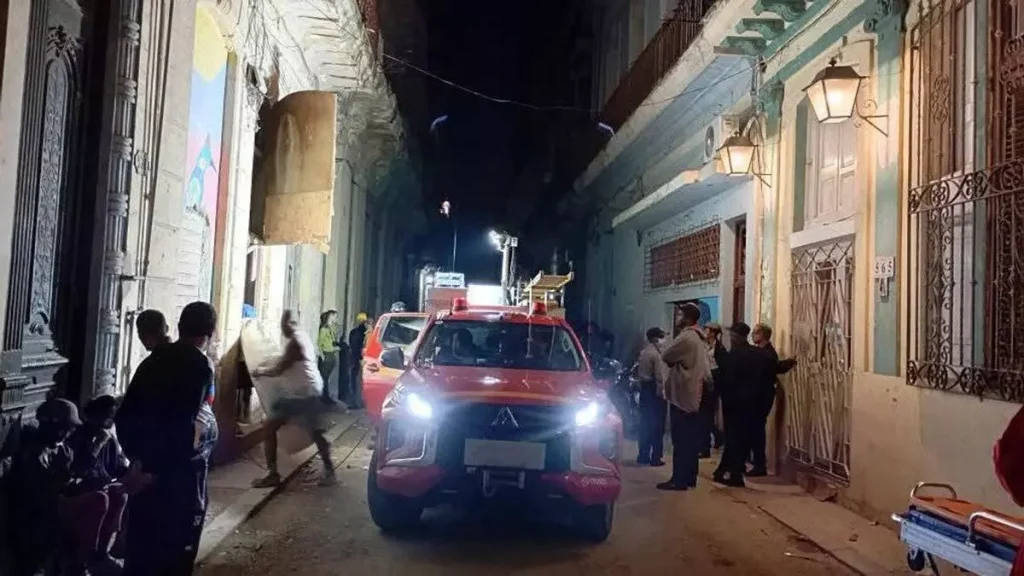
 14ymedio, Havana, November 16, 2025 — In the early hours of Sunday morning, another building collapse in Old Havana shook the residents of the capital’s historic center. The partial collapse of a house located at 568 Compostela Street, between Sol and Muralla, left two people dead: a mother and son, identified as Sara Paula Díaz, 64, and Carlos Fidel Sánchez Díaz, 38. The incident tragically coincides with the 506th anniversary of a city that, in recent decades, has become better known for its collapses than its architectural landmarks.
The incident occurred around 2:15 a.m., when the second floor of the building suddenly collapsed. Some neighbors reported that the loud crash woke them up, and that the first people to arrive tried to remove the rubble before the firefighters arrived. Rescue teams, along with the police and medical personnel, worked for hours to locate the victims and secure the area.
According to official journalists Lázaro Manuel Alonso and Alexander Ríos Cruz, the building had been in critical condition for years. Several families lived there, including a woman with four children, an elderly woman living alone, and a father with his adult son. They all lived aware of the risk, but without alternative housing or government support.
A Cubanet reporter also confirmed the building’s evident deterioration. Neighbors agreed that the collapse occurred at the rear of the building, where cracks and leaks had been visible for some time. Images circulating on social media showed rescuers, police, and onlookers gathered in front of the building, while emergency teams worked among the wreckage of the collapsed second floor.
The government itself has admitted that each year in the capital, around 1,000 homes collapse, either partially or totally.
This latest collapse adds to a long list of similar tragedies that frequently strike the Cuban capital. On September 28, also a Sunday, the partial collapse of a building located at 466 Sol Street claimed the life of an elderly man. In July, two consecutive collapses killed four people, including two young parents and their seven-year- old daughter.
The causes are well-known: buildings over a century old, overcrowded, and exposed for decades to humidity, salt air, and lack of maintenance. In Old Havana, thousands of buildings are at risk of partial or total collapse, as even official sources acknowledge. The government itself has admitted that some 1,000 homes collapse partially or completely each year in the capital, many of them occupied.
The deteriorating housing situation not only threatens the lives of residents but also reveals a profound institutional neglect. While authorities promote tourism projects and build new hotels, Havana residents’ homes are literally sinking. Urban renewal is progressing in the areas most visible to tourists, but it leaves out the alleyways and vacant lots where tens of thousands of people live.
The scarcity of building materials, bureaucratic hurdles in accessing subsidies, and the inefficiency of state-owned enterprises are exacerbating the crisis. Faced with a lack of solutions, many families are forced to live in conditions that expose them to the risk of roofs, walls, and beams collapsing. State-run shelters often offer only overcrowding, a lack of privacy, and basic necessities, leading some to return to their dilapidated homes despite the danger.
____________
COLLABORATE WITH OUR WORK: The 14ymedio team is committed to practicing serious journalism that reflects Cuba’s reality in all its depth. Thank you for joining us on this long journey. We invite you to continue supporting us by becoming a member of 14ymedio now. Together we can continue transforming journalism in Cuba.