The official newspaper Escambray publishes a report on the systematic violation of the regulation in the free trade zone and across the rest of the country
14ymedio, Madrid, August 4, 2026 / Although Cuban legislation requires that payments in the Mariel Special Development Zone (ZEDM) go through the banking system, so that accounts can be monitored according to international standards, reality is different. That is what a report published this Tuesday by the official Sancti Spíritus newspaper Escambray reveals, showing that none of the regulatory efforts aimed at eliminating cash are working on the island.
The article, the first in a series, draws on testimonies from private merchants and business owners who explain the failed push toward banking. Three years ago now, in August 2023, the authorities established – through Resolution 111/2023 – a set of rules limiting cash payments to 5,000 pesos and requiring all economic actors to take the necessary steps to be able to collect payment by transfer. Customers were free to choose how to pay, but sellers were obligated to accept whatever method they were told to.
The system has never worked the way the government intended. Cubans’ distrust of the banking system, and of putting their money – with its highly volatile value – in the hands of financial institutions, has been among the main causes. In addition, private businesses have needed cash to buy dollars on the black market, which are essential for importing goods and continuing to stock their businesses, and this has prevented money from recirculating: as a result, banks lack cash and customers cannot, in practice, withdraw what they have deposited. The country’s high inflation has made the situation worse.
“That business about payment by transfer being the law – only you believe that, reporter”
“I have three months’ salary trapped on my card, and I’m in debt,” a Cuban woman tells Escambray, showing the reporter 1,000 pesos and explaining that she hasn’t been able to withdraw any more. “I can’t even buy myself a snack with that,” says another woman who received the same amount despite having been waiting in line since 3 a.m. Although just a few days ago – in mid-July – the Central Bank of Cuba issued a new resolution eliminating the 5,000-peso limit, the consequences remain to be seen. “That business about payment by transfer being the law – only you believe that, reporter,” one of the interviewees snaps at the journalist.
The regulation, the reporter states bluntly, “is one of the most widely violated in Cuba.” Refusals to accept payment by transfer have been extensively documented by the press, both official and independent, including 14ymedio, but the scale of the problem is even greater than previously known. Some sellers, the article notes, have taken to charging a kind of toll for accepting bank payments, something the law expressly prohibits, but which the liberalization of prices – now that price caps have been eliminated – could help conceal.
“There’s no other option – right there in Mariel (Development Zone) everything is in cash and in large bills or dollars,” says one interviewee, who then adds, as his phone rings: “Look, I have to run, because this guy is going to give me cash in exchange for a transfer at 20 percent. Yesterday it was at 35.”
“There’s no other option – right there in Mariel (Development Zone) everything is in cash and in large bills or dollars”
The regulations governing the ZEDM are clear. Since its creation in 2013, the law has established that “concession holders and users open accounts at the banking institutions of their choice established in the Zone, through which they carry out the collections and payments arising from their operations.” There is additional legislation surrounding the obligations of those operating in the enclave, such as Resolutions 342/2021 and 117/2020. In principle, cash is intended only for very minor petty-cash transactions or consumer expenses by those working in the zone, never for wholesale buying and selling. Since the purpose of this zone was to encourage foreign investment – which has fallen far short of what was expected – traceability was meant to be the rule.
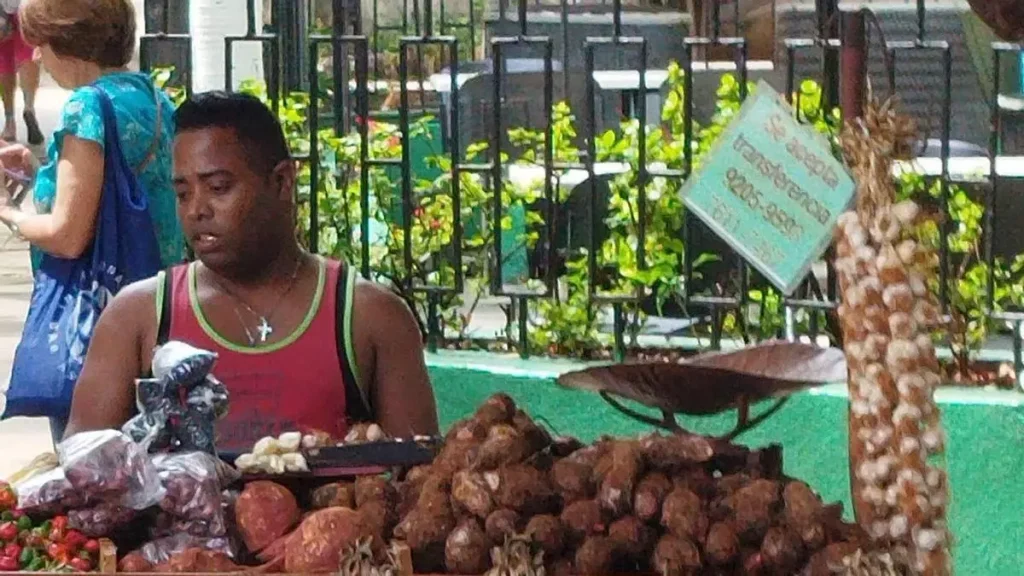
The reporter, who gathers a wide range of testimonies from merchants who claim they cannot accept transfers if they want to retain purchasing power afterward, visits, as part of her reporting, a fair in Sancti Spíritus where, she states, the law is enforced only under the threat of inspection. However, as soon as it’s possible, people try to evade it. “Take down the little sign (Transfers accepted), pal, you’re going to ruin business for us,” says the owner of a smoked-meat stand.
Eidy Rojas González, who runs a meat stand, says she has more than 800,000 pesos stuck in her card that she cannot withdraw, and that she even filed a complaint against the bank in Cabaiguán, though it agreed to give her 200,000 once it had the money. “I told them: ‘Can you give me a piece of paper so that when an inspector comes I can tell him: I, Eidy Rojas González, have all my money in the bank, I can’t accept a transfer’? But the bank couldn’t care less about that. In the countryside, nobody will sell you a pig that way,” she laments.
“Since January I’ve been registered with the bank and there’s no way they’ll give me a single peso. How exactly do they expect us to accept transfers?”
Another vendor says a woman complained because he wouldn’t accept transfers. “I told her: Can you read? Read this: ‘Two million and change.’ Since January I’ve been registered with the bank and there’s no way they’ll give me a single peso. How exactly do they expect us to accept transfers?”
The testimonies are numerous and reveal the harsh reality of the situation, though many questions remain unanswered: “How many businesses have been shut down, and how many owners have faced legal action? What do the banking compliance commissions do with the lists of violators? Why are bank deposits nearly bankrupt? Why do inspectors only act when there’s a complaint about a refusal to accept transfer payments? Will fines solve the cash payment problem?” the outlet asks. We’ll have to wait for the second installment of the series to find out the answer.
Translated by GH.
______________________
COLLABORATE WITH OUR WORK: The 14ymedio team is committed to practicing serious journalism that reflects Cuba’s reality in all its depth. Thank you for joining us on this long journey. We invite you to continue supporting us by becoming a member of 14ymedio now. Together we can continue transforming journalism in Cuba.