The two countries restored relations in 2024 and opened diplomatic missions in 2025 in both capitals, provoking North Korea’s displeasure
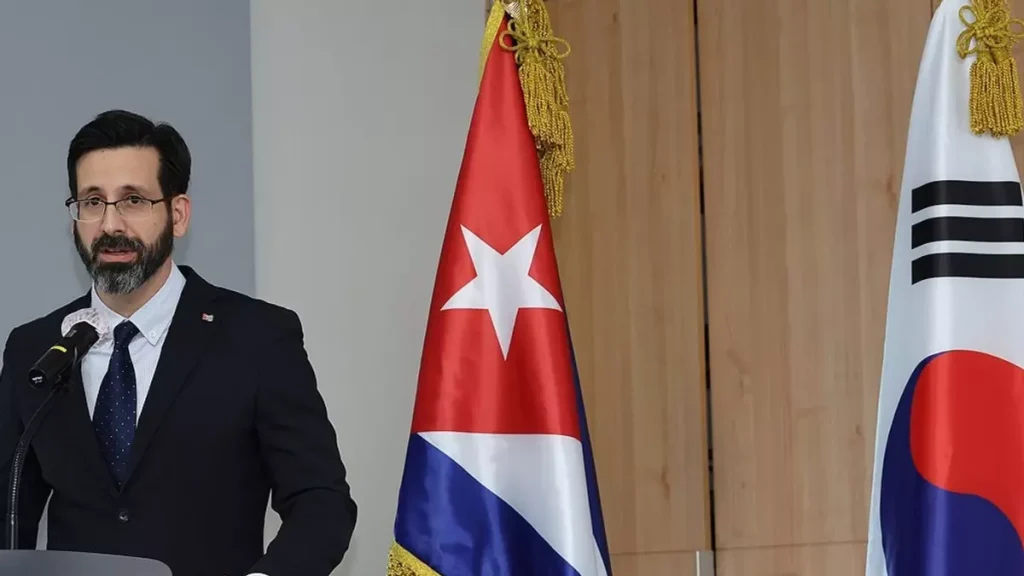
 14ymedio, Madrid, September 17, 2026 / Half of the diplomats at the Cuban Embassy in Seoul have recently returned to Cuba, reducing the island’s representation in the Asian country from four to two. The information was revealed by the newspaper Seoul Economic Daily, which cites a source from the South Korean foreign ministry and specifically indicates that the return is not due to a routine staff rotation, but rather a decision made by Havana.
Remaining in Seoul are Ambassador Claudio Monzón and Counselor Patricia Flechilla Prometa.
When consulted by the outlet, the Cuban Embassy gave no explanation for this significant staff reduction, but asserted that the decision has no political motivations. In diplomatic circles, according to the Seoul Economic Daily, there was some concern that Havana might have wanted to express some discontent with South Korea this way or, worse still, that it could be a step backward in the recovery of relations between the two countries. Seoul, the outlet notes, has made a significant effort in recent years to win the trust of North Korea’s traditional allies, as is the case with Cuba.
Seoul, the outlet notes, has made a significant effort in recent years to win the trust of North Korea’s traditional allies, as is the case with Cuba
The reopening of the embassies in Havana and Seoul formalized the restoration of ties broken in 1959, when Fidel Castro came to power and severed relations with the country, while exchanging diplomats with North Korea in less than a year. For decades, South Korea and the island lived, in a sense, with their backs turned to each other, though a relative rapprochement began in 2015, coinciding with the thaw between Washington and Havana. That year, economic exchanges in technology and energy began, though they were limited by the lack of a favorable diplomatic setting.
In 2022, according to data from South Korea’s Ministry of Foreign Affairs, the country exported goods to Cuba worth 14 million dollars and imported another 7 million dollars’ worth. Before the pandemic, around 14,000 South Korean citizens traveled to the island each year, and around a thousand descendants of Koreans who migrated during the Japanese occupation (1910-1945) lived in Cuba. All of them need “systematic consular assistance,” the foreign ministry warned in 2023.
In February 2024, Seoul surprised many by announcing the restoration of relations with Havana. The statement noted that Cuba’s government was the only one on the continent with which it had no ties, even though “the two countries have expanded cooperation, focusing on non-political fields such as culture, people-to-people exchange, and development cooperation. In particular, it is considered that the spread of friendly awareness between the two peoples through recent active cultural exchange contributed to the establishment of diplomatic relations between the two countries.”
In early 2025, it was announced who would head the diplomatic missions, with Claudio Monzón in Seoul and Lee Ho-yul – who until then had been part of the delegation in Mexico – in Havana. “We hope the opening of the embassy will improve the comfort of our citizens residing in or visiting Cuba by providing them with consular services and protection, and that it will contribute to expanding exchanges and bilateral cooperation,” the South Korean Foreign Ministry said in a statement in mid-January, when it opened the mission.
At the time, the Asian press was already speculating about Pyongyang’s displeasure, to the point that North Korean media went nearly a year publishing almost nothing about Cuba – an anomaly in the country and a symptom worth noting in such an opaque nation.
The state news agency KCNA briefly reported on the New Year’s message sent by Kim Jong-un to Miguel Díaz-Canel, notably omitting the usual references to Cuba’s “brother people.”
According to the ‘Seoul Economic Daily’, there are five people posted at the South Korean embassy in Havana and there are no plans to make changes
The diplomatic rapprochement has been very effective in the areas of humanitarian cooperation and trade exchange. The South Korean government has made significant shipments of food aid, with rice as the main item, and provided technical assistance to address the energy collapse the island is suffering. This June, delegations from the Cuban Chamber of Commerce and the Korea Importers Association (KOIMA) held a meeting in Seoul to boost bilateral trade, which has stagnated at around 40 million dollars – 43 million in 2023, of which 36 million favored the Asian country.
The main products exported from Korea are technology, vehicles – especially heavy machinery – and plastic products, while Cuba sends tobacco, alcohol, scrap metal, and biotechnology products.
“Companies cannot approach the market the same way they would elsewhere,” Ambassador Lee said this June, while calling for business deals to be analyzed “case by case” to avoid problems with sanctions. “Korean companies with assets or financial ties in the United States should act with a high degree of caution,” he added.
According to the Seoul Economic Daily, there are five people posted at the South Korean embassy in Havana, and there are no plans to make changes.
Translated by GH.
______________________
COLLABORATE WITH OUR WORK: The 14ymedio team is committed to practicing serious journalism that reflects Cuba’s reality in all its depth. Thank you for joining us on this long journey. We invite you to continue supporting us by becoming a member of 14ymedio now. Together we can continue transforming journalism in Cuba.