The institution avoids the “media show” that, in its view, occurred this Monday, when about twenty students gathered on the steps to demand the resumption of the academic term.
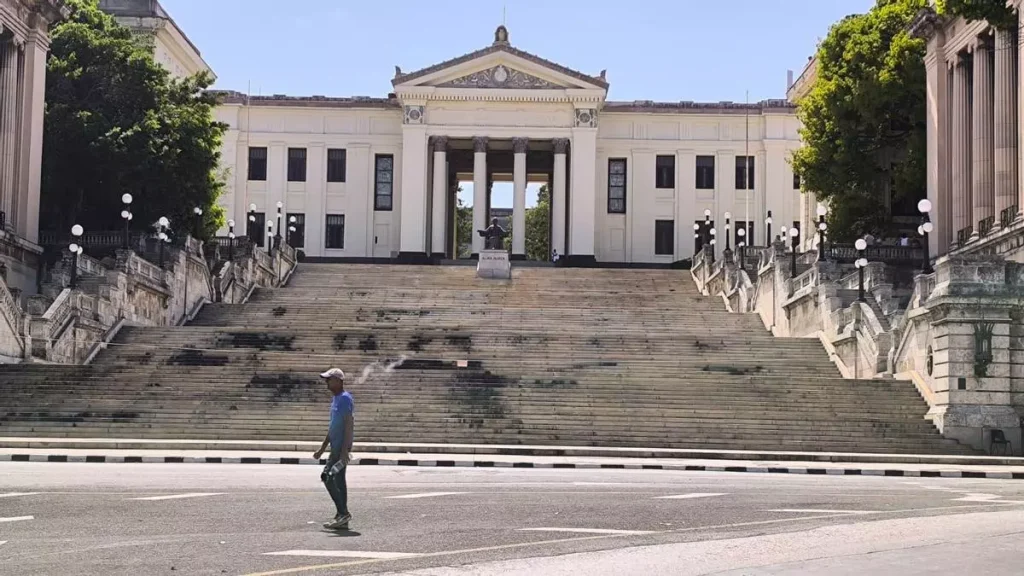
 14ymedio, Havana, March 10, 2026 – Cuban authorities seem to have achieved their objective of deactivating the continuation of Monday’s university student protest. The students had called for a dialogue this Tuesday at 10 a.m. in Víctor Hugo Park, but they moved the activity indoors at the request of the rector’s office. “After a fruitful negotiation, the University of Havana (UH), as an institution, has provided us with a classroom for our meeting in order to avoid unnecessary attention, the presence of the press, and agents external to the student body,” they announced in a WhatsApp group created to coordinate the actions.
The message indicates that the steps will once again be the meeting point for those who wish to attend the exchange, but from there participants will move to the room “enabled for use.” In this way, the institution avoids the “media show” that, in its view, occurred this Monday, when about twenty students gathered in that iconic place to demand the resumption of the academic term, which had been suspended due to extreme energy-saving measures taken to confront the energy crisis, aggravated by the U.S. oil blockade and transportation problems.
For the meeting scheduled for today, the student body has indicated some “parameters” to follow. “First, to clarify that our intention is to gather the opinions of students belonging or not to UH who are integrated into the higher education system. Second, that there will be zero tolerance for those who, through words or actions, hinder this process. This also implies zero tolerance for acts of provocation, vandalism, or eccentric behavior that ultimately damage the reputation and credibility of the process. Thank you in advance.”
“Where are the results, what the students are asking for? Oh, right, next week they will meet again to explain that they are ‘still’ working on it.”
These recent messages suggest that the idea promoted by the Cuban government has taken hold, that yesterday’s action serves “media outlets” seeking a “media show with the clear intention of harming” the Revolution. The students will discuss their demands behind closed doors in order to present their concerns to the Minister of Higher Education, Walter Baluja, who, they say, “agreed to listen to the claims of those present.” Next Monday, March 16, a meeting is scheduled for the entire university student body at UH with the aim of unifying positions.
The situation appears to have calmed after alarms were raised yesterday, when State Security prevented people from joining the initial group of participants. Official media reported the incident as an exchange of views with Baluja, who went to the steps due to the commotion, and the UH rector. Commentators in state media themselves have shown disagreement with the way that press coverage was handled.
“Let’s see… the students PROTESTED, just as Fidel Castro and Mella once did. Is that journalism?” said a Cubadebate reader on social media. Although another user repeatedly responded to those questioning the approach by asking why no one complains to the “pedophile master of the North,” most expressed their discomfort. “They are hypocrites trying to whitewash the student protest,” another commented. Most doubted the issue would be resolved, no matter how many meetings are held: “Where are the results, what the students are asking for? Oh, right, next week they will meet again to explain that they are ‘still’ working on it. Ok, thanks for the information.”
University students have expressed their displeasure over the postponement of the academic term, but they seem to fear a larger escalation in a context where fear still dominates the population.
“When you protest, you can’t find a job. They take measures against you or your family,” a sociology student from the University of Artemisa told the Reuters news agency. On Tuesday Reuters published a report from San Antonio de los Baños noting that guaranteeing anonymity is still the only way to get Cubans to speak about the regime. During a tour through several areas near Havana, the agency found about a dozen people willing to identify themselves, but the rest preferred to hide their identity. “People are not going to get involved, because in real life nobody wants to be imprisoned again. The people have no way to defend themselves.”
Translated by Regina Anavy
______________________
COLLABORATE WITH OUR WORK: The 14ymedio team is committed to practicing serious journalism that reflects Cuba’s reality in all its depth. Thank you for joining us on this long journey. We invite you to continue supporting us by becoming a member of 14ymedio now. Together we can continue transforming journalism in Cuba.