You Look and You Can’t Buy / Rebeca Monzo

These days, I have been working hard to earn a little money to be able to go shopping, not to buy food, like always, but to buy some garlands for Christmas, because each year I have to update them, because most break very easily.  I imagine that they are made that way on purpose: for a single season.

In spite of the persistent drizzle, I wanted to go, but really, I needed to distract myself a bit.  Upon arriving at the department store La Puntilla, I ran enthusiastically to the place where they sell the decorations for the holidays at the end of the year.  When I approached the garlands and checked the prices, I could do nothing less than show my amazement to the sales lady, because in previous years it always that place where I got the lights for my tree. The same ones, that in previous years I could buy for a little more than 4 CUC (Cuban Convertible Pesos, 1 CUC = 1 $US), now cost 11 and up to 14.  To my amazement, the employee gave me an explanation, that according to her she is used to giving to her clients: The problem is that we buy large packages, hence the prices, you should try to look for the ones that come in small packages, those are cheaper.  I didn’t understand anything, but also I didn’t insist on clarifying the concept, I preferred to watch an old movie repeat of Cantinflas.

I went by the shelves where the china and housewares are, and that is where I had to have intensive therapy; they had some china, square, oriental style, with a simple printed design, and they were marked 61.80 CUC.  I thought that was for a dinner service complete with Sushi, Japanese Chef, and everything! But the store clerk explained that it was the price of each plate. Immediately I understood why the employees were yawning, there wasn’t anybody buying, all the departments didn’t have any customers, and the few that went by, looked and continued on.  And this was Sunday!

Translated by: BW

November 7 2011

Craziness in the Neighborhood / Rebeca Monzo

Yesterday was payday for retired people and active workers who collect their pay by debit card. The wandering to and fro by people of various ages, in search of a Cadeca (a place where money can be exchanged), a bank that doesn’t have long queues (lines) or for an ATM that works, arouses disgust and some heated remarks between the neighbors of our neighborhood. It should be noted that the payments to retired people don’t happen at the end of the month as was custom some time ago. One fine day in one blow, they changed them to the first few days of the following month, bringing with it the agony of being without a penny extended, therefore, a couple of days more.

But this was not the case for my neighbor, who still works, and collects her pay by debit card. She was very needy the same as the vast majority of people collecting, even more so because she had to make a payment that had a due date. She went in search of an ATM and that’s where here odyssey began. The one at the Ministry of Transport was broken, the one at the Cadeca didn’t have any cash, the same thing happened at the Bank of the Ministry of Agriculture, finally, she went through all of the ATMs and banks in the neighborhood, and couldn’t get cash at any of them, because the only same was working and had available funds, but had a long line that wasn’t moving. She joined that very line and a little while later she overheard a conversation between two people.

One, an older person said to a young person: I don’t know what’s going on, I just went by the agricultural market of the YLW (Youth Labor Army) and they didn’t have anything, nor did the one on Tulipán, nevertheless, the self-employed individuals in their trucks have everything. How is it that the State is not able to supply their farmers markets and but the self-employed can!

The young person, without getting upset, answered: Lady, you yourself just answered your own question, because the State, as you rightly said, is not capable, at least that is what it has demonstrated so far.

The woman, without answering back, moved in the line to move away a little from the young person. Meanwhile, the rest continued complaining to each other about the slow way that they advanced. Finally, my neighbor, abandoned the line protesting without being able to achieve her objective, walking to her house frustrated and indignant, to use a word that is so in style.

Note: the photo had to be taken from far away, because the guard at the Cadeca at Panorama and Tulipán wouldn’t let me get close with camera in hand, he told me that I couldn’t take photos there, and I told him that he should show me documentation of the prohibition, and he answered that it didn’t exist, but that it is forbidden.

Translated by: BW

November 7 2011
Metamorphosis / Rebeca Monzo

Archive photo

On my planet much has been spoken about bad things or criminal acts, where one can see children involved, happening elsewhere in the world, excluding in fact, with this phrase, any allusion to our own children.

However, these reports do not appear to have taken into account that which has been so much insisted upon by international organizations dedicated to the physical and mental health of children: keeping them at a distance from politics and certainly not using them for political ends.

It seems that the director of La Colmenita — the Beehive — has ignored this precept; the group’s program on a tour of the United States includes a work called Abracadabra, where these child actors are utilized for ultimately political objectives.

If they continue down this direction on their artistic path, soon the innocent little bees will end up becoming wasps. I don’t believe that the children deserve to pass through this unpleasant metamorphosis.

Translated by: BW

October 20 2011

Media Saturation / Rebeca Monzo

Mayonnaise and ketchup that made it through the "blockade"

On my planet more than fifteen days ago the media was bombarding you at all hours and at every moment with The Five Heros, The Criminal Blockade, and the battle-hardened and invincible people who are our athletes. From all this this, of course, the most refreshing thing is to spend time watching the Pan American games, but pushing the mute button on the television, because ladies and gentlemen, to listen to our sportscasters, is like reading the newspaper Granma, holding your breath.

In every moment, still on the sports news, they obligatorily introduce the same old topics, or make reference to them. In truth, nobody can stand it, We could say that the indoctrination is “up until the soup“*, if it wasn’t that this tasty dish disappeared a long time ago from our tables. Our sportscasters are better known as political commissioners. That entails a visible lack of seriousness and professionalism: they are simply intolerable.

With each change of program, they introduce the subject of the great triumph of Cuba in the United Nations. What they don’t clarify is that certainly no country agrees with imposing a commercial embargo against another, simply they manipulate it as if those 186 countries that voted in favor of the lifting of the blockade, were in agreement with our domestic politics.

Likewise, all of the mutilated news that they offer us is, moreover, manipulated, leaving an information limbo for all who follow it and don’t have access to other media. They stress the cultural embargo that the U.S. imposes on us and I ask myself, then how is that La Colmenita, Silvio Rodríguez, Pablo Milanés, Los Van Van, La Aragón and other artists and groups of the island, constantly visit that country.

Nevertheless, why don’t so many Cuban musicians of a high caliber come over from there, musicians who moreover are very well-known here in spite of the censorship,who not only are denied entry, but they also prohibit the popularization of their music on our radio and television, depriving us during more than a half century of following them and enjoying them publicly and freely, without being forced to obtain their recordings clandestinely. We are truly, more than saturated from so much media propaganda.

Translated by: BW

* Translator’s note: “Up until the soup” means that something is seen everywhere.

October 27 2011

Reactions / Rebeca Monzo

Foreign press photo

He who lives by the sword, perishes by the sword, this very old refrain, I’ve been hearing it said since I had use of reason. My grandmother used to apply it constantly to people who have taken on a life of delinquency and crimes, and who finally fall into the hands of justice.

The images (the few that go by briefly on the TV in my planet) certainly are horrendous, you see Ghadafi, shot, bloody, and shoved onto the rear part of a vehicle. Those that have an antenna have told me that those that have spread around the world are really raw, but they haven’t inspired pity, but in every case, horror. That is owing to the fact that, without a doubt, this tyrant was really cruel to his adversaries, in his more than 40 years of dictatorship. After all, in these last few months, since his people came out against him and, instead of resigning and leaving (like they proposed), he insisted on staying, clinging to power and massacred everyone who dared oppose him, without feeling the least of pity for his opponents. That’s why the awful death that destiny reserved for him, the same one that surprised him trying to flee, as do the cowards who send others to fight on their behalf, while they don’t reach the gunpowder of the battle. Finally, his cadaver, after being on display for several days, as is the custom in these cultures, was buried in an unknown location in the desert, turning the page on one of the bloodiest chapters in Libyan history. Again the popular Spanish refrain, becomes a fount of knowledge: He who lives by the sword, perishes by the sword.

Translated by: BW

October 28 2011

So Long, Laura! / Rebeca Monzo

Photo taken 8/13/11

Brave, honest, sincere woman. She was obliged to confront the pain of the offended, insulted, trampled on by their own compatriots, most of them women, which were convened by the degrading tyranny, only some days ago surrounded her home, where and a group of the Ladies in White met, to go out in a silent march, raising pink gladioli, towards the church. They were surrounded by a convened mob that threw insults and dirty words, offending them and not letting them leave the building, shielded in the courage that flourishes in the cowardly, when in a group and protected by the authorities.

How must many of them who learned of the news of the passing away of this brave woman feel? Are they capable of realizing, in their mediocrity, that they were being paid to reenact those embarrassing rallies of repudiation of the 1980s?

The story, earlier rather than later, will, I’m sure, come back.

This is a very sad and grey day, as if nature itself wanted to join in the pain of her family members and friends, to show the sorrow that her departure has left us. So long, Laura!

Translated by: BW
October 16 2011

Family Recipe / Rebeca Monzo

In order to not continue losing our recipes, for lack of supplies or for how difficult it is for to get them in here, I am posting this recipe for your consideration, with the hope that those who are keen on the culinary arts will make it.

Catalonian Coca* (Family Recipe)

Before getting started, preheat the oven.

For the dough:

1 lb. of wheat flour (4 cups)

1/2 pound of refined white sugar (2 cups)

1/4 lb. of shortening (1/2 cup)

2 tablespoons of butter

1/2 teaspoon of salt

2 tablespoons of baking powder

2 tablespoons of dry white wine

3 eggs

So far things are going more or less well.

For the sauce:

1 can of tuna in oil

1 small can of baby peas (drained)

I can of red peppers (use about two)

1/4 pound of headless shrimp

2 hardboiled eggs for garnish

1 large chopped onion

4 cilantro leaves finely chopped

The first four ingredients are the hardest for us to get, but if anyone following me here, in my planet, has FE (Family in the Exterior), then they can give you the ingredients to make this recipe.

Procedure to make the dough:

Sift the dry ingredients and add the fat, breaking it up with a pair of knives until it is small lumps.

Add into the center of these ingredients, three beaten eggs and the dry wine.

Roll out the dough with a rolling pin to make a rectangle approximately the diameter of the pan to be used. Place the dough in a rectangular pan, greased. Separate out a small portion to make lattice strips.

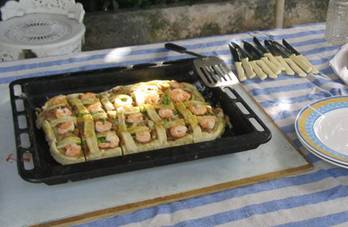
Spread the tuna mixed with onion, cilantro and baby peas across the dough. Take the extra piece of dough and cut it into strips, and make a grid (see the photo). Place on each square a piece of hardboiled egg, a shrimp, and two strips of red pepper, folded. Varnish the lattice with beaten egg.

Put in the oven, about 35 minutes.

In these times of so many wars, there is nothing more relaxing than to make a good recipe to share with family. Bon appetit!

*Translator’s Note: Catalonion Coca is a pastry typically made and consumed in Catalonia (region in the Eastern part of Spain)

Translated by: BW

August 28 2011

Architectural Horrors / Rebeca Monzo

From some few years back, it has been unleashed on the city, I’m not sure if it has in the country, I don’t have the data, but I submit that it is expanding here like a epidemic, it may have arrived in other provinces: the taste for columns. To someone to whom it occurred to begin and copy them, mimicking those that were used a lot in the architecture of the 30s and 40s, and that in some cases, for certain more modern constructions of the colonial style were a big hit. Also it the same thing has happened with Spanish tile and Jaimanitas stone.

I am in total agreement with the aforementioned construction and styles of those ages, they look very nice, always and when they are placed appropriately. But what is unforgivable is that to be in style they use them in houses and facades of the 1950s, that are characterized by designs of clean straight lines and curves, but they have nothing to do with the famous columns, and in doing so they succeed in just destroying their architecture. There doesn’t seem to be anyone putting a stop to this. I don’t know why those famous community architects are silent about it, or those who have to authorize those remodeling projects, who permit a similar atrocity, uglifying the city that was characterized by its beautiful architecture more each time.

Here I have some bad examples:

A building from the 1950s, whose first floor and common areas of the yard have been closed and converted with the unusual columns and tiles that have nothing to do with the rest of the building, similar to the painting. The La Timba Neighborhood, Plaza. It was a beautiful apartment building before this capricious transformation.

Three story building, from the 1950s, whose first floor was remodeled as well, without taking into account the original architecture. Nuevo Vedado, Plaza.

I think that who is truly guilty are the authorities who are named precisely to guide and authorize or not, these changes to the outside of these buildings. Please, folks, let’s not continue uglifying our city or treating it like our enemy.

Translated by: BW

August 17 2011

Affinities / Rebeca Monzo

Menu from 1963. Text: INRA National Park, Zapata Peninsula, Cafeteria De La Boca, Cook's Recommendations

The Cuban Film, Affinidades (Affinities), by Jorge Perogurría and Vladimir Cruz, awakened my interest, which is why I decided to to rent it for this weekend, because I still was able to remember the two of them in Fresa y Chocolate (Strawberry and Chocolate).

For me, I am not a critic of movies nor much else, although as a movie fan, it was like watching a tourist postcard, printed and flat.

All of the action takes place in the beautiful setting of Cienaga de Zapata (it just suffers from this). A quartet composed of two Cuban men, one ordinary technician and another high-ranking official, a Cuban women, wife or girlfriend of the first, and a Spanish investor, who apparently had an intimate and business relationship with the official of Aguas Habana.

As soon as they arrive in a small boat that makes this journey towards the Tesoro Lagoon, where a touristy area is found, the crossed looks start, a childish omen of what is to come.

From the disguised waiter, with extreme imposed kindness, who constantly winks at the official, the use of curse words out of context, the excessive fervor of the investor (the only great acting), played by the Spanish actress Cuca Esribano, up to the incomprehensible and excessive innocence that fades away like magic, of the wife, woman, or girlfriend of the ordinary technician, who throws her into the ring of the boss’s appetites to ensure his job, before the impending layoffs which will take affect in the workplace.

The night of the Taíno Show, in the cabaret restaurant in the tourist center, lacks authenticity (even though it is valid in the film) with the presence, somewhat anachronistic, of Omara Portuondo singing a bland song, until the sexual apotheosis, a Pas de Quatre type, that doesn’t add anything to the film, until the final exit by car along an infinite causeway, all gives the sensation that he came from nothing and left with nothing.

The only contribution for our eyes was the marvelous natural but mutilated scenery of a marsh without crocodiles or exotic birds.

If you would like to lose an hour and thirty minutes, which is about how long this film lasts, without seeing anything interesting, then I recommend it!

Translated by: BW

August 7 2011

Monumental Horrors / Rebeca Monzo

In the past few days, I wrote about architectural horrors, today I am going to dedicate this post to the aggressions committed against our monuments.

Walking through the neighborhood of El Vedado, as always with my little camera in hand, I stopped to look at the little park that splits the road in two.

There I was observing the state of abandonment and deterioration of the green spaces and painfully I could see it, the pillaged base of a sculpture of the famous musician Johann Strauss, covered in gold leaf (too shiny perhaps for our strong sun), donated by the Vienna Embassy to the people of Cuba.

Without any respect, the statue was mysteriously removed, under the sleepless eyes of the always alert CDR (Committee for the Defense of the Revolution), something truly incomprehensible, since the thieves would have had to have a truck at their disposal to take it away and would have made plenty of noise separating it from its pedestal

Also left there to the embarrassment of all, the stone with the dedication of the monument.

Unfortunately, this isn’t the only case, sometimes by theft, and other times by political motives, statues and parts of monument that shape the ornate history of our city have been destroyed, mutilated, and stolen. We remember the Maine Monument whose eagle was torn out, under the pretext of replacing it with a Picasanian dove that never arrived, as well as the statue of that President of the Cuban Republic, all that was left to remember him by was his pair of shoes. Also, they don’t have any respect for the sculptures and religious images of the Colón (Columbus) Cemetery, perhaps the most pillaged of our assets, considering by experts to be one of the most important necropolis, in design and monumental value, in the world.

I think it is the duty of all, to report these vandalisms to try to put the brakes on their impunity.

Translated by: BW

August 20 2011

R&R Cigar / Rebeca Monzo

It was a very fashionable refrain when we were kids. Right now, it again seems to occupy the foreground in the media of our planet: rescue the railroad right of ways, rescue agriculture, rescue the sugar industry, rescue the fishing fleet, rescue urban transport, rescue the dry cleaners, rescue the hair salons, rescue the bovine cattle, rescue the milk industry, rescue the food service, rescue the family doctor’s houses, rescue light industry, rescue the henequen plant, rescue, rescue, rescue.

The more I try to strain my memory, I can’t locate in which previous government it was that all this came down from, but I know we already spent 52 years with it. Why now, in the year 2011, is it that our leaders are informed of this and that everything I mentioned has to be rescued. Where were they (if they are the same ones), who didn’t realize that everything has deteriorated rapidly? With that mentality of always blaming imperialism for all of our problems, I don’t believe that we can move even a single step forward. If we continue giving time after time, implementing guidelines, studying even the most hidden places in the country and waiting for the proper implementation of these, the time will come when now there is nothing left to do. Well then we will go heads down, muttering the chorus goes like this: “R&R Cigar, R&R Barrel, the cars go fast, when there was a railroad.

Translated by: BW

July 20 2011

The Country Carousel / Rosa María Rodríguez Torrado

With its rustic figures of wood with a vertical tube going through it that no longer makes it go up and down, the little horses of Mónaco, en La Víbora, are the rusty gallop of boredom, the wheel of poverty in turns of hopelessness. With faces unexpressive of emotion, we purchased the rides for our toddlers on the plain slowness and monotony, to cross the doors of imagination in machines re-molded by abandonment and unrepaired from laziness.

That’s how we also find the adults, caught in the green map of prohibitions, with footprints of hammers of litanies and patched dreams of absence and silence. This unremarkable merry-go-round forces its tedious motor, whose arrhythmia of pistons can hardly turn the rusted structure.

Translated by: BW

July 11 2011

The Country Carousel

With its rustic figures of wood with a vertical tube going through it that no longer makes it go up and down, the little horses of Mónaco, en La Víbora, are the rusty gallop of boredom, the wheel of poverty in turns of hopelessness.  With faces unexpressive of emotion, we purchased the rides for our toddlers on the plain slowness and monotony, to cross the doors of imagination in machines re-molded by abandonment and unrepaired from laziness.

That’s how we also find the adults, caught in the green map of prohibitions, with footprints of hammers of litanies and patched dreams of absence and silence.  This unremarkable merry-go-round forces its tedious motor, whose arrhythmia of pistons can hardly turn the rusted structure.

Translated by: BW

July 11 2011

The Poet / Rebeca Monzo

(This story is fiction, based on reality)

My friend was finishing transferring to his flash memory, the last poems that, like all, had left his heart exhausted. Each time that he put the last period on one, he said that it was like having given birth. It is clear that this hadn’t happened out of his own experience, this sublime pain, but being the older son, he was the witness of the birth, one by one, of his fifteen siblings, and he could appreciate in the sweaty face of his mother, how painful it was.

Meanwhile, in the other bedroom, his wife hastily put in the suitcase everything that she understood was strictly necessary. After returning, because she knew return was inevitable, they would come loaded with gifts, books, and glory, things that weigh a lot and that would make the overweight fees very costly.

Whatever the case, his slovenly appearance urgently needed fixing, a product of none other than the extreme necessity brought by the passing years, leaving for the last moment the fixing of his teeth. They paid dearly and in the black market economy so that it would be done well. He knew that upon arriving at the town where his books wold be launched he would be obliged to smile and say some words of thanks.

The outbound trip was good, because really he didn’t bring more than the clothes he was wearing and a change for his arrival. His wife, friend, confidant, lover and editor, did the same, so that the luggage would be very light.

After a very tiring plane trip, they took the train. In Groñolo, the destination of both, a massive reception awaited them, with a band, regional dances, and streamers. Meanwhile, from the sky, an airship let mountains of confetti fall from the sky. It looked like it was snowing in the middle of summer.

Suddenly, the music stopped and the multitude of people began to chant his name and clap. He went up to the improvised podium, with his blue suit that the mayor had sent him as a gift and started his speech. As he was getting excited with his own words, he started to notice his tongue getting a little slipped-up: he felt that something was moving inside of his mouth. Relying on the serenity and grandeur that had always characterized him, he continued his address. Then those closest to the platform stopped paying attention to his words, to stoop to pick up those little white and shiny grains, that at first they believed were falling from the sky. When, suddenly, one of those who were present, raised up his arm into the air to show everyone his discovery: “It’s a tooth,” he exclaimed enthusiastically, “A tooth from our great poet!” Everyone crouched down to eagerly look for one, to take it as a souvenir. The poet, growing even bolder and without losing his composure, said, “I haven’t only come to offer the most passionate verses, projecting from my mind and heart, I also left you a little bit of myself: those teeth that you will take today as a souvenir, and that with great pleasure I will autograph, because even though acrylic, they are part of myself since what I paid was so very expensive.

The crowd, in the face of such words, acclaimed deliriously that great man that came from a small island far away, not only to deliver brilliant poems to them, but also his shiny teeth, no less, as proof of his love and friendship.

Translated by: BW

June 27 2011

4th of July / Rebeca Monzo

Today we celebrate the 235 year anniversary of the Declaration of Independence of the United States of America, a country of immigrants and grand opportunities, so defamed by some and so dreamed about by many. I, particularly, have some critics, who say that I am pro-American, they don’t offend me. It is true that I greatly admire that country. But, I was born, I grew up, and I educated myself feeling proud to be Cuban. That is contrary to others, who defame it, and they say they feel hate and resentment against it, but don’t miss the opportunity to shop in its famous stores, take their kids to Disneyland every time they can and dream that someday one of them will get a degree from one of its universities.

In any case, humbly from this, I join my space together to the happiness of the celebration.

Translated by: BW

July 4 2011