The external context has hardened just as the internal legitimacy of the system appears to be most eroded
The capture of Nicolás Maduro on January 3rd has put the Havana leadership in a difficult position. / Antonio Finlay/X
14ymedio, Yoani Sánchez, Generation Y, Havana, 25 January 2026 — I have lost count of the times the Cuban regime has been “on the verge of collapse.” I’ve heard it in diplomats’ after-dinner conversations, in expert analyses, and in the predictions of soothsayers who change their tune as easily as they change their shirts. One day it was the physical disappearance of the “supreme leader”; another, the supposed “imminent” fracture within the Armed Forces; then, the definitive economic collapse that, this time for sure, Castroism could not withstand. And yet, the country continued to wake up to its long lines, its managed fear, and its political inertia.
However, now, unlike in other times, those oracles might be right. The discontent is no longer a whisper; it is street corner conversation, arguments in the ration store, and exasperation in the bus line. Records of social conflict and protests reported by independent observatories paint a picture of 2025 with increasing numbers of public complaints, a barometer pointing to widespread and persistent unrest.
Is this the highest level of discontent since January 1959? No one has a scientific instrument to measure and compare decades of enforced silence, but I am convinced that three circumstances have never coincided so visibly: sustained material precariousness, the loss of fear in growing segments of the population, and the breakdown of the official epic narrative that for years served as anesthesia and a gag.
The scenario is unprecedented and fragile, because social unrest has ceased to be an exception and has become an everyday occurrence.
To this internal situation is now added a harsher international environment for the authorities. The capture of Nicolás Maduro on January 3rd has put the Havana leadership up against the ropes and reactivated pressure from Washington.
That is why, when people ask me if the regime is in its final moments, I don’t respond with unbridled optimism or fireworks about an imminent end. I say that the situation is unprecedented and fragile, because social unrest has ceased to be the exception and has become commonplace; because the economy no longer offers a margin to buy loyalties through perks; and because the external context has hardened just as the system’s internal legitimacy seems most eroded.
Endings, however, rarely happen as experts or prophets imagine. Sometimes they are not a sudden blow, but a drip by drip, a slow erosion that leads to extinction. In Cuba, the question is not only when the regime will fall, but what kind of country will remain standing when the dictatorship finally collapses upon us.
____________
COLLABORATE WITH OUR WORK: The 14ymedio team is committed to practicing serious journalism that reflects Cuba’s reality in all its depth. Thank you for joining us on this long journey. We invite you to continue supporting us by becoming a member of 14ymedio now. Together we can continue transforming journalism in Cuba.
New York Times, Opinion, Guest Essay, Yoani Sanchez, 16 January 2026.
The first messages in Havana about Nicolás Maduro’s capture, sent through WhatsApp before they reached official channels, were intermittent and contradictory. People felt hope and fear. Was something going to change here? many wondered as they waited in bread lines, at the bus stop or beneath the yellowish light of a rechargeable lamp during a blackout. The downfall of one of Cuba’s most important allies wasn’t a remote event for Cubans; it was a wave hitting us full on.
The most frequent question now heard by my colleagues at the 14ymedio news site, which I direct, is about what will happen to the Venezuelan oil, which Cuba relies on so much. Many Cubans have been overwhelmed by the particular worries of not knowing whether there’ll be electricity tomorrow, whether the refrigerator will shut off again, whether the struggling public transportation system will collapse. In markets, parks and hallways, they say, one comment is repeated over and over, with the same resigned cadence: “If there’s no more oil, things are going to be even worse.”
It’s not paranoia. In the fourth quarter of 2025, Venezuela sent Cuba about 35,000 barrels of oil a day. While that isn’t enough to keep all the island’s lights on, its industry functioning and its transportation flowing, it has kept the essential gears of our nation in motion. Losing that fuel, or having it drastically reduced, would be a severe shock to an economy that is exhausted, low on foreign currency, and increasingly constrained by American sanctions. Already a U.S. blockade of tankers has cut off some of the supply, and Mr. Trump on Sunday declared that Venezuela would send “no more oil or money” to Cuba.
It is true that Havana does not depend solely on Caracas. Mexico has kept up its fuel shipments, Russia sporadically lends a hand and we have low-quality local oil. But islanders aren’t kidding themselves. The Cuban regime has always been clear about its hierarchy of needs. If it is a choice between keeping the lights on in a hospital or guaranteeing fuel for police patrols, the balance will unerringly tip toward retaining a grip on society. A whole city will go dark before the state security headquarters does.
That is why the atmosphere among Cubans right now is not one of euphoria but anxiety. Some see Mr. Maduro’s capture as a spark that could set off a blaze on our island. “If the Venezuelan dictator can be removed, what’s keeping Castroism in place?” a young friend who has never known any other political system asked me.
In the opposition and in the Cuban diaspora, what happened in Venezuela is being interpreted as a sign that the unchangeable might change. Mr. Trump fueled that feeling by adding on Sunday, referring to Cuba’s government, “I strongly suggest they make a deal, before it is too late.”
Yet that desire comes up against an uncomfortable reality: After 67 years of the same regime and a mass exodus of those most opposed to it, Cuba does not have a well-articulated opposition group on the island that would be capable, in the short term, of vying for power.
Repression and banishment has largely dismantled the Cuban dissident movement. Its leaders are in prison, in exile or subjected to constant harassment. Emigration has sharply reduced the number of potential protesters for a popular revolt such as the one that erupted on July 11, 2021. Although widespread fear has waned, it remains a powerful deterrent in a country with nearly 1,000 political prisoners.
The regime has proved remarkably capable of surviving even greater cataclysms, such as the fall of the Soviet Union, its patron, and the abrupt loss of almost all its foreign trade in the 1990s that ensued. Its strategy, when it feels up against the ropes, is to radicalize its public statements, appeal to nationalist sentiment, sharpen its anti-imperialist slogans and make some timid economic reforms that serve as an escape valve. Granting amnesty to political prisoners, as brokered by the Vatican and Spain in the past, is another way to buy time.
However, Cuba is quite different from what it was after the dissolution of the U.S.S.R. There is no Fidel Castro to turn privation into heroism, no believable ideological narrative to seduce younger generations. Leadership of the Communist Party is disconnected from the people and deeply unpopular. President Miguel Díaz-Canel lacks charisma and the capacity to mobilize society in moments of crisis.
Furthermore, Mr. Maduro’s capture has made it clear that Cuban troops are not invincible, as the party line asserts. The death of 32 Cubans who the Cuban government said died during the operation and the speed with which Washington extracted Mr. Maduro were harsh blows to the image of Castroist security forces. Throughout the island, the powerful symbolism of that failure undermines the power of the regime to intimidate.
The next few weeks will be critical. If Chavismo manages to reorganize under Mr. Maduro’s vice president, Delcy Rodríguez, and Venezuela maintains its fuel commitments to Havana, the Cuban regime will breathe a sigh of relief. If, on the other hand, the negotiations between Caracas and Washington entail cutting the oil supply to the island and ending Cuban medical missions (one of Cuba’s main sources of foreign currency) in Venezuela, the fragility of the Cuban system will become even more manifest. That weakness does not guarantee a change but it could create visible fractures in the power structure, and cracks are always very dangerous to the survival of closed regimes.
On the streets of Cuba in recent days, my colleagues and family haven’t heard talk about revolution or transition. It’s been all about survival. But now, that talk of survival comes with a question that no longer sounds completely naïve: What if the time has come? It isn’t a gushing, radiant hope. It is something much more fragile and more real: the feeling that, finally, the future is no longer completely shut down.
Yoani Sánchez (@yoanisanchez) hosts the podcast “Cafecito Informativo” and is the director of the digital newspaper 14ymedio. This article was translated by Mara Faye Lethem from Spanish.
Havana reacted quickly, but it did so following a familiar, almost automatic script.
The Cuban regime’s alliance with Nicolás Maduro is not merely ideological; it is, above all, about energy and survival. / EFE
14ymedio, Yoani Sánchez, Generation Y, 3 January 2025 — In the early morning hours of Saturday, as darkness descended across large zones of the island, the political landscape of the Cuban regime’s main ally was being shaken. The United States carried out an attack on military installations in Venezuela, and shortly afterward, President Donald Trump announced that Nicolás Maduro had been captured and removed from the country.
Havana didn’t delay in reacting, but it followed a familiar, almost automatic script. From his account on X, President Miguel Díaz-Canel denounced “the criminal attack by the US on Venezuela” and demanded an “urgent” response from the international community. “Our zone of peace is being brutally assaulted,” he asserted. “State terrorism against the brave Venezuelan people and against our America,” he added in the hasty message, resorting to a rhetorical repertoire that is activated in Cuba whenever Washington makes a move on the continent. The biological clock of Cuban power was calibrated to respond before the sun rose and uncomfortable questions arose.
The speed of the pronouncement contrasts sharply with its lack of nuance. For Havana, the narrative has been clear from the first minute: imperialist aggression and violation of sovereignty. The old reflex of closing ranks with Caracas has once again prevailed, even though the regional and global context is very different today than it was a decade ago.
While the Cuban government is refining its condemnation, the reaction on social media has been less solemn and more down-to-earth.
While the Cuban government is finalizing its condemnation, the reaction on social media has been less solemn and more down-to-earth. As soon as the news broke, groups on Telegram and WhatsApp erupted. “Venezuelan oil is gone!” a young woman wrote to her family, bluntly and without slogans, putting her finger on the wound that really hurts on the Island. In a country plagued by daily blackouts, where the energy crisis is measured in hours without power and food spoiling, Maduro’s capture was immediately interpreted in domestic terms: what will happen now to the fuel that, for better or worse, keeps the Cuban electrical system afloat?
That popular interpretation says more about the current situation in Cuba than any official statement. The alliance with Caracas is not merely ideological; it is, above all, about energy and survival. That is why Havana’s inflammatory rhetoric sounds increasingly defensive, like someone shouting to ward off a very real fear.
Another phrase has also been repeated in the phone calls between friends that began before dawn: “Cuba is next,”a retiree from eastern Cuba said an audio message sent by Messenger, with a sense of finality from one who has been waiting for decades for the fall of Castroism.
The diplomatic and political alliance between the two regimes has been very close since the beginning of this century, which is why the “extraction” of the Venezuelan president leaves Havana more isolated in a regional landscape where it has lost much influence in recent years.
What happens in the coming hours is crucial for both nations, but it is already clear that the boastful and arrogant Nicolás Maduro is a thing of the past. The Cuban dictatorship will be watching him closely in his next appearances, like someone looking in a mirror.
COLLABORATE WITH OUR WORK: The 14ymedio team is committed to practicing serious journalism that reflects Cuba’s reality in all its depth. Thank you for joining us on this long journey. We invite you to continue supporting us by becoming a member of 14ymedio now. Together we can continue transforming journalism in Cuba.
Everywhere you hear: “So-and-so was knocked down by a fever” or “So-and-so hasn’t been able to move her legs for a week”
The number of wakes held at funeral homes in Havana has increased in recent weeks. / 14ymedio
14ymedio, Yoani Sánchez, 26 November 2025 — Just a few months ago, “chikungunya” was an unpronounceable word for most Cubans. It sounded like a distant term, one of those exotic diseases that appear on international news reports. But today, that strange term dominates conversations in the lines, on social media posts, and, worst of all, in the concerns of millions of people on the island. It has become, without question, the word of the year in Cuba.
Everywhere you hear: “So-and-so got knocked out by the fever,” “So-and-so hasn’t been able to move her legs for a week,” “The children in the building have swollen joints,” or “The neighbor can only manage to swallow gelatin.” The illness is no longer a statistic but a face, a voice, a weakness. It has the smell of homemade insecticide that families use to try to defend themselves and the sound of the insistent buzzing of mosquitoes that come in through the windows.
According to recent data, more than 50,000 Cubans were hospitalized last week with arboviral diseases, including dengue and oropouche. The extent of the problem can no longer be concealed. In provinces like Villa Clara, Camagüey, and Holguín, hospitals are at capacity, and in many municipalities, family doctors quietly admit that “this is out of control.” But while chikungunya spreads, the authorities have opted for caution. First, they downplayed the presence of the virus, then limited themselves to vague references to “local transmission.” Between one ambiguous statement and another even more confusing one, the country became increasingly filled with fever, rashes, and aching knees. continue reading
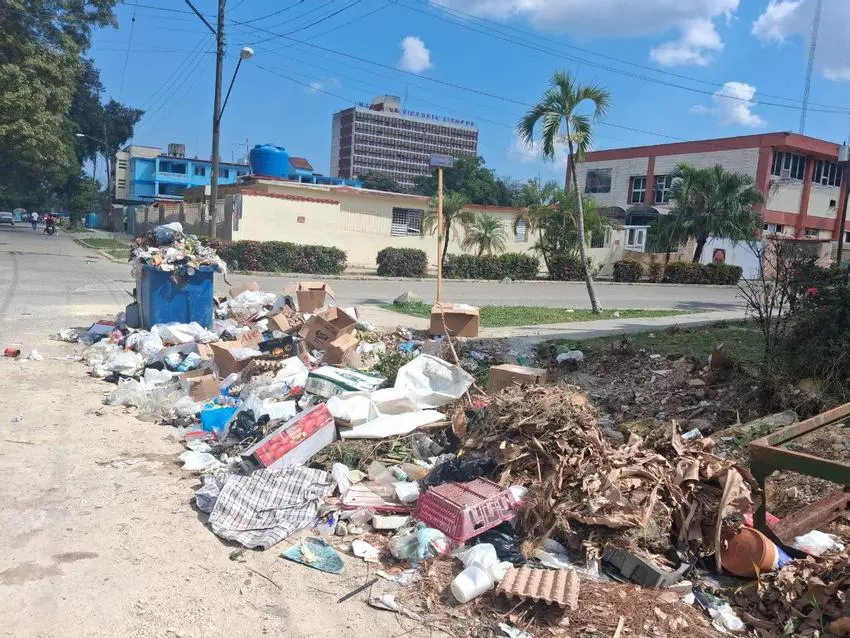
In many cities, garbage collection has ceased to be a daily task and has become a sporadic event.
The deteriorating epidemiological situation surprises no one. It is accompanied, like an inseparable shadow, by the collapse of basic services. In numerous cities, garbage collection has gone from a daily task to a sporadic occurrence. Mountains of waste rot in the sun. Adding to this visible decay are the power outages, which force people to open doors and windows to cope with the nighttime heat, precisely when the Aedes aegypti mosquito is having its feast.
Then there’s the water: it either arrives dirty, or only once a week, or with such low pressure that it forces people to store it in every container they can find. In this precarious ecosystem, breeding grounds multiply, while the old vector control program—that army of fumigators and inspectors—disappeared for years. The sound of fumigation wasn’t heard until just a few days ago, when the health crisis forced the reactivation of a tiny fraction of that massive campaign.
The streets know more than official bulletins. They know about the elderly man who spent ten days with a fever, unable to be admitted because there were “no beds” available. They know about the mother who, faced with the lack of state-provided insecticide, paid a private company 1,200 pesos for fumigation—a quarter of her monthly salary. They know about the young man who, despite his physical strength, shudders in pain, as if each bone had been replaced by a piece of rusted metal. And they know about the accounts that spread out from overflowing funeral homes, always faster than the official press, always more honest than any part of the Ministry of Public Health.
That is why, when someone says “chikungunya,” no one asks what it means anymore. It means a country that can barely move and is at the mercy of the mosquito. A word that was unspeakable yesterday has become commonplace today. A word that, unfortunately, sums up better than any other 2025 in Cuba .
____________
COLLABORATE WITH OUR WORK: The 14ymedio team is committed to practicing serious journalism that reflects Cuba’s reality in all its depth. Thank you for joining us on this long journey. We invite you to continue supporting us by becoming a member of 14ymedio now. Together we can continue transforming journalism in Cuba.
Here are my modest tips, which, while not intended to work for everyone, have helped me maintain my sanity.
Painting by Cuban artist César Leal, who died in December 2024. / César Leal
14ymedio, Yoani Sánchez, 13 November 2025 — One day the face on the screen was that of the poet Armando Valladares; then came the prime-time attacks against Martha Beatriz Roque, Elizardo Sánchez, and Dagoberto Valdés; until the moment came when I saw my own name on the news surrounded by the worst adjectives, and now it is the turn of the editors of El Toque and the economist Pavel Vidal. The bonfire of media stoning and reputational execution, which the regime needs to keep burning, is in dire need of fuel, new fuel to add to the fire of official victimhood and those flames that seek to shift the blame for the failure of the Cuban model onto others.
Each and every one of us born on the Island is a potential candidate to appear on one of those programs designed to morally and socially destroy a person. I wasn’t spared, nor were those convicted in the Black Spring case, nor were the Ladies in White spared the public humiliation, without the right to reply, and neither will you, the reader of these lines. All it takes is for you to say or publish something that displeases a group of intolerant individuals who have hijacked the nation’s name, and the full weight of a power that acts with the complete impunity of those who know they hold a monopoly on television broadcasts, control over the courts, and, sadly, still under their thumb are hundreds of thousands of docile citizens who will fall upon you.
Respond little or not at all to insults, because one of their goals is to distract you from your daily tasks.
Since we can’t change the way they look at us from that fortified dome where a few men in olive-green uniforms have locked themselves away, all that is left for us, the vilified ones, is to decide what attitude we’ll take in the face of such attempts to crush us. Here are my modest suggestions, which, while not intended to work for everyone, have helped me maintain my sanity, my inner peace, and my smile.
If you have already become “radioactive” and have been affected by the animosity of the Cuban dictatorship, I suggest the following: continue reading
Respond little or not at all to insults, because one of their goals is to distract you from your daily tasks, to drag you down into the dark pit of justifications and rebuttals. Don’t believe the saying “silence implies consent” and instead opt for a less neurotic approach to reacting to offense: “to hurtful words, turn a deaf ear.”
Focus on your work. Work heals everything, or almost everything, even the wounds left by not being able to access those same microphones from which they try to violate you.
Don’t resort to personal attacks against those who denigrate you. You don’t play by the same dirty rules as those who insult you. Don’t let them drag you into the mud of their slander.
Never think it’s personal. You’re just the latest target of infamy, but you should know that official propaganda always needs someone to blame; it can’t grease its indoctrination and submission machine if it doesn’t have a name or a face to pin the responsibility for the national debacle on.
Don’t wallow in self-pity. See it as if you’ve been given an award, the precious prize of being despised by a stale authoritarianism.
Think of it as a cycle that comes and goes. Today it was you, tomorrow they’ll insult someone else.
Think of it as a cycle that comes and goes. Today it was your turn, tomorrow they’ll insult someone else.
Think of it as a cycle that comes and goes. Today it was your turn, tomorrow they’ll insult someone else. Keep in mind that, most likely, right now, that “someone else” is one of those who will distance themselves from you after seeing the libel against you, claiming that they are indeed among the trustworthy and the “revolutionaries.” They’ll probably even use their face and voice as testimony to try to bring you down further. What they don’t know is that their neck could be the next target of a regime that is insatiable when it comes to creating adversaries.
Find a hobby if you don’t already have one. Observing the calyx, petals, stamens, and pistil of a flower will give you a true sense of the immensity in which we are but a mere speck of dust, and of what is truly transcendent and what is not. Believe me, Castroism is an ephemeral event in the course of Cuban and human history. Just look at the constellations above your head for a while, and the official spokespeople, in their pettiness, will provoke more laughter than resentment, more pity than anger.
Don’t let fear of being attacked by regime loyalists paralyze your public life. You’ll be surprised by the number of people who support you, the messages of solidarity that will pour in, and the knowing glances you’ll receive, even from those who until yesterday seemed the most extremist.
Don’t let any soldier disguised as a journalist, mixing images, figures, and falsified data, keep you up at night. They too come and go, some fall from grace and others appear, like replacement puppets in a decaying stage set. Remember so many others who played that deplorable role and are now… in Miami.
Don’t let the corrosive acid of that pamphlet affect your self-esteem. You are not the person they portray in those programs, nor do you resemble the malevolent caricature they’ve painted of you.
Life has given you an experience that will make you more mature, knowledgeable about the human soul, and strong.
Keep in mind that this type of television program is known, if at all, by Cubans living on the island and a few hundred thousand in the diaspora. But in Calcutta nobody knows the names of its presenters, in Sydney nobody cares what the spokesperson on duty says, and in Buenos Aires they would consider such a program a comedy show.
Feel a deep gratitude for having been chosen for this public humiliation. Life has given you an experience that will make you more mature, more knowledgeable about the human soul, and stronger. If you survive this emotionally, you can face almost anything. Put into practice all those psychological resources you had stored away for grief, illness, or a heartbreak. Use this vilification as a training ground to strengthen your mental health.
Perhaps the most difficult test will be trying, each day, to practice compassion for those who have wronged you. Imagine them abandoned and sick in the street, like a dog its owner discarded on a corner after use. Picture yourself approaching them, tending to their wounds, and asking, “Is there anything I can do to help?”
If you are still not comfortable appealing to compassion for these self-appointed aggressors, always entrenched in power, then imagine them in routine, even ridiculous, situations. Picturing one of them sitting on the toilet will make you take the whole thing less seriously.
Take a break from social media for a while, or at least don’t give them so much of your time. They rely on the amplification of public ridicule that thousands of users will generate by sharing and discussing the attacks launched against you. Put a stop to that with a good dose of “virtual disconnection.”
If you have children, pets, and friends, spend more time with them these days. Believe me, the eyes of a baby, the soft fur of a cat, or the hug of an old school friend make any audiovisual material against you sound like a distant, insignificant… fleeting echo.
____________
COLLABORATE WITH OUR WORK: The 14ymedio team is committed to practicing serious journalism that reflects Cuba’s reality in all its depth. Thank you for joining us on this long journey. We invite you to continue supporting us by becoming a member of 14ymedio now. Together we can continue transforming journalism in Cuba.
For many victims, the hurricane will be the final blow that plunges them into misery.
For many victims, Hurricane Melissa will be the final blow that plunges them into misery. / EFE
14ymedio, Yoani Sánchez, Generation Y, 29 October 2025 — Hurricane Melissa could not have come at a worse time for Cuba. The island, mired in a long economic crisis, has also experienced the collapse of its energy system in recent years and, more recently, a deteriorating epidemiological situation. Early Wednesday morning, as the storm’s winds and rains struck the eastern region, it was difficult to ignore a troubling question: Will this be the final blow to an already bleak outlook?
For decades, the Cuban regime has flexed its muscles in natural disaster management. In a militarized society where every aspect of daily life is controlled, mobilizing emergency forces, evacuating people, and preparing temporary shelters has been one of the few areas where the regime has demonstrated efficiency. Dictatorships are agile in emergencies and clumsy in normal times. Fidel Castro himself used to star in weather reports when a powerful cyclone was approaching, and, clad in his boots, uniform, and raincoat, he would supervise the the labors of the Civil Defense.
But those years, when Soviet subsidies and later Venezuelan oil revenues allowed for a swift response to hurricane relief efforts, barely leave a memory. This October, preparations for Hurricane Melissa have highlighted the limited capacity of a system materially crippled and with little capacities to assist the population. Of the more than 700,000 people evacuated in eastern Cuba, the vast majority have left on their own, staying with friends, neighbors, and relatives. continue reading
In the days leading up to Melissa’s arrival, people tried to stock up on food in a country hard hit by inflation.
In the days leading up to Melissa’s arrival, people tried to stock up on food in a country hard hit by inflation. Those with access to US dollars managed to buy canned goods, powdered milk, candles, and batteries, but many Cubans in the eastern region began the week with only a few supplies. A good part of the ration stores had barely received only meager deliveries, and the prolonged power outages of the previous days hampered domestic preparations.
Added to this is the poor condition of the housing. Deteriorated by a lack of maintenance and resources, many of the houses the hurricane encountered have flimsy roofs, some kind of structural damage, and are located in areas prone to flooding and landslides. The poorest region of Cuba has been the scene of this natural disaster, which comes on top of the damage already caused by poor economic decisions and the government’s stubborn insistence on prolonging a failed model.
The damage is already becoming apparent, the losses are being tallied, and testimonies are being heard after a hellish night. It is very likely that international aid will also support those who have lost part or all of their homes and belongings. But the main problem is that Melissa arrived in a context that was already experiencing negative indicators in almost all sectors.
For many victims, the hurricane will be the final blow that plunges them into misery.
The winds will pass, the rivers will return to their courses and, surely, the authorities will try to capitalize politically on the moment, portraying themselves as the only ones capable of managing a disaster of this magnitude. But reality tends to be obstinate. Even now, in eastern Cuba, there are people who lost their homes when Sandy struck in 2012 and haven’t even been able to rebuild a portion of them. Melissa could add another layer of vulnerability and fragility to a country already on life support.
COLLABORATE WITH OUR WORK: The 14ymedio team is committed to practicing serious journalism that reflects Cuba’s reality in all its depth. Thank you for joining us on this long journey. We invite you to continue supporting us by becoming a member of 14ymedio now. Together we can continue transforming journalism in Cuba.
The clash between these young people and power is inevitable and is getting closer every day.
Young Cubans Anna Sofía Benítez and Erlis Sierra. / Collage
14ymedio, Yoani Sánchez, 20 October 2025 — For several years now, they have positioned themselves at the center of popular protest and rebellion in Cuba. Born between the mid-1990s and 2010, they are known as Generation Z and are overthrowing authoritarian regimes, forcing openings, and filling the streets with their demands in countries as diverse as Nepal, Madagascar, Morocco, and Peru. On the island, they are currently leading the discontent, aware that the current political and economic model leaves them only two paths: emigration or perpetual crisis.
When pediatrician Erlis Sierra outlined the serious problems facing the residents of Baire, in Santiago de Cuba, last Friday, many were surprised by the combination of youth and consistency he displayed during that meeting with government officials. Digital natives, despite Cuba’s technological backwardness and the late adoption of the internet by its population, Cubans like this young doctor have grown up with a wealth of information and international political debate far removed from the monopoly that has prevailed in the country for decades.
Derided as indifferent, meek, and apolitical, Cuban zoomers have nonetheless taken the lead in the cacerolazos [pot-banging] that is shaking communities and the denunciations on social media. With a nimble thumb that glides across screens, a mind that works with TikTok, and technology intertwined with DNA, these youngsters are holding in check a power that, despite the proclaimed generational renewal, still has an outdated mentality, stuck in the mid-20th century.
They are also the ones who have suffered the most in terms of the quality of the Cuban education system and public health system.
They are also the ones who have suffered the most in terms of the quality of the Cuban education system and public health system. Since entering a classroom, Sierra has only known a shortage of teachers, a lack of supplies, high levels of indoctrination, and a rigid teaching system that contrasts with the increasingly high professional standards of today’s world. Without prospects and less well-educated than their parents, Cubans under 30 have not benefited from any of the so-called “achievements of the Revolution.”
As a result, many have had to manage their own knowledge acquisition, relying on their families’ tenacity and their families’ pockets to complete a university degree or learn another language. Anna Sofía Benítez, the young woman who recently described the island’s everyday situation with realism and grace on her Facebook page, is also one of those zoomers for continue reading
whom a printed book has become a luxury few students can afford, but the vastness of the internet has granted them, just a click away, millions of digital copies.
Benítez and Sierra belong to a generation that hasn’t fared well in terms of the housing crisis either. Most of them live under the same roof as their parents and grandparents, lack the resources to even consider renting something out of their own pockets, making one of the main reasons for emigrating is to have a roof over their heads where they don’t share a bathroom or bedroom with their siblings and nieces and nephews. They have lived a good part of their lives in a country where the buying and selling of houses was only authorized in 2011, but dreaming of buying a space sounds like something for the nouveau riche and micro-entrepreneurs.
They are also poorer than their parents were at that age, have eaten worse, struggled more with public transportation, seen the Cuban peso descend into the abyss, received worse dental care, and lived in dirtier, more run-down, and culturally dull cities. They know that when they reach retirement age, if the current regime continues, they will very likely live more miserably than their grandparents.
They are the ones who shout with the greatest force, “We are not afraid!” when the blackouts spread, the heat increases, and the lack of food brings residents to the streets.
Last may, when the telecommunications monopoly Etecsa announced the tarifazo, a massive rate hike, it was Generation Z that became embroiled in a bitter dispute with the state-owned company. From university classrooms, in WhatsApp groups, and with their Instagram posts, they made an entity — that believed it had a free pass to squeeze Cubans and, in return, provide them with terrible and overpriced service — sweat. To silence them, the offices of the Ministry of Communications had to rush to create navigation packages designed for university students, which have brought more dissatisfaction than results.
It is repeated everywhere that these zoomers aren’t interested in freedom, that individual independence isn’t among their priorities, and that they pay more attention to the virtual world than to what’s happening around them. But Cubans are shattering that broadly worded portrayal. They’re the ones shouting the loudest “We’re not afraid!” when blackouts spread, the heat intensifies, and the lack of food drives residents into the streets of Havana and Contramaestre.
They’ve said goodbye to so many friends who crossed the Darién jungle as children, left through the US Humanitarian Parole Program, or made the trek south, that these Cubans have ended up living an existence divided between inside and outside. Many live with their grandparents because their parents became cubañoles, crossing the southern U.S. border, and are now waiting to regularize their immigration status with an I-220A document. They’ve spent their adolescence seeing their mothers only through videoconferences and listening in on those conversations, from a distance, with the constantly repeated acronyms, like ICE or USCIS.
The chasm that separates their virtual, cosmopolitan, and diverse lives and the lack of freedoms they live under in Cuba has fueled their rebellion. The gap between their aspirations and what they can achieve in their own country is the main fuel for their insubordination. The clash between these Generation Z Cubans and those in power is inevitable and grows closer every day. We must all contribute to ensuring that this struggle is not won again by a stagnant and senile regime.
____________
COLLABORATE WITH OUR WORK: The 14ymedio team is committed to practicing serious journalism that reflects Cuba’s reality in all its depth. Thank you for joining us on this long journey. We invite you to continue supporting us by becoming a member of 14ymedio now. Together we can continue transforming journalism in Cuba.
One doesn’t reach Machado’s current position without having suffered personal losses and difficult emotional trials along the way. / EFE
14ymedio, Yoani Sánchez, 10 October 2025 (delayed translation) — Friday could not have started better. The Norwegian Nobel Committee awarded opposition leader María Corina Machado the 2025 Nobel Peace Prize “for her tireless work promoting the democratic rights of the Venezuelan people.” The recognition puts the spotlight on Latin America, where three long-standing authoritarian regimes—in Caracas, Havana, and Managua—had come to believe that impunity and international silence would allow them to control their nations until the end of time.
In several government palaces, today’s coffee must be tasting much more bitter. The delay in the reactions of Nicolás Maduro and the Castro regime, who have not commented as of this writing, betrays the surprise they have felt at the announcement. Perplexed and annoyed, the spokespersons for both authoritarian regimes also seem to have frozen, waiting for their superiors to dictate the script they should follow in their statements. No wonder. Machado’s Nobel Prize is like salt in the wounds for all of them.
At just 58, the Venezuelan opposition leader has a long road ahead to do much for her country and the entire continent.
At just 58, the Venezuelan opposition leader has a long road ahead of her, and with the renewed prestige this award brings, she can do much for her country and the entire continent. Not only is the democratic opening in Venezuela ahead of her, which will inevitably come despite Maduro’s intentions, but she can also help drive political change in other countries in the region. For a long time the cause of peoples subjugated by totalitarian continue reading
regimes, supposedly leftist and wrapped in a rhetoric “of the humble and for the humble,” has merited a boost. What happened this Friday is that consecration. The plight of more than 40 million people, under the thumb of these three satrapies, will once again receive the attention it deserves.
But this is, especially, a personal gratification. One does not reach the position Machado holds today without suffering personal losses, harsh emotional trials, successive pressures to go into exile, and an intense boycott of her political career. An intense campaign of reputational destruction has been launched against her, attempting to paint her as a terrorist who called for social confrontation. Her actions before, during, and after the elections more than a year ago shattered the entire image that official Venezuelan propaganda tried to plaster on the minds of voters and the international media. Serene, firm, and with constant calls for calm and peaceful action, the Venezuelan established herself as a leader of nonviolence.
Perseverance has been her greatest virtue. While many grew weary along the way, the opposition leader continued her activism. When exile knocked on the door of so many, she stayed in her country. While the world looked the other way and Miraflores bathed in petrodollars, the industrial engineer never lost hope that Chavismo would not last forever. Her Nobel Prize is not just a medal of gleaming metal; it is an award forged in tenacity. The perseverance of María Corina Machado is a breath of hope for all of us who live under the long night of a dictatorship.
________________________
Editor’s Note: This article was originally published on DW.
____________
COLLABORATE WITH OUR WORK: The 14ymedio team is committed to practicing serious journalism that reflects Cuba’s reality in all its depth. Thank you for joining us on this long journey. We invite you to continue supporting us by becoming a member of 14ymedio now. Together we can continue transforming journalism in Cuba.
How do we tell stories in contexts of censorship and surveillance? What tools enable independent journalists and creators to build audiences in hostile environments? Podcasting isn’t just a format: it’s a powerful form of resistance and connection. This seminar will cover the keys to creating a podcast from scratch: defining objectives, choosing formats, accessible technical tools, basic editing, and distribution strategies on platforms like Spotify or Apple Podcasts. Promotion tactics, monetization methods—such as sponsorships or crowdfunding—and the use of artificial intelligence to improve production and reach will also be explored. Drawing on her experience leading 14ymedio, Yoani Sánchez will share ideas, tools, and lessons learned on how to narrate freely and amplify voices amidst censorship.
Upon learning of his passing, I couldn’t help but remember how close I was to shaking his hand, but the demons of political intolerance prevented it.
José Mujica, former president of Uruguay and emblematic figure of the Latin American left, has died at the age of 89 / EFE/ Gastón Britos
14ymedio, Yoani Sánchez, Generation Y, 14 May 2025 [delayed translation] – – This Tuesday, one of the few Latin American leaders who, after serving as president, maintained a regional prestige free of accusations and scandals, died. He had been a man who was a model for the politics of service so lacking on our continent. José Pepe Mujica, former president of Uruguay and emblematic figure of the Latin American left, passed away at the age of 89. Upon learning of his passing, I couldn’t help but remember how close I came to shaking his hand, but the demons of political intolerance prevented me from doing so.
It was 2015, and I was visiting Montevideo, invited by the local journalists’ association. The tour’s agenda included visits to media outlets, conversations with reporters and graphic artists, and an extensive cultural program that lasted late into the night. One of the highlights of that stay in Uruguay was, precisely, meeting Mujica, a respected political oracle who delivered opinions and teachings with great ease and a fair amount of authenticity. The moment was also transcendent.
That year, hopes for a possible democratic transition in Cuba had reached a peak. Just a few months earlier, in December 2014, a diplomatic thaw between Washington and Havana had been announced, and the world’s eyes were focused on what was happening on the island. Fidel Castro, recovering from the illness that removed him from power in 2006, barely received visitors, and Mujica was one of the few chosen to access Punto Cero, the heavily guarded estate where Castro spent his final years. The Uruguayan was very reserved about those encounters, but had begun to slip in criticism of the authoritarian nature of the Cuban model. continue reading
Talking to Mujica was an opportunity for me to hear the opinion of an informed and sincere political actor who knew my country closely and had a vision of everything that was happening in the region.
Talking with Mujica was, for me, an opportunity to hear the opinion of an informed and sincere political figure who knew my country closely and had a vision of everything that was happening in the region. But we were never able to have that conversation.
One day before the scheduled date for the exchange of views, Pepe told the event organizer that he had to travel a few weeks later to a tribute where he would receive at the Casa de las Américas in Havana. “You know how Cubans are; I don’t want any trouble with them,” he excused himself before canceling the meeting, alluding to the Cuban regime’s traditional intolerance toward any gesture of dissent. The journalist who heard that excuse later told me that the former president was embarrassed and annoyed at having to accommodate the sensitivities of the Castro regime.
That official tribute took place, and Mujica shone before the audience with his ease, but in the years to come, the Uruguayan increasingly distanced himself from the Cuban establishment. In an interview, he revealed part of the chasm that had opened between the pluralism he had embraced and the single party imposed by Castro. “It doesn’t work, this doesn’t work,” he declared with his usual frankness. Reading his words, I felt I was listening to him, and that frustrated meeting had, in fact, taken place, and that we had been talking in Montevideo or Havana for long hours about life, liberty, and the future. Buen viaje, Pepe.
COLLABORATE WITH OUR WORK: The 14ymedio team is committed to practicing serious journalism that reflects Cuba’s reality in all its depth. Thank you for joining us on this long journey. We invite you to continue supporting us by becoming a member of 14ymedio now. Together we can continue transforming journalism in Cuba.
In Cuba, no one is allowed to resign from their position; disgrace and dismissal always come from “the top.”
A disabled man searches for something to eat in a garbage container in Havana. / 14ymedio
14ymedio, Yoani Sánchez, Generation Y, 16 July 2025 — Blackouts, inflation, and the economic crisis have ceased to be the talk in the streets in Cuba, at least for a few days. The focus of social anger has turned on the Minister of Labor and Social Security, Marta Elena Feitó, who launched a bitter tirade last Monday against people who beg for money in public or rummage through garbage to find food. The outrage has reached a point where the official resigned, a cosmetic move in a regime that refuses to acknowledge the extent and severity of poverty on the island.
Before Parliament, Feitó lashed out at those people “disguised” as homeless people who extend their hands to beg for bills, clean windshields at a traffic light to extract a meager payment, or plunge their hands into trash cans filled with garbage and then shove a piece of bread or a piece of nearly rotten fruit into their mouths. The minister accused all these Cubans living in extreme vulnerability, many of whom were homeless, of being drunks, deceivers, and illegal immigrants. Before dozens of parliamentarians, she unleashed her insults without receiving any criticism, without anyone raising their hand to ask to speak and rebut her.
Luckily, we have social media. Shortly after that disastrous intervention, Feitó’s brief moments in front of the microphone went viral on the internet. There was no way to defend her words, not even from a regime accustomed to closing ranks around the nonsense uttered by its leaders. For a system that prides itself on being “of the humble and by the humble,” the contemptuous tone of the Minister of Labor, specifically toward the poorest, was indefensible. The damage control strategy then began to unfold, culminating in Feitó’s departure from the ministry. But the reasons that led her to assert that homeless people are “people who have found an easy way of life” remain.
Recognizing the misery in which a large part of the population lives or continuing to boast that 66 years later the scourge of homelessness has been eradicated, that is the dilemma
The island’s authorities are trapped in a dilemma with a difficult solution. Acknowledge the misery in which a large part of the population lives in an attempt to alleviate these hardships, or continue boasting that 66 years after that January of 1959, the scourge of poverty has been eradicated in Cuba, making our political and economic model superior to its capitalist nemesis. Putting numbers on the unprotected and needy would be admitting that the system has failed in one of its initial objectives and that the loss of civic and individual freedoms has not been worth it if it has not even managed to reduce the number of homeless people.
In Cuba, no one is allowed to resign. The fall into disgrace and dismissal always come from “on high,” an order from the highest leadership, capable of sacrificing any party cadre to protect itself. This is what happened on this occasion. Officialdom is now trying to counter Feitó’s nonsense with the words of President Miguel Díaz-Canel, who, hours after the minister’s blunder and without mentioning her name, asserted that “the Revolution cannot leave anyone behind.” But the essence of the social security policy has been exposed. For Castroism, the poor are an annoying presence that reminds them and exposes their failure.
This may be the first time that a Cuban minister, in the last half-century, has resigned due to popular pressure stemming from publications in the independent press and dissemination on social media. The regime is no longer running solo on the path of the public narrative, and its stumbles, blunders, and profound reactionary nature are increasingly evident.
Editor’s Note: This article was originally published on DW and is republished with the author’s license.
_________________
COLLABORATE WITH OUR WORK: The 14ymedio team is committed to practicing serious journalism that reflects Cuba’s reality in all its depth. Thank you for joining us on this long journey. We invite you to continue supporting us by becoming a member of 14ymedio now. Together we can continue transforming journalism in Cuba.
At that moment, decades of pretending to be good-natured towards the international community and denying any repressive act towards citizens were broken.
The images made it clear that they didn’t have overwhelming support from the people, nor did they hesitate to pick up a weapon. / EFE
14ymedio, Yoani Sánchez, Generation Y, 11 July 2025 — Like any date that leaves a profound mark, every Cuban knows what they were doing when they learned of the protests of July 11, 2021 (11J). Those who followed the demonstrations on their mobile phones thousands of miles from the island and those who joined the sea of people who filled the streets shouting “Freedom!” There are also those who, in their military units, enlisted to go out and beat and suppress the crowd. Each one has their own story from that day, many of these anecdotes remain silenced out of fear.
Along with the more than 2,000 Cubans criminally prosecuted for 11J, of whom 421 remain in prison, one of the results of that historic day was the evolution of the regime to a new stage. If before that moment, Havana’s Plaza de la Revolución had worked diligently to create an image of a system “of the humble and for the humble,” that Sunday four years ago, that mask fractured. Before the eyes of the world, desperate people demanded change, and riot police responded with clubs and, in some neighborhoods, even gunfire.
The country’s own leader, Miguel Díaz-Canel, shook off any veneer of composure and uttered before national television a fateful phrase that will go down in history: “The combat order is given.” In that instant, decades of pretense of goodwill toward the international community and emphatic denials of any repressive acts toward citizens were shattered. It was a turning point for many who, despite frequent denunciations by activists and independent journalists, continued to believe that the Cuban system was incapable of forcefully punishing a popular and largely peaceful demonstration.
continue reading
Coercion is public, it is not hidden and it is so widespread that even those who claim not to get involved in politics feel it.
Also, many who swallowed the narrative of a country where ideological uniformity had been consensually established and where the Communist Party enjoyed unanimous support understood that, beneath the slogans and masks, social unrest had been growing for more than half a century. That day, something cracked in the narrative created and polished by Castro’s skillful ideologues since January 1959. The images made it clear that they neither enjoyed overwhelming support from the people nor did they hesitate to take up arms against the dissidents.
Since then, Cubans have lived in an era of repressive audacity. The coercion is public, unseen, and so widespread that even those who claim not to interfere in politics feel it. President Díaz-Canel no longer pretends to govern for everyone, nor are official spokespersons ashamed to openly threaten dissidents with imprisonment or exile. The shamelessness has reached such levels that some figures in the regime are issuing thinly veiled threats on social media against internet users who denounce everything from the dollarization of part of the retail sector to problems with garbage collection. They no longer hesitate to bare their teeth, unbuckle their belts, and threaten them with iron bars.
11 June left us a legacy of rebellion and a lamentable number of political prisoners, but it also enshrined the shamelessness of a system that will not hesitate to crush its own people again.
Editor’s Note: This article was originally published on DW and is republished with the author’s license.
____________
COLLABORATE WITH OUR WORK: The 14ymedio team is committed to practicing serious journalism that reflects Cuba’s reality in all its depth. Thank you for joining us on this long journey. We invite you to continue supporting us by becoming a member of 14ymedio now. Together we can continue transforming journalism in Cuba.
Days before the ‘rate increase’, no one could have predicted that the students would regain their rebellion.
Faculty of Mathematics and Computer Science, University of Havana. / 14ymedio
14ymedio, Yoani Sánchez, Generation Y, Havana, 18 June 2025 — The Cuban regime is holding its breath. There are only a few days left until the end of the academic year in all the island’s faculties, a period that this year is proving to be an uphill struggle for oficialdom. In the classrooms of higher education, outrage has multiplied over the price increases implemented late last month by the state telecommunications monopoly, Etecsa. After decades of being muzzled, university students seem to have regained their voice.
Protests against the popularly known “tarifazo” have swept across all social strata in Cuba, but students have been the most vocal in their reactions. The need to constantly turn to the internet for bibliography to support their courses, the desire to escape a stifling reality through social media, and the many emigrated relatives and friends they want to stay in touch with, make web browsing as imperative at these ages as food, transportation, and a roof over one’s head.
However, just days before the declarations of opposition to Etecsa began to pour from the desks, no one could have predicted that the University would regain its rebelliousness. The epicenter of many of the political changes that shook Cuban politics during the colonial and republican eras, our Alma Mater seemed to have been totally controlled and domesticated by the Communist Party. Years of purges, rigged elections, reprisals, and expulsions of inconvenient professors managed to transform a natural youthful disobedience into pure docility. Until one day.
Under the slogan that “the university is for revolutionaries,” Castroism implemented ideological filters that forced students to ‘fake it’
Under the slogan “the university is for revolutionaries,” Castro’s regime implemented ideological filters that forced students to pretend and to wear an ideological mask to allow them to graduate. The faculties, which had once given rise to revolts and social uprisings, became places where government policies were applauded and the olive-green leaders’ cult of personality spread. The University Student Federation became a sounding board for the power to speak to the students, and only the most trusted teachers taught in the classrooms.
But enough! The announcement of an internet connection price increase was enough for the academic outcry to spread to dozens of faculties, where students collected signatures, joined in on statements, and stood up to the rectors. More than two weeks after the price hike began, university students in several provinces continue to publish letters of protest, voice their criticisms in assemblies, and receive threats. The image of higher education, one hundred percent in tune with Havana’s Plaza de la Revolución, has been irreparably shattered.
Political police have attempted to divide the protesters, visited the homes of students leading the demand to reverse the rising costs of connecting to the world’s largest network, and warned of short-term repercussions for those who insist on publicly complaining.
For their part, young people are responding by calling for a strike in classrooms at several educational institutions and continuing to resist in meetings with administrators and officials. In an audio recording leaked in recent hours, the rector of the University of Havana can be heard saying that “if it’s a strike, then it’s a counterrevolution,” alluding to the implications of students stopping showing up to class. But her voice hasn’t sounded with the authoritarian conviction of yesteryear, but rather with a certain tone of fear, the fear of a political class when it senses that university youth, long dormant, are awakening.
________________________
Editor’s Note: This article was originally published on DW and is republished with the author’s license.
____________
COLLABORATE WITH OUR WORK: The 14ymedio team is committed to practicing serious journalism that reflects Cuba’s reality in all its depth. Thank you for joining us on this long journey. We invite you to continue supporting us by becoming a member of 14ymedio now. Together we can continue transforming journalism in Cuba.
Thanks to connectivity, Cubans feel like citizens of the world
No one has been unaware of the impact on wallets of the reduction and increase in web browsing gigabyte (GB) prices in local currency. / 14ymedio
14ymedio, Yoani Sánchez, Generation Y, Havana, 3 June 2025 – Cuba hasn’t felt this much popular outrage since the economic shock at the beginning of 2021 that buried the convertible peso, sent food costs through the roof, and plunged wages. Now, with internet connection prices rising as of last Friday, social outrage has erupted again, this time against the state-owned telecommunications monopoly Etecsa. In a country already starved for food due to prolonged blackouts, making the escape represented by connecting to social media more expensive has been too much for people to bear.
The discontent is not limited by age or economic class. Complaining are teenagers, digital natives, who find social contact in WhatsApp groups, which is so difficult for them on nights without electricity and overpriced recreational venues. Anger is knocking on the door of university students, who are forced to consult most of their bibliography online, given the decrepitude of school library archives. The unease extends to working-age adults, who, through remote work, have found a way to contribute to their diminished family coffers and also to apply for scholarships, courses, or visas to leave the island. Retirees have also expressed their discomfort, as many of them are forced to maintain contact with their emigrated children and grandchildren through weekly video conferences.
Retirees have also expressed their discomfort, many of whom are forced to maintain contact with their emigrated children and grandchildren through weekly video conferences.
No one has been blind to the impact on Cuban wallets of the reductions in service and increases in web browsing rates per gigabyte (GB) in national currency. Neither the explanations from Etecsa officials nor the calls for understanding the infrastructure crisis facing the state monopoly have served to silence the critics. The company is among Cubans’ most poorly continue reading
rated entities, a sad privilege it shares with the Electricity Union, State Security, and the Ministries of Transportation and Domestic Trade. Just mention the six letters of the telephone company’s name and its customers’ faces transform into grimaces of disgust and rejection.
The official explanation for increasing the price of per gigabyte by 1,229%, or, in other words, multiplying it by 13, lies in the need to raise foreign currency to invest in the country’s disastrous telecommunications infrastructure. By favoring top-ups paid for abroad, the state monopoly seeks to raise dollars that will allow it to buy cables, new telecommunications towers, and backup batteries to maintain service when the power goes out. The argument might have worked a few years ago, but Cubans have grown weary of their depreciated currency, of the privileges accorded to those with those greenbacks bearing the faces of Washington or Lincoln, and of a state that increasingly ignores those who only have access to the national peso.
“Soon they’ll be putting a portion of the electricity bill to be paid by the exiles from abroad,” reads the caption of one of the many Etecsa posts on Facebook that have sparked thousands of comments, most of them rejecting what has already been popularly dubbed the tarifazo*. “All this has happened because the money raised hasn’t been invested in telephone service, but in repression,” warns another internet user, who complains that in his small town in the province of Pinar del Río, he has to climb onto his roof in the early hours of the morning to get a precarious internet connection. “New cars for the police, but few resources to improve the connection,” he added with annoyance.
“New cars for the police but few resources to improve the connection,” he added with annoyance.
A distant observer of the Cuban situation would soon wonder why the rise in internet access prices has managed to mobilize citizens in a way that prolonged power outages and paltry salaries have not. In a country where official propaganda remains suffocating and the regime tries to control every aspect of daily life, access to the web has become a balm and a way to escape the daily crisis. Thanks to connectivity, Cubans feel like citizens of the world. Social media is that window that lets them know that there is something beyond the empty markets and the surveillance of the political police. It helps them to believe that there is hope.
On 11 July 2021, a few months after the Ordering Task was decreed, the island’s streets were filled with thousands of people shouting “Freedom!” We must be attentive to the reaction, in the short-term, of Etecsa’s current whim, which is already generating so much indignation.
*Translator’s note: The “azo” ending in Cuban Spanish is a ’magnifier’, in this case, roughly: “the gigantic price increase thing”
Editor’s Note: This article was originally published on DW and is republished with the author’s license.
___________________
COLLABORATE WITH OUR WORK: The 14ymedio team is committed to practicing serious journalism that reflects Cuba’s reality in all its depth. Thank you for joining us on this long journey. We invite you to continue supporting us by becoming a member of 14ymedio now. Together we can continue transforming journalism in Cuba.
Many families feel they have nothing left to lose because they have hit rock bottom.
Protests in Caibarién, Villa Clara, in 2022, over blackouts. / Screenshot
14ymedio, Yoani Sánchez, Generation Y, Havana, 26 May 2025 — Summer has always been the most feared season of the year for Cuban authorities. In addition to the high temperatures that on the island begin in spring, there are the unpopular power outages and school holidays that strain domestic life. This year, the situation is especially complicated due to the fragility of the national energy system and the fuel shortage, which has extended blackouts to more than 15 hours a day in many parts of the country. July and August are approaching, and social anger is growing.
In recent days, street protests have been reported in Bayamo, Granma, and Santiago de Cuba. In images shared on social media, dozens of people can be heard shouting a direct demand: “We want electricity, we want food.” Engulfed in darkness, some banging pots and pans and others using only their throats, the protesters are merely the vanguard of a popular uprising that some feel is just around the corner. That perception that people are going to take to the streets appears every summer, but this one is different. Many families feel they no longer have anything to lose because they have hit rock bottom.
“They’re not asking for freedom,” criticized many internet users, mostly Cubans living abroad, upon seeing footage of the protests. While the demands for an end to the blackout and for some food to reach the rationed market seem very basic from the outside, inside the country they take on a profound political character. In a nation where all thermoelectric plants, oil imports, and the electricity service that reaches every home are in the hands of a state that monopolizes the energy sector, demanding the restoration of power seems extremely daring. continue reading
This same state structure manages the supply of food to the ration stores, handles the international market purchases of products distributed in the basic family basket, and is at the forefront of most economic decisions that result in more or less foreign currency to purchase everything from rice to eggs. Any vocal public demand for improving services and the amount of food that reaches homes is taken by the regime as a challenge. A government that doesn’t tolerate the slightest criticism sees such requests as a gesture of rebellion that it cannot allow.
As temperatures rise and the darkness of power outages spreads across Cuba, the police force is preparing to confront the summer protests. The memory of the social explosion of 11 July 2021, is still very fresh in the minds of the regime, and state institutions have already warned their employees that they must take to the streets to “defend the Revolution.” This is the same repressive strategy deployed around this time every year, and it is marked this time by greater nervousness among the political police in the face of a possible popular uprising.
On one side are the military, the police, and a well-oiled propaganda machine that portrays the dissidents as enemies; on the other are the desperate and hungry people, whipped up by that “General Summer” riding on the back of heat and despair.
COLLABORATE WITH OUR WORK: The 14ymedio team is committed to practicing serious journalism that reflects Cuba’s reality in all its depth. Thank you for joining us on this long journey. We invite you to continue supporting us by becoming a member of 14ymedio now. Together we can continue transforming journalism in Cuba.