Generalizing the Blame / Fernando Dámaso

In my country there is this unfortunate custom of generalizing blame. Thus, when someone commits errors and, for one reason or another, sees himself obligated to explain them publicly, he doesn’t say “I made a mistake” but “we made a mistake.” He involves everyone who listens, be it ten, a thousand, or a million people. It must come from the supposition that shared blame touches fewer. Without a doubt, it’s a comfortable and advantageous position.

Anywhere the Constitution and laws are respected, when a public figure makes a mistake and, as a result, affects the lives of citizens, he should answer for it, and until he can, be separated from his duties. Examples are superfluous. Conceding the right to correct one’s errors is not the most usual course, much less to do so repeatedly. Just as no one is indispensable, no one possesses absolute truth — if he fails, he should leave the road free to those more capable and with better solutions. This practice excludes no one.

In closed systems, where power is obtained to hold onto it until the last breath, errors and mistakes repeat cyclically, using the nation as a laboratory and its citizens as guinea pigs, to experiment as it might occur to someone, without any concern for the costs, or the failures, and without having to account for them.

It’s something complex and difficult to solve, but not impossible. Each of us can start taking responsibility for our irresponsibilities and substituting the “we” with “I.” Thus the blame never becomes diluted, and it has a name. Nobody should be considered infallible nor untouchable. This would be a healthy and civilized way to clear paths.

With the advent of a new year, it’s right to think about these things and dream that they might come true, for at least — after so many failed years — to not lose the little optimism that still remains.

December 25, 2010

Bonsai / Fernando Dámaso

Bonsai was the last and smallest cat in a litter of three born in the garage of the building. From his early days was surly, hiding from people, to the extreme of only eating his meals after you moved away. Thus he grew and his mother died and his siblings were adopted by other neighbors, and he has stayed with us as a collective cat. He slept in the garage or in the nearby kindergarten and, later, at the opening of the door of the building, he became the owner of the premises on the fourth floor. Breakfast, lunch and dinner on the landing of the stairs, at the entrance to our apartment. There also we kept a pot with fresh water. He adored milk and after breakfast he waited patiently. Then he would wander around until lunch and repeat the process with dinner. At night he had his adventures and often returned wounded and abused, becoming an odyssey to be able to cure him.

So he left behind one and then another of his lives and so became more sedentary. One day a small black and white kitten turned up at the garage and we baptized her Wampi, and after he accepted her they became great friends. They played, ate and slept together. Wampi breathed new life into him and he would look for her in her hiding places when she disappeared. They acted like siblings. One day Bonsai disappeared and with the help of Wampi we found him crippled, unable to use his back leg. We fed and cared for him against all odds, and he recovered and impetuously climbed the stairs of the building, the same as always, even though we knew that he maybe only had one life left.

Time passed and one day I found him in the garden, without the strength climb the stairs to eat. I picked him up with care, as he was always so surly, and put him in the room on the fourth floor. I fed him, but every day he was weaker. I realized that he was living his final days. So passed two and then a third, cherished by me, he purred weakly and died at noon. I wrapped him in the cloth that served as his bed and dug a hole in the ground of the hall of the building, where he’d played with his siblings as a kitten and put him in it. This is his grave. Born, lived and died, with us. I think that, although he was small in size, hence his name, he was a cat who enjoyed his seven lives happily. Now, in cat heaven, he must have met his mother and siblings and greeted Putica and Falcor, his close neighbors, in dog heaven.

November 20, 2010

Garrincha’s Talons / Luis Felipe Rojas

Raul: Now go and tell the people why they are going to be laid off. Labor Union: I thought my job was to defend the Revolution, not explain it.

I was born in 1971. My generation grew up under the imprint of “Revolutionary” humor. I never knew about the Comics, except for those by Cecilio Avilès and Blanquito, the weekly Palante, and the late DDtè. I didn’t enjoy the ones by Quino and Fontanarrosa until I was over 20. I couldn’t see the magic behind Charlie Brown. After I was 25, my passion became Garrincha. I did not enjoy the lombricillas, little worms, that appeared in the military magazine Verdeolivo (Olive-green), but I began to collect every one of their comic strips from the Cuban newspapers starting from the beginning of the ’90s of the twentieth century.

I think we lost them from our national life about two years ago and later found them again in the graphic opinion section on Cuba posted on Miami´s EL Nuevo Herald. Garrincha is a character who exudes the best of humor from all sides. I think that he has, in abundance, the sarcasm that the Cuban press has lacked for a very long time. The lombricillas, his depressed men, super-light women, “cool dudes,” “hot chicks” and bureaucrats are the best of creole satire since Castor Bispo, Gaspar Pumarejo and the best of Enrique Nuñez Rodrìguez when he wasn’t being professorial or excessively pro-Castro.

Every month someone sends me the Garrincha vignettes from that Florida newspaper, and though we know that living in a village like San Germán in Holguin province might cost me my objectivity — given the apathy of the major media that surrounds me — my joy in good Cuban humor remains. Neither far-right and vulgar, nor from the center, nor moderated by luxury, it is simply him, humorous, sarcastic, and without loyalties to dull his sharpness. I celebrate my ignorance in front of my readers: I imagine he has a website or collaborates with various digital publications, but for now I’m content to know that every week I can expect to see him, re-posted from the press, copied on CD, or in some newspaper that managed to slip through the bars of the General Customs of the Republic of Cuba. This is good enough, while this mischievous boy who answers to the name Garrincha sticks out his tongue at the stiff-necks who think themselves safe from a good “raspberry.”

Just what we need to begin to be a real country.

December 24, 2010

100 Years of the Fat One of Trocadero / Iván García

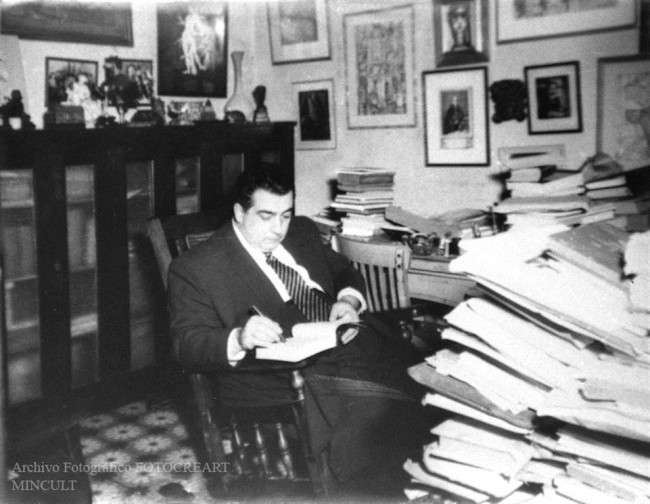
Jose Lezama Lima (1910-1976) is not gone. This is the feeling you get when you visit the museum of the master of Cuban prose in Trocadero street, in central Havana.

You don’t need to be supernatural to sense the weary, asthmatic breathing of the fat Lezama while you pass through the halls of this house, residence of one of the greatest authors of this green island.

The Cuban intellectual was born on December 19, 1910. And like nearly all the geniuses, he was misunderstood in his time. His father, Jose Lezama Rodda, of Basque heritage, founded, and eventually lost, a sugar business in Cuba.

Rosa Lima Rosado, his mother, formed part of a family of independent thought. At the end of the 19th century, she felt obligated to leave the island. she knew and collaborated with the national hero of Cuba, Jose Marti, in his exile in Florida.

Lezama Lima had two sisters, Rosa and Eloisa, who both died early in their lives. From when he was a boy, like every good Habanero, he played baseball and caused trouble with his friends from the neighborhood. He was an infielder, and had pretty good hands.

But one day when he was an adolescent, his friends went to find him for game, and Lezama told them “I’m not coming out today, I’m going to stay in and read.” He had started reading Plato’s Symposium. He was fifteen years old, and since he was eight he was a voracious reader of Salgari and Dumas, Cervantes and his Quixote.

He became a lawyer, and began to work in a simple post of the secretary of the Superior Counsel of Social Defense, in the jail of the Castillo del Príncipe, the main jail in Havana. And from this date forward, he was a great man of letters.

In 1937, his collection of poetry The Death of Narciso, was published, which was written in 1931. In his day, another giant, Cintio Vitier, affirmed: “All the poetry of Mariano Brull, Emililo Ballagas, Eugenio Florti, like witches riding brooms, flew out the window when I read ‘Danae wrote about the golden time by the Nile,’ the first verse of the Death of Narciso. Cuban poetry changed overnight.”

Later, he began to circulate in cultural reviews of high esteem, edited in Cuba in the decade of 1940-1950. It was in Origins, perhaps, where Lezama Lima made his impression as a writer.

In 1959, el comandante Fidel Castro arrived, along with his hurricane of radical reforms. So much machismo and testosterone; the caudillo style and an Olympian disdain for the free thinkers, caused more than a problem for the massive Jose Lezama.

Despite being married since 1964 to Maria Luisa Bautista, a noted literature professor, the fat Lezama was a closet gay. We already know how the Castro government treated homosexuals in this time.

They were turbulent times. Whoever had different sexual orientations was sent to prison or to a type of concentration camp called UMAPs (Military Units in Support of Production). And even though Lezama never received a punishment that severe, he suffered. The greatest scandal arrived in 1966.

The name of the scandal was the supreme novel of Cuban literature: Paradiso. It had a limited edition. It put in check the iron censorship of the state, that always held literature suspect, bourgeoisie, and counterrevolutionary. The sexual adventures of Jose Cemi disquieted the Criollo hierarchy, who saw in the gays, and sodomy, a latent danger to the concept of the New Man, dreamed up by Che.

In spite of everything, the Maestro never wanted to abandon his country. In Cuba he found his muse. His house on Trocadero was his heart, he came to say. And there he shut himself in amongst his writings. Tightly.

Difficult years. The economic shortages affected the population. And Lezama, an incurable luxurophile, suffered from royal hunger. He made up for it, and then some, whenever a friend invited him to dinner. It was said that at receptions in Western embassies, on certain nights of ferocious appetite, Lezama devoured an army of croquettes and canapes.

He died in 1976, his fame faded due to censorship and official acknowledgment of a low profile. They then turned him into an exquisite cadaver. A common thing for Fidel Castro’s government with critical intellectual figures or those with little loyalty to the regime. Once they’re buried, of course.

The big guy who would have been one hundred this year died in house No. 162 on Trocadero Street. His thick anatomy permeates the house turned into a museum. If you feel, as you tour the grounds, the coughing and asthmatic wheezing of the Master, don’t be frightened. It is Lezama who would like to greet you.

December 16, 2010

One Family, One Tragedy / Ernesto Morales Licea

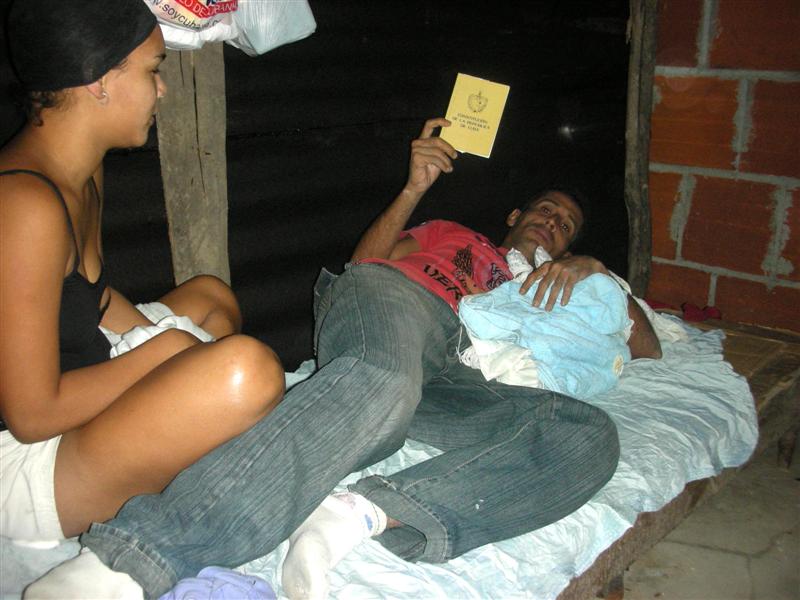
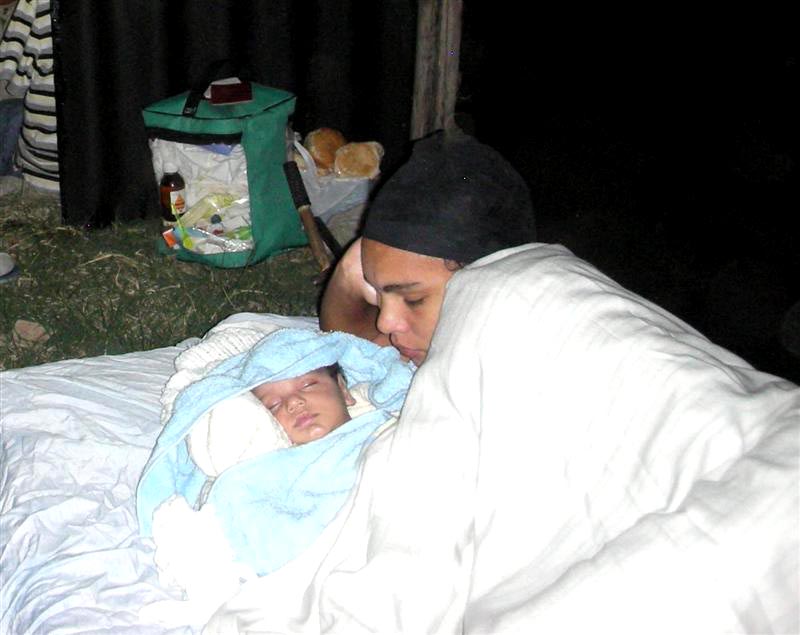
Just a few hours ago a shocking even took place in my semi-wintry Bayamo: at approximately seven at night this Wednesday, December 22, a young man of 34, Alexander Otero Rodriguez, appeared at a central corner of the city, accompanied by his wife, Aliuska Noguer Tornés, 18, along with their baby, born 48 days ago.

Accompanying them, a relative and a friend.

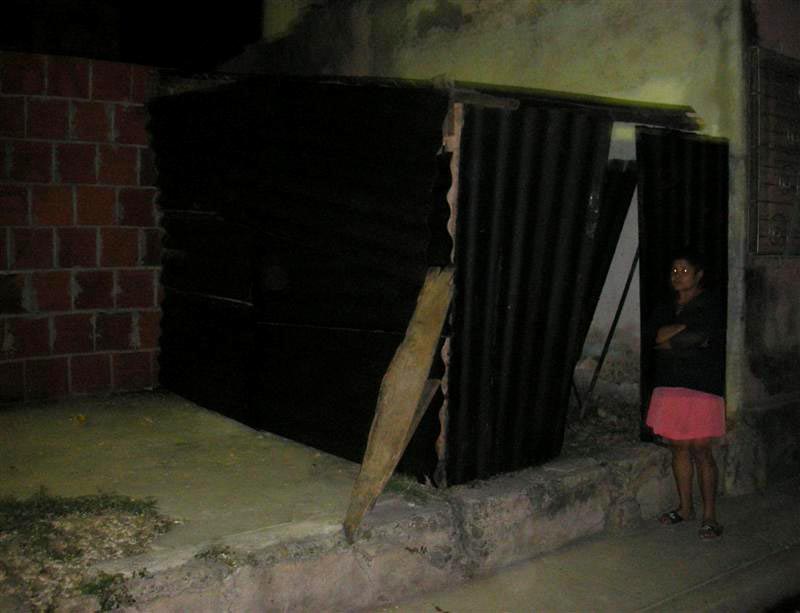
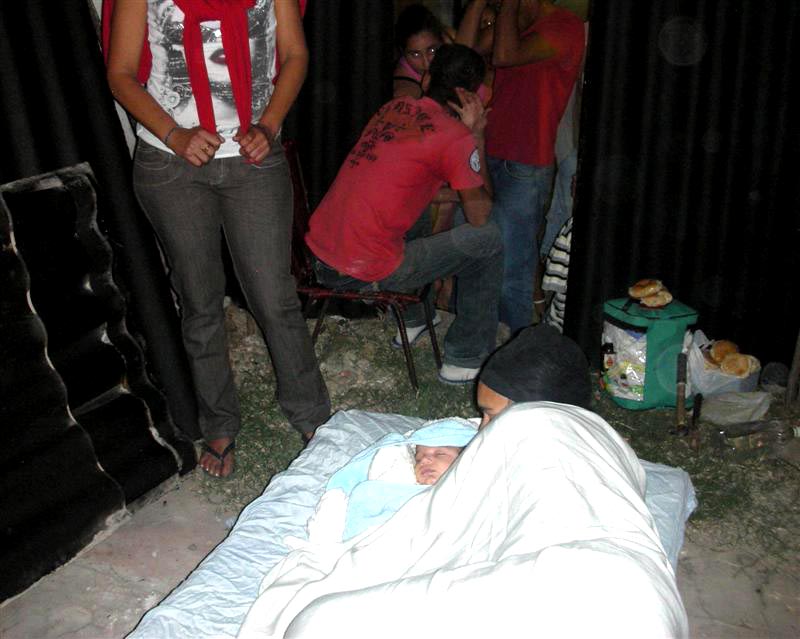
In a few minutes they built a fiber-cement hut from fragile boards, in a vacant lot once occupied by a grocery store. They spread out on the floor — surrounded by weeds — the rickety mattress they brought on their backs, and got ready for the storm.

Alexander Otero just took the riskiest step of his life, the most desperate: publicly claiming the right to adequate housing for him and his humble family.

Side view

It took no time at all for the public officials, the police, the Committee for the Defense of the Revolution (CDR) to come and question that blackish den where suddenly two people with a newborn baby had installed themselves. The answers from both young people were the same: “We’re not moving from here until someone puts an end to the way we are living. We have spent months wandering from place to place, we don’t have a home, and now that our son is born we are sleeping in the streets.”

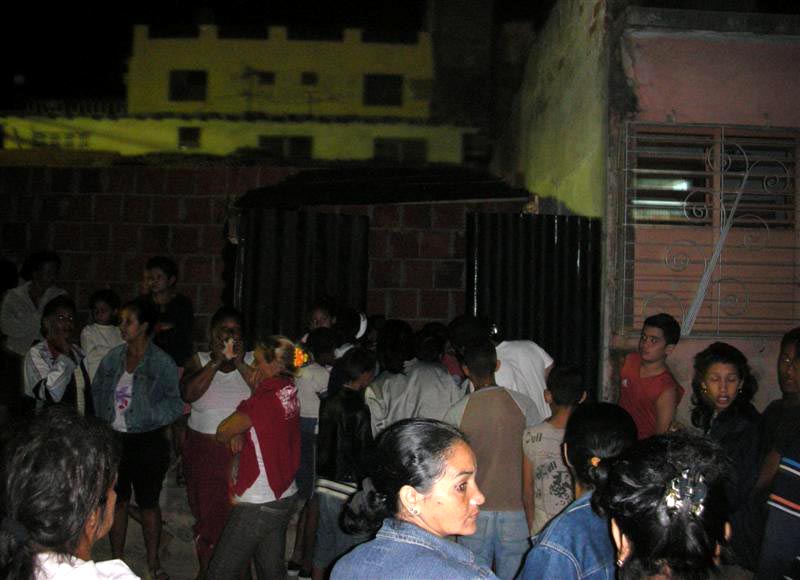
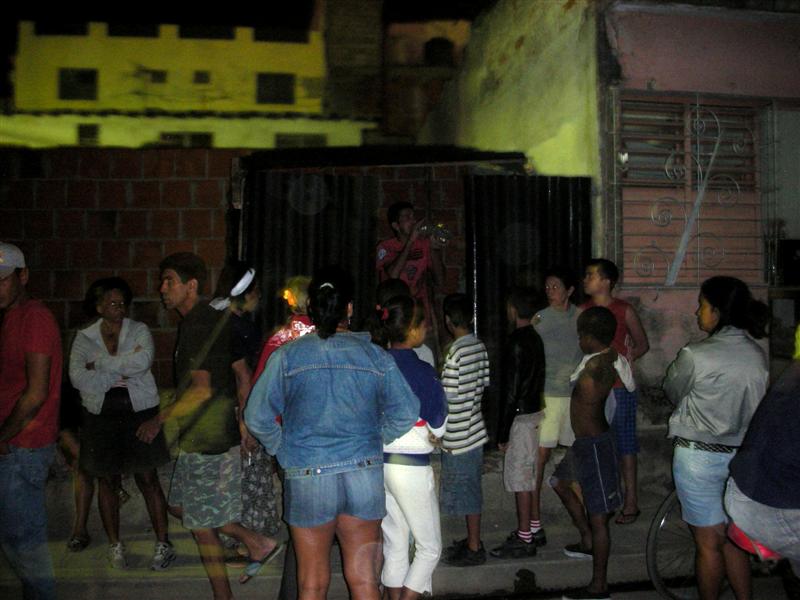
From the front, with neighbors all around

Not late in coming, either, were the curious, the supportive neighbors, who were suddenly left speechless by what these people were doing; nor was the informant late in coming, a member of the intelligence services who, unhappily, tried to avoid my filming the event and taking photos of him.

I repeat: unhappy man, who never imagined — as I could never imagine — that a crowd of dozens of Bayamese would turn against him, almost expelling him, and showing an enormous contempt for his sudden “coming out of the closet” as a citizen repressor.

According to the words of Otero Rodriguez, this action was the culmination of an inhuman waiting that started 11 years ago, when he first asked for a small space to build himself a home. Since then, the Housing Department continues to ask him to wait while, he said, they allocate huge amounts of land for houses for government and military officials in the area.

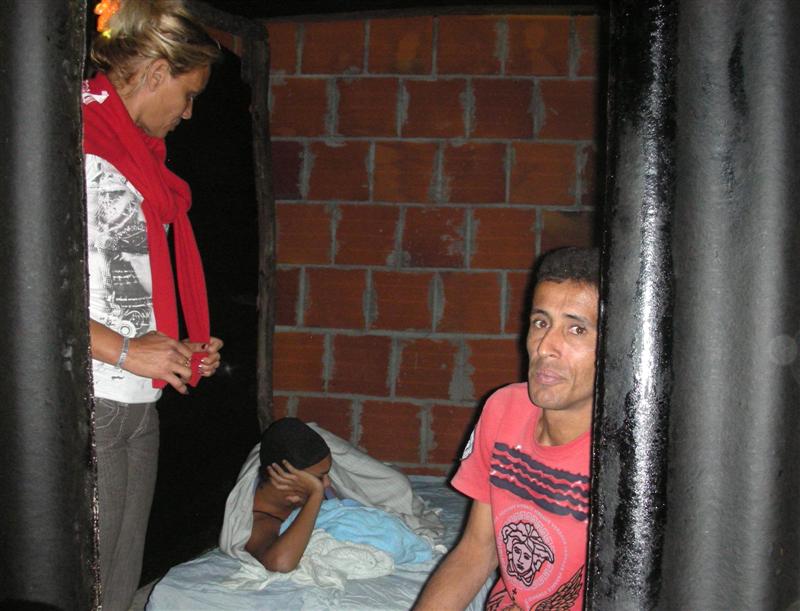
Alexander Otero and his family. In his hand, the Constitution of the Republic of Cuba

“For months Aliuska and I have lived as nomads, renting at night in a small room or sleeping in the Bus Terminal. When our son was born, we asked the authorities to pay attention to our situation (homeless and with a baby), and they only thing they did was to sell us these fiber-cement boards and seven bags of cement, without giving us authorization to build a house.

After leaving the Maternity Hospital, the three had continued to sleep in the open.

“In parks, in terminals, in doorways. We have knocked on the doors of the Housing Authority, we have been to the Party headquarters, and all, absolutely all, have shown no interest in our case. They tell us their help — selling us the boards and the cement — ended there. So here we are unable to move on with our life.”

Aliuska Noguer, and her small newborn

At nine at night, with a considerable crowd in strong support, both parents challenged the bureaucrats of the Housing Authority and the President of the Municipal Assembly of Peoples Power, and the handful of officials who dared to pass through the circle of neighbors.

Otero Alexander’s words were always the same, “As long as I don’t have in hand some land where I can build a house for my family, they won’t take me from here alive, and I charge them with the life of my child if they try to take me by force and pull down this roof.”

Another view from the front

I want to make clear the most exciting part of this, which at four in the morning got me typing like one possessed, and I am still excited by what I witnessed: the unyielding support of thirty, fifty people surrounding that place, who not only give them blankets, food and drink, but in an act of public spiritedness — never seen by me in my environment — they do not hesitate to denounce the corrupt officials, they don’t hesitate to back up with their own fists the decision of this young man, and they didn’t even feel gagged when a crouching repressor tried to block my camera.

I believe it’s time for me to reconsider what I published just two days ago in this same blog, about the ancestral fear of Cubans.

“Enough of lies, of thieving leaders. Enough of the only escape route in this country being emigration. I am Cuban and I do not want to leave my country,” were other words of Otero Rodriguez. “It is not I who should leave this country; those who should go are those who cause things like this, injustices like this.”

Interior of the improvised shelter

One of the options the young parents had rejected was an ambulance, sent by the authorities, to take the mother and baby to the hospital.

“My son is not sick. The illness my son has is to not have a home. The one most ill is me, I have a huge stomach ulcer, and I will not move from here.”

Arturo Pérez Sánchez, President of the Municipal Assembly of Peoples Power, also went to the site in person, stating that “acts like this are very damaging, they bring down the Revolution,” and then asking the people to retire so he could speak to Alexander Otero alone, a request that the masses disapproved and denied — and so he tried to evaluate the case in the early hours of the morning.

“Anyway,” repeated Otero, “without a signed document I’m not leaving here. We know too well about false promises. The second I leave they will knock me down, and I’ll be sleeping in the street again.”

From this morning of Thursday, December 24, I am sure that the life of this father, strangled by inefficiency, laziness, and the misery to which he’s been condemned, will change drastically, in one sense or another: he will, perhaps, receive a poor site where he can “legally” erect this same shack; or he will be expelled in some way from his scrap of ground and be punished for his act of rebellion.

I intend to follow this event, in the future, as the best way in which I can squeeze the hand of this brave Bayaman, along with so many supportive neighbors, and tell him he is not alone. From now on, he is not alone.

December 23, 2010

The Only Celebration / Fernando Dámaso

  1. Soon we will celebrate Christmas, the only celebration capable of uniting the majority of human beings, despite their ethnic, religious, political, and other differences. Increasingly, most countries embrace it as a day of love and tenderness, in a process of cultural integration, where traditions are mixed to form one, with births, illuminated trees, wreaths, Santa Claus, reindeer, sleighs, bells, snow, palm trees and everything imaginable. Here, Christian and pagan traditions form a whole, to the delight and joy of the whole family and friends.
  2. In my country it is traditionally celebrated. At first purely Christian, brought by the Spanish with cribs and Baby Jesus, and then over the years, expanded with illuminated trees and all the pagan symbolism. It went beyond the home and spread to shops, shop windows, streets, avenues and even buildings. I still remember the giant tree of lights on the front of the Havana Hilton, and the immense natural pine illuminated at the entry to Fontanar. But in the late sixties, by government decision, it was abolished on the grounds of the effort needed for the sugar harvest, and only restored when the Pope visited.
  3. Those were years of sad Decembers, trying unsuccessfully to be substitute the date of the victory of the insurrection. Even pens were complacent, writing two articles against it, denying its tradition and accusing it of being Americanized and commercial. They forgot, for convenience, that the traditions of the people are formed precisely by the addition of influences, and constitute a living process of constant renewal and enrichment, discarding the obsolete and adopting the new. Our Christmas is well-formed and, having continued without this absurd decision, now we will be like most Western countries, of which we are a part.
  4. Despite its official restoration, nothing has been officially done to revive it, quite the opposite. Shops and buildings are not decorated, let alone the streets and avenues. For the written press, radio and television, it’s as it didn’t exist, all the news is concentrated on the January victory of the Revolution. Small little islands of Christmas appear only in hotels, primarily to please tourists, and in some shops in Old Havana under the influence of the Historian of the City. Those who maintain the tradition, and try to revive it, place lit trees and nativity scenes, and we decorate our homes with garlands of lights. Although each year more people do so, we are seen as aliens. Still, neighbors who do not dare to publicly celebrate Christmas, congratulate us for doing so. It’s an interesting situation, where fear weighs more strongly than true feelings.
  5. Like every year, I will celebrate Christmas with my family and friends gracing my home and keeping it thus from the last Thursday of November until 7 January. It is a time to fully enjoy, which my neighbors would also like to be able to enjoy, think what they may. A Christmas greeting, with all its symbolism and the sum of multiple traditions, sooner or later will return to form, along with the Christmas, New Year and the Day of Kings, the most important holidays of my country. Part of the true national identity. To my readers: A MERRY CHRISTMAS AND A HAPPY NEW YEAR WHERE ALL YOUR DREAMS COME TRUE.

December 14, 2010

The Holidays Return / Yoani Sánchez

To go to work on December 25, to have school on New Year’s Eve or to be called to “voluntary labor” as the year drew to a close. All this was possible in an ideologically fervent Cuba, with its false atheism and disdain for festivities, that left us with grey Christmases, celebrated in whispers. The last weeks of 1980, 1983, 1987, so identically boring, lacking in color, run together in my mind. I spent many of those days sitting at a desk, while in other parts of the world people shared them with their families, opened gifts, celebrated in the intimacy of their homes.

It seemed that the Christmas vacations were never honored in Cuban schools, the students only had breaks for patriotic or ideological celebrations. But, little by little, unannounced, and never approved by our peculiar parliament, students themselves began to reclaim these holidays. In the beginning, each classroom would be missing about a third of its students, but slowly the absence virus began to infect everyone. Until finally the number of students missing in the last two weeks of the year left the Ministry of Education no choice but to declare a two-week break in classes. It is these small citizens’ victories, reported by no newspaper, that we all understand as terrain wrested from the false sobriety they try to impose on us from the podium.

Today, my son Teo got up late and he won’t return to school until next year. His classmates haven’t been to high school since Wednesday. Watching him sleep until ten, make plans for the coming days off, helps to make up for my boring childhood Christmases. I can forget all those Christmas Eves I spent without even realizing there was a reason to celebrate.

Memories of Christmas Eve / Fernando Dámaso

In my house in Mantilla, Christmas Eve was always a feast of family and friends. It was the most anticipated date and for days ahead of time we started the preparations, buying nougat, marzipan, figs, walnuts, hazelnuts, chestnuts, wine, cider and cheese. We looked for black beans and soft yucca, and well-threshed rice. The pig was sacrificed the day before and marinated and then taken to the oven at the bakery in the early hours. The same day we bought lettuce, radishes and tomatoes for the salad, to ensure they were fresh. The whole day was given over to preparing for the big dinner at night.

In the cement patio at the back of the house, we set up a big table made of boards on saw-horses. All around were benches, also wood. The table was covered with huge white tablecloths. My uncles made sure there was a barrel of beer, soft drinks, apples, pears and grapes, and an occasional bottle of wine. The dessert pancakes and coconut and guayaba candies were made by Joaquina, our neighbor, a black cook who was part of the family.

The children spent the day playing and helping out with whatever they told us to do. We also visited the homes of friends who were preparing their dinners. My neighborhood was modest, but the majority of the houses celebrated Christmas Eve with more or less comfort. The joy was contagious and all the shops were decorated, and in the houses were lit trees and manger scenes. It was a day of happiness. And music accompanied us the whole day.

At nine at night the dinner started. The whole family participated, along with friends we invited and those who dropped in to surprise us. We made enough food and always had room and a plate for whoever came. Rice with black beans, yucca with a mojo sauce of oil and garlic, pork roast and salad were universal. There was wine and beer for the grown-ups and soft drinks for the kids. By dessert we were drinking cider. The dinner lasted until eleven, when we went to the Rooster’s Mass* at the church facing Route 4. When we got home we continued the party into the wee hours of the morning.

Despite everything that has happened in these years, and even though we lack almost everything, we always try to celebrate Christmas Eve. Our family is dispersed through mass exodus, and the practice is officially frowned upon, but we gather those who are left, along with our friends, and around the lit tree and the creche we share this unique dinner on the best of all nights. We can not let something as important as our national identity be taken from us.

*Translator’s note: In Latin American countries the midnight mass on Christmas Eve is called the Rooster’s Mass because the belief that the only time the rooster crowed at midnight was the night Jesus was born.

Spanish post
December 19 2010

Penultimate Images of the Varadero Hotel International / Regina Coyula

This is the Hotel International they are planning to demolish in Varadero, the photos are from July 2010.

Terrace facing the sea
Lobby

Facade from the street

Facade from the beach

The Sun Cabañas, designed by the architect Nicolas Quintana and annexed to the Hotel, will suffer the same fate.

Sun Cabañas
Cabañas del Sol

Photos courtesy of Martha Aquino

December 23, 2010

The Repressive Eye / Miguel Iturria Savón

Albert Einstein used the say that God doesn’t play dice, but the Cuban government plays at being God and sets up the table of intolerance in any corner against those who don’t understand that the initiatives come out of the Palace and not the citizens, considered by the Owner-State like minors, incapable of enjoying Human Rights, more appropriate for Europe and North America than for an island in the Caribbean.

Friday, December 10, the game board was located around Villalon Park in Vedado, where Dr. Darsi Ferrer called for a silent march with banners, to evoke the Universal Declaration of Human Rights, approved by the United Nations General Assembly in New York in 1948.

This document is barely known on our island, and was ignored by Batista, from 1952 to 1958, and from 1959 by the Command of the Castros, still today clinging to military orders that contradict the articles of the Declaration, with which peaceful opponents to the regime identify, organized in turn around small political parties that promote democratic changes.

The struggle between democrats and the military is a common fact, but at times it touches on the absurd and reveals the unusual. Friday we watched the game of hundreds of cats against dozens of mice. The main command was located in the mansion occupied by the digital portal La Jiribilla, alongside the former mansion of Generalísimo Máximo Gómez, perhaps to frighten the ghost of the independent warrior and, incidentally, the officials of the UNESCO Regional Office, the musicians of the Amadeo Roldan Theater and the pedestrians of the area, where the arrests were a la carte.

There were guards in uniform and political police on adjacent corners, from Linea all the way to the Malecon and between A Street and the Park at Calzada and K, where those who are getting the immigration paperwork from the United States Interest Section in Havana wait, besieged by soldiers every day of the year.

Although most of the walkers don’t know the articles of the Universal Declaration of Human Rights, many are aware of the arrogance and audacity of the young agents, who pretend to listen to music with their right hand on their pistol, while watching possible suspects and following orders they receive.

Last Friday morning I witnessed the military deployment to block potential attendees of the celebration at Villalon Park. The scheduled time was 11 a.m but at 7 the SS boys were already at their posts. I went down first to the Malecon and D as far as Calzada, with a friend who was taking his children to the school located in front of the Superior Institute of MINREX. We returned at ten to avoid the hunters and their patrols.

They completed the harassment and arrests of Friday with early morning warnings, it’s common for them to knock on the doors of the opponents while the family is sleeping. They hide in the shadows of the night and in the anonymity of the agents, one of the tactics of the troop of Warlocks who throw the dice of intransigence and disregard the freedoms and rights of citizens.

Share

December 16 2010

The Little Hotel / Yoani Sánchez

The hospitable accommodations were built on land where pre-fabricated parts were once assembled to create a city for the New Man. As this chimeric individual never emerged, nor were there resources to build new housing, the site remained vacant for decades. When the so-called Battle of Ideas unfolded, they began to lay the foundations here for a hotel with more than a hundred rooms. The cranes and trucks arrived at an astonishing speed for construction in Cuba, and in barely two years they had raised the walls, installed the aluminum windows, and opened the place up. With the resources stolen from that project, many area families painted their facades, installed air conditioning in bedrooms, and remodeled bathrooms.

Known as the Little Tulip Hotel, it was intended as a shelter for Latin American patients who came to our Island for a cure. During the heights of the so-called “Operation Miracle,” its wide entrance was packed with buses discharging dozens of patients every week. Later, when the number who came for health reasons was shrinking, other groups came to receive political-ideological preparation to implement the “Socialism of the 21st Century” in their respective countries. The neighbors — from beyond the wall — were curious about the transformations taking place in those accommodations and ventured various hypotheses about what its final use would be. Some even placed bets on whether it would be given to the military, or if victims of the last hurricane would be brought to live in it.

However, a few days ago, a poster appeared with an offer of a “Christmas dinner” in the formerly exclusive dining room of the small hotel. A few weeks earlier, neighborhood youth had been invited to watch the match between Barcelona and Real Madrid from the plush lobby seating, for a two convertible peso entry fee. Now, the employees in reception say that anyone can rent a room and it’s no longer necessary to be a foreigner to enter the beautiful central courtyard. Undoubtedly, a clear sign that the Battle of Ideas has been laid to rest once and for all and that the real “miracle” proposed by the government, now, is to raise some foreign currency to earn enough profits to cover the costs. To see if the country does not sink into the abyss, as Raul Castro feared in his last speech.

The Persistence of Fear / Ernesto Morales Licea

An anecdote not often shared relates that, at the end of a meeting between Fidel Castro and Cuban artists in 1969, where he pronounced his polysemic “Words to the Intellectuals,” a discordant — and unexpected — voice spoke up.

It was Virgilio Piñera, perhaps the most immortal and lacerated playwright our Island has given birth to. A frail man who, facing the Commander in olive-green with his six feet and more and his gun in his belt, must have seemed like an insignificant blade of grass.

They say that, once in front of the microphone, pale due to his natural color and because of his nerves, the interjection of the effeminate Virgilio took less than ten seconds.

“The only thing I can say is that I feel very frightened,” he said. “Only that. I don’t know why, but I am afraid…”

His tortured life didn’t allow him to know that he wasn’t wrong that time, that fear would be his destiny.

I think of Virgilio when I hear from the mouth of another intellectual, and friend, very similar words. The only difference is that this teacher, this young writer knows perfectly well why he is afraid.

His name is Francis Sánchez and, like me, he lives in a little provincial city, Ciego de Ávila, where exercising individuality implies more risk than in the cosmopolitan capital. For a long time his name has been known among professionals of letters for his literary laurels, and his publications in the country’s diverse magazines.

Anyone who sees him, with his nicely fleshed-out body and his well-trimmed mustache, would think he was the most complacent and docile of citizens. A perfect pater familias who, like any ordinary Cuban, deals with the shortages and dissatisfaction. And shuts up.

But Francis Sánchez bears a cross of ashes on his forehead: he has never consigned himself to renouncing his condition as a free man, his condition as a non-conformist Cuban who doesn’t know how to close his eyes against the reality he doesn’t like, that doesn’t suit him.

Like a good man of letters, knowing the absolute impossibility of publishing his questioning articles in any institutional media, the personal chronicles about the country that he longs to have and doesn’t, he decided, like many of us, to open his personal blog. If I remember rightly, he just opened it with the excellent name: Man in the Clouds.

But Francis Sánchez is afraid, and doesn’t hide it. He tells me:

“You are a single boy, Ernesto. We are four. It’s not the same.”

And suddenly I feel very small, devoid of reasons before a circumstance like this: an honest Cuban has decided, knowing the risk, to endanger the stability of three people other than himself: his wife and their two children. And he has decided not how we choose one option ahead of another, or how we shuffle the possibilities on the negotiating table. No. Rather, he is someone who cannot contradict his abiding spirit, and who knows that it may cost him very dearly, and be very hard, but still he crosses the thin line.

One of his phrases has left me trembling like a leaf. He told me, with subtle indignation:

“I feel very afraid, not for myself, but about what could happen in the future to my family. And this fear only irritates me more. Because the fear is the most incontrovertible evidence that I must confront the country in which I live: I don’t want to feel afraid! I shouldn’t be afraid if the only thing I am trying to do is to express what I think!”

His rationale is scathing. Absolutely no one should fear for his integrity, social stability, if what he wants to do is done everywhere in the world of free people: raise his voice against the imperfect, the deformed, what he considers unacceptable. We should fear terrorists, pedophiles, those who corrupt. But men with their own voice, never.

But, that is the daily life of Cubans.

I’ve lost count of the number of times I’ve heard, from the mouth of one person or another, “I would love to do what you are doing, but I can’t.” And then, a long or short list of reasons that sweeten a painful reality: fear is stronger than the need for expression.

And so the mask never fails to hide the unpleasant features of our personality, and to camouflage the fear that takes hold in the most varied pretexts.

What are the most frequent arguments I hear in this regard? In the first place, the impossibility of survival without the employment offered by the State. Some say, “If, like you, I had at least one family member outside this country who could help me economically, I’m sure that I would have founded a Party, I would no longer go to the polls, I would say what I think in the assemblies at work, I would have opened a blog.”

Others say, “If I didn’t have a family to support, I would have exploded long ago and would have screamed at the officials everything I think of them.”

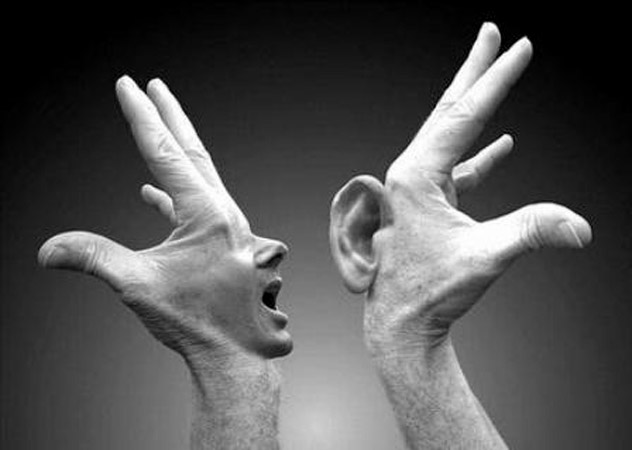
There is something undeniable, beyond ethical and moral judgment, that these words prove: There has never been a better partner for totalitarianism than naked fear. If this century’s technology has been the worst enemy of those who would like to control the minds of men, since ancient time it has been fear that has provided the fuel to sustain the machinery of the dictatorships.

What do people really fear in my socialist Cuba? It’s worth asking. It’s not the fear of death or disappearance, as used by tropical dictators like Trujillo or Somoza. The Cuban people’s fear is more ethereal: the fear of disintegration as a social being.

Losing a job without any possibility of finding another livelihood; the constant defamation surrounding a person; the exclusion from spaces and organizations that you used to frequent, and as may be the case, being refused admittance even to public cultural institutions. Add to that suffering constant harassment not only against yourself, but worse still, against your loved ones and your friends. And, depending on the strength of your positions and your consequent activism, physical repression and prison.

So the more I think about cases like that of Francis Sánchez, and so many others who once broke their chains and decided to play according to their own rules, I remember the vibrant words I heard from the mouth of Father José Conrado: “We are all afraid. The essence of the totalitarian system is precisely to provoke a response of paralyzing terror. The problem is when one has to conquer it in the name of a great responsibility.” And there are many more examples, dignified, beautiful, which make me believe more and more that to rely on presumed accommodating arguments is an irresponsibility that is even more costly, in terms of the eternal weight on one’s conscience.

After listening to Pedro Luis Ferrer quote his favorite phrase — “Nobody knows the past that awaits him” — I discovered what is in truth the greatest of my fears, the supreme terror I could not face: the fear of facing, in the future, my children and my grandchildren, and having to explain to them where I was and what I was doing when my country was suffering so much fear.

Now that President Raul Castro has said, with regards to the 6th Communist Party Congress, that from this point forward the only necessity is that each Cuban speaks the truth, whatever that might be, and that everyone must do so without fear (his exact words, confirming an open secret: Cubans have a sense of raging panic around expressing their truest opinions), I think it is the perfect time for all of us to dedicate five minutes to self-examination, and of taking the President-General at his word, lest we soon repent our failure to do so.

December 21, 2010