The Law of Supply and Demand Draws Cubans to Garage Sales

Garage sales have exploded since their formal authorization three months ago. (14ymedio)

14ymedio bigger14ymedio, Natalia Lopez Moya, Havana, October 12, 2021 — Clothes, shoes and small appliances, but also electrical outlets, a screw, hair clips, earrings, silicone, an ornamental plant, an old hookah and even a pre-1959 phone book. You can find anything at garage sales, which the government legalized on July 20 and are now proliferating across the island.

“In Cuba you can sell everything because no one has anything,” says a buyer from Central Havana who has become a regular customer at these types of businesses.

Retail merchandise for sale in Cuba’s national currency is in short supply. Increasingly, items such as shoes and clothing cannot be purchased with pesos and not everyone has the dollars needed to shop at the burgeoning hard currency stores. Customers can find products at online classified ad sites such as Revolico but prices there can be astronomical. As a result, garage sales, where prices are lower, have become an economical and pleasant shopping alternative for many Cubans, especially those most disadvantaged.

“Here in Central Havana, people are putting any little spare space to use. It could be a hallway next to a staircase, a tiny corner in a tenement or even empty building. A whole retail network has already sprung up,” say Iris, a vendor who, along with her cousins, has set up shop in a family member’s garage.

In a quick stroll through the neighborhood, 14ymedio found seven such operations.

Though garage sales have operated for years in Cuba — their popularity grew in 2013 after the government outlawed sales of imported goods in private stores, which were supplied by mules importing items from Mexico, Panama and Russia — they took off after being legalized as part of a package of emergency measures intended to calm public discontent after the July 11 demonstrations.

Though local authorities did not initially require sale organizers to obtain commercial licenses or register continue reading

as a self-employed workers, they were required to file permit applications with the Municipal Administrative Council and pay a fifty-peso fee. The fee requirement was subsequently waived on August 12 when the government updated the regulations.

There were, of course, other strict requirements. Items for sale had to be for domestic or personal use only — whether used, pre-owned or new — and transactions had to be carried out in garages, on front porches or in other residential areas in ways that did not obstruct pedestrian or vehicular traffic. The resale of products purchased through the rationed market or in hard currency stores, such as toiletries and food, was prohibited.

Shortages are so acute, however, that there are some laws that not even sixty-two years of total state control can undo, such as the law of supply and demand.

“Everyone comes here,” says Iris of her fellow vendors. “They even sell toiletries the rationed stores sell: low-quality brands like Daily and Lis.” Inspectors do not bother them, she says, because Cubans’ need for basic products is so urgent.

One example is tobacco, a product so difficult to obtain that fights often break out when it goes on sale at state-owned stores. At one garage sale, customers could buy H. Uppmann filtered cigarettes for 160 pesos and unfiltered for 140. (The price is almost double at state stores.) The vendor has the items out on a counter, in full view. “If an inspector comes along, I tell him I’m a smoker and that they’re mine,”  explains the vendor, who asks to remain anonymous.

Augusto, another garage sale vendor from Nuevo Vedado, employs different strategies to avoid being fined. “You have to be very careful about what you display because obviously [the inspectors] are not idiots. They could come and accuse you of selling things illegally” he says. For example, if he has several watches for sale, he will only display one.

Augusto is happy transactions like these are now legal. He and his family, who used to own several tourism-related businesses, have been laid low by the pandemic. They have adapted by selling their personal belongings, in some cases at very good prices. This weekend he is doing particularly very well. “I was dying of boredom being cooped up at home,” he confesses.

The capital is not the only city where this type of business is expanding. Lucretia from Santa Clara says, “My house has a front patio and it’s near Vidal Park so several friends and I organized a garage sale.” For the first one they had very few things: some kitchen towels that her grandmother made, some cables and parts of old laptops they had gathered together, old shoes and clothes they no longer wore. They were better prepared the second time around, collecting everything their relatives had to offer. “We even sold a small children’s bike,” she says. “That time we raised more than 2,000 pesos.”

Another advantage to this type of transaction is the flexible payment options it offers customers. For example, there are vendors who will set an item aside if the customer does not have enough money to pay for it at the moment.

Other conventional businesses also take advantage of garage sales. In Old Havna the owners of a bakery located on an undesirable corner have divided the premises in two. In one half they sell bread, meringues and ground peanuts. In the other other there are clothes, shoes, keys, scissors, locks and a whole arsenal of things.

“That’s how far we’ve fallen” says the Central Havana customer. “These are things humans invented a long time ago but, in the commercial Middle Ages we’re living in now, it’s like a major event.”

____________

COLLABORATE WITH OUR WORK: The 14ymedio team is committed to practicing serious journalism that reflects Cuba’s reality in all its depth. Thank you for joining us on this long journey. We invite you to continue supporting us by becoming a member of 14ymedio now. Together we can continue transforming journalism in Cuba.
Officials Station Rapid Response Brigades Near Key Government Sites

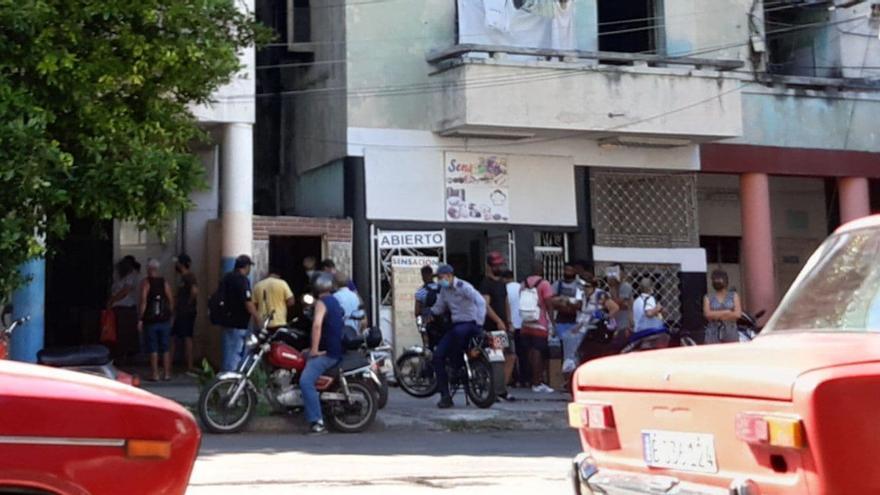
On Tuesday, police and State Security agents patrolled the area along 19 de Mayo Street between Ayestaran y Amezaga streets in Havana. (14ymedio)

14ymedio bigger14ymedio, Natalia López Moya, Havana, October 12, 2021 — The Rapid Response Brigades (BRR), the regime’s shock troops, were mobilized on Tuesday after the Cuban government refused to to allow a public march on this coming November 15. In neighborhoods where the July 11 demonstrations were most intense, state-employed workers, police and State Security agents were sent in to patrol the streets.

The presence of the BRR at Aranguren and Ayestaran streets, one of the busiest intersections in in Havana’s Cerro district and one of the closest to Plaza of the Revolution, has created a “tense atmosphere” according to Yulieska, an area resident. Even activity at the neighborhood’s underground market has been curtailed as people wait for the heavy security presence to diminish.

On July 11 a huge cordon of police, State Security agents, soldiers and young military draftees prevented demonstrators from reaching the Plaza of the Revolution. Hundreds of Cubans marched through the streets from Old Havana to Cerro before being stopped by security forces. Hundreds of people were arrested during the incident and some were injured.

“It’s a very protected area because they want to stop people from getting to the Plaza in the event of a protest,” explains Yulieska.

The Plaza of the Revolution complex houses the Palace of the Revolution and presidential offices, the Cuban government and the Cuban Communist continue reading

Party Central Committee. Adjacent areas are home to important ministries such as the Armed Forces, Interior, Communications, and Economy and Planning.

The Plaza, a enormous open space flanked by a tall tower and presided over by a statue of Jose Marti, has served as the stage for large rallies and official events for decades. For this reason, the government is trying desperately to prevent hundreds or thousands of people from gathering in an area that it sees as a symbol of the massive popular support that the regime enjoyed in its early days.

In other districts such as Central Havana, the pinch point of the July 11 protests, and in other neighborhoods such as Vedado, residents confirm the visible presence of State Security agents and plainclothes policemen. At Martyr’s Park, Infanta and San Lazaro streets, and the area around the Yara movie theater, many security personnel can be seen.

During the July 11 protests, officials mobilized the BRR along with workers and young military recruits. They were given sticks and baseball bats to confront thousands of demonstrators calling for freedom.

The brigades were conceived and created in the early 1990s to serve as a paramilitary police force that would allow the regime to control outbreaks of popular unrest. In an effort to avoid the image of men in uniform taking repressive actions against civilians, Cuban officials formed these “brown shirt” brigades as a first line of defense against public protests.

The BRR have played a prominent role in acts of public repudiation against dissidents and activist groups, most notably the Ladies in White. But they first came into their own in August 1994 when, together with police and construction workers armed with sticks, they confronted demonstrators during the popular revolt known as the Maleconazo — the Malecon uprising — which led to the so-called Balsero [Rafter] crisis.

____________

COLLABORATE WITH OUR WORK: The 14ymedio team is committed to practicing serious journalism that reflects Cuba’s reality in all its depth. Thank you for joining us on this long journey. We invite you to continue supporting us by becoming a member of 14ymedio now. Together we can continue transforming journalism in Cuba.
Havana Restaurants Reopen with Exorbitant Prices and at Full Capacity

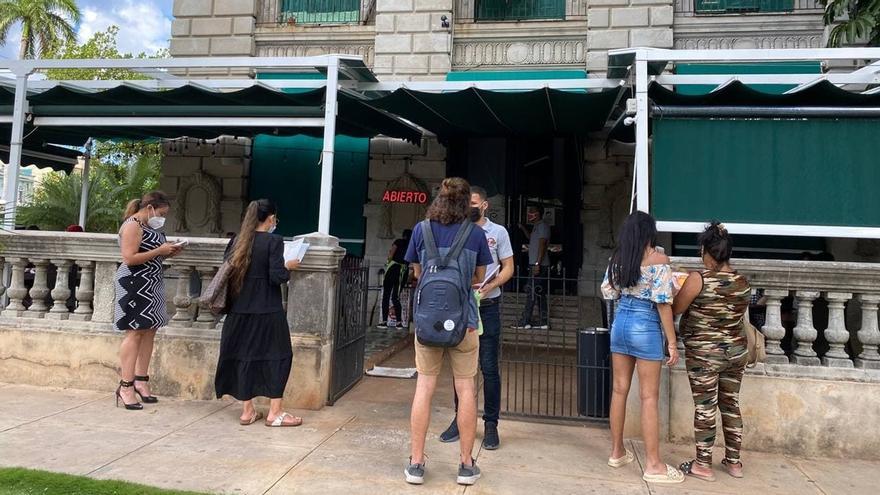
It has become impossible to get a table at Rey & Gaby before November (14ymedio)

14ymedio bigger14ymedio, Luz Escobar & Natalia Lopez Moya, Havana, October 9, 2021 — Rey & Gaby is fully booked until sometime in November. Currently, it is impossible to reserve a table at this privately owned restaurant in El Vedado. Before the pandemic set in, the place always had empty tables. Now that restaurants in Havana are reopening, it has become a go-to place, in spite of its prices. “Rey’s pizza is 150 pesos, which would have been about six convertible pesos. It used to cost three,” remarks a customer who was checking out the menu at the entrance this weekend.

It is not an isolated case. Reservations at the nearby Cocina de Esteban are also up. The place is large and the staff plan to seat anyone waiting in line. But since restaurants reopened on September 24, the number of reservations has exceeded all forecasts, even at state-run establishments.

At the pizzeria on the corner of 23rd and I streets there were five people waiting in line. “We can take your name and, if something opens up, we can seat you but everything is by reservation,” says an employee. She points to the menu board.

“Everything has gone up a lot. Before, you could get a pizza for six or ten pesos. Now it costs forty,” complains a man in his sixties as he waits in line with his two teenage granddaughters.

Not all restaurant and cafe owners are thrilled, however, at the prospect of reopening. Barbaro Dominguez claims continue reading

that, during the quarantine, he learned a lot about how to do business. That is why he is not planning to continue selling pizzas from the covered entryway of his house near the Vía Blanca.

“When I closed, there were 1,000 cases of Covid a day in the country. At the time that seemed like a lot. Now they tell us we can reopen but I’m not sure my family will be safe under these conditions,” he admits. “This is where we live. The bed where my daughter sleeps has a window that overlooks the area where I sell pizzas. If someone sneezes outside, coronavirus could get under the sheets.”

Dominguez does plan to keep operating but will focus on home delivery, which he believes will be much safer. “It’s better for me. I doubt that by year’s end I will still be behind the counter on my front porch,” he says. But not all the changes are driven by the pandemic. “I’m on various websites where people who live overseas buy food in dollars for their relatives who live here. They pay in real money.”

Operating under the names Mercadito XL and Hasta Tu Casa (To Your Door) Dominguez has turned his cafe into a small supermarket that delivers anything from a package of sausages to a bag of prebaked bread rolls to a pack of beer. “It solves a ton of problems like the obnoxious drunk on my front porch and the inspectors who always want more and more money.

“People are complaining about the prices at all those terrace restaurants because, of course, they charge in Cuban pesos and have to exchange a dollar for 70 or even 80 pesos. Every day they have to write the prices on the chalk board because things are constantly changing. I only accept dollars. The people who buy from me are those who have greenbacks,” he says.

Dominguez has posted a classified ad for several items in his cafe. “I am selling a bar, refrigerator with a glass display door, tall wooden stools and a sink with a drain for kitchen work,” the ad reads.

But a beer does not taste the same at home. At least that is what Dayana and Monica think. It has been a year since the two young women sat face-to-face at a restaurant. As soon as restrictions were lifted, they headed to the Maximo Bar, a privately owned establishment near the entrance to the Havana harbor.

“Between the two of us we spent 3,000 pesos but it wasn’t just for the items themselves. We wanted the experience of eating and drinking in a public space,” admits Dayana. The couple met in March 2020 and their relationship has been marked by the pandemic, which is why they want to finally enjoy being in a restaurant together.

“Yes, it’s expensive but we are willing to pay for the experience. We’ve spent months thinking about it. Even if it had cost a fortune, we would have figured out a way to do it, though I don’t know if we would be inclined to do it again tomorrow. Today is the first time but next time I’ll be checking the prices first and maybe we’ll have to settle for some other place,” one of them admits.

There are also those who are frightened by the growing number of zeros on restaurant menus. At the Malecon’s seawall, some carry their thermoses of tea or coffee, their hidden tankards of rum almost rusted out after months of not being used.

“Before, there used to be other problems,” says Lazaro, a fisherman from the outskirts of La Punta. “You were Cuban or you were a tourist. You paid or you didn’t pay… but now everybody is afraid. No one dares take a sip from a stranger’s bottle.”

The drunk guy who used to come here every day died of Covid in March. And the fisherman that I used to share soup with passed away in July. I’m the only one left around here. I used to worry about people bothering me. Now I wish people would come over. No one is fishing and no one goes near anyone else.

____________

COLLABORATE WITH OUR WORK: The 14ymedio team is committed to practicing serious journalism that reflects Cuba’s reality in all its depth. Thank you for joining us on this long journey. We invite you to continue supporting us by becoming a member of 14ymedio now. Together we can continue transforming journalism in Cuba.

Havana Residents Make Themselves Heard Through ’14ymedio’

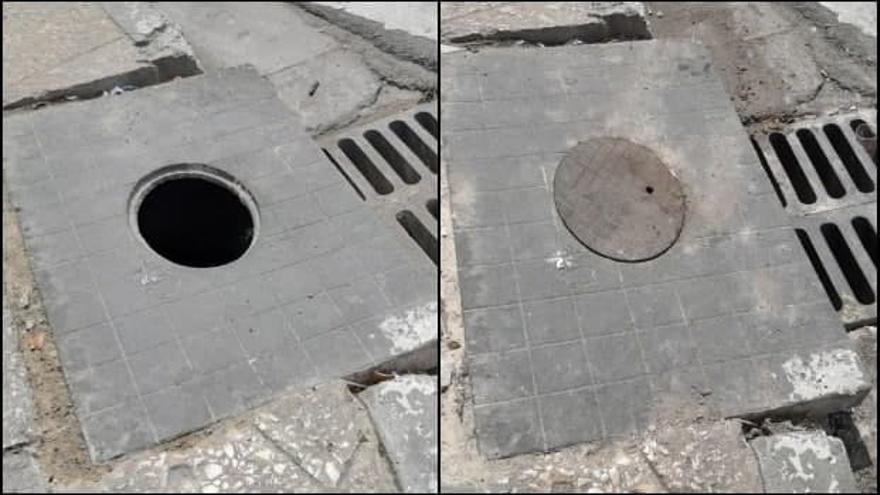
Sewer at the corner of Infanta and San Lázaro, in Havana. (Collage)

14ymedio bigger14ymedio, Natalia López Moya, Havana, 8 October 2021 — A few days after this newspaper echoed the dire state of many streets in Havana, which puts passersby at risk, citizen complaints have achieved something. Aguas de La Habana (Havana Water), responsible for leaving numerous sewer manholes without a lid, has closed the one that was open on the busy corner of Infanta and San Lázaro, just outside the Alma Mater bookstore, according to 14ymedio. “Now we will have a few fewer sprains,” commented a resident from the Plaza municipality, close to the corner.
____________

COLLABORATE WITH OUR WORK: The 14ymedio team is committed to practicing serious journalism that reflects Cuba’s reality in all its depth. Thank you for joining us on this long journey. We invite you to continue supporting us by becoming a member of 14ymedio now. Together we can continue transforming journalism in Cuba.
Havana’s Coppelia Ice Cream Parlor Opens a ‘Line for Failures’

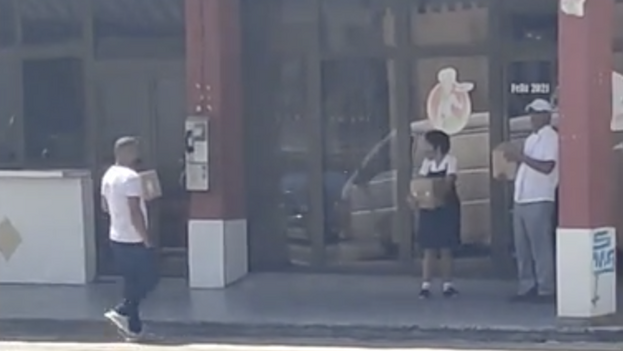
Telephone reservations at the ‘Cathedral of Ice Cream’ have not prevented the long lines or frustrating wait. (14ymedio)

14ymedio bigger14ymedio, Natalia López Moya, Havana, 3 October 2021 — A week ago the Coppelia ice cream parlor in Havana resumed table service but only for customers with a telephone reservation. The new access mechanism to the ’Cathedral of Ice Cream’ has not prevented the long lines or frustrating waits that have been an inseparable part of the place for decades.

“This damn country!” a child was heard saying this Saturday as he waited under the shade of a tree with other kids to enter one of the public service areas. The little boy’s expression provoked laughter and also the mother’s scolding: “Child, do you want me to be imprisoned? Do me a favor and calm down.”

Nine days have passed since the reopening and criticism of the new mechanism is already being heard. Tricks to skip it are also proliferating. Regular customers at the store on the central corner of 23 and L, in Havana’s Vedado district, prefer to take their place in the “line of failures,” the line where those who trust that several of the users with reservations will not show up.

“The guards’ business has already started. This will never change here,” said a man who complained about the parking area for vehicles — under the sun — where they had to wait to enter. “It is clear that it is convenient for them to have this line hidden back here, so that we do not see the ’line breakers’ who pass for a few pesos without calling or waiting.”

There were also those who learned of the requirements to have a reservation only when arriving at the place. Like a lady who was surprised to find out. “They don’t invent anything good, everything is putting the people to work. I’m from San Miguel del Padrón and I don’t have a phone, so if I’m around here and it occurs to me to have an ice cream, should I go home and ask the neighbor can I borrow the phone to make a reservation? “

The woman mentally calculated her possibilities looking at the dozen people who were waiting and gave up on ice cream: “I’m leaving, there are many people here, if nobody fails to reserve then I will only have to line up and sunbathe for fun.”

____________

COLLABORATE WITH OUR WORK: The 14ymedio team is committed to practicing serious journalism that reflects Cuba’s reality in all its depth. Thank you for joining us on this long journey. We invite you to continue supporting us by becoming a member of 14ymedio now. Together we can continue transforming journalism in Cuba.
The ‘House of Preserves’ Falls a Few Days After Opening

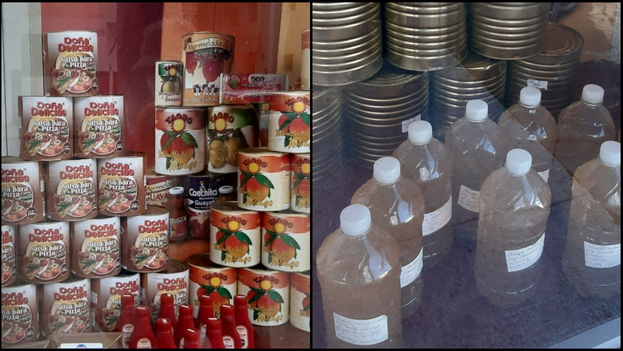
A before and after in the presentation and quality of the products in the store located in the municipality of Cerro. (Collage)

14ymedio bigger14ymedio, Natalia López Moya, Havana, 28 September 2021 — Almost three weeks after the inauguration of La Case de las Conservas (The House of Preserves), the products that the store sells today are far from the presentation and quality of those initially praised by authorities and the official press at the opening of the establishment.

This Tuesday one could find the Rial brand mayonnaise from that initial batch, which “is not of very good quality, but since it is the only one you can find, you have to buy it,” according to the shopper Alberto, a private sector worker in Havana speaking to 14ymedio. Apart from this sauce, one could also buy cumin, which had run out a few days after the market’s opening and that is once again for sale today, explains the customer.

Located in the Ayestarán neighborhood, between May 19th and Néstor Sardiñas streets, in the Cerro municipality, in Havana, the store specializes in “all kinds of preserves,” according to an article in the Havana Tribune. The official newspaper reported on September 12 that “there will be a permanence of products” that “will be controlled and regulated.”

As of days ago, at La Casa de las Conservas products such as jams and vinegar are now supplied by continue reading

mini-industries and not by state-owned factories which have higher production and quality. They arrive without labels, they only have a small paper tag attached with the description of the content and come in very rustic packaging, some buyers complain, although others, like Tania, don’t notice.

“We no longer look for attractiveness in shopping, what one tries to do is sort things out and that is why the huge line and killer conditions to continue to buy here,” the woman said with resignation. “But yes, there’s no longer ketchup or mustard or Taoro jam or VitaNova, which was the star product of this place,” she says.

The reluctance of customers also comes because food made in mini-industries is often far from the details printed on the labels. Tomato sauces mixed with beets to increase volume, tasteless pickles and sweets made with poor quality fruits are some of the most frequent criticisms of the production of these factories.

Customers also complain about long lines and say that every time merchandise arrives, no matter how little, they stop selling and until everything is downloaded and accounted for, marketing is not restarted. In addition, on several occasions they have demanded that the store workers place the notice board with the products that are dispensed in the window.

Since its inauguration, only one item from of each line can be purchased at La Casa de las Conservas and they scan the customer’s identity card “so that the same person does not buy again for a month,” a buyer complained on September 13.

According to various testimonies collected by 14ymedio, some people have arrived at the time when the 400 turns in line are distributed, at 5 am, and have not been able to enter until a day later. “The worst thing is that you cannot line up to buy a particular product, because it usually happens like in any other store, that things run out before your turn is due. That is why, after waiting so long, you have to buy whatever they have,” laments Alberto.

“Add to that that since your identity card has already been registered, if you don’t want to buy because the product you wanted ran out, you have to wait a month to buy again in the store.”

____________

COLLABORATE WITH OUR WORK: The 14ymedio team is committed to practicing serious journalism that reflects Cuba’s reality in all its depth. Thank you for joining us on this long journey. We invite you to continue supporting us by becoming a member of 14ymedio now. Together we can continue transforming journalism in Cuba.
Cuba: The Line Became a Roar When the Ice Cream Ran Out

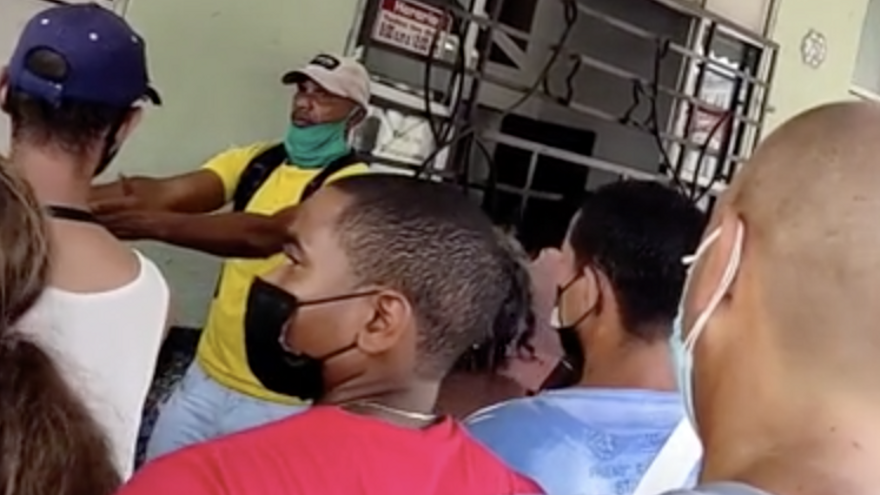
Employees of the El Italiano Pizzeria in Havana, carrying the tubs of ice cream they got without having to stand in line. (14ymedio)

14ymedio bigger14ymedio, Natalia López Moya, Havana, 21 September 2021 — A crowd gathered this Monday at the Infanta and Carlos III premises known as El Cuchillo at the same time that ice cream began to be unloaded from a recently parked vehicle. Dairy pleasure is increasingly scarce in Cuba and, therefore, all the passers-by who happened to be around came, eager and ready to line up.

Many of those who desperately asked “who’s last in line” — so they could take their proper place behind them —  did not even know what flavor they were going to get, much less its price. When they had been waiting for a while and found out how much it was going to cost, some of them had to leave the line because they did not have enough cash on them.

The 10-liter box of vanilla ice cream cost 520 pesos and only one was being sold per person. There were also small guava popsicles, at 15 pesos each, with a limit of 10 per buyer. continue reading

“The police have to come and mistreat us in order for us to get organized,” said one of those who waited under the sun at one in the afternoon. “Look how they have us, just to try to buy some ice cream, this is the last straw”

“The police have to come and mistreat us in order for us to get organized,” said one of those who waited under the sun at one in the afternoon. “Look how they have us, just to try to buy some ice cream, this is the last straw.”

The fascination for ice cream does not come only from the heat and the need to put something very cold in your mouth. In the 1970’s and 1980’s, Fidel Castro became obsessed with large livestock schemes that would make Cuba a dairy power.

Numerous cheese, yogurt and ice cream factories were established and, with technology from the socialist camp, State ice cream parlors opened throughout the whole country.

A man “organizes” the line to buy ice cream at the store known as El Cuchillo. (14ymedio)

But little remains of those menu boards that announced dozens of flavors, and the product is scarce in Cuban pesos. Now, ice cream is barely sold in some parts of the Cuban capital, and when it appears, it provokes more conflicts and fights than relief.

Just as a plainclothes agent was giving orders to position people, before the sale to the public began, those already lined up watched with surprise as workers from the El Italiano Pizzeria, located opposite El Cuchillo, came out with tubs of ice cream without having to wait for a place in line. The line then became a roar, but the protests were of little use: they only sold to the first 12 lucky ones, and the rest had to settle for 10 popsicles per person. Most left with empty bags and the bitter experience of having lost almost an hour of their lives.

“This is disrespectful, are they going to tell us that they only unloaded 12 boxes, nothing else?” One woman wondered indignantly. “How far will these people’s impudence against the citizens go? What do I tell my children now? That they have no right to eat ice cream? No ice cream, no candy, nothing,” she exploded. 

“This is disrespectful, are they going to tell us that they only unloaded 12 boxes, nothing else?” One woman wondered indignantly. “How far will these people’s impudence against the citizens go?”

At the casual market and at home delivery outlets, the same tub of ice cream costs twice as much. This Tuesday, several establishments that make home deliveries offered vanilla flavored tubs at 1,100 pesos each. The resale market is a profitable business in the case of this product, highly sought after by families with children and convalescent patients who cannot eat solid foods.

On the outskirts of La Dependiente Hospital, in the Havana municipality of Diez de Octubre, three out of five people who waited this Monday to deliver lunch containers to their hospitalized relatives, such as Covid patients, also brought ice cream. “My cousin just wants to eat this, so if I have to look for it buried underground, I’ll do it,” commented a woman.

The fights to get the most precious dairy product every day are not new. Recently, this newspaper found the same problem at Ditá, at 26th and 37th Avenues in the Nuevo Vedado neighborhood in Havana. More than 40 people lined up in the sun to try to buy six-packs of ice cream, which were selling for 258 pesos.

Meanwhile, the famous ice cream parlor of the capital, Coppelia, has limited the purchase of ice cream to a few scoops per person and its offers are purely to take away, as long as each customer brings their own container, since they do not sell containers there. Despite this, this Tuesday the line in Coppelia was stubborn like the drizzle under which Havana dawned.

“We Cubans are going to kill each other,” protested a woman in a custodian uniform as she left El Cuchillo this Monday, when the ice cream had already run out. A young man replied: “Those who are going to kill us are those up there, those who do not line up and have us all day running from here to there.”

Translated by Norma Whiting

____________

COLLABORATE WITH OUR WORK: The 14ymedio team is committed to practicing serious journalism that reflects Cuba’s reality in all its depth. Thank you for joining us on this long journey. We invite you to continue supporting us by becoming a member of 14ymedio now. Together we can continue transforming journalism in Cuba.
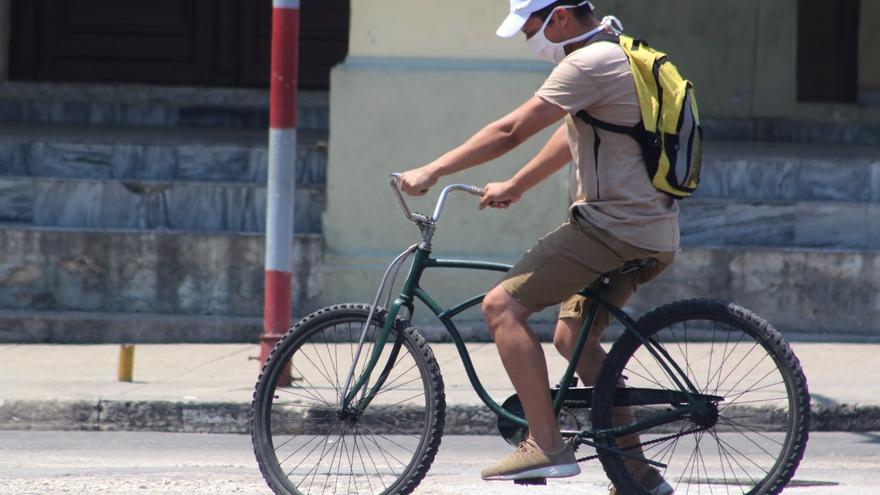
The Price of Biking in Cuba is Rising

Since Mi Bici closed some time ago, there is no longer a state business that sells spare parts in Havana. (14ymedio)

14ymedio bigger14ymedio, Natalia López Moya, Havana, 22 September 2021 — “Before there was a store called Mi Bici, that was by the train terminal. I used to buy some pieces there, when it was there,” says Elizabeth. At age 56, this woman from Havana, a resident of the Plaza municipality, has been pedaling around the city for more than three decades and considers herself an expert in cycling. The convergence of a constant energy crisis and a pandemic, in which avoiding public transportation is key, could have turned the bicycle into a lifeline for many Cubans, but that has not been the case.

Elizabeth says that since Mi Bici closed some time ago, there is no longer a state place to buy spare parts. “We have to die in the private businesses of Cuatro Caminos, and everything there is very expensive. You have to keep an eye out for any part, and they are not even original,” she explains. Of course, the area outside the shopping mall has become the main black market in Havana, where any accessory or spare part could be ’resolved’.

“Sometimes they bring the parts from outside and that makes them even more expensive,” continues Elizabeth, who sees it as impossible for many to be able to afford the prices and admits that they will have to return to the severely lacking public transport, where they are also more exposed to the coronavirus.

Pedals, racks, ball bearings, axles, tires and brake pads, among others, are parts that must be changed regularly to maintain a bike and many, like Elizabeth herself, must wait to receive help from someone they know abroad, if they are so lucky. “I’m waiting for a package that my nephew who is abroad sends me. From there he sends me some parts that I have to change, but while I wait, I will have to travel on two feet,” he concludes.

Having a “mountain” bike is a headache. A chain or sprocket can cost between 2,500 and 3,600 pesos, some pedals up to continue reading

3,000 and bearings 1,500. Most of the parts for these bikes are sold at ’millennial’ prices, so putting together a complete bike can reach more than 30,000 pesos.
As for racing bikes, the luxury is even greater, since the components are sold in dollars and a single tire costs no less than 100, almost 8,000 Cuban pesos at the exchange rate on the black market.

The expenses not only go include the parts and maintenance. In Havana, the number of bicycle parking spaces has fallen sharply. A few years ago it was common to have a place near each shopping center where, for one or two pesos, someone guarded the bike while the customer made their purchases, but as the use of cycles decreased, so did these places.

“Parking now is not less than 20 pesos and you have to walk a long way between parking the bicycle and getting to the place where you were going, it is a headache,” says Daniel, a young university student who regrets the limitations on getting many places by bike. “You come in and they tell you it’s forbidden but they don’t offer you a place to park.”

With classes suspended in recent months, Daniel has worked as a courier making home deliveries of pizza and other food through the popular Mandao service. “When a customer lives on a high floor and asks me to go up the elevator to deliver the order, I can’t, because if I leave the bicycle alone, even if I put a lock on it, it is very likely that it will be stolen and it is not easy for me to find place to park, and if I do I have to spend part of my profit on that.”

Daniel also regrets that the city “is no longer a place for bicycles.” In addition to the lack of parts and parking spaces, there is added “the removal of the cycle lanes”, previously marked on the main avenues. “Many of the tire repairers who used to work exclusively with bicycles have also gone out of business. This is going uphill, it is getting harder and harder.”

In the interior of the country, where the bicycle is used even more than in the capital, the situation worsens, since the prices exceed those of the capital. Jesús, 40 years old, resides in Sancti Spíritus and goes every day from his home to work by bicycle, a 7-kilometer journey.

“We have the Santa Clara factory close enough, which supplies us with a few spare parts. However, the quality is terrible and the variety is practically non-existent. What strikes us the most is the lack of tires, the Ring 26s are still available, more or less, because they bring them from abroad and they show up for about 4,000 or 5,000 pesos each. But for Ring 24, like mine, they simply don’t exist and, if they appear, I can’t buy them because they can ask for up to 6,000 pesos. That is to say: a single rubber tire could exceed my monthly salary,” he laments.

In spite of everything, Jesús considers that the rustic machinery which many entrepreneurs work with are helping to solve the problem. “Although the pieces are homemade, they have made our day to day a little easier,” he argues.

Last August, the State newspaper Granma announced that about a thousand students  from the Marta Abreu University of Villa Clara could benefit from the purchase in installments of bicycles assembled in the state company Ángel Villareal Bravo, located in the province and better known as Ciclos Minerva.

The price of each unit was 2,900 pesos, paying in full and in cash, but if the buyer chose to postpone payment (an option available since the option was approved in July), he had to pay 20% down and had one year to pay the remainder with an interest rate of 2.5%.

The official newspaper said then that it was a great opportunity for young people, who could access a means of transport in a more flexible way. But the great advantage, as is being demonstrated, is the opportunity people have found with the resale of parts on the black market, at 12,000 or 15,000 pesos.

____________

COLLABORATE WITH OUR WORK: The 14ymedio team is committed to practicing serious journalism that reflects Cuba’s reality in all its depth. Thank you for joining us on this long journey. We invite you to continue supporting us by becoming a member of 14ymedio now. Together we can continue transforming journalism in Cuba.
‘It Looks Like the July 11th of Jam’ a Cuban Shopper Jokes

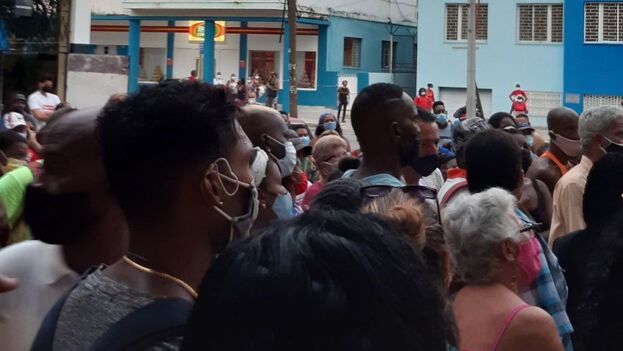
It was no more than five minutes after 5:00 in the morning, before dawn, when hundreds of people were already in line to enter La Casa de las Preserves. (14ymedio)

14ymedio bigger14ymedio, Natalia López Moya, Havana, 14 September 2021 – No sooner had I closed to the door to my house, early in the morning, and gone out into the street to get a place in line at the brand new Casa de las Conservas (House of Preserves), than I noticed the unusual scene. Four women were blocking the passage, huddling on the ground. They were hiding from the frequent Police patrols passing by to control anyone who might be violating the curfew, in force from 9:00 pm to 5:00 am in Havana.

“It’s five o’clock, let’s go!” They said to each other; and turning to me, as I stared at them in amazement, they added, “Thanks, muchacha, for not giving us away.”

I didn’t think it was necessary to run like they did – the store wasn’t going to open until nine, four hours later – until I got to the block where the line started. A few minutes after the curfew ended there were already 400 people at Ayestarán and 19 de Mayo, in the Cerro municipality.

Crouching, hiding in the undergrowth, perched on the branches of nearby trees, on stairways, and in doorways, and entrances to homes, thousands of Cubans wait every day for the curfew to end to be able to get a place in the line for stores that take payment in foreign currency or in continue reading

Cuban pesos.

The phenomenon, known by the authorities and ridiculed in cartoons in the official press, has extended to all the places when the word spreads that a product of wide popular demand is about to be put out on store shelves. The families arrange for one person to stay up all night and the others to arrive after the clock strikes 5 am.

From nearby places, coming from all directions, numerous groups of people with anxious faces and hurried steps came running, trying to reach a privileged position in the line to be able to shop in the recently opened store that takes payment in Cuban pesos, an anomaly in a city ​​and a country that every day surrenders more to foreign currency.

Being first in line did not guarantee any privilege. The police officers did not allow people whose identity cards showed distance residences to join the line. Anyone who did not live within a five-block area could not have made it to the line at that time of the morning without violating the curfew, they said, with an argument they themselves did not believe, aware of the subterfuges to circumvent the restrictions imposed by the pandemic.

But, there were exceptions. “Look at this one, it is from Old Havana, but he says he is someone’s nephew,” a policeman shouted at an obvious State Security agent, dressed in civilian clothes, while pulling a man out of the line; the man gave the name of a relative who is an “official of the Ministry of the Interior,” and they let him stay. From that moment and without explanation, they no longer checked any more addresses, and began to hastily collect the cards from the rest of those present.

“It is not possible that there are 200 people in front of me in the line, because I live on that balcony that you see there and I came down at five o’clock,” a girl complained to a policeman. “I live with my little daughter and my mother with schizophrenia,” she said to get him to let her pass, without achieving any results.

The agent replied that he understood her situation but could not do anything. “We already have 57 people at the Police station,” he justified. Those arrested, all in the early hours of the morning, will be fined 2,000 pesos and will receive a “warning letter.” As the products sold by the store are not “essential,” argued the officer, there was no separate line for the “vulnerable,” people with disabilities or bedridden patients in their family who obtain a card that allows them to shorten the wait in other stores and markets.

Despite the early hours, the hubbub that spread through the place gave the impression that the clock was already ticking past noon. People yelled at those who sneaked in relatives and acquaintances who arrived later, to the indifference of the agents, who collected, in total, some 300 identification documents.

Ayestarán Street, which until recently was an artery full of vehicles and dotted with private businesses with offers of pizzas and soft drinks, has now become an area of ​​long lines, not only because of the recently opened Casa de las Conservas, but also because of the nearby Trimagen store complex, managed by the military and supplying products that can be paid for with Cuban pesos.

More than 300 people were still in line after the first 300. From them, they would collect, they announced, 200 more cards, but later. At that moment, a crowd rushed at the agents to demand that they finish collecting the remaining documents. “Pick up a few and fine them 2,000 pesos right here and you’ll see how they calm down,” one of the officers rebuked. The tumult dissolved immediately.

“My God, what is this, where have so many people come from?” said a surprised woman her 60s who had run two blocks to get there on time and barely reached number 350. “This seems to be the 11th of July of Jam,” she said jokingly, making reference to the recent protests throughout the country on July 11th.

“I am here to buy a can of mayonnaise, because my daughter has her birthday today and she has asked us to make her a cold salad,” a young man who arrived at five o’clock in the morning explained to this newspaper. “We managed to get an appointment but I think we will be shopping after one in the afternoon, so we are going to spend part of the festivities in line.”

A lady came by for guava jam. “My mother is bedridden and cannot eat anything she has to chew, so every day I have to find her some yogurt, compote or a base to make juices,” she explained. The woman was one of those who did not not manage to get a number. “My address is a bit remote and I couldn’t justify what I was doing there at the time I arrived.”

The locals are used to crowds and shouting. Not surprisingly, a few meters yard is a Trimagen store famous for being the epicenter of endless lines, traffic accidents and fights. However, when passing by the House of Preserves, they were stunned: there was no comparison with the madness that was seen here this Tuesday.

____________

COLLABORATE WITH OUR WORK: The 14ymedio team is committed to practicing serious journalism that reflects Cuba’s reality in all its depth. Thank you for joining us on this long journey. We invite you to continue supporting us by becoming a member of 14ymedio now. Together we can continue transforming journalism in Cuba.

Lost Corpses and Broken Down Hearses, Covid Causes Funeral Chaos in in Cuba

With the collapse of the healthcare and funeral services, there have been dozens of complaints of corpses that spend hours and even days in a home or a state institution. (Facebook)

14ymedio bigger14ymedio, Natalia López Moya, Havana, 25 August 2021 — In Güira de Melena, municipality of Artemisa, a family lived an odyssey this Wednesday to recover the body of Armando, a relative who lost his life due to covid-19. On two occasions, those in charge of the funeral services at the Manuel Fajardo hospital in Havana delivered the wrong coffin.

It’s a story that feels like it was inspired by the popular film Guantanamera (1995), by the directors Tomás Gutiérrez Alea and Juan Carlos Tabío, but sadly it is real. How complicated it can be to achieve simple things, in Cuba; with the pandemic, it has become very common.

“We went through a lot of work to get a car to come from Güira to look for the body, but we finally succeeded,” says a source familiar to 14ymedio. “When the hearse returned to Güira, the son of the deceased, at the request of the sister who lives in the United States, asked to see his father for the last time. The driver did not want to open the box and said: ‘This is covid, it is forbidden to open the box.’ And he showed him the papers so that he could see that it was his father he was transporting.”

When Armando’s son reviewed the documents, he realized that there must be a woman in the coffin. The young man flew into a rage, demanded that the man open the box and that was when he realized that it was not the father, and it wasn’t even the woman described continue reading

in the papers.

The family, desperate, returns to Fajardo in search of Armando to try to say goodbye and bury him once and for all. “At the hospital they tell us they made a mistake and they give us another box with the deceased’s papers. There we discovered that the one they had given us before was from Caimito (Artemisa), and they didn’t even know where the corpse was,” explains the source.

Armando’s son, distrustful of what he experienced with the first coffin, asks again to open the box to confirm that this time he is taking his father. “When they opened it was a Chinese man, a resident of Havana’s Chinatown.”

Finally, after a “scandal” with the family in the hospital, Armando’s body appeared and he was able to be buried after 5 o’clock in the afternoon in Güira de Melena, his hometown. “Who knows how many corpses are buried in the wrong way. If we had not insisted on opening the box, we would never have found out,” complains the relative.

With the collapse of the healthcare and funeral services, dozens of complaints have arisen of corpses that spend hours and even days at home or in a state institution.

In a room at the Puntarena de Varadero hotel in Matanzas, which functions as a medical center for positive cases of COVID-19, the body of a traveler spent more than two days without the authorities picking it up. In a video published on social networks at the beginning of July, an oxygen tank was seen at the entrance of the room and then the silhouette of the lower extremities of the corpse lying on a bed covered with a white sheet.

In Ciego de Ávila, Lisveilys Echenique’s brother died at home after spending 11 days with covid and without receiving medical attention. The body had been in the living room of the house for more than seven hours and an ambulance did not arrive to pick it up. “The situation in Cuba is precarious. The government does not want to ask for help and there are no doctors,” Echenique denounced.

After much insistence, a family from the municipality of Placetas, in Villa Clara, could not fulfill the wish of Omar, a covid-19 patient who asked to be cremated if he died. “The hears] did not have tires in good condition and it was not possible to move [the body] to Matanzas, which was where the possibility of doing it [cremation] was found because in Santa Clara you have to wait four or five days to do it,” the wife of the deceased identified as Nancita Ñanguita narrates in a Facebook post.

The woman also denounces that after her husband died on August 15 “for lack of an intensive care room and better resources,” she spent four hours in a hospital corridor. After that time, the family spent hours finding a coffin.

“Please reflect, gentlemen leaders, so that you can avoid the terrible pain that one feels when losing a relative in their hands without being able to do anything, neither the family nor the doctors,” Nancita requests.

____________

COLLABORATE WITH OUR WORK: The 14ymedio team is committed to practicing serious journalism that reflects Cuba’s reality in all its depth. Thank you for joining us on this long journey. We invite you to continue supporting us by becoming a member of 14ymedio now. Together we can continue transforming journalism in Cuba.
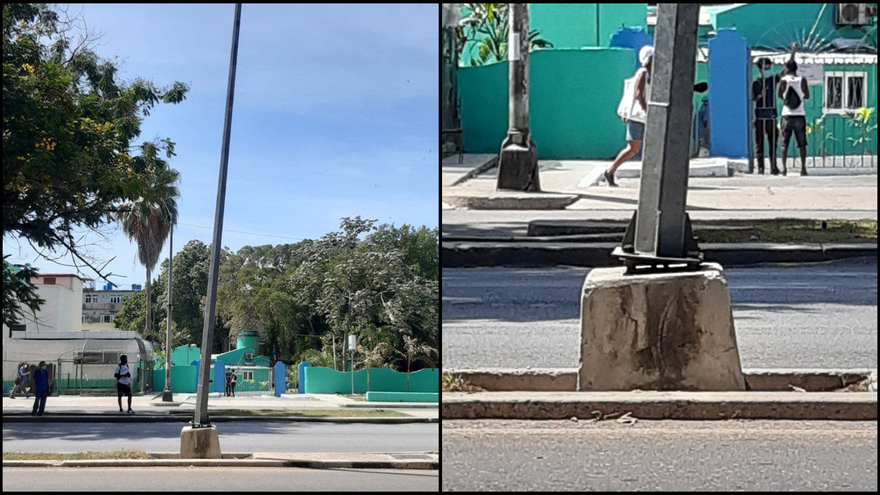
A Danger for Pedestrians and Vehicles at Carlos III Center

A post located in Carlos III, between Ayestarán and Requena, in the municipality of Plaza de la Revolución. (Collage)

14ymedio bigger14ymedio, Natalia López Moya, Havana, 20 August 2021 — Havana is falling apart. No matter how much that phrase is pronounced among Cubans and especially by those from the capital, it will not be enough, given the serious infrastructure problems that are seen in every corner of a city that is home to more than two million inhabitants.

This is the case at Carlos III — a four-story shopping mall — between Ayestarán and Requena, in the municipality of Plaza de la Revolución, right across from the veterinary clinic. The public lighting in the area has problems with the poles and streetlights.

Some of the supporting poles, such as the one captured by the 14ymedio lens, are a danger to pedestrians and vehicles. They lack a rigid support at their base, they are bent, almost to the point of falling onto the public street. continue reading

The most recent repair of streetlights on the capital’s roads was focused only on a part of the Malecón from Maceo Park to Paseo del Prado. In addition, according to the Office of the Historian of Havana, the Martí Park and the lights located at the entrance of the Bahía Tunnel were going to be included.

While other areas of the capital continue with deteriorated public lighting such as in the Plaza municipality, Cuban President Miguel Díaz-Canel went to the La Güinera Popular Council, in the Arroyo Naranjo municipality, without taking into account a resurgence of covid cases that does not decline.

According to the official press, the president went to the place on Friday “to speak with the authorities, local actors and the population about the process of transformation that is being undertaken in the community.”

In a first stage, work is being done on “urbanization, asphalt, bridge repair, hydraulic and sanitary infrastructure, roads, housing connections,” according to information published in the official Twitter account of the Cuban presidency.

In exactly that area, one of the most depressed areas of Havana, Diubis Laurencio Tejeda was shot and killed by policeman during the protests that began on July 11 (11J).

After learning of the death of Laurencio Tejeda, the Government has used La Güinera for its regular political propaganda and has sent several officials. “They wanted to rob our neighborhood,” Díaz-Canel said this Friday from the community. The Government also affirmed that the “actions to improve the infrastructure” are carried out with the support of the community and various entities.

____________

COLLABORATE WITH OUR WORK: The 14ymedio team is committed to practicing serious journalism that reflects Cuba’s reality in all its depth. Thank you for joining us on this long journey. We invite you to continue supporting us by becoming a member of 14ymedio now. Together we can continue transforming journalism in Cuba.
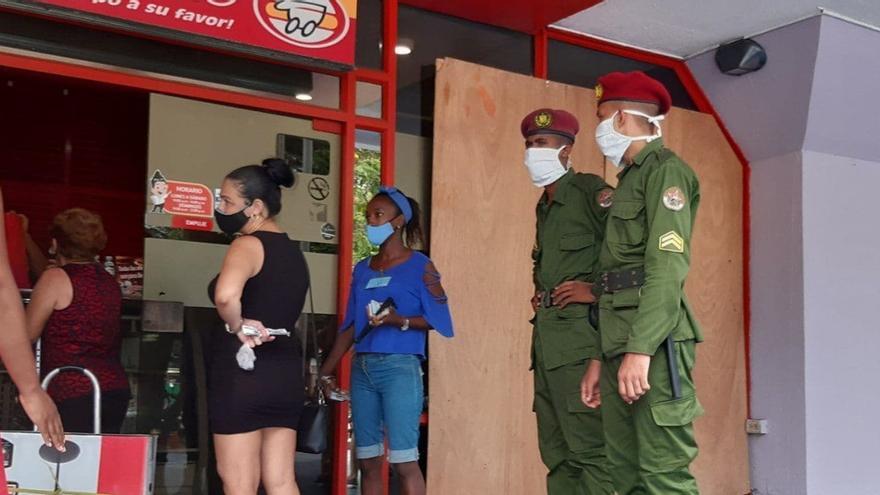
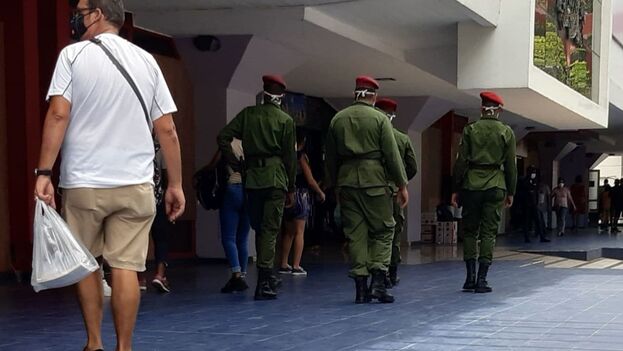
Military Continues to Guard the Streets of Cuba One Month after 11 July

Two “red berets” on guard outside the Plaza Comercial Carlos III, in Centro Habana. (14ymedio)

14ymedio bigger14ymedio, Natalia López Moya, Havana, 11 August 2021 — One month after the protests of July 11 (11J), the Police and the military continue to guard the streets of Cuba. In Havana they are especially concentrated in areas where there are often crowds or long lines.

Although the usual movement of people in the streets on any given day continues, 14ymedio also confirmed a large number of uniformed soldiers outside the Plaza Commercial Carlos III in Central Havana.

The presence of the “red berets” is notable, as they are known within the Armed Forces as “prevention troops,” who stand guard in groups of two and even four soldiers. Above all, they are seen in the portals and the surroundings of the capital’s markets, whose display windows facing the outside are walled up with wooden planks.

“Something strange is happening, in the stores of the Latin American Stadium and that of Aranguren and Panchito Gómez, I have not seen lines of people waiting to enter. They are not selling anything. Is it a coincidence because today is the 11th and they do not want riots in the streets?” asked a Havana resident who continue reading

went out this Wednesday morning to buy food.

The “red berets” guard in groups made up of two and up to four soldiers. (14ymedio)

This newspaper was able to verify that the scene was repeated in stores such as Trimagen, on Ayestarán Street. In that establishment they only sold one bottle of soda per person and two packages of ‘Pellys’ snacks.

Thousands of Cubans took to the streets on Sunday, July 11 (11J) to protest against the Government, shouting for freedom on a historic day. In response, president Miguel Díaz-Canel went on TV to make a call for people to go out into the streets to confront the protesters and defend the Revolution.

Central Havana was an area where thousands of protesters concentrated that Sunday, and from several streets tried to reach the Capitol building without success, and others succeeded, although dozens of them were repressed by police and State Security agents along the way.

The demonstrations took place with the country mired in a serious economic and health crisis, with the pandemic out of control and a severe shortage of food, medicine and other basic products, in addition to long power cuts.

____________

COLLABORATE WITH OUR WORK: The 14ymedio team is committed to practicing serious journalism that reflects Cuba’s reality in all its depth. Thank you for joining us on this long journey. We invite you to continue supporting us by becoming a member of 14ymedio now. Together we can continue transforming journalism in Cuba.
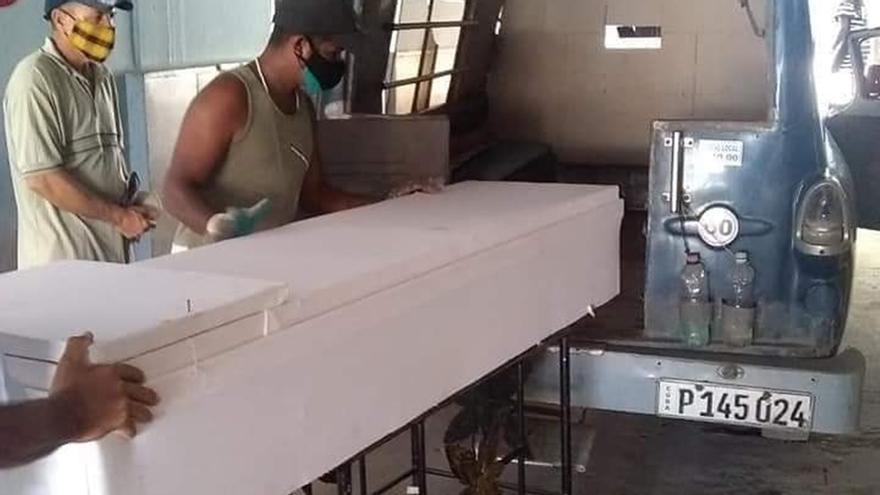
In Cuba, the Dead Go in White Coffins for Lack of Black Fabric

A coffin is transferred to a cemetery in Santiago de Cuba in August 2021. (Jorge Carlos Estévez García / Facebook)

14ymedio bigger14ymedio, Juan Diego Rodríguez/ Natalia López Moya, Havana, 8 August 2021 — An image invades social networks since the unstoppable increase in deaths from Covid: that of white coffins, a very unusual color in Cuba, where gray and black reigned until now at funerals. “There is no black fabric,” they tell 14ymedio employees of funeral homes in various provinces.

The pandemic has forced the use of different materials due to the increase in deaths. The State Communal Services company must search all over the country to obtain the wood, the cardboard and “the cloth cover for the box,” an improvisation that causes discomfort among the families of the deceased.

“Now they are all of poor quality,” lamented a relative this Friday, who was waiting to be transferred from the La Nacional funeral home in Havana to the Colón Cemetery.

The resurgence in deaths from Covid-19 has hit especially all the supplies related to wakes and burials: coffins, wreaths, dedication ribbons, tombstones and even niches to deposit the mortal remains.

“They could hardly load the box because it seemed like it was going to fall apart,” continue reading

 Margarita Luaces tells 14ymedio. Lucase is the sister of a Covid-19 patient who died last July in Morón, Ciego de Ávila. “The coffin was an made of bad wood, covered in cloth and the bottom of a very fine cardboard, we were afraid that the corpse would fall out on us.”

“My brother’s was a white coffin, something that shocked us because it was not the most common but they told us that it was the fabric they had available, it did not have any of the metallic ornaments that they used to use and as soon as they lowered it into the pit one of the corners opened up, it was a terrible image,” she adds.

“The coffins for adults, Model 900, are being lined with whatever fabric they can get, white, blue, whatever there is,” confirms to this newspaper a funeral employee of Ciego de Ávila, the province that has recently become one of the epicenters of the covid in Cuba and with the cemeteries packed daily with new burials.

This is also the case in neighboring Sancti Spíritus. “We have problems with the brads to place the lining, so the boxes are coming out with less,” acknowledges an employee of the company Producciones Varias. “The blackouts affect us a lot, you can’t use the saw to cut the slats and you have to do it with a machete,” he adds.

“If the family member brings me the fabric, I will line the box to their liking, but almost no one has time to bring anything because, between the death of the relative and the rush to bury him, there is no time for anything,” explains this worker with more than two decades of experience in the sector. “They are taken straight from the hospital to the cemetery in most cases.”

Numerous videos and photographs of very poor quality coffins arriving at cemeteries have begun to circulate in recent weeks on social media. The reports of mass graves, the bad smell around the cemeteries and the extensions of the mausoleums, have focused attention on the funeral services.

“Traditionally, here, white coffins are used only to deposit the remains of small children and people with Down syndrome,” an employee of the funeral home on Calle 37, between 60th and 62nd, in Cienfuegos explains to 14ymedio. However, the Communal Services worker does not rule out that they will soon have to resort to other tones given the rise in deaths.

But he has not only had to improvise with the colors. “I had a wreath made for my grandfather who died of a heart attack and he only had six flowers and everything else was leaves, they didn’t have a ribbon available so we had to cut some curtains to make him some pretty bows,” a young woman lamented this Sunday, at the Marcos Abreu funeral home, on Zanja Street at the corner of Belascoaín in Havana.

In the large room, that day the coffins were mixed, with some in dark cloth and another in white cloth, and all the bodies that were veiled had died of other causes, according to an employee. “In the case of burial they go in their box, but they are already going to the crematorium in bags because the demand for coffins is very high and there are no materials,” the employee admits under anonymity.

At another important funeral home in the Cuban capital, La Nacional, workers confirm that the situation is tense and the coffins they have are of very poor quality, with some lined in dark and others in white. “Those who died from covid here in Havana go in bags directly to the crematorium, they do not go in a coffin.”

“The coffin is what you see, like the flower wreaths, but there are many other problems that nobody fixes until you have to run with the procedures of a funeral,” says Mónica Estrada, sister of a deceased by a stroke in Morón. “The funeral home didn’t have any coffee to sell to the mourners.”

“There are not enough hearses a self-employed worker who lives behind the cemetery and is dedicated to making markers and placing the inscription chosen by the family, told me that he has a waiting list until September because his orders have skyrocketed and he has no material. “So we had to bury my sister without a marker or anything in place.”

“When you arrive at the cemetery it is another problem, because there are many families crying because of how quickly everything has gone and others who are going to remove the remains of a long-dead relative from their family vaults, to make room for the one who has just died,” he says. Estrada. “You have to remove one dead person to put in another because there is no space.”

Last February it was announced that the Cuban authorities were in talks with Industrias VEQ, one of the companies that manufactures the EcoAtaúd [EcoCoffin], which is produced in Mexico at a much lower price than the traditional one out of wood. The coffin is made of polyaluminum, a material that comes from the containers with a mixture of two raw materials, 70% plastic and 30% a thin layer of aluminum.

This media spoke with the company in the Mexican capital but the employee could not confirm if that contract was signed and if those coffins have arrived on the island.

____________

COLLABORATE WITH OUR WORK: The 14ymedio team is committed to practicing serious journalism that reflects Cuba’s reality in all its depth. Thank you for joining us on this long journey. We invite you to continue supporting us by becoming a member of 14ymedio now. Together we can continue transforming journalism in Cuba.
‘Free Rice Will Not Silence Us,’ Say the Residents of Punta Brava, Cuba

The Punta Brava bodega (ration store), in the Havana municipality of La Lisa, where the distribution of free food modules is carried out. (14ymedio)

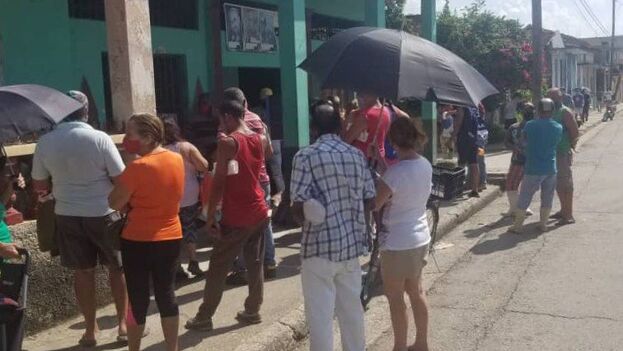
14ymedio bigger14ymedio, Natalia López Moya, Havana, 1 August 2021 — Since Friday, the line has not stopped outside the bodega (ration store) at 251st and 50th streets in Punta Brava, a Havana neighborhood of La Lisa. But unlike other times, customers only need their ration book and a bag, because the food module that is distributed is free.

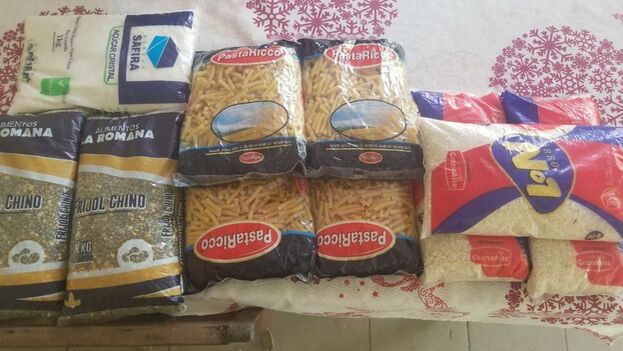
“People don’t believe it yet, that’s why half the town has come today, so they won’t regret it later and start charging us,” jokes Juan, one of the surprised residents in the vicinity of the premises who returned home with two bags of pasta, some sugar, two packages of peas and three of rice.

The products are part of a free distribution that the Cuban government has started in a hurry to try to calm things down after the popular protests on July 11. The first places where the distribution began on July 30 coincide with the neighborhoods of the capital where the demonstrations were most intense.

“Here the people rushed out into the street, and the people of Bauta, which is the nearby town, also joined to go from here to the center of Havana. There were many of us and we reached the checkpoint but they blocked us with a bus and several police cars to continue reading

prevent us from leaving,” Yantiel, age 25, told 14ymedio.

“In Punta Brava there are still many young prisoners, whose mothers have not even been able to see them since that day they were arrested,” he laments. “Although there have not been other protests like that one, it has happened that the neighbors have stoned the houses of the thugs who hit the people that day.”

Products included in the free modules distributed in the neighborhood of Punta Brava. (14ymedio)

María Elena, 64, also believes that “none of this would be distributed, much less for free, if it were not for the fact that people took to the streets.” According to this worker in an industrial products store, “we are living very badly here, there is hardly any food to be found and our electricity is cut off all the time.”

The free module is “a patch to cover the gap,” she adds, but it does not solve the serious problems of a neighborhood with more than 140,000 inhabitants, very affected by mobility restrictions with the Cuban capital. “They want to shut us up with a little rice, but don’t forget that this area is called Punta Brava [Brave Point] and it is for a reason.”

The delivery has begun in Havana, the epicenter of the protests, and will spread to other provinces with high population densities and where the demonstrations were also very numerous, such as Matanzas, Ciego de Ávila, Santiago de Cuba, Holguín, Guantánamo and Isla de La Juventud, before reaching the entire country.

The information was expanded on Friday by the Minister of Internal Trade, Betsy Díaz Velázquez, on the Roundtable television programThe minister explained that it was decided to distribute these modules after a donation from Russia and “after learning about offers and donations from Mexico, Bolivia, Vietnam and other nations.”

“In this way, a delivery schedule has been set up. In parallel, to those who are not receiving this module in the first 15 days, other products that are arriving will be delivered and others that will be received will continue to be delivered so that there is a benefit.”

The authorities have also announced the sale of an additional three pounds of rice per consumer from August to December, an increase that the minister justified from the profits of the unpopular stores that take payment only in freely convertible currency (MLC). “The result of the sales in those stores, it was always said, is for the benefit of the people,” said Díaz.

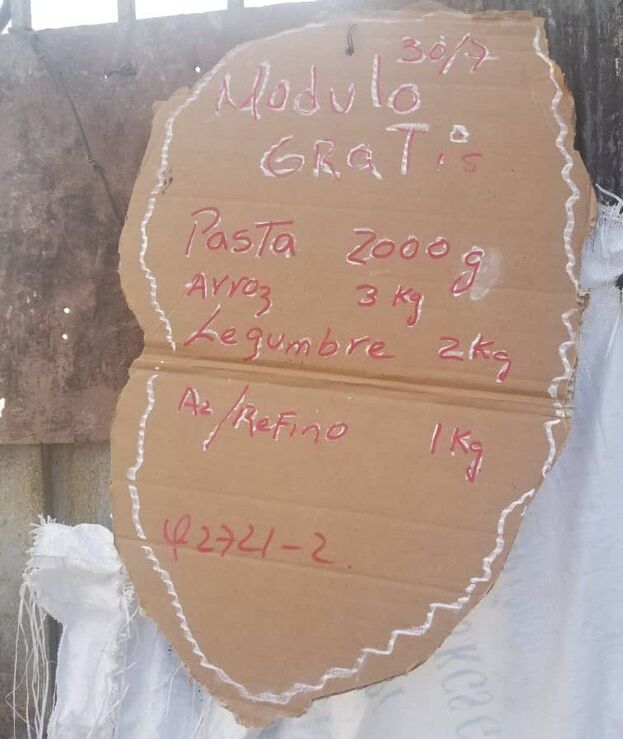
“They have not been able to do like in other times when they have sent donations and they have ended up selling them,” says a resident of Punta Brava. This sign at the ration store lists the items residents will receive for free. (14ymedio)

In a few hours, the report of the official’s words, published by the official press, has generated hundreds of comments, many of them critical. Several commenters alluded to the limited variety and quantity of the module’s products. “Minister, is there no chance of an increase in coffee?” Asked a netizen who identified himself as Luma.

But an official from the Ministry of Internal Trade responded that coffee “is not one of the donation products,” a statement that sparked another barrage of complaints from customers who have seen the popular drink disappear from stores in Cuban pesos, to remain available for sale in foreign currency or at sky-high prices on the black market.

“They have not been able to do like other times they have sent donations and have ended up selling them,” adds another neighbor who was waiting in line this Friday to acquire his family’s module. Last April, several Internet users denounced on social networks the sale in the rationed market of vegetable oil donated to the Island by the United Nations World Food Program (WFP).

At that time, the criticisms rose so much in tone that the Ministry of Internal Commerce had to come up with a statement in which it assured that the product “will be replaced” when the breakdowns in the national industry were repaired, but this action has not been reported so far by the official press.

Billboard near the ration store in Punta Brava, La Lisa, where the free food modules from international donations are distributed. “In La Lisa, Yes we could, yes we can, yes we will.” (14ymedio)

This was not the first time that this type of complaint came to light on the island. In 2017, after the onslaught of Hurricane Irma, numerous governments, non-governmental organizations and UN agencies sent donations to Cuba to alleviate the shortages in food, medicines, water and construction materials. Several victims then complained that they had to pay the state for mattresses, stoves and even charcoal.

In Punta Brava they feel they have won a little battle. “At least this time they are not going to get money from us for something that was donated for the people,” adds the neighbor. “But here we are still very upset with the situation and a little macaroni is not going to calm that down.”

____________

COLLABORATE WITH OUR WORK: The 14ymedio team is committed to practicing serious journalism that reflects Cuba’s reality in all its depth. Thank you for joining us on this long journey. We invite you to continue supporting us by becoming a member of 14ymedio now. Together we can continue transforming journalism in Cuba.
We Started Speaking the Same Language and Suddenly Dozens of People Were Joining In

“There was a police cordon on San Rafael where they tried to disperse us. Then there was an altercation with protesters who were marching ahead.” (14ymedio)

14ymedio bigger14ymedio, Natalia López Moya, Havana, July 12, 2021 — “It was very moving, something I had never experienced. I had seen it in videos from other countries but, here in Cuba, never in my lifetime,” confesses Yonder, one of the young Havana residents who, on Sunday afternoon, left their homes to call for freedom in Cuba.

“As I was walking towards 23rd and Malecón, I saw kids randomly hanging out, looking all around, and they began to join us. We started speaking the same language and suddenly dozens of people were joining in,” says Yonder, who is 32.

“Police officers were just standing there because they couldn’t do anything,” he adds. By the time he and his friends got to Galiano Street, there were already about five-hundred marching against the dictatorship, he claims. “A sea of people shouting ’homeland and life’, ’freedom’, ’we are not afraid.’”

A few hours after videos of protests in the town of San Antonio de los Baños went viral, thousands of Cubans in several cities across the island continue reading

raised their voices and peacefully took to the streets to join anti-government demonstrations.

https://www.facebook.com/watch/?v=1699489226925997

“One of the most emotional things I experienced was when an incredibly enthusiastic older man in flip-flops joined us. He hadn’t finished putting on his shirt and face mask when people began applauding him,” says Yonder.

He describes bystanders appearing to be “surprised, astonished,” applauding them as they walked past. Others shouted “strength” or “freedom” from their windows or from the street.

“At certain points — never with us on the street — some people shouted slogans like ’Long live Fidel’, ’Long live the revolution’, ’Look at the worms.’ The marchers yelled back, ’Go hungry, we’re doing this for you too.’”

Police had blocked the main streets so Yonder and other protesters had to take alternate routes to get to the Capitol. When they got to San Rafael Boulevard, he noticed a man in a wheelchair was marching too. He notes that many older people joined them but, unable to keep up the rapid pace, shouted “enough already,” “freedom” and “right now” in support.

“There was a police cordon on San Rafael where they tried to disperse us. Then there was an altercation with the protesters who were marching ahead. We reorganized a little but I had to run. It was a stampede. I didn’t see anyone on the ground. We were all helping each other. We changed direction and headed towards the Chinatown gate.”

Along the way, the police arrested anyone they saw filming or shouting cheers. “I saw a lot beatings; they hit a lot of people. Many were taken away in trucks. When they had fifteen or twenty people in a truck, they took off. People with head injuries who were still bleeding. They were put on those trucks and taken directly to the police station, not to a hospital.”

The police also arrested a taxi driver who had stopped his vehicle in the middle of the street as a form of protest. “They dragged the driver away to jail, beating him. Then one of the soldiers got in the taxi and drove off.”

As this was happening, a large crowd near the Marti Theater in Central Havana was trying to move towards the Capitol while another large group was approaching Central Park.

Shortly before leaving for home, Yonder saw stones flying overhead, directed at the police. “I tried to get out, out of safety concerns. but I was worn out. I hadn’t eaten anything since the day before and I was dying of thirst.” Between Ayestaran and Aranguren streets he saw a sign that stuck in his mind: “Diaz-Canel, resign.”


____________

COLLABORATE WITH OUR WORK: The 14ymedio team is committed to practicing serious journalism that reflects Cuba’s reality in all its depth. Thank you for joining us on this long journey. We invite you to continue supporting us by becoming a member of 14ymedio now. Together we can continue transforming journalism in Cuba.