The new balance of power in Congress raises expectations on the island, while some insist that the main problems are internal
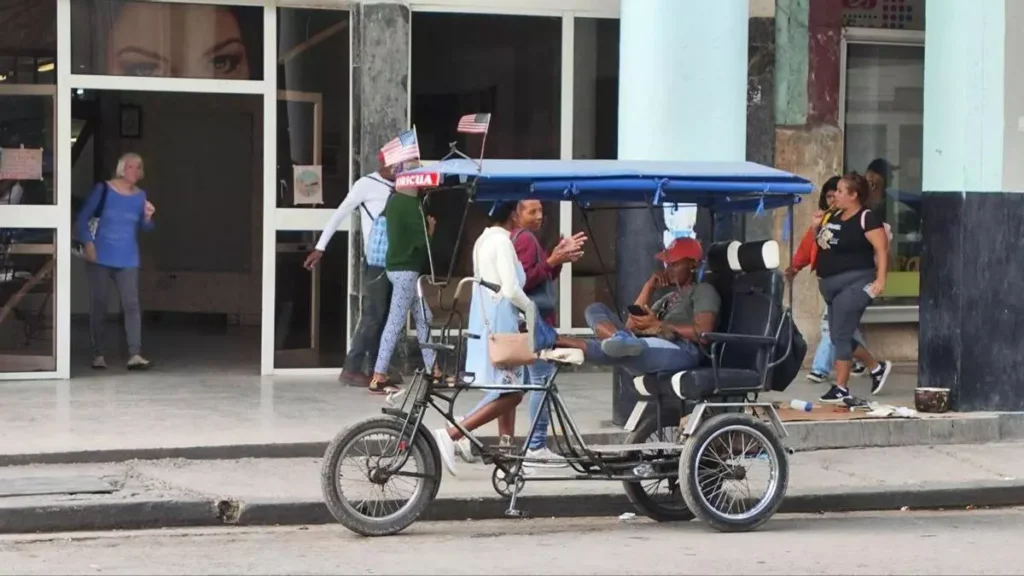
 14ymedio, EFE, Claudia Dupeirón and Yeny García, Havana, November 7, 2026 / Most Cubans are too busy trying to survive the deep economic crisis the country is going through to closely follow the US legislative elections. However, among those who know the results of last Tuesday’s vote, the Democratic Party’s victory raises some hope that there will be a change in relations between Washington and Havana. Others, however, believe that the solution to the island’s problems does not depend on who governs in the neighboring country.
“They’re all the same,” Havana resident Daniel Escobar, 60, tells EFE, referring to US politicians. Despite his skepticism, he acknowledges that “the Democrats are a little bit better” and maintains a moderate optimism in the face of the new political scenario that has opened up after the Republicans’ defeat in the midterm elections.
“We don’t lose faith that a change has to be made in favor of all Cubans. (With) the relationship or whatever, something favorable to Cuba has to happen, because the truth is that Cuba is going through very difficult times,” says Escobar.
The resounding Democratic victory, which has allowed the party to win back both the Senate and the House of Representatives, is a setback for Trump, whose Administration has, since January, stepped up pressure on the Cuban government through restrictions on oil supplies, new sanctions and threats of intervention. continue reading
“If I had to bet on what Trump’s next target will be, I’d say it’s Cuba”
The new Congress, which will take office on January 3, could hinder the Republican president’s agenda and limit his room for maneuver, although the concrete consequences for Cuba remain uncertain.
“If I had to bet on what Trump’s next target will be, I’d say it’s Cuba,” said Charles Kupchan, professor of International Affairs at Georgetown University, during a forum dedicated to analyzing the consequences of the elections for US foreign policy.
In the academic’s view, Trump could try to consolidate his historical legacy by becoming the president who managed to topple the island’s communist government, a goal pursued for decades by various sectors in Washington.
Nor does Cuban historian Fabio Fernández Batista rule out that the president, weakened by his results in domestic politics, might seek a victory abroad. Trump could “launch himself in search of a political success in the foreign arena, and that could be Cuba,” he maintains.
“The Democratic victory opens up, at least in the immediate term, a sense of hope that something will change”
However, Fernández Batista also considers the opposite possibility: that the US president will fall back on his negotiating side to reach some kind of agreement with Havana.
“Right now a scenario is opening up with widely differing possibilities. (…) A period of waiting and uncertainty is opening up,” the historian sums up.
For Ariel Dacal, also a Cuban historian, “the Democratic victory opens up, at least in the immediate term, a sense of hope that something will change.” However, he warns that the election result is not enough to count on a substantial transformation of bilateral relations.
“What remains, while enjoying the momentary respite, is to wait and see what course it will bring, with no more expectations than are warranted,” says Dacal.
University of Miami associate professor of History Michael J. Bustamante believes that a Congress opposed to Trump could “halt any further escalation against the Cuban government.” However, he points out in a post on X that the Democrats “have a long list of battles to fight, abuses to investigate and priorities to push.”
Among the citizens consulted in Havana, there is no unanimity either on the consequences of the Republican defeat.
Yoel Machado believes that a Congress controlled by the opposition could “take away from Donald Trump a little of the possibility of doing some things.” However, he fears that the new political limitations could provoke an unpredictable reaction from the president.
That strategy of resistance may suit Cuba’s leaders, but it “offers little to the Cuban people”
It could also be “a tense moment where some kind of desperate maneuver might arise. Other than that, if nothing happens until January 3, which is what I hope, then let nothing happen,” he tells EFE.
Meanwhile, the Cuban government seems to be betting on resisting pressure from Washington rather than giving public signs of a willingness to negotiate. Contacts between the two countries have not, at least so far, produced tangible results.
In October, Foreign Minister Bruno Rodríguez told The New York Times that the Cuban authorities were prepared to wait “as long as necessary” until the United States changed its policy toward the island. “It has to do it. It’s inevitable,” the foreign minister stated.
For Bustamante, that strategy of resistance may suit Cuba’s leaders, but it “offers little to the Cuban people,” who bear the consequences of both US pressure and the inefficiency and mismanagement of their own government.
This view is shared by a young Havana resident interviewed by EFE, who preferred to remain anonymous and emphasized the responsibility of the island’s authorities.
“Right now the biggest problems we have are internal, and if the internal problems aren’t solved, we can’t now blame what’s happening in the United States,” he concludes.
Translated by GH.
______________________
COLLABORATE WITH OUR WORK: The 14ymedio team is committed to practicing serious journalism that reflects Cuba’s reality in all its depth. Thank you for joining us on this long journey. We invite you to continue supporting us by becoming a member of 14ymedio now. Together we can continue transforming journalism in Cuba.