
The Deadly Kiss of Price Controls / 14ymedio, Yoani Sanchez

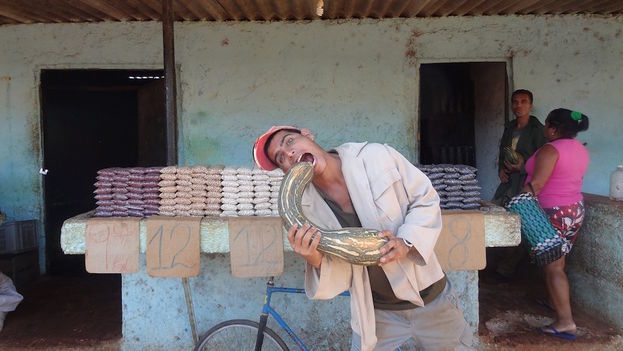
The official press blames private producers for the high prices of many foods. (14ymedio)

14ymedio bigger14ymedio, Generation Y, Yoani Sanchez, Havana, 4 January 2016 — I was ten years old when Fidel Castro launched the economic battle he called the “Rectification of errors and negative tendencies.” The Maximum Leader’s rage fell, at that time, on private farmers and on the intermediaries who marketed their products. Cuatro Caminos Plaza in Havana, then known as the Single Market, was assaulted by officials and after that raid several foods disappeared from our lives: onions, garbanzo beans, chili peppers and even taro.

Almost a decade later, when the country had reached bottom with food shortages and scarcities, the government again authorized non-state food markets. The first time I approached a stand and bought a string of garlic, without having to practice stealth, I recovered a part of my life that had been snatched from me. For years we had to appeal to the illegal market, to a precarious clandestinity, to get things ranging from a pound of beans to the cumin seeds needed to season them. continue reading

However, the return of “farmers markets” has not been free of attacks and government animosity. The official press blames private producers for the high prices of many foods, and the figure of the intermediary has been demonized in the extreme. In the last 2015 session of the National Assembly, the idea was floated of imposing price regulation on certain food products, to force merchants to reduce the amounts.

At first glance, this would appear to favor consumers. Who wouldn’t consider it good news that a pound of pork without bones would not exceed 30 Cuban pesos, or never reach the astronomical 50 peso asking price in Havana’s Egido market at the end of 2015. The initial reaction of customers would be to welcome it, because a single lemon would no longer cost one Cuban peso, nor would papaya sell for 5 Cuban pesos a pound. However, behind the regulated prices come greater evils.

What could happen is that the products subjected to price controls would disappear from the agricultural markets and once again go into hiding. We would not be able to go to the corner to buy a pound of onions, like we have done over the last two decades, but would return to the times when we’d end up at the side of some road or in the middle of nowhere illegally dealing directly with the producers or the persecuted intermediaries.

Consumers would end up paying the piper for a measure that does not solve the problem of the lack of productivity on our farms or of the extremely low wages.

An economy is not planned on a whim, nor is it managed by force of restrictions, rather it is a fragile framework where lack of confidence and excessive state control are like a deadly embrace, leaving us without the ability to breathe on our own. In this grip, controlled prices come to be feared as the kiss of death that strangles commerce and leaves it lifeless.
Abuse In Cuba’s Valle Grande Prison / 14ymedio, Manuel Morejon

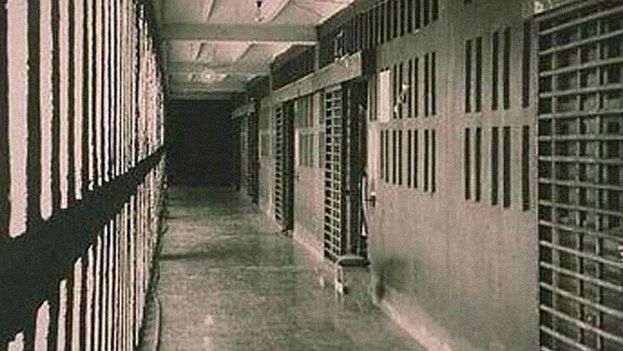
Lack of medical care is one of the most frequent abuses reported in Cuba’s Valle Grande prison.

14ymedio, Manuel Alberto Morejón, Havana, 30 December 2015 – From Havana, the supervisor of the Christian Alliance sent 14ymedio several prisoners’ testimonies collected in the Valle Grande prison, which make up a small sample of the abuse they are subjected to by the guards.

On 17 November 2014, at 10:00 am, First Lieutenant Maceo, known as “The Lasher,” took the hoses to Roberto Hernandez without caring that he was under psychiatric treatment. Hernandez, known as “El Loco,” is 32 and lived in Havana’s Plaza district, before entering Valle Grande prison where he received the beating. continue reading

Valle Grande belongs to the Department of Penitentiary Establishments of the Ministry of the Interior (MININT), and is located in Arroya Arenas on the outskirts of Havana. Like all MININT departments, the penitentiary has multiple and sophisticated control systems to silence complaints coming from the prisoners, or to filter those that suit them. But, at times, the voices of the prisoners leak out through the bars to describe the realities that are hidden in Cuban jails. Many of them relate to the lack of attention to inmates’ health.

Raul Garcia Ramos, age 55 and a resident of Regla, is another example. Despite being ill with cirrhosis of the liver and cancer of the esophagus, he was refused medical care. In addition, Garcia has been in prison since 2 June 2015, awaiting trail for the alleged crime of “threat.”

As of 16 December, Hugo Damian Prieto Blanco, age 50, a resident of Marianao and an organizer for the Orlando Zapata Tamayo Civic Resistance Movement, demanded political prisoner status via a hunger strike. Two days after the beginning of his protest, Prieto was transferred to Valle Grande and his whereabouts are unknown. The activist, who is diabetic and has pancreatic disease, has not been well cared for and also demanded better health care for the inmates.

Far from solving anything, the prisoners’ complaints and demands seem to only aggravate their situation. Lamberto Hernandez Planas, 46, a resident of the San Miguel del Padron neighborhood in Havana, complained about the lack of hygiene to El Niño, the officer guarding the dining room, because the food trays were caked with grime. El Niño threatened to give him a beating and said that, if he didn’t like the food, don’t eat it.

That day Hernandez went without eating, but his problems go deeper. His clinical history, issued by the Combinado del Este National Hospital for Inmates, indicates he suffers from peripheral neuropathy, gout, high cholesterol, a herniated disc, gastritis, esophagitis, malnutrition and low back pain. In this situation, recognized by the prison authorities, he requires a special diet that he is not being provided.

While the beatings of opponents, including the Ladies in White, who protest in the streets of Havana find some echo in the international press and human rights organizations, little information comes from the prisons where the inmates are totally defenseless.

Cuba And The Three Questions / 14ymedio, Carlos Alberto Montaner

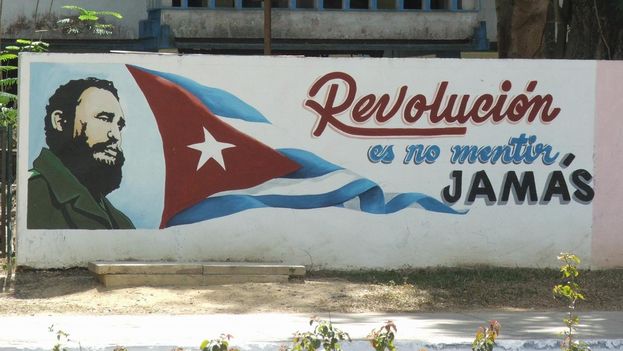
"Revolution is not lying. Ever." Revolutionary propaganda in Havana. (Wikicommons)
“Revolution is not lying. Ever.” Revolutionary propaganda in Havana. (Wikicommons)

14ymedio bigger14ymedio, Carlos Alberto Montaner, Miami, 2 January 2016 — The Castros have been in power for 57 years. At this point, general curiosity is limited to formulating three disturbing questions. Why have they lasted so long? Is it a failure, as their opponents say, or a success, as their supporters claim? What will happen after this extremely long-lasting government, the longest in the history of the Americas?

The Castros’ government has been so enduring because it is a dictatorship that does not seek the consent of society, nor does it dedicate itself to obeying it. On the contrary, its efforts are permanently dedicated to directing and controlling it.

The secret of this permanence is to convert people into sheep and to conveniently keep them penned up. To these ends a formidable apparatus of counterintelligence is organized, with some 60,000 people and a proven repressive script. That amounts to 0.5% of the population, consistent with the infallible formula learned from the German Stasi which, along with the KGB, was the mother and teacher of the Cuban services. continue reading

The other similar regime in the world, North Korea, is also a military dynasty and has continued for 68 years. The father of that orchestrated anthill of rhythmic gymnasts was Kim Il-Sung. He started in 1948 and died, in power, in 1994, but not before bequeathing to museums the chairs where he had placed his egregious buttocks. He was then followed by his son Kim Jong-il, and his grandson Kim Jong-un.

North Korean security troops exceed 106,000 members, to control 24 million survivors. More than twice the Cuban population. That police apparatus, which doesn’t do things by halves, has created a system of political castes called Songbun, dividing people into three groups: loyals, waverers, and hostiles. The loyals serve as auxiliaries to counterintelligence in the harassment and surveillance of the other two sectors. It is no wonder that when Fidel Castro visited North Korea, according to those who accompanied him, he was fascinated with the experiment. It seemed like a model country.

Has the Castro regime triumphed or failed? If measured by the ability to cling to power, it has undoubtedly triumphed. Raul Castro was the Minister of Defense at age 28, he is now 85 and has never ridden in anything but good official cars and never ceased to live lavishly with the royal family. For him and for his group of minions, it has been a success.

If measured by the influence achieved by the regime, the conclusion is the same. Venezuela has become a generous colony, meticulously exploited, and political operatives trained by Cuban intelligence services control or influence a dozen unfortunate Latin American countries, to the extent that the Colombian peace process is being irresponsibly negotiated in Havana.

But if what we take into account is the overall prosperity of the country and the degree of genuine happiness shared by the whole population, it has been a resounding failure. Across three generations Cubans have suffered thousands of executions, tens of thousand of political prisoners incarcerated, millions of people exiled, and the government has erected the most unproductive model of wealth creation in history, while meticulously demolishing the material structure it inherited. It is “the art of making ruins” at its finest.

In 57 years of absolute control of power, the Castros have aggravated to the point of martyrdom key elements of daily life: food and access to drinking water, housing, transportation, communications, electricity, shoes and clothing. From this grim landscape escape, as always, the thousands of Cubans currently stranded in Costa Rica, compassionately cared for by the government and people of that exemplary country.

These dire results are not, in reality, products of evil, but of ignorance, the ambition of power and the revolutionary arrogance emanating from Marxist certainties. They were willing to kill and do harm to remain in power and forced Cubans to live according to the utopia they lodged in their feverish brains. And so they have devastated the country.

What will happen in the future? Nothing substantial. As long as the Castros and their clique do not retire from public life, and as long as their system – today transformed into military state capitalism – remains standing, the country will continue to be condemned to the massive emigration of desperate Cubans and the most radical lack of productivity.

The basic problem lies in perceptions and in the confidence that emanates from them. It does not matter if the United States ends the embargo or substantially increases the number of tourists. It doesn’t matter if President Obama visits Cuba, like the last three popes, and gives a speech in favor of freedom.

Cubans, as a general rule, do not believe in the system. They do not believe in their compatriots. They do not believe in the destiny of their country. They do not believe in those who lead them, and much less in the capabilities of that sleepy and grim bureaucracy that imperturbably continues to practice centralized planning. All this will begin to change after the Castro regime is buried. Never before.

14ymedio’s 14 Cuban Faces of the Year for 2015 / 14ymedio

rostros_CYMIMA20151224_0001_13

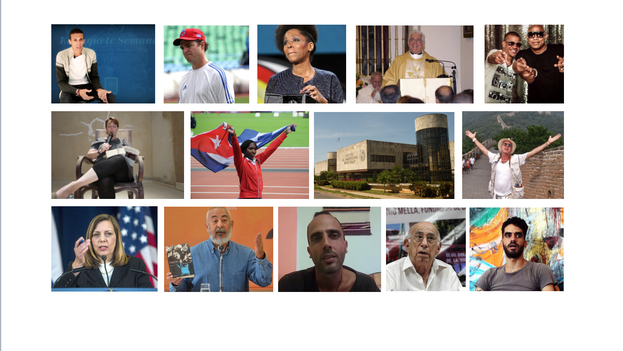
14ymedio bigger14ymedio, Havana, 24 December 2015 — The protagonists of 2015 Cuba have made their mark sometime in the past twelve months. These people from the areas of culture, sports, religion, politics, science or social activism made this year different and unique. They did it from celebrity or from ridicule; from victory or failure; from discretion or scandal.

All those included on this list barely a representation of the thousands of those who have been at the center of the commentaries, the headlines in the press, and in public opinion. These faces of 2015, according to 14ymedio, are the physiognomy of our country: a diverse and contradictory nation.

  1. Zacchaeus Baez Guerrero, government opponent
  2. Jose Ramon Machado Ventura, second secretary of the Communist Party
  3. Juan Carlos Cremata, playwright and filmmaker
  4. Gente de Zona, musical duo
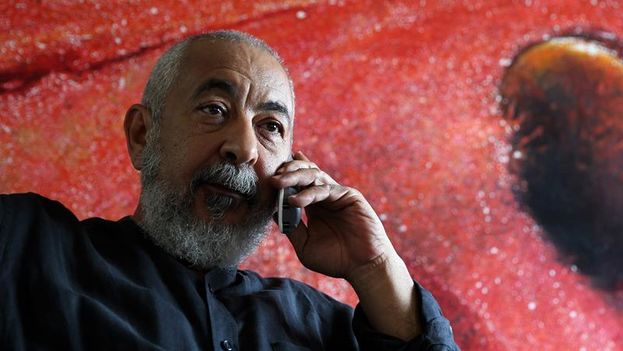
  5. Leonardo Padura, writer
  6. Yarisley Silva, pole vaulter
  7. Tania Bruguera, artist
  8. Josefina Vidal, diplomatic
  9. Yordanka Ariosa, actress
  10. Elio Hector Lopez, ‘The Transporter’ and manager of ‘The Weekly Packet’
  11. Danilo Maldonado, ‘El Sexto,’ graffiti artist
  12. Dionisio Guillermo García Ibáñez, Archbishop of Santiago de Cuba
  13. The Team that developed the vaccine against lung cancer
  14. Antonio Castro, son of Fidel Castro and doctor

Cuban Faces of 2015: Antonio Castro, Son Of Fidel Castro And Doctor / 14ymedio

Antonio Castro, the Cuban ex-president's youngest son. (EFE)
Antonio Castro, the Cuban ex-president’s youngest son. (EFE)

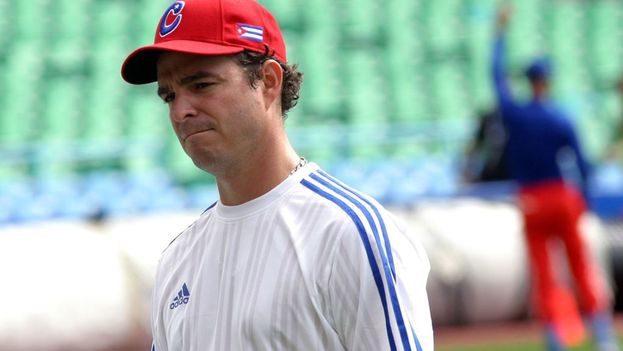
14ymedio bigger14ymedio, Havana, 30 December 2015 — Although his father based his political speech in a call for austerity and denigration of the powerful, Antonio Castro – the ex-president’s youngest son – leapt into the headlines in 2015 for doing the exact opposite. In July he was surprised while vacationing in Bodrum, Turkey. The Turkish press uncovered his stay at the most expensive hotel in the area, where along with his companion he reserved five suites.

Castro arrived in Bodrum from the Greek island of Mykonos on a 160-foot yacht and the images of his stay filtered into Cuba through alternative distribution networks. Fidel Castro’s son, who works as a doctor, dined in a luxury restaurant while just outside several Turkish photographers tried to capture the moment, but his bodyguards attacked the journalists and tried to grab their cameras.

Weeks later, Castro was captured by reporters during a stay in New York, dressed in brand name athletic clothes and holding a teddy bear.

Cuban Faces of 2015: The Team That Developed A Vaccine Against Lung Cancer / 14ymedio

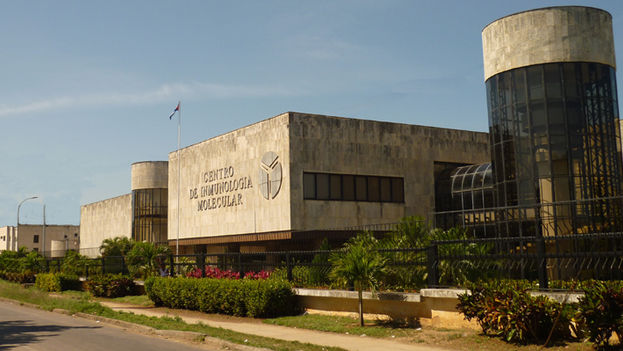
The Center of Molecular Immunology in the Playa district in Havana. (CIM)

14ymedio bigger14ymedio, Havana, 30 December 2015 — Under the name of Cimavax, Cuban has spent more than 25 years developing a vaccine against lung cancer. This year, the drug produced by a team at the Center of Molecular Immunology jumped into the public arena when the governor of New York, Andrew Cuomo, after a trade mission to Cuba, returned to his country proposing to import the product.

The center managed to sign an agreement in September 2015 with the Roswell Park Cancer Institute in Buffalo to bring Cimavax to the United States and start clinical trials there. Its managers hope to validate the results of a study conducted in 2007 on patients with stages 3 and 4 lung cancer, published in the Journal of Clinical Oncology. The article reports on the drug’s safety and its ability to increase production of tumor-reducing in more than half the cases and without significant side effects.

So far more than 5,000 patients worldwide have been treated with Cimavax, 1,000 of them in Cuba.

Cuban Faces of 2015: Josefina Vidal, Diplomat / 14ymedio

Josefina Vidal Ferreiro, Cuban Foreign Ministry director general for the United States

14ymedio, Havana, 27 December 2015 — The face that has represented the Cuban side in the talks with the United States government on the reestablishement of relations between the two countries is that of Josefina de la Caridad Vidal Ferreiro. With a PhD in International Relations from Moscow and member of the Communist Party, the diplomat grabbed headlines during 2015 on par with her counterpart, US Assistant Secretary of State of Western Hemisphere Affairs, Roberta Jacobson.

Vidal is considered one of Cuba’s leading experts on the United States. Between 1999 and 2003 the official worked as first secretary at the Cuban Interests Section in Washington DC, a post that allowed her to participate in negotiations on migration and mail service between the two countries. In 2003, her husband, the Cuban consul in the United States, was declared persona non grata by the George W. Bush administration, along with more than a dozen diplomats from the island. Vidal accompanied her husband back to Havana.

In an interview with the news agency Associated Press, Vidal said that Cuba welcomed the “whole package” offered by the administration of Barack Obama.


Cuban Faces of 2015: Tania Bruguera, Artist / 14ymedio

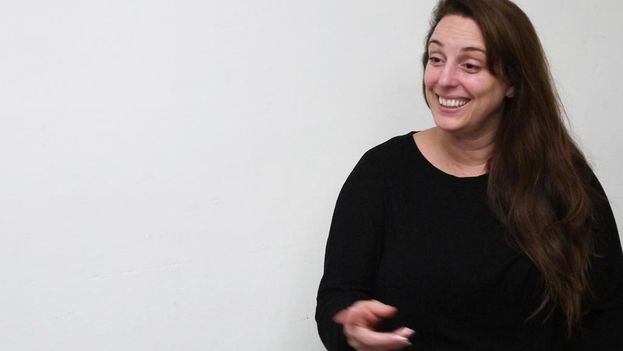
The artist Tania Bruguera. (14ymedio)

14ymedio bigger14ymedio, Havana, 27 December 2015 – Announcing a performance in the Plaza of the Revolution tossed the artist Tania Bruguera into the middle of a hurricane of repression and solidarity. The reprise of Tatlin’s Whisper, this time under the title #YoTambienExijo (I Also Demand), would have brought microphones to the emblematic locale for those who wanted to express themselves during the day on 30 December 2014.

Cuban cultural authorities initially pressured Bruguera to change the location of her artistic action, then rained down threats upon her and finally arrested her. Her passport was confiscated and retained, and for months she suffered several clashes with State Security, in addition to a sequence of interrogations and preparations for an alleged judicial process that never materialized.

Born in 1968, Bruguera defines herself as an artivista (art-activist), and was excluded from the latest edition of the Havana Biennial. Despite all of this she decided to honor Hannah Arendt with more than 100 hours of consecutive reading of her book, The Origins of Totalitarianism, and founded at her own home the International Institute of Artivismo, which carries the name of the renowned German philosopher.

In July of 2015, the authorities returned Bruguera’s passport, which enabled her to participate in international events, exhibitions and conferences. In New York City she was awarded a fellowship to the renowned Yale University, and was chosen by People Magazine in Spanish as one of the 50 most influential Latinos in the world.

Cuban Faces of 2015: Yarisley Silva, Pole Vaulter

Yarisley Silva won a silver medal at the Olympic Games in 2012. (CC)

14ymedio bigger14ymedio, Havana, 26 December 2015 — Yarisley Silva did not need to appeal to a metaphor to exalt the name of Cuba. She did it pole in hand with two magisterial vaults this year. That performance earned her the title of Athlete of the Year from the North American, Central American and Caribbean Athletics Association (NACAC), a title also recognized by the Cuban Athletic Federation and Prensa Latina.

This young woman from Pinar del Rio, born in 1987, broke into the headlines of the sports pages in 2011, and since then has not stopped breaking her own records. In 2015 she was proclaimed world champion in her discipline at the spectacular Bird’s Nest in Beijing, with a vault in which she flew 4.9 meters. On 3 August she outdid herself in Beckum, Germany with an impressive 4.91 meters, her personal best of the year and a national record.

Only 5’3” tall, “Yarita” dreams of exceeding five meters. Towards this goal, she works with her trainer Alexander Navas and hopes to medal at the Olympics in Rio de Janeiro in 2016.

Cuban Faces of 2014: Juan Carlos Cremata, Playwright and Filmmaker / 14ymedio

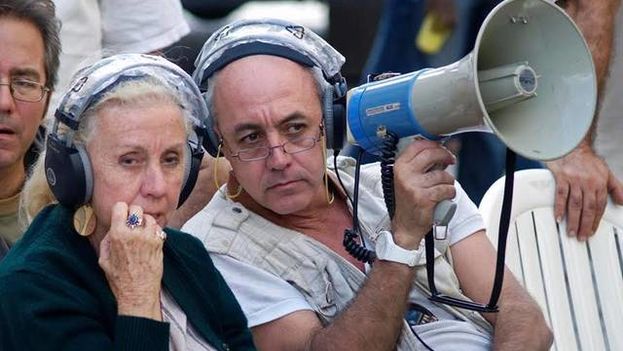
Juan Carlos Cremata with his mother, the television director Iraida Malberti. (Archive El Nuevo Herald)

14ymedio, Havana, 25 December 2015 — Last July Juan Carlos Cremata’s play Exit the King (also translated in English as: The King is Dying) was censored. A few weeks later Cremata’s contract as a theater director was cancelled and the cultural institutions accused him of making statements to the independent press. His fiercest critics claim that behind his version of Eugene Ionesco’s work was hidden a bitter criticism of Fidel Castro, while the director appealed to artistic freedom and the right of free expression.

The “Cremata case” has exposed not only the intolerance of Cuba’s cultural institutions, but also the complicit silence of many of the island’s intellectuals. However, the group of filmmakers pushing for a new Film Law, has expressed solidarity with the artist, who was born in 1961 and won the Coral Award for his film Nada, among other important awards.

Cremata has launched a crowdfunding campaign to raise money independently to produce his next films, including a documentary about the censorship he has suffered and the smear campaign against him.

Cuban Faces of 2015: Jose Ramon Machado Ventura, Second Secretary of the Communist Party / 14ymedio

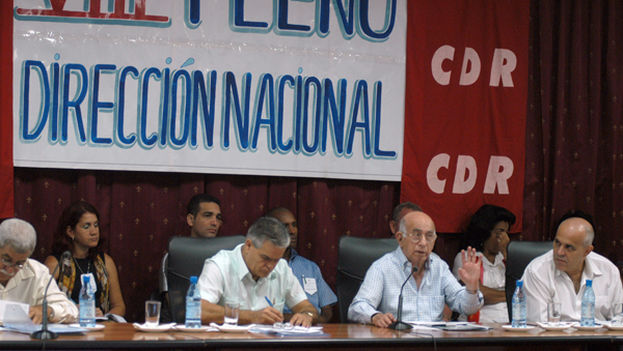
Machado Ventura speaking in 2012, in the eighth plenary session of the 1st Directorate of the National Committees for the Defense of the Revolution (CDR). (JCG)

14ymedio bigger14ymedio, Havana, 24 December 2015 — If the reputation of a politician is measured by his or her presence in the media, we should say that José Ramón Machado Ventura has been the most visible picture of the Cuban Communist Party (PCC) this year.

Exercising his functions as the second secretary of the PCC, he has been in charge of most of the provincial assemblies of this organization in advance of its 7th Congress scheduled for April of 2106. Also vice president of the Council of State, he is present at any event of a national character, be it for students, women or farmers. His role has made many fear a return to the hardest line within the government: a revival of the most rancid orthodoxy.

He has a well-deserved reputation of being extremely severe with his subordinates and of displaying his reluctance before any change or reform that departs to the slightest extent from the official line. His friends call him “Machadito” (“Little Machado”) though he was born in the now distant 1930.

Pablo Milanes Reprises “My 22 Years” in Havana / 14ymedio, Luz Escobar

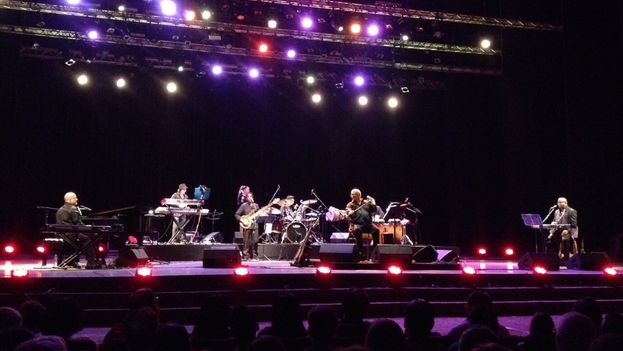
Pablo Milanes on 26 December during the concert at the Karl Marx Theater. (Luz Escobar)
Pablo Milanes on 26 December during the concert at Havana’s Karl Marx Theater. (Luz Escobar)

14ymedio bigger14ymedio, Luz Escobar, Havana, 28 December 2015 – Pablo Milanes gave a splendid concert on Saturday night to those who, with their Christmas hangovers, made it to the Karl Marx Theater in Havana. Starting before seven in the evening, the audience gathered in the doorways to enter the venue for what would be presentation with a memorable repertoire and guests.

The show began Tú mi desengaño (You, my disappointment) in the voices of the singer’s three daughters: Haydee, Suylen and Lynn Milanes. A sign that this singer’s lineage extends to the talent of artists who have the same surname but their own styles. continue reading

After the family reunion on stage, the show continued with the performance of Requium para un amor (Requium for a love) by the singer Miriam Ramos, followed by the versatile Fransico “Pancho” Cespedes, who sang the classic Ya ves (Now you see), and presented Milanes to a standing ovation from the audience.

The concert honored the theme Mis 22 años (My 22 years), five decades after it was composed, and had a luxurious guitar accompaniment by Jesus Cruz Dias. The song Cuanto gané, cuanto perdí (How much won, how much lost) preceded Los males del silencio (The evils of silence), a composition that recalls that “silence does not arise to live, silence is reborn to die.”

He could not skip Canto a La Habana (I sing to Havana) or Canción (Song), a theme that many know with the title De qué callada manera (In what a quiet way) and in which the verses of the poet Nicolas Guillen are set to music. Si ella me faltara aguna vez (If she misses me sometime) and Nostalgias echoed with the same freshness as those Días de Gloria (Days of glory). Meanwhile, Matinal (Morning), Plegaria (Prayer) and La libertad (Freedom) completed the first part of a concert where the voice of Milanes shone through, clean, fresh and clear, as always.

The presentation was recorded for the production of the album Aquellos 22 años, which will collect testimonies on the appearance of the song and what it has meant for Cuban music. The evening was especially dedicated to those in their twenties, although the audience was made ​​up of all generations.

In particular, those who came to the Karl Marx theater lived and loved with songs such as No ha sido fácil (It hasn’t been easy). Those who had seen, grown up and even grown old listing to Ámame como soy (Love me like I am) or Años (Years) were unmistakable, and Milanes sang his immortal phrase, “Time passes and we are getting old.”

Pablito was accompanied by a battery of excellent musicians such as Sergio Raveiro on bass, Esteban Puebla on guitar and keyboards, Edgar Martinez on percussion, Osmani Sanchez on drums and Germán Velazco on sax and flute. At the piano, as always, was Miguelito Núñez, also the musical director of the group.

Almost as a farewell the chords of Para vivir (To live) sounding, and of this immense theme, obligatory in Milanes’s repertory, the song named after a woman, Yolanda. The singer also left room to intone, along with his audience, El breve espacio en que no estás (The brief space where you are not), and the speakers rang with a selection of songs such as Pobre del cantor (Poor man, the singer), Hoy la vi (Today I saw her), and Yo no te pido (I am not asking you), while the audience said goodbye to an unforgettable Saturday night.

Fifty years of a song has just been an excuse for Pablo Milanes to bring joy to this Christmas, and to make the blue star of good music fall over Havana.

Happy Talk from Cuba’s General-President / 14ymedio, Reinaldo Escobar

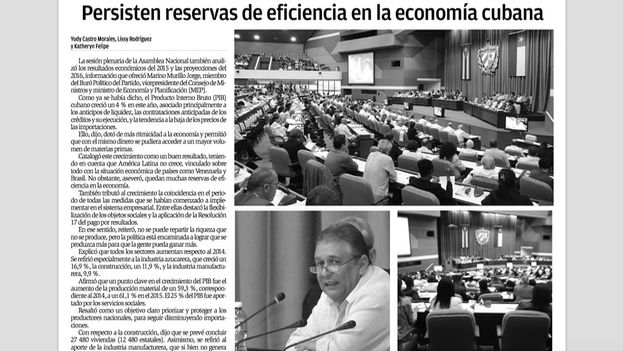
"Reserves of efficiency persist in the Cuban economy," Granma newspaper, December 30, 2015
“Reserves of efficiency persist in the Cuban economy,” Granma newspaper, December 30, 2015

14ymedio bigger14ymedio, Reinaldo Escobar, Havana, 2 January 2015 – In the Cuban National Assembly of People’s Power final meeting of the year, the Minister of the Economy and the general-president himself coined a new expression. Both alluded to “reserves of efficiency” available to the Cuban economy to face the challenges of the future.

The optimistic tone of the phrase gives the impression that, starting now, the government can count on a secret weapon to guarantee the long-promised prosperous and sustainable socialism. continue reading

Whatever the accepted meaning of the term “reserve” might be, in its sense of “value that is saved for special occasions” it must always imply the willingness to conserve – at least what is included under this heading – the fruits of an unexpected surplus. We hear about a nation’s “gold reserves,” or its “water reserves” for times of drought, “fuel reserves” for a long trip, as well as “troop reserves” which are not mobilized until they are needed, along with “food reserves,” jealously stored for an emergency situation.

Efficiency, an abstract noun with practical implications, cannot be saved or set aside for another time. That which was not used, irretrievably disappears when an action concludes with unalterable results. How can a surgeon explain to the family of a patient who just died on the operating table that some quantity of efficiency reserves remain unused in the failed operation?

In cutting sugar cane, one of the indicators of efficiency is the height of the pieces of cane remaining in the ground. If they are very long, it is unthinkable to make another pass to recover the wasted cane; if they are cut too close to the ground the cane will not germinate again and a great deal of useless organic material will inevitably – and without recourse – contaminate the mass fed through the mill. In that case, the efficiency will be vaporized and no one will be able to argue that having left the stalk too long or too short represents reserves of efficiency to achieve a better crop for the next harvest.

Efficiency is a value that must be constantly renewed under new circumstances and attached to the unstoppable development of productive forces, as a Marxist faithful to the catechism would say. Unlike stagnant water in a reservoir, resources that have served to make work efficient today will not be equally useful for what we are going to undertake tomorrow.

Whomever tries to exhibit, with cheerful optimism, their supposed reserves of efficiency, can do so only to the extent they have been inefficient. It is a trick of linguistics. There are no reserves: there were only deficits.

Cuban Faces of 2015: Leonardo Padura, Writer / 14ymedio

Leonardo Padura at his home in Havana. (EFE / Alejandro Ernesto)

14ymedio bigger14ymedio, Havana, 26 December 2015 — The creator of Detective Mario Conde enjoyed an extravagant 2015. In July he was awarded the Princess of Asturias Prize for Literature in recognition of his career as a novelist and journalist. During the ceremony, the writer acknowledged his “Three homelands”: Cuba, language and work.

Born in 1955 in Mantilla, Padura still lives in this Havana neighborhood and combines his work as a novelist with his passion for music and baseball. Although he received the National Literature Prize in 2012, his books have barely been published on the Island, but abroad he is considered one of the great masters of the thriller. He has also written screenplays for documentaries such as “From Son to Salsa,” which won the Coral Prize at the Havana Film Festival.

Author of titles such as “The Novel of my Life,” and “The Man Who Loved Dogs,” Padura will also have a successful 2016 with the debut of a Spanish television series based on his successful tetralogy made up of his books, Past Perfect (1991), Winds of Lent (1994), Masks (1997), and Autumn Landscape (1998).

Cuban Faces of 2015: Gente de Zona, Musical Duo / 14ymedio

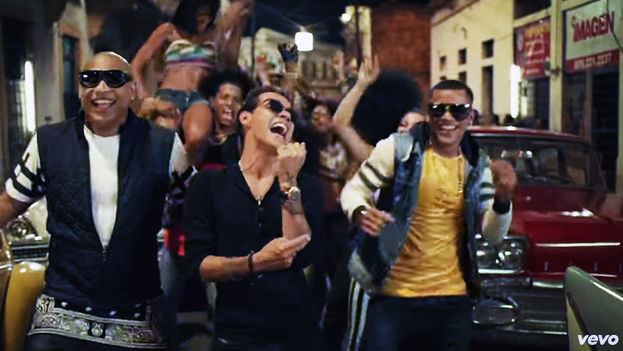
Screenshot of ‘La Gozadera' by Gente de Zona and Marc Anthony
Screenshot of ‘La Gozadera’ by Gente de Zona and Marc Anthony

14ymedio bigger4ymedio, Havana, 25 December 2015 — The Cuban duo Gente de Zona had a meteoric year, partly due to the continued success of their song Bailando (Dancing), performed with the Spanish singer Enrique Iglesias and the Cuban Descemer Bueno. Their theme La Gozadera (Sheer Pleasure) climbed the charts and became a summer hit in 2015, reaching number one Billboard magazine’s Latin charts.

Alexander Delgado, who created the group more than 15 years ago, and his colleague Randy Malcom, who joined three years ago, have the so-called “Cuban reggaeton” music label and this fall put out their new album with a mix of urban music and traditional Cuban rhythms.

The band is the first musical group to sign a contract with Marc Anthony’s new company, Magnus Media. The Cubans, who won three Latin Grammys in 2014, won two Latin American Music Awards and were honored during the ceremony held at the Dolby Theatre in Hollywood.