
Hay Festival Suspends Its Event In Havana / 14ymedio, Yaiza Santos

Wendy Guerra was among Cubans excluded from the Havana Hay Festival as reported by artists in exile. (Casa de America)

14ymedio bigger14ymedio, Yaiza Santos, Mexico, 21 January 2016 – For now, Cuba will not celebrate the Hay Festival planned for this coming week in Havana, as confirmed by the event organizers. The Hay Festival originated in the Welsh town of Hay-on-Wye in 1988, and since 1996 has been celebrated in several foreign cities, among them Kells (Ireland), happening now, Segovia (Spain), Mexico City, Arequipa (Peru) and Cartagena de Indias (Colombia).

The news that the Cuban capital would host a Hay Festival event as a part of the Hay Festival in Cartagena was announce in the first week of December, along with the controversy that accompanied that announcement. According to complaints from artists in exile, the festival organizers had proposed names of Cuban authors, among them Wendy Guera, Ena Lucia Portela and Yoani Sanchez, but “the pressure on the organizers from the Ministry of Culture finally forced them to not be included in the program.” Another source said that the organization simply accepted “an official list” that was presented to them. continue reading

Asked about the issue, the Hay Festival organization flatly refused to accept any kind of censorship, saying that the program in Havana was not closed, and that although there was still no final guest list, conversations with the Cuban Book Institute went “very well.” Cristina Fuentes, director of the Hay Festival for Latin America said, “We have suggested foreign participants, talking with Cubans and the suggestions are all first-rate.” She emphasized, “There is no censorship nor problems right now.”

On 24 December the Cuban News Agency (ACN) reported that the Havana Hay Festival would take place on 25-26 January. Quoting Jesus David Curbelo, the director of the Dulce Maria Loynaz Cultural Center and “one of the organizers of the event for Cuba,” the ACN confirmed that it was, ”just an experiment” and that there would be “two key events: literary workshops in the morning and author talks in the afternoon.”

The international guest list included Daniel Mordzinski, Andrés Trapiello, Jon Lee Anderson, Guadalupe Nettel and Hanif Kureishi, while Cuban guests included Pedro Juan Gutiérrez, Antón Arrufat, Mirta Yáñez, Reynaldo González, Marilyn Bobes, Dazra Novak and Rafael Grillo. Conspicuous by their absence were authors living in Cuba who had participated in other versions of the Hay Festival, such as Wendy Guerra, Ena Lucia Portela and Yoani Sanchez.

In addition, the ACN mentioned that the Hay Festival was being promoted by Bogota 39, an initiative that in 2009 brought together 39 young Latin American writers under 40, “all with one or more works published and read in their countries, but unknown beyond their borders,” forgetting that one of these was Wendy Guerra.

An official cable echoed the Spanish agency EFE, and hence, the Mexican newspaper El Universal and the Colombian magazine Arcadia. However, the Hay Festival did not comment publicly and insisted to 14ymedio, “The program is not yet closed.” Their idea, they said, was “to start with something very small and grow,” adding, “We don’t have to include all the Cuban authors the first year.”

By that time the controversy had jumped to the social networks. The Twitter account @HayFestivalCuba, now cancelled, denounced the planned event, saying “No to censorship at the Havana Hay Festival.” Some tweets were directed to the guests themselves according to the list published by the official press, such as the journalist Jon Lee Anderson and the writer Hanif Kureishi. Also participating in the exchanges on Twitter were the Mexican musician Armando Vega Gil, and the Barcelona writer Lolita Bosch.

This Tuesday, Cristina Fuentes told 14ymedio that the Hay Festival has postponed the project in Havana. “It is complicated for a number of reasons and we are going to leave it for another year,” she said, without clarifications. In a more extensive message, she said: “The organization of an event like this can only be done if the conditions are right for its realization, which could not be guaranteed, so we are not going to go forward with the project. It is because of this that our organization is not announcing, right now, the scheduling of this series of events on the island.” Fuentes concluded, “We would love to work in Cuba and hope it will be possible in the future.”

Defined as a non-profit company, the Hay Festival aims, according to its website, for the “dissemination of literature at local and international levels to promote dialogue and cultural exchange, education and development”, but has not been without controversy. In February 2015, it canceled the event that had been held in Xalapa, Veracruz since 2011, after pressure from Mexican intellectuals who denounced the partisan use of the festival by the government of Veracruz, and noted that 11 journalists had been killed and four others had disappeared in that Mexican state.
Three Members of Cuban Opposition Released After Three Months’ Detention / 14ymedio

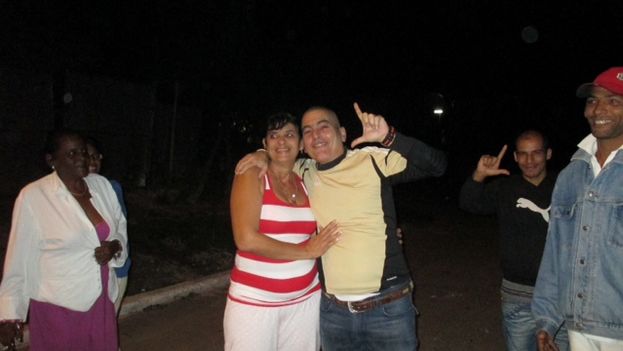
Hugo Damian Prieto and his wife, a few hours after being released. (Angel Moya)

14ymedio bigger14ymedio, Havana, 21 January 2016 – Released on Wednesday, after three months detention, were two members of the Cuban opposition: Hugo Damián Prieto Blanco, leader of the Orlando Zapata Tamayo Front for Civic Action, and Wilberto Parada Milan, a member of the Patriotic Union of Cuba (UNPACU), according to reports to this newspaper from opposition sources. Also released on Thursday morning was the opponent Carlos Manuel Figueroa, who was arrested after jumping the fence of the US embassy in Havana last October. According to dissident sources, the activist shouted slogans at the time: “Down with Raul” and “Down with the dictatorship.”

Figueroa was a part of the group of 53 political prisoners released in January 2015 after negotiations between Washington and Havana, according to a report at the time from Elizardo Sanchez, head of the Cuban Commission for Human Rights and National Reconciliation (CCDHRN). continue reading

Hugo Damián Prieto Blanco and Wilberto Parada Milan were arrested on 24 October 2015, two days after holding a protest against the Attorney General of the Republic through which they demanded the release of Maria Josefa Acón, Zaqueo Baez and Ishmael Reni, the three activists jailed for approaching Pope Francis before Mass in the Plaza of the Revolution on 20 September of last year

The opponents were charged with disorderly conduct and sent to prison pending trial. The first has been held in Valle Grande and the second in the Combinado del Este in Havana.

After his release, Hugo Damian Prieto and his wife visited the headquarters of the Ladies in White in Havana’s Lawton neighborhood, according to former prisoner of the Black Spring, Angel Moya.

The Cuban Commission for Human Rights and National Reconciliation (CCDHRN) reported the arbitrary detention of the two opponents in their last three reports and condemned it for going “against the well-known expectations encouraged by the announcement of the restoration of diplomatic relations between the governments of Cuba and the United States.”

According to the independent organization, “political repression increased steadily throughout 2015 from 178 cases in January to figures in the vicinity of 1,000 arrests by year’s end.”

Young People In Cuba Start Drinking Earlier / 14ymedio, Zunilda Mata

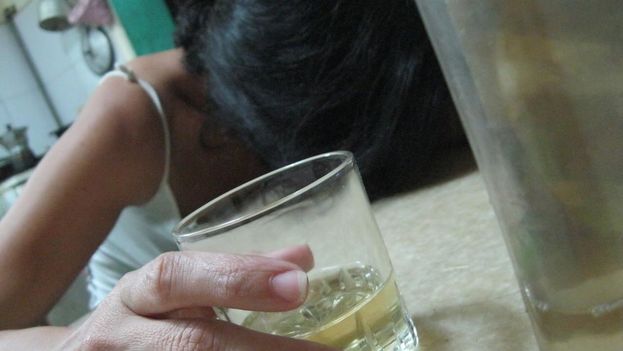
45% of Cubans over 15 consume alcoholic beverages. (Luz Escobar)

14ymedio bigger14ymedio, Zunilda Mata, Havana, 18 January 2016 – From the bar home, from home to the bar, so passes the life of Fico, a Havanan of 65 who has struggled for more than two decades against alcoholism. His situation is frequently repeated in a society where more than 45% of those over age 15 drink alcohol, according to research by the National Unit for Health Promotion and Disease Prevention published this Monday in the official press.

Cubans between 15 and 44 are the most frequent consumers of alcohol. Differences in consumption between the sexes are also narrowing, and drinking is no longer a “man’s thing” as was erroneously believed until recently. continue reading

The most recent studies warn that Cuban women are increasing their consumption of alcohol. The share of men who drink is 47% while for women it is more than 19%. In the case of women, they suffer greater rejection, being in a macho society, and they wait longer to seek expert help.

Experts also warn that alcohol does more harm to women because they have less body fluid than men. The saturation or condensation of substances in the body is higher and the level of toxicity faster and more intense for women.

A survey in 2014 showed that consumption before age 15 is more common in men than women, with rates of 11% vs. 3% respectively.

Alcoholism is among the top ten causes of death in Cuba. In late 2015, a report form the National Transportation Directorate detailed that in that year in Cuba, 17 people had lost their lives and more than 140 were injured in traffic accidents where it was shown that some of the parties had higher levels of alcohol than permitted.

Urban areas have the highest rates of alcohol consumption, both for men and women, but overall the highest rates were recorded in the central region of the country, where 53% of men are drinkers.

Education also influences consumption, as women with higher levels of education levels consumed more alcohol, some 24% more than those with the least schooling. Among men, however, the opposite phenomenon occurs and the highest percentage of drinkers is among those with little education.

Health officials are calling on the Community Mental Health Centers and specialized consultations in polyclinics to make a call to help those in need of treatment or counseling for alcohol issues.

There are more than 200 Alcoholics Anonymous groups in the country, with the entry of that organization into Cuba dating back to 1993; they mainly hold their meetings in facilities provided by Catholic and evangelical churches.

Cremata Stages His Play on the Internet / 14ymedio, Juan Carlos Cremata

Juan Carlos Cremata with his mother, Iraida Malberti, a television director. (Archive El Nuevo Herald)

Juan Carlos Cremata, the censored playwright, is publishing on the web a brief monologue on authoritarianism and censorship. Translator’s note: “The President” in the monologue is not the president of the country, but rather of the State organization in charge of the theater.

The President’s Monologue

By Juan Carlos Cremata

The scene is a meeting room. Only a sofa, some chairs, a large armchair. The president enters talking on her cellphone. She is a woman of an uncertain age, elegantly dressed, but not exaggeratedly so, almost casually. Her gestures are tough, energetic, with a certain diplomatic nuance, but always very tense.

President: No, no. Don’t worry. I’ll call you. Let me get this over with, I can’t take it any more. Yes, yes, the minister knows, of course! He supports me. If not, how could I take this measure? That [with a certain irony] “artist” has gotten too insolent. And it’s time for us to stop him. Wait. [She goes to the door she came in by and orders] Raisa! Tell all the vice presidents I want them here! Right now! And the specialists from every department too! Get Valdes Malo and Liudmila, the advisor, to come too [She continues her cellphone conversation but adds]

Oh, and bring coffee for everyone. But for me a cup of tea, or chamomile. Good and strong. [She explains to the cellphone] I have a terrible headache, ever since we saw that show last Saturday, it hasn’t quit. No, no. Don’t worry. I’ll fix it myself today. [Pause] I’ll call you later. Yes, yes. When you finish the news broadcast, I’ll ring and tell you. And [with the same irony] that “disagreeable character” is coming here. I’ll let you go, everyone has to be here. continue reading

She hangs up and arranges things a little. She puts the armchair across from a specific chair and settles herself comfortably. She looks in a large briefcase, takes out a datebook and opens it to make some notes. The subordinates begin to enter. One in a checked shirt, another in a striped T-shirt, and third in a short-sleeved guayabera. They all carry something to write with and their faces are circumspect. A specialist also enters, with glasses and dyed purple hair. She is a little affected in her mannerisms. Almost ridiculous. Another comes later. He is a young man in a Che T-shirt. He is going to sit in the chair the president put in front of her when a warning from his boss stops him.

President: No, no, no. That chair is for [with the now customary disdain] the “artist.” I want him right in front of me so I can see the expression on his face. Find another chair. [To everyone] And before the “aforementioned” comes through the door, I have to tell you something. [With a certain authoritarianism] I do not want to hear any more comments in the hallway about my potentially leaving this post, because of a rumor, I don’t know where it came from, that I want to go to Venezuela because they are going to make my husband a correspondent for Telesur. Don’t let anyone get that idea. Because I am going to continue here. Leading you. On the front line.

This is the post assigned to me by the Party. If tomorrow it is the Basic Industry job, we’ll go there. But this is what I have to defend today. And I am going to do it until I’m given another mission. Is that clear? Secondly, I will deal with this alone. I want to say, when this “problem person” comes through the door, I am not going to listen to any comments. From any of you! No one needs to add anything. And if there is any doubt, we’ll settle it later. Did you tell Liudmila to come down?

Suddenly the Artist enters. Clearly in a different mood than everyone else present. Not better, not worse, just very distinct, different. As if he does not fit in that environment. The President assumes an even more arrogant air. She rises to welcome him.

President: How’s it going? Come, come. We were expecting you. [She orders from the door] Raisa, don’t disturb us! [She turns and with her hand points to the chair facing her armchair] Please, be so kind as to sit down.

The Artist sits at the center. Everyone looks surprised. The President returns to her place.

President: Liudmila didn’t come down? [Almost without pause] Fine, it doesn’t matter, we’ll start without her. We won’t take too much time on this. [To the Artist] Look, I’ll get straight to the point. It is important that you understand that we greatly respect your work. We have followed you for a long time. Even from when were at the Youth Cadre School… [she stops talking for a moment and changes her attitude] you have done so much, dear heart. So much and for so long. And we have let you do it. But that’s good now. I think now is the time to stop. And you can rest.

I have felt betrayed, mocked and even wounded to the depths of my feelings. Because here we have put our complete faith in the work you were preparing. And suddenly, we saw “it,” what you staged last Saturday. And there was no level of artistic metaphor. The language was poor, direct, reactionary and vulgar. But worst of all is the frank mockery of the historical leader of our Revolution. A complete lack of respect for a person who has done so much for us in our country. And who is now very sick, poor man. And this is something we can’t allow! Not me, not any of us here. [She looks at everyone.] Isn’t that right? [They all nod their heads.]

So, in the name of the freedoms we have achieved over the years for our theater movement, we feel obliged to censor your show. If you want, we will explain it to the actors, we will issue a public note, I don’t know. And it doesn’t matter to me that we have spent a lot of money on the production, and on all the publicity. Or that you have spent so many months of rehearsing and so much work in the preparation. As it stands, this production has no possibility of being changed. And it cannot continue. Do you have something to add?

The artist looks at everyone without understanding what he just heard. Some avoid his gaze. They look at the ceiling as if they were looking for answers. He raises his arms a little bit, almost as if he were asking for mercy. And with that he gets up and leaves. Everyone is stunned.

President [speaking to the Che T-shirt): You! Prepare an article with enough theoretical foundation that explains everything that happened, our rationale and that the production is cancelled. [To the one with affected mannerisms] Draft a note for me as soon as possible to publish the ban. Very brief. Without a lot of details. The less explanation the better. [To the striped shirt] Valdes Malo, find the Ministry’s attorney to begin drafting a resolution that dissolves this damn theater group and ends any chance that this “harmful agent” will continue directing theater in this country. I will inform the minister. Don’t lose any time. We have to act quickly. The enemy is lurking here. Among us. On all sides. And we must attack.

They depart quickly and leave her alone. She approaches the stage, triumph on her face. Music with heroic overtones plays but stops abruptly at the insistent ringing of a cellphone. She answers.

President: Tell me, my life [pause]. No, no, everything’s fine [another pause]. Not one word. What could I say? This time we’re done with him! [She changes her tone, sounds more desperate] Have you heard anything from Telesur?

Then her face is flooded with deep frustration. She goes to the door and screams.

President: Raisa, where is the tea, please? I need it yesterday.

She drops crestfallen into the armchair as the curtain falls. Applause without much emotion. They are the same characters forever. The infinite and constant comedy. Such is the theater in today’s Cuba.

Holguin’s Garayalde Market Reopens with “Free” Prices but Regulated Sales / 14ymedio, Fernando Donate Ochoa

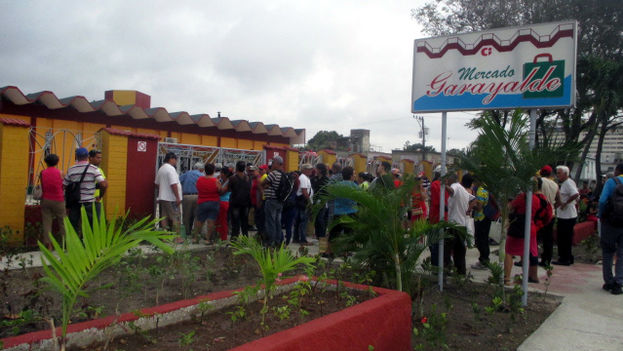
The Garayalde market in the city of Holguin, at its reopening on Tuesday 19 January. (Fernando Donate)

14ymedio bigger14ymedio, Fernando Donate Ochoa, Holguin, Cuba, 20 January 2016 — The rain did not stop hundreds of people from gathering on Tuesday morning outside the emblematic Garayalde market in the city of Holguin, waiting for its reopening after eight months of repairs. In its second opening in less than a decade, the commercial center aims to offer a wide range of products.

The line to enter Garayalde started forming the day before and to organize it people were given numbers and allowed to enter in groups. The first to enter when the market opened had slept outside from the early hours of the morning to guarantee their place.

Most customers were carrying backpacks and big bags to fill with some of the 180 products that had been announced for sale at the market, promoted by Ana Maria Aguilera, market administrator, on the local TV channel Tele Cristal the day before. continue reading

However, neither the quantity nor the quality of the available products lived up to expectations. Several consumers interviewed by 14ymedio agreed that they hadn’t found a great deal that was new. “They are the same products they had before they closed,” said one lady a little disgusted by the long wait. She also talked about the prices, which she considered excessively high.

The first day after the repairs had barely begun when most customers headed to the meat counters. Unlike other products, pork at 17 Cuban pesos a pound (about 56¢ U.S.) was an attractive price for people who, over the last quarter, had seen the price climb above 30 CUP a pound.

Nor were there controls lacking to prevent disruptions. Outside the market it was evident very early in the police operation and the presence of troops to making discipline at the reopening.

The local administrator told the press, “We appealed to the police to organize the link and to help avoid customers hogging products for resale. We are all going to work together to ensure that this scourge of society doesn’t happen here.”

She also clarified that sales would be unrationed, but regulated, and specified the amounts that would be sold per person: two cartons of eggs, five pounds of meat and ten pounds of rice, “with the objective that everyone would get some.”

In the line there were women with children. One of them confessed that she had brought her five-year-old daughter to get “priority in buying” and to not have to wait “in such a long line.”

The managers of the shopping center, which employs 70 workers, expected to exceed 100 million Cuban pesos in sales, which depends on producers and suppliers being able to deliver the amounts committed. Most of these are local industries, cooperatives and State farms.

It is not the first time this market center, created in the early eighties of the last century, has undergone renovation. Its previous reopening was in 2009, after repairs and conversion into a market for the sale of unrationed domestic products. This time there was a general reconstruction with a reorganization of the departments to make the market work better, according to an official from the provincial Accommodation and Food Services company, which owns the market.

Expectations, however, exceeded the internal distribution of supplies. Four hours after opening this Tuesday, the market had run out of meat and canned sauces and tomatoes.

A clerk said it had been a lot of demand and that he had sold everything available to him for the day.

The only meat remaining for sale, which no one wanted, was ground hamburger and ground chorizo, at 20 and 28 Cuban pesos per kilogram respectively. Also sold out was any kind of seafood. In the candy store, of ten products only three were still on display.

A Trampoline in Central Havana / 14ymedio

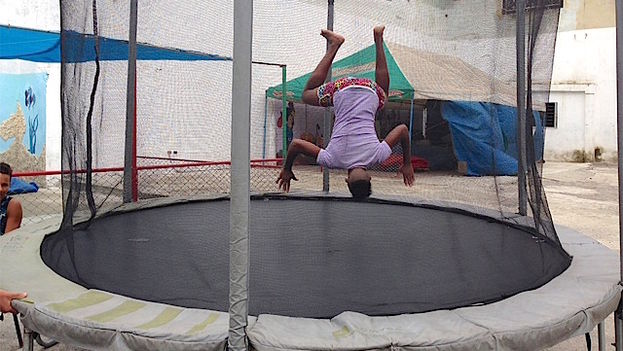
Trampoline located at the corner of Carlos III in Central Havana. (14ymedio)

14ymedio, Havana, 20 January 2015 – Havana is home to more than two million people, but has very few recreation centers for children and they are located on mostly on the outskirts of the city. In districts like Central Havana, parks, vacant lots and even the streets themselves become areas where young children play ball, fly kites and play incredible games with their tops. Children look for places to entertain themselves in the most densely populated municipality in the whole country.

On Carlos III Street, right at the corner with Marques Gonzalez and where more than a decade ago a tenement collapsed, they have placed a trampoline. It is rare to pass by this corner and not see a line of children and tends waiting to try the experience of jumping into the air. Some even try acrobatics, like the young man in the photo.

Jovellanos, a Cuban Town That Lives on Nostalgia / 14ymedio, Pedro Acosta

The old Gravi toothpaste factory is today Jovel, belonging to the joint venture company Suchel.

14ymedio bigger14ymedio, Pedro Acosta, Jovellanos, Cuba, 19 January 2015 – “People here live in the former Gravi factory that is now called Jovel,” says the driver of a bicitaxi (bike-taxi) during a tour of Jovellanos. The industry that made the town famous for its excellent toothpaste now belongs to the joint venture company Suchel, with products of little personality and worse flavor.

The lost glory days of its flagship factory is only one of the many problems of this village in Matanza province, crossed by the highway and the main rail line. If six decades ago the area had a growing economy, today its inhabitants remember past glories and imagine what could have been.

All the city’s transportation is by horse-drawn carts or bicycles. “To leave the village, there are private trucks, but at night its difficult to catch one,” says the driver of an old jeep that travels the route to Matanzas.

The place is no longer a destination of workers and has become a source of workers for the tourist areas of Varadero. “Here there isn’t much to do, so people leave and the young are the first to go,” says Ramon, born in Jovellanos 56 years ago. On Thursday he was having lunch at a private restaurant in the village with some relatives from Miami. With the suggestive name of Kitsch, decorated with baroque furniture and lamps, the restaurant is one of the few that exists in the small town. Young people complain that there is no disco and they have to settle for a depressing cabaret on the outskirts of town, much frequented by flies and drunks. continue reading

Joachim, 79, says he didn’t leave Jovellanos because he always believed that “things would get better. When I realized, it was too late for me to get out.” He worked in one of the two sugar mills that, during the harvest season, “never stopped grinding,” he says with enthusiasm. Now, “the two are closed and useless, pure junk lying in the field,” he laments.

On the streets of the small town many houses have signs saying “For Sale.” For a little more than 12,000 Cuban convertible pesos (roughly $12,000 US), Alina is offering the house where she was born and that was built by her grandfather. It has five bedrooms and a large terrace. “I don’t want to stay here, because I have to give my children a future,” she says. Her plan is to rent for a few months in the capital and ultimately to emigrate to the United States with the money.

Like anywhere else in Cuba, in this town private timbiriches — tiny “mom-and-pop” kiosks – have beat out the State snack bars. Vendors of costume jewelry and useful odds-and-ends furtively offer their merchandise in the doorways of the main street. “We once had three hardware stores, four general stores, two furniture stores and a printer, but that was a long time ago,” remembers Joaquin.

Renamed Jovellanos in 1870, due to the efforts of a mayor originally from Asturias, the town was initially known as Bemba. In the middle of the last century it had a library, two movie theaters, one of which also served as a live theater. Now there is only one still functioning, while the other is just a building with boarded up doors and a faded façade.

The local Communist Party headquarters is located in a beautiful building, which once housed the Association of Small Settlers of the territory. “They criticized the old landlords so much and look at how they’ve destroyed the earth,” comments Joaquin, who remembers when the region “boasted” of its farms with fruits and important crops of vegetables and grains.

In 1959 they had planned to build a jam factory in vacant lot in front of the rice mill and electric plant, “but the Comandante (Fidel Castro) arrived and ordered it to stop,” people comment satirically.

Just over half a century ago a plant was erected to assemble engines with Bulgarian technology, but it no longer functions. A modern smelter was also installed, but a short time after its launch it had to be disassembled.

A resident of Jovellano who was involved in that work and later emigrated to Havana said, “the investors in the foundry had not taken into account the electricity required for this work and when the foundry started running the whole village was left in the dark.”

The soft drink factory that was the pride of the region doesn’t exist any more, nor does the rope factory, nor the coffee roaster, nor the beef slaughterhouse, nor the cement block factory nor the dairies. All the conversations with residents older than 60 invariably end up in a review of these past glories.

Some of the younger people say they remember the taste of Gravi toothpate, “the queen of toothpaste,” but at their age it’s unlikely. In Jovellanos, those who don’t want to accept the fate of its people take refuge in the past to escape the present.

2,850 pesos for one night in Varadero / 14ymedio, Luz Escobar

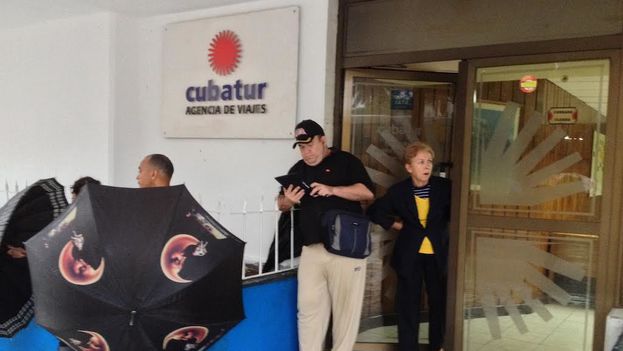
Cubatur travel agency office in the basement of the Havana Libre Hotel. (14ymedio)

14ymedio bigger14ymedio, Luz Escobar, Havana, 19 January 2016 – The noise of the rain mixed with the sounds of the clerk complaining because the cash envelopes were overflowing because they can’t cope with “so many Cuban pesos.” The scene is repeating itself lately at the Cubatur tourist office in the Habana Libre Hotel, with the authorization to allow payment in Cuban pesos for package tours focused on the Cuban market.

The measure has not yet been extended to all places in the capital offering accommodation and trips to different destinations in the country, but in several provinces it has been in effect since the beginning of 2016. In Havana, in addition to being able to pay with both currencies – the Cuban convertible peso (CUC) and the Cuban peso (CUP), also known as “national money” – in the so-called “Hard Currency Collection Stores” (TRDs), you can now rent a room in a hotel or pay for an “all-inclusive” excursion. continue reading

Over the last eight years – before that Cubans were not allowed in tourist hotels and resorts – customers were forced to change their Cuban pesos into convertible pesos to make tourist reservations, a procedure which lengthened the process and generated unnecessary inconvenience.

The new flexibility, however, makes even more evident the imbalance between the wages paid to Cubans and the prices they have to pay to vacation in their own country.

On Saturday a couple was inquiring at the Cubatur office in the Habana Libre Hotel about prices in national money for trips to the tourist beaches of Cuba. At the Iberostar Varadero hotel, 2,850 Cuban pesos was the cost for one night, all inclusive, “although you will have to arrange your own transportation,” the clerk told them.

For 2,550 Cuban pesos the stunned lovers could afford a night at the Melia Sol Palmera, also in Varadero. The price amounts to little more than 100 CUC [roughly $100 U.S.], but expressing that figure in the same currency in which wages are paid leaves many with a bitter taste.

“That’s my salary for five months,” the young man told this newspaper. “Only when you see it in the same currency do you realize that the prices here are crazy,” he said. Nevertheless he pulled the money out of his wallet and 10 and 20 CUP notes, to the annoyance of the clerk because she didn’t have any place to store so much “old money” and complained about it.

Since March 2008, when Cubans have been allowed to stay in the country’s hotels,  domestic tourism has experienced sustained growth and now Cubans are the second largest number of visitors to Varadero, exceeded only by Canadians.

The sale in national money of different tours and accommodation is also carried out in the Cubatur offices in Camaguey and Santa Lucia, according to Jorge Alvarez, director of the agency there, who spoke to the local press.

So far the measure has been well received, as it avoids unnecessary inconvenience. Alvarez added that the travel provider Havanatur also recently expanded its options available in national money.

In 2014, 1,208,123 Cubans stayed at hotels in the country, according to the National Tourism Report, Selected indicators, January-December 2014, published by the National Bureau of Statistics and Information. The document also details that these national customers spent more than 147 million CUC in tourist facilities.

Thermometers Again Available in Cuba, But Only on the Ration Book / 14ymedio

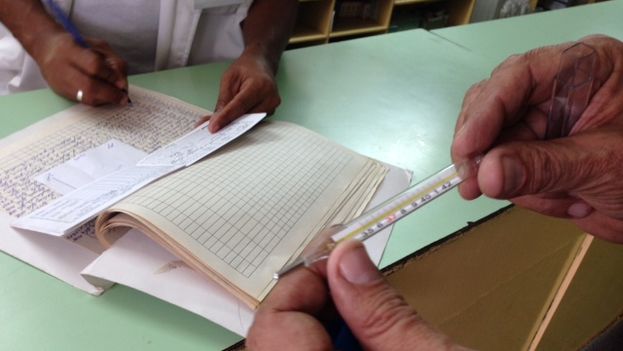
Thermometers are again available in some pharmacies in Havana, but to purchase one you have to submit your ration book. (14ymedio)

14ymedio bigger14ymedio, Havana, 15 January 2016 – After disappearing for months, this January thermometers have returned to some pharmacies in Havana, although they can only be purchased through the ration book.

In 2015, about 60 medications included in the “basic health core” where unavailable in Cuban hospitals and pharmacies, mainly those used in the treatment of cancer. Also missing were over-the-counter products such as adhesive tape, elastic bandages and Baind-Aids.

Cuba Will Attend Caribbean Security Conference For First Time / 14ymedio

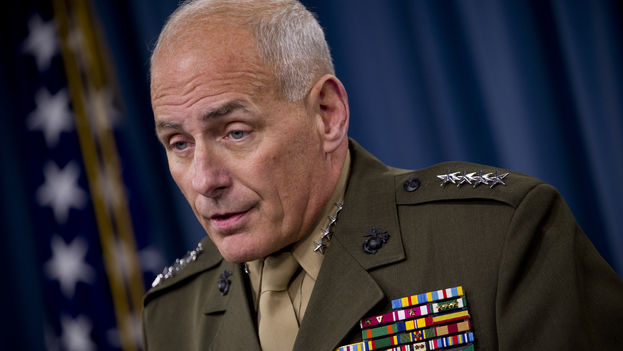
John Kelly, head of the US Southern Command

14ymedio bigger14ymedio (with information from agencies), Havana, 13 January 2016 – Cuba will participate for the first time in the Conference on Security of Caribbean Nations to be held from January 27 in Jamaica, announced Gen. John Kelly, head of the United States Southern Command, who interpreted the gesture as one more in the policy of rapprochement between the two nations.

“We have normalized diplomatic relations and, regardless of what we think about our respective political systems, we have extremely common challenges,” Kelly said in an interview.

The United States organized this three-day event, which will address issues affecting cooperation in the fight against trafficking in drugs, arms and migrants.

The event will take place in Kingston, the capital of Jamaica’s, and attendees are expected to include military leaders and security officials from 16 Caribbean countries, plus the United States, Canada, France, the Netherlands and the United Kingdom.

Cuba has not specified who it will send.

Cuban Communist Party Implemented Only a Fraction of Reforms From Sixth Party Congress / 14ymedio

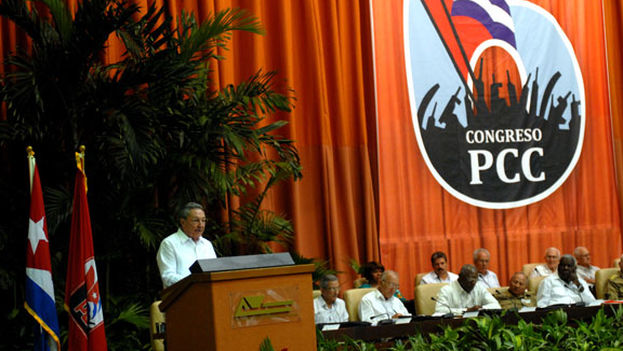
President Raul Castro at the inauguration of the Sixth Congress of the Communist Party of Cuba.

14ymedio bigger14ymedio, Havana, 15 January 2016 — Five years after approval, at the Sixth Party Congress, of the Political, Social and Economic Policy Guidelines of the Cuban Communist Party (PCC), the Party just admitted that it has only implemented 21% of the planned reforms.

At a plenary session this week of the PCC’s Central Committee, which was not previously announced, PCC leaders evaluated the results of the “updating of the socialist model,” enacted in 2011. They recognized that some of the measures implemented in the last five years “still have had no real impact on the family budget.” continue reading

Between congresses, the highest body of the PCC also analyzed several documents during the session, presided over by Raul Castro. The “2030 Economic and Social Development Program” was presented, which contains the “proposed vision of the nation” for the next fifteen years and defines the axes, objectives and strategic sectors that will shape the direction of the country.

According to the Party-run Granma newspaper, the development program is aimed at solving the structural problems of the economy, “starting with government policies with a comprehensive and sustainable focus that respond to a strategic and consensual vision of the medium and long term.”

Many analysts suggest that the updates of the economic and social model seem to have peaked after modest openings in the economy to private initiative and the easing the rules for foreign investment, as well as allowing Cubans to travel abroad and to buy and sell homes.

The 7th Congress will be held this April in a very difficult regional context for Cuba, as a result of the landslide victory of the opposition in legislative elections in Venezuela. There is now the risk of a cut in the enormous oil subsidies that South American country sends to the island, in the name of political solidarity. On the other hand, this meeting will be the first for Cuban communists after the reestablishment of relations with the United States.

Land Leases, a “Half-ownership” / 14ymedio, Juan Carlos Fernandez

Juan José Muñoz, 83-year-old who leases land, in the doorway of his home. (14ymedio / Juan Carlos Fernandez)

14ymedio bigger14ymedio, Juan Carlos Fernandez, Pinar del Rio, 14 January 2016 – The earth and the man who works it end up resembling each other. The skin becomes rough and dark like freshly plowed earth, and the face is lined with furrows where seeds could be planted. So it is with Juan José Muñoz, who at 83 has merged with the land that he recovered a few years ago, through a usufruct lease arrangement, long after they took it from him decades ago.

The old man with lively eyes can be found at kilometer 8 on the La Ceniza road, near the city of Pinar del Rio. He is one of the 2,596 farmers who, since 2012, have received lands under the usufruct form of leasing, with a total of roughly 36,000 acres now managed by private farmers. continue reading

“Planting tabacco soothes my soul, I learned it from my father as far back as I can remember, and I like it,” says Muñoz. Despire his advanced age, he still has the energy not only for cultivating, but also for cutting firewood, cooking and even making the odd joke when someone passes by his humble home.

“I was born here and I grew up working with my father, my uncles and two brothers, in the same place,” he says. However, at the end of the seventies State Planning decided to use his to grow citrus. “They forbade us to plant tobacco,” he says with regret, but affirms, “They couldn’t take it all from me and they left me 2.5 acres.”

Losing what had been the center of life as he knew it, Muñoz working in the citrus plant located in the road to La Coloma, but, he says, “I wasn’t born to spend eight hours in a factory, so I asked to be released and went back to the fields.” On his only remaining land he raised chickens, pigs and even grew a little tobacco. “They couldn’t prevent me because it was my land,” he says, with a wild glint in his eyes.

“It was a long time until they again allowed the widespread cultivation of tobacco, because the citrus never paid off; after that they approved the usufruct arrangements and I asked for the 12 acres we had always planted with tobacco,” and, he stressed, indicating the land around his house, “all of this we’d had forever, since I was tiny.”

With the adoption in 2008 of Decree Law 259, replaced by Decree Law 300 in 2012, the government of Raul Castro permitted “the delivery in usufruct [leasing] the benefits of state property to natural or legal persons.” Those interested could, from that time, request a maximum of 33 acres for a period of up to ten years, renewable for additional ten-year periods.

That’s how Muñoz as an old man returned to working the fields that had been his family’s. Now, he plants rice, corn, tomatoes, sweet potatoes and fruits, especially for his own consumption. “Life is hard, and the land does not produce like before,” he says, while straining a little coffee on his wood stove.

Electricity has not officially come to the house of Muñoz or the 15 other farmers who live nearby. An illegal line provides them the service, but not without setbacks. “That has brought me problems, inspectors have come to threaten us with fines.” The low voltage only allows turning on “one light bulb,” and so he hasn’t bought a refrigerator or television, “because it would just go to waste.”

This year the drought has taken its toll on the octogenarian’s fields. “All the seedlings the Fructuoso Rodriguez Agricultural Production Cooperative gave me have gone to waste. Now the land is bare, completely bare” and he has to “buy seedlings privately,” he explains.

The problems he experiences are shared by most of his neighbors. The land leasing arrangement has not worked in the region as expected and by the end of 2015 the local press reported that it 3,504 individuals in Pinar del Rio who had taken advantage of this arrangement had lost their land. According to the official version, irregularities were found, such as “the abandonment of an area for more than six months and not dedicating the land to the purposes for which it was granted.

Muñoz sees the situation very differently. Although he has been able to continue to work his piece of land, he says that most of the time he cannot get fertilizer, the tractors are broken and there is no fuel. “This year the seeds didn’t sprout,” and he complains that he can’t rely on crop insurance against natural disasters. “Three years ago my tobacco harvest was diseased, and I applied for the insurance but I am still waiting.”

Across the province 116,000 acres remain available to be leased, especially in the districts of Sandino, Mantua, Consolacion del Sur and Los Palacios. However the land is difficult to farm and infested with the invasive and very hard to get rid of marabou weed, so even the boldest decline to apply for it.

Despite the few advantages that the stubborn farmer has been found in leasing his land, he says he appreciates “tranquility” of labor in the tobacco fields. This calm, however, could be about to end. “They came to me and told me that this year if I don’t fulfill my plan they’re going to cancel the contract.” It would be the second time they took away his land.

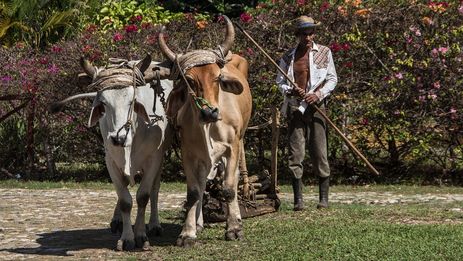
Cuba farmer working land with oxen
Cuba farmer working the land with oxen

Video Reveals Details of Demolition Of An Evangelical Church In Camagüey / 14ymedio


Note to readers: The video is not subtitled, but allows viewers to see the church before and after the demolition. The introduction notes that the video was filmed mostly clandestinely and apologizes for the poor quality.

14ymedio bigger14ymedio, Havana, 17 January 2016 — With his cell phone camera and through the window shutters, a man captures the police operation around an evangelical church in the city of Camagüey. The image is part of a recent video with details and testimonies about the demolition of the roof of Pastor Bernardo Quesada’s church on 8 January. [An interview with Pastor Quesada about these events is here.]

The recordings were made by several members of the Fire and Dynamics congregation to record surveillance around the temple, the machinery used to bring down the roof and the dismay among the faithful caused by the demolition of the church. Complaints and cries of faith are heard throughout the audiovisual material, along with brief interviews with parishioners.

The center of worship is located in the Versalles neighborhood in the city of Camaguey and is part of a Christian movement that split the Cuban Council of Churches in 2003. continue reading

In the early morning hours of 8 January, police forces raided the home of the pastor, who was violently arrested and taken, along with his wife, to the police station on Avellaneda Street, near the train station.

The nave that had served as a temple was totally destroyed. The conflict between Quesada’s church and the authorities dates back to 2012, when the pastor’s wife bought a property to serve as their home, and began renovations of a roofed open-walled structure for religious activities.

In October of that year, the Department of Physical Planning fined the owner for not having requested permission for the work on the outbuilding, which the authorities considered an independent housing unit. The pastor says that the administration of the agency itself had assured him that permission was not necessary.

On 3 December of last year, the religious leader was summoned to a meeting at the Provincial Department of Housing and was told he would have to demolish the roof of the outbuilding. The demolition would have to be undertaken within seven days of that date.

Quesada made an urgent call to the international community through the digital site Religion in Revolution, in which he claimed that it was a persecution “against the Church where more than 600 people gather.” However the authorities proceeded to demolish the temple at the beginning of this year.

United States Opens The Door To Telecommunications Services With Cuba / 14ymedio

US telecommunications company AT & T. (Flickr)

14ymedio bigger14ymedio, Havana, 17 January 2016 – “By removing Cuba from the Exclusion list, the Commission opens the door for U.S. telecom carriers to provide facilities-based telephone and Internet service to Cuba without separate approval from the Commission,” the U.S. Federal Communications Commission (FCC) reported Friday, through a statement posted on its web page.

With this measure, United States providers will not need special authorization to offer services to the island or to build installations on Cuban territory. The document clarifies that the decision will take effect immediately upon its publication. continue reading

Since 1996, Washington has included Cuba on a telecommunications exclusion list which required operators interested in offering services to the island to present a special request. Authorization was a joint process with the State Department.

“Removing Cuba from the Exclusion List benefits the public interest as it will likely alleviate administrative and cost burdens on both the applicant and the Commission, and will promote competition on the U.S.-Cuba route,” said the official statement.

The news has just begun circulating within the island, but comes at a time of widespread discontent with the management of the State Telecommunication Company of Cuba SA (ETECSA). Customers of the telephone monopoly complain about the high prices of services which are charged in Cuban convertible pesos rather than Cuban pesos, and the unreliability of services.

In the last trimester, ETECSA’s email service, Nauta, has suffered two interruptions lasting several days each, which has raised the volume of complaints against the operator. Many look hopefully to the arrival on the island of a competing company that would force the state monopoly to reduce rates and improve service.

Last November the U.S. mobile company Sprint reached a direct roaming agreement with Cuba, the first of its kind in the new relations between the island and Washington, since the beginning of the thaw in December 2014. However, the agreement has not yet been put into practice.

The Unfinished Cold War / Carlos Alberto Montaner

Mikhail Gorbachev, and Ronald Reagan (DC)

14ymedio, Carlos Alberto Montaner, 16 January 2016 — Again, thousands of Cubans are preparing to enter the United States. The first have already arrived. It is an old and exhausted story. They have come in massive numbers since 1959, when the Castro brothers’ communist dictatorship began. This time they are coming via Costa Rica.

Since 1966, Cubans have received preferential treatment from United States immigration authorities. They call it the “Cuban Adjustment Act. It is one of the multiple exceptions in the complex US legislation on migration. continue reading

There are others. For example, Temporary Protected Status (TPS) is awarded to thousands of undocumented immigrants living in the United States. A dozen nationalities benefit from this measure, conceived to protect certain people from the horrors of violence or natural disasters in their countries of origin.

But there are essential differences between TPS and the Cuban Adjustment Act. The temporary protection must be periodically renewed and depends on the will of a fickle Congress. The law that affects Cuban, on the other hand, leads to obtaining official residence after one year, and citizenship after five years.

Actually, it is a double stupidity that TPS does not lead to residency and eventual citizenship. The provisional nature and lack of progressive integration into U.S. society cruelly harms immigrants and turns the “American dream” into an unnecessary nightmare, tinged by the ominous persecution of “La Migra,” the immigration authorities.

The other piece of this nonsense is the self-inflicted damage to the United States. What is best for this country, and for everyone, is working citizens who comply with the laws, create wealth, pay taxes and become a part of the mix in the legendary American “melting pot,” as happens with the vast majority of Cubans.

Cuban exceptionalism began with the rules of the Cold War. It was a predictable American response when Castro and a small group of communists, convinced of the superiority of Marxist-Leninist ideas, the benefits of the USSR, and the perfidy of the United States and its market economy, decided to create a communist dictatorship on the island.

Moscow, which knew how to organize satellites, because they had done it cruelly and efficiently in Eastern Europe after the end of the Second World War, immediately offered its unconditional support. Without delay, Soviet advisors arrived discretely on the island with the primary objective of crushing the Cuban democratic opposition and creating counterintelligence networks. Their next step would be to fill the island with nuclear missiles.

Khrushchev said, “Now the United States will know what it means to live with a dagger pointed at its neck a few miles off its coast.” It was his retaliation in response to harassment from NATO.

The United States reacted. In mid-March 1960, President Eisenhower signed a secret order authorizing covert operations to liquidate the Russian satellite installed in Cuba.

It was too late. A week earlier the Spanish-Russian general Francisco Ciutat had arrived on the island. Fidel received him and called him “Angelito” – little angel. Soon there were 40,000 Soviet soldiers and advisors. The Cold War was at its peak in the Caribbean.

Thirty years later, the European satellites broke with the USSR and the Eastern Bloc disappeared, including the Soviet Union itself. The United States’ strategy of containment had worked. The U.S. had won the Cold War.

But not everything. In Cuba and North Korea they dug trenches. Fidel Castro, extremely angry at that “traitor” Gorbachev, proclaimed, as his brother Raul applauded, “I will sink the island into the sea before abandoning Marxism-Leninism,” assuring that Cuba would remain as a communist bulwark to light the day when the planet would recover the revolutionary lucidity.

Fidel, a die-hard Stalinist, with the backing of Lula da Silva in Brazil, was given the task of collecting the rubble of communism and building with it the Sao Paulo Forum, a kind on Third International with room for all the “anti-imperialist fighters,” from FARC’s narco-guerrillas to Islamic terrorists.

Until Hugo Chavez appeared on the horizon, haloed by ignorance and irresponsibility, and loaded with petrodollars. Fidel seduced and recruited him, first to exploit him, and later to fight against economic freedom and against Washington, to the glory of the world’s poor.

Together, de pipí cogido, as the Columbians say so gracefully, in an indomitable Havana-Caracas axis, they would triumph where the USSR had crumbled, an objective and strategy that no one has denied or dismissed. Felipe Perez Roque, then Cuba’s Foreign Minister, announced it in Caracas at the end of 2005. Hasta la victoria siempre, Comandantes.

From this spirit of the Cold War – all that some backward countries could deliver – arose the dreadful fantasy of “21st Century Socialism” and the anti-U.S. circuit of ALBA, set against the FTAA promoted by the United States.

It is not true, then, as Obama assumes, that the Cold War is over. At least in Latin America Castro, Maduro, Ortega, Evo and to a lesser extent Correa are keeping it alive, with the lateral support of Dilma Rousseff and Kirchnerism, the latter happily removed from power by Mauricio Macro.

It is inconceivable that Washington ignores this unfortunate reality or continues to think that this is a “nuisance rather than a danger.” Burying one’s head in the sand has never been a smart way to confront problems.