
Venezuelan Socialist Blames Hugo Chavez For The Disaster / 14ymedio

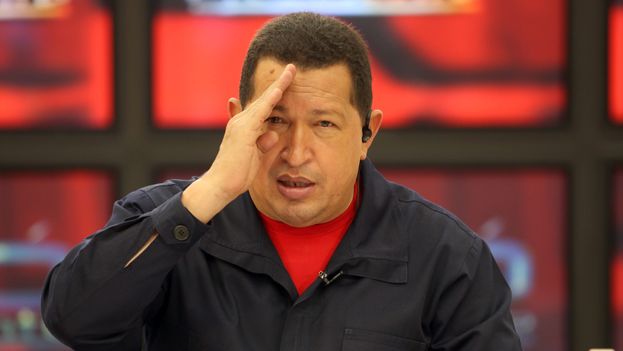
The late President of Venezuela Hugo Chavez. (Miraflores Palace)

14ymedio bigger14ymedio, Havana, 25 January 2016 — “We reject the infamy of trying to create a similarity between socialism and the Chavez model,” says an article published this Sunday by the Venezuelan journalist Leon Moraria on the site Aporrea, a digital page that is defined as a space identified with “the process of revolutionary and democratic transformation” in Venezuela.

Moraria’s article joins others that have appeared on the site with strong critiques from the Venezuelan left of Nicolas Maduro’s management. Moraria, also a social activist and defender of the rights of miners, called for putting a name on the failed model that has brought the oil-rich country to a deep economic and social crisis. continue reading

The writer refers to the recent speeches of the deputies in the National Assembly, of the opposition majority, in which they make constant refernces to the ineptitude of the current system. A situation that Moraria exemplifies with figures such as the 76% increase in poverty, galloping annual inflation that exceeds 300%, and an unemployment rate of over 50%, which condemns the majority of Venezuelans to working in the informal economy.

The enumeration of the Venezuelan disaster includes, according to the socialist, the shortage of some 60% in products that make up the daily diet; the paralyzation of more than 60% of urban and interurban transit for lack of parts, tires, abd batteries, as well as small and medium industry paralyzed by lack of raw materials, and agriculture abandoned for lack of inputs.

So Moraria questions whether the “described disaster” is “manna from heaven” or the consequences of a “failed economic model.” A question that he responds to by affirming that the situation “did not exist 17 year ago,” and “did not arise by chance nor because of domestic businesses nor imperialism,” but “is caused the government itself.”

His harsh critiques join those of former Chavez followers, such as Javier Antonio Vivas Santana, who in December called for the resignation of Nicolas Maduro in an article also published in Aporrea. On that occasion, the author of the article predicted that if the resignation does not occur, the Venezuelan leaders could “kill the Bolivarian revolution.”

Moraria believes that “devaluing the currency is the best factory of poverty yet invented.” A situation that the government decorates “with gifts, subsidies for everything (gas, food, medicine), plus political/populist handouts financed by oil revenues,” but that, “is not underpinned by economic development, as it should be.”

The activitist is incisive when noting that these “subsidies are turned unto alms, confusing social justice with charity,” and he passionately affirms that, “Charity is not socialism! Socialism is revolutionary transformation!”

The article reaches its highest level of criticism when he says that this “economic disaster has a name and surname: Hugo Chavez, the Chavismo ideologue, based on demagogic populism, ‘hyper-leadership’ and a cult of personality.” A political ideology adorned “with Bible quotes, Bolivarians, Marxists, Christian Socialists, fascists, neo-Nazis, militarists, in a very peculiar ideological syncretism.”

“The economic disaster is the legacy of Chavez,” concludes Moraria, who believes that the deterioration Venezuela is experiencing is “so perfect, so well prepared” that it could only be the work of a “genius” like the “eternal commander.” A president that governs “with enabling laws, approved by a complacent unanimity or by a parliamentary majority,” he adds.

The left-wing journalist notes that the current Venezuelan government “is not revolutionary, nor Bolivarian, much less socialist.” He sees it a system of the military, “with the military and for the military,” and warns that “it is a disgrace to say that Chavismo is socialism.”
Sean Penn: Spokesman For Drug Lords And Generals / 14ymedio, Yoani Sanchez

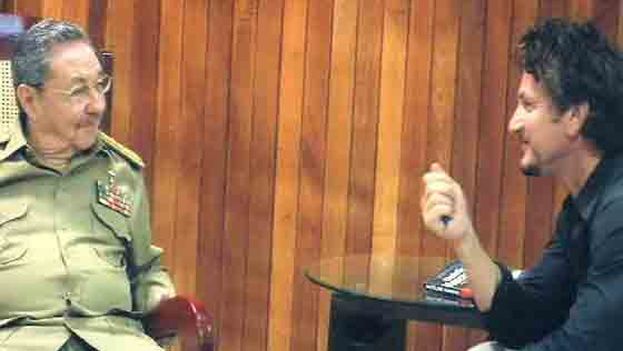
Sean Penn and Raul Castro during the interview held in 2008, brokered by Hugo Chavez

14ymedio bigger14ymedio, Yoani Sanchez, 25 January 2016 — They say they talked for seven hours, sharing cups of tea and glasses of wine. On one side was the American actor Sean Penn, staunch critic of the system he lives under, and on the other side, Raul Castro, newly appointed president of a country where just a few people have shaped the political course for almost six decades.

The prominent artist came from a Hollywood that disgusted him and a nation where anyone can yell at the government until they’re blue in the face. The general, almost an octogenarian at the time, had seen and approved the downfall of many intellectuals simply for looking askance at power.

Raul Castro must have looked with suspicion and cunning on this wealthy tantrum-throwing progressive. Unable to read aloud without committing innumerable errors, typical of people with few books and many orders, the former Minister of the Armed Forces in Cuba knows that behind every artist hides a critic of totalitarianism who must be neutralized and silenced, or at least an attempt must be made to buy them off. continue reading

That appointment in Havana in 2008, brokered by Venezuelan President Hugo Chavez, had only one objective: to sweet talk the irreverent Penn so that he would repeat the “virtues” of a system under which eleven million Cubans live. And so, the conversation was entirely a dance of conquest, with no outbursts, no guns on the table. The star of Mystic River must not suspect a thing, must not be afraid.

It is probable that the meeting proceeded amid knowing glances, paused words, in the style of “I never liked the idea of giving interviews,” offered by the younger of the Castro brothers. The makeshift reporter had to feel he was accessing the hidden soul of a hardened guerrilla, when in reality he was falling in the web of an adept totalitarian. The trap worked perfectly.

Penn not only left assuring us that “in fact ‘Raulism’ is on the rise along with a recent economic, industrial and agricultural boom,” and also passed on from his interview – without questioning it – the ‘fact’ that reports about the violation of human rights in Cuba published in the media in the United States “are very exaggerated and hypocritical.” A journalist would not have lost the opportunity to slip in a hard hitting question and try to get at the truth.

However, Sean Penn didn’t even flinch. His reason for being there was not to question the words of General – as an ‘inconvenient’ reporter might have done – but to use Cuba as the point of the sword in his personal battle against the United States government. We were nothing more than numbers before his eyes, figures that should explain why the Cuban “model” was superior to that emanating from the White House.

As a crumb, Penn later admitted that if he “were a Cuban citizen” and had to do an interview like that one, he could “be imprisoned.” But he said it as one recites the Lord’s Prayer before stealing from a neighbor; he clamors for transparency and then puts on a hood; brays for freedom and shakes hands with a dictator. He says it in a way that is not convincing.

Years later, Penn would repeat the same modus operandi. He would interview, in the back of beyond in Sinaloa, a fugitive from Mexican justice, a blood-stained drug lord, Joaquín Guzmán Loera, El Chapo. The caviar-progressive with his private planes would fall again, surrendering at the feet of power, becoming the ventriloquist for a story told by another famous culprit who wanted to clean up his image.

This time, the scene also developed like a mating dance, where the one who was in control the whole time managed his naïve prey who believed he was dictating the pace of the encounter. El Chapo also sweet talked the winner of two Oscars, as Raul Castro had done years earlier in Havana.

The actor-journalist gave himself up to the interviewee, joking with him, offering his hand. In their conversation, it is the other who sets the pace and dictates the topics. The idea is presented of the bloodthirsty criminal as a product of a corrupt society, someone who has been shaped by external causes and turned to violence as an act of rebellion.

However, far beyond the adversities and the context, there was a moment when both Raul Castro and El Chapo Guzman could have questioned the harm they were doing, the unhappiness and pain they left in their wake. The greatest failure of the condescending reporter was not to delve into why there was no repentance in either man, only the frigid stubbornness of the caudillos.

Again, Penn missed the opportunity to be a journalist and became, instead, a sad spokesman for drug lords and generals.

A Calamity Called Evo / 14ymedio, Carlos Alberto Montaner

Evo Morales, president of Bolivia. (Flickr)

14ymedio, Carlos Alberto Montaner, Miami, 24 January 2016 — Evo Morales has already served 10 years as president of Bolivia. He is the person who has occupied the post for the longest consecutive time since Simón Bolívar was inaugurated in 1825. He is in his third term. It will end in 2019.

It seems too little. He is not happy. He wants to be reelected when that date arrives. For him, generational change and the circulation of the elites sparks nervous laughter. He has called a referendum to be able to run a fourth time, which would put him in the presidential chair in 2025, and celebrating two hundred years since the inauguration of the Republic. continue reading

Then he wants to continue, and continue, and continue. It is very amusing to be president. He likes living in the Quemado Palace. He knows nothing of law, economics, history. He knows nothing about anything, except the infinite goodness of coca, a plant whose cultivation is increasingly widespread, to the sadness of the Drug Enforcement Administration.

It doesn’t matter. At the end of the day, the one who governs is his vice president, Álvaro García Linera, a Marxist professor, mathematician and sociologist with a hideous revolutionary past, who concerns himself with the official carpentry. Evo, meanwhile, shows off, plays football, avoids talking and greatly entertains himself.

There is something unhealthy about the need to rule that Evo exhibits. It is the living representation of the platonic idea of narcissism. He has twice amended the Constitution. If he wins the referendum he won’t have to update the text again. He will be able to be reelected indefinitely and will die in the royal bed, like the ancient monarchs.

Will he succeed? He should lose, but who knows. He has wildly increased public spending. When he came to power the government consumed 21.05% of GDP. Now it is 43.26%. It is the second highest per capita public spending in Latin America. The first is Ecuador (44.17%). Chile, the best governed nation in Latin America, dedicates 24.88% of GDP to this category.

That enormous public spending wouldn’t be so serious if the money belonging to everyone was handled honorably, but it isn’t. According to Transparency International’s Perception Corruption Index, Bolivia is a pigsty: its score is 35. In this cataloging, with anything under 50 the country is in very bad shape. Bolivia ranks 103 out of 175 countries, one of the worst in Latin America.

Bolivia is headed into a crisis. It will probably devalue its currency after the referendum. Like good populists, neither Evo Morales nor his vice president believe in economic freedom nor in the virtues of the market. They believe in Statism and cronyism, and have confiscated several key companies, subscribed to the fateful recipe of 21st Century Socialism, and, in collaboration with the Cuban security services, have not ceased to imprison their adversaries, exile them, and, once in a while, assassinate them.

When they came to power, Bolivia received a reasonable ranking on the Index of Economic Freedom from the Heritage Foundation. It was classified as “moderately free.” Today it is in the lowest ranks, and its economy classified as “repressed.” This is an infallible recipe for disaster. It is enough to review the list to confirm that greater freedom and openness corresponds to a better level of development.

But, in my judgment, the greatest damage has been in the institutional terrain and in the intimate fabric of the Bolivian nation. The multinational State is a stab to the idea of a republic of citizens equal before the law, united by constitutional patriotism, as Simón Bolívar claimed and as Victor Pas Estenssor tried to carry out with the unifying revolution of 1952.

Evo Morales returned Bolivia to the pre-Colombian period, as if that hostile and fierce world of ethnic remnant that had frequently made war had been a kind of peaceful confederation of beatific people.

He did not understand that the very idea of the Republic of Bolivia was the product of a modernity embodied in the dreams of Bolívar and Sucre, and not in the fantasies of Tupac Katari, inevitably erased from history by the insensitive European steamroller, as happened throughout the New World with indigenous cultures.

On February 21 we will know if this calamity called Evo Morales has an expiration date, or if he came to power to remain indefinitely. Very soon now.

Forty Years Later, What Does The Cuban Constitution Need? / 14ymedio, Manuel Cuesta Morua

The current Cuban Constitution was adopted 40 years ago, in 1976 (EFE / FILE)

14ymedio bigger14ymedio, Manuel Cuesta Morua, Havana, 23 January 2016 – Forty years in the life a nation is a short time in the long span of history. In politics, on the other hand, three generations are enough to measure the significance of accomplishments that mark a specific period.

With the Socialist Constitution of Cuba turning 40, we are left with the feeling that 1976 was an insignificant year for the institutionalization of the country. The seminal date continues to be 1959, in which the nature and dynamics of power – anti-institutional – were expressed, and not 1976 in which the Cuban Revolution supposedly institutionalized a process of inclusion of the whole society within fundamental rules that are the same for everyone. continue reading

The distance of 16 years between the Revolutionary event and its political institutionalization established and stabilized a particular habit that is typical of pre-modern politics: command by those who triumphed. And the triumph was one of a party above a nation. And so, before 1976, there was the First Congress of the Communist Party of Cuba in 1975, which was the year when those few who came to dominate the destiny of everyone were institutionalized.

The Communist Party is the origin of the 1976 Constitution. It goes without saying that the origins of the Cuban Constitution were anything but democratic. Its conception and drafting were not the work of a group of notables chosen for their diversity and representative of society, but a rather of a small appointed group consisting of militants of the old Socialist Party, specifically directed to copy the outline of the Bulgarian Constitution from the Socialist era, which in turn was a facsimile of the Soviet Constitution of 1936.

Thus, Cuba backtracked almost four years, if we take 1940 – the year Cuba’s pre-Revolution Constitution had been adopted – as a point of departure for a rich constitutional history that responded to the foundations of a modern constitutional state: limitation of power, fundamental freedoms and separation of powers.

Without prior public consultation, the 1976 Constitution inverts sovereignty and crystalizes two sovereign dimensions over society. In this it exceeds, so to speak, the socialist world that it imitates and where it constantly seeks legitimacy. The inverted sovereignty makes it clear to everyone that the source of law for the acts of the Government is not in the people but at the top of the pyramid: in those who rule in their name. The double dimension of this recovery of the concept of sovereignty that precedes the French Revolution warns us that above us is the Communist ideology and above it, and everything else, including international law, is the Revolution, the source of law in Cuba.

The history of the country over the past 57 years is one of tension between the hegemony of the Communists and the hegemony of the Revolutionaries who are active in the Communist Party and who, owners of everything, rule outside of them and the constitution they copied.

But there are two other basic tensions: that which occurs between the Revolutionaries and the country in which they reign, combining caprice and hormones; and that which is born from the clash between the will of the powers-that-be, and constitutional life.

These two tensions push sporadic reforms and counter-reforms of the Constitution to adapt to social and economic reality, that resists the structural and systematic blows of power, and the needs of survival in the face of this same reality. The 1992 reforms, reasserting the secular character of the Constitution and national sovereignty are in the first sense an adaptation. They were reforms to the extent that they put an end to official atheism, a form of State religion, and deleted the article that thanked the former Soviet Union for the very existence of the Cuban State.

In 2002 there was the counter-reform that once again evidenced the dominion of Revolutionaries with card-carrying Communist credentials. To any doctrinaire Communist, not to mention the rest of society that was emerging in all its plurality, it declared the irreversible character of socialism at the exact moment when evidence suggested the complete contrary. Nothing was irreversible nor had history come to an end: neither that proclaimed by the Communist Manifesto of 1848, nor that proclaimed by the American intellectual Francis Fukuyama in 1980 in his book The End of History and the Last Man.

The 2002 counter-reform indicated, however, a more important fact: the Cuban Revolution managed to institutionalize itself as habit precisely because it denies the constitutional life of the country. Cuban has been governed since 1976 in the same way it was in the 16 years between 1959 and 1976: by force of will and wishful thinking. This seems to tell us that the fundamental and necessary changes in the country can only be achieved through the triumph of another revolution.

Is this advisable? In my view, no. Someone said it superbly: The ends are nothing, the means are everything.

Cuban society has come to maturity through the blows of failures and there is already awareness, across all of society, that the country’s progress will be associated with clear and precise rules of the game that avail everyone and that are above everyone in the sense only that no one is above them.

The Constitutional Consensus project, promoted by various organizations of civil society and politically independent emerged from this awareness. For it what is essential it to define the what before the who and to return sovereignty to its only legitimate owners: the citizens. A prosperous and sustainable country can only grow within clear rules. Also moving in this direction are the proposals of the Cuba Possible project and the Coexistence project.

Similarly, the #Otro18 (Alternative Cuba 2018) project does the same, specifying and seeking to recover sovereignty through civil proposals for a new Electoral Law that guarantees plural participation without mediation of all Cuban citizens, leaving behind the single political subject recognized and legitimized by the powers-that-be: the revolutionary.

Important constitutional reforms of at least four articles of the Constitution are key to move in this direction. These are:

Article 3: Which has to do with the exercise of sovereignty and in which, for these involuntary derivations of the popular rhetoric, it is recognized that the people can exercise direct political power;

Article 5: Which awards hegemonic and implicit superiority to the Communist Party, whose reform extends to;

Article 62: Conceived to limit the exercise of the few recognized citizen rights, and;

Article 137: Which clearly defines the legal subjects with the capacity to reform the Constitution, and specifically excludes the citizens from this capacity.

These constitutional articles taken as a whole proportion the typical shielding of the State from society and the citizenry, and reveal the conceptual distortions in the contractual nature that are at the origins and foundations of constitutional law.

The Cuban government has realized that a profound constitutional reform is necessary. It has raised, on several occasion, that it is working on it, and is doing so clearly behind the backs of the citizens, as it develops a proposal for a new electoral law.

Unfortunately, 40 years later, the same spirit prevails: power is attempting an adjusted reform of its measure without prior public deliberation. A weak logic for the institutional future of the country.

The Powerful Bicycle / 14ymedio

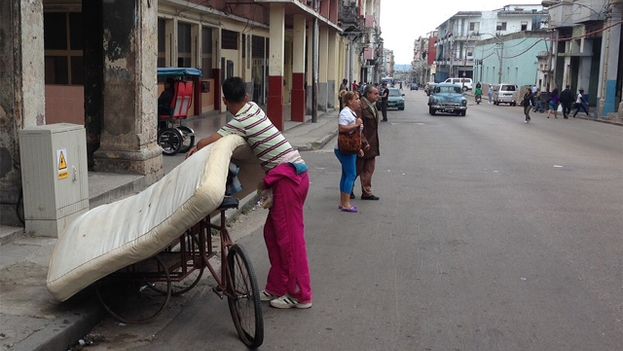
A man places a mattress on a bicycle in a street of Havana. (14ymedio)

14ymedio bigger14ymedio, Havana, 23 January 2016 – In the nineties nearly three million bicycles were distributed in Cuba, imported mainly from China. The collapse of the Soviet Union and the economic crisis suffered by Cuban society had a very negative impact on oil supplies and passenger transportation. The streets filled with cyclists, with bike-only paths, and parking lots where this alternative transport was kept, along with an informal network of spare parts sellers and bike repairers.

There were also all sorts of devices to adapt bikes to carry several family members, to carry small children, and haul goods and protect them from being stolen. With the passing of years, many of these ingenious inventions have fallen into disuse thanks to the upturn of the economy and the arrival of a steady supply of fuel. Not it is difficult to find a bike parking lot in Havana and none of the special paths created for them on the main avenues remain.

However, bikes remain the transportation of the poorest. With them they go to work, find food, and even carry every kind of object: a mattress – like in the photo – a suitcase, a shaky row of cartons filled with eggs.

Cuba Announces Measures to Stop Decline in University Enrollment / 14ymedio, Luz Escobar

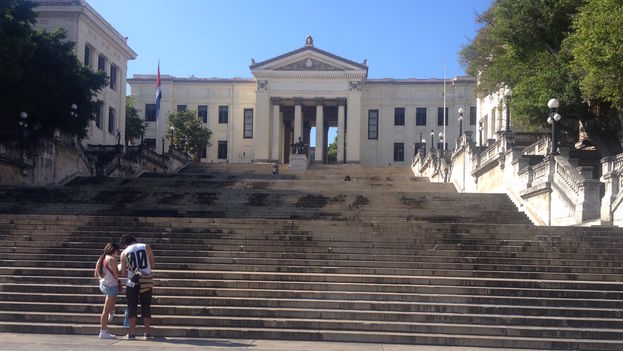
Steps of the University of Havana. (14ymedio)

14ymedio bigger14ymedio, Luz Escobar, 23 January 2016 – The upcoming school year will see transformations in access to higher education. The changes affect both regular and distance courses, and eliminate the entrance exams for the latter. This measure seeks to increase enrollment in universities, which in the last five years has decreased by 60,000 students, according to the Minister of Higher Education, Rodolfo Alarcón Ortiz.

Throughout this week, several television programs and reports in the press have detailed flexibilities which will be implemented starting in September. The requirement to take entrance exams in Spanish, mathematics and history – currently in force – has become “a barrier, not only cognitive but also psychological, for people who are workers who have been out of school for years,” the minister declared.

continue reading

Starting in the 2016-17 academic year, these materials will be included in the regular class program, as well as in distance learning, and occupy 5% of the total hours of study. Thus the evaluation of this knowledge will be after the first year of study, allowing students a chance to catch up on essential and basic content.

The current enrollment in regular and distance courses is one-tenth that recorded in 2007-2008. Although the minister did not specify other causes of the decline, a source from the Ministry of Education consulted by this newspaper said that “obtaining a diploma and graduating in a specialty is no longer the goal of many young Cubans.”

According to this official, “The attractions of the non-state sector, such as self-employment and working in a restaurant, seduce more and more young people.”

The problem is compounded if we add “the migration of labor to other countries,” Alarcon Ortiz acknowledged. The deficit is felt especially in the economic fields of stody, and in agriculture and the technical sciences, the official added. Although the most critical situation is faced by the departments that train future teachers, the minister acknowledged that there is “lack of motivation” to opt for these specialties.

The three traditional exams will be maintained for those who choose the regular course, and entrance will require a minimum of 60 points on a 100-point scale. There are three scheduled sets of dates for these exams: the “ordinary” to be held on May 3-10; the “extraordinary” scheduled for June 21-28; and the “special” on August 26-31.

University admission is awarded at the conclusion of each series of exams, and those who resort to the “extraordinary” or “special” series will be at a disadvantage in terms of the number of remaining places. Ministry of Education officials affirm, however, that there is a guaranteed place in the regular course for all students who pass the three admission exams.

Central Committee Plenary, Beans, Clothes, and the Roof / 14ymedio, Pedro Campos

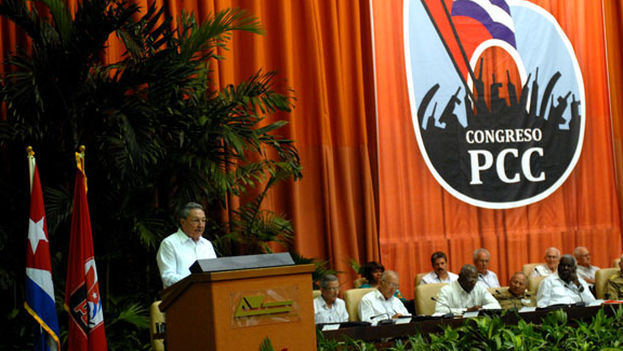
President Raul Castro at the inauguration of the Sixth Congress of the Communist Party of Cuba

14ymedio bigger14ymedio, Pedro Campos, Havana, 23 January 2016 — A brief note on 15 January in the State-Party controlled newspaper Granma reports that the 13th Plenary of the Central Committee of the Cuban Communist Party (PCC) was apparently held in secret – as it mentions no place nor date – and that at the session it was recognized that only 21% of the agreements of the 6th Party Congress, held in 2011, had been implemented while the rest continue to be in the process of implementation.

The press note disclosed that at the meeting there was an evaluation of the documents to be debated at the 7th PCC Congress, in particular “the conceptualization of the Cuban economic and social development model” and another document on the economic plan for 2030. This latter is a kind of three-part set of five-year-plans for 15 years. “In future editions Granma will provide more information on the issues evaluated in the 13th Plenary.” continue reading

Form and content suggest that, apparently, the leadership of the Party-Government is divorced from what is happening with the population, what its concerns and needs are, where and how ordinary people get along.

Nor do they appear to be connected to the serious problems of food and the prices of widely consumed products, nor the low wages, nor the serious issue of the dual currency system, nor the housing crisis, nor the transport failures, about all of which they were silent, not even trying to calm people’s worry. Nothing is said about the international situation and how it affects the country, nor about what some 10,000 Cubans stranded in Central America are going through.

Everything, as if none of this existed, is treated very sparingly, as if in this country there were not a collection of emergency situations.

Many wonder why these issues are not resolved with so much money entering the country, with so much left after the State pays their salaries, and with so much collected through taxes.

In Cuba there are two budgets: the official budget that is disclosed in the National Assembly and the “petty cash” budget, which in any case must be rather large and is controlled by the party leadership. So, with that concentration of decisions and wealth, this country cannot seem to work things out.

I have known that even senior government officials confess they do not know why the demands of the population are not being met, and that and analysis of the problems and solutions are offered by intellectuals, professionals of social sciences in the nuclei of the party. I have heard about the concerns of officers of the Revolutionary Armed Forces (FAR) and the Ministry of Interior (MININT) because no effective measures are taken to solve the serious problems identified. The discontent is general. Many of the highest ranked leaders have seen their own children leave the country.

And when you think about all this is when you realize that, given that these leaders have not reached these heights through the direct, free and democratic popular votes of anyone, they are apparently “lost in the clouds,” although they know what is happening down below on the ground and they do nothing to resolve it.

As “good Marxists” they know that human beings must, first of all, have food, clothes, shoes and a roof over their heads, before they can think about politics. Meanwhile, people are totally frustrated, worried about finding beans, saving money to buy clothes and shoes, and worrying about whether their roof is going to fall in, not thinking about how to resolve all this with the new political and economic approaches brought by new governments. In short, they are not going to get involved in politics. Hence, the de-politicization of the population. Meanwhile, of the internet we only have expensive, uncomfortable and dangerous wifi.

Faced with so much disaster and such uncertainty, we now come to talk about a 15-year economic plan in three five-year parts, at the end of which period 25% of the current population will already be dead and buried.

So it goes: without haste, with many pauses*, without details, without clear perspectives and as if there were little uncertainty, with “information” like this, laconic, unspecific, undefined… adding more uncertainty for a people who continue to worry about beans, clothes and the roof.

*Translator’s note: A play on words of what has become a “meme” from a 2014 speech by Raul Castro to the National Assembly, where he declared that the process of updating Cuba’s economic model would “advance without haste, but without pauses.”

Social Status is in the Cake / 14ymedio, Lilianne Ruiz

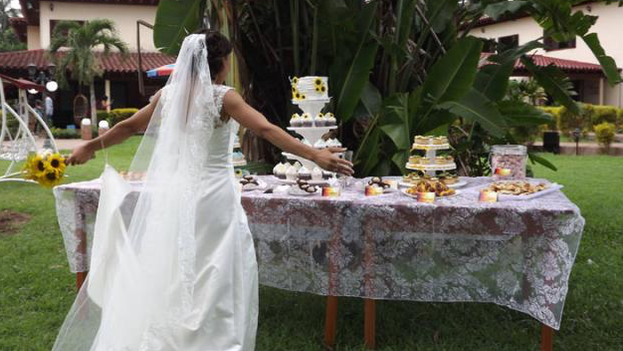
A bride looks at the multi-tiered cake designed for her wedding. (DC)

14ymedio bigger14ymedio, Lilianne Ruiz, Havana, 23 January 2016 — A cake in the shape of a camera, figures of the newlyweds modeled in sugar, or the Real Madrid team emblem are some of the offerings of a private company that arranges weddings and birthday parties. The company enjoys a growing number of customers in a society where the quality and height of the cakes has become a status symbol.

How many tiers will the cake have? The answer to this question demonstrates one’s economic solvency and widens the gap between those who can afford a pile of sugar and meringue, with fountains, LED lights and a layer of chocolate, and those who will have to make do with a sponge cake made at home with much ingenuity and few ingredients. continue reading

“For my son’s birthday I ordered a cake in the shape of a pool table,” said one 50-year-old lady who has become a faithful customer of Kirocake, a pastry making business that prides itself on making “art for the palate.” Located in the Miramar neighborhood, the small business also boasts of creating almost anything its customers ask for.

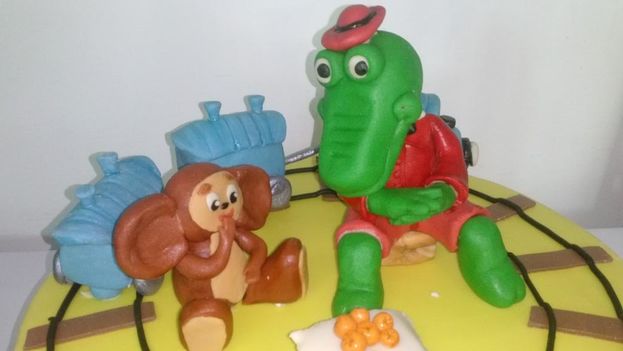
The orders are as varied as you can imagine. From the image of the little monkey Cheburaska for someone who grew up watching Russian cartoons, to the creation of Disney’s Tinker Bell for a little girl. As there are no limits on dreams, the small self-employed producers pick up the pace to anticipate the future. Some of them are already producing designs from the Star Wars or Minions movies.

At Kirocake the specialty is fondant, a sugar-based paste, and they offer their customers a tasting to choose the flavors for the filling and decorations. The confectioners also work in whipped cream, but it is considered unstable for cakes, which can measure up to four-and-a-half feet high.

“The fondant has a creamy milk texture and tastes like honey,” a Kirocake employee explained to 14ymedio while putting the final touches on a wedding cake. A classic cake for this kind of occasion, with sugar roses, for 80 guests and about 30 inches high, costs no less than 200 Cuban convertible pesos, the equivalent of eight months salary for a professional.

The producers of these sugary wonders generally have a food handler license and are subject to frequent inspections. “We have to have the receipts for all the ingredients,” says Richard, who runs a small company that arranges parties in San Miguel del Padron. But the man does not hide the fact that, “If we were guided by the law, we couldn’t even make a pancake.”

In the informal market there is a wide range of raw materials for pastry and baking products, such as eggs, flour and meringue dyes. Most of these products come from the diversion of resources from state agencies. “If we didn’t buy under the table, we would have to sell our cakes at prices where nobody would but them,” says Ricardo.

In March of last year, 19 employees from the Havana Base Business Unit for Collection and Distribution of Eggs and from the Provincial Trade Company were sentenced to prison terms ranging from 8 to 20 years for the theft of eight million eggs, with an economic impact of almost 9 million Cuban pesos, according to a report in the official press.

A few months later, in an inspection of 60 boxcars carried out by the Provincial Railway Company, it was determined that between September and October alone, over 100,000 pounds of flour disappeared while being transported by rail. A portion of this stolen merchandise is likely to end up in the cake of their dreams of countless brides and quinceañeras (girls celebrating their 15th birthdays).

Other ingredients, says Ricardo, such as “the most sophisticated, are imported by mules or people who travel abroad.” Examples of these delicacies include, “gold and silver edible sugar pearls, vanilla sugar, truffles and many of the accessories we use such as fountains, lights, Ferris wheels and carousels.”

Self-employed event organizers such as Megafiestas, D’eventos and Sentir Eventos, offer all-inclusive packages from the rental of the hall to the artistic invitations, including the décor, wedding clothes, stylists, photographers and classic car rentals, mostly convertibles. A wedding arranged in this way cannot be done for less than 3,000 CUC (about $3,300 US).

Not only do they specialize in wedding parties, quinceañeras, christenings and anniversaries, they can also arrange wedding showers and bachelor/bachelorette parties. Their business cards speak of “the discretion of their specialists” able to focus on “each customer’s uniqueness.”

Cake_CYMIMA20160122_0017_16
For those nostalgic for Russian cartoons, Kirocake designed this cake with the image of the little monkey known as Cheburashka.(Kirocake)

Having a party with a huge cake would be nothing without a hall decorated by professionals with flower arrangements or balloons, tablecloths, covers and bows on the chairs, fountains of champagne and chocolate. The wedding buffet has also emerged from the narrow framework of the cardboard box with cold salad, croquettes and party sandwiches.

“That went out of style,” says Mara, helping a friend prepare her wedding. The current buffet “contains shrimp, canapés, cheeses and smoked salmon.” The cake commissioned by Mara for her friend will have 14 layers on six tiers, constantly running colored fountains, mirrors, LED lights, and will cost 150 CUC. The new emerging class makes no excuses for falling into kitsch; what most matters is differentiating yourself from others.

Gabriela, 39, started saving money when her daughter was 10 years old: “I’m putting a convertible peso into the piggy bank whenever I can.” She, like most Cubans, lives day-to-day, but does not give up the dream of an elaborate celebration for her daughter’s 15th birthday. “I want to have an album of photos, and cake she can snack on with her friends,” says the woman. Her fear is that when the time comes she will have to make do with what the state offers.

When young women turn 15 they get a voucher for as subsidized cake at a conventional bakery. With this cake voucher, issued by the Basic Unit of the Food Industry, a person can get a birthday cake for 10 Cuban pesos (about 40¢ US), a quinceañera cake for 30 Cuban pesos, or a wedding cake for 40 Cuban pesos. This is vanilla sponge cake with a guava filling and merengue icing, without elaborate ornamentation and with a standard design.

Gabriela’s daughter has bigger ideas. “I want a cake with Beyoncé’s face” she warned her family. “And I want her music playing everywhere, Mommy.”

Ortega’s Wall Falls in Central America / 14ymedio, Carlos F. Chamorro

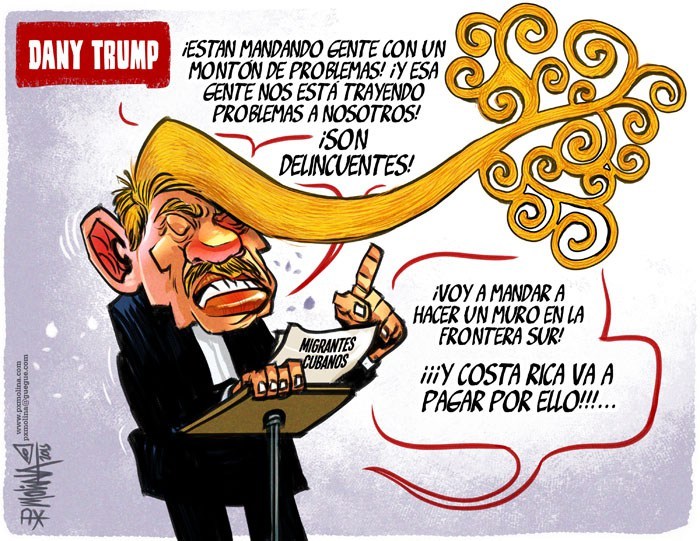
 'Confidential' cartoonist Pedro Molina immortalizes Commander Daniel Ortega in a cartoon titled 'Dany-Trump'. “They are sending people with a ton of problems! And these people are bringing problems to us! They are criminals! I am going to order a wall on the southern border! And Costa Rica is going to pay for it!!
‘Confidential’ cartoonist Pedro Molina immortalizes Commander Daniel Ortega in a cartoon titled ‘Dany-Trump’. “They are sending people with a ton of problems! And these people are bringing problems to us! They are criminals! I am going to order a wall on the southern border! And Costa Rica is going to pay for it!!

14ymedio bigger14ymedio, Carlos F. Chamorro, 22 January 2016 — The arrival of the first Cuban migrants to the United States, although they represent only a very small number compared to the more than 6,000 who are still stranded in Costa Rica, symbolizes the fall of the hated wall raised by President Daniel Ortega to block their way through Nicaragua. A wall built with the deployment of military troops, police and tear gas, citing reasons of “national security” to not grant Cubans temporary transit visas, although Ortega’s reasons failed to convince anyone in Nicaragua, nor in the member countries of the Central American Integration System (SICA).

The wall was knocked down by a diplomatic operation with the decisive participation of Mexico, which facilitated an agreement with Costa Rica and the northern countries of Central America – El Salvador, Guatemala, Honduras and Belize – and with the support of the International Organization for Migration (IOM), the approval of the United States and no objection from Cuba. A safe route has emerged to resolve an outstanding immigration problem, whose solution was always in the hands of SICA, but was boycotted by the arrogance of Commander Ortega. continue reading

Indeed, the underlying problem will not be resolved until the US Congress repeals the Cuban Adjustment Act and its policy of wet foot-dry foot, which gives Cubans a differentiated and unique treatment in the world with regards to migration. It is a law as anachronistic as the US embargo, in these times of normalization of diplomatic relations with Cuba and sooner or later its turn will come.

But it is one thing to demand the repeal of this law and quite another to orchestrate blackmail like that which Ortega imposed on SICA to keep his southern frontier closed. At the end of the day, the Cubans flew from the town of Liberia in Costa Rica to El Salvador, and from there made the trip to the United States through three countries.

Ortega’s wall raised the price of the journey, but cost the government of Nicaragua still more, leaving the Commander “out on a limb” and politically totally isolated in a region he is trying to lead against the United States on the issue of migration. In addition, Ortega dropped the mask of “Christian solidarity,” demonstrating to his neighbors and to international public opinion the existence of a demagogic discourse that only masks the authoritarian regime we suffer in Nicaragua.

At the root of this apparently irrational action by Nicaragua, there is a structural cause. With Ortega, a state foreign policy ruled by national interests ended. He substituted a conspiratorial strategy based exclusively on alignments with friends and enemies according to the Commander’s own interests. A conspiracy managed by a closed family circle, marked by a lack of transparency and public debate.

Thus, the canal concession was negotiated with the Chinese businessman Wang Jing, in detriment to the national interests, and in the same dynamic, in virtue of the alliance between Ortega and Putin, Nicaragua supports the independence of Abkhazia and South Ossetia.

And as we are also patronage partners with Venezuela’s Chavistas, Nicaragua denounced in international forums the “economic war” and “international plot” to overthrow President Maduro, while Ortega is profiting from private businesses sheltered under the diversion of millions in cooperation with the Venezuelan State.

On the issue of Cuban migrants, Ortega has taken advantage of an ideological alignment with Cuba to attack the United States. The paradox is that as long as the Cuban one-party regime occupies the center of his personal political ideology, the economic model does not represent a pattern to follow given its palpable failure and because the Commander, ultimately a Stalinist pragmatist, holds among the greatest amount of private capital in the country and is a partner in huge businesses.

In addition to his alignment with Cuba, the blockade of Cuban migrants has also affected Ortega’s political blindness leading him to perceive the democratic Government of Costa Rica as part of the enemy camp conspiring against him. A perception rooted in the cold war of the eighties, which, with the necessary collaborators on the part of Costa Rica, has prevented the two countries from maintaining a political dialogue over the last eight years.

Nicaragua being a country of emigrants – more than 20% of our population lives in the United States, Costa Rica and other countries – the absence of a permanent dialogue with Costa Rica is inexcusable and represents a mockery of the interests and rights of our fellow citizens who are working temporarily or permanently in that country.

For legal reasons, but also as a moral and human rights issue, Nicaragua should have a state policy to support legal and safe migration of our citizens to Costa Rica. However, Ortega has never designed a policy to support our migrants, and was even less prepared to accept the claim that Cuban migrants crossing through Nicaragua was not a political conspiracy, but a legitimate matter of migratory human rights.

Now we are facing the third consecutive failure of Ortega’s foreign policy over the past two months. The first was during the COP21 on climate change in Paris, where his government was one of the few in the world – forming a select club with North Korea – that opposed the global agreement, refusing to submit a proposal to reduce greenhouse gas emissions. A few days later, in The Hague, there was the ruling of the International Court of Justice condemning Nicaragua for violating the sovereignty of Costa Rican territory and even obliging it to negotiate compensation. The third is obviously the fiasco of Cuban migrants.

Common sense suggests that we should wait for a correction, but that will not happen until there is a democratic political change in Nicaragua. The worst of times, therefore, comes with the same lofty rhetoric of Ortega, fighting “battles” against his enemies. But at least we are left with the consolation that on matters of human rights, Ortega’s demagoguery has come to an end.

Confidential’s cartoonist, Pedro X. Molina, immortalized Commander Daniel Ortega in a cartoon entitled “Dany-Trump,” a fusion of both characters, in which Trump’s stuck-on blond tuft replenishes Ortega’s baldness like one of the metallic yellow “Trees of Life” installed by the First Lady of Managua, presenting us with a new symbol of the regime.

_________________________________________________________________

14ymedio Editor’s Note: This article has been previously published in the Nicaraguan online journal Confidential. It is reproduced with the permission of the author.

The ‘Oil-Houses’ Are Falling Apart / 14ymedio, Reinaldo Escobar

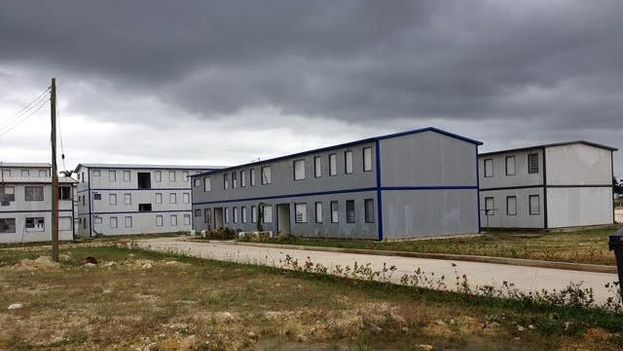
Dozens of people who lost their homes received one of these houses made of PVC, as the result of an agreement between Cuba and Venezuela. (14ymedio)

14ymedio bigger14ymedio, Reinaldo Escobar, Havana, 22 January 2016 – There are no colors. Only gray and white, with some ocher tones provided by the dry gardens, planted for opening day. In this hostile landscape in the Havana municipality of Cotorro, 19 buildings were made up of petrocasas (“oil-houses’). A dream of Fidel Castro and Hugo Chavez that is now falling to pieces far from the headlines and press photos.

Dozens of families who lost their homes due to building collapses, fires and hurricanes were happy when they were granted an apartment in the El Molino neighborhood, They were chosen to inhabit the “homes of the future” and leave behind the homeless shelters in Central Havana and Old Havana, where they’d been crammed in for 10 to 15 years. Their gratitude was incredible, but so were their expectations. continue reading

“We had nothing and this, at least, was a way to get out of that rattrap,” said Clare, one of those awarded an apartment in El Molina. She arrived at the shelter recently married and her children were born there. “It was very difficult to maintain a relationship as a couple in rooms where the neighbors on the other side of the partition heard everything,” she says.

Clara and her family lived for over a decade in an old motel that had been designed with rooms to be rented by the hour for lovemaking, and converted into a shelter for the homeless. “There we had the kitchen, the cradle for the children and our bed where up to six of us slept,” explains the woman, already retired.

Then hope interrupted her life. “They told us we were going to get a petrocasa and the truth is, to get out of there I would have gone to the moon,” she confesses. The day of the handover of the keys to the new apartments, Clara felt like it was her quinceañera, “I couldn’t stop crying and laughing from all the excitement.”

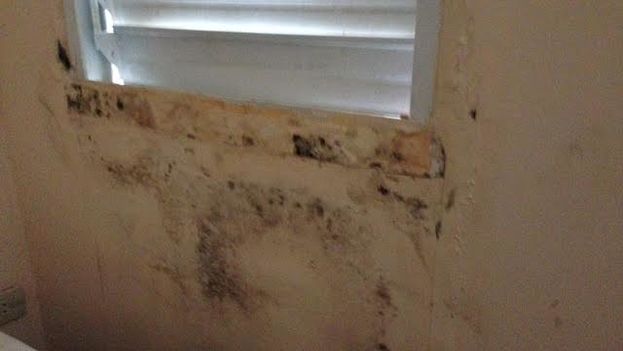
After the television cameras left and when the families were safely under their new roofs, the first thing they discovered was that they couldn’t hang a picture on those walls. Then they became aware of the vibrations caused by walking around upstairs, and in less than six months leaks began to appear.

In 2008 the petrocasas project manager, Julian Alonso, told the official press that “Cuba will produce more than 14,000 homes a year from polyvinyl chloride (PVC), thanks to a bi-national project with Venezuela.” However the figure was never reached and in 2015 the total number of homes planned for the whole country – of every kind of structure or construction method – was cut to 30,000, at least 17,000 of these to be built by people’s own efforts.

The panels to erect the petrocasas would be manufactured in a petrochemical complex that the late Venezuelan president promised to develop in the city of Cienfuegos. The work was not completed in its entirety and many of PVC panels that were used in Clara’s neighborhood were imported from other destinations such as Spain.

Poor construction quality has marked the settlement from day one: the windows began to fall out, the cement floors to crack, and there were short circuits in the electrical systems and leaks in the water pipes, several residents of the neighborhood told 14ymedio. On a bad day with high winds Clara’s top floor neighbor’s roof was about to fly away.

Rosa Helena, the mother of two children, slept in the living room to avoid the dampness in the bedroom. She complained that when the upstairs neighbor mopped the floor, the water started to drip on her furniture within a few minutes. “No one came to fix these problems, but we had barely arrived when they formed the Committee for the Defense of the Revolution,” she claims.

These problems were compounded by the area’s infrastructure. The woman tells how when she went to register “the boys in the elementary school they opened in the neighborhood, they told me it was full and we had to get up at six in the morning to get to the school where they accepted them.” She said her mother was visiting her one week and the first thing she said was, “Ah, sweetheart, you were better off in the shelter.”

The place could not be more inhospitable. The streets are unpaved and dampness gets into everything.

Carlos, considered a “social case” because of his serious health problems, complains that the Ephraim Mayor Polyclinic is too far away. Like the rest of the neighbors, he has to pay a monthly rent for the apartment granted. They haven’t even become owners of their petrocasas, but maintain the status of renters.

Inside one of the petrocasas

“In any event, I don’t even have a peso to eat, so I’m not going to pay anything,” he says. When asked if his house has the same defects as the others, he smiles sarcastically and says, “They explained to us that there was a one year warranty and that during that time the State would be responsible for any repairs. After one year, anything that breaks is charged to the tenant.”

However, the old man said that after he was there nine months, there was a short circuit that burned out the refrigerator. “Now I can only turn on the lightbulb in the bathroom and no one has responded to my complaints.”

Other neighbors who didn’t want to be identified said that in many houses from the very beginning there has been a lack of doorknob in the rooms along with other construction elements. They said that after the opening, buried near the houses were reserves of things that had been stolen, boxes of tiles, bags of cement, containers with silicon and bathroom fixtures.

The blame for these “diversions of resources” and the poor quality of the finishing is the responsibility of the ECOI 53 Industrial Works Construction Company, and the Julio Antonio Mella Brigade, that worked on this neighborhood of petrocasas. Many of the employees didn’t even stay on to finish the work because they were fired for bad work or stealing, as confirmed by a builder who was involved in the work.

Settlements of this type have also been raised in the San Agustin, San Miguel del Padron, Guanabacoa and Alberro neighborhoods. The neighbors have renamed the petrocasas “cardboard houses”.

An elderly lady who listened to the complaints of Carlos and Clara, says that she feels “happy” with her new home. “What happens is that there are many ungrateful people who do not recognize the efforts the Revolution has made to give us these houses.” There is a long pause and she concludes: “Perhaps we deserved something better than this?”

Price War in Havana / 14ymedio, Zunilda Mara

TV is blaming intermediaries as primarily responsible for the rise in food prices (14ymedio)

14ymedio bigger14ymedio, Zunilda Mata, Havana, 21 January 2016 – The imposition of price controls in some markets in Havana has provoked contradictory reactions in the population. Although it has been a relief to consumers’ pockets in the midst of the rising cost of living, the measure has been accompanied by an unwelcome raid on the cart vendors who sell agricultural products in the capital’s neighborhoods.

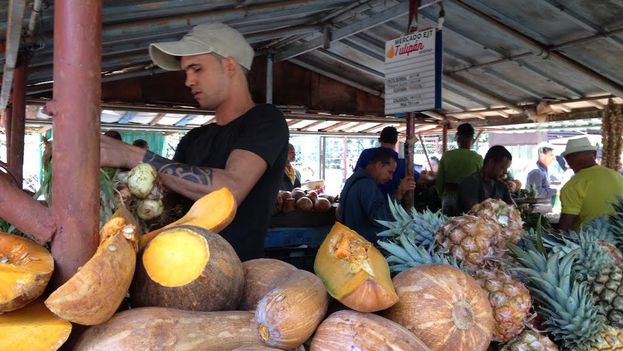
On Tuesday, the Youth Labor Army (EJT) market on Tulipan Street in the Nuevo Vedado neighborhood dawned with a singular hustle. After more than two weeks of empty stalls and worried consumers, a dozen products went on sale with controlled prices. continue reading

The measure was expected after an experiment that started earlier this month in Artemisa province, with the sale of agricultural products at “a maximum fixed value” by the Provincial Administrative Council.

In Havana, the controlled prices have not been extended to the majority of markets managed by the state farms and cooperatives. “This market has been one of the first to test the experiment,” said a vendor at the market administered by officials of the EJT.

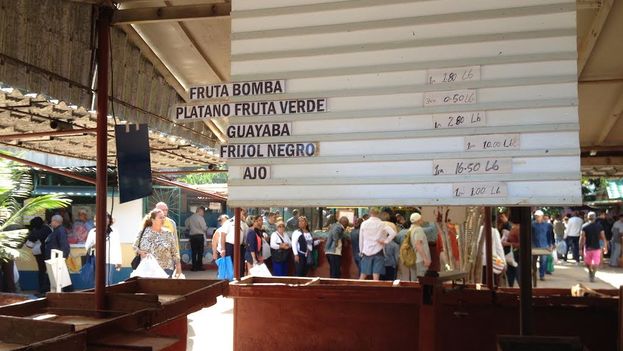
The young man, whose stall was selling pineapples, yucca and other products, seemed apologetic at having to charge a customer 2.80 Cuban pesos (CUP) for a pound of guavas. The same quantity of product hadn’t dropped below 20 CUP at the end of last year. “This can’t last long, because eight guavas for six pesos can’t be maintained,” the employee complained.

A very different picture was developing in the central market of Egido, managed by private sellers and intermediaries. Since the beginning of the week a pound of red beans has held steady at 16 CUP and pork hasn’t fallen below 50 CUP for months. Despite the high prices, the quality of the merchandise attracted dozens of buyers on Tuesday.

“We’ll see how long they keep it up,” comments Gerardo, a truckdriver who brings goods from private farms in Alquizar to the well-known market. “Since the beginning of the year they’re making our lives hell on the highway,” he says, referring to the escalation of police controls on all the trucks carrying farm products and trying to enter the capital.

“Now we even have to show proof that we bought the fuel legally,” complains Gerardo, who says “with these decisions prices are going to shoot up.”

Next to him, a customer was shocked by taro at 15 CUP a pound, threatening to leave “for the EJT” but ending up buying it there. “A ride from Boyeros and Tulipan costs me 10 CUP. What I’ll save on one thing I’ll spend on another. Anyway, the quality isn’t the same, here it is always better because ‘the master’s eye fattens the horse’,” she concludes.

Television has accompanied the price controls with reports blaming intermediaries for the rise in prices. An appeal recently published by the National Union of Agricultural and Forestry Workers called for the total elimination of intermediaries saying that this would “contribute to a lowering of prices.”

Havana residents are in the midst of a silent price war between the State and private vendors which has almost completely eliminated from the urban landscape an element they has already become common: vendors with rolling carts. These improvised “kiosks with wheels” bring access to agricultural markets to distant places and offer their goods house-to-house.

The Youth Labor Army market in Tulipan Street, Havana. (14ymedio)

Julia, who lives at Espada and San Lazaro Streets, says she is willing to pay “when I see a cart in the street.” With a bedriddem mother, she comments that she doesn’t have “the time or money to go a long way to buy food.”

Tato, one of the cart vendors who for years has sold near the park at Infanta and San Lazaro, was sitting on a wall this Tuesday with his legendary cart. “The inspectors they send take everything, the police won’t let us live anymore,” he says. He says the suppliers have had their goods confiscated on the roads entering the city.

The old man is convinced that what is happening now has been ordered by Raul Castro. “But let’s see how long the joke of controlled prices lasts,” he says.

Meanwhile, a young employee at the EJT market cajoled a girl looking undecidedly at pineapples. “Buy them now, my girl, you don’t know when they’ll run out. It’s the right gift for Epiphany, just a little late.”

Parasitic Cuba / 14ymedio, Beatriz de Majo

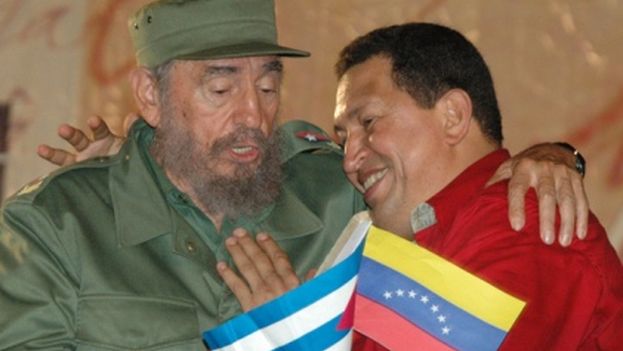
The Cuban president Fidel Castro and the late Venezuelan President Hugo Chavez, Cuba signed the Convention on Cooperation Venezuela in 2000. (Embassy of Cuba in Venezuela)

14ymedio bigger14ymedio, also , Caracas, 7 January 2016 — With the fallacy of development of a “mutually advantageous” cooperation that Raul Castro is still talking about, while his country comes apart at high speed, Communist Cuba got our revolutionary leaders to support the project that consists of awarding the Caribbean regime a network of subsidies of every kind that serve nothing more than to provide oxygen to the continental leaders in repression and totalitarianism. Cuba never had the intention, throughout the years of Chavismo, of using the facilities provided by its generous ally to strengthen its economy, much less to provide a solid foundation for development for the years to come.

On the contrary, this regimen of benefits is what has served to starve the population, to make the island economy dependent on the Venezuelan perks and, in recent years, to flirt with the Obama administration in order to prevent, through a rapprochement, the disaster that is already flagrantly on display. continue reading

Raul Castro just announced dramatic performance numbers for the current economy and hypocritically attributed 2015’s sagging GDP to the international crisis, the slowdown in international consumption – also to blame for the lower sugar exports – and, finally, for the problems of its great benefactor, the revolutionary Venezuelan regime that is a victim of the empire’s economic war led by Cuba’s new ally, the American government.

The reality is that without Venezuela Cuba would not have survived and Cubans would have known hours of unimaginable hardship, as they will face in the months ahead. The Caribbean brothers are at present in a situation similar to what they already had go through when they were forced to do without the special relationship also offered to them by the Soviet Union.

There has been no revision of the hunger-inducing model that Cuba has embraced for half a century and that managed to replicate metastatically on revolutionary ground. While the perverse and unequal relationship with Venezuela was lubricated, they never used the funds to implement a model that could come to the rescue of the new generations. The panorama is getting frightening. Those who study it assure us that in coming years the reduction in annual growth will be on the order of 4% to 7%.

The Cuban situation is dramatic now that they won’t be able to count on Venezuela and have no other saviors to rescue them. Some 45% of Cuban exports went to Venezuela through exotic forms and corrupt arrangements. Most of the foreign exchange earnings and energy came from Venezuelan soil.

A recapitulation is possible but it’s late for Cuba. Venezuela, which is in a similar situation having squandered the oil boom years when it could have organized a strong and healthy economy, is confronting an immensely complicated situation. But while it still has the ammunition to reinvent itself, Cuba has none left.

Ordinary Cubans have understood all this and the migration north has been increased by lack of confidence in the future and boredom, like that faced by Venezuelans today. Today there is no lifeline. China openly looks the other way, and while the relationship with the United States hasn’t hardened, foreign capital will not risk getting to close to the Caribbean beaches.

There is no possible retreat that isn’t ordered internally, which means accepting this resounding failure that has cost them their blood and tears.

* Editorial Note: Beatriz de Majo is a columnist for the Venezuelan newspaper El Nacional.


The Puzzle Of Housing In Cuba / 14ymedio, Orlando Palma

Construction of Housing. (DC)

14ymedio bigger14ymedio, Orlando Palma, Havana, 7 January 2016 — A year after the elimination of the National Housing Institute, the irregularities that led to dissolving that powerful government agency continue. Excessive paperwork and delays are an annoyance to the population that has barely seen any benefits from transferring its functions to other state agencies.

On 5 January 2015 Decree Law 322 took effect, ending the decades-long reign of the National Housing Institute. Since then, the Ministry of Construction assumed the power to govern the housing policy of the country, while other functions were given to the Institute of Physical Planning (IPF), the courts and the Ministry of Labor and Social Security.

During the last twelve months, 200,000 complaints have been received about procedures related to housing. This figure exceeds the documented dissatisfaction against the agency that previously dealt with these issues, as reported during last December’s session of the National Assembly. continue reading

Diana Rosa Suarez, legal director of the IPF, told the official media that there are delays in the procedures, mainly those related to technical advice and planning regulations, although there are also delays in materials and shortages of personnel, especially qualified people.

The official defended her organization, saying that the current document that certifies housing as “inhabitable” – for newly constructed or repaired homes – now includes more data than before. Among these are measures of the property and its boundaries and even the house number that is going to be attached to the façade.

However, the arguments of the IPF representatives don’t appease the critics. Caridad Rodriguez, a resident of the Regla district in Havana, believes that “things may have changed up there, but down here they continue as before.” The retiree says that asking for the services of the community architect is supposed to take two weeks, but you have to wait four months.

“To sell my house I had to get it on the property registry,” the lady explains, “so I needed a specialist to confirm that the property boundaries coincide with those on the paperwork. After getting the opinion of the architect, I had to wait 45 days for the registry office to give me a certified deed to the property. Now, I’m looking for a new buyer for the property because the previous one was in hurry and withdrew his offer.”

In Villa Clara province, 70% of the comments from citizens in last year’s Accountability Assemblies referred to problems in legalizing titles to land and housing or access to subsidies, as reported at the parliamentary meeting in the Palace of Conventions. The same thing happened in the provinces of Las Tunas, Granma and Sancti Spiritus.

The Institute of Physical Planning, led by General Samuel Rodiles Planas, is also increasingly unpopular. Many see this institution more as a brake than an accelerator on the initiatives of people to construct housing by their own efforts.

In an effort to combat the urban illegalities and violations, there has been a proliferation os demolitions of housing or additions that have been used for decades to expand living space.

In the Alamar neighborhood, Vladimir Pacheco, who lives in a two-room apartment on the ground floor of a five-story building, built two bedrooms attached to his home, as he interpreted it a no man’s land. “I came here with my wife and two sons in 1976,” he told this newspaper.

“In the eighties my daughter was born and by 2004 we were nine people counting my four grandchildren,” he adds. The man decided to extend his unit on land at the base of his apartment. In July of last year, inspectors from the Institute of Physical Planning announced that they would demolish the construction. “My two sons say that if they tear down the rooms they’ll launch themselves on the sea,” says the worried homeowner.

A notary in the Havana municipality of Playa, a lawyer who asked not to be identified, told 14ymedio that now it must be recognized that the procedures have become more complex. “The day that in this country we can build all the houses that people need, we are going to have to change all the mechanisms that exist today,” he says and confesses that “otherwise they will have to import notaries from elsewhere.”

The real challenge of housing policy goes beyond illegalities and corruption, beyond urban violations or determination of boundaries. The lawyer says, “The problem is much more complicated than shortening the lines or the waiting time for a document, and at the same time it is as simple as placing one brick on top of another.”

The Piñero Group Will Not Invest As Long As Cuba Is “Not A Free Country” / 14ymedio

Pablo-Pinero-presidente-Caribe-Flickr_CYMIMA20160121_0003_16
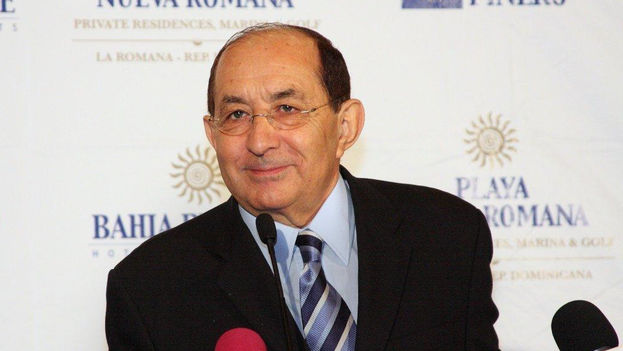
Pablo Piñero is president of the hotel group that bears his name and has reaped great success in the Caribbean. (Flickr)

14ymedio bigger14ymedio, Madrid, 21 January 2016 — The Spaniard Pablo Piñero, president of the Piñero Group hotel chain, insisted Wednesday in Madrid that he refuses to do business in Cuba as long as the government prevents him from owning the properties of his hotels, according to a report in Diario de Mallorca this Thursday.

“Our hotels are all ours. I will go to Cuba when I can own the hotel, hire my own people. And I can’t do this today, I will not go as long as it is not a free country,” said Piñero, whose hotel establishments extend successfully across the Caribbean. “There are many places to invest in outside of Cuba. I’m betting on the Dominican Republic and the benefits come quickly. And the same in Mexico, Jamaica, Aruba,” he said. continue reading

It is not the first time that Piñero publically expressed his position with respect to investing on the island, especially since the normalization of relations with the United States and the new Foreign Investment Law set off a furor of interest among the international tourism industry about investing in Cuba.

In January of 2015, during the celebration of the International Tourism Fair, held in Spain, Pablo Piñero stated his position with a blunt, “I will return to Cuba when I can buy.”

A company that doesn’t see so many drawbacks to betting heavily on the island and that is taking advantage of the situation is the Globalia Group, owner of the Air Europa airlines, and present in Cuba for over 20 years. The company said that it expected by mid-2016 to have authorization to operate between Miami and Havana.

“We already have the route to Miami, New York and Santo Domingo, so we are well positioned. In Miami we have a tour operator we want to promote, and of course we want to have flights between Miami and Havana,” said Juan Jose Hidalgo, president of Globalia.

Hidalgo also announced that Be Live, the group’s hotel chain, has hired a third hotel in Cuba and continues to fight for two major projects, one of them on the Malecon in Havana. “There will be more and more opportunities in Cuba. To see if they step on the accelerator because things there move slowly, and I like to move so fast it’s hard for me, but that’s the way it is,” he said.

The Ladies In White Denounce A New Act Of Repudiation Against The Headquarters Of The Movement / 14ymedio

Act of repudiation in front of the headquarters of the Ladies in White in Havana, Thursday. (Angel Moya)

14ymedio bigger14ymedio, Havana, 21 January 2016 — A new act of repudiation against the Ladies in White is developing right now outside the headquarters of the movement in the Havana neighborhood of Lawton. Since this morning the activists reported civilian groups with flags, loudspeakers and a projection screen that had been summoned to the street that leads to the house, according to the government opponent Martha Beatriz Roque.

At least five Ladies in White were arrested before reaching the site, where there are 43 women celebrating their traditional literary tea. On a “big screen” in front of the house, are projected “words of Berta Soler and images of activities” undertaken by the leader of the movement in travel to other countries.

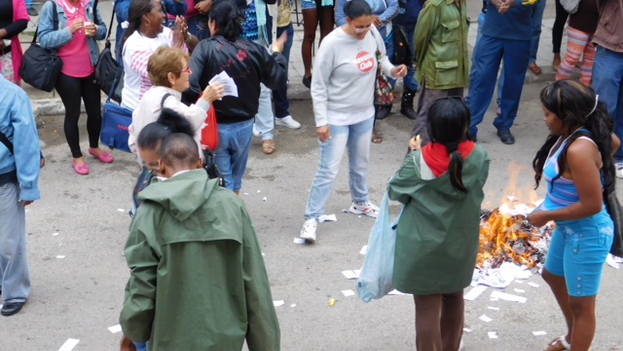
A witness at the scene told 14ymedio by telephone that repudiation groups were burning “leaflets and books” in garbage cans. According to nearby residents, who requested anonymity, the pamphlets were the Universal Declaration of Human Rights, information that could not be confirmed by another source.

From the site of the group’s headquarters the activists threw leaflets and balloons with messages.