Rafael Alcides Close Up / 14ymedio, Luz Escobar

14ymedio bigger14ymedio, Luz Escobar, Havana, 6 June 2016 — Cuban filmmaker Miguel Coyula participated in the New Media Film Festival of Los Angeles with the seventh chapter of his series Rafael Alcides. The short film was part of a more than two-hour interview with with the well-known poet and writer, addressing topics such as art, beauty and Cuba past and present.

Filmed in Havana, with a minimalist presentation, in this seventh installment the actress Lynn Cruz recites the poem The Stranger, which gives its title to the chapter, in a moving and unadorned interpretation that salvages the lyrical work of an author now silenced in Cuba’s official catalogs and anthologies. continue reading

In the previous installments of the series, Alcides reflects on the relationship between intellectuals and power, the figure of Fidel Castro and the role played by the Cuban people in several events of the last 150 years.

The Stranger is competing in the Web Series category, along with submissions from 37 countries, including Brazil, Colombia, Mexico, France, Germany, Spain, Russia and Vietnam. The festival will take place June 7-9 at Landmark Theatres in Los Angeles and the short, just over two minutes long, is being presented as a world premiere.

The showing in Los Angeles will constitute the premiere of an official exhibition of the series directed, edited and designed by Miguel Coyula, who is also in charge of photography. However, the film has been available for weeks on the filmmaker’s Youtube channel.

During the last Young Filmmakers Exhibition, Coyula was invited to participate in the panel Routes and Routes, Cuban Cinema of the Diaspora in the 21st Century, organized by the researched Zaira Zarza. This panel debated the peculiarities of the diaspora and the formulas to keep alive contacts between “those who leave” and their audience on the island.

In his presentation, Coyula formally introduced the sixth chapter of the series dedicated to Alcides, under the title Capitalism. The filmmaker maintains in these recent creations his particular style of independent and artisanal production, relaying on clean and simple visual effects that build to a striking finale, with his pinpoint accuracy in mixing music, voice and image.

Coyula’s debut in feature films was Red Cockroaches and among his most outstanding productions is Memories of Overdevelopment, which was chosen in 2010 as the Best Cuban Film of that year by the International Film Guide. After several years living in the United States, the filmmaker has returned to live in Havana, where he is filming his third feature film: Blue Heart.

See also:
“I want more movies and fewer laws” / 14ymedio, Luz Escobar

Miguel Coyula: All Movies All The Time / Regina Coyula

Resignation Over Censorship / Miguel Coyula

Independent Cinema, Dependent Cinema / Miguel Coyula


Oscar Biscet Fights For “The Disintegration of the Dictatorship of the Castros” / 14ymedio, Mario Penton

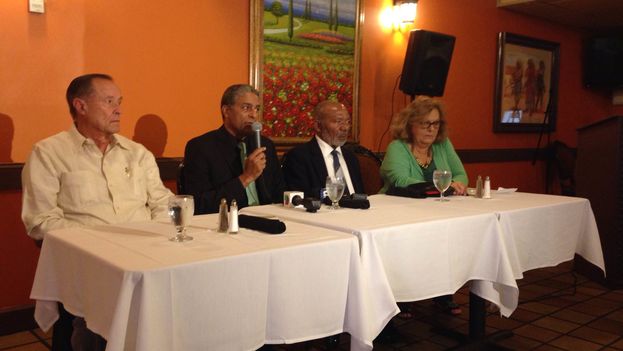
Dr. Oscar Biscet Cuba after his press conference (14ymedio)

14ymedio bigger14ymedio, Mario Penton, Miami, 4 June 2016 — On his first trip to the United States, former political prisoner Oscar Elias Biscet has shown once again that he doesn’t mince words: he has criticized President Barack Obama’s visit to Cuba, he has spoken in favor of repealing the Cuban Adjustment Act, and he has raised the possibility of a military coup on the island.

A doctor by profession, Biscet is backed by the Lawton Foundation, the National Democratic Party and the New Union for a Free Cuba Foundation. He presented the Emilia Project at a press conference this Saturday; the project is named in honor of Emilia Teurbe Toulon, who in the mid 19th-century first sewed the first Cuban flag. According to Biscet his initiative is a “project of freedom” that seeks “the disintegration of the dictatorship of the Castros.” continue reading

Biscet was sentenced to 25 years in prison for presenting research that denounced the abortion practices of the Cuban health system, but was released in 2011 and decided to stay on the island. Recently, the Cuban government allowed him to travel abroad “only once,” and the regime opponent is in the midst of a tour that has taken him to Spain and the United States. He has expressed fears for his life on his return to Cuba.

“The Emilia project declares that the Communist Constitution and the organs of state power are unconstitutional,” said the Biscet, arguing that the 1940 Constitution had been violated by Fidel Castro in 1959 with the arbitrary application of capital punishment. “In the first month they shot 900 people, 400 of whom were people who had nothing to do with the previous regime, simply because they dared to dissent,” he said.

The Emilia project has been signed by more than 3,000 Cubans with their names and identity card numbers. In it he demands that “the legal system of our country has as its base the democratic principles that prevail in other nations of the civilized world.”

Biscet argues that his movement is based on the 1940 Constitution which, since its amendment in 1976, has been an “eyesore” imposed by the Cuban government against the will of its own people.

Dr. Oscar Biscet from Cuba presented The Emilia Project in Miami

With regards to relations between the US and Cuba, Biscet believes that the steps taken by the current administration, including President Barack Obama’s visit to the island, “complicate the fight against the dictatorship.”

“It is a mistake to support a dictatorship that is falling. Free governments should demand freedom for Cuba,” said Biscet. “Emilia activists want to strengthen the people in their idea of achieving freedom, strengthening non-governmental organizations, seeking a multitude willing to end the dictatorship and execute a strategic plan to end this.”

According to the leader of the Emilia Project, there are several possible scenarios: that a group of “worthy” soldiers would put an end the regime (he would support this option), or that the son of Raul Castro, Alejandro Castro Espin, succeeds his father, or that there is a evolution towards a “softer dictatorship” in the style of the former Yugoslavia of Milosevic.

“Our purpose is to make a change from the base to the superstructure, a national insurrection,” said Biscet, who pointed out however the peaceful nature of his movement said. “There are many people who have hatred but we want justice to prevail.”

According to Biscet, the Cuban government has always lived on foreign aid, first from the Soviets and now Venezuela. “The Venezuelan people are starving like the Cuban people, not only materially starving but hungering for freedom,” he added. “Socialism has caused chaos and failure wherever it has been implemented, we knew that Venezuela would end like this.”

On the current immigration crisis the former political prisoner believes that “it is a human right to emigrate,” but regrets that the Cuban Adjustment Act allows people to continue leaving the island and then return in a year and a day “to speculate.” He said, “I agree with what Marco Rubio and Congressman Curbelo are doing; asylum must be for those who deserve it, the rest should stay in Cuba to fight.”

For Biscet “you can not enjoy a foreign freedom, with the resources of another country.”

Environmental Activist Detained And Interrogated In Najasa, Camagüey / 14ymedio

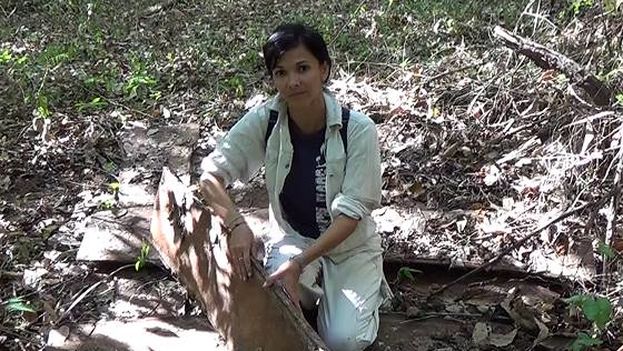
Environmental activist Inalkis Rodríguez (Courtesy)

14ymedio bigger14ymedio, 5 June 2016 — Environmental activist Inalkis Rodriguez was detained and interrogated on Friday after posting on her Facebook account criticisms of the delay in the construction of a polyclinic in Najasa, Camagüey. Rodriguez, a 14ymedio collaborator, reported that the police erased all the photos from her digital camera and threatened her to not to continue with her work.

Rodriguez posted on social networks a text accompanied by several photographs in which she reported that after 15 years of beginning the project, the local polyclinic still was not open and working. Following the publication of her criticism, the president of the government in Najasa, Kenia Marrero, said that the project would be inaugurated within a short period of time, a promise that has not yet been fulfilled. continue reading

At the time of arrest, Rodriguez was taking new pictures on the unfinished work and was intercepted by the official Miguel Fal, who took her to the Najasa police station. Once she was detained, the officers erased all the photos on her camera’s memory.

Before releasing her, the police insisted that Rodriguez sign warning notice that the activist refused to initial. They also questioned her about doing the work of a journalist without having a degree in journalism, an observation Rodriguez responded to by saying that her profession was “veterinarian” but reaffirming her right to criticize because she considers herself a “free” person.

Rodriguez has reported in recent years on the environmental damage suffered in the Camagüey area, particularly deforestation in the Sierra de Cubitas. Many of her texts, published on the Origins blog of this newspaper, denounce the involvement of forest wardens and government officials in the plunder of forest resources and wildlife in the region.

Tiananmen Square, Shared Silence / 14ymedio, Yoani Sanchez

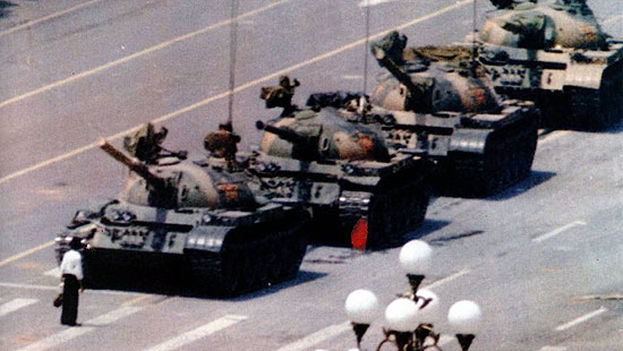
Tiananmen Square in China was the scene of protests calling for more openness in 1989

14ymedio bigger14ymedio, Yoani Sanchez, Havana, 4 June 2016 – Havana’s Plaza of the Revolution shows its loyalty to its friends in many ways. One of them is complicit silence. When the Tlateloico Massacre happened in 1968, Fidel Castro did not condemn it because his ally, the Institutional Revolutionary Party, ruled Mexico at the time. Something similar happened with the events in Tiananmen Square in China, still absent to this day in Cuba’s official press and discourse.

It has been 27 years since thousands of students demonstrating peacefully in Beijing to demand democratic reforms were forcibly evicted from the square. The turning point of these protests was on June 4, when the army cracked down violently to those gathered at the square, leaving hundreds dead and thousands injured. This coming October, the last known prisoner of those who were arrested during those riots, Miao Deshun, is expected to be released. continue reading

Along with the more than one thousand detainees who were sentenced to harsh penalties for showing their desire for change, China sent many other protesters to forced labor camps to be re-educated. Since then, significant resources and millions of hours of propaganda have been dumped on society, to suppress the idea of rebellion and stifle memories.

Recently, several activists who were trying to evoke the date have been detained by the government or prevented from leaving their homes to pay tribute to the victims. The gag-rule extends to virtual space, where China’s internet police have skillfully managed to erase many of the references to the events of Tiananmen Square.

However, despite the fact that in June 1989 the foreign press had been expelled from the area and the government restricted coverage of events, an iconic image was imprinted on the retina of humanity. A defenseless man with a bag, standing in front of a military tank, showed the absolute fragility of citizens under a totalitarian power.

That picture has never been reproduced in any Cuban media managed by the Communist Party. Thus the island’s authorities have joined in the attempt to erase history, vigorously led by their Chinese comrades. They are complicit in the attempt to create a hole in the past.

Today, along with China’s booming economy and environmental problems, there is a country where it is not permitted to speak publicly about its history. A nation that has been offered an unequal economic well-being in exchange for its conscience, but where, also, many have not accepted the deal. They are the ones who remeber that young man who was going to the market when his luck changed forever.

In the case of Cuba, the effort to force amnesia does not begin and end with the tragedy that took place in that vast and distant square. Cuba’s official media once hid from us the fall of the Berlin Wall, denied the Chernobyl accident for weeks, and “made itself scarce” in the face of Nicolae Ceausescu’s crimes.

The loyalty of the Plaza of the Revolution toward its ideological comrades includes the ignoble task of accompanying them in altering the figures, hiding the news, and burying the dead in silence.

Raul Castro, Continent’s Oldest Ruler, Turns 85 / 14ymedio

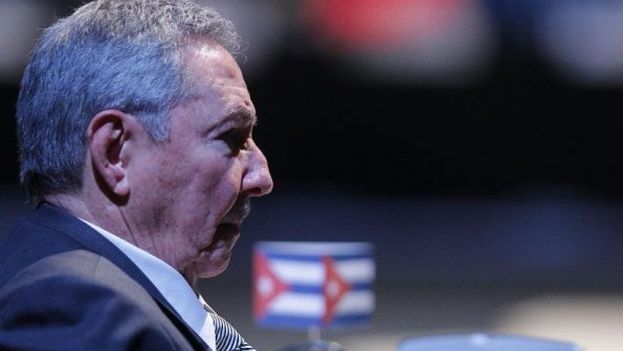
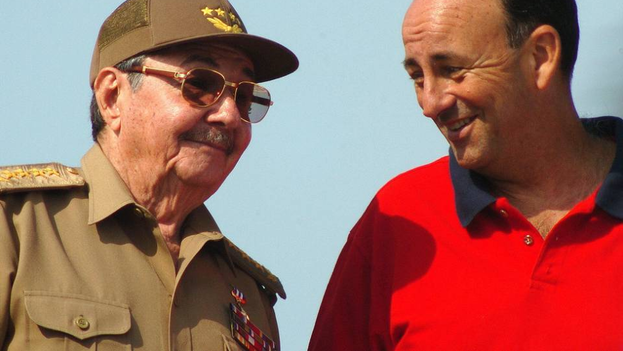
Raul Castro, president of Cuba and first secretary of the Communist Party, was born in 1931. (EFE)

14ymedio bigger14ymedio, 3 June 2016 — Raul Castro will celebrate his 85th birthday on Friday without anyone overshadowing him as the oldest president across the entire continent. Jose Mujica, who left the presidency of Uruguay shortly before turning 80, has been the only one able to come close to the Cuban president and various Peruvian media have highlighted recently the possibility of Pedro Pablo Kuczynski’s election as president in Sunday’s elections; at 77 he would become the oldest-ever president of that country. Unlike Cuba’s general-president, these other two were elected in democratic and multiparty systems. continue reading

Raul Castro would not be a rara avis in Africa or Asia, continents where the preponderance of absolute monarchies and dictatorships allows heads of state to reach surprising ages. This is the case of Robert Mugabe, president of Zimbabwe who, at 92, remains in office. This patriarch of the international leaders came to power in 1987, when he was considered an anti-colonial hero who made an essential contribution to the independence of his country (in 1980) and was elevated first as prime minister and then as president. Over the years, accusations of clinging to power through electoral fraud and repression against his opponents (he is accused of genocide) have undermined the credibility of this old man who is the sole ruler in the world over 90.

He is followed at a short distance by a group of leaders who are tied at 88-years-old Among these is Kim Yong-Nam, chief of state for North Korea since 1998, with the job of president of the Supreme People’s Assembly, although in his case the leadership is relative, considering the Supreme Leader, Kim Yong-un. Also in this group are two kings of Asian countries with very different paths. Bhumibol Adulyadej has been the king of Thailand since 1946. His reign, which has lasted 69 years, is the longest in all of history and the world. However Abdul Halim Mu’adzam Shah, king of Malaysia only since 2011, acceded to office at a staggering 84 years of age and is now 88.

Only one head of state in the Western Hemisphere is older than Raul Castro, Queen Elizabeth II who turned 90 in April. The Queen of England is a figure with notable constitutional and religious powers (she is head of the Anglican Church), and also serves as a symbol of cohesion of the United Kingdom and is an international ambassador for her country. However, national and international politics are governed by Parliament and the elected Government, leaving, in practice, symbolic functions for the Crown.

Except for the striking case of Mugabe, being in the 90s puts an end, one way or another, to the desire for leadership. Simon Peres, twice prime minister and president of the State of Israel from 2007 to 2014, left office when he was a month short of 91. Something similar happened with Giorgio Napolitano, president of Italy who left the post in 2015 just short of 90, after nine years as head of state and for health reasons. Other long mandates that came to an end only by the relentlessness of biology were that of President of Ethiopia, Girma Wolde-Giorgis, who died in office at age 91, and King Abdullah of Saudi Arabia, who died at 90, in January 2015.

Leaders of Cubans in Colombia Deported / 14ymedio, Mario Penton

Nelson-Maidelin-Hernandez-Colombia-Ecuador_CYMIMA20160531_0028_16
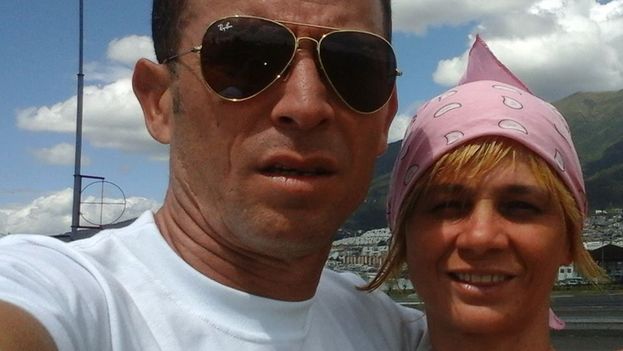
Nelson March and his wife, Maidelin Hernandez, who documented the situation of Cubans in Turbo (Colombia) were deported to Ecuador on Tuesday. (14ymedio)

14ymedio bigger14ymedio, Mario Penton, Miami, 31 May 2016 – Colombian immigration officials arrested Maidelin Hernandez and her husband, Nelson March on Monday night; the couple documented the daily situation of hundreds of Cubans who are stranded in a shelter in the Colombian city of Turbo.

The couple was reportedly deported to Ecuador, according to William Gonzalez de la Hoz, Ombudsman, despite the fact that Hernandez has cancer and wants to reach the United States so that his family can pay for treatment.

“This is a sign. Slowly they continue to deport small groups so as not to cause a scandal,” said a Colombian official who requested anonymity. continue reading

Turbo’s mayor, Alejandro Abuchar, confirmed that the Cubans had been arrested, but the mayor says he has no tied to the Colombian immigration authorities. “We continue making every effort for migrants, trying to ensure that their rights as human beings are respected,” said the mayor.

The deportation of this couple happens after last Sunday’s repatriation to to Cuba of an undocumented immigrant couple, who were arrested near Medellin.

“That was very unjust, we are all in the shelter or homes, according to what each person is able to pay, but we thought they would make a collective decision. Now we see that is not the case,” said Aylin Gari Cruz, an activist in the Republican Party Cuba currently in Turbo.

The process of detention occurred when the couple left the hostel where more than a hundred Cubans are sleeping in this Caribbean city. According to statements by the Hernandez himself, he was brought down by an official of Colombia Migration while trying to find medication to alleviate the pain of his illness. After a quick scuffle, they were arrested and forbidden to communicate with family and friends, and one of their cell phones was confiscated.

Hernandez managed to hide his cellphone in his underwear and from the immigration office sent brief messages to the press on the situation they found themselves in.

In documents shared with this newspaper by Turbo’s Municipal Ombudsman Office, the migrants refused to give their names and, on being considered “undocumented,” the deportation process began.

When Will the Government of Cuba Have Normal Relations With the Cuban People? / 14ymedio, Henry Constantin


14ymedio bigger14ymedio, Henry Constantin, New York, 31 May 2016 — This video is mute. Like Josefina Vidal, an official from Cuba’s Ministry of Foreign Relations (MINREX), and José Ramón Cabañas, Cuba’s ambassador to the United States, when I asked them questions that they did not expect, after their lecture on “normalization” at the Latin American Studies Association (LASA) held in New York a few days ago:

  • Most Cubans believe that the real blockade is what “those up above” in Cuba maintain against the initiatives of the rest of us.
  • The normalization between Cuba and the United States is well advanced: Cubans receive with joy both the United States president as well as the simple tourist from the north. And they have privileged status when they arrive on the northern soil.
  • We Cubans want not only tourism or entertainment from the United States, but also to be its counterpart in politics, business, media, academics…
  • The biggest obstacle to normalization is that put in place by the Cuban government.
  • This occurs because the Cuban government does not have normal relations with its own people, neither asks nor listens to them, on this or any other subject.
  • And, finally: When will Government of Cuba have normal relations with the Cuban people?

They did not respond. They don’t know how. The “abnormal” is in effect.

At the end of the video I am standing against the conference room wall but content, because it is they who will be against the wall of the future, the day that more Cubans are encouraged to question them. And demand from them.

Villa Clara Sugar Harvest Will Be Much Less Than In 2015 / 14ymedio, Jose Gabriel Barrenechea

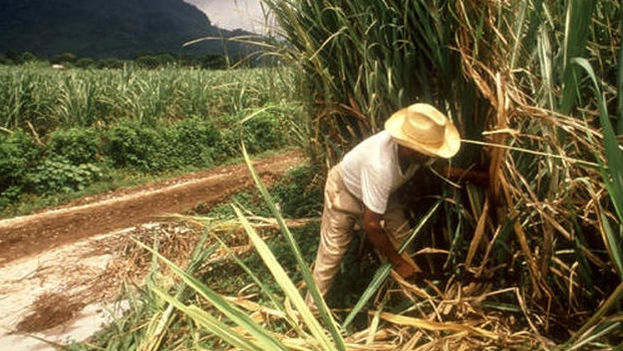
The sugar harvest in Villa Clara will not reach 2016 levels (CC)

14ymedio bigger14ymedio, Jose Gabriel Barrenchea, Santa Clara, 29 May 2016 — With the shutdown of seven of its nine active sites, the 2016 sugar harvest is nearly complete in Villa Clara. It has emerged that the province that currently produces the most sugar in the country has fallen far short of the 250,000 metric tons programmed: as of last Thursday only 180,000 metric tons have been produced, well below the previous harvest.

Only two centers are still milling, Hector Rodriguez of Sagua la Grande, and Panchito of Quemado de Guines. With expected quantities of 36,200 and 39,700 metric tons, respectively, only these plants now have a chance, however remote, of meeting their planned targets. It is very unlikely that the province will reach the 190,000 metric tons proposed by the first secretary of the Communist Party in the region and, in any case, that result would only represent a fulfillment of 76% of its sugar plan. continue reading

Among the causes of this marked decline are the late delivery of the assurances needed to start up the plants, but especially the very low agricultural yields and scant maturity of the reeds. This latter, by the way, is a result of last season’s cutting ahead of time much of the cane that would have reached its full development only this year, as a result of last year’s government stubbornness to meet that year’s plans, whatever it took.

The cane cutters are saying that this year they have cut fields that are yielding less than 30,000 arrobas (a measure of weight that varies by country; in Cuba it is 25 pounds) per caballeria (about 33 acres). In addition, the small size of many fields and their less than optimal location prevents a rational distribution of the cutters and resources needed to transport the cane to the mills, which is also taking a toll on the season.

The provincial authorities have insisted, however, that this disastrous season is the fault of the rains, a statement completely at odds with their frequent pronouncements that the province is experiencing a drought. But in Villa Clara, it seems, it is a question of drought when they are talking about aqueducts, and of rains when they are talking about sugar harvests.

Colombia Repatriates Undocumented Cuban Couple Who Arrived From Ecuador / 14ymedio, Mario Penton

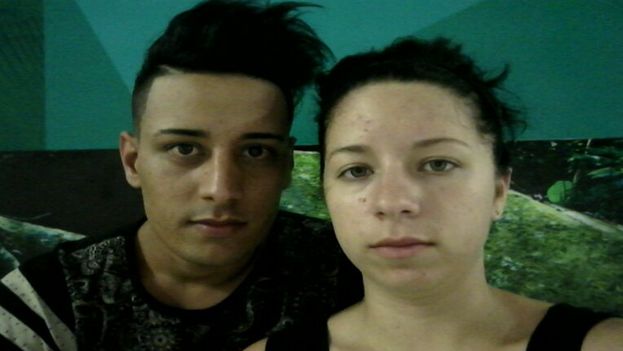
Two migrants were repatriated to Cuba on Sunday from Colombia (courtesy)

14ymedio bigger14ymedio, Mario Penton, Miami, 29 May 2016 – A Cuban couple who arrived from Ecuador, were repatriated to the island by the Colombian authorities this Sunday, after being detained in the center of the country without proper documentation.

Leira Valle Piedra and Yoandy Boza Canal, ages 19 and 23 respectively, entered Colombia through its border with Ecuador with the intention of joining the Cubans who are in the town of Turbo, in Antioquia Department, but they were discovered two hours from Medellin and transferred to Pereira, where they were informed they would be returned to Cuba. continue reading

“They told us it will be the same for all Cubans who are in Colombia without a visa,” Leira Valle told 14ymedio. She said that they decided to cross into Colombia with the aim of continuing the journey to the United States, where they have family. “They refused to renew my husband’s visa in Ecuador so we had to leave there,” she said.

The deportation to Cuba happened after Colombia Migration issued a statement on 25 May in which it expressed that the new measures that the country was taking in the face of human trafficking are beginning to show good results.

The new actions consist of an increase in checkpoints both along highways and at border points. The authorities referred to the new irregular migration routes they detected in the departments of Nariño, Huila and Amazonas.

The communiqué also said that more than 150 migrants were deported in recent days to their countries of origin or to the location where they had entered Colombia.

With regards to hundreds of Cubans who are being housed in a warehouse in Turbo the text was categorical: “Colombia Migration and the National Government will not facilitate any aircraft to transport them to a different place that is not the border where they entered Colombia or their place of origin. To do otherwise would be contributing to the criminal bands of human traffickers.

In 2016 alone, the town of Turbo has discovered more then 3,700 irregular migrants. Most of them obtained a safe conduct giving them 10 days to pass through the country but, after the closing of the border with Panama to the avalanche of Cubans and migrants from other continents, the Colombian government has decided to deport the undocumented to their countries in origin.

In response to the request for information on the case, the communications office of Migration Colombia told this newspaper that, due to the internal policies that manage the institution, they can not address the issue only from the Cuban problem, “every time, for the Colombian state these people are victims of migrant trafficking networks and we would be ‘revictimizing’ them.”

Away From “The Honey Of Power” Carlos Lage Focuses On Fighting Mosquitoes / 14ymedio, Zunilda Mata

President Raul Castro with Carlos Lage, then vice president, when everything was still complicity. (EFE)

14ymedio bigger14ymedio, Zunilda Mata, Havana, 30 May 2016 – Every evening he emerges with his briefcase from the place where he purges his fate of being ousted. Carlos Lage, former vice president of Cuba’s Council of State, works on the campaign against the Aedes aegypti mosquito at the 19 de Abril polyclinic. Seven years ago he was removed from office and accused by Fidel Castro of being addicted to “the honey of power,” but today he is an employee of the Ministry of Public Health and avoids talking about his past.

At 64, Lage barely practices the pediatrics that he specialized in after studying medicine. His activities as president of the University Students Federation (FEU) and subsequent responsibility as secretary general of the Union of Young Communists (UJC) left him no time to attend patients. After his political downfall, in 2009, he went through several minor administrative positions in which he has had little contact with the public. continue reading

Currently, the man who is also the former secretary of the Council of Ministers works in the Department of Hygiene and Epidemiology in a polyclinic that often receives visits from foreign delegations. More than once, in the hallways, he has run into former colleagues and diplomats who revered and honored him when rumors suggested he might become the first vice president.

The name of Lage was among the successors mentioned in the proclamation with which Fidel Castro announced his departure from power due to health problems, read out on national media on 31 July 2006. In paragraph six of that text Lage is called out for his accomplishments, such as being the “driving force of the energy revolution program” and the management of its funds. Off the Island, the vice president was seen as a civil figure with whom it might be possible to negotiate a future transition.

Between 1993 and 2009, from his high position, Lage represented Cuba at several Latin American summits, in speeches before the United Nations and at the inaugurations of numerous presidents. Popular humor baptized him as “the administrator of the madhouse,” for showing a certain sense in the midst of the political delusions that characterized those moments in Cuba.

However, rather than promote him to the position of first vice president, in February 2008, Raul Castro named the orthodox Jose Ramon Machado Ventura, thus sending a clear signal of strengthening the power of the so-called “historic generation” and avoiding potential reformers. A Reflection published by Fidel Castro confirmed the disgrace, when he accused Lage and Foreign Minister Felipe Perez Roque of having played an “undignified role.”

Now, every morning, el benjamín—the youngest son—separated from power imparts guidance to workers in the campaign against the mosquito that transmits dengue fever and chikungunya. The rest of the day he receives complaints from residents of Nuevo Vedado about the fumigators and medical personnel linked to the inspections for mosquito breeding sites.

Lage’s relations with the rest of the polyclinic workers are cordial, according to what several of his colleagues told this newspaper. Few dare to remind him of the times when his order was sufficient to appoint a director or remove an administrator. Often, after work, he offers a colleague a ride in his red-wine Russian made Lada, a replacement for the car he kept in his time in power.

In the corridors of the healthcare center he is called “the goodies bag man,” an allusion to his order at the beginning of this century that put an end to the bags with products like soap, frozen chicken and detergent that were distributed among healthcare personnel. Scornfully, his current compañeros remind him of that cut.

Not even in the domino games regularly organized at his home, where he invites other polyclinic workers, does Lage speak of that 3 March 2009, when Raul Castro removed him from his position as vice president. He was also dropped from the Central Committee of the Communist Party and lost his position as a deputy in the National Assembly of People’s Power.

“He will not mention his previous life,” an employee of the 19 de Abril laboratory told 14ymedio. “At first they maintained a visible surveillance operation” on him, said the employee, but “over time it has been lessened.”

An attempt to obtain statements from Lage himself received no response. “That man knows that silence is what keeps him alive,” commented his colleague.

Korea, That Distant But Nearby Country / Yosmany Mayeta Labrada

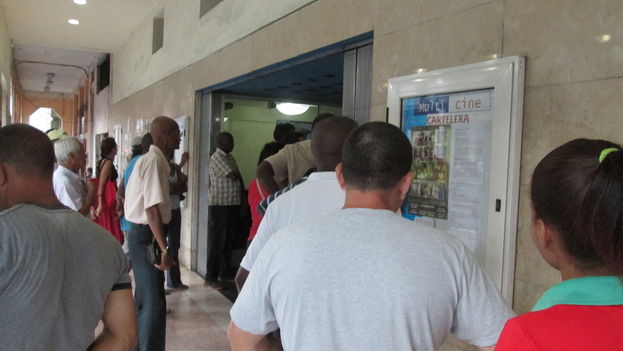
The audience outside the Infanta Multicinema during the first day of the South Korean cinema week in Havana (14ymedio)

14ymedio bigger14ymedio, Yosmany Mayeta Labrada, Havana, 28 May 2016 — When Cuban children playing mention distant countries, they talk about Singapore, Burundi and Korea. But in the latter case, they do not think about the country controlled by Kim Jong-un, but the one on other end of the peninsula, where Samsung was born. With film production the same thing happens: the theaters fill up for productions coming from the land of Hyundai and remain empty if the films come from the country’s “eternal president.”

With all seats occupied and dozens of people outside the theater, the screening of the first movie of South Korean Film Week in Havana occurred this Thursday at the Infanta Multicinema. The event, which this year celebrates its third edition, was organized by Cinemateca de Cuba with the Cuba-Korea Exchange Association. continue reading

The audience that gathered in the centrally located theater turned out to be very diverse, especially considering that Cuba does not have diplomatic relations with South Korea and this Asian country lacks official representation on the island. Nevertheless, officials from the Cuban Institute of Cinematographic Art and Industry (ICAIC) attended, along with the very official Cuban Institute of Friendship with the Peoples (ICAP).

Also in attendance were South Korean students residing on the island and several diplomatic representatives of other nations, including the ambassador of the People’s Republic of China.

The founder of the Busan International Film Festival, Kim Dong-Ho gave the welcome in Spanish and said that a week of the films of his country would help with “understanding Korea” and “improving our relationship.” After he praised the cultural level of Cubans he closed with an emotional “thank you” that hastened the applause of spectators. Then came darkness and with it a point of light that widened on the screen.

The night gave way to “A Hard Day,” by South Korean director Kim Seong-Hoon. The thriller maintained its suspense until the end, with the avatars of Detective Gun-Su, trying to hide the body of a person he ran over. A standing ovation just as the credits started to roll confirmed that the organizers were right to choose this film to “break the ice” for the week.

Among those responsible for the careful film selection is Susana Molina, vice president of ICAIC, who told 14ymedio that “all the films in previous years have been good quality, but the curation of these was done by Tony Mason and also this edition presents a wider program.”

The programming for Korean film week will run until next Thursday. Stand outs among the films are titles such as: I’m a Cyborg But That’s OK, Moebius, 200 Pounds Beauty, Coin Locker Girl, and The Satellite Girl and the Milk Cow. Productions that deal with romance and survival in a world of violence, as well as police dramas and the conflicts of an obese girl trying to make it in the world of pop music.

However, few moments are likely to exceed those of opening night, when the cinema mixed diplomacy with a certain dash of showbiz. After the screening of the first film, the celebrations moved to the Bar Su Restaurante in Miramar, where the surprise of the evening was the presentation of young Cubans who sang in Korean and danced typical dances of the region.

From the tables nearest the stage well-known actors such as Enrique Molina, Isabel Santos and Luisa Maria Jimenez applauded and laughed, all spellbound by that distant but nearby country.

The “Little Witches” Arrived / 14ymedio, Yoani Sanchez

”Little witches” (known is rail lilies in English) in the 14ymedio newsroom. (14ymedio)

14ymedio bigger14ymedio, Yoani Sanchez, Havana, 14ymedio – There are those who believe that the pages of newspapers only have space for tragedy, armed conflicts and diatribes against politicians. In a world where the newspapers prioritize the extraordinary and the TV screens are filled with crises or shipwrecks, the little things, the common moments, lose narrative space. However, a good part of our existence takes place among the everyday, in the middle of a cycle that repeats itself over and over, like the seasons and the flowerings.

In the 14ymedio newsroom, 130 feet above the ground and amid the informational hustle, these “little witches” have been born. Known as “rain lilies” in English, no one planted them in a flowerbed, but they have arrived in the earth of some other plant and bloomed this summer. They are fragile and fleeting, but their simple presence convinces us that life continues, despite the problems, the fears, and the stubbornness of the leaders.

With their herringbone stems and ephemeral petals, these “little witches” have wrested a smile from the work team that reports a reality where there are few reasons for joy. One afternoon, just after a very long power outage, they sprang into bloom, on the same day that the political police browbeat one of our provincial collaborators. But here are these “little witches,” to remind us that being journalists is also narrating the diminutive, describing the ordinary and supporting freedom, like a plant, that returns to bloom again.

“I Am Prepared To Go to Prison Today,” says Berta Soler / 14ymedio

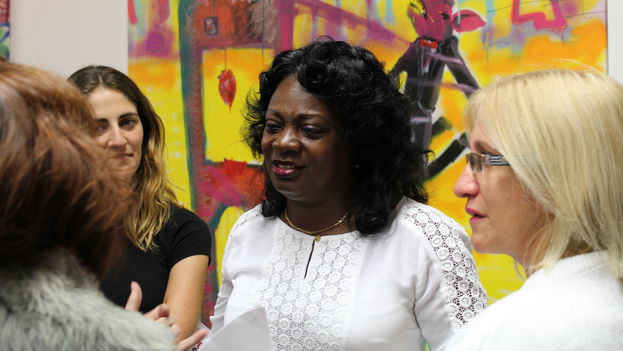
Berta Soler, leader of the Ladies in White, during the art exhibit by El Sexto in Miami, Florida. (14ymedio)

14ymedio bigger14ymedio, Havana, 29 May 2016 – From early hours Sunday a major police operation surrounded the headquarters of the Ladies in White in the Havana neighborhood of Lawton, according to denunciations by several activists from that organization. At least “13 women and four opponents were brutally intercepted outside the house” and forced into police cars in the last 13 hours, dissident Luisa Ramona Toscano Kendelan said by telephone to 14ymedio. continue reading

The group that surrounded the property included, as has become customary, a conga line with music through powerful speakers and signs that use the opposition campaign slogan “We All March” together with the phrases “with Fidel,” “with the Revolution” and “with socialism.”

At several points in the city similar operations prevented the women who form part of the human rights organization from reaching Santa Rita Church. Several on-scene witnesses report that at least two Ladies in White had managed to reach the vicinity of the parish on the western periphery of Havana.

Minutes before her arrest and in statements to this daily, Berta Soler, leader of the Ladies in White, declared that she was ready to confront the risks of leaving her organization’s headquarters in order to exercise the right of “peaceful demonstration.” She explained that she was prepared to go “to prison to await the trial” with which they threatened her last week for a charge of resisting the authorities.

“I am prepared, I have my blood pressure monitor, my pills, shots, personal hygiene articles, flip flops … I carry it all. I am again going to commit the crime they accuse me of, so I expect to end up in the Manto Negro women’s prison.”

In the morning hours in the Matanzas province, Lady in White Leticia Ramos Herreria, who urged agents to take her directly to prison to await trial, was detained. Nevertheless, the State Security officers responded to her that “it was still not time.”

Translated by Mary Lou Keel

UNPACU Activists Denounce Raid On Their Homes / 14ymedio

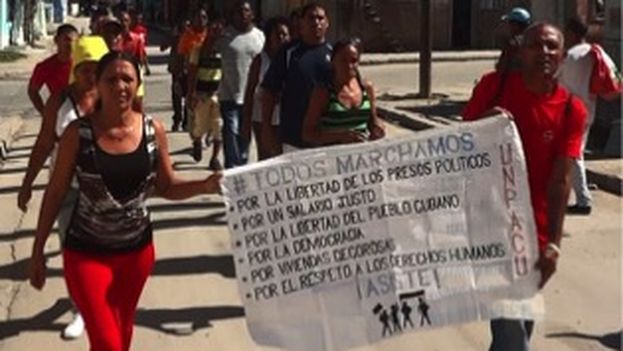
UNPACU Activists marching in protest. “We all march, for the release of political prisoners, for fair wages, for freedom for the Cuban people, for democracy, for decent housing, for respect for human rights. (UNPACU Archive)

14ymedio bigger14ymedio, Havana, 28 May 2016 – This week has been one of surprises for several activists from the Patriotic Union of Cuba (UNPACU) who denounce that they have been victims of a raid on their homes and the confiscation of their belongings. The dissidents detailed that the political police raided three houses in the city of Santiago de Cuba on Saturday morning and a fourth in Havana on Wednesday.

Ermito Morán Sánchez, an UNPACU activist, confirmed to14ymedio that they “raided the homes of Carlos Oliva Torres, Yusmila Reyna and Karel Reyes where they seized printed materials, a camera, and other items in response to our activities to disseminate the reality of this country among the people.” continue reading

In a telephone conversation with 14ymedio, Yusmila Reyna said that at six in the morning, while her family was sleeping, there was a “knock on the door.” It was the police with “a search warrant for subversive activities.” An officer showed her a paper, but did not allow her to read it carefully or to take it in her hands. The incident occurred on 12th Street in the Mariana de la Torre neighborhood in Santiago de Cuba.

Reyna managed to read that the order specified that they came to “seize methods of communication, money, and any other means of counterrevolution.” A total of ten uniformed officers plus two in plain clothes, who supposedly came to witness the search (Cuban law requires two civilians to witness such a search), participated in the operation.

The raid lasted over an hour and ultimately they seized working notes, two laptops, an electronic tablet, two hard drives, a printer, a camera, “and even receipts for items acquired abroad,” according to Reyna.

The activist circulated a text where she says that “acts like these do not prevent us from continuing our work in defense of human rights and accelerating the process of democratization of our island.”

During the search of her house they also seized a number of issues of the magazine Coexistence, documents relating to the initiative Otro 18 (Another 2018)—in support of free multiparty elections—and documents relating to the Roundtable for United Democratic Action (MUAD).

“They took two staplers and the boxes of staples, and a hole-punch. They didn’t leave any document I was working on and warned me that any demand [for the return of the seized items] would have go to the ‘Confrontation Offices’ but that they were not going to return anything.”

Meanwhile the dissident Arcelio Rafael “Chely” Molina Leyva said that Wednesday morning the police arrived to search his home, which serves as the UNPACU headquarters in Havana.

“They came with several gentlemen in plainclothes and after a thorough search took three laptops, a battery to recharge cell phones, two mobile phones, office supplies, news from international agencies, printed civic material and digital backups,” Chely enumerated.

This is the fourth search of this nature by the political police on UNPACU’s Havana headquarters. As a part of the operation they arrested Carlos Amel Oliva Torres, who despite having a temporary residence permit for Havana was taken to the third station of the National Revolutionary Police (PNR) in Santiago de Cuba, where he is still under arrest.

Oscar Elias Biscet Says That Cuba Can No Longer “Bring Down” The Opposition / EFE (14ymedio)

Cuban dissident Oscar Elias Biscet. (EFE)

14ymedio biggerEFE (via 14ymedio), Miami, 26 May 2106 — Cuban dissident Oscar Elias Biscet said Wednesday, on arriving at the Miami airport from Spain, that the opposition on the island is “well defined” and that the regime “can no longer bring it down.”

Biscet, who was happy to be in “land of freedom” for Cubans, told reporters that he would explain to the Cuban exile community in South Florida his civic political project to end the dictatorship and promote democracy, through a method of non-violent struggle. continue reading

The medical doctor said that the opposition is “very united” and that part of the opposition is his initiative, the Emilia Project, which has gathered the support of more than 3,000 signatures.

He noted that the signers are “brave people, who gave their names, who gave their addresses, their identity card data, saying they do not want more communism.”

Biscet, 54, was optimistic that this group would become “a crowd that would end the dictatorship in Cuba.”

He said his initiative seeks to “make change by shifting the superstructure” and he calls this “the revolution on non-violent human rights.”

The dissident was arrested in late 2002 and sentenced to 25 years in prison for being part of the so-called Black Spring, where a group of dissidents known as the Group of 75, were accused of conspiring with the United States.

Biscet was released from prison in March 2011 during the process of the release of political prisoners carried out by Raul Castro’s government after mediation by the Vatican.

The dissident, who visited Madrid to give a lecture and see friends, admitted this week in Spain that he is afraid of reprisals in Cuba when he returns.