
Cuban Civil Society, For The First Time Present In The Regional Internet Governance Forum / 14ymedio, Regina Coyula

The Regional Latin American and Caribbean Preparatory Meeting for the Internet Governance Forum, is a regional meeting prior to the upcoming global forum in Mexico. (Twitter)

14ymedio biggerRegina Coyula, Havana, 26 July 2016 — ¿Gover… what? That reaction has become increasingly familiar in a conversation discussing internet governance. Although many users who take advantage of it aren’t aware, governance is a fundamental issue for everyone when we venture out onto the World Wide Web. That our family email travels equally with the statistics of scientific research, with an online purchase, or with a bank account statement, is thanks to governance.

Behind any familiar and easily remembered address is a long string of numbers without which the internet couldn’t function. Early developers realized that the ordinary user would be unable to recall those long strings of numbers and so created a protocol to tie them to a name. Name and number indissoluble leading us unmistakably to the desired destination. These technical protocols that make our lives easier, also have to do with governance. continue reading

Governance, a term originally applied in the social sciences, has gained strength within international organizations, and in the case of the internet, seeks interactions and consensus among interested parties, or an English word that is difficult to pronounce – multistakeholders – (multiple interested parties, academia, businesspeople, leaders and civil society).

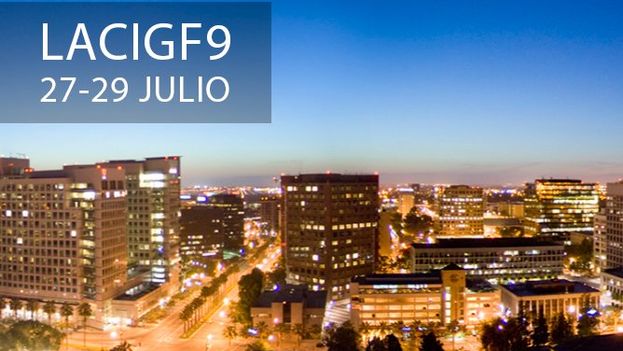
The natural result of this interaction are world forums on governance, very fruitful meetings where those who participate know each other personally and engage in discussions at committee and plenary sessions. Prior to these world forums which have been held since 2006 and which this year will take place in Guadalajara, Mexico, in December, preparatory meetings will be held by geographic region and, in some case, even national groups. The meeting for Latin America and the Caribbean will be held in San Jose, Costa Rica, between 27-29 July.

The sessions approved for the meeting include:

  1. Security and privacy – Concerns about cybersecurity and confidence in the digital environment.
  2. The situation of human rights on-line in Latin American and the Caribbean: advances, challenges and trends.
  3. Evolution, progress and challenges of the implementation of a multi-sector approach to the work of public policy and Internet governance at national and regional levels.
  4. Lessons on the development and implementation of strategies for providing access and legal initiatives on network neutrality: What are the next steps to ensure open and interoperable internet in the region?
  5. Expand understanding with regards to the responsibilities of internet intermediaries: the scope and limits of their responsibilities in the digital ecosystem.
  6. The balance between intellectual property and access to knowledge: the scope and impact of interregional trade agreements in the regulatory ecosystem.
  7. Persistent and emerging challenges for Internet access: Connecting the next billion.
  8. Integration of Internet governance with the 2030 Sustainable Development Agenda: What are the priorities of the region for digital inclusion?
  9. A multi-stakeholder perception of the digital economy.
  10. Future of Governance of the Internet Forum of Latin America and the Caribbean (LACIGF).

Undoubtedly, the meeting will address the issue of the independence of the US government’s Internet Corporation for Assigned Names and Numbers (ICANN), which will go into effect in September, and how ICANN, as a highly hierarchical international organization should guarantee the technical standards of internet quality: interoperability, scalability, and resistance to potential failures; but also the sovereignty of the virtual space, the equality of all users, the privacy of data, freedom of expression and the right to information, and also deal with cybersecurity. All of this in the context of a lack of rules for its proper use which diminish individual rights or national security, or favor some to the detriment of others.

Cuban civil society will be present at this event with a small representation, something that has no precedences but that could be very healthy for a citizenry that is just beginning to open itself to an internet that has restricted access and a censorship of opinions, and that is disregards of the rights that come solely by connecting to the world, human rights recognized as equals, in real space as in the virtual.
The Erratic Corrections of Machado Ventura / 14ymedio, Reinaldo Escobar

The only “next” is the looming return of the economic difficulties. (14ymedio)

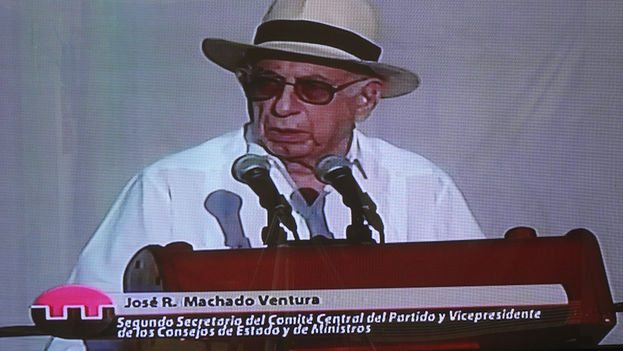
14ymedio bigger14ymedio, Reinaldo Escobar, Havana, 26 July 2016 – Sporting a hat to protect himself from the rays of the sun, Jose Ramon Machado Ventura explained in his speech for the 26th of July that the changes introduced in the Cuban model “are aimed at consolidating our socialism, to make more prospero (prosperous) and sustainable.” The keynote speaker at an event this morning in Sancti Spiritus realized immediately that he had omitted the enclitic pronoun “it” next to the verb “to make” and corrected it but introduced a new error: “To make it more proximo (next) and sustainable.”

To the cheerful confusion of those who didn’t notice the initial grammatical slip, the vice president conveyed the impression that he hadn’t meant to say prosperous, but proximo (next). The correction thus became a political problem, because if there is something Cubans know it is that the promised socialism “without haste, but without pause” could be anything or have innumerable oddities, but in no way is it “next.” continue reading

Perhaps, later on, Machado Ventura will argue that the gaffe obeyed the desires that “all revolutionaries have to reach the goal for which they have fought.” However, the subtle equivocation, which doesn’t appear in the official version of the speech published in the state newspaper Granma, may have set listeners to thinking about the controversial issue of deadlines to deliver on certain promises.

At least three generations of Cubans have witnessed, for years, the commemorations around that fateful 26th of July 1953, a tragic date that has been cataloged – brazenly – as “the happiest day in history” in a chorus of the worst tune ever.

For decades, the interminable speeches that Fidel Castro delivered on the ceremonies of those events that immolated young people were expected as the moment when he would announce “the good news.” On the podium, index finger pointing skyward, he would prophesy a luminous future for the country and convince his audience of the inevitable and imminent materialization of utopia.

However, those times have passed and today the model of socialism that is debated among “hundreds of thousands of militants of the Party and of the Union of Young Communists, and representatives from all sectors of society,” with reference to the documents of the Seventh Communist Party Congress, shows no practical signs that it will bring prosperity, nor that it will be sustainable over the long term.

Instead, what is coming “next” is only the return of the economic difficulties now classified as temporary that characterized the most difficult years of the Special Period. These material limitations, in fact, never disappeared completely from daily life, but could get worse given the collapse of Venezuela and the economic dysfunction of the national model.

Machado Ventura referred this Tuesday to these conquests which had to be “temporarily” given up in the most acute phase of the Special Period, but indicated with optimism that “today they are practically all being recovered,” while “some belonged to that historic moment and it would not be rational to reestablish them.” He also spoke about other conquests, which he did not enumerate, that “are in a quantitative and qualitative phase superior to those years.”

The most important element of the vice president’s speech lay in its omissions, more than in its affirmations. The man who is seen as a recalcitrant orthodox avoided deciphering the enigma that now torments millions of Cubans and that has been converted into history in his wishy-washy speech. Did the Special Period end, or are we just going through a less acute phase? Is the current crisis a new stage in the chronic fall of the system, or is it the evidence of the “next” – that is the imminent – end of Castroism?

Ramon Machado Evokes a 26th of July Marked By “Complex Circumstances” / 14ymedio

The vice president of the Councils of State and Ministers, Jose Ramon Machado Ventura. (Screenshot)

14ymedio bigger14ymedio, 26 July 2016 – In a total break with the optimism that Cuban leaders usually squander on every 26th of July, Jose Ramon Machado Ventura addressed this Tuesday the “difficult circumstances” the island is currently experiencing. The vice president evoked, in addition, the problems derived from the international situation whose resolution is “outside the scope” of the government.

With the first light of dawn, lasting for barely an hour and ten minutes, Sancti Spiritus hosted the main event for the 63rd anniversary of the assaults on the Moncada and Carlos Manuel de Cespedes barracks. The event was punctuated by calls for efficiency and sacrifices, and continuous references to the “economic situation,” characterized by a lack of liquidity that has obliged the government to reduce the expectations for economic growth. continue reading

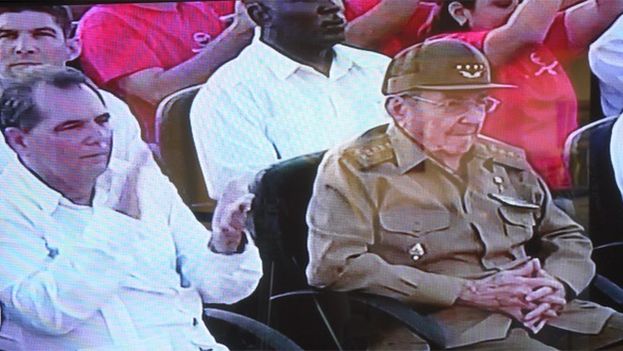
The main speech of the day fell to Machado Ventura, as has happened several times over the last decade. Sitting in the first row of the audience was president Raul Castro, who did not speak publicly and who left as soon as the ceremony concluded.

The constant references to Fidel Castro and his 90th birthday (coming up in August) also marked the event, although the former president did not send a message for the occasion and had to be remembered for his words on 26 July 1953, which he spoke in Sancti Spiritus.

Machado Ventura’s speech emphasized the words with which Castro acknowledged that Cubans had been “capable of stressing and inculcating that the first duty of the revolutionary is work.” The number two man of the Communist Party emphasized that “fulfilling the [economic] plan is not synonymous with meeting the needs of the country nor having reached the existing potential,” and appealed to the “reserves of efficiency” remaining to be tapped.

In response to those who demand faster economic and political transformations, the vice president warned that “the few changes that are necessary will be introduced at the pace we decide,” and declared that “there will be not even the slightest response to external pressures.” The affirmation coincided with what has become the slogan of Raul Castro’s regime: “Without haste, but without pause.”

Some of these pressures to accelerate the transformations on the island have, according to the orthodox leader, “the underhanded or open purpose to dismantle the work of the Revolution.” He stressed this again later when he referenced “the enemies of the country,” without specifying names or details.

Red shirts and little paper flags highlighted the morning under an enormous bronze sculpture dedicated to the patriot of independence Serafin Sanchez, in the plaza of the same name, although missing were the faces of the foreign leaders and personalities who traditionally attend these 26th of July celebrations.

Machado Ventura confirmed that the discussion of the documents of the Seventh Congress of the Communist Party will conclude in September and their final approval by the Central Committee will take place in December. The debate, he explained, involved “hundreds of thousands of militants from the Party and the Union of Young Communists (UJC), and representatives of all sectors of society.”

Raul Castro, who did not play an active part in the event, remained in the first row of the audience and left as soon as the ceremony ended. (Capture)

Machado Ventura defined the Special Period as a stage in which the conquests of the process “had to be temporarily given up, in good part” to avoid a comparison with the current situation, despite the fact that many Cubans fear a repeat of the Special Period in all its gravity.

José Ramón Monteagudo Ruiz, a member of the Central Committee and first secretary of the Party in Sancti Spiritus, said that “there are conditions in the territory to achieve more productive agriculture.” The local official spoke of “the difficulties and damages arising from the current situation,” in reference to the economic cuts and lack of liquidity in the country.

Mentions of the United States embargo were not lacking, although unlike other years the United States and “Yankee imperialism” were not central to the discourse, which was led by the need to make the domestic economy more efficient.

Not In The Name Of Socialism. Another Sign Of Contempt For Cuban Workers / 14ymedio, Pedro Campos

14ymedio bigger14ymedio, Pedro Campos, 25 July 2016 – Several news reports confirm that there is a contingent of Indian workers in Cuba… Yes, you read that right: workers from India, from the other side of the world, working on tourist projects for foreign companies. A French company brought them over here and is paying them first world salaries.

Can anyone in the State-Party-Government explain what is happening? Are there no Cuban workers to employ in these construction projects?

Is the state-run Construction and Specialized Installations Company (ECME), which builds and remodels hotels, luxury buildings for foreigners and hospitals, among other projects, which has seen the most brilliant contemporary Cuban engineering and architecture, unable to undertake this work? continue reading

Does the remodeling company under the Office of the City Historian of Havana, which has rescued wonders of Cuban architecture, not have the capacity for these commitments?

I originally found it hard to believe the news, because no one could explain to me the reasons why foreign companies prefer to contract for Indian workers instead of Cubans, but it was even harder for me to understand why the “socialist” government, “representative of the Cuban working class,” accepts it when there are thousands of professionals, specialists, technicians and workers who are unemployed or under-employed in this kind of work, eager to exercise their professions and receive good remuneration for their work.

I don’t pretend to have found the reasons. Something that only the Government-Party-State can understand, one god in three persons like the holy trinity, although nobody explains it, nobody knows, they believe that nobody cares and ultimately nobody agrees.

Several media reports address the issue, and there is no shortage of information and speculations about the interests of the company run by the Cuban military that is charged with these works, in allowing this contracting on the part of a foreign firm because “Cubans can’t do the job,” “they are not good workers,” “the boys in the military service don’t know how,” and other things of this style.

Whatever the explanation might be, one thing is clear: workers from very far away are being employed in Cuba, they are being paid good salaries, while there are hundreds of thousands of Cuban workers who are trying to invent a life without adequately paid jobs, who have no other option in order to improve their and their families’ lives other than to leave Cuba, if they can, risking everything.

At the very least, this is another example of the contempt the bureaucracy has for Cuban workers, who decide nothing and receive little.

But it is no coincidence that such a barbarity is happening right now. The bureaucrats who have appropriated the country, who manage “their state enterprises” as if they were the owners, seem desperate to please the few foreign investors who have accepted their conditions to try to resolve the crisis, the disaster, of what they want to continue calling socialism in Cuba.

And because the Cuban government does not allow foreign companies to freely contract for Cuban labor, but requires them to go through the state-run intermediaries who authorize the selection of the personnel and who keep around 90% of what the foreigners pay for each worker, the foreign capitalists who want to select and control their own workers have adopted this method of importing labor to be able to do so.

The desperate rulers, in their eagerness to produce joint venture companies, have accepted this nonsense, as usual, without considering all the consequences.

Of course, they do not care about the reactions of the Cuban workers and the Cuban people. Anyone who doesn’t agree can leave, and if they protest they can go to jail. All very democratic.

It is no wonder that since the late nineteenth century this kind of state-socialism as been called a prison or a barracks. No wonder, as our José Martí wrote, “It goes badly for a people of bureaucrats! All the power which would be gradually acquired by the caste of public officials, bound by their need to remain in a privileged and lucrative position, would be gradually lost by the people, who lack the same reasons for complicity in hopes and profits to confront the public officials fettered together by their common interests.”

It is left to us once again, from the positions of democratic socialism, to condemn these anti-national, anti-labor and counterrevolutionary practices of the centralized statist-wage economic and political model, of the semi-feudal court, imposed in Cuba in the name of socialism.

No, no. No more in the name of socialism.

‘Yumas’ In Cuba, “As If They Had Never Left” / 14ymedio, Zunilda Mata

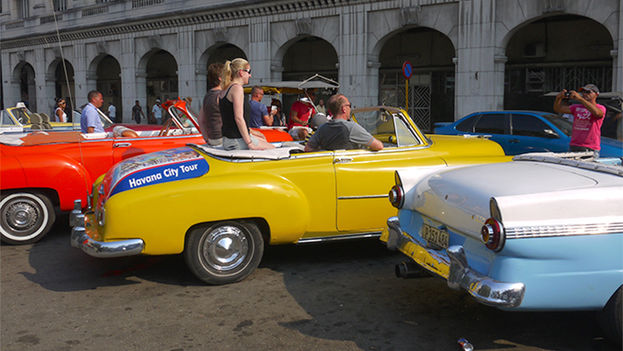
'Yumas' in Havana. (14ymedio)
‘Yumas’ in Havana. (14ymedio)

14ymedio bigger14ymedio, Zunilda Mata – He didn’t know that in Cuba he would be rebaptized yuma, but, within a few days of arriving he’s become accustomed to the word and his condition as a “hidden” tourist. Daniel, born in Oklahoma, is one of the thousands of travelers from the United States who have officially visited the island under one of the 12 categories authorized by Barack Obama’s administration.

They are everywhere and are distinguished by their accents, their generous tips and a fascination with everything they see.

“I came with a group of Protestant pastors, but in total we’ve only had one day of religious programming, the rest of the time we’ve visited bars, museums and come to know the country better,” he tells 14ymedio at an outdoor café at the Hotel Inglaterra in Havana. continue reading

Daniel arrived two weeks ago with a group organized by the Martin Luther King Cultural Center, founded by Raul Suarez, a religious man who enjoys official favor.

Under the terms of the relaxations, Americans are obliged to justify their trips to the island in great detail, and are at risk of the United States Office of Foreign Assets Control (OFAC) imposing a heavy fine if they don’t comply with the requirements of their visit.

However, since the opening of the island to tourism in the nineties, many of them have come to Cuba through third countries. The basic change in the last year and a half bas been the ability to set aside circumspection, and jet-set American have turned Havana’s streets into their latest fashion show.

In the first quarter of this year about 100,000 Americans arrived in Cuba, a figure that is double last year’s number.

“I went to Viñales, Maria La Gorda beach, and tomorrow I’m going to Holguin and Santiago de Cuba,” Daniel details. “Part of the agenda was prepared from there,” he added. His program was put together thanks to the increasing number of alternative agencies and private accommodations that offer ever expanded services.

“I’m staying in a private home near Neptune Street and the family has connected me with another to accommodate me in the East,” says Daniel. He prefers spending time “with the people, to get to know the country better,” but doesn’t rule out “enjoying the Hotel Nacional or the Riviera for the last two nights,” two of the great architectural obsessions of yumas who tour Havana.

“They come looking for anything that reminds them of the US presence in Cuba: Hemingway’s house, old cars, hotels that were erected with money from the mafia and, of course, they want to try a famous Cuba Libre,” explains Yamilé, a Havanan who runs a dance academy near the Prado and also offers city tours and “escapes to all sorts of places.”

“The yumas are now the preferred tourists, because they have money, they’re willing to pay for high quality, and they try to be nice,” explains one of the guides working with Yamilé. “We have people who rent rooms who will only accept Americans.”

Ivón rents two rooms on Compostela Street, in the historic center of the capital. “A few years ago having an American or an Israeli was a real pain,” he said. “We had to inform [the police] every time the tourist left the room, talked to someone, or if they had a really big suitcase,” but now “there are so many yumas” that the controls have eased up somewhat.

At Jose Marti International Airport in Havana, the immigration officials’ practice of stamping the visa on a separate piece of paper, rather than on one of the pages of the US passport, remains in place. This way the passport doesn’t record the trip to Cuba.

In legal respects, for the United States they are not tourists, but citizens who come to expand the “people to people” diplomacy pushed by Obama. But Cuban ingenuity has also adapted to this furtive way of entertainment and has created offerings that meet the requirements.

“We have a visit to the town of Regla to see the museum, which has very good explanations of Santeria in Cuba, and then the program includes a fiesta we they can dance and eat,” explains Yamilé. “When the activities are done, they are free to do whatever they want and go wherever they want.”

Yoga classes, visits to ecologically interesting places, visits to small industries, and even programs focused on helping Havana’s abandoned dogs, make up a part of the kaleidoscope of activities that have been developed since the easing of travel for yumas.

“They just need a justification and we give it to them, we adapt to what they need because we have people who know everything,” boasts Yamilé.

In a bar in Old Havana, dozens of Cuba Libres are waiting for thirsty yumas. “I see them and it’s like they never left, as if they had always been here,” says the waiter, while mixing Cuban and American flavors.

The Emigrant Must Earn Brownie Points to Enter Cuba / 14ymedio, Mario Penton

14ymedio bigger14ymedio, Mario J. Penton, Miami, 21 July 2016 — With blood-stained clothes and wounds and bruises on her arms, Ana Margarito Perdigon Brito returned to Miami from Havana’s Jose Marti Airport this past June. No one knew how to rationalize that the Cuban government prohibited her, a citizen of that country whose paperwork was in order, from entering the land of her birth.

“It is a form of revenge by the Cuban government towards emigrants. It is a type of blackmail by which, if you behave as they desire – which is to say, without being rebellious – you can enter your country; but if you dare to criticize the regime you may lose that right,” says the activist who left Cuba in 2012 in order to live in the US. continue reading

The Cuban exile, who lives in Homestead in south Florida, tried to enter Cuba for a second time in order to visit her sick mother in the Sancti Spiritus province. “The first time they turned me away at the Miami airport when I tried to fly to Santa Clara.   On this second occasion, they let me arrive in Havana, but once I was there, they told me I could not enter the country because, according to the system, I was prohibited entry into Cuba,” she says.

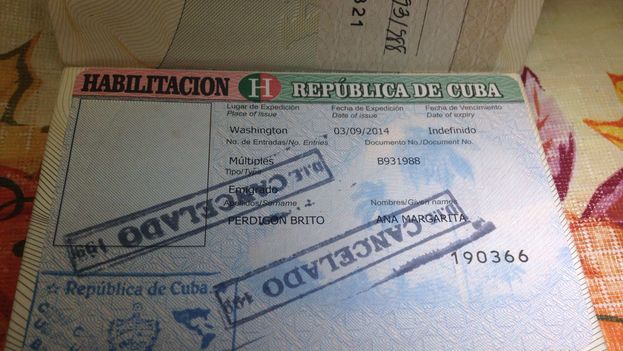
Her passport is up-to-date and valid with the corresponding renewals plus the authorization, an entrance permit for which Cubans living abroad pay and that supposedly has “lifelong” validity, although it can be nullified by Cuban officials.

She tried in vain to convince the immigration agents to let her speak with a supervisor or to explain to her by what rationale they impeded her access to a universal right. The answer was always the same: “The system indicates that you are prohibited entry. You must go back,” while they insisted that if she wanted to enter the country, she would have to seek a humanitarian visa.

The practice is not new; from Arturo Sandoval to Celia Cruz, a considerable number of Cubans have had to deal with the all-powerful Bureau of Immigration and Nationality in the last six decades in order to enter the Island. In many cases unsuccessfully as has happened to several people who could not even attend funerals for their parents. Many experts thought that with the new immigration law enacted in 2012, the situation would change, but it has not.

Perdigon believes that this is another sign of the Cuban government’s unscrupulousness as regards the diaspora. “They do not forgive me for the activism that I carried out within Cuba,” she explains.

Receiving no answer about her case, she tried to escape from the room where the immigration officials had taken her, and she was hit and wounded in a struggle. “I tried not to beg for my right but to win it [because] no one is obliged to obey unjust laws,” as Marti said.

Originally from the Sancti Spiritus province, she and her family belonged to several independent movements, joining political parties and initiatives favoring the promotion of human rights.

The passport of exiled Cuban activist Ana Perdigon Brito (14ymedio)

The passport of exiled Cuban activist Ana Perdigon Brito (14ymedio)

“On many occasions we were repressed, and we suffered acts of repudiation. One afternoon, my little daughter came running in a fright to warn me that many screaming people were coming. It was an act of repudiation that they had prepared for me in the neighborhood. On another occasion, they gave us a tremendous beating in a town called Tuinucu and jailed us,” she remembers.

Her case is not unique. According to independent statistics compiled by media, dozens of similar stories have happened in recent years. Nevertheless, there are no official data about the number of Cubans who have been denied entry into the country.

“People do not demand their rights publicly, and they don’t denounce these arbitrary situations,” comments Laritza Diversent Cambara, manager of the Cubalex Legal Information Center, via telephone from Cuba. “When we go to review statistics, countries like Canada have more complaints about human rights violations than Cuba, and we all know that is because of ignorance or lack of information about demanding their rights, because if there is anything abundant in this country, it is human rights violations,” she contends.

According to the lawyer, denial of entry by nationals is not contemplated in Cuban legislation. “It is a discretionary decision by State Security or the Bureau of Immigration and Nationality, but there exist no laws that regulate it, so people are exposed to the whims and abuses of officials,” opines the jurist.

“They cannot give the reasons for which they deny entry into the country. They do not argue that he is a terrorist threat or that the person lacks some document or formality. It is simply an arbitrary decision,” she adds.

The practice is not limited only to dissidents, activists and opponents. Diversent says that her office handled the case of a rafter who left the Island in 2011 and who continued traveling regularly, until in 2015 the Cuban authorities told him that he could not enter the country again.

14ymedio has known of similar cases of journalists, members of religious orders and doctors who took refuge in the Cuban Medical Professional Parole (CMPP) offered by the United States.

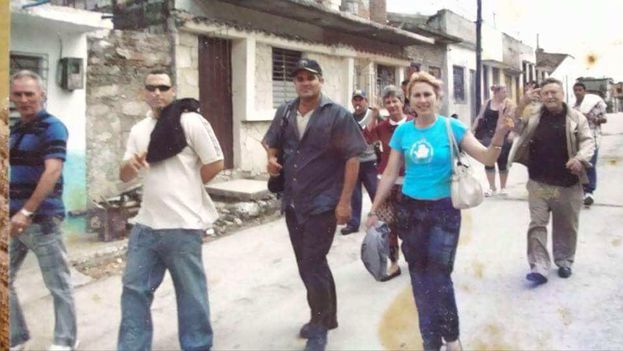
Exiled Cuban activist Ana Perdigon Brito marching through the streets of Santa Clara (14ymedio)

“One time I made some statements to a local newspaper in Spain about the hardship suffered by the Cuban people, and on return to the Island several officers confronted me in the airport, telling that if I did something like that again, they would revoke my temporary religious residency,” said a Spanish missionary who prefers for safety reasons not to be named.

The methods for preventing entry are as varied as the steps to take for immigration procedures in Cuba. There are people who have been denied passport authorization, as was the case of the well-known visual artist Aldo Menendez. On other occasions, Cubans are turned back at the last minute from the airport from which they tried to fly to the Island, as occurred to activist Ana Lupe Busto Machado, or they wait until they land in Havana after having spent 450 dollars on passport preparation, 20 dollars on the entrance permit or 180 dollars on the renewals, plus the price of passage from Miami which approaches 500 dollars, to tell them that they cannot ever enter their country again.

14ymedio tried to communicate with the Cuban Office of Immigration and Nationality, but authorities refused to respond to our questions.

“This kind of procedure should not surprise anyone,” says attorney Wilfredo Vallin, founder of the Cuban Law Association. “The government has a long history of actions that do not abide by its own law. Until recently wasn’t there in effect an express and unconstitutional prohibition against nationals entering hotels? What about human mobility within the Island? Isn’t that regulated, too?”

Translated by Mary Lou Keel

Oscar Arias Asks Fariñas To Suspend His Hunger Strike / 14ymedio

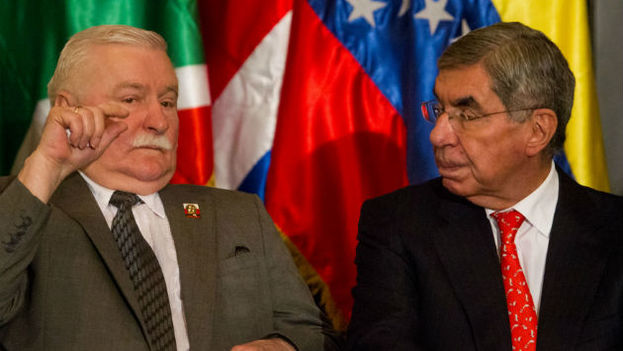
The former president of Costa Rica Oscar Arias (R) with former Polish president Lech Walesa (L). (EFE)

14ymedio bigger14ymedio, Havana, 23 July 2016 — In a letter published Saturday by the former president of Costa Rica and 1987 winner of the Nobel Peace Prize, Oscar Arias Sanchez asks his “friend” Guillermo Fariñas to “lift his hunger and thirst strike.”

Arias Sanchez explains that the hunger strike will not succeed as a recourse to persuade the government of the island “that you cannot pursue noble ends with ignoble means.” He also says that Cuba “is not a different democracy” but rather is “a dictatorship.” The former Costa Rican president (1986-1990 and 2006-2010) recalled the case of regime opponent Orlando Zapata Tamayo, who died after an 86-day hunger strike. He did not manage “to convince the Cuban regime that it was necessary to preserve the life of this person, regardless of any ideological differences” and nor did he move “the compassion of the Cuban dictatorship.” continue reading

The missive, published on Arias Sanchez’s Facebook account, says that “nothing we could do could save Orlando Zapata.” He emphasized that his voice will not be silent as long as “they continue to violate human rights in Cuba” and that he has lived long enough “to know that there is nothing worse than being afraid to tell the ‘truth’.”

Guillermo Fariñas, 2010 recipient of the European Parliament’s Sakharov Prize for Freedom of Thought, declared himself on a hunger and thirst strike in the early hours of Wednesday, July 20 to demand that the beatings of non-violent opposition members in Cuba be stopped and that a dialogue be opened with government.

Friday, Fariñas added a third demand which requires the regime to “cease the arbitrary confiscations from the self-employed, small businesses and entrepreneurs and all Cubans who are being violently attacked” by the “military.”

Fariñas expressed solidarity with Carlos Amel Oliva, youth leader of the Patriotic Union of Cuba (UNPACU), who began a hunger strike on July 13 “to protest the arbitrary confiscations” and said he would continue the strike until the belongings that were confiscated from him are returned. On Friday, one of the 75 dissidents imprisoned during the Black Spring of 2003, Eduardo Diaz Fleitas, joined the hunger strike.

“When we achieve justice we can build a new society” / 14ymedio, Ofelia Acevedo, Mario Penton, Luz Escobar


Note: The video is a brief excerpt from the interview and is not subtitled in English.

14ymedio bigger14ymedio, Mario Penton, Luz Escobar, Miami, 22 July 2016 – His name is tattooed on the skin of a Cuban graffiti artist (Danilo Maldonado, known as El Sexto) or is suggested by the letter L, standing for Liberty, formed by the angle between the index finger and the thumb, increasingly displayed by those asking for democracy. The legacy of Oswaldo Payá Sardiñas (1952-2012) and Harold Cepero (1980-2012) lives on in the nation for which they worked their hearts out and ultimately sacrificed their lives. Four years after the tragic crash that claimed their lives, and that their families and international organizations have classified as a settling of accounts by the repressive Cuban apparatus, 14ymedio speaks with Ofelia Acevedo, widow of Payá, former president of the Christian Liberation Movement (MCL).

14ymedio: A few days ago the one year anniversary of the reopening of the embassies between the United States and Cuba was celebrated. Could we be closer to justice in the case of Harold Cepero and Oswaldo Payá? continue reading

Acevedo: The restoration of diplomatic relations has been good. It is clear that it is the Cuban government that does not continue the normal process that this rapprochement should take. On the other hand, justice is the most important step to achieve real change in the Cuban nation. To look forward in our country we need justice. The Christian tradition makes it very clear: if there is a recognition of the truth, there will be justice and forgiveness.

Once we have achieved justice we can talk about reconciliation between Cubans. We Cubans must seek it, starting by reclaiming our rights. This is a key step for the future. The greatest injustice is to deprive the Cuban people of our rights, because of this there has been so much misery and we have not progressed. Human rights are natural and inherent in the person. When we achieve justice we can build a new society, and for this it is important that this crime does not go unpunished.

14ymedio: How has the family faced the loss of your husband?

Acevedo: We are a very close family. We love each other very much and miss him so much. We live in our faith that sustains us. Our faith makes us believe that truth, justice and democracy are possible for our people. All of Oswaldo’s work is imbued with a great deal of hope, of Christian hope. That is what helps us go on in the midst of the adverse environment in which we sometimes live. Oswaldo believed greatly in the betterment of humanity and in the individual, as José Martí said. He looked for ways to give Cubans the tools to decide their future. He understood that change begins with the ability to decide. He affirmed that dialog is the only way to change Cuba, an unconditional dialog, one without exclusions and among all Cubans.

14ymedio: How do you perceive the Cuban opposition four years after the death of its most prestigious leader?

Acevedo: In Cuba there are probably more opponents than there were in Central Europe in 1989. The Cuban opposition has done a great job. We know that the government and intelligence services create moles, “construct” figures, infiltrate groups, defame and blackmail their opponents. This has existed and does exist, they are intransigents with those who don’t think like they do and who have the courage to raise their voice to express it. We Cubans who want changes have to think for ourselves and think about others, think about the Cuban people. We have to forget about egos and go where the people are to explain what are the steps for them to begin to demand their own rights, because they are the ones who should decide. We have to be with the people in this.

14ymedio: What happened to the Christian Liberation Movement after the death of Oswaldo Payá?

Acevedo: The movement received a very strong blow with the death of Oswaldo and Harold. Even before, the persecutions against them were very strong. It was the movement that had the most political prisoners and they were all exiled to Spain without the option to stay. At this time, within Cuba, the MCL is decimated, is my impression. The repression against them is very strong.

14ymedio: How was the experience of exile for your family? Will you return to Cuba?

Acevedo: My family never thought of going into exile. After Oswaldo’s murder I made the decision to go into exile for my children, because State Security was focused on my oldest son. They prevented my daughter Rosa María from starting work at a research center where she already had a place. I panicked and decided to leave because of “them” (State Security). Friends, neighbors, everyone was terrorized, because the whole world knew what had happened and that they enjoy total impunity.

I am working as a teacher and wondering when I can return to my country. I want to return to Cuba, but I hope that things improve because it costs me a lot to have to face them. My rejection of them is huge. I know I have to deal with them but it’s very difficult, because of what they are doing, what they did, how they have made my family and our people suffer.

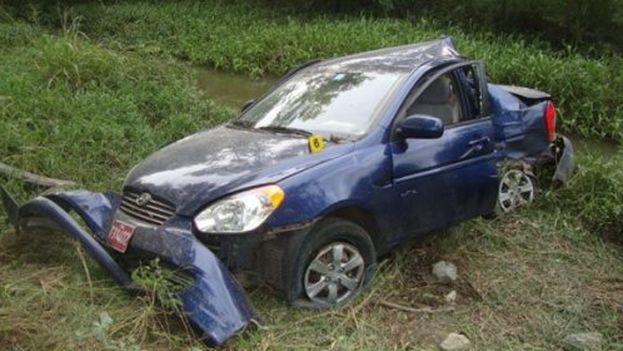
The car in which Harold Cepero and Oswaldo Payá were killed four years ago

Acevedo: The only meeting I had with them was a week after Oswaldo’s funeral. They called me in to ask if I was going to ask from compensation from Angel Carromero [the leader of the youth organization New Generations of the Popular Party of Madrid, who was driving the car in which Payá died and who was convicted of manslaughter). I told them I would not accept their version and I wanted to talk with the survivors. They never granted me that. The Cuban penal code does not give the victims a chance. My children were not allowed to attend the trial, which the regime had announced would be public. There was an immense repression in Bayamo [where the trial was held]. We could not carry out any legal action because a lawyer friend of the family said there was no chance to demand anything because of the criminal code.

I asked the government and the hospital for the autopsy report. They have never given it to me. I spoke to State Security, with Legal Medicine. Everyone told me that the hospital had to give me the report. The hospital administration, at six in the evening, after I did whatever paperwork was possible, told me to send it to them by mail and gave me a telephone number. The number didn’t work and we are still waiting on the autopsy. I wrote to the minister of Public Health. Rosa María tried to deliver a letter to the Cuban embassy, but they wouldn’t even let her enter the diplomatic site. Then we sent the letter in Cuba and we we had a receipt for it, but they have never answered.

14ymedio: What did Aron Modig (former leader of the Swedish Christian Democrat Party youth organization who was also in the car at the time of the crash) say about the day he Payá and Harold died?

Acevedo: Modig maintains his position. He doesn’t remember anything until reaching the hospital. It is a selective loss of memory. To me there are things that bother me sometimes in the media, because they talk about an accident, when we all know that it was a murder. A report by the international organization The Human Rights Foundation and another by physics professors at Florida International University demonstrated that it is impossible for [the crash] to have happened in the way the Cuban State says it did.

14ymedio: What legacy have Harold Cepero and Oswaldo Payá left?

Acevedo: The blood of freedom fighters is the seed of free men. This applies to Harold, Oswaldo, to all who have given their lives for human rights. The blood of innocent people, those who give their lives for others, is not spilled in vain. They crashed Oswaldo’s cars* when he was in the street. We keep fighting to give the Cuban people the possibility of deciding, which was Oswaldo’s fight as well. The Cuban government, in exchange, fights to destroy Cubans’ hopes.

*Translator’s note: There was a similar incident with another vehicle Oswaldo Payá was traveling in prior to the fatal crash.

See also:

Rosa Maria Paya’s Press Conference on the Crash That Killed Her Father and Harold Cepero

Angel Carromero Details Car Crash That Killed Oswaldo Paya and Harold Cepero

Interview with Rosa Maria Paya / Lilianne Ruiz, Rosa Maria Paya

The Political Legacy of Oswaldo Paya / 14ymedio

Human Rights Foundation suggests “Direct Responsibility of the Cuban Regime” in the death of Paya / 14ymedio

Carromero’s Courage / Orlando Luis Pardo Lazo

Surprising Sentence for Angel Carromero for the Deaths of Oswaldo Paya and Harold Cepero in a Car Crash / Yoani Sanchez

Roberta Jacobson Queries the Castros’ Crime / Rosa Maria Paya

Erdogan Unmasked / 14ymedio, Yoani Sanchez

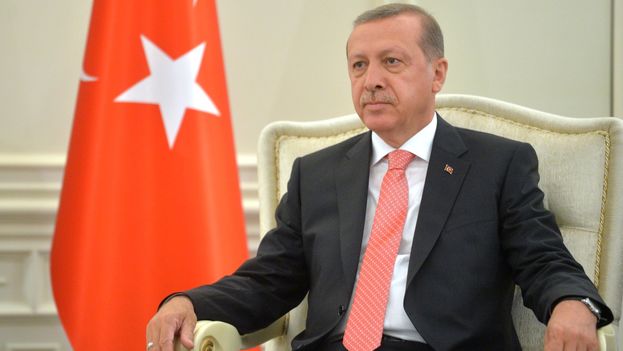
Recep Tayyip Erdogan became president of Turkey in 2014 after eleven years as prime minister. (DC)

14ymedio bigger14ymedio, Yoani Sanchez, Havana, 22 July 2016 — Recep Tayyip Erdogan has taken off the mask and let us witness the spectacle of his contorted and autocratic face. Last week’s failed coup d’etat has allowed him to unleash political persecution in Turkey. Now he rails against his opponents, decrees a state of emergency and suspends the European Convention on Human Rights. The sultan is out of control.

We are witnessing the moment when the serpent emerges from the egg, but we knew long ago it was incubating, its heart beating beneath the shell of an elected president. From playing at blackmailing the European Union with the refugee crisis and embracing other caudillos enthroned in power, in the style of Raul Castro, the red warning lights have been flashing all around Erdogan. continue reading

He just needed a justification. All he lacked was an argument with sufficient nationalist weight and the breath of a defensive gesture to show his true self. Now we contemplate the pure despot, without sweeteners. He no longer wants to pretend that he governs in a state of law. It suits his purpose that only one man is in charge of the situation.

With this turn of the authoritarian screw, the president of Turkey has betrayed those who elected him through the ballot box and the thousands of citizens who, just a few days ago, took to the streets to preserve the democratic order. None of them deserve this autocratic slap in the face.

Erdogan has ended up being worse than any coup, because he has broken the agreement. He used the attack on his person to arrest about 7,000 soldiers, accusing them of being linked to the coup attempt, and even publicly flirted with the idea of applying the death penalty, a punishment that is currently no longer in force in Turkey and that would prevent his country from becoming a part of the European Union.

The long arm of this unscrupulous authoritarian didn’t stop there, he has suspended 21,000 teachers from their jobs in private educational institutions. He has prohibited officials from traveling abroad and has withdrawn the broadcast licenses of 24 stations. A decision he justifies under the framework of an investigation to find the alleged collaborators and those involved in the failed coup.

Erdogan has taken advantage of the circumstances to request the extradition of Fethullah Gülen, an Islamic preacher exiled in the United States whom he holds responsible for all his ills, including the recent coup attempt.

Meanwhile, official spokesmen say that the state of emergency would only last 40 or 45 days and not three months as initially announced by the president. They promise that the current situation is not synonymous with martial law and that citizens will not be affected. They even assure that parliament will continue to function, but the Turkey that tried to maintain its chequered democratic journey has been broken.

Erdogan plans to dismantle all the plurality that the transcontinental nation has achieved and reduce the opposition to a minimum. He wants Turkey only for himself: a country that he can manage as if it were the Ottoman Empire, as he has dreamed of his whole life.

One Hundred Workers From India Rush To Complete Hotel In Havana

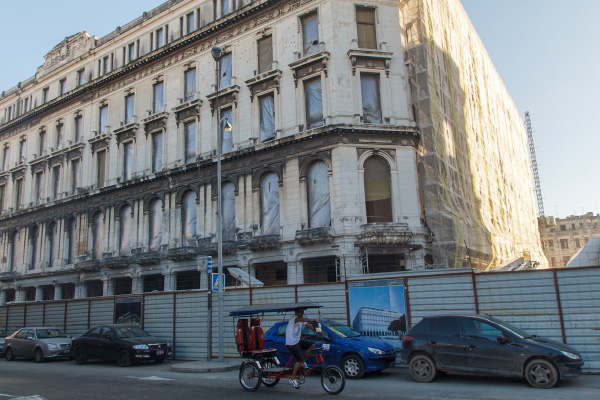
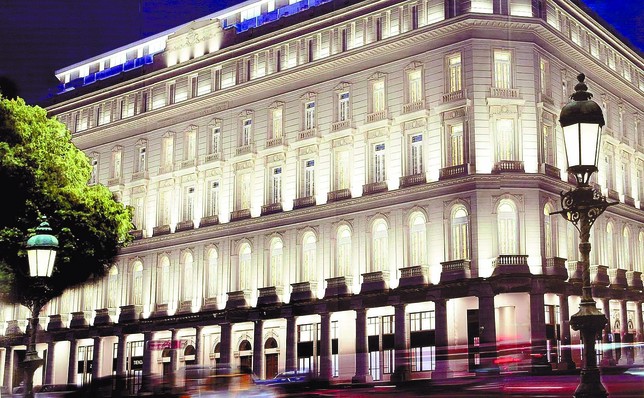
The Manzana de Gomez Hotel building today. Source: Havana Times
The Manzana de Gomez Hotel building, originally opened in 1910, prior to its renovation. Source: Havana Times

14ymedio bigger14ymedio, 21 July 2016 – Over 100 workers from India are working on the construction of the Manzana de Gomez hotel in Havana, being reconstructed by the French construction group Bouygues, according to Reuters. This is the first time there has been a massive contracting of foreign labor on the island.

The company resorted to the exception introduced by the Cuban government in the Foreign Investment Law, that authorizes “special regulations” with regards to foreign workers in “special circumstances.” continue reading

Apparently the delays experienced in the construction of the hotel, whose opening was scheduled for October 2016, in a context of high tourist demand, are the extraordinary reason, which has led to the contracting for these workers.

Although the government has not responded to questions fro Reuters, the workers interviewed by the agency and information confirmed by sources from the company, this appears to be the first time a company has passed over state workers on the island to hire their own from elsewhere.

A spokesman for the French Company, which it currently building three hotels in Cuba, says that Bouygues has plans to bring more Indian workers to the island, currently being trained, in the coming months.

Inderjeet Singh Chopra, one of the workers interviewed by Reuters, said more than a hundred of his compatriots are engaged on the island working as electricians, plumbers, carpenters and masons.

Similarly, a diplomat quoted by the agency, estimated that they are paying the Indians around 1,500 euros a month, more than ten times what a Cuban receives. “The Cuban workers are not well paid, so they have very little motivation,” he said.

A rendering of the rebuilt hotel. Source: San Cristobal UK Blog
A rendering of the hotel as it will look when it is rebuilt. Source: San Cristobal UK Blog

Travel, Whatever the Cost / 14ymedio, Marcelo Hernandez

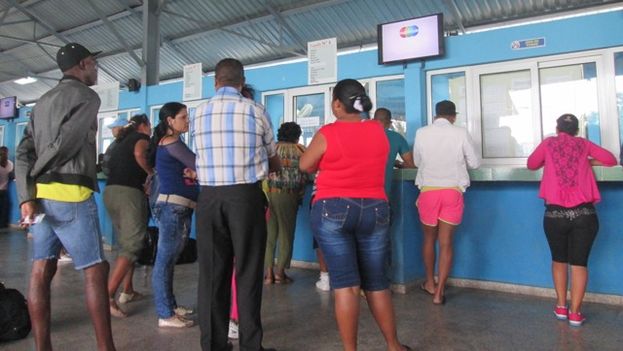
The "last minute" terminal in Havana for the purchase of interprovincial bus and train tickets. (14ymedio)
The “last minute” terminal in Havana for the purchase of interprovincial bus and train tickets. (14ymedio)

14ymedio bigger14ymedio, Marcelo Hernandez, Havana, 18 July 2016 – “Give me the suitcase, I’m off to the countryside,” says the chorus of a tune that gets more popular during the school holidays. Many families visit their relatives in rural areas, travel to tourist destinations in other provinces, or spend some days camping far from home. Interprovincial transport collapses with the high demand in July and August, while customers’ criticisms also intensify.

Under a roof of metal tiles that converts the place into a free sauna, hundreds of people are waiting this weekend to travel “last minute” or “on the waiting list” from the terminal on Puerto Avenue in Old Havana. Some of them no longer remember when they got there, because the hours have passed one after another, without hearing the good news that their number in line can board the next bus. continue reading

The expansive hall is a place where people spend a lot of time. Friendships are created there, some play cards and others take advantage of no one looking to have a sip of alcohol to help them forget the fatigue. The most impatient end up paying a private car to take them to their destination at ten times the price of the official ticket.

Iliana has worked there since they opened the new “last minute” terminal and knows that in these summer months the provinces most in demand are those in the east of the country. A situation that is repeated “at the end and beginning of the year, on some special dates such as Mother’s Day, school holiday weeks and summers.”

Near Iliana a woman dozes on a suitcase, a little boy cries because he’s hot and a furtive peanut seller manages to sell some of his merchandise. All are attentive to the monitors that announce the numbers on the waiting list that can board the next bus, but for several hours no vehicle “has seats.”

A murmur of discontent spreads among the passengers with the first numbers on the list of routes that are longest, to the east of the island. “That’s because the drivers themselves and the conductors resell free spaces before they get here,” complains a father with three kids.

The man asserts that the buses leave from the central Astro terminal, near the Plaza of the Revolution, and between there and the waiting list terminal
“the employees themselves sell the unoccupied seats, arriving at the terminal with only one or two, to be consistent with the formalities.” No other passengers join in the customer’s outraged complaint, some look at the floor and others fan themselves mechanically, their eyes glazed over.

The most prudent travelers are not at this location. They bought their tickets three months ago from the state interprovincial bus system, but such a decision takes a lot of forethought and quite a bit of risk. “I just had to be sure of getting to Morón after my wife confirmed she’d have a vacation from work,” said Raudel, who is from Ciego de Avila but has been living in Havana for the last two decades and this weekend is waiting at the “last minute” station.

Two young men in a corner of the hall decide not to wait any longer. “I’ll buy the ticket outside, because I have to be at my sister’s wedding in Palmarito del Cauto and if I don’t leave now I won’t get there in time,“ one of them tells several customers who are seated nearby. The young man will add to the 169 peso coast of a Santiago de Cuba some 15 convertible pesos – for a total of more than three times the official price – to get there.

“It won’t fail me,” he says, and he notes a connoisseur of the “mechanism” that makes things appear even when the blackboard says they’re out. “I pay and I get on the bus a few blocks from here,” he explains. “No one sees me and it’s just an agreement between the driver and me.”

Some have listened to the call to be careful. “The inspectors are everywhere,” warns a woman heading to Trinidad. There is a lot of surveillance, but it doesn’t fix the problems with transport, what they have to do is import more cars and lower the prices of the tickets which are too high,” she says.

In the recently concluded session of the National Assembly, the deputies criticized the constant violations in the itineraries in urban and interprovincial transport in the country. Also figuring into the debate were the corruption in the sale of tickets at some terminals, irregularities in the vehicle control stations, and the poor maintenance of the roads.

The deputies also mentioned the lack of comfort in the Yutong buses – from China – which operate on the interprovincial routes of the state company Astro, the lack of information for travelers, the disconnect between ticket prices and service, the overuse of the equipment and the poor cleaning standards. But this is only a distant echo for travelers who, lately, suffer firsthand the rigors of getting around the island.

Night begins to fall in the “last minute” terminal and some get comfortable in a corner planning to sleep on their luggage. “I do this twice a month, so this place is like my second home,” says a young woman who studies at the Higher Institute of Art. The rain sounds on the metal tiles and the loudspeaker emits the lucky numbers of those who will take the next bus.

“It Has Sparked Harsh Repression” / 14ymedio

A few months ago police stormed a children’s party being hosted by UNPACU. (Twitter)

14ymedio bigger14ymedio, 21 July 2106 — The harassment against the Patriotic Union of Cuba (UNPACU) intensifies. Several activists of the opposition organization have denounced the up to five raids that took place in the early morning hours this Thursday.

Ovidio Martin Castellanos, a member of UNPACU’s Coordination Council in Santiago de Cuba, confirmed to 14ymedio that antiriot troops entered the home of Jose Maria Heredia, on 8th Street in the Mariano de la Torre neighborhood. “They mixed antiriot troops with the political police. At the front was a Major from counterintelligence who calls himself Bruno. Once inside the house, they seized and stole his possessions. continue reading

Carlos Amel Oliva, on hunger strike since last July 13 “to protest the arbitrary confiscations” experienced similar interventions to those of last night, also explained in detail the raid on the house where the Heredia cell is organized and where the father of the youth leader Carlose Oliva lives.

“The operation was led by three State Security officers known as Charles, Bruno and Julio Fonseca. The troops were assault troops, officers fully clothed in bullet-proof vests with long shotguns. They entered my house, tearing down the first door, and taking a video camera and some documents. They also went into the house of some neighbors who have shown a lot of solidarity with me in previous days and took a laptop and hard disk from them,” he said.

The operation was even extended to a kindergarten managed by UNPACU that serves 20 children, children of sympathizers of the movement. There they confiscated a laptop and “frightened the coordinator who cares for the children,” according to the activists, who were relieved that the raid occurred at dawn and that there were no children in the house.

“It has sparked a harsh repression,” says Ovidio Martin, who adds that at Yasmani Magaña’s house, in Palmarito de Cauto, various slogans were painted on the walls, including “Viva Fidel.” According to the opponent, eleven people were detained in this operation, driven approximately 10 miles away and beaten before being released far from town.

“This wave of repression comes because the regime knows the situation that is looming. They are preparing the population for a new Special Period, because people don’t want to live through that again. To us, we are determined to take to the streets and we have attracted their sympathy, and they have intensified harassment because they are afraid that people are joining and becoming activists,” he says.

Carlos Amel has taken advantage of the new wave of attacks against the organization he belongs to, to detail the reasons for his hunger strike. Despite being determined not to eat until they return his belongings, he clarifies the meaning of his words. “It is not [for] a laptop and a computer, they are things that are not worth the life of any human being, but because they arrest us when we go out. Or come into our homes and take whatever they want. This is a constant violation of our rights,” he denounces.

Oliva has shown his appreciation for the support he has received from his organization and other opposition groups such as Somos+ (We Are More) and FANTU (Anti-Totalitarian Forum), and in real solidarity with Guillermo ‘Coco’ Fariñas, on hunger strike as of this Wednesday.

“I am a little weak physically, but firm in my position,” says Oliva. “I have received many calls from abroad, from friends, from media… it is very comforting, for someone on a hunger strike this is the only source of strength.”

Fariñas Begins Hunger And Thirst Strike To Demand Dialogue With The Government / 14ymedio

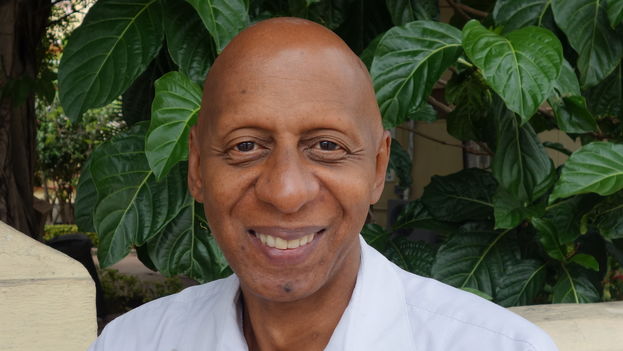
Cuban dissident Guillermo Farinas. (Wikicommons)

14ymedio, Havana, 20 July 2016 — Guillermo Fariñas, winner of the European Parliament’s Sakharov Prize for Freedom of Thought in 2010, has declared a hunger and thirst strike and as of dawn Wednesday to demand an end to the beatings of non-violent opponents in Cuba and that a dialogue be opened with government.

“It would be cynical of the Cuban government, which was a mediator in the dialog between the Colombian [FARC] guerillas and the authorities of that country, to be unable to sit down and dialog with a non-violent opposition to avoid these beatings and other outrages,” he said in a conversation with 14ymedio. continue reading

The opposition figure is asking Cuban president Raul Castro to “publically commit before national and international public opinion to cease these beatings, torture, death threats, the creation of false criminal charges against opponents, searching dissidents’ homes and confiscating the personal belongings of opponents,” and that the government “designate a vice president to meet with 12 prominent leaders of the internal opposition,” responsible for ensuring the end of the violence.

The announcement comes after Fariñas denounced, on Tuesday, a beating by police officers in Santa Clara, and would direct the Fifth Police Station to communicate with the Pinar del Rio Unit where a member of the Anti-Totalitarian Forum (FANTU) – the group Fariñas coordinates – who was arrested last Thursday.

“I offered no resistance, but they still beat me, they threw me into a patrol car, they forcefully handcuffed me, and used a strangulation technique to drag me to the patio behind the Central Fire Station in Villa Clara,” he says. The opponent said that after being transferred to the Provincial Criminal Investigation Unit in Villa Clara, they left him “handcuffed and exposed to the sun” and officials from the Special Brigade continued to beat him. “They told that this was the rigor that they would apply if I went out into the street again, better I dedicate myself to writing, because they would kill me,” he says.

Fariñas also wrote a letter to Raul Castro, in which he says he was “tortured while handcuffed by members of the Special Brigade of the Ministry of the Interior in the province of Santa Clara.” In the missive, he emphasizes that his phenomenon forms a part of the “wave of abuses, terror and violence,” that he has unleashed against “the non-violent opposition, which civilly faces totalitarianism.”

Fariñas has undertaken many hunger strikes. In 2010 he received the European Parliament’s Sakharov Prize for Freedom of Thought after 135 day strike in protest against the death of Orlando Zapata Tamayo and in a demand for better condition for 26 of the 75 prisoners of the 2003 Black Spring, who were suffering serious health problems. Finally, this strike and its media impact were decisive in the beginning of the process of negotiations that ended with the release of the 75 detained since March of 2013.

Guilty! / 14ymedio, Yoani Sanchez

This summer, taxi drivers have become the government’s new public enemy. (14ymedio)

14ymedio bigger14ymedio, Yoani Sanchez, Havana, 20 July 2106 – At the beginning of the year evil was incarnated in the intermediaries, who were blamed for the high food prices in the produce markets. At the end of 2013, the boogeymen were those who worked for themselves selling imported clothes and other merchandise. In February of this year the war against the pushcart vendors reached its height, and today the enemy drives a shared taxi, a person who in common parlance is called a “boatman.”

If there is anything that has characterized the Cuban system of the last 57 years it is its ability to find a scapegoat. When the agricultural plans are not met it is the fault of the drought, the indiscipline of the workers or the poor organization dictated by some low-ranking bureaucrat. If in times of heavy precipitation the water supply remains unstable in towns and cities it is because, “the rain is not falling where it should,” as was explained to us in recent statements by an official of the National Institute of Hydraulic Resources (INRH). continue reading

Urban transport does not work well due to “vandalism” and because “the population doesn’t treat this equipment as it deserves,” they tell us. Meanwhile most road accidents are because of the “recklessness of the drivers,” and not because of the poor state of the roads and highways, the terrible signage or the inventive measures taken by drivers to keep their obsolete vehicles running.

The powers-that-be point their index fingers in all directions to accuse others, but never turn it back on themselves. From time to time, to display a certain tone of self-criticism, they come down on Communist Party members themselves, and accuse them of not voicing their opinions “in the right place and at the right time,” or they make some minister take the fall for the failed policies in the areas of public health, education or some other sector.

We citizens are the main culprits, according to what state television tells us, for the presence of the Aedes aegypti mosquito that, for years, has failed to yield to spraying or campaigns against it. Our homes are the “main foci” of the mosquito, they spit at us from the press, as if state and government entities were untainted redoubts of cleanliness and order.

Emigration is also among our sins, because we go in search of “siren songs” and let ourselves fall “into the hands of the coyotes,” declares the Castro regime’s discourse. In this script it is third parties who are always to blame; the migrants who protested in front of the Cuban embassy in Ecuador were ‘scoring points’ with the United States and some of them, once they are settled in our neighboring country to the north, will end up sending “illicit funds” to their relatives on the island to support a private business.

The easiest to find are the external enemies, like imperialism, “the criminal United States blockade,” the conspirators “from the Latin American right,” and even the “historic betrayal” of the old comrades of Eastern Europe. This scarecrow to install fear is accompanied by the demonized “counterrevolutionaries” in our own backyard, who are targeted by all the insults the rude government machinery has created over almost six decades.

If products are missing on market shelves, television reports accuse the “profiteers.” If a papaya has come to cost an entire day’s wages for a professional, it is “the fault of the unscrupulous” who want to “profit at the expense of the people,” or so they lecture us from the little screen. In this apportioning of blame we have all been placed in the center of the allegations.

Right now the government propaganda apparatus is taking on the drivers of shared taxis, but tomorrow it could be the proprietors of private restaurants, the teachers who offer private tutoring, or the water carriers who sell their precious commodity in neighborhoods where the pipes have run dry for weeks now.

There will always be an “evildoer,” an “irresponsible” or an “enemy” that keeps the system from working in all its great manual-guided humanity, its never demonstrated efficiency, or it supposed but still un-proven capacity to make Cubans happy.

But the strategy of blaming others, in waves and programmed installments, has a weak point. There comes a time when the culprits outnumber the accusers. There is a second in which, from this side, from the stigmatized, we agree with the rafters, the dissidents, the pushcart vendors, the self-employed, the taxi drivers, the ousted ministers and the vilified trinket sellers. At this point, where we have been for a long time now, we have every right to point our index fingers at the system that has condemned us to the perennial dock of the accused.

Hurricane Isidoro’s Victims Are Still Waiting / 14ymedio, Ricardo Fernandez

14 years after Carlos Lage’s promises, the victims of Hurricane Isidoro remain without their homes. (Ricardo Fernandez)

14ymedio bigger14ymedio, Ricardo Fernandez, Pinar del Rio, 19 July 2016 — “I pledge that very soon you will have your homes,” Carlos Lage Davila, vice president of the Councils of State and Ministers, said in 2002 to those who had lost everything and still today have not received what he promised.

Alexander Sanchez Villafranca, 33, was one of those affected by Hurricane Isidoro. “If I had listened to my mom and had cut down the mango tree, I would not be in this shelter. I never thought that the wind could pull it up by the roots,” he says. His home, at kilometer 1 in Santa Damiana, was reduced to rubble under the weight of the tree. He is among the 16 families living in shelters in Portilla in Rio Seco, in San Juan y Martinez municipality, as a result of Hurricanes Lili and Isidore. continue reading

The place, 19 kilometers from Pinar del Rio, had been a military unit of the Youth Labor Army (WCY), then in 1994 became a Battalion Task Force that housed those who came to support tobacco workers, and in 1995 it became a warehouse for oilcloth.

In 2002, after the hurricanes, they used it to receive the victims from Santa Damiana, Forteza and Rio Seco, who had no means to rebuild their own homes. Within a month of being there, they received a visit from Carlos Lage Davila, accompanied by former first secretary of the Party in the province, Maria del Carmen Concepcion, and other government and party officials.

At first, the mass organizations delivered lunch and dinner to residents, who were seen by a family doctor daily. Then-delegate Sergio Carrelegua visited them frequently and at meetings urged them to be patient and assured them that the promises would be fulfilled. “A few months later the attentions and promises disappeared,” recalls Sanchez, now married with a daughter of six who has known no other home. “Over time the roofs began to deteriorate and the solution from the delegate was to remove the roofs over the bathrooms and use them to replace the broken tiles over the bedrooms, so the toilets have no roof.”

The situation gets worse in the spring because of the rains, and for the elderly, whose health is delicate, dampness is a greater risk. “In the rainy season you have to do everything (even the physiological needs) in your bedroom,” says an old woman to illustrate the “hell” she is living in.

“I don’t know how many times I’ve gone to the municipal government to demand that they help us, but they don’t do anything,” says Arelys Rodriguez, Sanchez’s wife, while showing off the poor hygienic-sanitary conditions of the outdoor bathrooms. “I have to carry water from the neighbors’ house, because the raised tanks are uncovered and are filled with decomposing frogs, bats and even pigeons. I’d die before I drank that water,” she says with disgust.

Sanchez talks about his effort in agriculture, the work he does as a laborer, hoping that a relative living in the United States will help get her out of the hostel and he can buy a house. Meanwhile, her little daughter Thalia flits around her. That little girl, with her innate curiosity and boundless naiveté, manages to help Sanchez forget for a moment the neglect and misery that surrounds her.