Havana Impedes Progress of Obama’s Policy Toward Cuba / 14ymedio, Pedro Campos

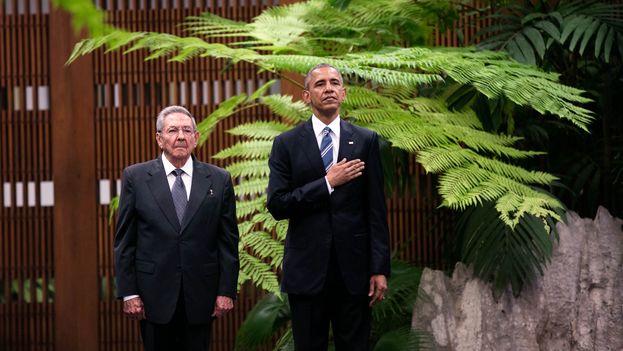
 US president, Barack Obama, and his Cuban counterpart, Raul Castro, in March of 2016 at the Palace of the Revolution in Havana. (White House)
US president, Barack Obama, and his Cuban counterpart, Raul Castro, in March of 2016 at the Palace of the Revolution in Havana. (White House)

14ymedio bigger14ymedio, Pedro Campos, Havana, 18 July 2106 — Paradoxes of history: The United States and Cuba began a process of normalization of relations on 17 December 2014 and with the visit of President Barack Obama to Havana in March of 2016, aimed at expanding and deepening what has been achieved, came the counteroffensive of Fidel Castro to put on the brakes with his sarcastic Reflection column titled “Brother Obama.”

Since then, not only have they pushed the stop button on the process of rapprochement with the “main enemy,” difficult by nature, but they have increased the government’s repression against the opposition and those who think differently, and begun advancing positions against the reforms initiated and slowly developed since Raul Castro assumed power. continue reading

The clear moment of the halting of the process can be found in the Seventh Congress of the Cuban Communist Party (PCC), which supported the statist-wage model as the axis of the economic system, and the only party as the base of the political system, while at the same time postponing the expected renewal of the ruling elite.

Documents of the “conceptualization” and the 2030 Plan reference the stagnation and recent speeches by Raul Castro and other deputies, calling for confronting the critical situation looming with more of the same. In the most recent session of the National Assembly, they unambiguously supported the anti-reformist course.

This doubling-down on state-socialism comes accompanied by the decline in the authoritarian wave Latin America, especially the crisis in Venezuela.

Meanwhile, there is the push and pull in the US Congress for and against the policy changes toward Cuba favored by Obama. More recently, in the House of Representatives, support has grown to not loosen the strings of the embargo-blockade thanks to the Cuban government’s open reaction against the new policy out of a fear that the rapprochement will end up giving control of Cuba’s economy and society to the United States, as if the “American Dream” did not already draw a great part of the island’s population.

In this sense, Mario Diaz-Balart, a member of the Appropriations Committee of the House, told El Nuevo Herald that “there is bipartisan support in the House to strengthen sanctions against the regime and reject the policy of appeasement of the dictatorship.”

However, the counter-reform is in open contradiction with the economic policy of the island Government that is trying to benefit from money coming and expected from the exchange with the US and especially its tourism, particularly now that the Government of Venezuela is less able to continue sending oil to Cuba.

Measures have already been announced that clearly recall the worst moments of the so-called Special Period, which never ended. They want to blame imperialism “for creating the crisis in oil prices and destabilizing the Bolivarian Revolution,” when nobody doubts the Party-Government-State’s opposition to undertaking real economic reforms, to making consequent progress in the relations with the United States and to relieving the pressures of the internal political environment.

With these policies, the Cuban government is contributing to consolidating the support in the United States Congress for not loosening the embargo, which is directly proportional to Havana’s policies in support of Fidel’s faithful, reaffirming a proclamation of isolation and “anti-imperialism,” while running like the devil from the cross in the face of rapprochement, dialog and exchange.

The latest battle between the two forces just took place when the Cuban government refused to allow the United States commission charged with reviewing the conditions of the island’s airports to enter the country, and when of a group of U.S. legislators presented a bill to block travel to Cuba until the necessary security norms are met.

The United States Transportation Security Administration (TSA) said it will not allow flights to Cuba until it is convinced that island airports are as safe as those of the rest of the world.

If anyone had doubts, this event is the latest evidence of how the Cuban government, while showing a negotiating face, in practice hinders any progress in the normalization of relations. But regardless of who is at fault for the new Special Period, for the lack of progress in relations, the failure of the tourism that would save us will surely be the fault of the United States “blockade.”

More UNPACU Activists on Hunger Strike / 14ymedio

The UNPACU) youth leader, Amel Carlos Oliva. (Center for Coexistence Studies)
The UNPACU) youth leader, Carlos Amel Oliva. (Center for Coexistence Studies)

14ymedio bigger14ymedio, Havana, 18 July 2016 — The Patriotic Union of Cuba (UNPACU) reports at least twenty have been arrested in recent hours, after five activists, on Monday, joined the hunger strike started six days ago by the organization’s youth leader, Carlos Amel Oliva, to demand the return of two laptops, a cellphone and a removable hard disc confiscated by the police.

“The repression has been tough. Some 16 activists were arrested in Santiago de Cuba when they went to visit Oliva. The arrests were violent,” one of the opposition group’s coordinators, Ovidio Martin Castellanos, told 14ymedio. In addition to those arrested in the provincial capital, nine other people were intercepted in other areas of eastern Cuba, like Palmarito de Cauto, in the municipality of Mella. continue reading

Katherine Mojena Hernandez, wife of the youth leader and UNPACU member, said that Oliva is physically weakened, “but with the same fortitude with which he started the strike.” She added that the one who calls himself “Official Bruno” personally told Carlos Amel that “you are going to die of hunger” if he waits for his belongings to be returned.

Lazarus Curvelo Mejia, one of the Cubans who has been on hunger strike for four days, said he was willing to support the demand of Carlos Amel until the final consequences.

Among the five activists who have supported Oliva are two women, Zulma Lopez and Joanne Quesada.

The activist Yasmany Magaña from the province of Santiago de Cuba also joined.

UNPACU has denounced the increase in repressive actions against its organization, which it attributes to its growing membership throughout the island.

The group of hunger strikes, in addition to Oliva, includes Lazaro Curbelo Mejias, who has been on strike since the 15th of this month, Maikel Mediaceja Ramos, Zulma López Saldaña, Yoanna Quesada Masabeaux and Yasmani Magañana Díaz who have spent between 24 and 48 hours without eating.

Making a Living Off Coffee / 14ymedio, Ricardo Fernandez

Café Soler’s customers in Pinar del Rio. (14ymedio)

14ymedio bigger14ymedio, Ricardo Fernandez, Pinar del Rio, 16 July 2016 — In the early morning hours insomniacs, travelers and night watchmen are surprised to find an ode to excellence in a cup of coffee.

At 3:00 in the morning the rush to prepare the nectar begins at the clinic on 27th of November Street between Maceo and Marti in Pinar del Rio, where Luis Armando Cabrera Soler lives. His wife, the doctor Madalina, helps him to organize the thermoses, bags and harnesses he uses in providing the service. Meanwhile, the guard working on the corner is seduced by the spreading aroma. continue reading

“I have a light on my cap so the customers don’t have to walk to the spotlight when they want to buy, but then I realized it worked as a kind of promotion,” said Luis, who started selling a thermos of coffee in June of 2013 and now has increased production fivefold. “I got the idea of varying the menu preparing cortadito from a taxi driver they call loco, because I saw it in Havana. Since then I added chocolate, cappuccino and café bombón. The chocolate intensifies the flavor of the coffee and the cappuccino follows the traditional standards, the bombóm (a mix of condensed milk, chocolate and coffee) leaves a pleasant taste in the mouth.

Without his having to hawk his products, the customers come to him. “The best advertising is the quality,” he says. “When it’s a large bill and I don’t have change I just give them a free coffee. I don’t lose money because I end up winning customers,” he says.

Luis does not mince words when he talks about the origin of the coffee he serves. “I sell 100% Café Soler,” he says, while showing us the logo he designed himself, “harvested by my family, roasted and steeped by me. I don’t have that many plants so I’m not forced to deliver the coffee [to the state]; but it’s enough for me for the year,” he says, referring to the parcel he owns in Sumidero in the municipality of Minas de Matahambre.

The state monopolies are the only legal buyers of the beans and to enforce that control there is a framework of laws that equate trafficking in coffee with crimes such as theft or illegal departures from the country.

The only legal way to market coffee is to buy it in the state’s Hard Currency Collection Stores and the high prices mean the business is not viable, so the self-employed generally turn to the informal market.

“The hardest thing to get is disposable cups. There is no place to buy them, I have to rely on the good will of neighbors and friends who bring them to me from abroad,” he comments, while serving coffee.

Cabrera worked as a buyer for the Pinar del Rio Fuel Company which belongs to the Ministry of Energy and Mines, work that, out of fear, he made compatible with selling coffee. “Many are afraid to trade a job for a business. I decided to take this step as long as the earnings are stable and the work shifts didn’t interfere with sales.”

With characteristic island humor and the amiability of someone who even lights the cigarettes of those who like to smoke while they drink their coffee, Cabrera knows how to relax the disaffected and cheer up the reticent. “What series bills do you want?” he jokes with someone who rejects coins in change. “My goal is to make the customer happy even with the change,” he says.

Generally sales end at 9:00 in the morning and then the preparations begin for the next day: roasting the coffee, grinding it, cleaning the thermoses with chlorine and washing the many towels used to wipe up the drips, removing the stains from the white coat he wears while selling and, finally, doing the accounts. This ends Luis Armando Cabrera’s day, and he does not repent becoming a small businessman.


Mariano Murillo, the Marked Card Up Raul Castro’s Sleeve/ 14ymedio Reinaldo Escobar

Mariano Murillo, former Minister of Economy and Planning

14ymedio bigger14ymedio, Reinaldo Escobar, Havana, 15 July 2016 — The ouster of Marino Murillo as head of the Ministry of Economy and Planning (MEP) raises the question of whether it was a fall into disgrace or an act of protection. An official statement said that Murillo would dedicate himself to the implementation of the Communist Party Guidelines and recognized his work as minister. The praise contrasts with the terrible results of the Cuban economy in the first half of this year and raises the question of whether Murillo’s removal, in reality, hides a promotion.

It is obvious that Cuba’s current situation is producing an important shuffling in the higher echelons of the government. The replacement of the first secretary of the Union of Young Communists, the untimely replacement of the Minister of Culture, and the departure of the head of Higher Education, have put the entire cabinet on notice at a time when even the official media speak of “the critical situation the country is experiencing.” continue reading

However, the “fall” of Murillo could also be interpreted as a strategy to distance him from blame for the disaster. What is more important: the management of the Ministry of Economy and Planning or the implementation of the Party guidelines? In the latter case, removing his ministerial portfolio would be a protective mantle placed over the former minister by Raul Castro himself. As if he wants to make people see that “if the economy is bad, it’s not Murillo’s fault.”

Why should he save Murillo? The answer to that question is in the future, at the end of 2017, when it will be made clear whose names will appear on the candidate list for the positions of president of the Councils of State and of Ministers, that Raul Castro will step down from in February of 2018, having come to the end of two consecutive terms.

If, finally, the current first vice president, Miguel Diaz Canel, replaces the General-President, the second echelon of these responsibilities would immediately become vacant. In a few more years, given the inevitable physical disappearance of the “historic generation,” a depleted quarry of cadres – lacking experience in power and also lacking prestige among the people – will have to take over in what will necessarily be a transition.

Since the high-level house cleaning that took place after Raul Castro took possession of the position of president, when Carlos Lage Davila, Felipe Perez Roque and Carlos Valenciaga, among other promising “younger sons,” were removed from their posts, the question of who will replace the current leaders has become more difficult to answer.

Sending Murillo out by the back door today, would be losing an unrecoverable card that has taken many years to develop. Compared with Jose Ramon Machado Ventura, the former Economy minister, he appears to be a reformer, a pragmatic politician who has spoken clearly about the need to produce wealth, and we have never heard him mention socialist emulation or moral encouragements as methods to boost production of material goods.

Murillo is a marked card which Raul Castro has kept up his sleeve all these years and he will not be discarded for the triviality of failing to deliver 50% growth in gross domestic product for this year. The so-called czar of reforms is the face that can give foreign investors confidence. Gone are the days when candidates for the throne had to make a show of their oratory, their imagination in creating new slogans or their histrionic capacity to show up for volunteer work.

Ricardo Cabrisas Ruiz, vice president of the Council of Ministers, has been named as a substitute for Marino Murillo in the MEP. His claim to fame is having convinced half of the world’s creditors to renegotiate the country’s foreign debt. Together they make a good match to try to save the shipwreck of a nation adrift.

If Murillo and Cabrisas are to steer the ship in one direction or another, they will have to conquer a faithless people and convince the Taliban that they are not betraying the legacy, or make them see that there is no choice but to start all over from the beginning.

A Phone Number for Cubans to Report Taxi Drivers Who Overcharge / 14ymedio

An almendrón at Fraternity Park in Havana. (14ymedio)

14ymedio bigger14ymedio, Havana, 18 June 2016 — The Directorate General of Transportation has taken a further step to freeze the fares for private transportation in Havana. Price controls take effect this coming Monday, and a phone number – 18820 – has been established for customers to denounce boteros (“boatmen” as the drivers are popularly called) who raise prices on the passengers, according to the official press.

Drivers who violate the prices agreed by the state entity will be penalized by the confiscation of their licenses to work as self-employed. A measure that has begun to raise complaints among the private drivers of passengers transport. continue reading

This Saturday, around Fraternity Park, one of the starting points of the so-called “almendrones,” opinions were being voices about the price controls. Some drovers said that they wouldn’t drive on Monday, a way to pressure the government to withdraw the measure.

“I am going to take this opportunity to do some repairs on the car and wait to see what happens with all this madness,” Luis Tamayo, driver car model popularly known as a pisi-corre (station wagon), told 14ymedio. However, the man also clarified that no agreement has been reached among those affected. “No, it’s not about a strike, but we will wait until everything calms down,” he emphasized.

The driver fears that the telephone number for complaints will be used “ to take on people who haven’t committed any violation. Anyone who has something against me, could call this command post and end by ability to make a living,” he explains.

The Provincial Director of Transportation in Havana, José Conesa González, said in a press conference, that a process of written notice to all carriers and their assistants has begun. In the document it states that prices are not to be increased higher than those “referenced as of 30 June of the current year.”

However, the drivers allege an increase in the price of fuel in the informal market, due to the cuts in the oil supply of state entities from where it is diverted to the illegal networks. The cost of a liter of fuel bought “under the table” has risen from 8 to 15 Cuban pesos (CUPs). The gas stations sell it for more (1 Cuban convertible peso, the equivalent of 24 Cuban pesos), and to few of the drivers buy it in the state service stations.

“The government has failed us all these years because it has not facilitated a wholesale price to buy oil or gasoline,” the driver a jeep who drives the route to Alamar, to the east fo the city, said on Saturday outside the capitol building.

The acting vice president of the Monitoring and Control Activity, Isabel Hamze Ruiz, said at an emergency meeting that conditions “have not changed” to justify an increase in the cost of transport and that the price of fuel is “stabilized” in the country. Nor have the fees and taxes paid by the self-employed varied, according to the official.

Customers are torn between satisfaction and alarm at the capped prices. “It will happen like it did with pork and other foods, they capped the prices and now you have to get up at the crack of dawn to get anything,” Miriam, a mother of two, complained this morning while waiting for an almendrón near the Computer Palace.

In a call to the new phone number to report drivers who violate the rules, this newspaper’s newsroom was able to confirm that it is already in service and works around the clock.

Cuban Government to Set Price Controls on Private Transport on Monday / 14ymedio

A shared fixed-route taxi, known as an "almendrón," in Havana. (14ymedio)
A shared fixed-route taxi, known as an “almendrón,” in Havana. (14ymedio)

14ymedio bigger14ymedio, Havana, 15 June 2016 — The Cuban government will apply price controls to private transport starting Monday, according to information broadcast on official television this Friday. The measure seeks to put the brakes on the rising prices of shared fixed-route taxis – the collectivos – serving various routes in Havana, due to the increase in the price of fuel which the drivers buy on the informal market.

The rates will return to the levels prior to the latest increase decreed by the drivers, who raised prices from 20 to 40 Cuban pesos (roughly from 75¢ to $1.50) on the longest trips and from 10 to 20 Cuban pesos (CUPs) on the shortest trips on the most popular routes, such as Lisa-Capitolio, Santiago de las Vegas-Fraternity Park or Virgen del Camino-Vedado. continue reading

Isabel Hanze Ruiz, acting vice president of the capital’s provincial Administrative Council, said on primetime news that the terms of the agreement made by the Council is being communicated to the drivers and compliance is mandatory.

Violation of the regulations “will be considered a very serious offense and offenders will be punished with confiscation of their license to operate privately,” the official added.

Most of the collectivo taxies, known as almendrones (after the almond-shape of the old American cars commonly used in this service), run on gas. The price at the official service stations is 1 CUC per liter (approximately 24 CUPs or roughly $4 US per gallon), but the taxi drivers primarily buy their fuel on the illegal market which is supplied by product “diverted” from State supplies.

Until the end of June, a liter of fuel on the black market cost between 5 and 8 CUPs. However, Venezuela’s economic problems and its failure to fulfill its commitments to supply oil to Cuba, has forced severe restrictions on the allocation of fuel to the state sector.

In most government run companies and institutions, delivery quotes of gasoline and oil have fallen by 30%. This decision has contributed to a reduction in the availability of fuel in the informal market, the scarcity of which has led to an increase in prices.

Some of the private taxi drivers, known as “boatmen,” have told 14ymedip that if they had to depend only on the fuel sold at state gas stations they would not be able to work, “because nobody would be able to pay the fares.”

Among the passengers who regularly use this service, there are fears that starting on Monday, 18 July, there will be a significant decrease in the number of shared fixed-route taxies on the streets of Havana.

It is not the first time this year that the government has used the policy of price caps. Some months ago, it did so in the state produce markets as well as those managed by cooperatives, which has contributed to shortages and a drop in quality of the products.

Exile Group is Creating Database Of Cuban Repressors To Share With US / EFE, 14ymedio

Presentation Thursday of the page 'Register a repressor'. (Facebook)
Presentation Thursday of the page ‘Register a repressor’. (Facebook)

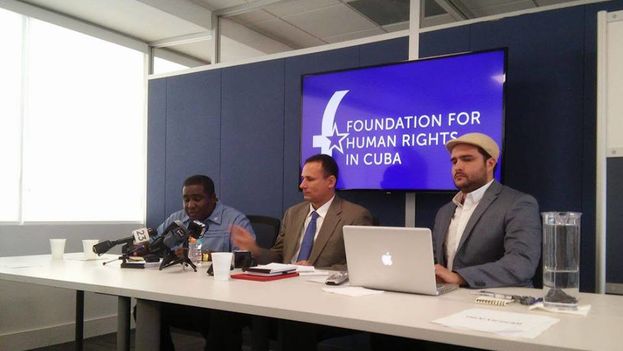
14ymedio biggerEFE, 14ymedio — The Foundation for Human Rights in Cuba (FHRC) announced Tuesday in Miami the creation of a database of Cuban repressors that will be shared with governments, especially the United States.

Juan Antonio Blanco, FHRC director, told EFE that the initiative is aimed at the “Cuban repressive body” and is an opportunity for its officials to “repent in time” and to counter the rise of this violence against opponents in Cuba. continue reading

The activist said that there is an onslaught against the opposition caused both by the social and economic crisis, and by the “growing exodus,” among other factors.

The project is a way “to contribute to stopping this madness in time,” said Blanco, adding this it is not about a witch hunt or revenge.

“We do not want a truth commission in 20 or 30 years where these people are going to repent, and for what!” he said.

The project, he explained, will support an initiative undertaken by a group of lawyers in Miami, led by Wildredo Allen, that has been collecting information on these abusers for four years.

Now, this database of photos, videos, the names of the oppressors and other information will be expanded with more information through exile organizations in Miami and the opposition in Cuba, and also from individuals who want to provide evidence.

Blanco said they will only collect the information, which will be confirmed by experts in human rights from organizations such as the United Nations and the Organization of American States and many other civic groups expert in this kind of material.

The expert noted that only complaints that have been confirmed by multilateral human rights organizations because they are “credible and possible” will be entered into the database that will be shared with governments, among them the United States.

Marino Murillo Leaves His Ministry To Devote Himself To The Management Of Cuba’s Economic Crisis / EFE, 14ymedio

Mariano Murillo, former Minister of Economy and Planning in Cuba. (EFE)

14ymedio biggerEFE/14ymedio, Havana, 14 July 2016 – Cuba’s Council of State, at the request of president Raul Castro, has named Ricardo Cabrisas minister of the economy, replacing Marino Murillo, who remains a vice president and will chair a commission in charge of reforms to update the country’s economic model.

The change was announced Wednesday in an official note published in the official media, where it was also reported that the Minister of Higher Education, Rodolfo Alarcon, has been replaced by the department’s vice minister, Jose Saborido. continue reading

In the case of the Minister of Economy and Planning, the change reflects the need for Marino Murillo – considered Cuba’s “czar of reforms – to concentrate his efforts in the related tasks of updating the Cuban economic and social model,” according to the official note.

Cabrisas, his replacement in the Ministry of Economy and also a vice president, “has vast experience and training demonstrated in the exercise of responsibilities” in the Executive “and in undertaking important missions, including the recent process of successfully managing the restructuring of Cuba’s external debt,” the statement added.

The State Council recognized “the work done by compañero Murillo in fulfilling the duties of the office of minister” of Economy.

These changes occurred after Raul Castro’s recognition on July 8 before the National Assembly that the Cuban economy is experiencing “stress” and “adverse circumstances” caused, among other factors, by the crisis in Venezuela. The island’s main ally, Venezuela has reduced oil shipments to the island.

After rejecting speculation about the “imminent economic collapse” of the island, President Raul Castro announced at the session a plan of measures to confront the situation, which requires savings, reductions in expenses and energy use restrictions.

In the Ministry of Higher Education the new head will be Jose Saborido, who has been deputy minister for four years.

Saborido holds a PhD in Economics and until moving to the ministry held positions in education as an instructor, professor, dean, vice chancellor and provost.

In this case, the Council of State did not specify in its official note the reasons for replacing outgoing minister Rodolfo Alarcon, but recognized his “meritorious career. ” Alarcon had served in the position since 2012 and previously had served for two decades as vice minister.

“The Tentacles of Castroism Are Long” / 14ymedio, Mario Penton

Efrain Sanchez Mateo refuses to abandon his countrymen, whom he calls brothers. (14ymedio)

14ymedio bigger14ymedio, Mario Penton, Miami, 13 July 2016 — Desolate, but firm and willing to continue fighting for Cubans, whom he calls “my brothers.” Thus, Efrain Sanchez Mateo defines himself after serving a sentence of five days in jail for allegedly assaulting a police officer during the eviction of Cuban migrants camped at El Arbolito Park in Quito, Ecuador.

“That was something they were planning for a long time, but they didn’t have the courage to do it. The turning point was our protest outside the Cuban consulate in Quito,” explained Sanchez Mateo. The unprecedented march in which hundreds of migrants repudiated the statement from the embassy accusing them of trying to score points to get political asylum “frightened the regime,” added the Cuban. continue reading

“How long are we going to continue supporting the Association of Cuban Resident in Ecuador (ACURE)? How long will we continue supporting the lies of an embassy that doesn’t represent us?” he says in a reference to the accusation of the pro-Castro association that accuses them of receiving money from abroad and “serving the interests of Miami.”

“If this inhumane action and violation of human rights committed by the Ecuadorian government in collusion with Cuban State Security has made something clear, it is that nobody has sustained and supported us from the outside,” he argues.

Mateo, a coordinator of Cuban migrants, says the presence of the Mambi or “Freedom” encampment, as he called their tents in the Quito park, had authorization from the police and the Ministry of Social Inclusion and they have evidence to prove it.

“We had been promised they would not intervene. We had an organization and lived in solidarity with other Cuban brothers and many who are still there, having no place to sleep, went to work and carried on the cause,” he comments.

Ecuador’s Vice Minister of the Interior, Diego Fuentes, told the press that it wasn’t exclusively about the Cubans, but “of migratory control that affects all citizens and all nationalities.” The official also explained that these controls sustain “a regular and responsible migratory flow” that will avoid the “abuse” of Ecuador’s image of universal citizenship and open doors, something that Mateo agrees with.

“The night the camp was evacuated, the police followed the same modus operandi as they used the first time when they evacuated the migrants from the around the Mexican embassy,” he explained. “They came at midnight and about two in the morning a large group of police and anti-riot troops evacuated the place. However, this time they used migration control as a pretext, so it could not be called an eviction, but it’s clear that the motive was xenophobia against Cubans,” he says.

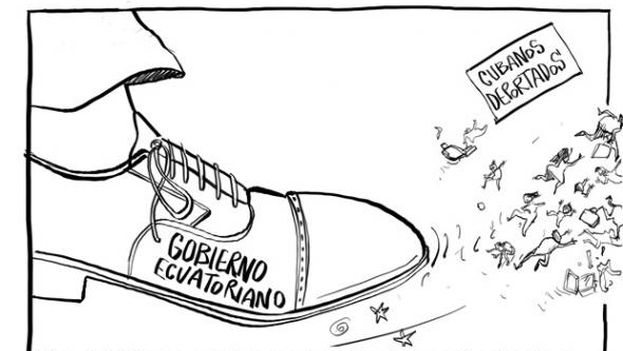
Caricature by Bonil, El Universo, 11 July.

“We men try to protect the women. We are beaten and threatened. Cuban State Security agents in plainclothes in among the Ecuadorian police tried to catch me. Every day I receive threats toward me and my family, because they believe it will make me abandon my brothers. I regret what happened, but I will not do that, neither those in Cuba nor those here,” he says.

Efrain Sanchez Mateo regrets that the Cuban community abroad has not shown their support for respect for the rights of their compatriots in Ecuador. “We have been beaten, our rights have been violated, we are trying to escape communism and they have left us on our own,” he laments.

“I call on the internal opposition in Cuba and those who fight for their freedom from exile. Do not leave the 75 Cubans who were deported to the island on their own. Do not let them fall back into the clutches of the government,” says Mateo says he is in contact with several of those who have been repatriated and has urged them to continue what they started in Ecuador.

At 3:30 am on Wednesday morning, a judge responsible for procedural rights and guarantees rejected the habeas corpus petition for 47 of the 48 Cubans being held at the Hotel Carrion. Yesterday afternoon a group of Ecuadorian and Cuban protestors demonstrated their support for the migrants with protest actions in front of the court. On Monday morning, Ecuador completed the second transfer of Cubans to their country of origin, bringing the number of those repatriated to 75.

“The Cubans in Ecuador could not possibly show more courage. We did everything possible, but the tentacles of Castroism are long,” he adds.

“They are afraid of us” / 14ymedio Reinaldo Escobar

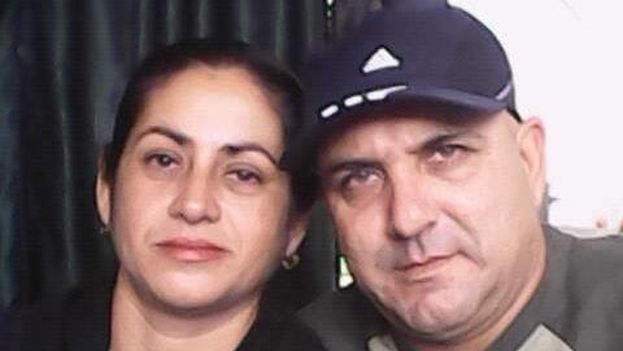
Armando Avila and his wife, Yurisleisy Pérez Calzada. (Facebook)

14ymedio bigger14ymedio, Reinaldo Escobar, Havana, 13 July 2016 — Before leaving Cuba, Armando Avila was an auto mechanic specializing in brake systems in Ciego de Avila. In December 2015, he took a flight to Ecuador with the intention of reaching the border between Mexico and the United States to invoke the Cuban Adjustment Act. On July 9 he was returned to Havana by force, in a group of 29 Cubans deported by Rafael Correa’s government.

Avila, 45, spoke with 14ymedio by telephone on Monday and said he did not feel like a deportee or a returnee, “but someone kidnapped.” The migrant, who wanted to keep his current whereabouts unknown, recalled that “the laws of Ecuador consider that no one is illegal and they can only deport those who have committed a crime.” continue reading

One day after the deportation of Avila, a new group of 46 Cubans, also repatriated from Ecuador, arrived on the island. Island authorities claimed in a note that the deportations were carried out “in strict compliance with the provisions of the legislation of both countries and existing international standards for this type of situation.”

However, Avila maintains that he had presented his case “before a legal hearing and less than one day before learning of the outcome” he was arrested. “At 2:40 in the morning they took all our belongings, I was handcuffed and put into a military plane that took us from Quito to the province of Esmeralda and from there to Cuba,” he explains.

A few hours after arriving in Havana he learned that he was acquitted at the hearing, which means that there were no “grounds for deportation,” he insists. Thus, he considers himself to have been a victim of revenge or a “policy violation,” motivated by his having exposed, in Ecuador, “the reality we experience in Cuba.”

Avila returned to Havana, despite the official press note saying that “all” of the people were taken to their “home provinces.” However, his wife, Yurisleisy Pérez Calzada, was not deported and remains in Ecuador.

Avila says he fears for his life. “Upon arrival at Jose Marti International Airport in Havana, waiting for us was a squad of riot police, several police officers and a large number of senior officers of the Interior Ministry.”

He said that the group was treated as if its members were “terrorists.” “They divided us by provinces and we were told to wait, that later we would be contacted to determine our situation,” he says.

On Monday, the defense lawyers for the Cuban migrants in Ecuador denounced the violation of a habeas corpus petition that had been submitted to avoid repatriation. The lawyers have questioned the constitutionality of the measure, because since 2008 Ecuador’s Constitution has recognized “free human mobility.”

A complaint about possible violations of the law join the accusations against the Ecuadorian police for acting violently against Cubans being held in the Hotel Carrion detention center and the Flagrancia Unit.

Avila intends, this Monday, to begin procedures at the United States Embassy to “ask for political asylum,” feeling that he has “no other option” and fearful of reprisals. “I’m afraid, because I realize that they are afraid of us.”

Minister Abelito’s Second Go-Round / 14ymedio, Ernesto Santana

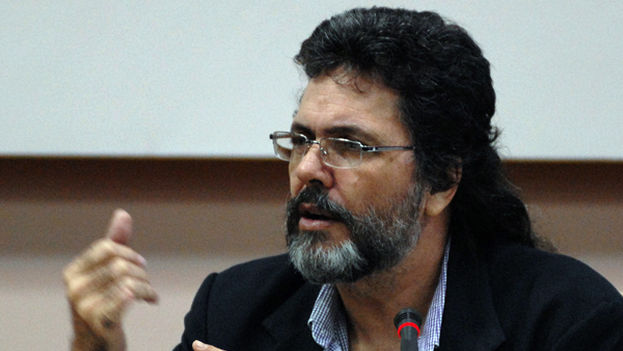
Abel Prieto returns to the post of Minister of Culture. (EFE)

14ymedio bigger14ymedio, Ernesto Santana, Havana, 11 July 2016 — At the end of his first stint as Minister of Culture (1997-2012), comments were frequently heard about Abel Prieto’s desire to leave the job. The most practical said it was due to illness, the most romantic claimed he wanted to devote himself to writing.

Now comes his second stint, and although he holds the job “provisionally,” many artists and intellectuals are already pleased because, to them, Abelito is a good person and they prefer a minister from the profession versus a simple political cadre.

Others, free from these superstitions, consider Prieto more dangerous than Armando Hart and Julian Gonzalez put together, given the great energy and fangs he demonstrated last year in command of the “rapid response brigade” – self-proclaimed as “the real Cuban civil society” – that stormed the Summit of the Americas in Panama to block the peaceful participation of the “anti-Cuban mercenaries.” continue reading

This advisor to Raul Castro has devoted himself in recent years to emphatically warning us about the advances of bad taste, the sexism of the barracks, the lack of ideas and other trashy behaviors, defining them as cultural dangers against our identity and our nation, emanating, of course, from the capitalist hell.

The announcement that Julian Gonzales was “released from the job” was made on Friday the 8th at the end of the Second Plenum of the Cuban Communist Party Central Committee, before the plenary session of the National Assembly of People’s Power. Not only was no reason given for such a sudden “release” but not time was taken to do anything more than designate Prieto as provisional minister, with the official media not mentioning the issue since then.

Prieto returns to the franchise that made him a superstar in the Revolution’s show business, but between the two stints he has been a player in significant media performances, like that of the Panama skirmish, with declarations that, if not for his desperate shamelessness, would seem like drunken jokes in game of dominos or crazy antics in the street. For example, he claimed that the Cuban government cannot legalize opposition organizations for the same reason that “Al Qaeda could not be legally registered as an association,” because, in fact, if opposition members weren’t Cubans, “they would be in cages in Guantanamo.”

He also appeared in the recent forum Culture and Nation: the Mystery of Cuba, a miniseries hastily made to counteract the enthusiasm left by the assault – brazenly starring himself – of the US president, and called for a house-by-house fumigation. The “Mystery of Obama” made clear the obsolescence of the Castro catechism, the uselessness of half a century’s anti-Yankee screaming and the poor market for the package of stories about the bogeyman who steals children.

Alarms sounded. Hysteria ensued. Abel Prieto talked about the “cultural and symbolic war,” about the problem of telling the story in “a world where entertainment, pleasure, fragmentation, amnesia, the worship of now, have been turned into pillars of the cultural hegemony industry,” while erecting the cross of “efficient socialism, de-bureaucratized, democratic, that we are creating” (sic).

We imagine his concern as a democratic socialist on talking with people about “open communication with the United States” and finding “innocence, excessive optimism, forgetfulness, childish and uncritical admiration by the superpower and, in some cases, uncontrollable desires to abandon their principles to surrender themselves to arms of Satan.”

Thus, we must put an end to the fallacy that associates “Yankee” with “modern” and with “development,” because “this Yankeephilia idealization is one of the tendencies we must confront in the war of ideas and values that must be fought.”

In the forum mentioned above, Abel Prieto proposed students be ‘vaccinated’ not with Soviet cartoons or Randy Alonso, but as tourist guides with Yankee trash like Oliver Stone and Michael Moore. Also House of Cards would serve as an antidote. And South Park should also be included. And it’s too bad that Noam Chomsky has not made entertaining tapes of his unsurpassed diatribes against his own country.

As for the inevitable “academic exchange with the United States” we have to swallow the mix of “very clear principles” in order to “avoid the glare and small-town positions.” Prieto also warned about the attempt to “foment an enemy fifth column of a new kind, with well-designed and conceived digital publications, social-democratic or ‘centrist’ ornamentation and verbiage full of euphemisms,” all this financed from abroad “in the face of the discredited traditional counterrevolution.”

Although he had to recognize that the new technologies are not to blame, he again hammered home that they serve “as a conduit and catalyst for the avalanche of disintegrating forces,” ones that deny the role of governmental institutions without which “the cultural environment would become a jungle and mediocrity would gain an irreversible preponderance.”

Referring to young people – those who launch themselves on the sea, or go to prison or to the purgatory of the streets – Prieto wants to make us believe, in all seriousness, that we must “feel and live the Revolution in all its historic journey, with passion and depth, and at the same time feeling and living and defending its continuity as the only guarantee of having a country, of having dignity.”

As the press note on the “release” of Julian Gonzalez Toledo contained no more information than the traditional tagline that he has been “assigned other tasks,” the traditional range of speculation immediately arose, including the idea of a supposed campaign to deprive first vice-president Miguel Diaz-Canel of the cronies who support his clinging to power.

There is another speculation that could have a certain logic. When Julian Gonzalez replaced then Minister of Culture Rafael Bernal Alemany in 2014, it transpired that the latter was ousted because of the outrageous theft of hundreds of pieces of art from the Museo de Bellas Artes, some of which later appeared in Miami. Now, although Gonzalez Toledo is considered “a hard-working and honest functionary,” his superiors are not content with his “lack of leadership,” mentioning again the specter of corruption.

Moreover, there are those who relate this fall to several money scandals featuring the president of the Cuban Music Institute, Orlando Vistel, and other predators of the cultural jungle. But, naturally, there is no official statement that clarifies the matter and reports on it as they should, because making the truth known continues to be seen as giving arms to the enemy.

We Cubans only need the scrapings from Abel Prieto’s brain, as he calls us to “build a digital socialism,” as he reminds us that “the main force for democratization of the new technologies in Cuba, and I believe in the world, is Fidel,” while warning that the market is a “much more terrible [censor] than the worst that existed in the time of Stalin.”

If second acts are never a good thing, in this case the first one wasn’t either. This second stint, however brief it might be and whether we like it or not, comes to save us from Uncle Sam’s cultural poison. Meanwhile, the local chupatintas (pencil-pushers) will continue to protect us from the tropical chupi chupi, from the national vulgarity and the empire’s chupacabras – that mythic animal that wants to suck our blood.

See also:

Abel Prieto Attacks The “Packet” and “Technological Nomadism” / 14ymedio, Rosa Lopez

Abel Prieto’s Travels / Orlando Luis Pardo Lazo

So Long Minister of Culture Abel Prieto / Yoani Sánchez

El Chupi Chupi and the Dilemma of Limits / Yoani Sánchez

Vulgarity as a Resource (I) / Miriam Celaya

Vulgarity as a Resource (II) / Miriam Celaya

Guilty of Singing El Chupi Chupi / Ernesto Morales Licea

The Christian Section of the ‘Weekly Packet’ / 14ymedio Luz Escobar

Abraham Campos, from team 'Luzvisión'. (Frame)
Abraham Campos, from team ‘Luzvisión’. (Frame)

14ymedio bigger14ymedio, Luz Escobar, Havana 8 July 2016 – For decades, Cuban evangelicals have lost the ability to operate their own schools, to defend their ideas on the radio, and to distribute their written publications in the newsstands throughout the country. However, new technologies have allowed them to place their new audiovisual media in the popular ‘weekly packet,’ where political topics are not allowed, but religious ones are.

In 2009, group of young developers involved with the Communications Center of the Assembly of God in Havana, began creating a compendium of videos with news, proselytizing and life tips, which they call LuzVisión (Light Vision). It is promoted as the “Christian family channel” and updated weekly on the alternative distribution networks. continue reading

Abraham Campos is one of the five members of the team that designs “a varied program, which is both informative and dramatic,” he explains to 14ymedio by phone. Since this initiative began, he emphasizes, they have wanted to prioritize the promotion of the activities of the Evangelical Church.

When selecting materials, he clarifies, everything “goes through a filter of the doctrinal purity of our denomination,” which ensure that it does “not affect any other sector of the country, neither social, nor political, nor economic.”

Campos says that the benefits of expansion through the weekly packet are numerous, as it has opened the possibility for their product to reach those who do not receive material through disks or magazines and serialized publications, such as Arpeggio or Buenas Noticias (Good News).

Although they have not found a reliable way to measure their audience, they receive constant signals that the message is now reaching a larger number of users. “We are signing up more people and the acceptance is very good.”

Several distributors of the weekly packet have told this newspaper that the folder with the “Christian” label containing the LuzVisión productions is in “high demand.” There are more than 900 churches and 1,640 homes of worship legally authorized in Cuba, according to an article by the Ministry of Foreign Relations on Ecured, a state-managed website.

On San Lazaro’s central street and a few yards from Infanta Street, lives Juan Carlos, 33, one of the sellers of a weekly packet, an alternative compendium of videos, TV shows and digital sites.

“What most people want are telenovelas and newly-released films, but I have several clients who are looking for religious material,” says the vendor. He explains that many of them are “older people, mainly women, but there are also young people who live in religious families or who attend church.”

Campos does not mince words. The objective of the channel is “to concentrate God’s people in one point,” but also to reach “those who do not know the Word. It is, also, an evangelistic medium, although the principle focus is to concentrate on the church and its edification.”

He says that LuzVisión draws on all of the collaborators in their “different denominations.” In addition, he professes that it is very useful for young people who want their work and the Church to be known, and it is greatly enriched by the international Christian music that is included every week. “It helps to expand your music archive and repertoire,” he says.

In his selection he also collects a summary of “activities and community events” that are held in churches and on the street. One of the objectives of Campos and the rest of the creators is that “the young Christian, instead of subscribing to the weekly packet to feed on other things that perhaps distance him a little from his religious activity, obtains instructional materials within his faith.”

LuzVisión is something that for many is starting to be established, but “nobody knows how it will play out tomorrow.” Campos dreams of having, in the future, “a radio station or a TV channel,” although he confesses that he has prayed for it for many years but has not achieved it. “But in the end it will come,” he says optimistically.

The young man says that the distribution through the weekly packet is “training” that helps them to involve themselves “naturally in this communication medium. We all want, when the time comes, to have a space on national television and for that we must prepare,” he says.

Zona+ Hopes to be Cuba’s First Wholesale Store / 14ymedio, Reinaldo Escobar

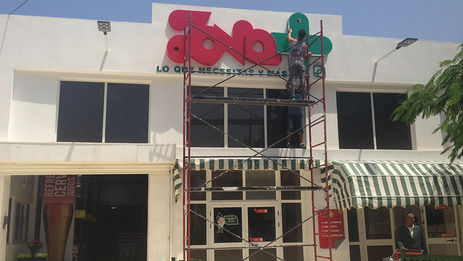
Zona+ from the outside.
The new Zona+ store from the outside.

14ymedio bigger14ymedio, Reinaldo Escobar, Havana, 9 July 2016 – A week after its opening the store Zona+ still hasn’t received permission to offer its products at wholesale prices, Located on Calle 7th A, between 66th and 68th in Havana’s Playa district, it has a strong competitor about 300 yards away in the market on 70th Street, one of the most well-stocked in the capital.

The commercial slogan of the new store says that clients can find what they need there “and more.” Although it has not been officially announced in any national media, it’s already known that its most promising attraction is that it will operate under the concept of a wholesale market, one of the most common demands of private entrepreneurs, especially those who have restaurants, cafes, or rent rooms with meals included. continue reading

“We are just waiting for directions, otherwise everything is ready,” one of the clerks who identified herself as Sonia told 14ymedio. However, no employee was able to respond with certainty whether there will be some kind of identification required to shop there, proving a customer is self-employed, or if there will be a certain quantity of merchandise that is is sold at “warehouse prices.”

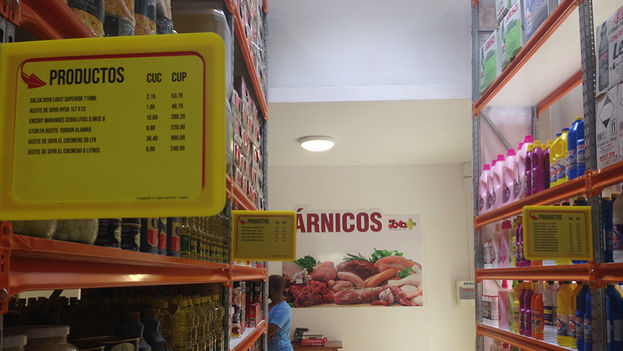
If it is compared to other stores that sell in hard currency, clearly its offerings are more varied, especially in the areas of food, cleaning supplies and personal hygiene items. The merchandise is also available in larger sizes and wrapped in containers appropriate for carrying larger volumes than would be needed by a customer buying for family consumption.

Such is the case for the 20 liters of soybean oil at a price of 38.40 Cuban convertible pesos (CUC). However, the new establishment is still a long way from parity with similar outlets of any chain in the international market in other countries. A man of middle age, with the aspect of a “man of the world,” on leaving the store expressed his hope that the store would continue as it is, clean, well ordered and with pleasant air conditioning. “The problem is we have no ‘fixer’ to ensure this and we can confirm that a new broom sweeps clean. Come and check at the end of the year,” he said, with a certain air of skepticism.

The store manager, Javier Muñoz, explained on another occasion that there is an intention to open two more of these markets in Havana, which, according to his version, can be supplied smoothly because the “necessary reserves” exist. Some optimists see in this step the unmistakable sign that soon the creation of small and medium enterprises will be allowed, which could not exist if they had to purchase their inputs in the retail market.

Some of the products sold here, like boxes of frozen chicken pieces or the sacks of powdered milk, belong to the group of goods whose prices have recently been lowered on a widespread basis. These offerings, however, do not appear in the all markets and here they do have them, but that does not mean they are selling at wholesale prices, which has generated confusion about whether Zona+ will be allowed to do that.

The custom of announcing as fact what is intended has resulted in many people thinking this is already a wholesale store, but even if all the workers are optimistic and predict that the authorization will be here soon, the truth is that it still is not working under that definition.

The Zona+ store does not yet have permission to sell their products at wholesale prices. (14ymedio)

The Blackboard Mafia / 14ymedio, Miriam Celaya

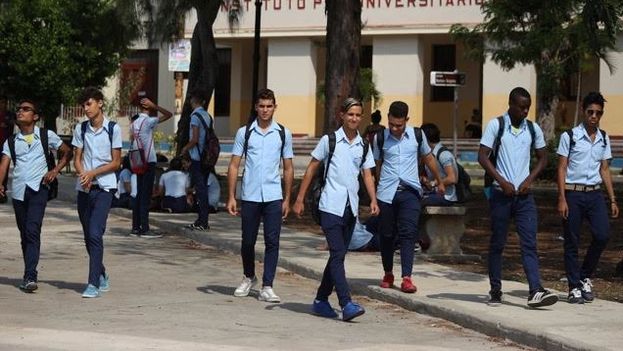
High School Students in Havana (14ymedio)

14ymedio, Miriam Celaya, Havana, 5 July 2015 — “Everyone knows which teachers accept money,” a group of young people tells me. In fact, some not only accept, but clearly require it from students who know they would not be able to pass the exam on their own.

The final days of the 2015-2016 school year are here, and once again the recurring theme of fraud by students and teachers surfaces, poor preparation of students, low quality of education and the shocking loss of values among not a few education professionals.

A group of five 10th and 11th graders of the pre-university Gerardo Abreu Fontán, of Centro Habana, agreed to offer their testimony on the subject under conditions of anonymity, in an interview that lasted more than two hours and uncovered before me a broad and deep network of corruption. continue reading

“You know you are going to have to come straight with me…” says a professor to a bad student, in a full classroom and in the presence of all other students. A phrase that, from a pure semantics point does not say much, but that in marginal code says it all. The aforementioned understands and abides: the game’s move is set.

Around this sunspot there is a whole system of tariffs and strategies that work seamlessly interlocked with the precision of a Swiss watch. Impunity in this maze of fraudulent trickeries is almost absolute.

The teacher acting as proctor will charge 5 CUC for each student thus strategized in the case, of which he will pay a portion of the professor who teaches the subject and another to the person in charge that year.

There is a kind of unwritten agreement In Havana that stipulates an approximate rate, depending on the type of examination (whether oral or written), the period evaluated (if the test is partial or final), the neighborhood where the school is located (which is usually indicative of the purchasing power of the student’s family) and quality and/or experience of the professor.

Thus, to achieve a good grade on a mandatory mid-term (known as a “Partial Control Work” with the initials TCP), a student from a relatively solvent family who is generally behind must pay between 2 or 3 CUC (Cuban convertible pesos) to the subject’s teacher. Some teachers, however, charge at a rate of 4 CUC per grade per question, so, considering that a TCP contains three questions; the cost can go up to 12 CUC for each TCP for each core subject.

Meanwhile, the final exam contains five questions, but the system and the going rate in this case vary, depending on what manoeuver is used. For example, a variant is that a certain number of students previously disclose to the subject’s teacher their interest in paying for the proctor during the exam so he will let the students cheat, whether it is looking up each correct answer in books or notebooks or copying among themselves.

The proctor, in turn, charges 5 CUC for each student involved in the plot, from which he will pay a portion to the professor who teaches the subject and another to the person in charge that year, who will turn a blind eye when he makes the classroom rounds to guarantee the transparency of the evaluation process.  So the circle of what we might call a blackboard mafia is closed.

Assuming that there are four subjects with written finals—Spanish, Math, Biology and History—and that there are an increasing number of students interested in using this negotiated evaluation process, it is easy to conclude that the dividends to these “educators” stemming from fraud far exceed their paid wages.

Dividends obtained by these “educators” through fraud far exceed the amount of their wages.

Another variation, usually applied when the teacher has a close relationship with the student and his family, is to conduct the review of examinations at either the home of the student or teacher, where the professor will dictate the correct answers to the student, thus allowing for corrections of mistakes made in the classroom. In these cases, payment is not in the form of cash, but masked in the form of a more or less expensive gift, accompanied by the corresponding eternal “gratitude” of the adolescent’s family.

Finally, there is also the old trick of altering official assessment records, so the teacher gives the student a higher grade than the grade received in the evaluations, which raises the student’s rank so he will have easy access to better university career choices once he finishes high school.

However, the juiciest peculiarity takes place at the provincial level, where the tests are prepared and the final exams and revaluations are “guarded.” According to the students interviewed, both can be bought for a price of about 30 CUC, although the student or his family must know the right person to contact, because otherwise it could mean severe sanctions.

Meanwhile, the new form of oral assessment for subjects like Physics and Chemistry in pre-university education, which was established in the 2014-2015 school year to “facilitate” student grades and elevate their advancement, has only managed to diversify the corruption behaviors of teachers to defraud the system.

These tests are performed through paper forms known as “ballots,” developed at the provincial level. The procedure is simple: the “paying” student will speak to that subject’s professor, who in turn will coordinate the gimmick with some member of the hearing panel to whom he will deliver a list with the names of those students who will pay for their grade in advance. Meanwhile, on the date of the exam, the corrupt faculty panel member, once he has verified the student’s name on the list, gives the student a ballot containing the answers, or he points out the answers to the incorrect ones written by the student, in cases when the student chooses to fill out the ballot himself.

Another variation is to conduct the review of examinations at either the home of the student or teacher, where the professor will dictate the correct answers to the student.

Each subject has a different price, depending on its complexity. A Physics test, for example, costs 15 CUC this year. Chemistry is often cheaper, 5 to 10 CUC, or a gift, which can be anything from perfume, a wallet, or any article of clothing to a bottle of rum.

Evaluations of subjects that are “not important,” such as Political Culture, English, or Computing, almost always are bought, because they are cheap and almost everyone can do it, and so you get it off your mind easily with 2 or 3 CUC or a modest gift, if it is a TCP”.

For a final exam, those who can will pay 5 CUC so they won’t have to make a presentation at the evaluation seminars, which is how they are evaluated. “Sometimes you pay the teacher to give you seminar from a previous year, and you can then transcribe it, as if it was your own work.”

“And all that without taking into consideration that, in addition, on Teachers Day, they get lots of presents,” says M, the most lively of the students interviewed.

But the corruption of the education system is not limited to the evaluation process. According to testimonies from students and parents, access at the end of the ninth grade (secondary school) to a pre-university slot higher than the student’s rating would entitle them to, costs about 100 CUC, paid directly to the school board, or it is “negotiated” through some municipal official with the Ministry of Education (MINED) responsible for the “grants.”

Judging by these statements, corruption is decaying the previously formidable Cuban educational system and it is sprinkling into everyday life, so much so that even students who have not succumbed to the mechanism of fraud—whether for moral reasons or their family’s financial limitations—perceive it as commonplace, perhaps a questionable issue, but not a crime at all.

Each subject has a different price, depending on its complexity

“It’s normal to some extent,” states G, an 11th grader who dreams of making a career in design. “It’s not that I feel respect for those corrupt professors, but I don’t care. It’s not my problem.”

In the case of R, an adolescent with beautiful features and pleasant manners who wants to be a doctor, he believes that what these educators do is not right, but “each person is worthy of respect, that is their livelihood.  If we had a different economy, other wages, different teacher training … perhaps it would be different.”

Once again, M intervenes with a sharp reflection for his young age.  He expresses himself with ease: “The problem is that the Government doesn’t pay them enough. It doesn’t invest in professors or their training, because they don’t produce immediate gains, as in the case of doctors, for instance, who go to foreign assignments and the government takes almost all the money they get paid abroad. Of course teachers are looking for any way to make money, especially the younger ones, who want to go out, have fun and buy fashionable clothes and shoes, just like us.”

All the teens assent in tacit agreement, while something akin to despair invades my being. These youngsters have offered me a glimpse of the true dimension of the damage inflicted to the spiritual body of Cuban society, not just to the economy. I am impressed by the colossal task that will be entailed in rebuilding the moral fragments of our nation, once the long nightmare of the Castro regime has ended. Of course, I don’t accept defeat in advance, but, for now, corruption is continuing to spread its tentacles and threatening to win the game.

Translated by Norma Whiting
Raul Castro Dismisses Culture Minister and Names Abel Prieto / 14ymedio

Abel Prieto will serve, provisionally, as Minister of Culture

14ymedio bigger14ymedio, 8 July 2016 — Abel Prieto is the new Minister of Culture after Raul Castro decided to “release from his duties” the person previously responsible for this area, Julián Gonzalez Toledo.

The designation of Prieto, until now advisor to the president of the Councils of State and of Ministers, is provisional, according to the note published in the Party newspaper Granma. continue reading

González Toledo had assumed the portfolio of Culture in March 2014, after two years as deputy minister, replacing Rafael Bernal Alemany after a notorious scandal over the theft of dozens of works in the Museo Nacional de Bellas Artes, which could have cost the outgoing minister his job.

Toledo Gonzalez previously led the National Council of Performing Arts from 1999-2011.

His last public appearance as minister occurred on July 1 when he inaugurated the new edition of the Art Fair on La Rampa, and in particular the exposition Fidel, Soldier of Ideas by photojournalists Livorio Noval and Ismael Francisco González.

Prieto, originally from Pinar del Rio, now returns to a position that he previously served in between 1997 and 2012. A graduate of the University of Havana in Hispanic Literature and author of the novel The Flight of the Cat and Other Stories, he was director of the publishing house Letras Cubanas and president of the National Union of Writers and Artists of Cuba (UNEAC).

As an advisor to Raul Castro, in forums with artists and youth on artists he has been prodigious in his criticisms of “new forms of cultural consumption, like that of postmodern relativism that accepts everything as good.”