Do Hunger Strikes Work as a Strategy to Pressure the Cuban Government? / 14ymedio

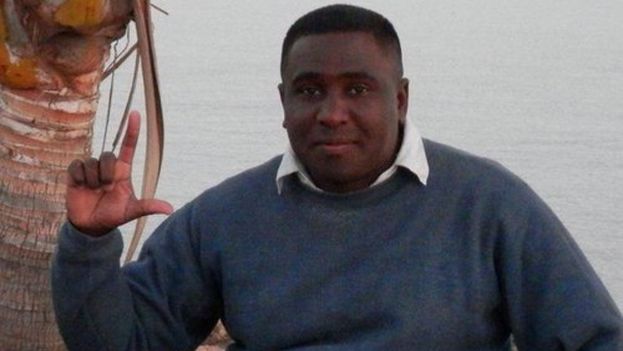
Guillermo Fariñas, UNPACU Activist: “With this [hunger strike] I am giving the Castro regime leaders to decide if they want to assassinate me publicly.”

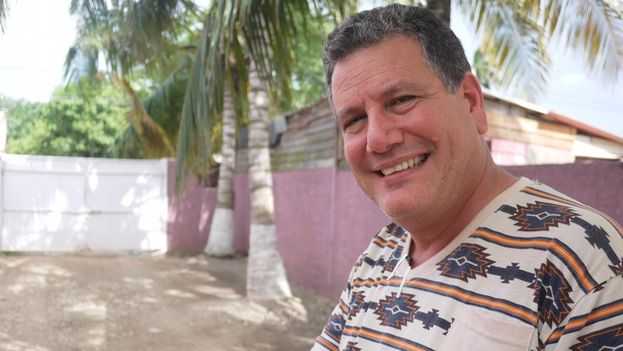
Eliécer Ávila, President of Somos+ (We Are More): “I don’t see how the death of leaders who should motivate people and push changes can be helpful.”

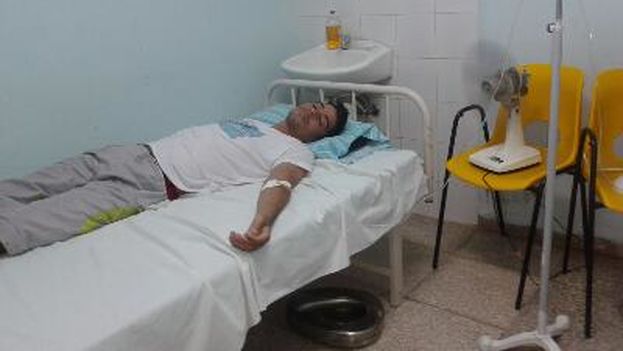
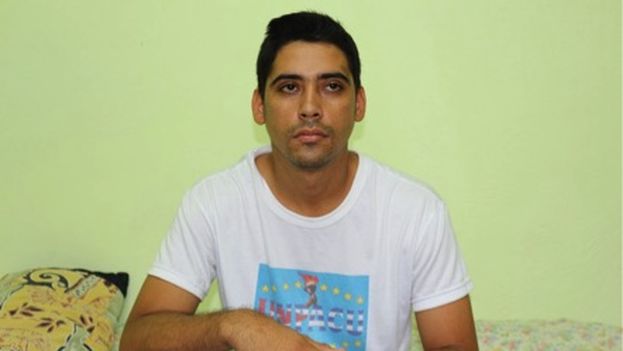
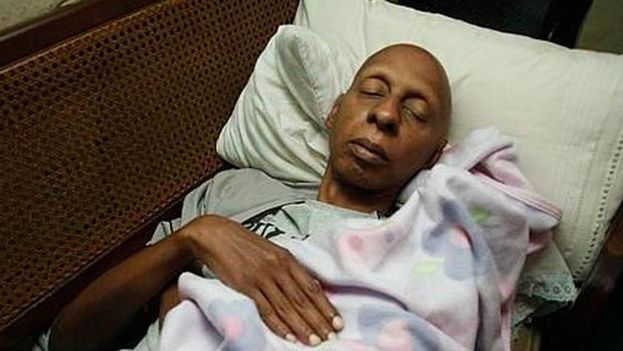
14ymedio, 10 August 2016 – This Tuesday, activist Carlos Amel Oliva has ended four weeks on hunger strike after spending the last five days in hospital due to the deteriorating state of his health. Eight members of the Patriotic Union of Cuba (UNPACU) had seconded his protest and decided not to eat in solidarity with the opponent’s demands, including State Security returning his personal belongings, the confiscation of which he considered a violation of his rights.

On 20 July, regime opponent Guillermo Fariñas also began a hunger and thirst strike, for which he has received hospital care on several occasions in recent days. Winner of the European Parliament’s Andrei Sakharov Prize for Freedom of Thought, he is demanding that the Cuban government cease its repression against dissidents and that the authorities agree to a dialog with the opposition. continue reading

In the last twenty years Fariñas has undertaken a total of 25 hunger strikes, the last of these six years ago when he demanded the release of a group of opponents from the 2003 Black Spring. On that occasion the opponent went 135 days without eating, the great part of the time hospitalized and receiving parenteral nutrition and hydration.

Fariñas began that strike on February 24, 2010, one day after the death of Orlando Zapata Tamayo, who died after staging a hunger strike for 86 days while incarcerated.

Amnesty International considered Zapata Tamayo a prisoner of conscience and many analysts agree that his death was decisive in the negotiations subsequently held between the Cuban government, the hierarchy of the Catholic Church and the Spanish government that ended with the release of many political prisoners.

Previously, a hunger strike had been maintained to its final consequences by Pedro Puis Boitel, who died in prison in May 1972 after 53 days without food or medical care. The young man was buried in an unmarked grave in Colon Cemetery in Havana.

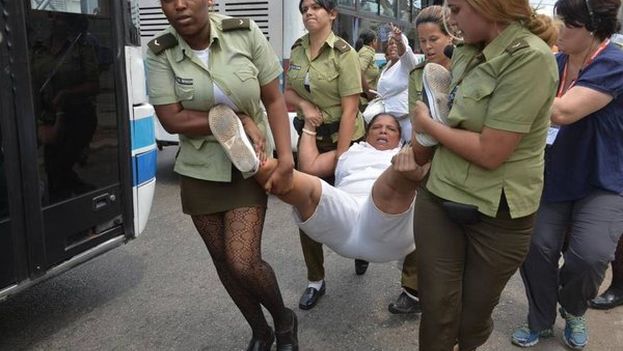
Since January 1959 it has been common for activists and opponents to use hunger strikes as a form of protest against the government and to demand improvements in prison conditions or political reforms. Currently some opponents believe that this strategy of peaceful struggle is not effective.

However, other dissidents cite the importance of the hunger strike as a way to attract the attention of international organizations to pressure the government and bring about political change.

On Tuesday, the Cuban Observatory for Human Rights called on all opponents to abandon their fasts, considering that it is not an effective method of struggle and activists are people who are needed “with all their energy, strength, intelligence and courage in the demand for freedom, democracy and better living conditions for Cubans.”

Guillermo Fariñas, who currently is continuing his hunger strike, has recently stated in an interview that he has a responsibility given that he is a person known internationally for the use of this method of protest. “With this I’m giving time for Castro’s rulers, extending my possible death, so that they can assess, among and political and ideological international allies and opponents, which really has to do with my demand, if they are going to publicly murder me,” he said.

Eliecer Avila, who on Tuesday wrote a letter asking Carlos Amel Oliva to abandon his strike, emphasized the importance of activists who are still alive today being, one day, public representatives of the citizens if they wish. The leader of Somos+ (We Are More) ended his letter with the words: ” Do not give away your life to these bastards, compadre!”

The Revolution is Exactly That / 14ymedio, Carlos Alberto Montaner

Hun
Hunger in Venezuela (EFE)

14ymedio bigger14ymedio, Carlos A. Montaner, Miami, 6 August 2016 – They are hungry in Venezuela. It is the revolution. It does not matter that it potentially may be the richest country in the world. The same thing happened in 1921 in the newly debuted USSR. A million Russians died of hunger. Lenin rejoiced. “The revolution and I are like that, madam.” They kept the peasants from trading, and the Red Army confiscated food, including the seeds.

It happened in China. There were 20 million deaths. In that country grieving also is multitudinous. It happened in Cambodia and North Korea, where some desperate subjects resorted to cannibalism. It always happens. In Cuba sixty thousand people lost their sight or mobility in their lower limbs because of peripheral neuritis cause by malnutrition after the end of the Soviet subsidy. continue reading

Castro protested against the US “blockade.” The Minister of Health, who warned about what was happening, was removed from his post. The Revolution is also about keeping your mouth shut. It was not the embargo. It was the Revolution. It is always the Revolution. They gave the Nobel Prize in economics to the Bengali Amartya Sen for demonstrating that famines invariably are caused by state interference. Any of the victims of Communism could have explained to the Swedes with equal clarity and without need of getting a doctorate from Cambridge.

Why do the Communists do it? Are they sadists? Are they stupid people who commit the same errors time and again? Nothing of the sort. They are revolutionaries bent on creating a new world based on the prescriptions of Karl Marx.

Didn’t Karl Marx assert that the ruling oligarchy and state model were the consequence of the regime of capitalist property? Didn’t he claim that if a Communist vanguard were to take over the means of production in the name of the proletariat that there would emerge a new society ruled by new men endowed with a new morality?

It is a matter of priorities. Communist revolutionaries are not interested in people living better or farms and factories producing more. Those are the petty bourgeois stupidities typical of liberal democracies which include the Social Democrat traitors, the Christian Democrats and other minor species insistent on the babble of social pseudo-justice.

The two essential jobs of the Communist revolutionaries are, first, to demolish the power structure of the “old regime” and to substitute their own people for it; second, to take over the productive apparatus, ruin businesses that they cannot manage and nationalize the rest in order to deprive the old capitalist oligarchs of resources.

It is in these activities that Communist revolutionaries demonstrate if they have succeeded or failed. That is the benchmark. Lenin and Stalin succeeded, at least for several decades. Mao and the Castros succeeded. Chavez succeeded … for now.

What does it matter to Maduro that there are skeletal children who faint from hunger in school or that the sick die for lack of medicine? His definition of success has nothing to do with the feeding or health of Venezuelans, but with that fevered and delirious little world they call, pompously, the “consolidation of the revolutionary process.”

That explains the leniency in the face of immense theft of public treasure or the complicity with drug traffickers. Welcome. Marx also delivered the perfect alibi: They are in the first phase of capital accumulation. In this period of regime change, like someone who sheds a skin, anything goes.

And there will be time to re-establish honesty and to trust that the centrally planned five-year plans will bring something like prosperity. For now it’s about enriching the key revolutionaries: The Cabello brothers and their nephews, the docile generals, the Bolibourgeois, which is to say the revolutionaries in service to the cause. They have to have full pockets in order to be useful.

Do you understand now why the Communist revolutionaries repeat time and again the same framework of government? They are not mistaken. The upheaval is part of the construction of the new State.

Do you understand why the Castros advise Maduro to follow the unproductive Cuban model and why he doggedly obeys? What matters to the Chavistas is keeping power and exchanging the government elites for their own.

Do the Colombians understand what the guerrilla chief, Timochenko, means to say when he promises to revolutionize Colombia when he comes to power? Or Pablo Iglesias in Spain when he asserts that he will use in his country the same prescription that was recommended to the Venezuelans? They are consistently destructive.

That is the Revolution. Exactly that. Nothing more and nothing less.

Translation by Mary Lou Keel

Recipe For Forgetting Fidel Castro / 14ymedio, Yoani Sanchez

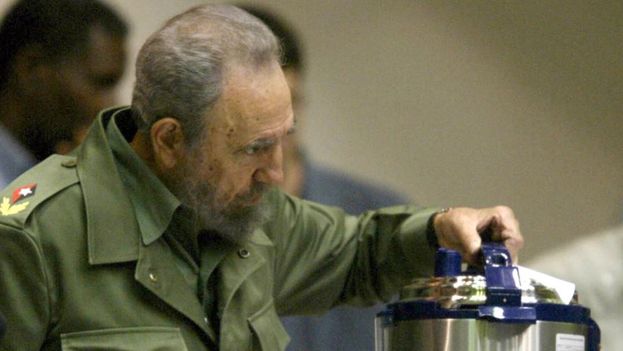
Former president Fidel Castro with a “Queen” brand pressure cooker, made in China. (EFE)

14ymedio bigger14ymedio, Generation Y, Yoani Sanchez, Havana, 13 August 2016 – Turn on the radio and the announcer reads a brief headline: “Fidel Castro, The Great Builder.” The man goes on to explain that the most important works of the country have come from this head that for decades has been covered by an olive-green cap. Weary of so much personality cult, I decided to watch television, but on the main channel a lawyer was detailing the legal legacy of the Maximum Leader and at the end of the program they announced a documentary about “The Invincible Guerrilla.”

For weeks, we Cubans have lived under a veritable bombardment of references to Fidel Castro, which has increased in proportion to the closeness of the date of his 90th birthday, this 13 August. There is no shame nor nuance in this avalanche of images and epithets. continue reading

This whole excess of tributes and reminders is, undoubtedly, a desperate attempt to save the former Cuban president from oblivion, to pull him out of that zone of media abandonment in which he has fallen since announcing his departure from power a decade ago.

We have left the man born in the eastern town of Biran, in 1926, in the past, condemning him to the 20th century, burying him alive.

Children now in elementary school have never seen the once loquacious orator speak for hours at a public event. Farmers have breathed a sigh of relief on not having to receive constant recommendations from the “Farmer in Chief” and even housewives are thankful that he does not appear at a congress of the Federation of Cuban Women to teach them how to use a pressure cooker.

The official propaganda knows that people often appeal to short-term memory as a way of protecting themselves. For many young people, Fidel Castro is already as remote as, for my mother in her day, was the dictator Gerardo Machado, a man who so adversely marked the life of my grandmother’s generation.

Followers of the figure of Fidel Castro are taking advantage of the celebrations for his nine decades of life to try to erect a statue of immortality in the heart of the nation. They deify him, forgive him his systematic errors and convert him into the most visible head of a creed. The new religion takes as its premises stubbornness, intolerance for differences, and a visceral hatred – almost like a personal battle – against the United States.

The detractors of “Él,” as many Cubans simply call him, are preparing the arguments to dismantle his myth. They await the moment when the history books no longer equate him with José Martí, but offer a stark, cold and objective analysis of his career. They are the ones who dream of the post-Castro era, of the end of Fidelismo and of the diatribe that will fall on his controversial figure.

Most, however, simply turn the page and shrug their shoulders in a sign of disgust when they hear his name. They are the ones who, right now, turn off the TV and focus on a daily existence that negates every word Fidel Castro ever said in his incendiary speeches, in those times when he planned to build a Utopia and turn us into New Men.

Tired of his omnipresence, they are the ones who will deal the final blow to the myth. And they will do it without hullabaloo or heroic acts. They will simply stop talking to their children about him, there will be no photos in the rooms of their homes showing him with a rifle and epaulettes, they will not confer on their grandchildren the five letters of his name.

The celebration for the 90th birthday of Fidel Castro is, in reality, his farewell: as excessive and exhausting as was his political life.

********

Editor’s note: This text was published Saturday August 13, 2016 in the newspaper O Globo of Brazil

The “Comandante’s” Carnivals / 14ymedio, Marcelo Hernandez

Floats being built for the “Comandante’s” carnivals. (14ymedio)

14ymedio bigger14ymedio, Marcelo Hernandez, Havana, 12 August 2016 – After weeks of anxieties and rumors, the Havana carnivals are starting tonight. A popular celebration whose date* has again been postponed this year to make it coincide with the eve of ex-president Fidel Castro’s 90th birthday.

For several days, the floats that will parade in front of the stands, bleachers and grandstands along Havana’s Malecon, have been under construction near the site. This Friday, the official newspaper Granma published a note with the names of the streets that will be closed and warned people not to “attend the festivities carrying glass containers, knives or fire.” continue reading

The choice of this day for the start of the carnival once again alters its date, which for decades had been moved from its traditional February. The first of these changes happened in 1970, when the celebrations were moved to coincide with the celebrations for July 26 (the date of the failed attack on the Moncada Barracks in 1953, that is considered the beginning of the Revolution), but over the years it has been postponed again and again.

The increasing scarcity of domestic beers in the retail market and the announcements of economic setback had made many fear that the festivities would not be celebrated in Havana. However, the worst fears have not been realized and now Havana residents say, half jokingly and half seriously: “These are the Comandante’s carnivals.”

Wake Up, America / 14ymedio, Pedro Campos

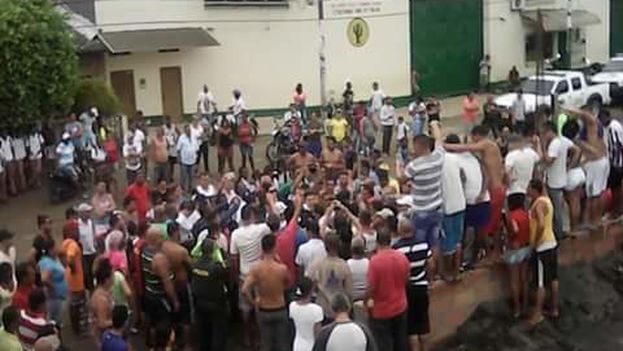
Cuban migrants stranded in Turbo, Columbia (courtesy)

14ymedio bigger14ymedio, Pedro Campos, Havana, 11 August 2016 — Latin American governments who are closing their borders to the crossing of Cubans seeking to leave Cuba’s state slavery to reach the United States are complicit in the genocide that is increasing in the Straits of Florida, the only escape route left to the island’s new escaped slaves.

Don’t they know that the border closures are forcing Cubans to risk their lives at sea? Don’t they realize, doesn’t it pain them, don’t they feel remorse?

First was the government of Daniel Ortega in Nicaragua, unconditional ally of the Castro regime, which was then was followed by other Central American governments and joined by Mexico, Colombia and Ecuador, the latter of which is now deporting Cubans. continue reading

These are countries with millions of its citizens in the United States, a good part of them illegally, whose governments systematically condemn our northern neighbor for its policy of closing its borders with Mexico to try to prevent the arrival of Mexicans, Nicaraguans, Central Americans, Colombians, Ecuadorians and other nationalities.

They scream about the, but now close they close their borders so that Cubans cannot pass. This is called the politics of a double standard.

Where is the solidarity with Cuba? Or do they understand that this should be addressed to the government responsible for this genocide and not the Cuban people, its victim?

How long are they going to look away before the Cuban government’s repression against its own people, its guilt for the exodus because of the absence of democracy and freedoms of every kind imposed on the island in the name of a socialism that doesn’t exist and whose mission is to piteously and arbitrarily exploit the workers, who are paid poverty level wages by the state that decides everything and is the principal employer, for the primary benefit of an elite and corrupt elite?

Are they still afraid that the Castro regime will send them guerillas? Do they know that one of the most famous Latin Americans of all time, José Martí, called state socialism, later imposed on Cuba by the Castro regime, “future slavery”?

Every day the international press agencies report on dozens of Cubans intercepted on the high seas by the US Coast Guard and returned to Cuba, or that dozens of others reach the coasts of Florida, but almost never reported are those who leave and never arrive, who are not news because their corpses never appear and their families in Cuba keep a desperate silence, imaging that some day they will get a call from the United States.

Do they have any idea of how many thousands of Cubans have lost their lives facing the waves, the Gulf Stream and the sharks, trying to escape to the north? Latin Americans trying to do the same run other dangers in the jungles, with the coyotes, whose existence is the responsibility of those governments, precisely for making the passage through their territories forbidden when it should be normal.

These governments should show solidarity with the Cuban people, open their doors and allow them to continue their journey to the United States in a safe way. This is their responsibility and I hope they rectify their position.

There is already a certain resentment, a deep rejection among many Cubans toward these governments for their attitude toward our fellow citizens, who have been mistreated for the simple desire to get to the United States, something very common among Latin Americans tired of the misery and repression in their countries.

We Cubans have always shown solidarity with the just causes and misfortunes of our Latin American brothers, we have always opened our doors to Latin American victims of repression. Do the Cuban people deserve this treatment from their governments.

It is well-known that many Latin Americans who arrive in the United States have received broad support and collaboration from Cubans who live there; Artists, businesspeople, media workers, simple employees. We also know that Cubans are a wealthy and influential nationality in the United States.

The demands made by some nations to end the US laws that favor the emigration and settlement in the United States of Cubans, seem motived more by the desire to have the same advantages conferred on their citizens. Then fight for this and not for it to be taken away from the suffering Cuban people.

Wake up, America.

***

Editor’s Note: The author of this article is a former Cuban diplomat and was in charge of consular affairs of the Embassy of Cuba in Mexico.

Cuban Second National Conference Debates Principles of a “New Cuba” / 14ymedio, Reinaldo Escobar

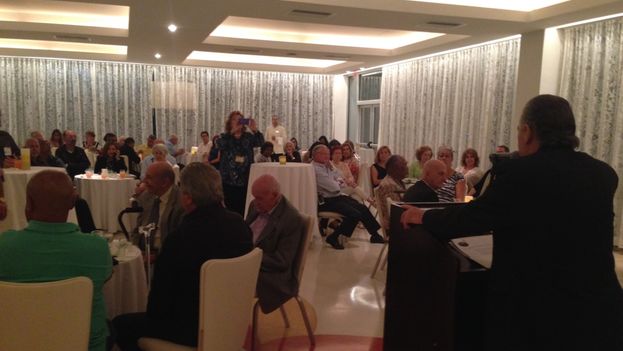
”United We Will Be Free” is the slogan of the conference, which involved nearly a hundred activists from the island and from exile (14ymedio)

14ymedio bigger14ymedio, Reinaldo Escobar, San Juan, Puerto Rico, 12 August 2016 — The Cuban 2nd National Conference is meeting this Friday in San Juan, Puerto Rico, under the slogan “United we will be free,” with the presence of nearly a hundred activists from the island and from exile.

The event seeks to “provide a space for reflection and dialogue among the greatest possible number of opposition organizations” to discuss, among other things, the principles of a “New Cuba.” Throughout the meeting, which will run until noon on Monday, there will be a discussion of the creation a structure of unity of action in diversity inside and outside Cuba. continue reading

The organizers of the conclave have predicted, at the end of the discussions, there will be proposals of candidates for the elective positions of the resulting structure, and a vote. The members elected by the new organization will inform the plenary regarding the work to be carried out both within Cuba and from the exile.

The meeting has as its antecedent the one held last year, where a nine-member Coordinating Committee was created, with five members from the internal opposition and four from the exile. Their principal mission has been to communicate the contents of the Declaration of San Juan and coordinate the current meeting.

On the eve of the conference and during the first day of work, attendees focused on ironing out differences and finding common ground in order to achieve the democratization of Cuba. Creating a coalition or common front among the opposition is the larger challenge ahead of the participants.

The Cuban 2nd National Conference is taking place at a time of intense debate among Cuban activists on the island, a situation reflected in the departure of at least two of the most representative opposition groups on the island – the Patriotic Union of Cuba (UNPACU) and the United Anti-totalitario Forum (FANTU) – from the Democratic Action Unity Roundtable (MUAD).

A statement released this week by Boris Gonzalez, MUAD spokesperson, sent a greeting to all the participants in the Second Conference, and wished them “the greatest successes to achieve the democratization of Cuba.” The document recognizes “all efforts in this direction.” This opposition coalition is widely represented in the San Juan meeting.

Cuban Government Lifts Censorship Against Revolico / 14ymedio, Zunilda Mata

Revolico’s user portal. (Silvia Corbelle / 14ymedio)

14ymedio bigger14ymedio,Zunilda Mata, Havana, 12 August 2016 — With the same discretion that eight years ago led the government to censor a popular Cuban version of Craigslist, it has now lifted its electronic blocking, without any announcement or public statements. The news of the unlocking the Revolico, a site filled with classified ads, has revolutionized the wifi connection sites.

Access to Revolico is also possible now from the computers in the Nauta internet rooms managed by the government-run Cuban Telecommunications Company (ETECSA), according to what this newspaper was able to confirm.

In several Havana hotels that offer internet access to their guests from terminals in the lobby, one can go directly to Revolico’s home page, navigate its menu options and look at the classified ads without any hitches.

However, users of Infomed, managed by the Ministry of Public Health, complain that Revolico remains inaccessible from servers at that institution.

Despite the government’s long-standing censorship of Revolico, it became the leading classified site on the island. Its main attraction is the vast assortment of ads – 16 million accumulated from the start – for property, the buying and selling of technology, job offers, and every kind of home appliance, all scarce on the country’s store shelves, can be found on their pages.

The well-known “weekly packet” distributed in the informal market each week, for years has included a copy of Revolico intended for users without internet access, a solution that facilitates the posting of ads via email and has helped increase users to the current 300,000 unique visitors a month.

Hiram Centelles, cofounder of Revolico, is satisfied with the new situation of the site and already anticipates possible improvements. “In the near future we will launch a new version of the product and platform, and we are getting many more users in Cuba, now that the site is unblocked. Our goal is to continue providing the best classified ad service to Cubans, as we have done these past eight years,” he told 14ymedio.

Several digital sites that have been censored for years, such as 14ymedio, still remain inaccessible, unless the surfer uses an anonymous proxy anonymous or other tricks to circumvent censorship.

Private Transport Drivers in Central Cuba Demand End to Excessive Controls / 14ymedio, Zunilda Mata

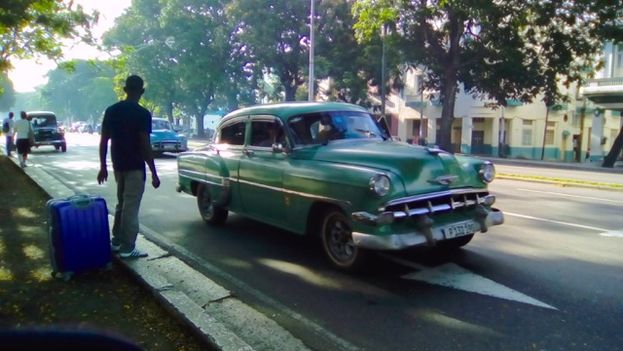
An "almendrone" -- old American car used as a fixe-route shared taxi (14ymedio)
An “almendrone” — old American car used as a fixe-route shared taxi (14ymedio)

14ymedio, Zunilda Mata, Havana, 9 August 2016 — Private trucks covering the stretch between Santa Clara and Sancti Spiritus remained out of service during the weekend and Monday in response to new demands from the authorities. For several days, at checkpoints along the road drivers have been asked to show an invoice for the purchase of fuel in state service centers, a move intended to discourage them from resorting to the illegal hydrocarbon market, 14ymedio’s reporter Jose Gabriel Barrenechea told this newspaper.

As of noon Monday, “not a single truck” had passed on the route which also serves intermediate towns like Placetas and Cabaiguán, a decision the private drivers of both provinces made together in protest against increased controls by the police. continue reading

This kind of transport is very popular in the area and moves thousands of passengers every day, in old trucks reconditioned to move people. The situation got worse this weekend with the celebration of carnivals in Santa Clara, which significantly increased the number of travelers in the region.

There was a huge crowd of people at the Sancti Spiritus terminal on Monday around noon. The truck drivers refused to provide their services, explaining that last Friday a group of private drivers was detained at the provincial delegation of the Ministry of Interior.

The arrests occurred at several operations at checkpoints on roads connecting Santa Clara with Sancti Spiritus, where the carriers were required to show proof of having purchased their vehicle’s fuel through the Cupet chain of state gas stations.

Ubaldo, 53, one of the drivers who serves the route and who has refused to work for the past three days, told this newspaper that the business does not make enough to buy fuel at Cupet because a liter is nearly 30 Cuban pesos, and the same amount can be bought illegally for about half that. “Nobody wants to drive the road because the fares are the same and we don’t do charity,” he says.

Most of the gas that is sold in the informal market comes from state enterprises [i.e. is illegally “diverted” at various points], which in recent months have experienced up to 30% cuts in their fuel assignments because of the tense economic situation in the country.

Given the crowding of passengers at interprovincial terminals and various points between Villa Clara and Sancti Spiritus local authorities yielded to pressure after noon on Monday and called the truckers one by one to ask them to make the trip and guaranteed that no one will ask for proof of payment.

Some of the self-employed saw this decision as a small victory and returned to work Monday afternoon, but others, more distrustful, have preferred to wait to verify that the controls have been ended. “I do not want to lose money nor my license,” Raymundo, who owns a Ford truck that regularly makes the trip from Villa Clara to Trinidad told this newspaper.

State buses in the region are not adequate to meet the demand for interprovincial travel. From the bus terminal in Sancti Spiritus vehicles leave five times a day – at 5, 6, 7 and 10 am and 2 pm – bound for Santa Clara, but they suffer frequent breakdowns and technical glitches.

Transport managers and specialists in the area are studying “setting caps” on the prices of private transport, as was done in the capital, according to sources in Villa Clara’s provincial government. The authorities, are hoping to counter the rising fares by also bringing in a fleet of new “Diana” brand buses assembled on the island.

An "almendrone" (14ymedio)
An “almendrone” (14ymedio)

In Havana, the picture is not very different. Desperate customers crowding corners to board a shared fixed-route taxi and workers who need more than three hours to get home at the end of the working day are scenes that are repeated everywhere. The imposition of price controls for “almendrones” (the old American cars used in this service, named for their “almond” shape) has contributed to the transport crisis, which interferes with daily life in the Cuban capital.

Passengers see this as a test of strength between the government and the self-employed transportation providers, a confrontation where the private operators seek to overcome the fare restrictions, and the authorities try to control the rising prices the sector has experienced since mid-June.

The shortages at the gas stations regulated by the State contribute to the problem. Of the five gas stations in Havana’s Vededo district 14ymedio visited this Sunday, only one, at 25th Street and Avenue of the Presidents, was open for business. El Tangana, at the corner of Malecon and Linea, and the station at 17th and L, as well as the station at Linea and D Street all remain closed for lack of supply.

An article published last Thursday by the official daily Granma recognizes the reduction in the number of private cars that make up a major part of the transportation routes within the capital city, due to the drivers’ response to the freezing of rates on July 14, a decision taken by the Provincial Administration Council in Havana.

With the application of Agreement 185, which established that self-employed drivers could not raise their fares and must adhere to the fares in effect prior to July 1, drivers have chosen to shorten their routes or significantly curtail their working days, as recognized by Granma, the official organ of the Communist Party.

“Before, I could take just one car from my house in Santiago de las Vegas,” a passenger told this newspaper. “Now I have to take two vehicles, one to Sports City and another to the end, so the trip costs me twice as much,” the woman lamented, who said the government thought it had found a solution to the price increases caused by a reduction in the supplies of fuel in the informal market. However, she says, “what has happened is that the drivers have split the routes and no one can force them to run the whole way,” explains the irritated customer.”

Of the more than 496,400 people who in January of this year were “self-employed,” at least 50,482 are dedicated to the transport of cargo and passengers.

Ivan Hernandez And Felix Navarro Prevented From Leaving Cuba “A Second Time” / 14ymedio, Reinaldo Escobar

Ivan Hernandez Carrillo. (Twitter / @ivanlibre)

14ymedio bigger14ymedio, Reinaldo Escobar, Havana, 11 August 2016 – Cuba’s immigration authorities prevented activists Ivan Hernandez and Felix Navarro from traveling outside Cuba this Thursday. The former prisoners of the 2003 Black Spring were invited to participate in the 2nd Cuban National Conference that be held in San Juan, Puerto Rico, from 12 to 14 August, but were unable to board their flight at Havana’s José Martí International Airport, where they ran into Reinaldo Escobar, 14ymedio’s editor

The answer that each of the dissidents received on presenting their documents to the Immigration and Nationality official was: “You cannot leave a second time.” continue reading

Both Hernandez and Navarro had received, in March of this year, special permission to go abroad “one-time” after being placed on parole, a condition the authorities continue to maintain since release from prison in 2011. All those released from the Black Spring “Group of 75” who continue to reside in Cuba benefited from a similar authorization.

The opponent Librado Linares, also a former prisoner of the Black Spring and general secretary of the Cuban Reflection Movement (MCR), did manage to board his flight on Thursday to participate in the meeting of Puerto Rico, since it was the first time he made use permit leave the Island.

The American Federation of Labor and Congress of Industrial Organizations (AFL-CIO) recently sent a letter to Raul Castro expressing “deep concern” about the “violent treatment” received by the trade unionist Ivan Hernandez on his return to Cuba after his first trip abroad.  He traveled on the same flight as the opponent Vladimir Roca and attorney Wilfredo Vallin, of the Law Association of Cuba.

Hernandez was arrested on July 31 and reported that he received a “savage beating” when he refused to be subjected to a search at the time of arrival. During his trip abroad he met with organizations and activists from Europe and the United States.

Both Hernandez and Navarro cataloged the “injustices” and said they will continue trying to assert their right to travel freely.

The Cuban National Conference is a continuation of one held last year, which involved 23 organizations in Cuba and 32 from exile. It has been convened by the Coordinating Liaison Committee composed of Ana Carbonell, Rosa María Payá, Sylvia Iriondo, Guillermo Farinas, Juan Carlos Gonzalez Leyva, Rene Gomez Manzano, Mario Félix Lleonart and
 Saylí Navarro

Among the participants in the conference traveling from Cuba are also Eliecer Avila, leader of Somos+ (We Are More) and Boris Gonzalez, a member of the Democratic Action Roundtable (MUAD). The great absence the meeting will be Guillermo Fariñas, who remains on hunger strike in Santa Clara.

In the early hours of Thursday, Lady in White Leticia Ramos Herrería was arrested while traveling from Matanzas to Havana to take the flight that would also have taken her to the conference in Puerto Rico, according to the leader of the Ladies in White movement, Berta Soler, speaking to this newspaper. The activist was returned to her home where she is under police surveillance.

Event organizers want to use this 2nd Conference to create a “structure of unity of action in diversity,” whose purpose is to “operate inside and outside Cuba, coordinating the efforts of both shores.” In addition, they discussed “the general principles of the new Cuba” desired, an issue that was left pending at the previous meeting.

Injustices of a Debate / 14ymedio Miriam Celaya

Note: The video is not subtitled in English

14ymedio bigger14ymedio, Miriam Celaya, Havana 10 August 2016 – The recent broadcast of a television program from Miami with Maria Elvira Salazar as moderator, where there was a heated debate between the well-known Cuban opposition leader, Jose Daniel Ferrer, and the also well-known Castro regime panderer, Edmundo Garcia – former presenter from a decadent musical program on Cuban television, before he chose to settle in Miami “for personal reasons” – has sparked an avalanche of wide-ranging comments about the performance of one rival or the other, as well as about the appropriateness or otherwise of the topics introduced by the host on the set.

While the confrontation between an opposition leader living on the island, and a regime defender – but not a “representative” – of the Cuban dictatorship was original, the truth is there are antecedents where supporters and opponents of the Castro regime have faced off before the cameras. continue reading

Almost 20 years ago, on 23 August 1996, Maria Elvira herself participated, along with two of her colleagues, in moderating an unusual debate between a representative of the opposition in exile and a senior official of Fidel Castro’s government.

The memorable and passionate debate between Jorge Mas Canosa, then chairman of the Cuban American National Foundation, and Ricardo Alarcon, then president of the National Assembly of Cuba, was recorded simultaneously from both sides of the Florida Straits – Mas Canosa in Miami, Alarcon in Havana – and released by the CBS television in more than 20 countries.

Lasting almost an hour, that discussion made clear the superiority of an opponent who expressed himself with total freedom, in contrast to the obedient servant of a totalitarian ideology, tied to slogans and cliches, who was literally run over by his rival.

An important moment of that program came when Mas Canosa exhibited the dehumanizing nature of the assumptions on which the Castro regime stands, reading Alarcon the text, printed on the back of a Cuban internationalist’s card, with a phrase from Che Guevara taken from his speech during the Tricontinental Conference: “… the revolutionary needs to know how to become a cold killing machine…” There is nothing to discuss.

Saving the differences, the most recent debate between Jose Daniel Ferrer and Edmundo Garcia repeats some elements of that one from two decades ago, namely, the passionate defense of diametrically opposing positions and the adherence of the Castro regime supporter to the same scheme of slogans and repetition of the discourse dictated by the Cuban totalitarian power.

However, a great many of the colleagues and friends who from Cuba and from emigration have shared with me their views on this program, agree that Ferrer fell below expectations, and could and should have been more precise and direct in his responses to the hackneyed postulates and attacks of Mr. Garcia.

They feel, moreover, that the confrontation demonstrated, on the one hand, the ability developed by the Castro regime’s servants in the media to evade positions about the Cuban reality and the continuing violations of the rights under the dictatorial Castro regime, clouding the atmosphere and attacking the adversary with the usual disqualifications that are repeated ad nauseam in the official media of the island; and secondly, the lack of training of the leaders of the opposition in controlling the debate and taking advantage of the many weaknesses of the pro-Castro discourse, even when it is presented by a minor extra lacking any credentials, as is the case with Edmundo Garcia.

Personally, I agree with most of these opinions, but I know, from the times I have been able talk with José Daniel Ferrer, that his ideas are better informed and his discourse is better articulated than that he offered us during his presentation in Miami.

We have to recognize that, like it or not, Mr. Edmundo Garcia, an emigré who defends the olive-green caste from the comfort of a Florida city – which however, he considers a nest of terrorists – dominates the job of disinformation, and misinforms, distorts and disguises truths before the cameras with astonishing tranquility. José Daniel, on the other hand, was visibly uncomfortable. His natural setting is the tribunal of the streets, the passionate call, the colloquial discourse among Cubans; not the media. A limitation that must be overcome.

The use of inexact or poorly enunciated terms on the part of the moderator was not helpful, nor was the poor selection of the video that should have been shown (but wasn’t) of the beatings the political police deal out to opponents. The well-trained and opportunistic Edmundo knew how to use these failures to his favor.

These and other miscues explain how Garcia handled himself and dared to say without blinking and without a blush on his cheeks, that the painful events of the 13 de Marzo tugboat massacre, when a group of innocent Cubans were killed by Castro’s military forces, were the direct responsibility of the victims.

He also downplayed the scandalous hiring of foreign labor on the island, when there are thousands of unemployed Cubans, a fact that Ferrer pointed out to him and that the ineffable Edmundo Garcia considered something “normal.” I can understand that Ferrer could barely contain his outrage in the face of the rampant cynicism of this man, and to a certain extent this explains to me Ferrer’s distraction while responding in the debate.

Another unnecessary altercation between the two was related to the number of activists and members belonging to the Patriotic Union of Cuba (UNPACU), recognized as the largest opposition group inside Cuba. A topic on which Ferrer was left in the dust by Garcia. The latter tried to ridicule the figure and question the veracity of the numbers quoted by the opposition leader, when in reality what is essential here is not the number of members of this or any other opposition party, but the legitimacy and fairness of their demands and their right to exist as an alternative to the powers-that-be.

It is known that, in a dictatorship, the opposition is always a minority, so there is no need to emphasize how many fans support one team or the other. Why play this crooked game of the Castro regime’s servants and make it so easy for them?

But, put in that position, Ferrer coud have, in response, reminded Garcia of the ridiculous membership numbers of the Cuban Communist Party (PCC), which the last Congress officially cited as 700,000 – despite the almost 60 years “in Revolution” and the more than 50 of a “single party” – which constitutes barely 6.36% of a population of 11 million people. Isn’t this a compelling piece of data if we are talking about legitimate rights based only on a question of numbers?

Moreover, Ferrer should avoid comparisons between the Castro regime and North Korea, or extemporaneous allusions to the similarities between it and Stalinism, the fascism of Mussolini and Hitler, or other equally criminal regimes.

The Cuban reality, by itself, is sufficiently subversive so as not to have to appeal to historical or geographically distant paragons. It would have caused a better effect to enumerate the many and urgent existential problems and the absence of freedoms in Cuba than to try to describe the fascist nature of the Castro regime, which we all know ad nauseam.

One of the most recurrent vices of the opposition is precisely this, taking every opportunity to characterize the island dictatorship, instead of putting your finger on the everyday problems of the Cubans, or disclosing your own platforms and proposals to reverse them.

For example, the government’s blockade toward prosperity and the happiness of the population is reflected in the continuing, growing and unstoppable emigration of Cubans. Or there is the subject of the laws that have been changing in recent years, with the express ban on Cubans investing in Cuba, or unionizing, or the free contracting of workers, to mention just a few. These are issues that would have been difficult for Mr. Garcia to rebut, or had he done so, he would have done so very badly. Not to mention other sins, such as a lack of freedom of the press, of expression and of information, or the right to strike and other issues of great importance, timeliness and relevance to those they were talking about.

It is clear we must urge finally overcoming the media oversimplification of bad Castro regime and the good opposition. We simply have to engage in effective opposition and if the media over there or everywhere offers the space, we have to take advantage of the opportunity to present our own message, instead of allowing others, from the comfort of the television studios with one eye on the audience ratings, to write the script for a sterile course. It is not reasonable to squander the moral capital of a leader on a mediocre program.

Of course, to achieve this it would have been necessary to have a good script and a better moderator. Maria Elvira pitifully lost control of the program, which at times seemed like a cockfight arena without any order. Although she probably considers this a manifestation of spontaneity and democracy.

She was also truly unfortunate in some of the issues focused on, looking for easy sensationalism – like the Chanel fashion show on the Prado or the arrival of US cruise ships to the Port of Havana – rather than essential questions that really affect Cubans’ daily lives. The right to attend a parade is truly innocuous compared to the pressing problems of Cubans: the total absence of freedoms and the material needs of an entire nation. Frivolity strikes when it comes to politics.

In the end, the moderator repeated to the combatants the exact same question that 20 years ago she asked Mas Canosa and Alarcon: Would you be willing to recognize the triumph of your adversary in democratic elections? And their answers demonstrated once again the moral superiority of free thought: Jose Daniel, as Mas Canosa did before him, said he would accept the decision of the people at the ballot box; not so Edmundo Garcia, who declared that he would take to the Sierra Maestra before accepting the electoral triumph of UNPACU. Perhaps this was the high point of the program.

However, what I really deplored in the end was the fact that a leader of the prestige and courage of Jose Daniel Ferrer would accepted a debate with a character who isn’t even a legitimate representative of the dictatorial regime he defends. In any even, there was nothing to gain. I would say Ferrer spent artillery shells to shoot a mosquito… without success.

In my opinion, the problem of the program-debate in question is not who came out better or worse, or who better defended his position. The truth is that the debate of José Daniel Ferrer versus Edmundo Garcia should never have taken place, because it tends to lend prestige to someone like Garcia, who does not have the least relevance now nor will he later. A political leader must be careful when choosing his opponents.

Either way, I take this opportunity to express my solidarity with Ferrer and my respect for his performance as an opposition leader, his honesty and courage in the defense of that cause that belongs to many Cubans like him and like the members of UNPACU. Know that my criticism is anointed with the greatest good will, so I reject in advance any misrepresentations about it. In any case, opinion journalism is the way some of us contribute to the development of democracy and freedoms. I have reason to have confidence in the greatness and ability of Ferrer to understand this as well.

UNPACU Activists End Hunger Strike / 14ymedio

Amel Carlos Oliva receiving hydrating serum at the 28th of September Polyclinic. (Twitter)

14ymedio bigger14ymedio, Havana, 9 August 2016 – Patriotic Union of Cuba (UNPACU) activists have decided to end the hunger strike they have engaged in for periods ranging from days to weeks, among them Carlos Amel Oliva who, as of this Tuesday, had not eaten for four weeks. The opposition member told 14ymedio that the decision was made because they have managed “to put a focus on the human rights violations that occur in Cuba.”

His voice sounding tired over the phone line, the dissident told this newspaper that after five in the afternoon he drank his first glass of water since last Friday, when he also declared a thirst strike. He confirmed that the other seven UNPACU strikers have joined in his decision. continue reading

Activists who had joined the Oliva’s fast included Maikel Mediaceja Ramos, Zulma López Saldaña, Oria Casanova Josefa Romero, Ruben Alvarado Reyes, Laudelino Rodriguez Mendoza, Alexander Martinez Rizo and Carlos Infante Rodriguez. The latter joined the protest from the prison in Las Tunas.

Oliva said that he did “not want to abandon the strike” but realized that “vanity or foolishness without any purpose is useless.” So he decided to end the fast and the first place he visited after his hospitalization was UNPACU’s main headquarters in Santiago de Cuba to “acknowledge the support” of the other strikers.

“For us it was a victory,” said the youth leader, who also said that other activists who had supported the strike felt “comforted and useful in the midst of the pains and sorrows,” on hearing the news. Oliva said the meeting with his partners in the cause was “very emotional and beautiful.”

For his part, Jose Daniel Ferrer, UNPACU’s leader, told this newspaper that the leadership of the organization was “very happy with the decision.” The opponent said that they had been asking them to end the strike for some time. According to Ferrer, the strike succeeded “in attracting international public opinion to the situation faced by opponents of the regime.”

Oliva now hopes to convince the well-known dissident Guillermo Fariñas that he should also end his hunger strike that began last July 20, through which he is demanding the end of repression against dissidents and for the authorities to agree to a dialogue with the opposition.

However, Jorge Luis Artiles Montiel, spokesman for Guillermo Fariñas during his hunger strike, told this newspaper that the dissident “will continue until the final consequences” and believes that “these young Easterners have performed a brave act,” referring to the UNPACU activists.

Eliecer Avila, who on Monday published an article urging Oliva to end the strike said it filled him with satisfaction that the activists have made that decision. “It is really reasonable and I am happy to have contributed a bit in that direction, because their lives will always be the most important thing,” said the leader of the movement we Somos+ (We Are More).

“The Cuban Nation Is Wounded, But It Will Laugh Again” / 14ymedio, Reinaldo Escobar

Camagüey Pastor Bernardo de Quesada. (14ymedio)

14ymedio bigger14ymedio, Reinaldo Escobar, Havana, 8 August 2016 – Everyone in the Versalles neighborhood in the city of Camagüey knows Bernardo de Quesada Salomon. Loquacious, restless and the founder of the Apostolic Movement, he has experienced intense months this year, especially January 8th, when the police entered his home and demolished the structure in the backyard that served as a center of worship.

Quesada opened his doors to this newspaper to talk about how he became an adored pastor to his neighbors and malefactor to State Security. On the slab behind his house, where until recently the temple stood, he now meets every Sunday with his congregation under the intense August sun. None of them have stopped coming in the last months, despite the campaign against the leader of the church which continues to rage every day. continue reading

The Christian movement he is a part of separated from the Cuban Council of Churches in 2003, but Quesada had devoted himself to religion since much earlier, in 1984, a year after he began studying Biology, for which he received his degree just as the Berlin Wall was falling in Europe.

Now, while showing the place where he sang and improvised sermons, he recalls that when he was working as a high school teacher “every time I taught some of the subjects such as evolution, embryology, anatomy, physiology and genetics, I ended up seeing the hand of God.” His faith began to clash with the education authorities.

“In 1991 I felt there was little left for me in the education system. I was working then in Vladimir Ilich Lenin University in Las Tunas, where I taugh microbiology and botany to students in agricultural engineering,” he says. Quesada was named to various positions at the national level in his Church, a situation that strained the atmosphere in his job.

Cuba was currently in the midst of the Special Period and the island was suffering economic hardship and despair. Thousands of former atheists began to embrace religion and Protestant movements grew everywhere.

In September 1991, he was called in by the university leadership, who evaluated him with “a kind of judgment looking at all factors, the party, the union, youth” he recalls. They accused him of speaking about God to students and teachers, although he remained in his post until April 1992 when he was expelled. Among the complainants was an employee there who now “works in Radio Marti in Miami,” he said derisively. “Beware of extremism and extremists” he says in a passage in his book, In The Eye Of The Hurricane.

When he cut his ties with his state position, Bernardo began to consider himself “a free man” and began “preaching in different churches in Cuba.” He came to be an “itinerant evangelist” which brought him to very poor places like Macareño, in Santa Cruz del Sur. In those places he found thousands of followers who attributed to him even physical healings.

Quesada believes that the shepherds of the people with the greatest problems should not even go to Havana, much less, emigrate to another country. “People avoid talking to me about an illegal exit,” he explains, talking about the issue of the thousands of rafters who each year cross the sea from the Cuban coast to try to reach the United States. “I tell them it is going to divide the family, like the medical missions abroad have done,” he says.

He reiterates, stressing each syllable, that it is “against Cubans to leave Cuba. We must change our nation ourselves and fleeing only numbs the problem more,” he says.

His critics within the system have validated the animosity of the authorities. “In Cuba there is no Law of Associations. No one can register an organization to give it legal status,” he denounces in his writings. With regards to the dissidents on the island, he believes that “expressing their rights, going out into the street to demand justice” should not be classified as “a counterrevolutionary action like they want to make people think.”

He has been accused of being a CIA agent, a provocateur, and even a madman, but Bernardo seems to know how to deal with the insult. “When they throw the stones of defamation, don’t toss them away: use them to keep building your platform for further growth,” he preaches.

The road ahead is very difficult, he thinks, but he is confident that a “genuine church” will be an “important factor in the future.”

“The Cuban nation is wounded, it bears a great social wound, but it will laugh again,” he predicts with conviction, smiling in the same courtyard where eight months ago the police thought they had dismantled his place of worship.

See also:

Video reveals demolition of an evangelical church in Camagüey

Evangelical pastor arrested during demolition of temple

Don’t Give Away Your Life to Those Bastards, Compadre! / 14ymedio, Eliecer Avila

Carlos Amel’s hunger strike has continued for almost a month. (Twitter / UNPACU)

14ymedio bigger14ymedio, Eliecer Avila, Havana, 9 August 2016 — I think I should say at this time what I think of the situation of human beings who are on hunger strike, especially my friend Carlos Amel.

In Somos+ (We Are More), being respectful of the decisions they took, we send them in their moment our messages of solidarity. Not because we believe that hunger strikes work as a method to achieve anything in Cuba today, but because it always seems unjust to us that ordinary people did not know what was going on and the reasons behind these extreme decisions.

Today, I want to express my personal opinion, as a friend. This is not an official statement of the President of Somos+, it is the opinion of Eliecer Avila. continue reading

I am dying of pain when I see the images of Carlos, an intelligent young man, father of two beautiful children and with a future ahead of him, at risk of suffering irreversible traumas and even death, for demanding things from a cruel and ruthless system that will gain more with his death than with his life.

If Carlos was a member of my organization I would not have allowed him to do something like this or, at least, I would have done everything possible to dissuade him. I think there are many more effective ways to generate pressure, especially when in theory we have thousands of activists across the country, to have to simply rely on the health, and even death, of these young people to be able to move forward.

I do not consider the sacrifice of one’s life as a “natural cost” of any political battle, on the contrary, to encourage an attitude like this seems to me a crime, and more so from the abundance of the table of many who today light up Facebook with messages such as: “The death of these patriots paves the path of freedom.” This is cynical.

I do not see how the death of leaders who must motivate people and drive change can help in any way. For days I have felt the need to say it, although some may not find it not politically correct. Today I could not hold back anymore.

Our struggle is for life, for family, for the future, for our children. All this becomes meaningless if we die.

There is no material value in Carlos Amel’s or any of the others ceasing to breathe. I would gladly give everything I own for a man like him to live and to live a long life, because the nation will need him more and more. In the past, many patriots, with their pressures, pushed our best men to die. I will not be part of the club of those who accept or promote such a horrendous act that rather than providing any political gain, not only forever stains our history, but our consciences.

Carlos, friend, I want to attend your valuable participation in political life, not your funeral.

Do not give away your life to these bastards, compadre!

I love you and respect you always.

Eliecer Avila

US Embassy Official Visits Guillermo Fariñas / 14ymedio

Guillermo Fariñas on a hunger and thirst strike (courtesy)

14ymedio, Havana, 9 August 2016 – A note published on the digital site of the Anti-totalitarian Forum (FANTU) reports that Dana Brown, Political and Economic Section Chief of the United States Embassy in Havana visited Guillermo Fariñas at his home in Santa Clara on Monday. The official showed her “concern” for the health of the opposition leader, who has been on a hunger and thirst strike for more than 20 days.

Fariñas said that the American diplomat arrived at this house around noon, interested in his “state of health” and “the demands” that the dissident made to Raul Castro’s government. She asked the winner of the European Parliament’s 2010 Sakharov Price for Human Rights how the United States government could help him. The conversation between them lasted “almost an hour” and was a “very fruitful and respectful dialog” according to Fariñas.

With the visit of Brown, two diplomatic representatives have now visited Fariñas since the beginning of his hunger strike. On 31 July the first secretary of the Apostolic Nunciature in Cuba, the priest Jose Manuel Alcaide Borreguero visited his home in the Santa Clara neighborhood of La Chirusa.

Fariñas, 54, has undertaken more than 20 hunger strikes since 1995, the most recent of them in 2010 lasting 135 days, in which he demanded the release of a group of opponents of the 2003 Black Spring.

Cuban Human Rights Group Denounces 845 Arbitrary Arrests in July / 14ymedio

Cuban Human Rights Group Denounces 845 Arbitrary Arrests in July / 14ymedio

14ymedio bigger14ymedio, Havana, 5 August 2016 – The Cuban Commission on Human Rights and National Reconciliation (CCDHRN) recorded at least 845 arrests during the month of July in Cuba, according to a report issued this Friday. This figure represents an increase from the prior month when there were 498 cases.

The organization notes its concern with the situation of Guillermo Fariñas, on a hunger and thirst strike since 20 July, as well as that of other activists who are also fasting.

Compared to the month of June, there was also an increase in physical aggressions by police and parapolice, from23 to 46 cases, as well as acts of harassment on the part of the police and State Security, from seven to 19.